| Tenn. Comp. R. & Regs. 0940-05-38-.04(3)-(4) | Client-mix attestation at application and renewal Submit a written attestation, on TDMHSAS’s form, of the category of the majority of the client base with the initial application and with every renewal. "The renewing agency shall submit with the renewal application a written attestation acknowledging the categorization of the majority of its client population base." | 1.3 Client population: the majority category and the client-mix attestation1.4 License, insurance, posting, renewal, changes and closure |
| Tenn. Comp. R. & Regs. 0940-05-38-.04(6) | Counties served and records address Give TDMHSAS the list of counties served and the address where employee and client records are kept (the rule says "should"), and keep it current. "The agency should submit to the licensing department a list of the counties in which they provide services and the address at which the agency maintains its employee and service recipient records." | 1.4 License, insurance, posting, renewal, changes and closure5.1 Client records and service delivery records |
| Tenn. Comp. R. & Regs. 0940-05-38-.05(1) | Comply with all laws Comply with all federal, state and local laws, ordinances, rules and regulations. "The licensee shall comply with all federal, state, and local laws, ordinances, rules and regulations." | 1.1 Licensee, person responsible for operation and organizational chart |
| Tenn. Comp. R. & Regs. 0940-05-38-.05(2) | Operate under written policies Administer and operate the agency under written policies and procedures, including at least the 0940-05-38-.06 list. "The licensee shall ensure that the agency is administered and operated in accordance with written policies and procedures including, but not limited to, those specified in Rule 0940-05-38-.06." | 1.1 Licensee, person responsible for operation and organizational chart1.2 Written policies: adoption, staff access and review |
| Tenn. Comp. R. & Regs. 0940-05-38-.05(3) | General direction and operating policies The licensee directs the agency and sets policies for its operation and for clients’ welfare. "The licensee shall exercise general direction over the agency and establish policies governing the operation of the agency and the welfare of service recipients." | 1.1 Licensee, person responsible for operation and organizational chart1.2 Written policies: adoption, staff access and review |
| Tenn. Comp. R. & Regs. 0940-05-38-.05(4) | Designate the person responsible Designate one individual responsible for operating the agency. "The licensee shall designate an individual responsible for the operation of the agency." | 1.1 Licensee, person responsible for operation and organizational chart |
| Tenn. Comp. R. & Regs. 0940-05-38-.05(5) | Serve only clients the license allows Accept only clients who will not put the agency outside its licensed category (no nursing-level care; client mix within the attestation). "The licensee shall ensure that the licensed agency serves only service recipients who will not cause the agency to violate its licensed status based on the distinct licensure category." | 2.1 Description of services, enrollment and termination criteria, and tasks workers do not do1.3 Client population: the majority category and the client-mix attestation |
| Tenn. Comp. R. & Regs. 0940-05-38-.06(1)(a) | Description of services, with enrollment and termination criteria A written description of the services the agency provides, including who can enroll and when services end. "A description of services provided by the licensee. The description shall include enrollment and termination criteria;" | 2.1 Description of services, enrollment and termination criteria, and tasks workers do not do2.2 Intake, needs assessment, service plan and consent |
| Tenn. Comp. R. & Regs. 0940-05-38-.06(1)(b) | Organizational chart An organizational chart that clearly shows or describes lines of authority. "An organizational chart which clearly shows or describes the lines of authority;" | 1.1 Licensee, person responsible for operation and organizational chart |
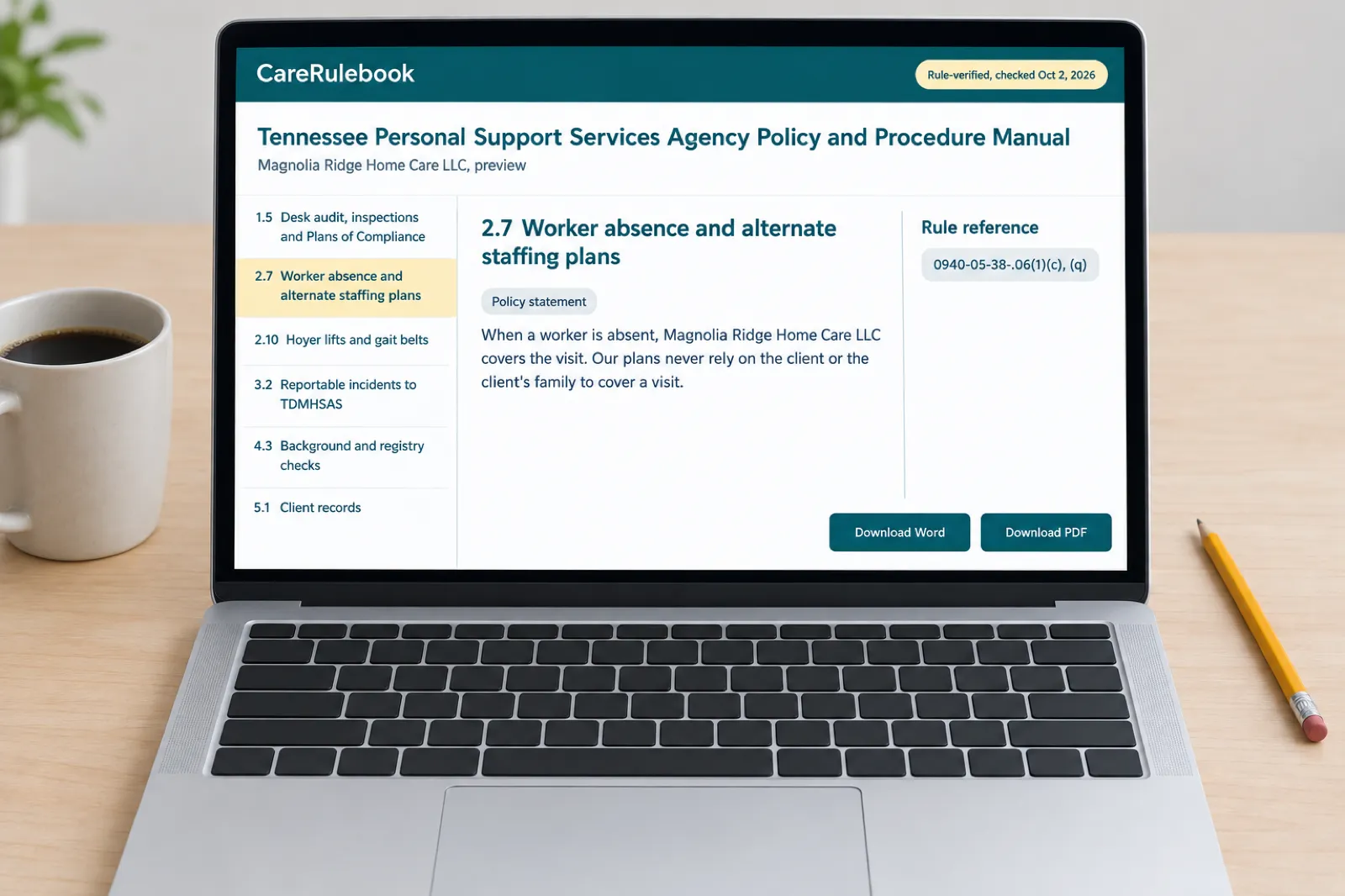
| Tenn. Comp. R. & Regs. 0940-05-38-.06(1)(c) | Worker absence plan A policy and procedure for when the assigned worker is absent: notice to the client, the action taken and timeframes for action. "A policy and procedure which outlines the plan of action to be followed when the personal support worker is absent including, but not limited to, notice to the service recipient, the action that shall be taken, and the timeframes for action;" | 2.7 Worker absence, alternate staffing plans and missed visits |
| Tenn. Comp. R. & Regs. 0940-05-38-.06(1)(d) | Schedule of feesif the agency charges fees A schedule of the agency’s fees, when it charges fees. "A schedule of fees when applicable;" | 2.3 Schedule of fees and written fee agreement |
| Tenn. Comp. R. & Regs. 0940-05-38-.06(1)(e) | Statement of rights and grievance procedure A statement of the client rights in 0940-05-38-.10 and the grievance procedure for reported suspected rights violations. A common deficiency. "A statement of service recipient rights as listed in 0940-05-38-.10 and the grievance procedures to be followed when a suspected violation of rights has been reported;" | 2.5 Client rights and grievance procedure |
| Tenn. Comp. R. & Regs. 0940-05-38-.06(1)(f)1 | Confidentiality policy: workers follow confidentiality laws A confidentiality policy requiring workers to comply with applicable confidentiality laws and regulations. "The licensee’s personal support services workers shall comply with applicable confidentiality laws and regulations;" | 2.6 Confidentiality, public statements and photographs |
| Tenn. Comp. R. & Regs. 0940-05-38-.06(1)(f)2 | No required public thank-you statements The confidentiality policy says clients are never required to make public statements of gratitude to the agency (for example testimonials). "The service recipient shall not be required to make public statements which acknowledge gratitude to the licensee or for the licensee’s services; and" | 2.6 Confidentiality, public statements and photographs2.5 Client rights and grievance procedure |
| Tenn. Comp. R. & Regs. 0940-05-38-.06(1)(f)3 | Written consent for identifiable photos No identifiable photographs of clients without written, signed consent from the client or their legal guardian or conservator. "Identifiable photographs of service recipients shall not be used without the written and signed consent of the individual or the individual’s legal guardian and/or conservator." | 2.6 Confidentiality, public statements and photographs |
| Tenn. Comp. R. & Regs. 0940-05-38-.06(1)(g) | Emergency plans Plans and procedures for emergencies, including at least fire evacuation and natural disasters. "The plans and procedures to be followed in the event of an emergency including, but not limited to, fire evacuation and natural disaster emergencies;" | 3.3 Emergency plans: fire evacuation, natural disasters and staff coverage |
| Tenn. Comp. R. & Regs. 0940-05-38-.06(1)(h) | Reporting and investigating abuse, neglect and critical incidents Policy and procedures for reporting and investigating suspected or alleged abuse or neglect and other critical incidents, with corrective action and reporting to TDMHSAS’s Office of Licensure and any authority the law requires (APS, DCS, police). "Policy and procedures to be followed in the reporting and investigation of suspected or alleged abuse or neglect of a service recipient, or other critical incidents. ... reporting to the department’s Office of Licensure and to any authority as required by law;" | 3.1 Abuse, neglect and exploitation: prevention, reporting and investigation3.2 Reportable incidents to TDMHSAS and incident records |
| Tenn. Comp. R. & Regs. 0940-05-38-.06(1)(i) | Communicable disease procedures Require workers to follow Tennessee Department of Health procedures for detecting and preventing communicable diseases. "Requirement that personal support services workers comply with procedures for detection and prevention of communicable diseases according to procedures of the Tennessee Department of Health;" | 3.4 Infection control and communicable disease |
| Tenn. Comp. R. & Regs. 0940-05-38-.06(1)(j) | Receipt and disbursement of client money A policy on receiving and spending money on behalf of clients (shopping, bill paying). "Receipt and disbursement of money on behalf of service recipients;" | 2.8 Clients’ money and property |
| Tenn. Comp. R. & Regs. 0940-05-38-.06(1)(k) | TDMHSAS access to workers A policy giving TDMHSAS licensure staff access to workers to discuss investigations of any service. "Access by department licensure staff to personal support services workers to discuss investigation of any service provided under this chapter;" | 1.6 Cooperation with TDMHSAS: access to workers, records and investigations |
| Tenn. Comp. R. & Regs. 0940-05-38-.06(1)(l)1 | Medication assistance only with written authorizationif the agency provides medication assistance Written medication assistance procedures, starting with written authorization from the client or authorized representative before any assistance. "Medication assistance shall be provided only after written authorization has been obtained from the service recipient or the service recipient’s authorized representative." | 2.11 Medication assistance |
| Tenn. Comp. R. & Regs. 0940-05-38-.06(1)(l)2 | Medication assistance training first, documentedif the agency provides medication assistance Workers are trained in medication assistance before giving it, and the training is documented in their record. "Medication assistance training shall be provided to personal support services workers prior to providing assistance and training shall be documented in the personal support service worker’s record." | 2.11 Medication assistance4.6 Competency before work, client-specific and annual training |
| Tenn. Comp. R. & Regs. 0940-05-38-.06(1)(l)3 | Collecting medication informationif the agency provides medication assistance Procedures for workers to collect information about the medications clients take. "Personal support workers shall have procedures for collecting information about medications taken by service recipients." | 2.11 Medication assistance |
| Tenn. Comp. R. & Regs. 0940-05-38-.06(1)(m)1 | Transportation: safe vehiclesif the agency or its workers transport clients If the agency or workers transport clients, all vehicles are maintained and operated safely. "All vehicles shall be maintained and operated in a safe manner;" | 2.9 Transporting clients |
| Tenn. Comp. R. & Regs. 0940-05-38-.06(1)(m)2 | Transportation: driver’s license on fileif the agency or its workers transport clients Drivers hold an appropriate Tennessee Department of Safety driver’s license, documented in the agency’s records. "All licensees or personal support services workers providing transportation shall possess an appropriate driver’s license from the Tennessee Department of Safety and documentation of such license shall be maintained in the licensee’s records; and" | 2.9 Transporting clients4.4 Personnel files, job descriptions and the worker roster |
| Tenn. Comp. R. & Regs. 0940-05-38-.06(1)(m)3 | Transportation: vehicle liability insurance on fileif the agency or its workers transport clients Vehicles owned by the agency or worker and used for clients carry liability insurance covering injury to occupants, documented in the records. "All vehicles used for service recipient transportation and owned by the licensee or personal support services worker shall be adequately covered by vehicular liability insurance for personal injury to occupants of the vehicle" | 2.9 Transporting clients1.4 License, insurance, posting, renewal, changes and closure |
| Tenn. Comp. R. & Regs. 0940-05-38-.06(1)(n) | Hoyer lifts and gait belts Policies on using devices such as a Hoyer lift or gait belt, after training, for transfers into or out of bed, chair, toilet or shower, but not as therapy. Required for every agency, and on TDMHSAS’s list of common PSSA deficiencies. "Polices to address use of devices such as a hoyer lift or gait belt, after training, to assist the service recipient in getting out of or into bed, a chair, toilet or shower but not as part of a therapeutic regimen." | 2.10 Hoyer lifts and gait belts |
| Tenn. Comp. R. & Regs. 0940-05-38-.06(1)(o) | Categorizing the majority of the client base Policies on categorizing the majority (over 50%) of the agency’s client population, matching the attestation. "Polices to address categorization of the majority (over fifty-percent (50%)) of the agency’s client population base." | 1.3 Client population: the majority category and the client-mix attestation |
| Tenn. Comp. R. & Regs. 0940-05-38-.06(1)(p) | Cooperation with TDMHSAS investigations A policy that the agency will cooperate with TDMHSAS investigating alleged abuse, neglect, mistreatment, misappropriation or exploitation. A common deficiency. "Policy that the agency will cooperate with the department when investigating any case of alleged abuse, neglect, mistreatment, misappropriation or exploitation of a service recipient." | 1.6 Cooperation with TDMHSAS: access to workers, records and investigations3.1 Abuse, neglect and exploitation: prevention, reporting and investigation |
| Tenn. Comp. R. & Regs. 0940-05-38-.06(1)(q) | Alternate staffing plan policy A policy that an alternate staffing plan is prepared for each client in case the assigned worker is absent (the rule text reads "absence or the assigned" worker). "Policy that an alternate plan for staffing will be prepared in case of absence or the assigned personal support services worker." | 2.7 Worker absence, alternate staffing plans and missed visits |
| Tenn. Comp. R. & Regs. 0940-05-38-.07(1)(a) | Signed, dated job description Each worker’s file holds a written, signed and dated job description with the employment requirements and responsibilities for each position held. "A written, signed and dated job description including the employment requirements and job responsibilities for each staff position held;" | 4.4 Personnel files, job descriptions and the worker roster |
| Tenn. Comp. R. & Regs. 0940-05-38-.07(1)(b) | Verification of employment requirements Proof the worker meets the employment requirements of each position held. "Verification that the worker meets the respective employment requirements for each position held;" | 4.4 Personnel files, job descriptions and the worker roster4.2 Hiring, work history and references |
| Tenn. Comp. R. & Regs. 0940-05-38-.07(1)(c) | Evidence of the criminal background check Evidence of the criminal background check required by T.C.A. 33-2-1202. "Evidence of a criminal background check, as required by T.C.A. § 33-2-1202." | 4.4 Personnel files, job descriptions and the worker roster4.3 Criminal background, Abuse Registry and Sex Offender Registry checks |
| Tenn. Comp. R. & Regs. 0940-05-38-.07(1)(d) | Abuse Registry check on file; no listed workers Evidence the worker’s status on the Tennessee Abuse Registry was checked (T.C.A. 68-11-1004(b)). No employee or volunteer on the registry may be hired or allowed to provide services. "No employee or volunteer who is listed on the Abuse Registry may be hired or otherwise permitted to provider services;" | 4.4 Personnel files, job descriptions and the worker roster4.3 Criminal background, Abuse Registry and Sex Offender Registry checks |
| Tenn. Comp. R. & Regs. 0940-05-38-.07(1)(e) | Sex offender registry check on file; no listed workers Evidence of the worker’s status on the state sex offender registry. No one listed may be hired or allowed to provide services. "No individual or volunteer who is listed on the state’s sexual offender registry may be hired or otherwise permitted to provide services;" | 4.4 Personnel files, job descriptions and the worker roster4.3 Criminal background, Abuse Registry and Sex Offender Registry checks |
| Tenn. Comp. R. & Regs. 0940-05-38-.07(1)(f) | Date of birth The worker’s date of birth (supports the 18-or-older rule). "The worker’s date of birth;" | 4.4 Personnel files, job descriptions and the worker roster |
| Tenn. Comp. R. & Regs. 0940-05-38-.07(1)(g) | Annual performance evaluations Annual performance evaluations that at least assess the worker’s ability to give daily supports to clients. A common deficiency. "Annual performance evaluation reports evaluating, at a minimum, the ability of personal support services workers to provide daily supports to service recipients;" | 4.7 Consultation, supervision and annual performance evaluations4.4 Personnel files, job descriptions and the worker roster |
| Tenn. Comp. R. & Regs. 0940-05-38-.07(1)(h) | Worker notice A worker notice setting out whether the agency is employer or contractor; its responsibility for wages, taxes, Social Security, workers’ compensation, unemployment and overtime over 40 hours a week; and the duties and liabilities of the agency and client, including insurance and personnel management. "A worker notice that outlines the general relationship between an agency and the personal support services worker that includes the following:" | 4.5 Worker notice4.4 Personnel files, job descriptions and the worker roster |
| Tenn. Comp. R. & Regs. 0940-05-38-.07(1)(i) | Five-year work history A continuous description of the worker’s activities over the past five years. "The personal support service worker’s work history containing a continuous description of activities over the past five (5) years; and" | 4.2 Hiring, work history and references4.4 Personnel files, job descriptions and the worker roster |
| Tenn. Comp. R. & Regs. 0940-05-38-.07(1)(j) | Three personal references Personal references from at least three people, one of whom has known the applicant for at least five years. "Personal references from at least three (3) individuals, one of whom shall have known the personal support service worker/applicant for at least five (5) years." | 4.2 Hiring, work history and references4.4 Personnel files, job descriptions and the worker roster |
| Tenn. Comp. R. & Regs. 0940-05-38-.07(2)(a) | Workers 18 or older Personnel policy: all workers are 18 or older. "That all personal support services workers shall be eighteen (18) years of age or older;" | 4.1 Personnel policies |
| Tenn. Comp. R. & Regs. 0940-05-38-.07(2)(b) | Infection control and standard precautions Personnel policy: all workers practice infection control and standard precautions to protect clients. "That all personal support services workers shall practice infection control procedures and standard precautions that will protect the service recipient from infectious diseases;" | 4.1 Personnel policies3.4 Infection control and communicable disease |
| Tenn. Comp. R. & Regs. 0940-05-38-.07(2)(c) | Criminal background check timing Personnel policy: workers submit to a criminal background check within 10 days of employment, within 10 days of a change to duties with direct client contact or responsibility, and (by the rule’s words) every two years, which TDMHSAS has said it will not enforce. TDMHSAS reads the statute as needing results before any direct contact. "That all personal support services workers shall submit to a criminal background check every two (2) years or within ten (10) days of employment or within ten (10) days of a change of responsibilities that includes direct contact with or direct responsibility for service recipients, as required by T.C.A. § 33-2-1202;" | 4.1 Personnel policies4.3 Criminal background, Abuse Registry and Sex Offender Registry checks |
| Tenn. Comp. R. & Regs. 0940-05-38-.07(2)(d) | Abuse Registry check yearly and before contact Personnel policy: check every worker on the Abuse Registry annually and before direct contact with clients; no listed employee or volunteer may work. "shall be checked annually and prior to direct contact with service recipients." | 4.1 Personnel policies4.3 Criminal background, Abuse Registry and Sex Offender Registry checks |
| Tenn. Comp. R. & Regs. 0940-05-38-.07(2)(e) | Sex Offender Registry check yearly and before contact Personnel policy: check every worker on the Tennessee Sexual Offender Registry annually and before direct contact with clients. "That evidence of the status of every personal support services worker on the Tennessee Sexual Offender Registry shall be checked annually and prior to direct contact with service recipients;" | 4.1 Personnel policies4.3 Criminal background, Abuse Registry and Sex Offender Registry checks |
| Tenn. Comp. R. & Regs. 0940-05-38-.07(2)(f) | Language skills and documented training before work Personnel policy: before providing services, each worker shows language skills to read instructions, keep written records and communicate with the client, and has documented training in self-care, household management, community living and service methods. "That the personal support services worker shall demonstrate the following prior to providing personal support services:" | 4.1 Personnel policies4.6 Competency before work, client-specific and annual training |
| Tenn. Comp. R. & Regs. 0940-05-38-.07(2)(g) | Access to consultation Personnel policy: workers have access to consultation for any service, for example a registered nurse, other agency staff or the primary family caregiver. "That personal support services workers shall have access to consultation for any of the services provided under this chapter." | 4.1 Personnel policies4.7 Consultation, supervision and annual performance evaluations |
| Tenn. Comp. R. & Regs. 0940-05-38-.07(2)(h) | No borrowing or taking client money or property Personnel policy: workers never borrow, receive or take money or other property from clients (by our reading this covers gifts too). "That the personal support service worker shall neither borrow, receive nor take funds or other personal property from the service recipient." | 4.1 Personnel policies2.8 Clients’ money and property |
| Tenn. Comp. R. & Regs. 0940-05-38-.07(3) | Proof of liability insurance Keep proof of liability insurance covering the agency, its workers and others who provide services. No minimum amount is set. "The licensee shall have proof of liability insurance coverage for the agency, workers and others who provide personal support services." | 1.4 License, insurance, posting, renewal, changes and closure |
| Tenn. Comp. R. & Regs. 0940-05-38-.07(4) | Current roster of all workers Keep a current roster of all workers at all times, including on-call and back-up workers. "The licensee shall maintain a current roster of all personal support workers at all times including workers kept on an on-call or back-up basis." | 4.4 Personnel files, job descriptions and the worker roster2.7 Worker absence, alternate staffing plans and missed visits |
| Tenn. Comp. R. & Regs. 0940-05-38-.08(1)(a) | Basic competency in seven areas before work Ensure and document that workers show basic competency before working with clients in: observing, reporting and documenting changes; abuse, neglect and exploitation; client rights; universal precautions and infection control; personal hygiene help; client safety; and emergency and disaster procedures (including emergency transportation, emergency medical care and staff coverage). A common deficiency. "Individuals who provide personal support services demonstrate basic competency in the following skill/knowledge areas prior to beginning work with service recipients:" | 4.6 Competency before work, client-specific and annual training |
| Tenn. Comp. R. & Regs. 0940-05-38-.08(1)(a)7 | Emergency training covers transport, medical care and coverage The emergency topic covers at least emergency transportation, emergency medical care and staff coverage in emergencies. "Procedures to be followed in the event of an emergency or disaster that at least includes emergency transportation, emergency medical care and staff coverage in such events;" | 4.6 Competency before work, client-specific and annual training3.3 Emergency plans: fire evacuation, natural disasters and staff coverage |
| Tenn. Comp. R. & Regs. 0940-05-38-.08(1)(b) | RN-supervised medication assistance trainingif the agency provides medication assistance Workers who give medication assistance get documented training by, or under the general supervision of, a registered nurse, consistent with T.C.A. 63-7-102. A common deficiency. "Individuals who provide medication assistance receive documented training in medication assistance performed by, or under the general supervision of, a registered nurse and consistent with T.C.A. § 63-7-102;" | 2.11 Medication assistance4.6 Competency before work, client-specific and annual training |
| Tenn. Comp. R. & Regs. 0940-05-38-.08(1)(c) | Annual job-related training Workers receive training on job-related topics at least annually, documented. No hour minimum is set. "Individuals who provide personal support services receive training on job related topics at least annually; and" | 4.6 Competency before work, client-specific and annual training |
| Tenn. Comp. R. & Regs. 0940-05-38-.08(1)(d) | Client-specific training, documented Documented training specific to each client’s needs in self-care, household management, community living and service methods. "Documented training specific to meeting individual service recipient needs in the areas of self-care, household management and community living, and methodologies for service delivery." | 4.6 Competency before work, client-specific and annual training2.2 Intake, needs assessment, service plan and consent |
| Tenn. Comp. R. & Regs. 0940-05-38-.09(1)(a) | Client identity details Name, address, telephone number, gender and date of birth. "Name, address, telephone number, gender, and date of birth;" | 5.1 Client records and service delivery records2.2 Intake, needs assessment, service plan and consent |
| Tenn. Comp. R. & Regs. 0940-05-38-.09(1)(b) | Date of enrollment The date of service enrollment. "Date of service enrollment;" | 5.1 Client records and service delivery records |
| Tenn. Comp. R. & Regs. 0940-05-38-.09(1)(c) | Emergency contact Name, address and telephone number of an emergency contact. A common deficiency. "Name, address, and telephone number of an emergency contact person;" | 5.1 Client records and service delivery records2.2 Intake, needs assessment, service plan and consent |
| Tenn. Comp. R. & Regs. 0940-05-38-.09(1)(d) | Signed fee agreement before servicesif the agency charges fees If the agency charges fees, a written agreement dated and signed by the client, legal representative or payer before services start, stating the fees, the services they cover and any extra charges. "Written fee agreement. If the licensee charges fees for personal support services, a written agreement dated and signed by the service recipient ... The written agreement shall include at least the following information:" | 2.3 Schedule of fees and written fee agreement2.2 Intake, needs assessment, service plan and consent5.1 Client records and service delivery records |
| Tenn. Comp. R. & Regs. 0940-05-38-.09(1)(e) | Rights acknowledgement Written acknowledgement that the client or legal representative was told the client’s rights and responsibilities and the agency’s rules affecting clients. A common deficiency. "Written acknowledgement that the service recipient or service recipient’s legal representative (conservator, parent, guardian or legal custodian) has been informed of the service recipient’s rights and responsibilities and the agency’s general rules affecting the service recipients;" | 2.5 Client rights and grievance procedure2.2 Intake, needs assessment, service plan and consent5.1 Client records and service delivery records |
| Tenn. Comp. R. & Regs. 0940-05-38-.09(1)(f) | Service plan from a needs assessment A written service plan based on a needs assessment, stating the type, frequency, duration and amount of services. "A written service plan based on a needs assessment which indicates type, frequency, duration, and amount of personal support services provided to assist the service recipient in performing major life duties." | 2.2 Intake, needs assessment, service plan and consent5.1 Client records and service delivery records |
| Tenn. Comp. R. & Regs. 0940-05-38-.09(1)(g) | Consent for services Consent for services from the client or legal representative, surrogate decision maker (T.C.A. 33-3-219) or health care attorney-in-fact, when applicable. "Consent for services by the service recipient or service recipient’s legal representative (conservator, parent, guardian, or legal custodian), surrogate decision maker under T.C.A. § 33-3-219 or attorney-in-fact under a durable power of attorney for health care, when applicable;" | 2.2 Intake, needs assessment, service plan and consent5.1 Client records and service delivery records |
| Tenn. Comp. R. & Regs. 0940-05-38-.09(1)(h) | Legal representative’s contact detailsif the client has a legal representative, surrogate or attorney-in-fact If applicable, the address, phone or email of the client’s legal representative, surrogate or health care attorney-in-fact. "If applicable, address, phone number or e-mail address to reach the service recipient’s legal representative" | 5.1 Client records and service delivery records2.2 Intake, needs assessment, service plan and consent |
| Tenn. Comp. R. & Regs. 0940-05-38-.09(1)(i) | Who pays Documentation of the party responsible for payment. "Documentation of party responsible for payment of services;" | 2.3 Schedule of fees and written fee agreement5.1 Client records and service delivery records |
| Tenn. Comp. R. & Regs. 0940-05-38-.09(1)(j) | Record of services delivered A record of services actually delivered, with dates and times (visit notes and timesheets). "A record of services actually delivered with dates and times documented;" | 5.1 Client records and service delivery records |
| Tenn. Comp. R. & Regs. 0940-05-38-.09(1)(k) | Medical problems and incidents Documentation of medical problems, illnesses and treatments, accidents, seizures, adverse incidents and follow-up while receiving services. "Documentation of medical problems, illnesses and treatments, accidents, seizures, adverse incidents and follow-up, while the service recipient receives services;" | 5.1 Client records and service delivery records3.2 Reportable incidents to TDMHSAS and incident records |
| Tenn. Comp. R. & Regs. 0940-05-38-.09(1)(l) | Client funds received and spentif the agency handles client money Documentation of all funds received and disbursed on the client’s behalf. "Documentation of all funds received and disbursed on behalf of the service recipient;" | 2.8 Clients’ money and property5.1 Client records and service delivery records |
| Tenn. Comp. R. & Regs. 0940-05-38-.09(1)(m) | Alternate staffing plan in each record Each client record holds an alternate staffing plan in case the worker is absent. "An alternate plan for staffing in case of absence of the personal support services worker;" | 2.7 Worker absence, alternate staffing plans and missed visits5.1 Client records and service delivery records |
| Tenn. Comp. R. & Regs. 0940-05-38-.09(1)(n) | Medication assistance authorization in the recordif the agency provides medication assistance Written authorization from the client or authorized representative if the agency gives medication assistance. TDMHSAS lists it first among common deficiencies. "Written authorization by the service recipient or the service recipient’s authorized representative if the agency is providing medication assistance;" | 2.11 Medication assistance5.1 Client records and service delivery records |
| Tenn. Comp. R. & Regs. 0940-05-38-.09(1)(o) | Client evaluation of quality every six months The agency develops an evaluation form; the client or legal representative evaluates service quality at least every six months and signs it. A common deficiency. "Written documentation that the service recipient has evaluated the quality of personal support services provided at least semi-annually. Each agency shall develop an evaluation form for the service recipient, or legal representative of the service recipient, to fill out and sign to acknowledge this requirement has occurred;" | 2.13 Client evaluation of services every six months5.1 Client records and service delivery records |
| Tenn. Comp. R. & Regs. 0940-05-38-.09(1)(p) | Consumer notice before services A written consumer notice given before services start: the duties, responsibilities, obligations and legal liabilities of the agency, worker and client, the agency’s role as employer or contractor, and the client’s responsibility (if any) for supervising, assigning duties, hiring, firing and discipline, equipment, background checks, references and credentials. A common deficiency. "A written consumer notice outlining general service responsibilities as well as general notification of the agency’s responsibilities as an employer or contractor provided to service recipients before beginning service" | 2.4 Consumer notice before services begin2.2 Intake, needs assessment, service plan and consent5.1 Client records and service delivery records |
| Tenn. Comp. R. & Regs. 0940-05-38-.09(1)(q) | Copies of legal authority documentsif someone holds legal authority for the client A copy of any document giving someone authority to act for the client (conservatorship, power of attorney, durable power of attorney for health care or mental health care). "Copy of legal document granting another individual or corporation authority to act as the service recipient’s legal representative/conservator/power of attorney/durable power of attorney for health care/mental health care." | 5.1 Client records and service delivery records2.2 Intake, needs assessment, service plan and consent |
| Tenn. Comp. R. & Regs. 0940-05-38-.10(1)(a) | Rights information before services Before services start, give oral and/or written rights information: the specific rights under the rules and state law, the grievance procedure, a list of advocacy services and a copy of agency rules affecting the client, in an understandable way with a chance to ask questions. "The licensee shall ensure that the service recipient is given oral and/or written rights information that includes at least the following:" | 2.5 Client rights and grievance procedure2.2 Intake, needs assessment, service plan and consent |
| Tenn. Comp. R. & Regs. 0940-05-38-.10(1)(a)4 | Clients who cannot understand at admission If the client cannot understand the information at admission, present it when they can; if they are likely never to understand it, promptly give it to a guardian, other appropriate person or rights protection agency. "If the service recipient is unable to understand the information at the time of admission to service but later becomes able to do so, the information shall be presented to the service recipient at that time." | 2.5 Client rights and grievance procedure |
| Tenn. Comp. R. & Regs. 0940-05-38-.10(1)(b) | Right to voice grievances without reprisal Clients may voice grievances to the agency and outside representatives free from restraint, interference, coercion, discrimination or reprisal. "Service recipients have the right to voice grievances to the licensee and to outside representatives of their choice with freedom from restraint, interference, coercion, discrimination, or reprisal;" | 2.5 Client rights and grievance procedure |
| Tenn. Comp. R. & Regs. 0940-05-38-.10(1)(c) | Right to dignity and respect Clients are treated with consideration, respect and full recognition of their dignity and individuality. "Service recipients have the right to be treated with consideration, respect and full recognition of their dignity, and individuality;" | 2.5 Client rights and grievance procedure |
| Tenn. Comp. R. & Regs. 0940-05-38-.10(1)(d) | Protection from abuse, neglect and exploitation The agency protects clients from neglect, physical, verbal and emotional abuse (including corporal punishment), misappropriation and exploitation. "Service recipients have the right to be protected by the licensee from neglect, physical, verbal, and emotional abuse (including corporal punishment), and from all forms of misappropriation and/or exploitation; and" | 2.5 Client rights and grievance procedure3.1 Abuse, neglect and exploitation: prevention, reporting and investigation |
| Tenn. Comp. R. & Regs. 0940-05-38-.10(1)(e) | Help exercising civil rights The agency assists clients in exercising their civil rights. "Service recipients have the right to be assisted by the licensee in the exercise of their civil rights." | 2.5 Client rights and grievance procedure |
| Tenn. Comp. R. & Regs. 0940-05-06-.03(1) | Trustee or representative payee duties; no retaliationif the agency holds client funds or property as trustee or representative payee If the agency holds funds as trustee or representative payee, follow the laws on that fiduciary role; never retaliate against anyone who reports a breach. "A licensee may not retaliate against an employee, volunteer or other individual who reports a violation of the licensee’s fiduciary obligation to the service recipient." | 2.8 Clients’ money and property |
| Tenn. Comp. R. & Regs. 0940-05-06-.03(2) | Prohibit soliciting or borrowing from clients Prohibit staff, volunteers and owners from soliciting or borrowing money or property from clients. "The licensee shall prohibit staff, volunteers and proprietors from soliciting or borrowing money or property from service recipients." | 2.8 Clients’ money and property4.1 Personnel policies |
| Tenn. Comp. R. & Regs. 0940-05-06-.03(3) | Client money only for the clientif the agency handles client money All money received, held or spent for a client is for the client’s strict personal benefit. "The licensee shall ensure that all money received, held and/or disbursed on behalf of the service recipient is for the strict, personal benefit of the service recipient." | 2.8 Clients’ money and property |
| Tenn. Comp. R. & Regs. 0940-05-06-.03(4) | No mixing; separate insured accountif the agency holds client money Do not mix client funds with agency funds; keep a separate account at a federally insured institution for client funds. "The licensee shall maintain a separate account in a federally insured financial institution for the deposit and/or disbursement of service recipient funds." | 2.8 Clients’ money and property |
| Tenn. Comp. R. & Regs. 0940-05-06-.03(5) | Never take client funds or property The licensee never takes client funds or property for personal or organizational use or gain. "The licensee shall not take funds or property of the service recipient for the licensee’s personal or organizational use or gain." | 2.8 Clients’ money and property |
| Tenn. Comp. R. & Regs. 0940-05-06-.03(6) | Written account and annual report to the clientif the agency handles client money Keep a written account of all money received or spent for a client and give the client or legal representative a report of funds held and spent at least once a year. "No less than annually, the licensee shall provide the service recipient or the service recipient’s legal representative a report of all funds held and disbursed on behalf of the service recipient." | 2.8 Clients’ money and property |
| Tenn. Comp. R. & Regs. 0940-05-02-.03(1) | No services before the license Do not begin delivering services until TDMHSAS issues the license. "No person, partnership, association or corporation may begin delivering services until the Department issues a license." | 1.4 License, insurance, posting, renewal, changes and closure |
| Tenn. Comp. R. & Regs. 0940-05-02-.04(2) | Complete, legible applications Submit applications in writing, legible, with all the requested information. "Each application for a license must be submitted in writing, legible, with all the information requested on the application." | 1.4 License, insurance, posting, renewal, changes and closure |
| Tenn. Comp. R. & Regs. 0940-05-02-.07(2) | Renewal application with the fee invoice Submit the renewal application, fee invoice and other information TDMHSAS requires; send a copy of the invoice with every payment. "The applicant must submit the renewal application, fee invoice and other information required by licensure." | 1.4 License, insurance, posting, renewal, changes and closure |
| Tenn. Comp. R. & Regs. 0940-05-02-.10 | New license for a new owner or location Apply for and receive a new license before providing services after a change of ownership or location. "Licenses are not assignable or transferable except as provided by law." | 1.4 License, insurance, posting, renewal, changes and closure |
| Tenn. Comp. R. & Regs. 0940-05-02-.13 | Give TDMHSAS access and records Comply with TDMHSAS’s reasonable requests, let it talk to clients and others, and let it review and copy records, with or without notice. "The facility or service shall comply with all reasonable requests of the Department and allow it to obtain information from third parties, including, but not limited to, individuals being served by the facility or service, and/or to review and obtain copies of all records of the facility or service sufficient to determine compliance with licensure laws, ordinances, regulations and rules." | 1.5 Desk audit, inspections and Plans of Compliance1.6 Cooperation with TDMHSAS: access to workers, records and investigations |
| Tenn. Comp. R. & Regs. 0940-05-02-.14(1)(d) | Never give TDMHSAS false information Submitting false information is a ground for denial, suspension or revocation. "The submission of false information to the Department; or" | 1.5 Desk audit, inspections and Plans of Compliance1.1 Licensee, person responsible for operation and organizational chart |
| Tenn. Comp. R. & Regs. 0940-05-02-.16 | Post the license Post the license certificate for public viewing in a conspicuous place. "The license certificate shall be posted for public viewing in a conspicuous place at the facility or service." | 1.4 License, insurance, posting, renewal, changes and closure |
| Tenn. Comp. R. & Regs. 0940-05-02-.17 | Surrender the license when required Return the license certificate on revocation, suspension, transfer of ownership or closure. "The license certificate must be surrendered to the Department upon revocation or suspension of the license" | 1.4 License, insurance, posting, renewal, changes and closure |
| Tenn. Comp. R. & Regs. 0940-05-02-.20(2) | Complaint number sign Post a sign with TDMHSAS’s toll-free number telling clients, families and the public they may complain to TDMHSAS (TDMHSAS decides exemptions). For a home-based agency, by our reading, also give the number in the client’s rights information. "The licensee shall post a sign in the facility or service displaying the Department’s regional toll-free telephone number" | 2.5 Client rights and grievance procedure1.4 License, insurance, posting, renewal, changes and closure |
| Tenn. Comp. R. & Regs. 0940-05-02-.20(3) | Report serious allegations to TDMHSAS Report any serious allegation or suspicion of abuse, dereliction or deficiency in operation to TDMHSAS. "The licensee must report to the Department any serious allegations or suspicion of abuse, dereliction, or deficiency in the operation of the facility or service." | 3.2 Reportable incidents to TDMHSAS and incident records3.1 Abuse, neglect and exploitation: prevention, reporting and investigation |
| Tenn. Comp. R. & Regs. 0940-05-02-.20(4) | Report significant occurrences Report significant occurrences involving the service, clients and staff to TDMHSAS (the rule text runs words together: "staffires"). "The licensee must report to the Department any significant occurrences involving the facility/service or service recipient and staffires" | 3.2 Reportable incidents to TDMHSAS and incident records |
| TDMHSAS Incident Reporting Requirements (under 0940-05-02-.20) | Incident report by the next business day Send the Reportable Incident Form and supporting documents to the TDMHSAS Licensure Investigation Unit by close of the next business day after the event or after learning of it. "Report incidents to TDMHSAS Licensure Investigation Unit by the close of the next business day after the event or the next business day after the agency was made aware of the event." | 3.2 Reportable incidents to TDMHSAS and incident records |
| TDMHSAS Incident Reporting Requirements | Document non-reportable medical incidents too Keep documentation of how each non-reportable medical incident not caused by injury (such as an ER visit for a fever) was handled. Documenting the other non-reportable events is good practice. "documentation must be maintained on how each situation was handled." | 3.2 Reportable incidents to TDMHSAS and incident records5.1 Client records and service delivery records |
| Tenn. Comp. R. & Regs. 0940-05-02-.21(2)-(3) | Plan of Compliance by the deadline Answer each Notice of Non-Compliance with a written Plan of Compliance by the date given, describing each corrective action and its completion date. "The licensee must submit, by the date specified on the Notice of Non-Compliance, a written Plan of Compliance in response to the Notice of Non-Compliance." | 1.5 Desk audit, inspections and Plans of Compliance |
| Tenn. Comp. R. & Regs. 0940-05-02-.21(5) | Keep compliance plans together Keep copies of the most recent compliance plans in a central location. "The licensee shall maintain copies of the most recent compliance plans in a central location." | 1.5 Desk audit, inspections and Plans of Compliance |
| Tenn. Comp. R. & Regs. 0940-05-02-.23(2) | Pay inspection invoices within 30 days Pay any inspection fee within 30 days of the invoice, or before the license expires if sooner. "The applicant or licensee shall pay the inspection fee within thirty (30) days after receipt of the invoice, unless the current license expires before the end of the 30-day period." | 1.4 License, insurance, posting, renewal, changes and closure |
| T.C.A. 33-2-1202 (as summarised by TDMHSAS, PSSA slides 11 and 34) | Background check results before direct contact Have the criminal background check completed, with results in hand, before a worker has any direct contact with or direct responsibility for clients. "The background check shall be completed before allowing the person to have any direct contact with or direct responsibility for service recipients." | 4.3 Criminal background, Abuse Registry and Sex Offender Registry checks4.2 Hiring, work history and references |
| T.C.A. 33-2-1202(c)(1) (as quoted and read by TDMHSAS, PSSA slides 35-36) | Check references and employers before employment Before employment, communicate directly (or document attempts) with at least two of the three references, the most recent employer and each employer of more than 6 months in the past five years; ask about gaps. "The organization shall check past work and personal references prior to employment of applicants." | 4.2 Hiring, work history and references |
| T.C.A. 33-3-101(d) (as quoted by TDMHSAS, PSSA slide 30) | Keep records 10 years after service ends Keep records of services and supports for each client for at least 10 years after service ends. "Records shall be preserved by the chief officer for not less than ten (10) years after termination of service" | 5.2 Keeping and disposing of records5.1 Client records and service delivery records |
| Tennessee Adult Protection Act, T.C.A. 71-6-101 ff (as stated by DHS) | Report suspected adult abuse to APS Report suspected abuse, neglect or financial exploitation of a vulnerable adult to Adult Protective Services (1-888-277-8366 or online), as well as to TDMHSAS. "is your legal obligation to notify APS at:" | 3.1 Abuse, neglect and exploitation: prevention, reporting and investigation |
| T.C.A. 37-1-403(i)(1) (as quoted by DCS) | Report suspected child abuse to DCS Everyone must report suspected child abuse or neglect, immediately, to the DCS hotline (1-877-237-0004) or online. "Tennessee Code Annotated 37-1-403(i) (1) requires all persons to report suspected cases of child abuse or neglect." | 3.1 Abuse, neglect and exploitation: prevention, reporting and investigation |
| TDMHSAS PSSA slides, slide 31 (reading of 0940-05-38-.06(1)(c) and (q)) | Back-up plan cannot leave coverage to the client Implement the back-up plan for every missed or called-off visit; TDMHSAS says it is not appropriate for coverage to fall back on the client, and it may substantiate the agency and the aware supervisor. "TDMHSAS feels it is not appropriate for care coverage to fall back on the client." | 2.7 Worker absence, alternate staffing plans and missed visits |
| TDMHSAS PSSA slides, slide 22 (Public Chapter 730 of 2024) | Medication Safety Policy if staff will administer medicationif the agency will use medication-administration-certified unlicensed staff Before certified unlicensed staff administer medication: notify the assigned TDMHSAS surveyor, keep each certificate in the personnel file, and develop and implement a Medication Safety Policy. TDMHSAS says "should"; rules are promised but not yet filed. "Notify their assigned TDMHSAS Licensure Surveyor that they intend to seek caregiver certification." | 2.12 Medication administration by certified staff (Medication Safety Policy) |