Paid employees
Every applicant for paid employment, in any position. The criminal record report covers each compensated employee, and every applicant for employment gives a sworn disclosure statement.
12VAC5-381-110 A; -200 FWhere are you starting?
Virginia · HCO hiring · Va. Code § 32.1-162.9:1 · 12VAC5-381-110
Every Virginia home care organization checks its caregivers the same way: a sworn disclosure statement from each applicant, a Virginia State Police criminal record report within 30 days of employment, and no direct client contact until the report arrives unless the new hire is directly supervised. Here is each step, the barrier crimes rule, and what to keep on file.

Quick answer
Before hiring, take a sworn disclosure statement from every applicant covering any criminal convictions or pending charges, in or outside Virginia. For every paid employee, get a Virginia State Police criminal record report: "The criminal record report shall be obtained within 30 days of employment." Until the original report arrives, the new employee works in direct contact with clients only under the direct supervision of an employee whose check is complete.
You may not hire anyone convicted of a barrier crime in clause (i) of § 19.2-392.02, except one misdemeanor not involving abuse or neglect after five years. You also need written drug-free workplace policies, and you report positive drug test results to the person’s licensing board, if they have one.
The rule is "to obtain a criminal record report on applicants for compensated employment from the Virginia Department of State Police", plus a sworn disclosure statement from every applicant for employment. 12VAC5-381-110 A
Every applicant for paid employment, in any position. The criminal record report covers each compensated employee, and every applicant for employment gives a sworn disclosure statement.
12VAC5-381-110 A; -200 FIf you use contractors, the written agreement makes them follow your policies, including the sworn disclosure statement and criminal record check.
12VAC5-381-220 DOnly an original report is accepted, with one exception: for substitute staff from a temporary staffing agency, a letter from the agency giving the person’s name, their date of employment with the agency, and a statement that the report was obtained within 30 days, is on file there and shows no barrier crimes.
12VAC5-381-110 DThe statute’s check rules do not apply to volunteers who work with the permission or under the supervision of a person who has received a clearance.
§ 32.1-162.9:1 AAn organization that became Medicare or Medicaid certified, or accredited by a CMS-recognized body, after initial licensure is exempt from licensure but still follows these hiring rules.
§ 32.1-162.9:1 A; § 32.1-162.8 3For each new paid employee. Tick steps off as you go; progress is saved in this browser only.
Every applicant for employment gives a sworn statement or affirmation disclosing any criminal convictions or pending charges, in or outside Virginia. A materially false statement is a Class 1 misdemeanor.
You may not hire for paid work anyone convicted of an offense in clause (i) of the barrier crime definition in § 19.2-392.02, apart from the five-year misdemeanor exception explained below.
An original criminal record clearance, or an original criminal history record from the Central Criminal Records Exchange. A report dated more than 90 days before the date of employment is not accepted.
Until the original report is received, the new employee works in direct contact with clients only under the direct supervision of another employee whose background check is complete.
Obtain the criminal record report within 30 days of employment, and confirm the employee has no barrier crime conviction.
Attach the sworn disclosure statement to the criminal record report, keep both in a locked file, and record them in the employee’s personnel record.
If you serve Medicaid members, the statute lets you tell the Department of Medical Assistance Services whether you have run the check on an employee and whether that person is eligible for employment. § 32.1-162.9:1 B
A licensed home care organization may not hire for paid work anyone convicted of an offense set out in clause (i) of the definition of barrier crime in § 19.2-392.02 of the Code of Virginia. The list itself is in that section, so read it there rather than from a summary. Va. Code § 32.1-162.9:1 A Read § 19.2-392.02 on the Code of Virginia site →
There is one exception: "However, a home care organization or hospice may hire an applicant who has been convicted of one such offense punishable as a misdemeanor that does not involve abuse or neglect if five years have elapsed since the conviction." All three conditions apply together: one offense, punishable as a misdemeanor, with no abuse or neglect, and five years since the conviction.
The regulation puts the responsibility on you: "It shall be the responsibility of the organization to ensure that its employees have not been convicted of any of the barrier crimes listed in § 32.1-162.9:1 of the Code of Virginia." 12VAC5-381-110 B
A conviction that is not a barrier crime does not bar employment under this section. The sworn statement still tells you about it, and your hiring decision follows your own policy. If you turn an applicant down because of convictions on their report, give them a copy of it. 12VAC5-381-110 I
A person who follows § 32.1-162.9:1 in good faith is not liable for civil damages for carrying it out, unless an act or omission results from gross negligence or willful misconduct. § 32.1-162.9:1 D
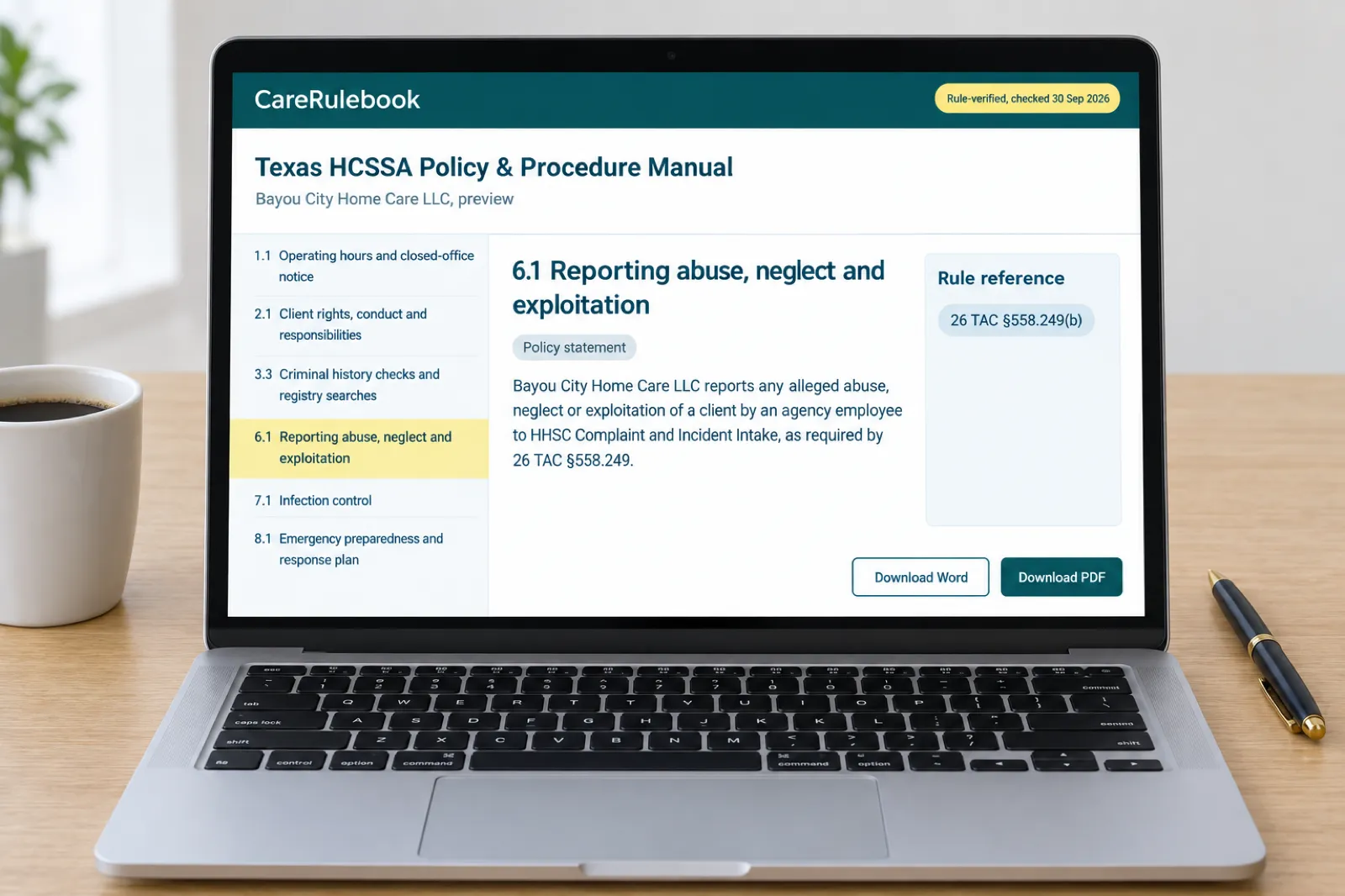
CareRulebook
CareRulebook’s Virginia manual includes Policy 3.4, criminal history checks and registry searches, covering the sworn statement, the State Police report, supervised work until it arrives, transfers and confidentiality, and Policy 3.5, drug testing, set to the choices you make.
$199CareRulebook founding price for the first 50 Virginia organizations, then $249. Not an OLC fee.
The Virginia rules do not set a periodic re-check: a report lasts as long as the employment, with these rules when someone moves or takes leave.
No new check
A criminal record report stays valid as long as the employee remains in continuous service with the same organization.
12VAC5-381-110 FNew report and statement
A person who leaves one home care organization and starts at another needs a new criminal record report and sworn statement.
12VAC5-381-110 GWithin 30 days
A transfer within 30 days to an organization owned and operated by the same entity keeps the original report. The employee’s file holds a statement that it was transferred or forwarded.
12VAC5-381-110 G 1Up to six months
The report and sworn statement stay valid if the separation is no more than six consecutive months. After that, get a new report and sworn disclosure statement.
12VAC5-381-110 G 2"All criminal record reports shall be confidential and maintained in locked files accessible only to the administrator or designee." 12VAC5-381-110 J
The report and the sworn disclosure statement may be shared further only with the Commissioner’s representative, or a federal or state authority or court where the law expressly requires it. 12VAC5-381-110 K The Commissioner enforces § 32.1-162.9:1, § 32.1-162.9:1 A and OLC representatives have access to the records they need during an inspection, so keep the report and statement where the administrator can produce them. 12VAC5-381-80 B
Every licensed home care organization "shall establish policies for maintaining a drug-free workplace, which may include drug testing when the employer has cause to believe that the person has engaged in the use of illegal drugs and periodically during the course of employment." Va. Code § 32.1-162.9:1 C
So the policy is required, and testing is your choice. Your personnel policies must include a process for maintaining a drug-free workplace alongside the background check process (12VAC5-381-180 E 6). If you test, decide which kinds:
When you have cause to believe the person has used illegal drugs. Write down what gave you cause.
Periodically during the course of employment, on a schedule your policy sets.
All positive results from testing under the statute go to the health regulatory board that licenses, certifies or registers the person, if any.
§ 32.1-162.9:1 C; 12VAC5-381-200 PSeparately from drug testing, your personnel policies need a "Process for reporting licensed and certified medical personnel for violations of their licensing or certification to the appropriate board within the Department of Health Professions." 12VAC5-381-180 E 7
In a personal care organization that usually includes your supervising RN and any LPNs. CareRulebook’s manual puts this in Policy 3.6, reporting licensed staff to their licensing boards.
One of the ten items every employee personnel record must hold.
Confidential, and accessible only to the administrator or a designee.
For an employee who moved within 30 days to an organization with the same owner: a statement that the original report was transferred or forwarded.
For substitute staff, the agency’s letter with the person’s name, their date of employment with the agency, and confirmation of the report.
Each employee personnel record is kept in its entirety for at least three years after employment ends.
A clear background check is not the whole story. Home attendants must speak, read and write English and meet one of six qualification routes, such as nurse aide certification or the DMAS Personal Care Aide Training Curriculum (personal care only). Verify and file the evidence alongside the check. 12VAC5-381-290
No. Only barrier crimes do, and even then a single misdemeanor that did not involve abuse or neglect is allowed after five years. Every applicant still gives a sworn disclosure statement, and you need the State Police report within 30 days of hire.
"However, a home care organization or hospice may hire an applicant who has been convicted of one such offense punishable as a misdemeanor that does not involve abuse or neglect if five years have elapsed since the conviction."
No. Nurse aide certification is one of six routes. For personal care, completing the Department of Medical Assistance Services Personal Care Aide Training Curriculum also qualifies, as does a competency evaluation on the personal care tasks. Aides must also speak, read and write English.
"However, this training is permissible for home attendants of personal care services only."
For every applicant, a sworn statement or affirmation disclosing any criminal convictions or pending charges, in or outside Virginia. For every paid employee, an original criminal record clearance or criminal history record from the Virginia State Police’s Central Criminal Records Exchange, obtained within 30 days of employment and dated no more than 90 days before it. You may not hire anyone convicted of a barrier crime, with one narrow exception.
They can start, but they may not work in direct contact with clients until the original report has been received, unless they work under the direct supervision of another employee whose background check is complete. The report must be obtained within 30 days of employment.
Offenses in clause (i) of the definition of barrier crime in Va. Code § 19.2-392.02. There is one exception: you may hire someone convicted of one such offense punishable as a misdemeanor that did not involve abuse or neglect, if five years have passed since the conviction. Other convictions do not bar employment under § 32.1-162.9:1, though the sworn statement still discloses them.
Yes. A new criminal record report and sworn statement are needed when someone leaves one home care organization and starts at another. The exceptions are a transfer within 30 days to an organization owned and operated by the same entity, and a leave of absence of no more than six consecutive months.
Reports are confidential, kept in locked files that only the administrator or a designee can access. They may be shared further only with the Commissioner’s representative, or a federal or state authority or court where the law expressly requires it. An applicant turned down because of convictions on the report gets a copy of it.
They must have policies for a drug-free workplace. Those policies may include drug testing when you have cause to believe someone has used illegal drugs, and periodically during employment, so testing is your choice. All positive results from that testing are reported to the health regulatory board that licenses, certifies or registers the person, if any.
The statute’s check rules do not apply to volunteers who work with the permission or under the supervision of a person who has received a clearance.
VDH has proposed amendments to the home care organization regulations under executive branch review. Leave your email and we will tell you when they move forward and what they change in your hiring policies.
No spam. Only emails about Virginia home care rule changes. How we use your email.
Virginia
How to start a home care agency in Virginia
The HCO license, RN supervision every 90 days and the 35 policy topics.
Virginia
The Virginia license application
The OLC Portal, what to have ready, fees, renewal and changes.
Virginia
Virginia home care policies and procedures
Every rule that asks for a written policy, including background checks and a drug-free workplace.
Tool
Virginia license checklist
Every step, tailored to your organization, emailed to you.
Manual
Build your Virginia policy manual
Including Policy 3.4 on background checks and Policy 3.5 on drug testing.
Texas
Texas background checks
HHSC registries, SEMARC and the EMR.
North Carolina
North Carolina background checks
Criminal history checks and the Health Care Personnel Registry.
Georgia
Georgia background checks
GCHEXS fingerprints, registries and the 2026 rule change.