Skip to content
CareRulebook

England · CQC registration · Your location

Can you run a home care agency from home? CQC office rules

Care happens in people’s homes, but CQC still registers an office: the place you plan care, keep records and manage staff. It can be your home. It cannot be a virtual office or PO box. Here is what CQC accepts, and the legal occupancy evidence it needs with your application.

  • Rule-verified 30 September 2026
  • Quoted from CQC’s location guidance
  • Re-checked October 1, 2026
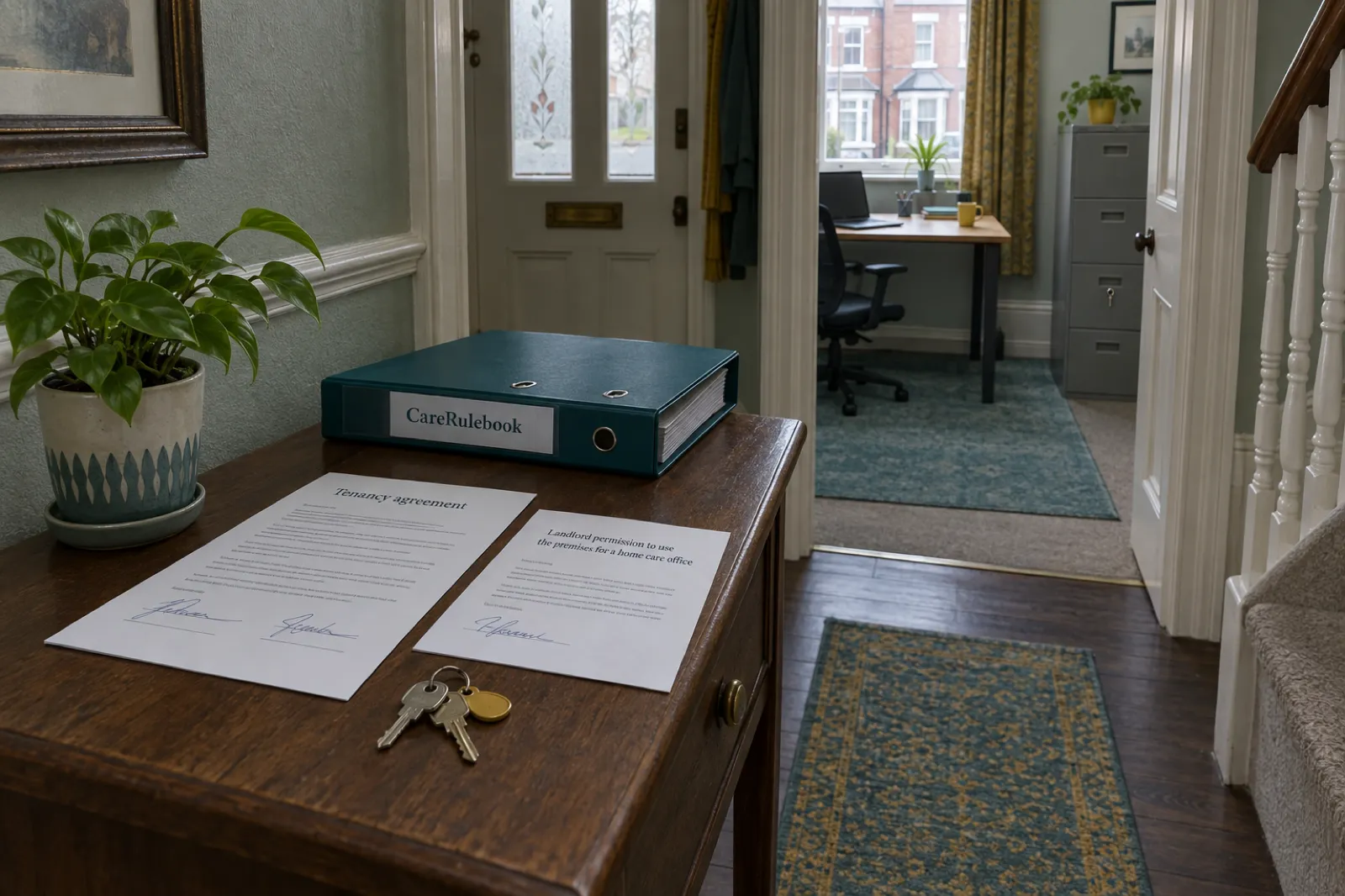
A signed tenancy agreement and a landlord permission letter on a hallway table, with a CareRulebook binder and keys

Quick answer

Yes, you can run a home care agency from home in England, if your home is genuinely where you run it. CQC’s location guidance says a location is not "a private home, where that private home is not the primary place from where the service is managed", so a home that is your main base can be your registered location.

What CQC will not accept is an address you do not work from: "We do not consider virtual offices to be a location." PO boxes are out too, and the office must be in England.

Whatever the premises, you send evidence of legal occupancy with the application: the title register, a signed tenancy agreement or a signed licence agreement, plus written permission from your landlord, mortgage provider or equity release provider if you do not fully own it. "If you do not provide this evidence, we will not be able to approve your application."
What CQC means by your office

CQC registers a provider to carry on regulated activities at or from named locations. For home care, the location is the office the service is run from. CQC’s rule 5 says "A location is any given setting that is a place where care is routinely planned, co-ordinated and the regulated activity is managed across the geographical area covered from that location in an effective way." CQC rule 5

In practice that is where "this includes where records relating to the management of the regulated activity are maintained and/or where staff management activities take place (meetings, supervisions, training, etc.)". It can be the same address as your business address or head office. If you later run care from more than one office, each one is a separate location, and "If you add or remove a location, you must apply to vary your conditions of registration." CQC CQC’s annual fee is charged per location.

CQC may visit at the assessment stage, alongside the registration interview: it says it may "interview you and your registered manager by telephone, online or face-to-face visit your premises". CQC

Home, rented, serviced or virtual: what CQC accepts

Your own home

Yes, if it is where you run the service

CQC excludes a private home only where it is not the primary place the service is managed from. Describe it in your statement of purpose, including that it is also a home, and get any landlord or mortgage lender’s written permission.

CQC

A rented office

Yes

Send the signed tenancy agreement, plus your landlord’s signed and dated permission to use it for a homecare service.

CQC

A serviced or shared office

Depends how you use it

CQC rules out temporary premises such as serviced offices used for short periods, for example for recruitment. A space you occupy under a licence and actually run the service from is different: send the signed licence agreement.

CQC

A virtual office or PO box

No

CQC does not consider a virtual office or a PO box to be a location, because it can only inspect premises where the service is carried on at or from.

CQC

A records store or admin-only site

No

A place used only to store records or for another purely administrative function is not a location.

CQC

An office outside England

No

Your main office must be in England. A provider based elsewhere must supply an address in England.

CQC

The legal occupancy evidence CQC needs

Homecare agencies send this with the application. The evidence must be valid when you apply, clearly show you have legal permission to run the service from the location, and "include specific details about how the location is suitable for the type of service you plan to provide". CQC

You own it

The title register (previously called the title deed). If there is a mortgage or equity release, add your lender’s written permission.

You rent it

A signed tenancy agreement, plus your landlord’s written permission.

You occupy it under a licence

A signed licence agreement, plus written permission from the landlord.

Someone else owns it

If the owner is not the provider or one of its directors, for example a director’s spouse or the registered manager, written permission from that person.

Any written permission must "confirm that you can use the premises for the service you plan to provide" and be signed and dated by the landlord, mortgage provider or equity release provider. CQC, Evidence of legal occupancy

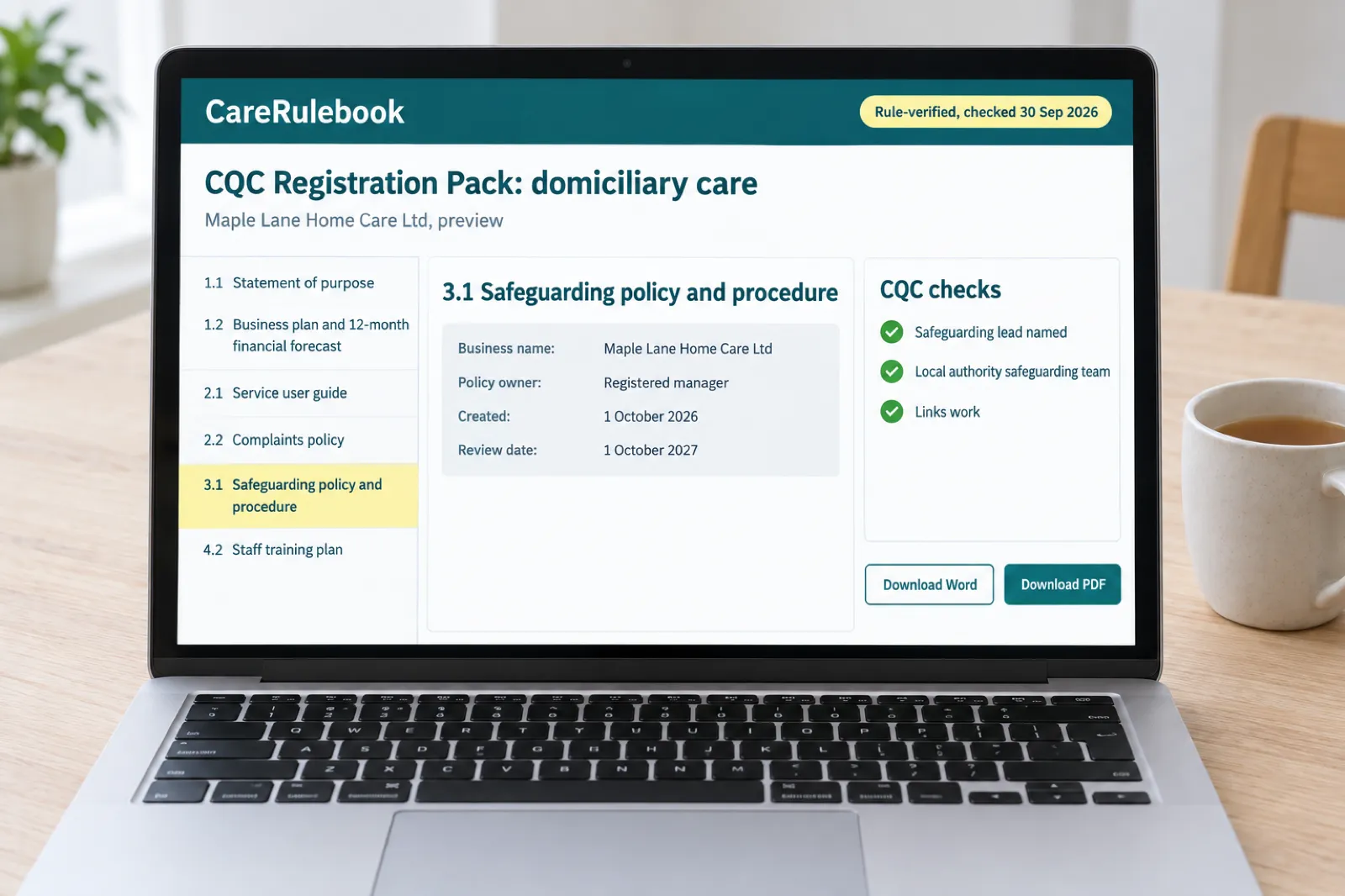
The CareRulebook CQC pack preview on a laptop

CareRulebook

Premises sorted, documents next

CareRulebook's CQC pack includes a legal occupancy document that lists the evidence for how you hold your premises and states why they suit your service, and a statement of purpose that describes your location, including when it is also your home.

  • Every document CQC asks for with a homecare application
  • Your business name, the person responsible and dates on every document
  • Editable Word and PDF

Your location in the statement of purpose

Your statement of purpose must give details of each location, with its address and contacts, a description of it, the type of service, the needs of the people you support, the regulated activities and the registered manager. CQC

If your office is also your home, say so. CQC’s statement of purpose guidance asks you to describe each location, including any other uses of the property, such as it also being a home. CQC Statement of purpose guide →

Myths about your office

Does CQC refuse home care agencies run from the owner’s house?

No. CQC excludes a private home only where it is not the primary place the service is managed from. If you really run the service from home, it can be your location, with legal occupancy evidence and permission from any landlord or lender.

"a private home, where that private home is not the primary place from where the service is managed"

Can you register a virtual office address with CQC?

No. CQC does not treat a virtual office or PO box as a location, because it can only inspect premises where the service is carried on at or from.

"We do not consider virtual offices to be a location."

Do you need to rent a commercial office?

No. Not necessarily. You need a physical location in England that you can prove you legally occupy, not a PO box or virtual office. A private home is excluded only where it is not the primary place the service is managed from.

"a private home, where that private home is not the primary place from where the service is managed"

Frequently asked questions

Can I run a domiciliary care agency from my home?

Yes, if your home is the primary place you run the service from. CQC excludes a private home only where it is not the primary place the service is managed from. You need legal occupancy evidence, written permission from any landlord or mortgage lender, and a statement of purpose that describes the location, including that it is also a home.

Can I use a virtual office for CQC registration?

No. CQC does not consider a virtual office to be a location. It also rejects PO boxes. It can only enter and inspect premises where the regulated activity is carried on at or from.

What is legal occupancy evidence for CQC?

Proof you are legally allowed to use your office for the service: the title register if you own it, a signed tenancy agreement if you rent, or a signed licence agreement if you occupy it under a licence. If you do not fully own the premises, you also need written permission from your landlord, mortgage provider or equity release provider. Without it, CQC cannot approve your application.

Do I need my mortgage lender’s permission to run a care agency from home?

For CQC, yes. If you do not fully own the premises, CQC asks for written permission from your landlord, mortgage provider or equity release provider, signed and dated, confirming you can use the premises for the service.

Does CQC need a commercial office?

No. CQC needs a physical place in England that you legally occupy and run the service from. It can be a home, a rented office or space under a licence agreement.

What if I open a second office later?

Each office that directly manages care staff is a separate location, sometimes called a branch. Adding or removing a location means applying to CQC to vary your conditions of registration, and CQC’s annual fee is charged per location.

Will CQC visit my office?

It may. At the assessment stage CQC says it may visit your premises, as well as interview you and your registered manager.

Get CQC rule-change alerts

CQC updated its legal occupancy guidance on September 30, 2026. Leave your email and we will tell you when a change affects your registration documents.

No spam. Only emails about rule changes that affect homecare in England. How we use your email.

Keep reading

Sources

  1. Registering a homecare agency (personal care) · Care Quality Commission · retrieved 30 September 2026
  2. Supporting documents for new provider registration applications · Care Quality Commission · retrieved 30 September 2026
  3. What is a location? · Care Quality Commission · retrieved 30 September 2026
Build your CQC registration pack