
Skip to content
CareRulebook
MenuClose

What do you run?

Home care in the US19 states with a manual, 6 with a free guide
ColoradoManual
ConnecticutPack
DelawareManual
GeorgiaManual
IllinoisManual
IndianaManual
KansasManual
MaineManual
MarylandManual
MinnesotaManual
NevadaManual
North CarolinaManual
OklahomaManual
OregonManual
South CarolinaManual
TennesseeManual
TexasManual
VirginiaManual
WashingtonManual
CaliforniaGuideFloridaGuideNew JerseyGuideNew YorkGuideOhioGuidePennsylvaniaGuideAll US home care states →
Care homes in the USCalifornia, Michigan, Minnesota; more states coming
Home care in the UKEngland, Scotland, Wales
Free toolsChecklists, calculators and templates

Oklahoma · Hiring · Long-term Care Security Act, 63 O.S. 1-1944 to 1-1951

Oklahoma caregiver background checks: OK-SCREEN and fingerprints before client contact

An Oklahoma home care agency runs every caregiver through OSDH’s OK-SCREEN portal before they regularly have contact with clients: a registry screening, then a fingerprint check by the OSBI and FBI, and OSDH’s eligibility determination. A new hire can start sooner only as a conditional hire, for up to 60 days, under direct on-site supervision.

  • Rule-verified October 9, 2026
  • Quoted from 63 O.S. 1-1945 to 1-1950.1
  • And OSDH’s OK-SCREEN page
A man in a denim shirt sorts printed pages into a teal CareRulebook binder at a desk in a newly rented, nearly empty office, with a sticky note on the binder reading Alternate RN in writing? and a flat landscape outside the window

Quick answer

Home care agencies are among the employers the Long-term Care Security Act covers (63 O.S. 1-1945(4)(f)), and "an employer shall not employ, independently contract with, or grant privileges to, an individual who regularly has direct patient access to service recipients of the employer until the employer conducts a registry screening and criminal history record check" (1-1947(F)). The check runs through OSDH’s OK-SCREEN portal: registry screening first, then fingerprints, and OSDH makes the eligibility determination (OK-SCREEN page).

A caregiver can start before the result only as a conditional hire: "The period of provisional employment shall not exceed sixty (60) days pending the completion of the required background check. During this time the employee shall be subject to direct on-site supervision." (1-1947(L)) The employer pays OSDH $19 per applicant, and the applicant pays $10 when fingerprinted (1-1947(J)(1)). These are state fees.

10 days

for the applicant to be fingerprinted after OSDH authorizes it

63 O.S. 1-1947(I)(4)

60 days

at most for a conditional hire, under direct on-site supervision

63 O.S. 1-1947(L)

5 years

after the sentence is completed, for the offenses that bar employment for a time

63 O.S. 1-1950.1(C)(2)

$19

OSDH’s employer fee per applicant fingerprinted or enrolled (a state fee)

63 O.S. 1-1947(J)(1)

Who is checked

Anyone with direct patient access

Direct patient access is access to a client, through employment, a contract or clinical privileges, where the duties involve or may involve ongoing one-on-one contact. It includes access to a client’s property, medical information or financial information.

63 O.S. 1-1945(9)
Your caregivers

For the background check statute, a nurse aide includes anyone who provides nursing care or health-related services for pay to people in their own homes as an employee or contractor of a home care agency, and the check is done before the person starts.

63 O.S. 1-1950.1(A)(1), (B)

Not contractors without ongoing contact

An independent contractor whose services are not directly related to client care, or whose access to clients is not ongoing, is outside the check, for example a utility, maintenance, construction or communications contractor.

63 O.S. 1-1947(F)(2)

Staff employed before November 2012

The fingerprint rules do not apply to a person employed or under contract on or before November 1, 2012, who may move to an employer under the same ownership. A move to an employer under different ownership needs a new check by the new employer.

63 O.S. 1-1947(F)(1)
  • Since 2014. The fingerprint program applied to home care agencies from August 1, 2014 at the latest (July 1, 2014 for Medicare-certified agencies). (OAC 310:2-29-3(b)(6))
  • Medicaid waiver providers. Medicaid home and community-based services waiver providers (Section 1915(c) or 1915(i)) may take part in fingerprinting voluntarily; otherwise they get a name-based state criminal history check from the OSBI and decide eligibility on the same disqualifying criteria. (63 O.S. 1-1947(I)(5)) Our reading: a licensed home care agency still runs OK-SCREEN for its staff; ask OSDH before relying on a name-based check for staff who serve waiver clients.
  • RN-trained caregivers. A worker employed by a licensed agency only for personal care, with no convictions on the criminal history check, continuously trained by an RN for the client’s needs, supervised by an RN on site at least every three months, and competent in an RN-written training plan, falls outside the Act, so needs no aide certification. (63 O.S. 1-1962(D)(9)) Our reading: a conviction of any kind keeps a worker off that route until OSDH says only disqualifying offenses count. The three caregiver routes.
  • Companion services. Companion and sitter services keep each client’s name, address and services, the duties performed each day of service, and background checks meeting the nurse aide criteria. (63 O.S. 1-1972(B)(7))

Each new hire, step by step

The statute’s steps and OSDH’s OK-SCREEN process in order. Tick steps off as you go; progress is saved in this browser only.

  1. Open your OK-SCREEN account

    Before your first hire

    OSDH’s OK-SCREEN page links a Provisional Employment Form, the OK Consent and Release Form, the list of employment disqualifiers under the Long-term Care Security Act, and the Facility/Provider OK-SCREEN account and user application an agency uses to open its account.

    OK-SCREEN page
  2. Photo ID and written consent

    Before the registry screening

    "The employer shall maintain the written consent and information regarding the individual’s identification in their files for audit purposes."

    63 O.S. 1-1947(H)
  3. Registry screening in the portal

    Before regular client contact

    With the consent and ID in hand, the employer enters the applicant’s name, any aliases, address, former states of residence, Social Security number and date of birth in OSDH’s internet portal for a check of the registries. If nothing bars the person and they have no monitored employment record, OSDH authorizes fingerprints at an authorized collection site for an OSBI and FBI check, and the results go back to OSDH.

    63 O.S. 1-1947(I)(1)
  4. Fingerprints within 10 days of authorization

    Within 10 calendar days

    After authorization the applicant has 10 calendar days to be fingerprinted, or the application is treated as withdrawn. OSDH’s page says fingerprints are collected at IdentoGO sites, run by MorphoTrust USA under a state contract, and links the current list of Oklahoma live scan locations and ink card instructions.

  5. OSDH decides eligibility

    When results return

    OSDH, not the employer, makes the eligibility determination, from the criminal history record obtained through the fingerprints. Disqualified applicants are told of their appeal rights. If the OSBI or the FBI rejects the fingerprint images, the applicant is fingerprinted again.

  6. Start work only when eligible

    Before regular direct access

    "an employer shall not employ, independently contract with, or grant privileges to, an individual who regularly has direct patient access to service recipients of the employer until the employer conducts a registry screening and criminal history record check", unless you use a conditional hire (below).

    63 O.S. 1-1947(F)
  7. The written agreement to report arrests

    At hire

    As a condition of continued employment, each employee or contractor agrees in writing to tell the employer immediately of an arraignment, indictment, conviction or plea for a disqualifying offense, or a substantiated registry finding.

    63 O.S. 1-1947(Q)
  8. File the records, confidentially

    As you go

    Eligibility determination records are confidential and destroyed one year after the person’s employment ends. The consent and ID stay on file for audit.

  9. Keep the person’s OK-SCREEN status current

    Every year, and whenever it changes

    OSDH says employers must update each employee’s status in OK-SCREEN every year; people not continuously employed may be dropped from OK-SCREEN and arrest monitoring.

Questions go to OSDH’s OK-SCREEN office: OSDH’s OK-SCREEN office: phone (405) 426-8145, email okscreen@health.ok.gov. OSDH asks that questions go to that address only. (OK-SCREEN page)

What disqualifies

OSDH screens registries first, then the criminal history. Do not employ or contract with anyone disqualified by the check, a federal exclusion, a substantiated abuse finding, the community services worker or child care restricted registries, a sex or violent offender registry, or a listed conviction; end employment at once when OSDH says so. (63 O.S. 1-1947(D)-(E)) When a disqualification shows up, "the Department shall advise the employer or requesting agency to immediately terminate the person’s employment or contract".

No time limit

Abuse, neglect or financial exploitation of a person in one’s care, sex offenses, child abuse, murder, manslaughter, kidnapping, human trafficking, aggravated assault and battery, assault and battery with a dangerous weapon and first-degree arson bar employment.

For the offenses that bar employment with no time limit, a conviction, a guilty or no contest plea, or a deferred sentence, for a felony or a misdemeanor in any state or federal jurisdiction, all count.

63 O.S. 1-1950.1(C)(1)

For five years after the sentence

If less than five years have passed since the sentence was completed, a conviction or guilty or no contest plea for assault; battery; indecent exposure and indecent exhibition (unless it puts the person on a sex offender registry); pandering; first or second degree burglary; first or second degree robbery; robbery or attempted robbery with a dangerous weapon or imitation firearm; second degree arson; unlawful manufacture, distribution, prescription or dispensing of a Schedule I to V drug; grand larceny; or petit larceny or shoplifting bars employment.

Completion of the sentence means the last day of the whole term of incarceration imposed, including any part that is deferred, suspended or subject to parole.

63 O.S. 1-1950.1(A)(5), (C)(2)
  • Drug addiction. "An employer shall not employ or continue employing a person addicted to any Schedule I through V drug as specified by the Uniform Controlled Dangerous Substances Act unless the person produces evidence that the person has successfully completed a drug rehabilitation program." (63 O.S. 1-1950.1(D))
  • Which list applies. For the background check statute, a nurse aide includes anyone who provides nursing care or health-related services for pay to people in their own homes as an employee or contractor of a home care agency, and the check is done before the person starts. Our reading: the 1-1950.1(C) lists therefore apply to the caregivers of a home care agency. OSDH, not the agency, makes the determination (OK-SCREEN page).
  • Beyond these lists. The statute also bars someone whose record shows they have not acted in conformity with the laws that apply to their professional license, certification or employment class, as set by the authority for that license or class (63 O.S. 1-1947(D)(1)). We found no other bar. By our reading, a record that none of these covers does not disqualify the person under the Act, and the decision is yours, except for a caregiver on the RN-trained route, who must have no convictions at all (above). Our suggestion: take employment law advice before turning someone down for a record the statute does not list.

Conditional hires: up to 60 days

The statute lets an employer start someone before the result, if it decides it is necessary and all of these apply (63 O.S. 1-1947(L)):

  • Request the check on hiring. The employer requests the criminal history check when it conditionally employs the person.
  • A signed statement. A conditional hire signs a written statement that they are not disqualified, that their employment ends if the registry screening and criminal history check do not confirm this (unless they appeal and show the information is wrong), and that these conditions are good cause for termination. OSDH must make a model form for the conditional employment statement available free on request. (1-1947(M)) OSDH’s OK-SCREEN page links a Provisional Employment Form (OK-SCREEN page).
  • 60 days, supervised. "The period of provisional employment shall not exceed sixty (60) days pending the completion of the required background check. During this time the employee shall be subject to direct on-site supervision." The 60-day conditional period may be extended only for an employee who is appealing the background check results, and only for the length of the appeal. (1-1947(L)(3))
  • Honesty matters. Knowingly giving false information about identity, convictions or substantiated findings on the conditional employment statement is a misdemeanor: a fine of $100 to $300, up to 30 days in county jail, or both. (1-1947(O))

Our reading: in home care this means a supervisor present, so many agencies will not use it. Home care is given one-to-one in the client’s home, so "direct on-site supervision" would mean a supervisor present for every visit during those 60 days. In the CareRulebook manual, conditional hiring is a choice in the builder: if you choose it, Policy 2.2 adds the conditional employment statement and the supervision steps; if not, no one starts before OSDH’s determination.

Unclear records, appeals and waivers

  • An unclear record. If the record does not let OSDH make a final determination, the employer and applicant are told, and the applicant has 60 days to make corrections or additions. If they cannot, OSDH denies employment on the disqualifying results and explains the right to appeal. (63 O.S. 1-1947(K))
  • Rejected prints. If the OSBI or the FBI rejects the fingerprint images, the applicant is fingerprinted again. (1-1947(I)(3))
  • Appeal and waiver. A person disqualified or denied employment after the check may appeal to OSDH within 30 days of the notice, if the record is wrong or if time passed, extenuating circumstances, rehabilitation or relevance to the job merit a waiver. OSDH weighs those factors in its waiver review. (1-1947(T); OAC 310:2-29-5)
  • A conditional hire who appeals. The 60-day conditional period may be extended only for an employee who is appealing the background check results, and only for the length of the appeal. (1-1947(L)(3))
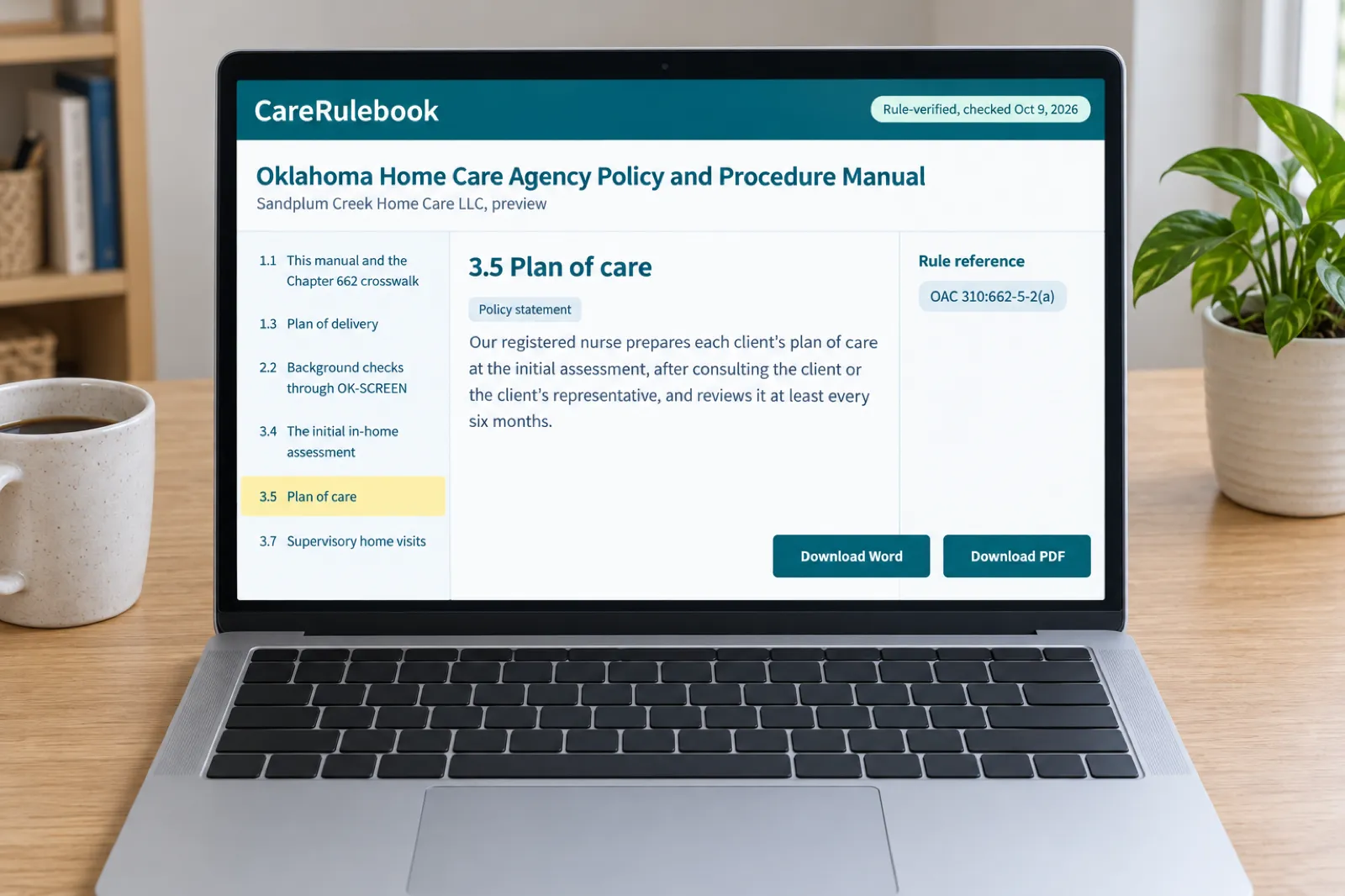
The CareRulebook Oklahoma manual preview on a laptop: policy 3.5 on the plan of care for a sample agency, citing OAC 310:662-5-2(a), with six of the manual’s policies listed beside it

CareRulebook

Background checks written for your agency

CareRulebook’s Oklahoma manual includes Policy 2.2 (Background checks through OK-SCREEN): who has direct patient access, the OK-SCREEN steps, the photo ID and written consent, the disqualifying offenses, appeals, arrest reporting and record destruction, with conditional hiring only if you choose it. It comes with an OK-SCREEN steps checklist, a photo ID and written consent record, an arrest and conviction reporting agreement, a background check log and a record destruction log.

  • 33 policies, 92 requirements mapped
  • Written to OAC 310:662 as amended on August 11, 2025, and the Long-term Care Security Act
  • Your own RN adopts the clinical policies
  • Editable Word and print-ready PDF, with the rule quoted under each policy
Preview your manual

$199CareRulebook founding price for the first 50 Oklahoma agencies, then $249. Not an OSDH fee.

After the hire: arrests, monitoring and moving jobs

  • Arrest monitoring. For people fingerprinted under the program, the OSBI reports a later arrest to OK-SCREEN; a potentially disqualifying arrest is followed to conviction, and the employer is told if eligibility is revoked. (OK-SCREEN page)
  • The employee reports too. As a condition of continued employment, each employee or contractor agrees in writing to tell the employer immediately of an arraignment, indictment, conviction or plea for a disqualifying offense, or a substantiated registry finding. A reported arraignment may lead to leave without pay, direct supervision, restriction from direct patient access, termination or denial of employment. (63 O.S. 1-1947(Q))
  • Keep the status current. The employer keeps each person’s employment, contract or privileges status current in OSDH’s web system, which sends automated notices about people convicted of a disqualifying offense or given a substantiated registry finding since their first check. (1-1947(V)) OSDH says: "Employers are required to annually update an employee’s status in OK-SCREEN." (OK-SCREEN page)
  • Moving between employers. OSDH says a person is fingerprinted once, as long as there is no extended gap in their employment record in OK-SCREEN, and does not need new prints when changing employers within the industry. Someone dropped from OK-SCREEN after leaving work is fingerprinted again at the next application. (OK-SCREEN page)
  • Aides on the registry. If you employ certified aides or CNAs, report any allegation of abuse, neglect, mistreatment or misappropriation against them to OSDH by telephone within 24 hours and in writing within five working days (OAC 310:677-1-4). Policy 3.11 covers the report.

Records

  • Consent and ID. "The employer shall maintain the written consent and information regarding the individual’s identification in their files for audit purposes." (63 O.S. 1-1947(H))
  • Eligibility records. "All employment eligibility determination records received by the employer pursuant to this section are confidential", and "These records shall be destroyed after one (1) year from the end of employment of the person to whom such records relate." (1-1950.1(E))
  • In the personnel file. Personnel records hold qualifications, employment history, orientation and in-service, health screening, evaluations, discipline and current license or certification checks (OAC 310:662-3-4(f)). CareRulebook’s manual keeps the personnel file checklist in Policy 2.8 and a record destruction log in Policy 2.2.

Who pays, and what skipping a check costs

  • The fees. The employer pays OSDH $19 per applicant submitted for fingerprinting or monitoring; the applicant pays a $10 administrative fee when fingerprinted. People already monitored in OK-SCREEN are not fingerprinted again. These are OSDH’s fees, not CareRulebook prices (63 O.S. 1-1947(J)(1)).
  • Paying. Fees are paid in the OK-SCREEN portal by instant credit or debit card, a 30-day batch payment by card, or e-check. (OK-SCREEN page)
  • Skipping a check. An employer convicted of knowingly and willfully failing to run the required checks may be fined $1,000 to $3,000, jailed up to 30 days, or both. (1-1947(R))
  • Acting in good faith. An employer that acts in good faith to comply with the background check section is immune from liability in carrying it out. (1-1947(U))

Owners, and the license application

We found nothing in the Home Care Act, Chapter 662 or OSDH’s application guidance that runs the owners themselves through OK-SCREEN for the license. Instead, ODH Form 757 asks about convictions:

  • Item 15. Item 15 asks the applicant to list, as a numbered attachment, any applicant or affiliated person with one of the convictions the form names, and the type of conviction. (ODH Form 757)
  • The signature. The signer certifies they are at least 21, of reputable and responsible character and in sound physical and mental health; a firm, partnership or corporation is ineligible if any member, officer or major stockholder has a felony conviction for a listed offense. (ODH Form 757, signature block)
  • Denial. OSDH may deny a license for failure to meet any minimum standard of the Act or rules, or for a conviction of the applicant or an affiliated person for a listed offense. (63 O.S. 1-1965(D))

By our reading, an owner who also works with clients, as administrator, nurse or caregiver, with regular direct patient access is checked through OK-SCREEN like any other employee. The whole application is on the Oklahoma license application.

Myths about Oklahoma hiring checks

Can a new Oklahoma caregiver start before the fingerprint check is back?

It depends. Only conditionally. The employer requests the check when hiring, the person signs a statement that they are not disqualified, and the provisional period may not exceed 60 days with direct on-site supervision. In home care that means working alongside a supervisor, so, on our reading, many agencies wait for OSDH’s eligibility determination.

"The period of provisional employment shall not exceed sixty (60) days pending the completion of the required background check. During this time the employee shall be subject to direct on-site supervision."

Do Oklahoma personal care workers have to be certified home health aides?

It depends. Not always. A home health aide must be certified and on OSDH’s registry within four months of starting. Since 2021 a worker employed only for personal care can instead be trained continuously by the agency’s RN, show competency in an RN-written training plan on seven set topics, and be supervised by the RN on site at least every three months (sooner after a hospital stay or surgery). Certified nurse aides also count. Either way, the RN carries the training and supervision.

"is supervised by a registered nurse via an on-site visit at least once every three (3) months or sooner if the client experiences a significant change in health condition"

Frequently asked questions

Do Oklahoma home care agencies have to fingerprint caregivers?

Yes. Under the Long-term Care Security Act, a home care agency may not employ or contract with anyone who regularly has direct patient access until it has run the registry screening and fingerprint-based state and national criminal history check through OSDH’s OK-SCREEN portal. Home care agencies have been covered since August 1, 2014 at the latest.

Can a new caregiver start before the result is back?

Only as a conditional hire. The employer requests the check on hiring, the person signs a written statement that they are not disqualified, and the provisional period may not exceed 60 days, under direct on-site supervision. By our reading, in home care that means working alongside a supervisor, so many agencies wait for OSDH’s eligibility determination.

What crimes stop someone working for an Oklahoma home care agency?

With no time limit: abuse, neglect or financial exploitation of a person in one’s care, sex offenses, child abuse, murder, manslaughter, kidnapping, human trafficking, aggravated assault and battery, assault and battery with a dangerous weapon and first-degree arson, and a deferred sentence counts. For five years after the sentence is completed: assault, battery, indecent exposure and indecent exhibition, pandering, first or second degree burglary or robbery, robbery with a dangerous weapon, second-degree arson, unlawful drug manufacture or distribution, and grand or petit larceny or shoplifting. A substantiated abuse finding, a federal exclusion, the community services worker or child care restricted registries, and a sex or violent offender registry also disqualify.

Does a caregiver have to be fingerprinted again at a new job?

Not usually. OSDH says a person is fingerprinted once, as long as there is no extended gap in their employment record in OK-SCREEN, and new hires do not need new prints when changing employers within the industry. The new employer still screens them and pays the employer fee to enroll them as a monitored employee.

How much do Oklahoma background checks cost?

The employer pays OSDH $19 for each applicant submitted for fingerprinting or monitoring, and the applicant pays a $10 administrative fee when fingerprinted. These are state fees, not CareRulebook prices.

Can a disqualified caregiver appeal?

Yes. A person disqualified or denied employment may appeal to OSDH within 30 days of the notice, if the criminal history report is wrong or if the passage of time, extenuating circumstances, rehabilitation or the relevance of the offense to the job merits a waiver.

Get Oklahoma rule-change alerts

We will email you when Oklahoma changes its home care rules, OSDH’s forms or the background check law, with what it means for your hiring checks and your policies.

No spam. Only emails about Oklahoma home care rules. How we use your email.

Keep reading

Sources

  1. Home Care Act, 63 O.S. 1-1960 to 1-1969 and 1-1972 (OSCN 2026) · Oklahoma State Courts Network (OSCN) · retrieved October 2, 2026
  2. OAC 310:662, Home Care Agencies (official text as amended effective August 11, 2025, incl. Subchapter 8 Sitter or Companion Services) · Oklahoma State Department of Health (Oklahoma Administrative Code, Title 310, official PDF from rules.ok.gov, generated March 23, 2026) · retrieved October 9, 2026
  3. OAC 310:677, Nurse Aide Training and Certification: general provisions, registry and Subchapter 9 Home Health Aides (official text; links go to LII’s matching copy) · Oklahoma State Department of Health (Oklahoma Administrative Code, Title 310, official PDF from rules.ok.gov, generated March 23, 2026) · retrieved October 9, 2026
  4. Long-term Care Security Act and nurse aide statutes, 63 O.S. 1-1944 to 1-1951 (OSCN 2026), with OAC 310:2-29 (criminal history background checks, official text) · Oklahoma State Courts Network (OSCN); Oklahoma State Department of Health (Oklahoma Administrative Code, official PDF) · retrieved October 4, 2026
  5. Home Care Application Guidance letter, ODH Form 757 (12/2020), ODH Form 758 (12/2020, branch application), Home Care License Renewal letter and Change of Ownership guidance letter · Oklahoma State Department of Health, Medical Facilities Service, Home Services Division · retrieved October 2, 2026
  6. Oklahoma Long Term Care National Background Check Program (OK-SCREEN) page · Oklahoma State Department of Health · retrieved October 4, 2026

Free sample, no email needed

Read a full policy before you buy

Policy 3.1, Client rights and responsibilities, and client autonomy, as it prints in the Oklahoma manual, filled in for a fictional agency. The rule text it rests on is quoted word for word under Rule basis.

PDF · 10 pages · 125 KB · Rule-verified October 9, 2026

Collecting answers for an agency or a client? The intake questionnaire lists all 48 questions the builder asks, what each decision changes in the manual, and a completed example: Word · PDF.How consultants use CareRulebook.

Download the sample (PDF)
Or email it to me

We send the link once. Nothing else unless you tick the box. Privacy notice.

Build your Oklahoma manualfrom $199