Skip to content
CareRulebook
MenuClose

Where are you starting?

United StatesTexas, North Carolina, Georgia, Virginia, Ohio
United KingdomEngland
Free toolsChecklists, calculators and templates

Georgia · Private home care · Chapter 111-8-12 · GCHEXS

Georgia home care background checks: GCHEXS, registries and the 2026 rule change

Every Georgia private home care provider checks owners, administrators and caregivers before they work with clients: registry checks first, then a fingerprint check through DCH’s GCHEXS system. Here is each step, what a satisfactory determination means, the 30-day grace period, the records to keep, and what the 2026 rule change adds.

  • Rule-verified September 30, 2026
  • Quoted from Chapter 111-8-12 and 111-8-65
  • GCHEXS details from DCH’s July 2026 checklist
A Georgia home care agency owner sorts new-hire paperwork beside two folders labelled Registry check first and Fingerprints: GCHEXS, with a CareRulebook binder on the desk

Quick answer

Georgia’s background check rules, Chapter 111-8-12, cover every licensed private home care provider. "Prior to a criminal background check required by these rules, the facility shall perform a registry check of the owner, administrator, onsite manager, director, and employees." The criminal background check is then fingerprint-based, a search of Georgia Crime Information Center and FBI records, submitted through DCH’s Georgia Criminal History Check System (GCHEXS).

A caregiver may work up to 30 days under direct supervision while their check is pending, never an administrator. The 2026 amendment to Chapter 111-8-65, adopted July 9, 2026, asks for a satisfactory fingerprint result "Prior to serving as a direct access employee". DCH has not published an effective date we could confirm.

Who must be checked

A licensed private home care provider is a “facility” under Chapter 111-8-12, the same rules that cover personal care homes and home health agencies. 111-8-12-.03(9)(c) “Direct access” means "routine personal contact with a patient, resident, or client, including face-to-face contact, hands-on physical assistance, verbal cuing, reminding, standing by or monitoring", or being routinely alone with a client’s property or financial information. 111-8-12-.03(7)

Owners

Each individual with a 10% or greater ownership interest who also exercises authority, operates the agency, keeps an office there, has direct access, supervises staff, or is buying it. Checked on applying for a new license or a change of ownership.

111-8-12-.03(13), .05(1)

Administrators, onsite managers and directors

They need their result before they start: the 30-day grace period never applies to them, and no one can be appointed while their check is pending.

111-8-12-.06(3)(a)

Direct access employees

Anyone with routine personal contact with clients or their property or finances, hired as an employee or through a contract, including volunteers whose duties match an employee’s.

111-8-12-.03(7)-(8)

Licensed nurses and other professionals

Chapter 111-8-12’s definition of employee leaves out licensed healthcare providers such as nurses. Their license is checked with the board instead, before any criminal background check.

111-8-12-.03(8), .04(2)

The checks, step by step

For each new caregiver, and for administrators. Tick steps off as you go; progress is saved in this browser only.

  1. Print the notice on your job application

    Before you advertise

    Every application form you give to job applicants must conspicuously state that state law requires a national and state background check as a condition of employment.

    111-8-12-.06(5)
  2. Get the misconduct statement

    At application

    Under Chapter 111-8-65 as printed, each new staff member and any administrator gives an oral or written statement at application that they have never been shown by credible evidence to have abused, neglected or exploited anyone.

    111-8-65-.09(5)(a)1
  3. Run the registry checks first

    Before fingerprints

    The nurse aide registry, the Georgia sex offender registry and the federal List of Excluded Individuals and Entities. For someone who has lived in Georgia less than two years, also each state they lived in during the previous two years.

    111-8-12-.03(15), .04(1)
  4. Check any professional license

    Before fingerprints

    For a licensed professional, or a job that requires a license, confirm with the licensing board that the license is current and in good standing.

    111-8-12-.04(2)
  5. Submit the fingerprint check through GCHEXS

    On application or before placement

    A records check application is fingerprints plus DCH’s records search fee. Instead, you may give DCH proof of a satisfactory determination from the previous 12 months.

    111-8-12-.05
  6. Wait for the determination, or supervise closely

    Up to 30 days

    While a check is pending, a caregiver may have client contact for up to 30 days, only under the direct supervision of a staff member with a satisfactory determination. Never for administrators. The 2026 amendment requires a satisfactory result first.

    111-8-12-.06(3)(a)
  7. Act on the result

    When DCH decides

    With a satisfactory determination, the person can work. With an unsatisfactory determination, a registry listing or a license not in good standing, they cannot work for the agency, though a current employee may stay while they appeal.

    111-8-12-.06(1), (3)(b)
  8. File the evidence

    Always

    Keep each employee’s satisfactory determination, registry check and any license check in their personnel file, open to DCH but otherwise confidential.

    111-8-12-.06(4)

The registry check

A registry check is "a review of the nurse aide registry provided for in O.C.G.A. § 31-2-14, the state sexual offender registry, and the List of Excluded Individuals and Entities", or any other registry useful for the rules. 111-8-12-.03(15)

  • The nurse aide registry, kept under O.C.G.A. 31-2-14;
  • The state sex offender registry;
  • The federal List of Excluded Individuals and Entities, kept under Sections 1128 and 1156 of the Social Security Act.

It comes before the fingerprint check, for owners, administrators, onsite managers, directors and employees. "If an individual has not resided in this state for at least two years, the facility shall conduct registry checks of each state in which the individual resided for the previous two years", as the person tells you or as you otherwise find out. 111-8-12-.04(1)

Someone who appears on a registry cannot be employed by, contract with or work at the agency, and neither can someone with a substantiated state or federal finding of neglect, abuse or misappropriation of property. 111-8-12-.06(1)

The determination

The fingerprint check is "a search of the criminal records maintained by the Georgia Crime Information Center and the Federal Bureau of Investigation". 111-8-12-.03(4) DCH then issues one of two written results:

Satisfactory

"a written determination that an individual for whom a criminal background check was performed was found to have no criminal record"

111-8-12-.03(16)

Unsatisfactory

"a written determination that an individual for whom a criminal background check was performed was found to have a criminal record"

111-8-12-.03(17)

What counts as a criminal record

A conviction

A finding or verdict of guilty, or a guilty plea, for a covered crime, whether or not an appeal has been sought.

111-8-12-.03(2)

A nolo contendere plea or first offender treatment

For a covered crime, even without an adjudication of guilt.

111-8-12-.03(5)(b)

A pending charge

An arrest and charge for a covered crime that is still pending, unless the time to prosecute has run out.

111-8-12-.03(5)(b)3

Covered crimes. Seven named offenses: O.C.G.A. 16-5-70, 16-5-101, 16-5-102, 16-6-4, 16-6-5, 16-6-5.1 and 30-5-8 (abuse, neglect or exploitation of a disabled adult or elder person). 111-8-12-.03(3)(a) Also a felony violation of Chapters 5, 6, 8, 9 or 13 of O.C.G.A. Title 16, or of 16-4-1, 16-7-2 or 31-7-12.1, and matching offenses in other jurisdictions. 111-8-12-.03(3)(b)-(c) The rule lists Code sections; check the statute for what each covers.

Ten years on. It is not a criminal record where "at least ten years have elapsed from the date of his or her criminal background check since the completion of all of the terms of his or her sentence", except for certain crimes the statute names. 111-8-12-.03(5)(c)

Rule in force · and the 2026 amendment

Starting work while a check is pending

Under Chapter 111-8-12 as printed: "While a criminal background check is pending, the facility may permit an individual to have direct access to residents for a period not to exceed 30 days, provided that the individual is under the direct supervision of a staff member who has a satisfactory determination". 111-8-12-.06(3)(a) "At the end of 30 days, if no background check determination has been issued by the department and the individual is working at the facility, the facility shall ensure that the individual does not have direct access to residents."

Never for leadership: "The 30-day grace period shall not apply to placement of an administrator, onsite manager or director". You cannot appoint anyone to those roles while their check is pending. 111-8-12-.06(3)(a)

Under the 2026 amendment: one of the minimum qualifications for all staff becomes "Prior to serving as a direct access employee, obtain a satisfactory fingerprint records check determination in compliance with the Rules and Regulations for Criminal Background Checks, Chapter 111-8-12". Amended 111-8-65-.09(5)(a)1 The Board of Community Health adopted it on July 9, 2026, but DCH has not published an effective date we could confirm, and DCH told the Board the background check changes were not substantive. Until DCH confirms how the two fit together, the cautious policy is no client contact before a satisfactory result. If you do use the grace period, write down the start date and the supervising staff member for each visit.

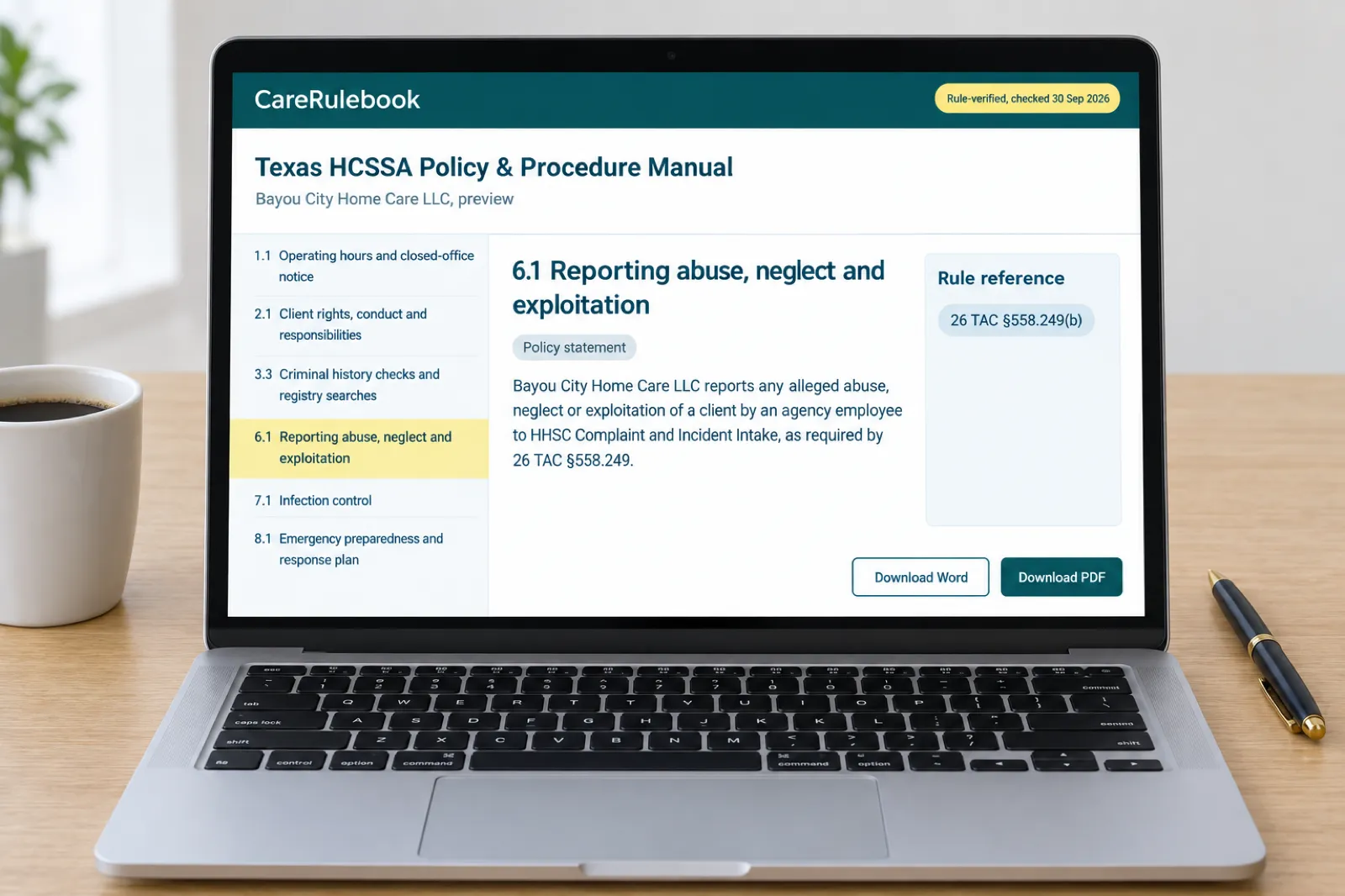
The CareRulebook manual preview on a laptop

CareRulebook

Background checks are a policy DCH reads

Your Affidavit of Compliance confirms your policies exist, and DCH reviews them at your survey. Policy 3.3 in CareRulebook’s Georgia manual covers registry and license checks, GCHEXS, the grace period, appeals and the records to keep, quoting Chapter 111-8-12 under each step, with your agency’s details filled in.

  • 25 policies, 52 rule requirements mapped
  • Flags the policies the 2026 amendment affects
  • Editable Word and PDF, delivered instantly
Preview your manual

$199CareRulebook founding price for the first 50 Georgia agencies, then $249. Not a DCH fee.

Owners and administrators at application

DCH’s application checklist lists a "Satisfactory determination letter, dated within 12 months of the application submission date, from the DCH Georgia Criminal History Check System (GCHEXS)." and adds: "All administrators and individual owners with 10% or more ownership interest must complete a fingerprint-based background check through GCHEXS." DCH checklist, items 7, 9 If no individual owns 10% or more, send a signed letter on company letterhead saying so. DCH checklist

The agency owner requests GCHEXS access. For help, DCH’s Office of Inspector General can be reached on 404-463-7154 or at gchexs.user@dch.ga.gov. DCH checklist, item 7 The checklist also points to DCH OIG for its list of exempted professional healthcare providers.

Chapter 111-8-65 as printed says "Prior to the issuance of any new license, the owner of the business or agency applying for the license shall be required to submit a records check application", unless DCH decides the owner has no office, residence, direct access or supervisory role where services are given. 111-8-65-.05(1)(b) If an owner has an unsatisfactory determination or appears on a registry, "the department shall notify such owner of the ineligible status for ownership" and moves to revoke or refuse the license. 111-8-12-.07

Already have a recent result? Instead of a new records check application, you may give DCH proof that "the individual has received a satisfactory determination within the immediately preceding 12 months". 111-8-12-.05(2) A records check application is fingerprints plus a records search fee that DCH sets. The rule does not state the amount or who pays it. 111-8-12-.03(14)

Every document on DCH’s application checklist →

Records to keep

Keep a personnel file for each employee. "Such files shall be available for inspection by the department but shall otherwise be maintained to protect the confidentiality of the information contained therein", and it must include "evidence of each employee's satisfactory determination, registry check, and licensure check, if applicable." 111-8-12-.06(4)

The job application

Showing the background check notice, as every form must.

111-8-12-.06(5)

The misconduct statement

The oral or written statement obtained at application, under the rule as printed. A written, signed statement is the easiest to show.

111-8-65-.09(5)(a)1

Registry check results

Each registry searched, including other states for recent movers, with the date.

111-8-12-.06(4)

License check

For licensed professionals or jobs that need a license.

111-8-12-.06(4)

The satisfactory determination

The written determination from DCH, or the earlier one you relied on.

111-8-12-.06(4)

Grace period notes

If you use it: the start date and the supervising staff member, so you can show the 30-day limit was kept. Our suggestion, not rule text.

111-8-12-.06(3)(a)

The notice must read: "FOR THIS TYPE OF EMPLOYMENT, STATE LAW REQUIRES A NATIONAL AND STATE BACKGROUND CHECK AS A CONDITION OF EMPLOYMENT." 111-8-12-.06(5) Every policy the Georgia rules require →

Appeals, DCH checks and penalties

Appeals

A person with an unsatisfactory determination or a registry listing can appeal under the Georgia Administrative Procedure Act. The hearing officer considers time since the crime, no further charges, the circumstances and rehabilitation.

111-8-12-.10(2)

Keeping staff during an appeal

Unless federal rules prohibit it, you may keep a current employee or administrator with an unsatisfactory determination while they appeal.

111-8-12-.06(3)(b)

Checking a record

A person can ask about the accuracy of their record (DCH refers them to the law enforcement agency) or challenge that they are the person on a registry.

111-8-12-.10(1)

Checks DCH starts

DCH may require a new check on anyone during an abuse investigation, or after learning of an arrest. The person then gives DCH two full sets of fingerprints.

111-8-12-.08

DCH fines the lesser of $10,000 or $500 a day, from when the agency knew or should have known it employed someone with a criminal record until that employment ends. Following the steps above, and keeping the evidence on file, is how you show you checked. 111-8-12-.09

Adopted July 9, 2026 · effective date not yet confirmed

What the 2026 amendment changes

The Board of Community Health gave final adoption to changes in Chapter 111-8-65 on July 9, 2026. DCH Board summary For background checks, it points each role to Chapter 111-8-12:

  • 111-8-65-.09(5)(a)1

    Fingerprints before client contact

    Staff must have a satisfactory fingerprint determination before serving as a direct access employee.

  • 111-8-65-.09(3)(a)

    Administrator checks

    Administrators need a satisfactory fingerprint determination under Chapter 111-8-12, replacing the misconduct statement.

  • 111-8-65-.05(1)(b)

    Owner checks

    Owners applying for a license follow Chapter 111-8-12.

In practice, the misconduct statement at application gives way to a satisfactory fingerprint determination for staff and administrators. DCH told the Board that "no substantive changes were being made to the requirements." Board minutes, May 14, 2026 The rule text we can still read online has the old wording, so keep the misconduct statement until DCH confirms the effective date; it does no harm alongside the fingerprint check. You can ask DCH’s Private Home Care Unit at hfrd.phcp@dch.ga.gov.

DCH, Chapter 111-8-65 final adoption text · All the 2026 changes in the guide →

TB screening: the other hiring check

Health screening sits beside the background check in each personnel file. The rule as printed asks for "Documentation of a satisfactory TB screening test upon employment and annually thereafter". 111-8-65-.09(4)(c)4 The 2026 amendment replaces this: "Prior to starting work, all employees must be screened for TB in accordance with CDC guidance for baseline screening and testing for health care personnel." It also requires a health screening program for employees and contractors who work with clients. Amended 111-8-65-.09(4)(c)4 Confirm the effective date with DCH before dropping annual tests.

TB and health screening in the Georgia guide →

Myths about Georgia background checks

Can a new Georgia caregiver start before the fingerprint result comes back?

It depends. Chapter 111-8-12 allows up to 30 days of client contact while a check is pending, only under the direct supervision of a staff member who has a satisfactory determination, and never for an administrator. The 2026 amendment to Chapter 111-8-65, adopted July 9, 2026, requires a satisfactory fingerprint result before serving as a direct access employee. Until DCH confirms when it takes effect, the cautious course is to wait for the result.

"While a criminal background check is pending, the facility may permit an individual to have direct access to residents for a period not to exceed 30 days, provided that the individual is under the direct supervision of a staff member who has a satisfactory determination"

Is a registry search enough for Georgia home care staff?

No. The registry check comes first, then a fingerprint-based criminal background check of Georgia Crime Information Center and FBI records, run through DCH’s GCHEXS system.

"Prior to a criminal background check required by these rules, the facility shall perform a registry check of the owner, administrator, onsite manager, director, and employees."

Do licensed nurses at a Georgia home care agency need a fingerprint check?

It depends. Not as employees under Chapter 111-8-12, whose definition of employee leaves out licensed healthcare providers such as nurses; their license is checked with the board instead. DCH’s application checklist still asks for a GCHEXS letter for every administrator and every owner of 10% or more, and points to DCH’s Office of Inspector General for its list of exempted professionals, so confirm with DCH OIG before relying on the exemption for a nurse who is also the administrator or an owner.

"Such term shall not include any licensed healthcare provider, including, but not limited to physicians, dentists, nurses, and pharmacists"

Do Georgia caregivers need an annual TB test?

It depends. The rule as currently printed says yes: on hire and every year. The 2026 amendment, finally adopted on July 9, 2026, replaces that with a health screening program and TB screening before work starts, following CDC guidance. Confirm the effective date with DCH before dropping annual tests.

"Prior to starting work, all employees must be screened for TB in accordance with CDC guidance for baseline screening and testing for health care personnel."

Frequently asked questions

What background checks does a Georgia home care agency need?

Under Chapter 111-8-12, a registry check first, for owners, administrators and employees, then a fingerprint-based criminal background check of Georgia Crime Information Center and FBI records, submitted through DCH’s Georgia Criminal History Check System (GCHEXS). Licensed professionals also get a license check. Keep the evidence in each personnel file.

Which registries do I check?

The nurse aide registry, the Georgia sex offender registry and the federal List of Excluded Individuals and Entities. If the person has lived in Georgia less than two years, also check the registries of each state they lived in during the previous two years.

What is a satisfactory determination?

A written determination from DCH that the person was found to have no criminal record, as Chapter 111-8-12 defines it. A criminal record covers convictions for listed crimes and also nolo contendere pleas, first offender treatment and pending charges for them, unless ten years have passed since the whole sentence was completed (with some exceptions).

Can a caregiver start work before the fingerprint result comes back?

Chapter 111-8-12 allows up to 30 days of client contact while a check is pending, under the direct supervision of a staff member with a satisfactory determination, and never for an administrator. The 2026 amendment to Chapter 111-8-65, adopted July 9, 2026, requires a satisfactory fingerprint result before serving as a direct access employee. DCH has not published an effective date we could confirm, so the cautious course is to wait for the result.

Do owners need fingerprint checks?

Yes, each owner of 10% or more who has a role in the agency, on applying for a new license or a change of ownership. DCH’s application checklist asks for a GCHEXS satisfactory determination letter, dated within 12 months of applying, for every administrator and every individual owner of 10% or more. If no individual owns 10% or more, send a signed letter on company letterhead saying so.

How do I get access to GCHEXS?

DCH’s application checklist says the agency owner requests access to GCHEXS. For help, DCH’s Office of Inspector General can be reached on 404-463-7154 or at gchexs.user@dch.ga.gov.

What happens if someone gets an unsatisfactory determination?

They cannot be employed by, contract with or work at the agency. A current employee or administrator may be kept while they appeal under the Georgia Administrative Procedure Act, unless federal rules prohibit it. They can also ask about the accuracy of their record or challenge a registry match.

Know when the 2026 amendment takes effect

DCH adopted changes to Chapter 111-8-65 on July 9, 2026, including fingerprint results before client contact. Leave your email and we will tell you when they take effect and what changes in your hiring policies.

No spam. Only emails about Georgia home care rule changes. How we use your email.

Keep reading

Sources

  1. Ga. Comp. R. & Regs. Chapter 111-8-65, Rules and Regulations for Private Home Care Providers · Georgia DCH (text via Cornell LII, checked against the Secretary of State text) · retrieved September 30, 2026
  2. Private Home Care Providers, Chapter 111-8-65, final adoption (2026 amendment to rules .03, .05 and .09) · Georgia Department of Community Health · retrieved September 30, 2026
  3. Board of Community Health meeting minutes and summaries, May 14 and July 9, 2026 · Georgia Department of Community Health · retrieved September 30, 2026
  4. Ga. Comp. R. & Regs. Chapter 111-8-12, Rules and Regulations for Criminal Background Checks · Georgia DCH (text via Cornell LII) · retrieved September 30, 2026
  5. Private Home Care Providers Application Checklist (July 2026) · Georgia Department of Community Health · retrieved September 30, 2026

Build your Georgia manualfrom $199