Skip to content
CareRulebook
MenuClose

Where are you starting?

United StatesTexas, North Carolina, Georgia, Virginia, Indiana, Ohio, New York, Illinois, Washington, Colorado, Tennessee, Maryland, Kansas, South Carolina, Nevada
TexasManual
North CarolinaManual
GeorgiaManual
VirginiaManual
IndianaManual
OhioGuideNew YorkGuide
IllinoisManual
WashingtonManual
ColoradoManual
TennesseeManual
MarylandManual
KansasManual
South CarolinaManual
NevadaManual
All US states →
United KingdomEngland
Free toolsChecklists, calculators and templates

South Carolina · In-Home Care Provider license · R.60-122 §301

South Carolina home care policies and procedures, section by section

Since May 22, 2026, every South Carolina in-home care provider, new or already licensed, needs written policies addressing each section of R.60-122, followed, available to staff at all times and reviewed at least every two years. Here is every section with its Class mark and the policy that answers it, the random drug testing policy DPH reads with your application, all 84 requirements mapped, where the rule is silent, and what agencies licensed before that date must add.

  • Rule-verified October 2, 2026
  • 84 requirements quoted verbatim
  • From R.60-122 and DPH’s form 1307
A woman with short silver hair and tortoiseshell glasses, in a sage green cardigan, signs a printed page at a light wood desk beside an open teal binder with yellow tabs and an upright teal binder whose spine reads CareRulebook, with sticky notes reading Every section and 2-year review, a white mug, a yellow highlighter and a snake plant, and pink crepe myrtles, a parking lot and wooded hills outside the window

Quick answer

Policies for every section. "Written policies and procedures addressing each section of this regulation regarding client care and operation of the provider shall be developed." "The provider shall be in compliance with these policies and procedures." They must be available to staff in print or electronically at all times, and reviewed within a period you set of no more than two years, with each review documented and signed by the administrator (R.60-122 §301). Section 301 is marked (II), so a gap is a Class II violation (R.60-122 §301, §205.D).

One policy goes to DPH. DPH’s application form asks for "A copy of your Random Drug Testing Policy" with initial and renewal applications (Form 1307-ENG-DPH). The rest of the manual stays at your office for unannounced inspections (R.60-122 §202.A).

Already licensed? "This regulation will apply to all in-home care providers in South Carolina." (R.60-122 §101) Before May 22, 2026, the only written policy the rule’s text required was the random drug testing policy (pre-2026 text). What to add now.

Each

Section of R.60-122 needs written policies on client care and operations

R.60-122 §301.A

2 years

The longest your review period may be; each review signed by the administrator

R.60-122 §301.B

1

Policy DPH’s application form asks you to send: random drug testing

Form 1307-ENG-DPH

1,307

Unexpired in-home care licenses in DPH’s data, all under the 2026 rule (our count, Oct 2, 2026)

DPH Find a Facility

What Section 301 requires

Section 301 is new in the 2026 rule and has four sentences. Each one is a separate duty:

  1. Write them. "Written policies and procedures addressing each section of this regulation regarding client care and operation of the provider shall be developed."
  2. Follow them. "The provider shall be in compliance with these policies and procedures."
  3. Make them reachable. "These policies and procedures shall be accessible to provider staff, in print or electronically, at all times."
  4. Review them. "The provider shall establish a time period for review, not to exceed two (2) years, of all policies and procedures, and such reviews shall be documented and signed by the administrator." (R.60-122 §301.A-B)

Three other parts of the rule lean on the policies. Care must be "rendered effectively and safely in accordance with provider policies and procedures" (R.60-122 §700.A). A copy of the rule itself must be kept where caregivers can reach it (R.60-122 §103.B). And whoever signs DPH’s application confirms under oath: "Furthermore, I understand that I must comply with the standards set forth in South Carolina Regulation 60-122." (Form 1307, Part D)

Who it applies to. Every provider. The rule applies to all in-home care providers in South Carolina and has no transition period in its text (R.60-122 §101), so all 1,307 unexpired licenses in DPH’s data on October 2, 2026 are under it, by our count (DPH Find a Facility). New applicants need the policies before DPH will license them: an initial license is not issued until the applicant shows substantial compliance with the standards (R.60-122 §103.B).

Class I, II and III: what the marks mean

"The notations “(I)” or “(II)”, placed within sections of this regulation, indicate those standards are considered Class I or II violations if they are not met, respectively." Anything not marked is Class III (R.60-122 §205.D). The marks tell you which policies DPH treats most seriously:

  • Class I is an imminent danger to clients, or a substantial probability of death or serious physical harm. "The condition or practice constituting a Class I violation shall be abated or eliminated immediately unless a fixed period of time, as stipulated by the Department, is required for correction." (R.60-122 §205.A)
  • Class II is a negative impact on clients’ health, safety or well-being. "The citation of a Class II violation shall specify the time within which the violation is required to be corrected." (R.60-122 §205.B)
  • Class III is every unmarked standard, and also "those that are against the best practices as interpreted by the Department" (R.60-122 §205.C).

By our count, 14 of the 29 rows in the table below that set duties carry a mark. Penalties run from $100 to $5,000 per violation on a schedule by class and frequency (R.60-122 §205.F). The full penalty schedule, and how DPH inspects and cites.

Every section of R.60-122, its mark and the policy that answers it

DPH has not published a policy checklist that we found; its in-home care page links the rule, two statutes, the application form, a TB form and a 2015 memo (DPH, In-Home Care Providers). Our reading of "each section": a policy for every numbered section that sets a duty on client care or operations, with a crosswalk so you, and an inspector, can find it. The "Mark" column is the rule’s own notation. The last column is the policy in the CareRulebook manual, from the crosswalk in Policy 1.1.

Section 100: purpose, definitions and licensure

SectionWhat it covers (our summary)MarkPolicy in the manual
§101Purpose and scopeSets no duty1.1 Policies and procedures: adoption, staff access, two-year review and the R.60-122 crosswalk
§102DefinitionsSets no duty1.1 Policies and procedures: adoption, staff access, two-year review and the R.60-122 crosswalkand each policy that uses a defined word
§103.ANo operating or advertising without a license(I) Class I1.2 License, application, renewal, amendments, change of licensee and variances
§103.BSubstantial compliance; a copy of the standards for caregiversUnmarked (Class III)1.1 Policies and procedures: adoption, staff access, two-year review and the R.60-122 crosswalk1.2 License, application, renewal, amendments, change of licensee and variances1.4 Inspections, investigations and plans of correction
§103.CPosting, transfer, separate lines of businessUnmarked (Class III)1.2 License, application, renewal, amendments, change of licensee and variances1.3 Primary office, zoning and multiple locations2.4 Staff records4.1 Client records: content, visit documentation, storage and retention
§103.DPrimary office, zoning and multiple locationsUnmarked (Class III)1.3 Primary office, zoning and multiple locations
§103.EProvider nameUnmarked (Class III)1.2 License, application, renewal, amendments, change of licensee and variances
§103.FThe application and what goes with itUnmarked (Class III)1.2 License, application, renewal, amendments, change of licensee and variances1.5 Liability insurance or surety bond, indemnity coverage and workers’ compensation2.2 Criminal background, residency and registry checks2.3 Drug testing: pre-employment and random
§103.G-HSigners’ SLED checks and drug testsUnmarked (Class III)1.2 License, application, renewal, amendments, change of licensee and variances2.2 Criminal background, residency and registry checks2.3 Drug testing: pre-employment and random
§103.I-KFees, late fee and renewalUnmarked (Class III)1.2 License, application, renewal, amendments, change of licensee and variances
§103.L-NAmended license, change of licensee, variancesUnmarked (Class III)1.2 License, application, renewal, amendments, change of licensee and variances1.3 Primary office, zoning and multiple locations

Sections 200 and 300: enforcement, policies and insurance

SectionWhat it covers (our summary)MarkPolicy in the manual
§201-205Inspections, plans of correction, consultations, enforcement, violation classes202 is (I); 202.C is (II)1.4 Inspections, investigations and plans of correction2.1 Administrator
§301Policies and procedures(II) Class II1.1 Policies and procedures: adoption, staff access, two-year review and the R.60-122 crosswalk2.1 Administrator
§302Insurance(II) Class II1.5 Liability insurance or surety bond, indemnity coverage and workers’ compensation

Section 400: staff

SectionWhat it covers (our summary)MarkPolicy in the manual
§401Administrator(II) Class II2.1 Administrator
§402.ACriminal background checksUnmarked (Class III)2.2 Criminal background, residency and registry checks
§402.B-CPre-employment and random drug testing402.B is (I)2.3 Drug testing: pre-employment and random
§403Staff recordsUnmarked (Class III)2.4 Staff records
§404Training(I) Class I2.5 Training before client contact and every year
§405Caregiver minimum qualifications(II); 405.F and G are (I)2.6 Caregiver minimum qualifications and hiring2.2 Criminal background, residency and registry checks2.7 Supervision of caregivers5.4 Transportation
§406Health status(I) Class I2.8 Health self-assessment and communicable disease6.1 Infection control

Section 500: incidents and closure

SectionWhat it covers (our summary)MarkPolicy in the manual
§501.A-CIncidents: documentation, 24-hour reports, 5-day reportsUnmarked (Class III)3.1 Incidents: documentation, 24-hour reports and 5-day investigation reports
§501.DAbuse, neglect and exploitation reports to APS or CPSUnmarked (Class III)3.2 Abuse, neglect and exploitation: prevention and reporting
§502Provider closureUnmarked (Class III)3.3 Closure and continuity of care

Section 600: client records

SectionWhat it covers (our summary)MarkPolicy in the manual
§601Client record, visit notes, service agreement, care services plan(II) Class II4.1 Client records: content, visit documentation, storage and retention4.2 Service agreement: services, fees, refunds and termination4.3 Care services plan
§602Record storage, closing and keeping recordsUnmarked (Class III)4.1 Client records: content, visit documentation, storage and retention4.4 Confidentiality and privacy of client information3.3 Closure and continuity of care

Sections 700 to 1100: care, infection control, rights, disasters

SectionWhat it covers (our summary)MarkPolicy in the manual
§700Client care services and the non-medical limit(I) Class I5.1 Care services and the non-medical limit5.2 Medication reminders5.3 Shopping, errands and client funds5.4 Transportation1.1 Policies and procedures: adoption, staff access, two-year review and the R.60-122 crosswalk3.3 Closure and continuity of care
§800Infection control(I) Class I6.1 Infection control
§900Rights and assurances(I) Class I7.1 Rights and assurances4.4 Confidentiality and privacy of client informationPolicy 7.2 adds a complaints policy the rule does not require
§1001Disaster preparedness(II) Class II8.1 Disaster plan
§1002Emergency call numbersUnmarked (Class III)8.2 Emergency procedures and call numbers
§1100SeverabilitySets no dutyNo duty for the agency; listed in the crosswalk as such

A mark on a section heading covers the whole section; a mark on a subsection covers that subsection. Section 1100 says that if a court finds part of the regulation invalid, the rest stays in effect (R.60-122 §1100).

The policies, plans and forms the rule names

Beyond the general duty, the rule names these written items in so many words. Each is a starting point for an inspector.

Named in the ruleSourceCareRulebook policy
Policies for each section of the rule, followed, available to staff, reviewed within two yearsR.60-122 §301.A1.1 Policies and procedures: adoption, staff access, two-year review and the R.60-122 crosswalk
Random drug testing: the policies must address it and describe the procedure chosenR.60-122 §402.C; §103.F.5; S.C. Code 44-70-702.3 Drug testing: pre-employment and random
Communicable disease: reporting to the administrator, and excluding or restricting caregiversR.60-122 §406.C2.8 Health self-assessment and communicable disease6.1 Infection control
Care given according to the provider’s policies and proceduresR.60-122 §700.A5.1 Care services and the non-medical limit1.1 Policies and procedures: adoption, staff access, two-year review and the R.60-122 crosswalk
A disaster plan, given to every client or responsible partyR.60-122 §10018.1 Disaster plan
A service agreement signed before care (not for Medicaid clients)R.60-122 §601.B.24.2 Service agreement: services, fees, refunds and termination
A care services plan within seven business daysR.60-122 §601.B.34.3 Care services plan
Written rights and assurances, signed before careR.60-122 §900.B7.1 Rights and assurances
Every incident documented, with a review, investigation, evaluation and any corrective actionR.60-122 §501.A3.1 Incidents: documentation, 24-hour reports and 5-day investigation reports
A written plan of correction, signed by the administrator, when DPH cites a deficiencyR.60-122 §202.C1.4 Inspections, investigations and plans of correction2.1 Administrator
Emergency call data readily available to caregiversR.60-122 §10028.2 Emergency procedures and call numbers

The one policy DPH receives: random drug testing

Why it goes in. The Act says "A licensed in-home provider and an individual employed as an in-home caregiver by a licensed in-home care provider are subject to random drug testing." (S.C. Code 44-70-70). The rule adds the people who sign the application to the pool and says "The provider’s policies and procedures must address random drug testing and describe the procedure chosen." (R.60-122 §402.C).

When it goes in. The 2026 rule lists five kinds of evidence with an initial application: liability insurance or a bond, indemnity coverage, workers’ compensation, the signers’ checks and drug tests, and the random drug testing policies and procedures. Item 5 is "The policies and procedures for the provider’s random drug testing program, pursuant to S.C. Code Section 44-70-70." (R.60-122 §103.F). DPH’s form asks for the drug testing policy, liability insurance and workers’ compensation coverage "to be submitted with your Initial and/ Renewal Application" (Form 1307, Additional Documents). Before May 22, 2026, the rule itself asked for this evidence "for an initial or renewal license" (pre-2026 text). By our reading, send it with every renewal, as the form asks; whether DPH still requires it is on our list of questions for DPH.

What it has to cover. From the rule:

  • The test. A five-panel urine, hair, saliva or blood screen for cannabis, cocaine, amphetamines, opiates and phencyclidine, as the minimum (R.60-122 §402.C).
  • Pre-employment, Class I. "Persons shall not be eligible for employment as a caregiver unless and until they have a negative test." The test is taken no earlier than 30 days before the job offer (R.60-122 §402.B).
  • Who reviews. "Test results shall be received and reviewed by a nurse, the administrator, or human resources/hiring personnel." (R.60-122 §402.B) No nurse is required.
  • A positive random test. A caregiver with a positive random test does no caregiving until a physician confirms a prescribed medication or a later test is negative. (R.60-122 §402.C)
  • Records. Keep the lab result, or for in-house tests: name, date, time and signature of the person tested and of the reviewer, kit manufacturer and model, results, and kit lot number and expiry. (R.60-122 §402.B-C) All drug test results also go in staff records (R.60-122 §403).
  • The signers’ own test. Each signer takes a 5-panel urine, hair, saliva or blood drug screen (cannabis, cocaine, amphetamines, opiates, phencyclidine) no earlier than 30 days before DPH receives the application, reviewed by an unrelated person. A positive test means denial unless a physician confirms a prescribed medication. (R.60-122 §103.H)

The rule leaves the frequency, the share of staff tested and the selection method to you. By our reading, "describe the procedure chosen" means writing those down, so the policy reads as a procedure DPH can check, not a promise to test "from time to time". The stand-alone file in the manual; what else goes with the application; the checks that go with each hire.

Every South Carolina requirement, mapped to a policy

All 84 rows, filterable by topic or manual section. Each row quotes R.60-122, the In-Home Care Providers Act, the criminal record check and adult protection statutes, or the DPH page named. 13 rows apply only in the situation shown, and 3 rows are marked Recommended practice because no rule requires them.

84 rows

RuleWhat it requiresPolicy in your manual
R.60-122 §301.A

Written policies for every section of the rule

Develop written policies and procedures addressing each section of R.60-122 on client care and operations, follow them, and keep them available to staff in print or electronically at all times.

"Written policies and procedures addressing each section of this regulation regarding client care and operation of the provider shall be developed."

1.1 Policies and procedures: adoption, staff access, two-year review and the R.60-122 crosswalk
R.60-122 §301.A

Follow the policies; staff can reach them

Comply with the policies and keep them accessible to staff, in print or electronically, at all times.

"These policies and procedures shall be accessible to provider staff, in print or electronically, at all times."

1.1 Policies and procedures: adoption, staff access, two-year review and the R.60-122 crosswalk
R.60-122 §301.B

Review at least every two years

Set a review period of no more than two years for all policies; document each review and have the administrator sign it.

"The provider shall establish a time period for review, not to exceed two (2) years, of all policies and procedures, and such reviews shall be documented and signed by the administrator."

1.1 Policies and procedures: adoption, staff access, two-year review and the R.60-122 crosswalk2.1 Administrator
R.60-122 §103.B

Copy of R.60-122 available to caregivers

Keep a copy of the licensing standards at the provider, accessible to all caregivers, and comply with local, state and federal law.

"A copy of the licensing standards shall be maintained at the provider and accessible to all caregivers."

1.1 Policies and procedures: adoption, staff access, two-year review and the R.60-122 crosswalk
R.60-122 §700.A

Care given according to policy

Render care effectively and safely according to the provider’s policies, and provide at least the services in the service agreement or care services plan.

"Care services shall be rendered effectively and safely in accordance with provider policies and procedures."

5.1 Care services and the non-medical limit1.1 Policies and procedures: adoption, staff access, two-year review and the R.60-122 crosswalk
R.60-122 §103.A

Licensed before operating or advertising

Do not operate, advertise or market as an in-home care provider before DPH issues the license.

"without first obtaining a license from the Department"

1.2 License, application, renewal, amendments, change of licensee and variances
R.60-122 §103.C.1

License posted

Post the license in a public area of the business office or keep it readily available.

"The license issued by the Department shall be posted in a conspicuous place in a public area of the provider’s business office or readily available to the public."

1.2 License, application, renewal, amendments, change of licensee and variances
R.60-122 §103.C.6

Separate lines of businessif the provider offers services other than in-home care

If the provider offers other services (for example private duty nursing), keep them separate: separate marketing, caregiver records and client records.

"This includes, but is not limited to, maintenance of separate representations to the public regarding these businesses, separate maintenance of caregiver records, and separate maintenance of client records."

1.2 License, application, renewal, amendments, change of licensee and variances2.4 Staff records4.1 Client records: content, visit documentation, storage and retention
R.60-122 §103.D.1

In-state primary office, zoning permit

Keep at least one in-state primary office in a commercially zoned or unzoned area, with a county or municipal zoning permit, or a letter from the county or municipality if unzoned.

"For the primary office, the applicant must obtain a county or municipal zoning permit to operate the provider."

1.3 Primary office, zoning and multiple locations
R.60-122 §103.D.2-4

Register additional locations firstif the provider operates from more than one office

Register each additional site with DPH and get approval before operating from it.

"A provider desiring to obtain approval for the registration of a multiple location shall file with the Department an application on a form prescribed, prepared, and furnished by the Department."

1.3 Primary office, zoning and multiple locations1.2 License, application, renewal, amendments, change of licensee and variances
R.60-122 §103.E

Name rules

Use a name not the same as or similar to another licensee’s; franchises include their geographic area.

"No proposed provider shall be named, nor shall any existing provider have its name changed to, the same or similar name as any other provider licensed in South Carolina."

1.2 License, application, renewal, amendments, change of licensee and variances
R.60-122 §103.F

Accurate, sworn application

Submit a complete and accurate application with the oath, signed by the owners (or two corporate officers), naming the persons in control; pay outstanding fees and penalties first.

"The application includes both the applicant’s oath assuring that the contents of the application are accurate and true and the applicant will comply with this regulation."

1.2 License, application, renewal, amendments, change of licensee and variances
R.60-122 §103.G.2

Signers report convictions

Anyone who signed the application reports disqualifying convictions to DPH immediately.

"Person(s) signing the licensure application must immediately report to the Department any convictions for the above-referenced offenses."

1.2 License, application, renewal, amendments, change of licensee and variances2.2 Criminal background, residency and registry checks
R.60-122 §103.J-K

Renew before expiry

File the renewal application with any required documentation and the $800 fee before the license expires; late filing adds $200, and 30 days late leaves the provider unlicensed.

"For a license to be renewed, applicants shall file an application with the Department, including any required documentation to evidence compliance with the regulation and pay a license fee of eight hundred dollars ($800)."

1.2 License, application, renewal, amendments, change of licensee and variances
R.60-122 §103.L

Amend the license before moving or renaming

Apply for an amended license before a change of location, or of name or postal address ($50 each).

"A provider shall request issuance of an amended license by application to the Department prior to any of the following circumstances:"

1.2 License, application, renewal, amendments, change of licensee and variances
R.60-122 §103.M

New license for a change of owner or entity

Apply for a new license before a change in controlling interest or legal entity.

"A change in the controlling interest even if, in the case of a corporation or partnership, the legal entity retains its identity and name; or"

1.2 License, application, renewal, amendments, change of licensee and variances
R.60-122 §103.N

Variances by requestif the provider seeks an alternative to a standard

Request any variance from the rule in the format DPH sets; DPH decides case by case and may revoke it.

"The provider may request a variance to this regulation in a format as determined by the Department."

1.2 License, application, renewal, amendments, change of licensee and variances
R.60-122 §202.A-B

Access for unannounced inspections

Allow inspections and investigations without notice; give access to all areas and records in a timely way; if staff are out, say when they will return.

"When staff members are not present, the provider shall provide information as to the expected return of staff."

1.4 Inspections, investigations and plans of correction
R.60-122 §202.B; §601.A.2

Records produced promptly

Make all records readily accessible, in a timely manner, for DPH inspections and investigations.

"All records must be readily accessible, in a timely manner, for inspections and investigations by the Department."

1.4 Inspections, investigations and plans of correction4.1 Client records: content, visit documentation, storage and retention
R.60-122 §202.C

Plan of correction

For any noncompliance, return an acceptable written plan of correction signed by the administrator by the date on the report, covering corrective action, prevention of recurrence and completion dates.

"When there is noncompliance with licensing standards, the provider shall submit an acceptable written plan of correction to the Department that shall be signed by the administrator"

1.4 Inspections, investigations and plans of correction2.1 Administrator
R.60-122 §302.A

Liability insurance or surety bond

Keep liability insurance or a surety bond of at least $100,000 per occurrence and $300,000 aggregate.

"The provider shall maintain either liability insurance coverage or, in lieu of liability insurance coverage, a surety bond."

1.5 Liability insurance or surety bond, indemnity coverage and workers’ compensation
R.60-122 §302.B

Indemnity coverage for clients

Keep indemnity coverage to compensate clients for injuries and losses from services.

"The provider shall maintain indemnity coverage to compensate clients for injuries and losses resulting from services provided."

1.5 Liability insurance or surety bond, indemnity coverage and workers’ compensation
R.60-122 §302.C

Workers’ compensation

Keep workers’ compensation insurance under S.C. Code 42-5-10 et seq.

"The provider shall maintain workers compensation insurance in accordance with S.C. Code Sections 42-5-10, et seq."

1.5 Liability insurance or surety bond, indemnity coverage and workers’ compensation
R.60-122 §401; §102.A

Administrator

Designate an administrator with authority and responsibility for all functions and activities of the provider.

"Each provider shall have an administrator who is responsible for the overall management and operation of the provider."

2.1 Administrator
R.60-122 §402.A; S.C. Code 44-7-2910

Criminal background check before employment

Run a criminal background check under 44-70-60(B) and 44-7-2910 before employing or contracting any caregiver.

"Before being employed as an in-home caregiver by a licensed in-home care provider, a person shall undergo a criminal background check as provided by S.C. Code Sections 44-70-60(B) and 44-7-2910."

2.2 Criminal background, residency and registry checks
S.C. Code 44-7-2910(C)

Verify 12 months’ residency; federal check if needed

Have each applicant verify 12 months’ residency. SC residents: state check. Otherwise: state check before employment and a federal check started after, or the other state’s check if residency there is verified.

"A direct caregiver applicant shall provide verification of residency for the twelve months preceding the date of the employment application."

2.2 Criminal background, residency and registry checks
S.C. Code 44-7-2920

Checks through SLED or a SLED/FBI-based vendor

Use SLED, or a background check business using current SLED or FBI records; repeat the check after a year or more out of direct care work.

"Criminal record checks required pursuant to this article must be conducted by the State Law Enforcement Division or by a private business, organization, or association which conducts background checks"

2.2 Criminal background, residency and registry checks
S.C. Code 44-7-2910(A)(2)

Agency staff checked tooif the provider uses an employment or staffing agency

Use staffing agencies only if they have run a criminal record check on each worker supplied.

"An employment agency may not furnish employees to a direct care entity without conducting a criminal record check on each employee."

2.2 Criminal background, residency and registry checks
R.60-122 §405.F

Sex Offender and Nurse Aide Registry checks

Confirm no adverse findings on the Sex Offender Registry or the Nurse Aide Registry for each caregiver (Class I). The rule sets no timing; checking before client contact is our suggestion.

"Not have adverse findings on the Sex Offender Registry or Nurse Aide Registry; and (I)"

2.2 Criminal background, residency and registry checks2.6 Caregiver minimum qualifications and hiring
R.60-122 §405.G

Disqualifying offenses

Do not use a caregiver with a conviction or no-contest plea for forgery, larceny, embezzlement or false pretenses (10 years), drug offenses (10 years), abuse, neglect or exploitation of a vulnerable adult, or any violent crime (Class I).

"Criminal offenses involving drugs within ten (10) years of providing in-home care to clients;"

2.2 Criminal background, residency and registry checks2.6 Caregiver minimum qualifications and hiring
R.60-122 §402.B

Pre-employment drug screen

5-panel screen (cannabis, cocaine, amphetamines, opiates, phencyclidine) no more than 30 days before the offer, reviewed by a nurse, the administrator or HR; no caregiver work until negative (Class I).

"The test must not be taken earlier than thirty (30) days before the provider’s offer of employment as a caregiver to the person."

2.3 Drug testing: pre-employment and random
R.60-122 §402.B.1-5, §402.C.1-5

Drug test documentation

Keep the lab result, or for in-house tests: name, date, time and signature of the person tested and of the reviewer, kit manufacturer and model, results, and kit lot number and expiry.

"Lot number and expiration date, as displayed on the original screening kit."

2.3 Drug testing: pre-employment and random2.4 Staff records
R.60-122 §402.C; §103.F.5; S.C. Code 44-70-70

Random drug testing policy

Write policies that address random drug testing of the application signers and caregivers and describe the method chosen (minimum 5-panel). The rule asks for it with the initial application (§103.F.5); DPH’s Form 1307 also asks for it with each renewal.

"The provider’s policies and procedures must address random drug testing and describe the procedure chosen."

2.3 Drug testing: pre-employment and random
R.60-122 §402.C

Positive random test: off caregiving

A caregiver with a positive random test does no caregiving until a physician confirms a prescribed medication or a later test is negative.

"Positive tests of caregivers as a result of the random drug testing shall be not be eligible for caregiver responsibilities"

2.3 Drug testing: pre-employment and random
R.60-122 §403

Staff records

Keep accurate information on all staff: current address, phone, training, all drug test results, criminal background checks and self-assessments.

"The provider shall maintain accurate information on all staff members including, but not limited to, current address, phone number, training, all drug test results, criminal background checks, and self-assessments."

2.4 Staff records
DPH, Background Checks for Direct Caregivers

Keep DPH’s eligibility determinationif a fingerprint-based check is run through DPH

For fingerprint checks run through DPH, keep DPH’s eligibility determination in the caregiver’s file.

"The eligibility determination should be maintained by the direct care entity in the caregiver’s file."

2.2 Criminal background, residency and registry checks2.4 Staff records
R.60-122 §404

Training for assigned duties

Caregivers receive or obtain the training needed for their duties, from appropriate resources (licensed or certified persons, books, electronic media).

"Caregivers shall receive or independently obtain necessary training to perform the duties for which they are responsible."

2.5 Training before client contact and every year
R.60-122 §404

Signed training records

Trainer and trainee sign and date all in-service training records (trainer signature optional for computer-based training).

"Documentation of all in-service training shall be signed and dated by both the individual providing the training and the individual receiving the training."

2.5 Training before client contact and every year2.4 Staff records
R.60-122 §404.A

Basic first aid

Basic first aid before client contact and at least annually (Class I).

"Basic first aid;"

2.5 Training before client contact and every year8.2 Emergency procedures and call numbers
R.60-122 §404.B

Condition-specific caredepending on the clients served (for example dementia)

Depending on clients, training in care for their physical or mental conditions, for example Alzheimer’s disease, other dementias or cognitive disabilities.

"Depending on the type of clients, care services for persons specific to the physical and/or mental condition of the individual"

2.5 Training before client contact and every year
R.60-122 §404.C

Confidentiality

Training in confidentiality of client information and records.

"Confidentiality of client information and records;"

2.5 Training before client contact and every year4.4 Confidentiality and privacy of client information
R.60-122 §404.D

Documentation and recordkeeping

Training in documentation and recordkeeping procedures.

"Documentation and recordkeeping procedures;"

2.5 Training before client contact and every year4.1 Client records: content, visit documentation, storage and retention
R.60-122 §404.E

Ethics and relationships

Training in ethics and interpersonal relationships.

"Ethics and interpersonal relationships;"

2.5 Training before client contact and every year
R.60-122 §404.F

Lifting and transfersif caregivers help clients move or transfer

Training in proper lifting and transfer techniques, if caregivers help with transfers.

"Proper lifting and transfer techniques, if applicable;"

2.5 Training before client contact and every year5.1 Care services and the non-medical limit
R.60-122 §404.G

Infection control

Training in infection control techniques.

"Infection control techniques; and"

2.5 Training before client contact and every year6.1 Infection control
R.60-122 §404.H

Preventing abuse, neglect and exploitation

Training in prevention of client abuse, neglect and exploitation.

"Prevention of client abuse, neglect, and exploitation."

2.5 Training before client contact and every year3.2 Abuse, neglect and exploitation: prevention and reporting
R.60-122 §405.A-C

Literacy and capability

Caregivers can read, write and communicate effectively, complete assigned duties, and follow the care services plan with minimal supervision.

"Be able to read, write, and communicate effectively with client and supervisor;"

2.6 Caregiver minimum qualifications and hiring
R.60-122 §405.E

Age 18, with ID

Caregivers are at least 18, shown by government ID or other valid documentation.

"Be at least eighteen (18) years of age, as evidenced by a government-issued identification card or other valid documentation;"

2.6 Caregiver minimum qualifications and hiring
R.60-122 §405.D

Drivers: license, insurance, driving recordif caregivers transport clients

Caregivers who transport clients hold a valid license and proof of insurance; verify the official driving record and keep a copy.

"Have a valid driver’s license and proof of insurance if transportation is a part of the caregiver’s duties."

5.4 Transportation2.6 Caregiver minimum qualifications and hiring
R.60-122 §406.A-B

Health self-assessment before client contact

Staff with client contact complete a self-assessment disclosing communicable diseases, reviewed and signed by a nurse, the administrator or HR before first client contact (Class I).

"The self-assessment shall be reviewed and signed by a nurse, the administrator, or human resources/hiring personnel prior to the staff member or caregiver’s initial client contact."

2.8 Health self-assessment and communicable disease
R.60-122 §406.C

Communicable disease reporting and exclusion policy

Policies for caregivers to report communicable disease to the administrator, and for excluding or restricting caregivers with communicable diseases or symptoms.

"The policies and procedures shall further include provisions for excluding and/or restricting caregivers with communicable diseases or symptoms of such diseases."

2.8 Health self-assessment and communicable disease6.1 Infection control
R.60-122 §501.A

Document and review every incident

Document every incident with a review, investigation, evaluation and any corrective action; keep incident records five years after the client leaves.

"The provider shall document every incident, and include an incident review, investigation, and evaluation as well as a corrective action taken, if any."

3.1 Incidents: documentation, 24-hour reports and 5-day investigation reports
R.60-122 §501.B

Report serious incidents within 24 hours

Report fractures, hospital admission or death from an incident, suspected crimes against a client by a caregiver, and suspected abuse, neglect or exploitation by a caregiver to the responsible party and to DPH’s electronic system within 24 hours or the next business day.

"The provider shall also notify the Department within twenty-four (24) hours or the next business day from the incident, via the Department’s electronic reporting system or as otherwise determined by the Department."

3.1 Incidents: documentation, 24-hour reports and 5-day investigation reports3.2 Abuse, neglect and exploitation: prevention and reporting
R.60-122 §501.C

Five-day investigation report

Submit a separate written investigation report to DPH within 5 calendar days with the listed contents (license number, date, client age and sex, witnesses, injury and treatment, cause, internal findings, agencies notified, reporter).

"the date the incident occurred, the client age and sex, witness names, extent and type of injury and how treated, cause of incident"

3.1 Incidents: documentation, 24-hour reports and 5-day investigation reports
R.60-122 §501.D

Report abuse allegations to APS or CPS

Report any allegation of abuse, neglect or exploitation of clients to DSS Adult Protective Services under 43-35-25, or to Child Protective Services as appropriate.

"The provider shall report any allegation of abuse, neglect, or exploitation of clients to the Adult Protective Services Program in the Department of Social Services in accordance with S.C. Code Section"

3.2 Abuse, neglect and exploitation: prevention and reporting
S.C. Code 43-35-25(A), (C)-(D)

Caregivers are mandated reporters

Caregivers who have reason to believe a vulnerable adult has been or is likely to be abused, neglected or exploited must personally report within 24 hours or the next working day (APS for home settings).

"A person required to report pursuant to this section is personally responsible for making the report"

3.2 Abuse, neglect and exploitation: prevention and reporting
S.C. Code 43-35-25(F)

Policy must not get in the way of reporting

The Act bars a facility’s internal procedures (telling a supervisor first) from interfering with the reporter’s own duty to report; by our reading an in-home care provider should follow the same rule, as the Act’s facility definition does not name in-home care providers.

"No facility may develop policies or procedures that interfere with the reporting requirements of this section."

3.2 Abuse, neglect and exploitation: prevention and reporting
S.C. Code 43-35-25(G)

Police for emergencies and sexual assault

In an emergency, serious injury or suspected sexual assault, contact law enforcement immediately as well.

"in cases of an emergency, serious injury, or suspected sexual assault law enforcement must be contacted immediately"

3.2 Abuse, neglect and exploitation: prevention and reporting8.2 Emergency procedures and call numbers
S.C. Code 43-35-75(B)

No retaliation against reporters

Do not change an employee’s status because they report or cooperate with an investigation.

"It is against the public policy of South Carolina to change an employee’s status solely because the employee reports or cooperates with an investigation"

3.2 Abuse, neglect and exploitation: prevention and reporting
S.C. Code 63-7-310(D)-(E)

Reporting suspected child abuseif the provider serves children or may observe children in clients’ homes

Where children are served or seen, report suspected abuse or neglect to county DSS or law enforcement. Caregivers are not on the mandated list, so this is recommended practice beyond R.60-122 §501.D.

"may report, and is encouraged to report, in accordance with this section"

3.2 Abuse, neglect and exploitation: prevention and reporting
R.60-122 §502.A-B

Notify DPH before closing

Give DPH written notice of intent and date; within 10 business days before closure, give records arrangements, clients needing transfer, and (permanent) refunds or (temporary) reopening date. Return the license on permanent closure; after more than a year closed, DPH decides whether to inspect before reopening.

"On the date of closure, the provider shall return the license to the Department."

3.3 Closure and continuity of care
R.60-122 §502.C; §700.C

Notify clients and help them move

Give all clients written notice at least 10 business days before closure, notify them promptly and give them a list of licensed providers for continued care.

"the provider shall ensure continuity of care services by promptly notifying the client and/or the client’s responsible party and providing a listing of licensed providers for continued care"

3.3 Closure and continuity of care
R.60-122 §602.B

Preserve records on closure

Before closing, arrange for preservation of records and tell DPH in writing where they will be.

"The licensee shall notify the Department, in writing, describing these arrangements and the location of records."

3.3 Closure and continuity of care4.1 Client records: content, visit documentation, storage and retention
R.60-122 §601.A

An organized record for each client

Keep an organized record per client identifying the client and the person responsible for care; paper or electronic; legible, complete, signed and dated promptly (late signatures dated).

"The provider shall initiate and maintain an organized record for each client."

4.1 Client records: content, visit documentation, storage and retention
R.60-122 §601.A.3

Backup for electronic recordsif records are kept electronically

If records are electronic, provide for backup and retrieval in a shutdown or power outage.

"Providers that use electronic systems must provide for data backup and retrieval in the event of a system shutdown or power outage."

4.1 Client records: content, visit documentation, storage and retention
R.60-122 §601.B.1

Visit notes, updated weekly

Document each visit: services provided, significant changes in physical or behavioral condition, caregiver name and signature or electronic verification, and date; maintain or update weekly.

"Documentation shall be maintained or updated on a weekly basis."

4.1 Client records: content, visit documentation, storage and retention4.3 Care services plan
R.60-122 §601.B.2

Service agreement signed before care

A service agreement with the services, fee disclosure and advance notice of fee changes, refund policy and timing, and termination terms, signed and dated by the provider and client or responsible party before care. Later changes recorded and agreed. Not required for Medicaid clients.

"Refund policy to include when monies are to be forwarded to client upon termination of care services; and"

4.2 Service agreement: services, fees, refunds and termination
R.60-122 §601.B.2

Recording changes to the agreement

Changes in services may be handled by recording in the client record the specific change and that it was discussed and agreed with the person who signed, before the change.

"Subsequent revisions to the initial service agreement may be handled by the provider documenting in the client’s record the specific changes in care services that will occur"

4.2 Service agreement: services, fees, refunds and termination
R.60-122 §601.B.3

Care services plan

Within seven business days of starting care: types of services, expected times and frequency, expected duration, goals and objectives; revise when any of these change.

"Goals and objectives of the care services."

4.3 Care services plan
R.60-122 §602.A

Secure record storage

Provide space, supplies and equipment adequate to protect and store client records.

"The licensee shall provide accommodations, space, supplies, and equipment adequate for the protection and storage of client records."

4.1 Client records: content, visit documentation, storage and retention4.4 Confidentiality and privacy of client information
R.60-122 §602.B-C

Close records in 30 days; keep 5 years

Complete the record within 30 calendar days of discharge and keep it at least five years after services end.

"Upon termination of care services to a client, the record shall be completed within thirty (30) calendar days, and filed in an active or closed file maintained by the licensee."

4.1 Client records: content, visit documentation, storage and retention
R.60-122 §700.B

Non-medical tasks only

Caregivers do only non-medical tasks from the permitted list (Class I section).

"Care services provided by caregivers are strictly limited to non-medical tasks."

5.1 Care services and the non-medical limit
R.60-122 §700.B.13

Medication remindersif the provider offers medication reminders

The rule lists medication reminders as the medication service. Our recommendation: the agency policy says what caregivers may and may not do, with no administering and no setting up doses (the rule does not mention setting up doses).

"Medication reminders."

5.2 Medication reminders5.1 Care services and the non-medical limit
R.60-122 §700.B.8

Shopping: receipts and written accountingif caregivers shop for clients

For any shopping for a client, give the client receipts and account for the client’s money in writing.

"For any shopping on behalf of a client, receipts must be provided to the client and client funds for such shopping must be accounted for in writing."

5.3 Shopping, errands and client funds
R.60-122 §700.B.10

Transportationif caregivers transport clients

Transportation to appointments and shopping is a permitted service; the driver rules in 405.D apply.

"Providing transportation to appointments, shopping, etc."

5.4 Transportation
R.60-122 §700.B.11

Home safety hazards

Caregivers may address safety hazards found in clients’ homes; the policy says how hazards are spotted, fixed or reported.

"Addressing safety hazards found in clients’ homes."

5.1 Care services and the non-medical limit8.2 Emergency procedures and call numbers
R.60-122 §800

Infection control practices

Maintain and implement staff practices that prevent the spread of infectious diseases, including screening, standard precautions and transmission-based precautions (Class I).

"The provider shall maintain and implement staff practices that prevent the spread of infectious, contagious, and communicable diseases, including but not limited to, screening, standard precautions, and transmission-based precautions."

6.1 Infection control
R.60-122 §900.A

Rights and assurances

Assure clients of: the agreed services; respect for property; freedom from abuse, neglect and exploitation; respect and dignity; and confidentiality of records, including privacy and disclosure (Class I).

"Confidentiality of client records, to include privacy and disclosure requirements."

7.1 Rights and assurances4.4 Confidentiality and privacy of client information
R.60-122 §900.B

Rights in writing, signed before care

Give clients the rights in writing before care starts; the provider and client or responsible party sign and date it.

"The documentation of informed rights and assurances shall be signed and dated by the provider and the client and/or client’s responsible party."

7.1 Rights and assurances
R.60-122 §1001

Disaster plan

Develop a disaster plan setting out the services, if any, provided in a disaster and how clients or responsible parties are notified if staff cannot come.

"The provider shall develop a disaster plan that identifies the care services obligations, if any, of the provider to be provided to the client during a disaster event."

8.1 Disaster plan
R.60-122 §1001

Document disaster notifications; give clients the plan

Document notification (or attempts) when services cannot be given in a disaster, and give the plan to each client or responsible party.

"the provider’s notification (or attempted notification) to the client and/or responsible party shall be documented"

8.1 Disaster plan
R.60-122 §1002

Emergency call numbers for caregivers

Keep readily available to caregivers: fire, police, ambulance and poison control numbers, and the staff to notify in an emergency.

"Emergency call data, including telephone numbers of fire and police departments, ambulance service, and poison control center, shall be readily available to the caregiver."

8.2 Emergency procedures and call numbers
DPH, File a Complaint (recommended practice)

Complaints procedure

Recommended: a written complaints procedure that also tells clients they can contact DPH (online form or 1-800-922-6735). R.60-122 has no complaints section.

"The hotline number is 1-800-922-6735."

7.2 Complaints7.1 Rights and assurances
R.60-122 §405.C (recommended practice)

Supervision of caregivers

Recommended: a supervision policy (who supervises, check-ins, visit spot checks). The rule expects caregivers to follow the plan with minimal supervision but sets no supervision schedule.

"Be capable of providing care as provided in the care services plan with minimal supervision, if applicable;"

2.7 Supervision of caregivers

Every policy by manual section

The manual’s eight sections follow the rule: section 1 answers R.60-122 Sections 100 to 300, then one manual section for each of Sections 400, 500, 600, 700, 800, 900 and 1000. Beside each policy: the rule sections it answers, from the table above, and how many of the 84 requirements it meets, counted from the crosswalk. A requirement can be met by more than one policy.

1Licensing, inspections, policies and insurance

  • 1.1 Policies and procedures: adoption, staff access, two-year review and the R.60-122 crosswalk5 requirementsAnswers §101, §102, §103.B, §301, §700
  • 1.2 License, application, renewal, amendments, change of licensee and variances11 requirementsAnswers §103.A, §103.B, §103.C, §103.E, §103.F, §103.G-H, §103.I-K, §103.L-N
  • 1.3 Primary office, zoning and multiple locations2 requirementsAnswers §103.C, §103.D, §103.L-N
  • 1.4 Inspections, investigations and plans of correction3 requirementsAnswers §103.B, §201-205
  • 1.5 Liability insurance or surety bond, indemnity coverage and workers’ compensation3 requirementsAnswers §103.F, §302

2Staff, caregivers and training

  • 2.1 Administrator3 requirementsAnswers §201-205, §301, §401
  • 2.2 Criminal background, residency and registry checks8 requirementsAnswers §103.F, §103.G-H, §402.A, §405
  • 2.3 Drug testing: pre-employment and random4 requirementsAnswers §103.F, §103.G-H, §402.B-C
  • 2.4 Staff records5 requirementsAnswers §103.C, §403
  • 2.5 Training before client contact and every year10 requirementsAnswers §404
  • 2.6 Caregiver minimum qualifications and hiring5 requirementsAnswers §405
  • 2.7 Supervision of caregivers1 requirementAnswers §405
  • 2.8 Health self-assessment and communicable disease2 requirementsAnswers §406

3Reporting and closure

  • 3.1 Incidents: documentation, 24-hour reports and 5-day investigation reports3 requirementsAnswers §501.A-C
  • 3.2 Abuse, neglect and exploitation: prevention and reporting8 requirementsAnswers §501.D
  • 3.3 Closure and continuity of care3 requirementsAnswers §502, §602, §700

4Client records

  • 4.1 Client records: content, visit documentation, storage and retention9 requirementsAnswers §103.C, §601, §602
  • 4.2 Service agreement: services, fees, refunds and termination2 requirementsAnswers §601
  • 4.3 Care services plan2 requirementsAnswers §601
  • 4.4 Confidentiality and privacy of client information3 requirementsAnswers §602, §900

5Client care services

  • 5.1 Care services and the non-medical limit5 requirementsAnswers §700
  • 5.2 Medication reminders1 requirementAnswers §700
  • 5.3 Shopping, errands and client funds1 requirementAnswers §700
  • 5.4 Transportation2 requirementsAnswers §405, §700

6Infection control

  • 6.1 Infection control3 requirementsAnswers §406, §800

7Rights and assurances

  • 7.1 Rights and assurances3 requirementsAnswers §900
  • 7.2 Complaints1 requirementThe rule has no complaints section; see where the rule is silent

8Disaster preparedness and emergencies

  • 8.1 Disaster plan2 requirementsAnswers §1001
  • 8.2 Emergency procedures and call numbers4 requirementsAnswers §1002

Requirements that depend on what you do

Where the rule is silent, and how the manual handles it

A policy still has to say what your agency does where R.60-122 leaves it open. In each of these places the CareRulebook manual sets out a process and labels it as the agency’s own choice or reading, so you know what you are free to change and what a DPH answer could change.

What "each section" means

Section 301.A asks for policies "addressing each section of this regulation regarding client care and operation of the provider". It does not say whether the definitions (102), enforcement (201 to 205) or severability (1100) sections need a policy of their own, and DPH has not published a checklist.

In the manual: Policy 1.1 ends with a crosswalk listing every section of R.60-122 from 101 to 1100, the class mark the rule gives it and the policy that addresses it. Sections that set no duty for the agency, such as 1100, are listed and say so. The manual’s eight sections follow the rule’s own order: 100 to 300, then 400, 500, 600, 700, 800, 900 and 1000.

R.60-122 §301.A

How often to review, and what a review checks

The provider sets a review period of no more than two years, and the administrator documents and signs each review. The rule does not say what a review must look at.

In the manual: You choose one year or two years in the builder. Policy 1.1 has the administrator check every policy against the current rule, DPH’s forms and what the agency actually does, and sign the policy review log at each review, even when nothing changes. The person who acts for the administrator does not sign a review in the administrator’s place.

R.60-122 §301.B

How often to run random drug tests, and how many people

The provider chooses its random testing procedure and must describe it in its policies, with a five-panel screen as the minimum. No rule sets a frequency or a share of staff.

In the manual: Policy 2.3 states your schedule and the percent of the pool tested at each draw. The builder suggests every calendar quarter and 25 percent; those are our suggestions, not rule figures, so pick a schedule you can always keep. Everyone has the same chance at every draw, people go back into the pool after each draw, and a person selected is tested the same day.

R.60-122 §402.C

Results that are not negative, and refusals

The rule says what follows a negative and a positive result. It does not say what follows an invalid or dilute result, or a refused random test.

In the manual: Policy 2.3 treats an invalid, dilute or unreadable result as not negative, so the person stays off caregiving until a negative test, and treats a refused random test like a positive one. Both are labeled as the agency’s own procedure where the rule is silent.

R.60-122 §402.B-C

A positive random test of someone who signed the application

The people who signed the application are in the random testing pool, but the rule says what follows a positive random test only for caregivers.

In the manual: Policy 2.3 keeps that person away from client contact until a physician’s statement about a prescribed medication, or a later negative test, is on file. It is labeled as the agency’s own procedure.

R.60-122 §402.C

Who reviews the reviewer’s own test

A nurse, the administrator, or human resources or hiring personnel may receive and review drug test results. The rule does not say who reviews the reviewer’s own random test in a small agency.

In the manual: Policy 2.3: when no one else in a role the rule names can review it, the reviewer’s own test is done at a laboratory, never with an office kit. Whether DPH accepts this is on our list of questions for DPH.

R.60-122 §402.B

How long to keep staff records

Section 403 lists what staff records hold, but sets no retention period. Client records are kept at least five years after services end.

In the manual: Policy 2.4 keeps each staff record, and each signer’s record, while the person works or signs for the agency and for five years after they leave, matching the client record period.

R.60-122 §403, §602.C

What a medication reminder includes

The rule lists "Medication reminders" among the care services, which are strictly non-medical. It does not say whether a caregiver may open a container, hand medication over or fill a pill organizer.

In the manual: Policy 5.2 reads it narrowly: caregivers remind and observe, and do not touch the client’s medication, open containers or fill organizers. It says DPH has not confirmed this reading.

R.60-122 §700.B.13

Supervision

Caregivers must be capable of following the care services plan with minimal supervision, if applicable. The rule sets no supervisory visits and no schedule.

In the manual: Policy 2.7 is in every manual and says the rule sets no schedule. Supervisory visits and check-ins are offered under Recommended practice, which you include or leave out in the builder.

R.60-122 §405.C

Complaints

R.60-122 has no complaints section. DPH takes complaints about licensed providers through its online form or its hotline.

In the manual: Policy 7.2 is in every manual. It sends any concern that is also an incident, an abuse report, a service shortfall or a rights issue to the duty the rule sets. The agency’s own complaints procedure, which tells clients they can contact DPH, is Recommended practice.

DPH, File a Complaint

When clients get the disaster plan

The provider must give its disaster plan to the client and/or responsible party. The rule does not say when.

In the manual: Policy 8.1 gives it at the start-of-care meeting, with the service agreement and the rights form, and records the date. For an agency already licensed, the paperwork plan in Policy 1.1 gives it to every current client.

R.60-122 §1001

Included with the South Carolina manual

The stand-alone drug testing policy for DPH

Because DPH’s form asks for "A copy of your Random Drug Testing Policy" with each initial and renewal application, the South Carolina manual comes with a second download:

  • Policy 2.3, Drug testing: pre-employment and random, on its own, as an editable Word file and a PDF, in your agency’s name, with its random selection log, drug test log, in-house drug test record and positive result record.
  • Without the rule text and without Recommended practice, so DPH reads your procedure, not pages of quoted regulation. The full manual, with every rule quoted, stays on file at your office.
  • Written for a new application. The "What changed on May 22, 2026" note that an already-licensed agency’s manual carries is left out of this copy.
  • Your choices filled in: laboratory or office kits, who reviews results, the schedule of draws and the share of the pool tested at each one.

Policy 2.3 also tells the administrator to reread it before each renewal, update it if the method, reviewer, schedule or percentage has changed, and send a copy with the renewal application. Read it before you send it: DPH reads your procedure, and you must follow what it says (R.60-122 §301.A).

Licensed before May 22, 2026: the policies to add

DPH replaced the rule in its entirety from May 22, 2026 (Document No. 5407), and the text has no transition period. We found no DPH guidance on how it applies the new sections to agencies licensed before that date; its in-home care page was last updated on November 10, 2025 (DPH, In-Home Care Providers). We found no enforcement order citing the new rule in DPH’s reports to July 2026 (DPH enforcement actions). Each change below quotes the rule now, with the policies in the CareRulebook manual that answer it.

Since May 22, 2026What the rule now requiresPolicies

Written policies for every section

R.60-122 §301 (new)

New general duty: written policies and procedures for each section of the rule, followed and accessible to staff, reviewed at least every two years and signed by the administrator. The only written policy the old rule required in its text was the random drug testing policy (its TB appendix also asked whether the provider had a written TB procedure).

"Written policies and procedures addressing each section of this regulation regarding client care and operation of the provider shall be developed."

1.1 Policies and procedures: adoption, staff access, two-year review and the R.60-122 crosswalk

Primary office zoning

R.60-122 §103.D (new)

The primary office must be in a commercially zoned or unzoned area with a zoning permit or local letter. The old rule had no zoning requirement; it tied the license to a specific location and required the provider to be accessible in person, by phone or by page from 9 a.m. to 5 p.m., Monday to Friday, except state holidays.

"The primary office must be in an office that is in a commercially zoned or unzoned area."

1.3 Primary office, zoning and multiple locations

Client records, service agreement and care services plan

R.60-122 §601 (new)

New: an organized client record, visit documentation updated weekly, a signed service agreement (fees, refunds, termination; not for Medicaid clients) and a care services plan within seven business days. The old rule had no client record section.

"The care services plan shall be completed by the provider within seven business days after care services are initially provided."

4.1 Client records: content, visit documentation, storage and retention4.2 Service agreement: services, fees, refunds and termination4.3 Care services plan

Client rights and assurances

R.60-122 §900 (new)

Five rights and assurances given in writing and signed before care starts.

"The provider shall inform clients in writing of the rights and assurances in Section 900.A prior to the provider’s provision of in-home care."

7.1 Rights and assurances

Incident reporting

R.60-122 §501

Every incident documented and reviewed; listed incidents reported to the responsible party and DPH within 24 hours or the next business day via DPH’s electronic system, then a written investigation report within 5 calendar days. Before: phone the next of kin immediately and write to DHEC within 3 days.

"The provider shall document every incident, and include an incident review, investigation, and evaluation as well as a corrective action taken, if any."

3.1 Incidents: documentation, 24-hour reports and 5-day investigation reports

Disaster plan and emergency numbers

R.60-122 §1001-1002 (new)

A disaster plan given to every client, documented notifications when care cannot be given, and emergency numbers available to caregivers.

"The provider shall provide its disaster plan to the client and/or responsible party."

8.1 Disaster plan8.2 Emergency procedures and call numbers

Health self-assessment replaces health assessment and TB screening

R.60-122 §406

Staff complete a communicable disease self-assessment reviewed by a nurse, administrator or HR, and the provider adopts a communicable disease exclusion policy. The old health assessment within 12 months with TB screening and the annual TB risk assessment are gone.

"All staff members and caregivers who have contact with clients shall complete a self-assessment prior to initial client contact."

2.8 Health self-assessment and communicable disease

Training timing and topics

R.60-122 §404

Training is now required before client contact and at least annually. Abuse prevention became its own topic; medication assistance training was removed.

"prior to client contact and at least annually thereafter unless otherwise specified by certificate"

2.5 Training before client contact and every year5.2 Medication reminders

Non-medical task list; infection control

R.60-122 §700, §800 (new)

A list of 13 permitted non-medical tasks (medication reminders only; shopping with receipts) and an infection control standard.

"Care services provided by caregivers are strictly limited to non-medical tasks."

5.1 Care services and the non-medical limit6.1 Infection control5.3 Shopping, errands and client funds

What the rule does not settle

  • Clients and staff who were already with you. The service agreement and rights form are tied to the start of care, the care services plan to seven business days after it, and the self-assessment to first client contact (R.60-122 §601.B; §900.B; §406). The rule does not say whether people already with you on May 22, 2026 need them. By our reading, the safe course is yes. Client paperwork for existing clients.
  • The office. The primary office must be in a commercially zoned or unzoned area, and the zoning permit duty names "the applicant" (R.60-122 §103.D.1). By our reading, existing licensees should hold one too; a renewal is an application. Ask DPH. The administrator and the office.
  • The first review. The rule does not say when the first two-year review falls for an agency that adopts policies after May 22, 2026. By our reading, it runs from the date the administrator adopts the manual.

In the manual: choose "Already licensed" in the builder’s first step. Policy 1.1 then ends with a checklist of what changed on May 22, 2026, with the policy that now answers each item and a box to tick and date, and a plan for current clients and staff: a service agreement for every current client not served under a Medicaid program, a care services plan, a signed rights form and the disaster plan for every current client, a self-assessment and registry checks for every current caregiver, the zoning permit or local letter, and the first signed review. The full to-do list on the South Carolina guide.

Checking a South Carolina policy manual

Whichever manual you use, including ours, check these 6 things before your administrator adopts it.

  1. 1

    Does it follow R.60-122 as rewritten on May 22, 2026?

    A manual written for the 2014 rule (R.61-122) has no service agreement, care services plan, rights form, disaster plan or 24-hour incident report to DPH, and still has TB screening. Check the cover and the citations. Document No. 5407

  2. 2

    Can you find the policy for every section?

    Section 301.A asks for policies addressing each section. A crosswalk from rule section to policy lets you, and an inspector, check that nothing is missing. R.60-122 §301.A

  3. 3

    Is the drug testing policy specific?

    DPH reads it with your application. It must describe the procedure you chose: who is in the pool, how often, how many, how people are selected, who reviews results and what happens after a positive test. R.60-122 §402.C

  4. 4

    Is it non-medical all the way through?

    Care is strictly limited to non-medical tasks, and medication help is reminders. A manual borrowed from a home health agency describes nursing tasks your caregivers may not do. R.60-122 §700.B

  5. 5

    Does it describe what you will really do?

    The provider must comply with its own policies. Our suggestion: read every policy before the administrator adopts it, and change anything that does not match how you work. R.60-122 §301.A

  6. 6

    Is there a signed review record?

    Each review is documented and signed by the administrator, at least every two years. Keep the log with the manual. R.60-122 §301.B

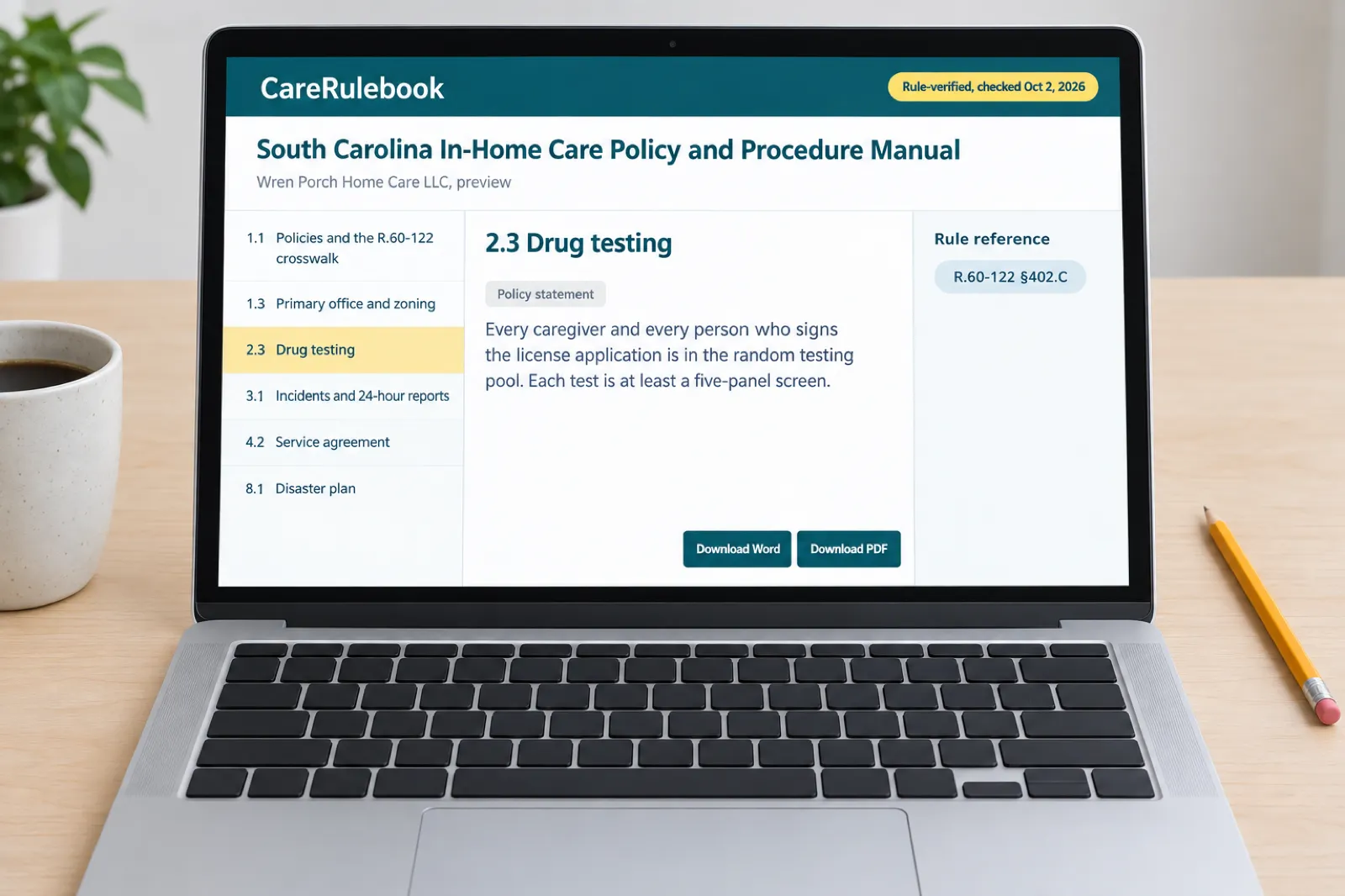
The CareRulebook South Carolina manual preview on a laptop: policy 2.3 on drug testing for a sample agency, citing R.60-122 §402.C, with six of the manual’s policies listed beside it

CareRulebook

Your South Carolina manual, in the rule’s section order

Answer a few questions and CareRulebook writes the South Carolina in-home care policies and forms for your agency, in your agency’s name, with each policy built on the rule it quotes, a crosswalk from every section of R.60-122 to its policy, and your random drug testing policy as its own file for DPH. Where the rule is silent, the policy says the process is your agency’s own. You choose whether to include Recommended practice. Read every policy before you adopt it.

  • 29 policies in 8 sections, 84 requirements mapped
  • For new applicants and agencies already licensed, with a May 22, 2026 checklist for the second
  • Non-medical throughout: no nurse required, medication reminders only
  • Editable Word and PDF when you pay; download again free for 12 months
Preview your manual

$199CareRulebook founding price for the first 50 South Carolina agencies, then $249. Not a DPH fee; DPH’s own license fees ($1,000 initial, $800 yearly renewal) are separate.

South Carolina policy myths, checked against the source

Is the drug testing policy the only written policy a South Carolina in-home care agency needs?

No. It is the only policy DPH’s application form asks you to send, with initial and renewal applications. But since May 22, 2026, R.60-122 §301 requires written policies and procedures addressing each section of the regulation on client care and operations, followed, available to staff at all times and reviewed at least every two years. The rest of the manual is checked at unannounced inspections, not sent in.

"Written policies and procedures addressing each section of this regulation regarding client care and operation of the provider shall be developed."

Do South Carolina home care policies have to be reviewed every year?

No. Not necessarily. The provider sets its own review period, which may not be more than two years, and every review is documented and signed by the administrator. A yearly review meets the rule; so does a two-year cycle. DPH’s form does ask for the drug testing policy with every yearly renewal, so many agencies check that one each year.

"The provider shall establish a time period for review, not to exceed two (2) years, of all policies and procedures, and such reviews shall be documented and signed by the administrator."

Does DPH review my whole policy manual before licensing?

It depends. Not as a set submission. Only the random drug testing policy goes in with the application (and again at each renewal). But DPH may not issue an initial license until you show substantial compliance with the standards, and inspections are unannounced, so the full manual should be in place before you apply. Ask DPH whether it inspects before the first license.

"A copy of your Random Drug Testing Policy"

My agency was licensed before May 2026. Do the new rules apply to me?

Yes. The rewritten R.60-122 applies to all in-home care providers from May 22, 2026, and the text has no transition period. Existing agencies need written policies for each section of the rule, a disaster plan given to clients, signed rights forms, service agreements, care services plans, the new incident reporting and a primary office in a commercially zoned or unzoned area (the zoning permit duty names the applicant; by our reading existing licensees should hold one too). DPH has not published guidance on how it will inspect existing agencies against the new rule.

"This regulation will apply to all in-home care providers in South Carolina."

Can caregivers give medication in South Carolina non-medical home care?

No. Care is strictly limited to non-medical tasks, and the only medication service the rule lists is medication reminders. The definitions of in-home care in the statute and in R.60-122 §102.J also include supervising self-administered medications. Neither says caregivers may administer medication, and skilled care needs a home health agency. Whether caregivers may set up doses or fill pill organizers is not addressed; by our reading they should not, and DPH can confirm.

"Care services provided by caregivers are strictly limited to non-medical tasks."

Do South Carolina in-home caregivers need a TB test?

No. Not under the 2026 rule. The old health assessment with TB screening and the annual TB risk assessment were replaced by a self-assessment that discloses communicable diseases, including tuberculosis, reviewed and signed before first client contact. DPH’s page still links the old TB risk assessment form, and Medicaid contracts may ask for more, so check with your payers.

"All staff members and caregivers who have contact with clients shall complete a self-assessment prior to initial client contact."

Frequently asked questions

Does South Carolina require written policies for in-home care?

Yes, since May 22, 2026. R.60-122 §301.A requires written policies and procedures addressing each section of the regulation on client care and the operation of the provider. The provider must follow them and keep them available to staff, in print or electronically, at all times. Section 301 is marked (II), so not meeting it is a Class II violation.

How often do policies have to be reviewed?

The provider sets its own review period, which may not be more than two years, and each review must be documented and signed by the administrator. A yearly review meets the rule as well as a two-year one.

Which policies do I send to DPH?

DPH’s application form 1307 asks for one: "A copy of your Random Drug Testing Policy", with initial and renewal applications, alongside your liability insurance and workers’ compensation coverage. The rule itself lists the random drug testing policies and procedures among the evidence for an initial application. The rest of your manual stays at your office, ready for unannounced inspections.

Does DPH have a policy checklist?

Not that we found. DPH’s in-home care page links the rule, two statutes, the application form, a TB risk assessment form and a 2015 memo, but no policy checklist. Our reading of "each section" is a policy for every numbered section that sets a duty on client care or operations, with a crosswalk showing which policy answers which section. Ask DPH (IHCP@dph.sc.gov) if you want its view.

What must the random drug testing policy say?

The rule says the policies "must address random drug testing and describe the procedure chosen", with a five-panel screen for cannabis, cocaine, amphetamines, opiates and phencyclidine as the minimum. By our reading, describing the procedure means saying who is in the pool (the application signers and every caregiver), how often draws happen, how many people are tested, how they are selected, who receives and reviews results, what records are kept and what happens after a positive test.

We were licensed before May 22, 2026. Do we need new policies?

Yes. The rewritten rule applies to all in-home care providers, with no transition period in its text. Before May 22, 2026 the only written policy the rule’s text required was random drug testing; now every section needs one. Existing agencies also need the new client paperwork, incident reporting, staff checks and a zoned primary office. Whether clients and staff who were already with you need the new paperwork is not stated; by our reading, the safe course is yes.

Can I use policy templates?

We found nothing in R.60-122 about templates. It requires policies addressing each section that the provider then follows, so whatever you start from has to describe what your agency actually does, under the rewritten R.60-122, and be reviewed and signed by your administrator.

Get South Carolina rule-change alerts

R.60-122 was rewritten from May 22, 2026, and DPH has published no guidance yet on applying it to agencies licensed before then. Leave your email and we will tell you when a South Carolina change affects your policies.

No spam. Only emails about South Carolina home care rule changes. How we use your email.

Keep reading

South Carolina

How to start a home care agency in South Carolina

The in-home care provider license, what changed on May 22, 2026 and how DPH licenses you.

Manual

Build your South Carolina policy manual

Every requirement on this page, written for your agency, with the drug testing policy for DPH.

South Carolina

South Carolina administrator and office

The administrator who signs policy reviews and plans of correction, the zoned primary office and the records it keeps.

South Carolina

South Carolina inspections and incidents

What DPH inspectors can ask for without notice, plans of correction and the Class II rating for missing policies.

South Carolina

South Carolina client paperwork

Service agreements, care services plans, visit notes, rights forms and the disaster plan, and what current clients need.

South Carolina

South Carolina license cost and timeline

DPH’s $1,000 fee, the late fee, the penalty schedule and each step to the license.

South Carolina

The South Carolina license application

DPH’s form 1307 and what goes with it, including the drug testing policy.

South Carolina

South Carolina caregiver training

The eight topics behind the training policy, before client contact and every year.

Tool

South Carolina license checklist

Every step to a DPH license, or to the 2026 rule if you are already licensed.

Kansas

Kansas home care policies and procedures

KDHE’s 13 folders, item by item.

Tennessee

Tennessee home care policies and procedures

The 17 items and 8 topics TDMHSAS reads at its desk audit.

Virginia

Virginia home care policies and procedures

The 12VAC5-381 policy topics, mapped.

Georgia

Georgia home care policies and procedures

The written policies DCH expects, mapped.

Texas

Texas home care policies and procedures

The same map for Chapter 558.

Trust

How we verify rules

Every quote checked against the official text.

Sources

  1. Regulation 60-122, Standards for Licensing In-Home Care Providers (Document No. 5407, State Register Vol. 50, Issue 5, effective May 22, 2026, with the errata in Vol. 50, Issue 6, June 26, 2026) · South Carolina Department of Public Health; South Carolina Legislative Council (State Register) · retrieved October 2, 2026
  2. Regulation 60-122 (formerly 61-122) as in force before May 22, 2026: the 2014 text (Doc. No. 4433), from the S.C. Code of Regulations, Chapter 60, and DHEC’s unofficial copy of R.61-122 · South Carolina Legislative Council (Code of Regulations); S.C. Department of Health and Environmental Control · retrieved October 2, 2026
  3. Document No. 5407, R.60-122 rewrite: notice of proposed regulation (State Register Vol. 49, Issue 9, September 26, 2025), final regulation (Vol. 50, Issue 5, May 22, 2026), errata (Vol. 50, Issue 6), with the 2024 and 2025 drafting notices and the pre-2026 text · South Carolina Legislative Council, State Register (Department of Public Health filings) · retrieved October 2, 2026
  4. S.C. Code 44-70-10 to 44-70-80, Licensure of In-Home Care Providers Act · South Carolina Legislative Services Agency · retrieved October 2, 2026
  5. In-Home Care Providers (regulations, forms, memos, map) · South Carolina Department of Public Health · retrieved October 2, 2026
  6. Licensure Application for In-Home Care Provider, form 1307-ENG-DPH (08/2026) · South Carolina Department of Public Health · retrieved October 2, 2026
  7. File a Complaint (health facility complaints) · South Carolina Department of Public Health · retrieved October 2, 2026
  8. Healthcare Quality Enforcement Actions (monthly reports, January 2025 to July 2026) · South Carolina Department of Public Health · retrieved October 2, 2026
  9. Find a Facility: In-Home Care Providers (licensed provider list behind DPH’s facility map, exported October 2, 2026) · South Carolina Department of Public Health · retrieved October 2, 2026
Build your South Carolina manualfrom $199