Skip to content
CareRulebook
MenuClose

Where are you starting?

United StatesTexas, North Carolina, Georgia, Virginia, Indiana, Ohio, New York, Illinois, Washington, Colorado, Tennessee, Maryland, Kansas, South Carolina, Nevada
TexasManual
North CarolinaManual
GeorgiaManual
VirginiaManual
IndianaManual
OhioGuideNew YorkGuide
IllinoisManual
WashingtonManual
ColoradoManual
TennesseeManual
MarylandManual
KansasManual
South CarolinaManual
NevadaManual
All US states →
United KingdomEngland
Free toolsChecklists, calculators and templates

South Carolina · Hiring · R.60-122 §402, §405; S.C. Code 44-7-2910

South Carolina caregiver background checks: residency, registries and the 2026 offense list

Every South Carolina in-home caregiver has a criminal record check before you employ them. Twelve months of verified South Carolina residency decides whether a state (SLED) check is enough or a federal fingerprint check through DPH follows. Since May 22, 2026, R.60-122 also names the two registries to search and lists the offenses that bar a caregiver, and a negative drug test comes before any caregiver work.

  • Rule-verified October 2, 2026
  • Quoted from R.60-122 and S.C. Code 44-7-2910 to 2950
  • And DPH’s background check page
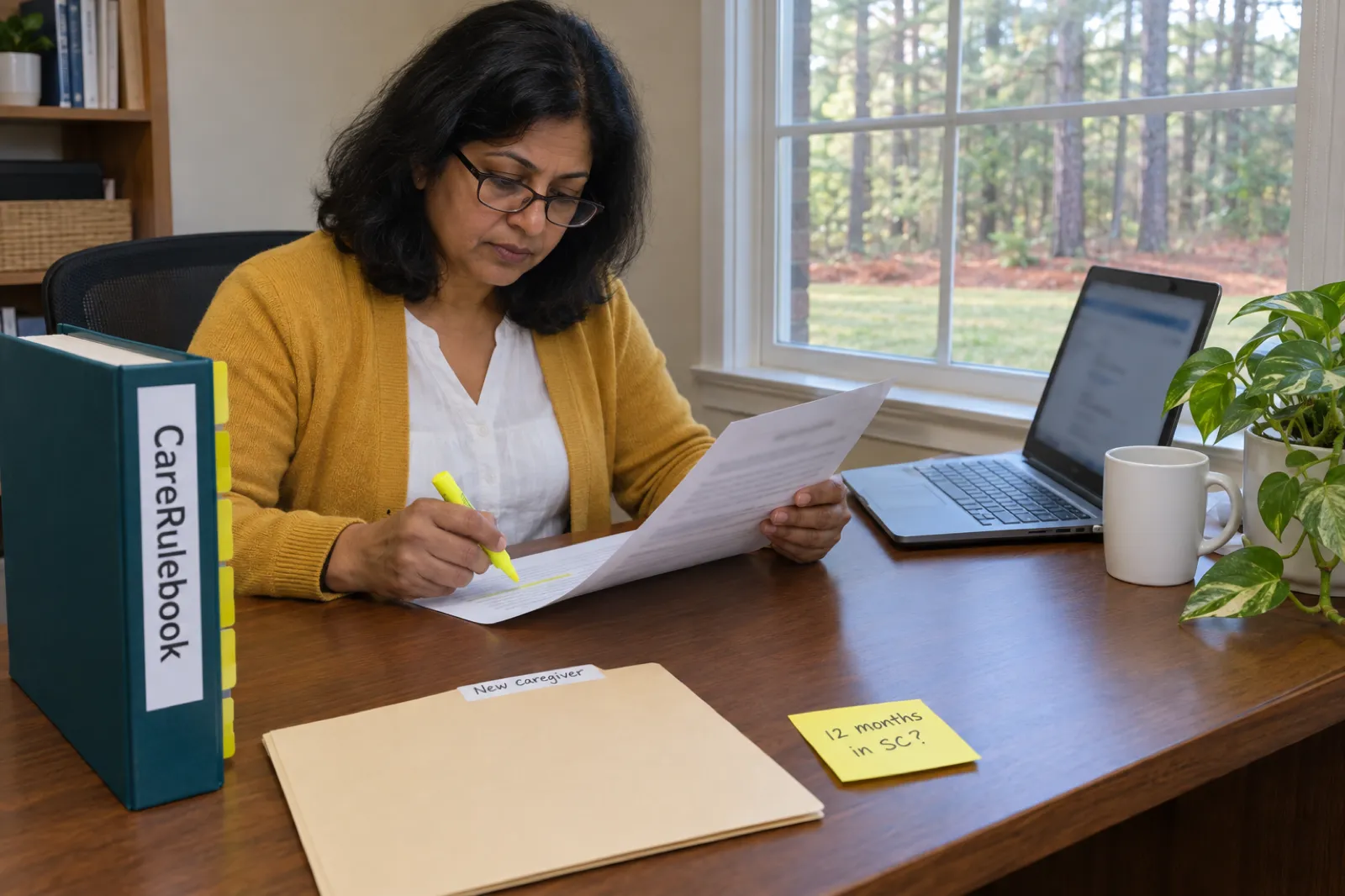
A woman with shoulder-length black hair and glasses, in a mustard cardigan, highlights a line on a printed page at a wooden desk, beside a CareRulebook binder, a manila folder labelled New caregiver, a sticky note reading 12 months in SC? and a laptop, with pine trees outside the window

Quick answer

"Before being employed as an in-home caregiver by a licensed in-home care provider, a person shall undergo a criminal background check as provided by S.C. Code Sections 44-70-60(B) and 44-7-2910." (R.60-122 §402.A). If the applicant verifies 12 months of South Carolina residency, a state check is enough; if not, you run a state check before employment and "commence a federal criminal record check after employment" (S.C. Code 44-7-2910(C)). Checks are run by SLED or a business using current SLED or FBI records (44-7-2920).

A caregiver must also not have adverse findings on the Sex Offender Registry or Nurse Aide Registry, and must not have convictions or no-contest pleas for the offenses in §405.G; both standards are Class I (R.60-122 §405.F-G). Since May 22, 2026, theft-type offenses bar a caregiver for ten years instead of for good, and child abuse is no longer on the caregiver list, though it still bars the people who sign the application (§103.G.1).

12 months

of verified South Carolina residency means a state check is enough

S.C. Code 44-7-2910(C)

2 registries

named by the rule: Sex Offender and Nurse Aide

R.60-122 §405.F

10 years

bar for theft-type offenses (new in 2026) and drug offenses

R.60-122 §405.G.1-2

30 days

most a pre-employment drug test may precede the job offer

R.60-122 §402.B

Who is checked

Every caregiver

In-home care providers are direct care entities, so each caregiver has a criminal record check before you employ or contract with them.

S.C. Code 44-7-2910(A)(1), (B)(1)(h); R.60-122 §402.A

Anyone who may meet clients

The check law’s "direct caregiver" includes unlicensed people who give physical help or care, and anyone employed by or under contract with you whose duties include the possibility of client contact. By our reading that can include an office scheduler who covers visits.

S.C. Code 44-7-2910(B)(2)

Workers from a staffing agency

An employment agency may not supply workers to you without a criminal record check on each one.

S.C. Code 44-7-2910(A)(2)

The people who sign the application

A separate check under R.60-122, with a different list of offenses. How it differs.

R.60-122 §103.G

Each new hire, step by step

The checks in the order a new caregiver meets them. Tick steps off as you go; progress is saved in this browser only.

  1. Take the application and proof of residency

    Application

    The applicant verifies where they lived for the 12 months before the date of the employment application. What counts as proof.

  2. Run the state criminal record check

    Before employment

    Through SLED, or a background check business that uses current SLED or FBI records. For applicants with 12 months of verified South Carolina residency, this is the whole criminal check. The ways to run it.

  3. Search the two registries

    Before employment (our timing)

    The Sex Offender Registry and the Nurse Aide Registry. A caregiver must not have adverse findings on either (Class I). The rule sets no timing; CareRulebook’s manual runs both before employment.

    R.60-122 §405.F
  4. Check the results against the barred offenses

    Before employment

    Forgery, larceny, embezzlement, false pretenses and cheats, or drug offenses, within ten years; abuse, neglect or exploitation of a vulnerable adult; any violent crime (Class I). The list.

    R.60-122 §405.G
  5. Get a negative 5-panel drug test

    Before employment

    Taken no earlier than 30 days before your job offer, and reviewed by a nurse, the administrator or human resources or hiring staff. No caregiver work until it is negative (Class I).

    R.60-122 §402.B
  6. Start the federal fingerprint check, if needed

    After employment

    For anyone without 12 months of verified South Carolina residency: commence a federal check after employment, through DPH. DPH’s steps.

  7. Finish training and the health self-assessment

    Before client contact

    Eight training topics and a signed self-assessment, both before client contact. Caregiver training.

    R.60-122 §404, §406
  8. File everything in the staff record

    As you go

    Criminal background checks and all drug test results are part of the staff record, and DPH’s eligibility determination goes in the caregiver’s file.

    R.60-122 §403; DPH

The 12-month residency rule

"A direct caregiver applicant shall provide verification of residency for the twelve months preceding the date of the employment application." (S.C. Code 44-7-2910(C)(1)). The statute names four kinds of proof of South Carolina residency: a South Carolina driver’s license or ID card; rent, mortgage or utility receipts in the applicant’s name for a home in South Carolina; "pay stubs in the applicant’s name from a business located in South Carolina"; or bank records in their name for an account at a South Carolina branch (44-7-2910(C)(1)(a)-(d)).

It does not say whether one document is enough or the evidence must cover the whole 12 months. By our reading the evidence should show South Carolina residency at the start of the period and at the application date, for example a South Carolina license issued at least a year before. That is how CareRulebook’s manual treats it, and it is on our list of questions for DPH.

The applicant hasThe checkSource
12 months of verified South Carolina residencyA state criminal record check before employment.44-7-2910(C)(1)
Not verified for the whole 12 monthsA state check before employment, and a federal check commenced after employment.44-7-2910(C)(2)
12 months of verified residency in another stateThe statute lets you run only a state check in that state instead. Section 44-7-2920 also says checks must use current SLED or FBI records; how the two fit is not settled.44-7-2910(C)(2)

Ways to run the state check

"Criminal record checks required pursuant to this article must be conducted by the State Law Enforcement Division or by a private business, organization, or association which conducts background checks" if that entity "utilizes current criminal records obtained from the State Law Enforcement Division or the Federal Bureau of Investigation" (S.C. Code 44-7-2920). In practice that gives two routes for the state check:

  • SLED CATCH. SLED’s online search of South Carolina criminal records. A SLED CATCH name-based South Carolina record check costs $25, plus an online service fee ($1.43 from July 1, 2026). These are SLED’s fees, not ours (SLED CATCH, Fees). "SLED CATCH is a name-based search only." It covers South Carolina records only, and SLED says a name-based result can differ from a fingerprint-based one, for example when someone has used an alias (CATCH, Search Expectations). "SLED CATCH does not check for persons registered as sex offenders." (CATCH, Registered Sex Offenders)
  • A background check company. Allowed if it uses current SLED or FBI records. Get the company’s confirmation of that in writing; its price is its own, not a state fee. By our reading a company report does not replace the registry searches either, unless it shows both registries by name.

Section 44-7-2920 also says "An applicant shall submit with the application one complete set of the applicant’s fingerprints on forms specified or furnished by the State Law Enforcement Division." (44-7-2920). DPH’s fingerprint instructions are written for "direct caregiver applicants who require a state and federal background check" (DPH, Background Checks for Direct Caregivers). By our reading, fingerprints are taken for the federal check only, as DPH’s page describes. That is not settled.

The federal fingerprint check through DPH

DPH acts as the channel for federal checks under the check law (S.C. Code 44-7-2940). DPH’s page sets out the steps:

  1. A valid relationship first. SLED requires one before the applicant is fingerprinted: "acceptable documentation includes an application for employment at the facility or proof of current employment at the facility" (SLED memo, August 23, 2023).
  2. Two notices. DPH says "the direct care entity shall provide the applicant with the following notices": the Noncriminal Justice Applicant’s Privacy Rights and the FBI Privacy Act Statement. Applicants are told they may challenge the accuracy or completeness of their record, out-of-state records with the FBI’s CJIS Division and South Carolina records with SLED at (803) 737-9000 (DPH, Important Information).
  3. The authorization form. You complete DPH’s Verification of Application and Authorization for Background Check form and email it to HQCBC@dph.sc.gov. Then "Healthcare Quality staff will provide the service code for undergoing the background check at an approved vendor." DPH names IdentoGO as an approved vendor (DPH, Important Information).
  4. The fee. For state and FBI fingerprint checks under 44-7-2910, DPH lists $30.25 per employee, paid directly to the fingerprint vendor. That is a state-listed fee, not ours (DPH FY2026 Fees and Fines Report). The statute says any FBI fee "must be paid by the individual direct caregiver or the direct care entity" (44-7-2920).
  5. The answer. DPH cannot send in-home care providers the record itself. "SLED has directed the Department to make an eligibility determination regarding caregivers for these direct care entities and provide such determination to the applicable direct care entity." Keep it in the caregiver’s file (DPH, Background Checks for Direct Caregivers).

The statute sets no deadline for commencing the federal check after employment. CareRulebook’s manual sends DPH’s form within five business days after the caregiver starts; that timing is the manual’s, not the law’s.

The two registries (Class I)

A caregiver must "not have adverse findings on the Sex Offender Registry or Nurse Aide Registry" (R.60-122 §405.F). The rule does not say when to search, which searches DPH accepts or what to keep as evidence.

  • Sex Offender Registry. A CATCH report does not check for registered sex offenders. SLED says the S.C. Sex Offender Registry, which covers people living or working in South Carolina convicted of sex offenses in any state, can be searched free of charge. (SLED CATCH, Registered Sex Offenders)
  • Nurse Aide Registry. SCDHHS’s Medicaid manual links the South Carolina CNA registry lookup at cna365.examroom.ai (SCDHHS, Personal Care scope, D.6). R.60-122 does not name a lookup.

CareRulebook’s manual searches both before employment, saves or prints each result page showing the name searched, the date and the result, and files it in the staff record. That is the manual’s method until DPH says which searches it accepts. Whether any listing on either registry is an "adverse finding" is not settled.

Offenses that bar a caregiver (Class I)

A caregiver must not have prior convictions or no-contest (nolo contendere) pleas to the offenses in §405.G, marked (I) (R.60-122 §405.G):

  1. "Criminal offenses involving forgery, larceny, embezzlement, false pretenses and cheats, as described in Title 16, Chapter 13 of the S.C. Code of Laws, within ten (10) years of providing in-home care to clients" (§405.G.1).
  2. "Criminal offenses involving drugs within ten (10) years of providing in-home care to clients" (§405.G.2).
  3. "Abuse, neglect, or exploitation of a vulnerable adult, as defined in the Omnibus Adult Protection Act, S.C. Code Ann. Sections 43-35-5, et seq." (§405.G.3).
  4. "Any violent crime, as defined in S.C. Code Ann. Section 16-1-60" (§405.G.4).

What counts as a violent crime

S.C. Code 16-1-60 lists the violent crimes. Among them: murder, criminal sexual conduct, kidnapping, armed robbery, first degree burglary, second degree burglary under 16-11-312(B), domestic violence of a high and aggravated nature and in the first degree, homicide by child abuse, inflicting great bodily injury upon a child, abuse or neglect of a vulnerable adult resulting in death or great bodily injury, and drug trafficking. Only the offenses it lists count. (S.C. Code 16-1-60). Two consequences, by our reading:

  • Some child abuse still bars a caregiver. Child abuse is no longer listed for caregivers, but homicide by child abuse and inflicting great bodily injury upon a child are violent crimes, so they bar a caregiver with no time limit (16-1-60).
  • Drug trafficking has no ten-year limit. Drug trafficking under 44-53-370(e), trafficking cocaine base, and manufacturing or trafficking methamphetamine are on the violent crime list. So those convictions bar a caregiver as violent crimes, whatever their age, while other drug offenses bar for ten years (16-1-60).

Caregivers and application signers side by side

The people who sign the license application have their own list in §103.G.1 (R.60-122 §103.G). The two lists differ.

Offense or findingCaregivers (§405.F-G)Application signers (§103.G.1)Source
Forgery, larceny, embezzlement, false pretenses and cheats (Title 16, Chapter 13)Barred within ten years of providing in-home careForgery, embezzlement or breach of trust with fraudulent intent: barred, no time limit statedR.60-122
Drug offensesBarred within ten years of providing in-home careAny other drug-related felony: barred, no time limit statedR.60-122
Abuse, neglect or exploitation of a vulnerable adultBarred, no time limit statedBarred, no time limit statedR.60-122
Any violent crime (S.C. Code 16-1-60)Barred, no time limit statedBarred, no time limit statedR.60-122
Unlawful conduct toward a child or cruelty to childrenNot listed (unless it is also a violent crime); the old rule barred child abuseBarred, no time limit statedR.60-122
Sex offender registrationNo adverse findings on the Sex Offender RegistryBarred if required to registerR.60-122
Nurse Aide RegistryNo adverse findingsNot listedR.60-122

What changed on May 22, 2026

The rewritten R.60-122 changed the caregiver list. Before May 22, 2026, the rule barred "crimes related to theft, abuse, neglect, or exploitation of a child or a vulnerable adult", with no time limit, and drug crimes for ten years (R.60-122, 2014 text). It said "The provider shall coordinate with appropriate abuse-related registries prior to the employment of staff" without naming any (2014 text). The check law in S.C. Code 44-7-2910 to 2950 did not change.

TopicBefore May 22, 2026Since May 22, 2026
Theft-type offensesCrimes related to theft barred, with no time limit 2014 textForgery, larceny, embezzlement, false pretenses and cheats barred within ten years R.60-122
Child abuseAbuse, neglect or exploitation of a child barred 2014 textNot listed for caregivers; still listed for the people who sign the application R.60-122
Vulnerable adultsBarred 2014 textBarred, as the Omnibus Adult Protection Act defines it R.60-122
Violent crimesNot listed as such 2014 textAny violent crime under S.C. Code 16-1-60 barred R.60-122
Drug offensesBarred within ten years 2014 textBarred within ten years (unchanged) R.60-122
Registries"Appropriate abuse-related registries", none named 2014 textThe Sex Offender Registry and the Nurse Aide Registry, named R.60-122

The pre-employment drug test also gained a 30-day window and set records for tests run in your office, and the people who sign the application now have a SLED check no older than 90 days with their own offense list (all the 2026 changes).

Deciding about a record

The list in §405.G is the floor, not the whole decision. "A direct care entity may consider all information revealed by a criminal record check as a factor in evaluating a direct caregiver’s application to be employed by or contract with the entity." (S.C. Code 44-7-2910(A)(1)). So you may decline someone whose record is not on the list, as long as your decision is consistent and lawful; the rule does not tell you how.

Three things the rule leaves open, each on our list of questions for DPH:

  • When the ten years start. The rule counts "within ten (10) years of providing in-home care to clients" but not from what: the conviction or plea, the offense, or the end of a sentence. CareRulebook’s manual counts from the conviction or plea.
  • Out-of-state and federal convictions. The theft-type bar refers to offenses "as described in Title 16, Chapter 13" of South Carolina law (§405.G.1). By our reading, a similar conviction elsewhere should be treated the same way; DPH has not said.
  • Telling the applicant. The rule is silent. DPH’s page says applicants may challenge their record with SLED or the FBI (DPH); CareRulebook’s manual tells them privately which record a decision rests on.

Drug tests: before hire and at random

  • Before hire (Class I). A five-panel urine, hair, saliva or blood screen for cannabis, cocaine, amphetamines, opiates and phencyclidine, reviewed by a nurse, the administrator or human resources or hiring staff. "Persons shall not be eligible for employment as a caregiver unless and until they have a negative test." "The test must not be taken earlier than thirty (30) days before the provider’s offer of employment as a caregiver to the person." A positive test bars employment unless a physician states it came from a prescribed medication (R.60-122 §402.B).
  • Random testing. "A licensed in-home provider and an individual employed as an in-home caregiver by a licensed in-home care provider are subject to random drug testing." (S.C. Code 44-70-70). The rule covers the people who signed the application and all caregivers, and lets you choose the method: "The provider’s policies and procedures must address random drug testing and describe the procedure chosen." (§402.C). A caregiver with a positive random test does no caregiving until a physician’s statement or a later negative test (§402.C).
  • Records. Keep the lab’s result, or for a test you run in your office: name, date, time and signature of the person tested and of the reviewer, the kit’s manufacturer and model, the date, time and result, and the kit’s lot number and expiration date (§402.B.1-5, C.1-5).
  • The policy DPH reads. The random drug testing policy is the one policy DPH asks for with the application: "A copy of your Random Drug Testing Policy", with both initial and renewal applications (Form 1307).

The rule sets no testing frequency or percentage for random tests. CareRulebook’s manual asks you to choose one and writes it into Policy 2.3, which also comes as its own file to attach to DPH’s form. What DPH receives, and when, is on the license application page; how the policy fits the rest of the manual is on South Carolina policies and procedures.

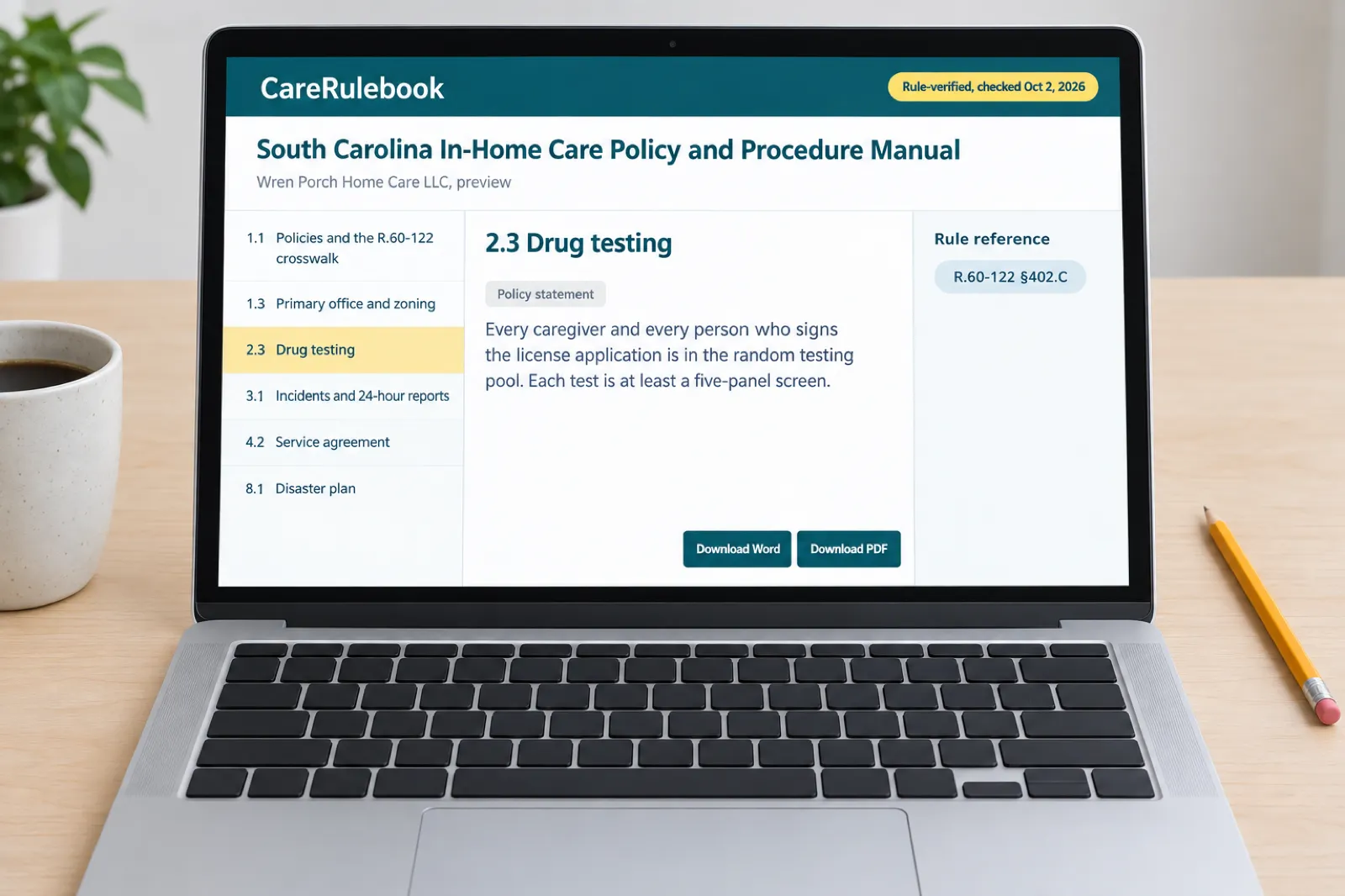
The CareRulebook South Carolina manual preview on a laptop: policy 2.3 on drug testing for a sample agency, citing R.60-122 §402.C, with six of the manual’s policies listed beside it

CareRulebook

Checks, registries and drug tests, written for your agency

CareRulebook’s South Carolina manual includes Policy 2.2 (Criminal background, residency and registry checks), with a residency verification checklist, a check and registry log and the fingerprint steps; Policy 2.3 (Drug testing: pre-employment and random), also as a separate file for DPH’s application form; and Policy 2.6 on the minimum qualifications and the §405.G decision.

  • 29 policies, 84 requirements mapped to R.60-122 and S.C. Code 44-70
  • Already licensed? What changed on May 22, 2026, and what to do for current caregivers
  • Editable Word and print-ready PDF, with the rule quoted under each policy
Preview your manual

$199CareRulebook founding price for the first 50 South Carolina agencies, then $249. Not a DPH fee.

Already licensed: your current caregivers

The 2026 rule applies to every provider from May 22, 2026, with no transition period (R.60-122 §101). Section 405 says what "A caregiver must" be, so by our reading it applies to caregivers you already employ, not only new hires:

  • No new criminal check is needed for someone who has stayed in direct care work: the check is not repeated while the person remains employed by or under contract with a direct care entity (S.C. Code 44-7-2920).
  • Re-read the results you hold against the 2026 list, especially for violent crimes, which the old rule did not list as such (§405.G.4).
  • Run both registry searches for any current caregiver without them on file, since the old rule named no registry (2014 text).

DPH has not published guidance on how it will inspect existing agencies against the new rule. More on the 2026 changes for existing agencies is on the South Carolina home care guide.

Records, renewal and fines

  • Staff records. "The provider shall maintain accurate information on all staff members including, but not limited to, current address, phone number, training, all drug test results, criminal background checks, and self-assessments." (R.60-122 §403). CareRulebook’s manual keeps them in Policy 2.4.
  • Another employer’s records. One direct care entity may give another the personnel records of current or former caregivers, including disciplinary matters and reasons for termination, and is presumed to act in good faith. The entity receiving them must still run its own criminal record check. (S.C. Code 44-7-2930)
  • Checked at renewal. "shall verify that a direct care entity is conducting criminal record checks as required in this article before the department issues a renewal license for the direct care entity" (S.C. Code 44-7-2940). The statute does not say how DPH verifies this.
  • Fines. Violating the direct caregiver check law brings a civil fine of $100 for the first violation and $500 for each later one, paid before the license is renewed. (S.C. Code 44-7-2950). Under R.60-122, §402.A carries no (I) or (II) mark, so by our reading a missed check is a Class III violation there, while §405.F-G are Class I (§205.D). Penalties run from $100 to $5,000 per violation (§205.F).

The people who sign the license application

Each person who signs the application needs a SLED name-based criminal record check no older than 90 days when DPH receives it. (R.60-122 §103.G). No license if a signer must register as a sex offender or has a conviction or plea for abuse, neglect or exploitation of a vulnerable adult, unlawful conduct toward or cruelty to children, any violent crime, any other drug-related felony, or forgery, embezzlement or breach of trust with fraudulent intent. Signers must report such convictions to DPH immediately. (§103.G.1-2). Each signer takes a 5-panel urine, hair, saliva or blood drug screen (cannabis, cocaine, amphetamines, opiates, phencyclidine) no earlier than 30 days before DPH receives the application, reviewed by an unrelated person. A positive test means denial unless a physician confirms a prescribed medication. (§103.H)

Signers stay subject to random drug testing (§402.C). A signer who may also have client contact needs the caregiver checks on this page too, by our reading of the "direct caregiver" definition (44-7-2910(B)(2)). The application itself, including when the signers’ checks go to DPH, is on the license application page, and the fees on South Carolina license cost and timeline.

What Medicaid adds

If you serve Medicaid waiver participants, SCDHHS’s scope of services (July 1, 2025) sets stricter screening than DPH’s license. These are SCDHHS’s rules for its contracts, not DPH’s.

CheckWhat SCDHHS asksSource
SLED checkBefore hire and at least every two years, for all employees, searching at least ten years and every state the worker lived in during that time.Personal Care scope, D.5
FeloniesA felony conviction in the last ten years bars work with SCDHHS/OIDD participants. An older non-violent felony is allowed only if the participant or responsible party is told and signs a statement agreeing, kept in the participant record.D.5
CNA registry and OIGBoth searched for all staff before hire and at least every two years, with a copy of each search results page in the personnel file.D.6-7

Not settled yet

Points the rule and statute leave open. Each is on our list of questions for DPH, and CareRulebook’s manual states its own reading until DPH answers:

  • Which Sex Offender Registry and Nurse Aide Registry searches DPH accepts, what evidence it wants on file, and whether any listing is an "adverse finding".
  • Whether DPH accepts another state’s own check for an applicant with 12 months of residency there, given that checks must use current SLED or FBI records (44-7-2920).
  • Whether the fingerprint sentence in 44-7-2920 applies to every caregiver applicant or only to those needing a federal check.
  • Whether a caregiver may have client contact before DPH’s eligibility determination arrives.
  • When the ten years in §405.G start, and how out-of-state convictions are treated.

Myths about South Carolina caregiver checks

Is a SLED CATCH report all the screening a South Carolina caregiver needs?

No. By our reading a CATCH report can be the state criminal record check for an applicant with 12 months of verified South Carolina residency. But CATCH covers South Carolina records only and does not check sex offender registration, so you still search the Sex Offender Registry and the Nurse Aide Registry (R.60-122 §405.F). Applicants without 12 months of verified South Carolina residency also need a federal fingerprint check started after employment, run through DPH. And every caregiver needs a negative drug test before hire.

"SLED CATCH does not check for persons registered as sex offenders."

Does an old theft conviction bar someone from in-home caregiving in South Carolina for life?

It depends. Usually not since May 22, 2026. R.60-122 now bars forgery, larceny, embezzlement, false pretenses and cheats offenses within ten years of providing in-home care. Before that date, crimes related to theft were barred with no time limit. Some offenses involving property are violent crimes under S.C. Code 16-1-60, such as armed robbery, first degree burglary and second degree burglary under 16-11-312(B), and those bar with no time limit. Your agency may also weigh everything a check shows, and Medicaid has its own ten-year felony rule.

"Criminal offenses involving forgery, larceny, embezzlement, false pretenses and cheats, as described in Title 16, Chapter 13 of the S.C. Code of Laws, within ten (10) years of providing in-home care to clients;"

Do South Carolina home care workers need FBI fingerprint checks?

It depends. Only if they cannot show 12 months of South Carolina residency. A state (SLED) check is enough for verified residents. Otherwise run a state check before employment and start a federal fingerprint check after, through DPH (HQCBC@dph.sc.gov) and IdentoGO; DPH sends you an eligibility determination, not the record. Every caregiver also needs registry checks and a negative drug test.

"shall conduct a state criminal record check on the applicant prior to employment and shall commence a federal criminal record check after employment"

Can a new caregiver start before the drug test result comes back?

No. A person is not eligible to work as a caregiver until they have a negative 5-panel test, taken no more than 30 days before the job offer. This is a Class I standard.

"Persons shall not be eligible for employment as a caregiver unless and until they have a negative test."

Frequently asked questions

Do South Carolina home care caregivers need FBI fingerprints?

Only when you cannot verify 12 months of South Carolina residency before the date of their employment application. Then you run a state check before employment and commence a federal fingerprint check after employment, through DPH (HQCBC@dph.sc.gov) and an approved vendor such as IdentoGO. DPH sends you an eligibility determination, not the record. With 12 months of verified South Carolina residency, a state check is enough.

Is a SLED CATCH report enough for a South Carolina caregiver?

By our reading it can be the state criminal record check for an applicant with 12 months of verified South Carolina residency, since the law accepts checks run by SLED. It does not cover the rest: CATCH searches South Carolina records only, by name, and does not check sex offender registration. You still search the Sex Offender Registry and the Nurse Aide Registry, and run the drug test.

What convictions disqualify a caregiver in South Carolina?

Under R.60-122 §405.G, a conviction or no-contest plea for forgery, larceny, embezzlement, false pretenses and cheats, or a drug offense, within ten years of providing in-home care; abuse, neglect or exploitation of a vulnerable adult; or any violent crime as defined in S.C. Code 16-1-60. Adverse findings on the Sex Offender Registry or the Nurse Aide Registry also bar a caregiver. All of these are Class I standards.

Can a caregiver with an old theft conviction work in South Carolina home care?

Since May 22, 2026, forgery, larceny, embezzlement, false pretenses and cheats offenses bar a caregiver for ten years, where the old rule barred crimes related to theft with no time limit. Armed robbery, first degree burglary and second degree burglary under 16-11-312(B) are violent crimes under 16-1-60, so those still bar with no time limit. The law also lets you weigh everything a check reveals, and the rule does not say when the ten years start.

How often do South Carolina caregivers need a new background check?

The check law says the check need not be repeated while the person stays in direct care work. It must be repeated before they resume if they have been out of direct care employment or contract for a year or more. R.60-122 sets no yearly re-check. Medicaid is different: SCDHHS requires a SLED check and CNA registry and OIG searches at least every two years.

Can a new caregiver start work while the FBI check is pending?

The statute lets employment start after the state check, with the federal check commenced afterwards. R.60-122 does not say whether the caregiver may have client contact before DPH’s eligibility determination arrives. CareRulebook’s manual allows it once every other step is complete, and takes the caregiver off client work the same day if DPH finds them not eligible. Ask DPH if you want certainty.

Who pays for a caregiver’s fingerprint check?

The statute says any FBI fee for the fingerprint review is paid by the caregiver or the agency. DPH’s fee report lists $30.25 per employee fingerprinted, paid directly to the vendor (a state-listed fee, not our price).

Get South Carolina rule-change alerts

The rewritten R.60-122 took effect on May 22, 2026, and we found no proposal to amend it since. DPH may still publish guidance on registries or fingerprint checks, or change its forms. Leave your email and we will tell you when a South Carolina change affects your hiring checks or your policies.

No spam. Only emails about South Carolina home care rule changes. How we use your email.

Keep reading

Sources

  1. Regulation 60-122, Standards for Licensing In-Home Care Providers (Document No. 5407, State Register Vol. 50, Issue 5, effective May 22, 2026, with the errata in Vol. 50, Issue 6, June 26, 2026) · South Carolina Department of Public Health; South Carolina Legislative Council (State Register) · retrieved October 2, 2026
  2. Regulation 60-122 (formerly 61-122) as in force before May 22, 2026: the 2014 text (Doc. No. 4433), from the S.C. Code of Regulations, Chapter 60, and DHEC’s unofficial copy of R.61-122 · South Carolina Legislative Council (Code of Regulations); S.C. Department of Health and Environmental Control · retrieved October 2, 2026
  3. S.C. Code 44-70-10 to 44-70-80, Licensure of In-Home Care Providers Act · South Carolina Legislative Services Agency · retrieved October 2, 2026
  4. S.C. Code 44-7-2910 to 44-7-2950, criminal record checks of direct caregivers · South Carolina Legislative Services Agency · retrieved October 2, 2026
  5. Licensure Application for In-Home Care Provider, form 1307-ENG-DPH (08/2026) · South Carolina Department of Public Health · retrieved October 2, 2026
  6. Background Checks for Direct Caregivers, with SLED’s August 23, 2023 memo on civil applicant fingerprint processing · South Carolina Department of Public Health · retrieved October 2, 2026
  7. FY2026 DPH Fees and Fines Report (Proviso 117.70), fee appendix · South Carolina Department of Public Health · retrieved October 2, 2026
  8. HCBS Provider Manual, Scope of Services for Personal Care, HASCI Agency Attendant Care and Respite (July 1, 2025) · South Carolina Department of Health and Human Services · retrieved October 2, 2026
  9. SLED CATCH (Citizens Access to Criminal Histories) · South Carolina Law Enforcement Division · retrieved October 2, 2026
  10. S.C. Code 16-1-60, violent crimes defined · South Carolina Legislative Services Agency · retrieved October 4, 2026
Build your South Carolina manualfrom $199