Skip to content
CareRulebook
MenuClose

Where are you starting?

United StatesTexas, North Carolina, Georgia, Virginia, Indiana, Ohio, Illinois, Washington, Colorado, Tennessee, Maryland, Kansas
TexasManual
North CarolinaManual
GeorgiaManual
VirginiaManual
IndianaManual
OhioGuide
IllinoisManual
WashingtonManual
ColoradoManual
TennesseeManual
MarylandManual
KansasGuideAll US states →
United KingdomEngland
Free toolsChecklists, calculators and templates

Maryland · Hiring · Health-General §§19-1901 to 19-1912

Maryland caregiver background checks: the criminal history check and the employer reference

Before a caregiver starts work at a Maryland Residential Service Agency, you apply for a State criminal history records check through CJIS, or ask a licensed private agency for a check covering every state they lived or worked in during the past 7 years, and you ask their most recent employer about any history of physical abuse. COMAR adds seven more screening steps, including an in-person interview and a skills demonstration before referral to clients.

  • Rule-verified October 2, 2026
  • Quoted from Health-General Title 19, Subtitle 19 and COMAR 10.07.05.10
  • And DPSCS’s rules in COMAR 12.15
A woman in a burgundy sweater slides a printed page into a manila folder labelled Background checks at a wooden desk, beside a CareRulebook binder, a blue mug, a closed laptop and two sticky notes reading Before work starts and 7 years, every state, with a brick sidewalk and an autumn tree outside the window

Quick answer

For criminal history checks, a residential service agency is an adult dependent care program (Health-General §19-1901(b)(6)). "Before an eligible employee may begin work for an adult dependent care program, each adult dependent care program shall, for each eligible employee": apply for a State criminal history records check or request a private agency background check, and request a reference from the potential employee’s most recent employer (§19-1902(a)). That reference request "shall, at a minimum, seek information about any history of physical abuse on the part of the potential employee" (§19-1902(b)).

The statute asks for the application before work begins; it does not say the results must be back first. COMAR’s screening list adds license and certification checks, health and TB screening, references, employment history, the I-9, identity, an in-person interview and a skills assessment and demonstration, the last two before referral to clients (COMAR 10.07.05.10B(1)). Neither the statute nor the RSA rules list offenses that bar someone from the work.

Before work

apply for the criminal check and request the employer reference

Health-General §19-1902(a)

7 years

of states a private agency check must cover

§19-1902(d)

$38

DPSCS’s State-only check, fingerprinted in person (a state fee)

DPSCS fee schedule

9 steps

of screening in COMAR, two of them before referral to clients

COMAR 10.07.05.10B(1)

Who is checked

Eligible employees

Anyone who works for pay for your agency, has routine, direct access to clients, and is not licensed or certified under the Health Occupations Article. Most aides who are not certified fall here. The statute leaves out people who only deliver or collect medical equipment.

Health-General §19-1901(h)

Contractors and contractual employees

COMAR’s screening policy covers every prospective employee, independent contractor and contractual employee who will serve clients. The statute says "works for" without mentioning contractors; by our reading, check them exactly as you check employees.

COMAR 10.07.05.10A

The statute and the rule read differently. The statute’s duty is for each "eligible employee", who "is not licensed or certified under the Health Occupations Article" (§19-1901(h)). COMAR’s screening applies to "a prospective employee, independent contractor, or contractual employee who will provide services to clients" (COMAR 10.07.05.10A), and its first screening step is the check "as required under Health-General Article, Title 19, Subtitle 19" (.10B(1)(a)). By our reading, the cautious course is to check everyone who will serve clients. The hub guide says the same.

Each new hire, step by step

The statute, COMAR and DPSCS’s duties in hiring order. Where a source sets no timing we say so. Tick steps off as you go; progress is saved in this browser only.

  1. Get a CJIS authorization number, if you will use the State check

    Before your first hire

    Complete DPSCS’s Application to Receive Criminal History Record Information for Employment or Licensing Purposes, choosing Adult Dependent Care. DPSCS charges no fee to become authorized. If you will use a private agency instead, choose one that meets the statute’s definition. The two routes.

  2. Interview in person

    Before referral

    An in-person interview is one of COMAR’s nine screening steps, and it comes before the person is referred to clients.

    COMAR 10.07.05.10B(1)(h)
  3. Apply for the criminal history check

    Before work begins

    State route: the worker signs the disclosure statement and has live scan fingerprints taken using your authorization number, and you submit them with the fee. Private route: you request the check covering every state the worker lived or worked in during the past 7 years. Either way, you pay.

  4. Request a reference from the most recent employer

    Before work begins

    The request must at least ask about any history of physical abuse. What to ask.

  5. Finish the other screening steps

    Before referral (our timing)

    License or certification verification, basic health screening including TB, references, employment history, Form I-9, and identity and work eligibility.

  6. Assess skills and watch a demonstration

    Before referral

    A skills assessment and demonstration is the ninth screening step, before client referral. How skills are shown.

    COMAR 10.07.05.10B(1)(i)
  7. Review the results and decide

    When results arrive

    Neither the statute nor the RSA rules list barring offenses, so the decision is yours. Keep the results confidential and secure. Deciding about a record.

  8. Watch for revised statements and answer the yearly list

    After hire

    On the State route, DPSCS sends a revised printed statement when a new Maryland record appears, and at least once a year asks you to confirm who still works for you, within 15 working days.

Two routes: the State check or a private agency

The statute gives you a choice: "Apply for a State criminal history records check" or request a private agency to conduct a background check (Health-General §19-1902(a)(1)). Both meet COMAR’s first screening step. Pick one, write it into your screening policy, and use it for everyone.

 State check through CJISPrivate agency checkSource
Who runs itDPSCS’s Central Repository, on your application under your authorization number.A private detective agency licensed in Maryland, with at least $1,000,000 of errors and omissions insurance, able to finish within 2 working days in Maryland and 5 outside it.DPSCS; §19-1901(j)
What it searchesThe criminal history record information held in the Central Repository.Each state where you know or have reason to know the worker worked or lived during the past 7 years.COMAR 12.15.03.02B(8); §19-1902(d)
FingerprintsYes. DPSCS says in-state employment checks use live scan; ink cards only for a bona fide medical reason. DPSCS may waive fingerprints after two failed attempts for a physical or medical reason.The statute defines it as a check of court and other records by a private agency, and sets no fingerprint step.DPSCS; §§19-1901(c), 19-1904(c)
State feeDPSCS: $38 for a State-only check fingerprinted in person, including its $20 service fee. Private fingerprinting providers may add their own fee. These are DPSCS’s fees, not ours.Set by the company you choose.DPSCS fee schedule
Who paysYour agency.Your agency.§19-1902(c)
Extra stepsThe worker completes and signs a sworn disclosure statement of any conviction or pending charge.You follow the federal Fair Credit Reporting Act, including a statement of your findings to the worker when adverse information precludes hiring them.§§19-1905, 19-1906(b)
The worker can contestYes: a hearing within 20 workdays unless waived, and a decision within 5 workdays.Yes: the worker has an opportunity to contest the findings.§§19-1906(a), 19-1908
After hireRevised printed statements when new Maryland records appear (State Rap Back).The statute provides no updates. By our reading, a private check is a snapshot on the day it is run.§19-1907(a)(2); COMAR 12.15.01.19

Which reaches further. By our reading, the State check searches Maryland’s Central Repository (COMAR 12.15.03.02B(8)), while a private check must cover each state of the last 7 years. For a worker who recently moved to Maryland, the private route reaches records the State check may not. The State route, in turn, keeps sending updates after hire. Whether DPSCS would add an FBI check for an RSA is not stated in what we saved; the statute asks for a State check.

The State check through CJIS

  1. Get authorized. DPSCS lists Adult Dependent Care among the services that complete its Application to Receive Criminal History Record Information for Employment or Licensing Purposes. "There is no fee required to become an authorized agency to receive criminal background information." (DPSCS, Background Checks)
  2. The worker’s part. "As part of the application process for a criminal history records check, an eligible employee shall complete and sign a disclosure statement." (§19-1905(a)) It is a sworn statement of any conviction, or any pending charge without a final disposition. The worker then has fingerprints taken at a designated law enforcement agency or approved provider, showing valid photo ID (COMAR 12.15.03.03C). DPSCS says: "If you are requesting a background check for employment or licensing purposes you must provide the agency’s name and authorization number." (DPSCS, Fingerprinting Services)
  3. Your part. "The adult dependent care program shall submit the fingerprints, disclosure statement, and payment for the costs of the criminal history records check." (§19-1904(b)) The Central Repository charges $38 for a State-only check with in-person fingerprinting, including its $20 service fee, or $18 by mail-in fingerprint card. DPSCS says in-state employment checks must use live scan fingerprinting, with ink cards only for a bona fide medical reason, and private fingerprinting providers may add their own service fee. These are DPSCS fees. (DPSCS fee schedule)
  4. The receipt. DPSCS, or its designee, mails an acknowledged receipt of the application to the agency and the worker within 3 days of receiving it. (§19-1905(b)) The Central Repository then issues a printed statement of the worker’s State record to the agency and the worker (§19-1907(b)). DPSCS publishes no processing time for live scan employment checks (DPSCS).
  5. If fingerprints cannot be taken. DPSCS may waive the fingerprints if the worker has tried at least twice, a physical or medical condition of the fingers or hands makes a legible set impossible, and the worker sends documentation and the other information the check needs. (§19-1904(c))

DPSCS’s rule also covers people who are not eligible employees: "An adult dependent care program shall decide if and when to submit an application for a printed statement for another individual." (COMAR 12.15.03.03B(2)) That includes volunteers, but not people licensed or certified under the Health Occupations Article (.02B(14)); more on that below.

A private agency check

  • Which companies qualify. A private agency must be licensed as a private detective agency in Maryland, carry errors and omissions insurance of at least $1,000,000, offer customer help with employment checks, and be able to finish a check within 2 working days in Maryland and 5 working days outside it. (Health-General §19-1901(j)) Ask for a copy of the company’s Maryland license and its insurance certificate before your first order.
  • Every state, 7 years. "The private agency shall conduct a background check in each state in which the adult dependent care program knows or has reason to know the eligible employee worked or resided during the past 7 years" (§19-1902(d)). Your application form should ask every applicant where they have lived and worked in that time, so you know which states to name.
  • The Fair Credit Reporting Act. "The adult dependent care program shall comply with the federal Fair Credit Reporting Act", including a statement of your findings to the worker when adverse information precludes hiring them (§19-1906(b)). Which federal notice steps apply to your hiring is a question for an employment lawyer.
  • The worker’s copy. The private agency gives a statement of its findings to the agency and, on request, to the worker, and the worker has an opportunity to contest them. (§19-1906(a))

DPSCS’s adult dependent care rule does not apply to private agency checks (COMAR 12.15.03.01B), so nothing in it limits who a private check may cover. The statute’s confidentiality rules still apply to the results (below).

The reference from the most recent employer

Before an eligible employee begins work, you "request a reference from the potential employee’s most recent employer" (§19-1902(a)(2)), and the request "shall, at a minimum, seek information about any history of physical abuse on the part of the potential employee" (§19-1902(b)). Ask the question in writing, in plain words, and keep a copy of the request with the date sent.

  • The law protects the employer who answers. An employer that gives a reference under the statute in good faith is not liable for disclosing information about job performance or the reason employment ended. Good faith is presumed unless actual malice or knowingly or recklessly false information is shown by clear and convincing evidence. (§19-1911) Saying so in your request may help a former employer reply. The same protection covers your agency when another agency asks you about a former worker.
  • If no reply comes. The statute requires you to request the reference; it does not say what happens if the employer never answers. By our reading, record each attempt and verify another work reference instead, as CareRulebook’s manual does.
  • COMAR’s wider steps. Screening also includes verification of references and of employment history (COMAR 10.07.05.10B(1)(d)-(e)). Neither sets a number of references or years; the manual asks for two references and verifies the history the applicant gives.
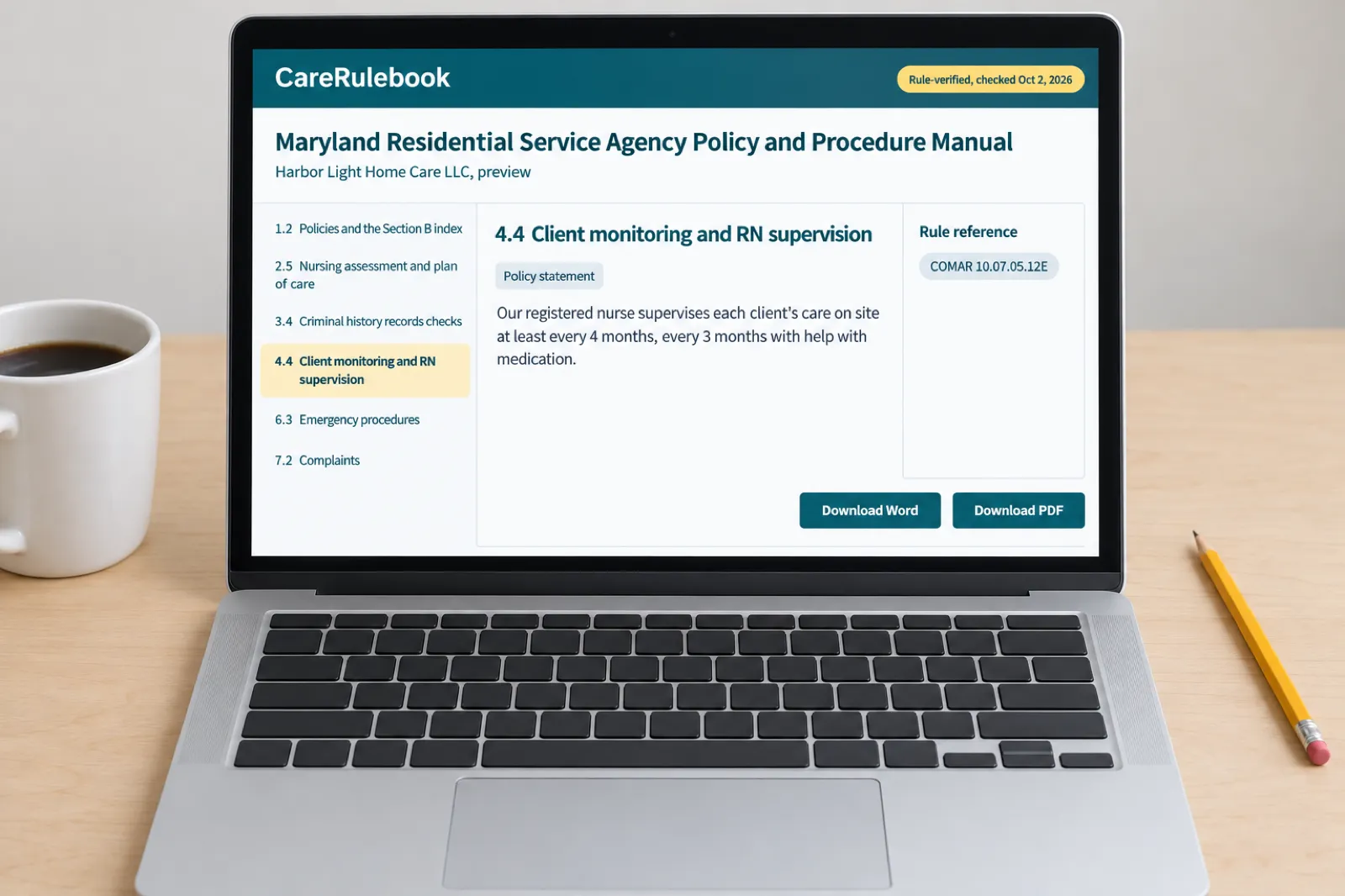
The CareRulebook Maryland manual preview on a laptop: policy 4.4 on client monitoring and RN supervision for a sample agency, citing COMAR 10.07.05.12E, with the manual’s contents listed beside it

CareRulebook

Hiring checks written for your agency

CareRulebook’s Maryland manual includes Policy 3.4 (Screening and criminal history records checks): your choice of CJIS or a licensed private agency, whether to wait for results before referral, whether to check certified staff, the nine COMAR steps as a screening checklist, a reference request that asks about physical abuse, a criminal record assessment record and a background check log. Policy 3.6 covers certification checks and Policy 3.2 the skills demonstration.

  • 33 policies, 102 requirements mapped to COMAR 10.07.05 and Health-General Title 19
  • The 23 COMAR 10.07.05.08B items in the order OHCQ’s application lists them, with a Section B index
  • Editable Word and print-ready PDF, with the rule quoted under each policy
Preview your manual

$199CareRulebook founding price for the first 50 Maryland agencies, then $249. Not an OHCQ fee.

Deciding about a criminal record

The statute tells you how to check, not whom to turn away. We found no list of barring offenses in Health-General Title 19, Subtitle 19, in DPSCS’s rule or in COMAR 10.07.05 (§19-1902; COMAR 10.07.05.10). The decision is yours, and it should be made the same way every time.

  • An honest disclosure matters. A worker who fails to disclose a conviction or pending charge on the disclosure statement is guilty of perjury. (§19-1909(a))
  • The worker’s side. A worker may contest a conviction or pending charge in a printed statement. A hearing is held within 20 workdays unless the worker waives it, and the decision follows within 5 workdays. (§19-1908) Private agency findings can be contested too (§19-1906(a)).
  • Drug and alcohol tests. An agency may also require an alcohol or controlled dangerous substance test of a potential employee; the test must follow Health-General §17-214. (§19-1903) They are optional.

CareRulebook’s manual does not invent a list. The person who runs the agency reviews every result personally and weighs the nature and seriousness of the offense (with particular attention to violence, sexual offenses, abuse or neglect, theft, fraud, exploitation and drug offenses), how it relates to the job, how long ago it was, what the person says about it and, for a pending charge, whether to wait for the outcome before any client contact. Before deciding not to hire, the person is told which record is the concern and given a chance to explain. These are the manual’s own steps (Policy 3.4), not OHCQ’s. Our suggestion: take employment law advice before withdrawing an offer because of a record.

After hire: revised statements and the yearly list

The statute and the RSA rules set no fixed re-check. On the State route, the record keeps watch for you:

  • Revised statements. "The Department shall update an initial criminal history records check and issue a revised printed statement, listing any of the convictions or pending charges occurring in the State after the date of the initial criminal history records check" (§19-1907(a)(2)).
  • What brings one. Under DPSCS’s State Rap Back rule, the Central Repository sends a revised printed statement to the employer and the worker when an arrest, an arrest warrant, a charging document, a conviction, a verdict of not criminally responsible or probation before judgment is added to the worker’s record. (COMAR 12.15.01.19A) Review each one as soon as it arrives, the same way you reviewed the first result.
  • The yearly list. At least once a year the Central Repository sends each enrolled employer a list of its previously processed individuals. The employer deletes anyone who no longer works for it and may not return, and sends the list back within 15 working days; revised statements stop for anyone deleted. (COMAR 12.15.01.19B) By our reading, keeping a worker who may return on the list is what lets them come back without new fingerprints (COMAR 12.15.03.03D(1)).
  • Certified staff. If you learn of conduct by a caregiver you provided or referred that may be grounds for Board of Nursing action, "the agency shall report the action or condition to the Board of Nursing and the Office of Health Care Quality immediately when the action or condition is known by the agency" (COMAR 10.07.05.10F).

A private agency check has no follow-up in the statute. If you use one, decide in your policy whether and when you re-check; the rules leave that to you.

What you may and may not pass on

"Information obtained from the Department or a private agency under this subtitle shall be confidential" and may be shared only with the worker who is its subject and the program seeking to hire them. It "may not: (1) Be used for any purpose other than that for which it was disseminated; or (2) Be redisseminated." And "Information obtained from the Department or a private agency under this subtitle shall be maintained in a manner to insure the security of the information" (§19-1907(c)-(e)). DPSCS’s rule adds that the results "may only be disseminated to" the person checked and the program involved in hiring, kept so only authorized people can see them (COMAR 12.15.03.08).

You may

  • Use the result to decide whether to hire, and show it to the worker it is about.
  • Record in your log that a check was applied for, the date the result came, and your clearance decision.
  • When another licensed agency subcontracts staff to you, receive its evidence that it verified the screening (COMAR 10.07.05.10H).
  • Give a reference about a former worker in good faith (§19-1911).

You may not

  • Hand a printed statement to another agency, even one the worker is moving to; they apply for their own (COMAR 12.15.03.03D(2)).
  • Tell a client, a family or a referral source what a record says.
  • Use the result for anything other than the hiring decision.
  • Leave results in an open file or a shared drive.

The lists are our reading of the confidentiality sections above. By our reading, the evidence a subcontracting agency sends under COMAR 10.07.05.10H is a statement that each step was done, not the records themselves. Whether OHCQ surveyors expect to see printed statements at an inspection is not stated; it is on our list of questions for OHCQ. How surveys run is on Maryland RSA inspections. Screening records are kept at your business office (COMAR 10.07.05.10C), so keep the criminal history section of each file separate and locked.

Nurses, certified nursing assistants and medication technicians

This is the least settled part of Maryland’s hiring checks. The sources point in different directions:

  • The statute leaves them out. An eligible employee is someone "who is not licensed or certified under the Health Occupations Article" (§19-1901(h)).
  • COMAR’s screening covers them. The screening policy applies to everyone who will serve clients (COMAR 10.07.05.10A).
  • DPSCS’s rule leaves them out too. DPSCS’s adult dependent care rule covers eligible employees and "other individuals", such as volunteers, whom a program chooses to check. Its definition of other individual excludes anyone licensed or certified under the Health Occupations Article. The rule does not apply to private agency checks. (COMAR 12.15.03.01B, .02B(14)) By our reading, CJIS may not process an adult dependent care check for them under your authorization.
  • The statute allows other checks. "Nothing in this subtitle may be construed to prevent an adult dependent care program from obtaining a criminal history records check or background check on any other individual applying for a job or volunteering services in the program" (§19-1912). By our reading, a private agency check is open to you for licensed and certified staff.
  • Medicaid personal assistance providers check nurses. A Community First Choice provider must "conduct a criminal history records check on all direct service workers including nurses", using the State check procedure (COMAR 10.09.84.06A(11)). How that fits DPSCS’s definitions is not explained in what we saved.
  • The Board checks nursing assistants itself. An applicant for nursing assistant certification submits to a criminal history records check, State and FBI, for the Board of Nursing. That check is part of the Board’s certification; the rule does not send its results to employers. (COMAR 10.39.01.04A(2)) The Board has also proposed criminal history checks for every profession it regulates, including medication technicians, and put them in place as emergency rules from August 25, 2026 while the proposal is pending (Maryland Register 53:18, 26-127-P). That changes the Board’s certification process, not the RSA rules.

What to do for them

  1. Verify the license or certificate before referral (COMAR 10.07.05.10B(1)(b)). The Board of Nursing says primary source verification of a nursing assistant’s certification is the "Look Up A License" feature on its website, updated daily, and warns that paper licenses and certificates are easy to forge. (Board of Nursing) Print or save the dated result.
  2. Search the Board’s abuse registry for nursing assistants. The Board of Nursing publishes a "CNA-I (formerly GNA) Abuse Registry" listing nursing assistants with findings, with their certificate number, date of finding and offense; the copy we saw was updated September 28, 2026. The RSA rules do not require checking it. (Board of Nursing) Our suggestion only.
  3. Decide on a criminal check and write the decision into your policy. By our reading the cautious course is a check for everyone, by CJIS where it will process one and by a licensed private agency where it will not. CareRulebook’s manual lets you choose, and says what it does if OHCQ expects otherwise.

Whether CJIS will process these checks, and which check OHCQ expects to see for certified staff, are on our list of questions for OHCQ. More on certification levels is on Maryland caregiver training.

The nine COMAR screening steps

"Screening shall include" nine items (COMAR 10.07.05.10B(1)). OHCQ’s FY 2018 list of most cited RSA rules was led by .10, this screening regulation (OHCQ slides, 2020, slide 21). That list is old, but it shows where surveyors have looked.

ItemScreening includesNote
.10B(1)(a)State criminal history records check or private agency background check, as Title 19, Subtitle 19 requiresThis page
.10B(1)(b)Verification of current professional licensure or certificationNurses, CNAs and medication technicians
.10B(1)(c)A basic health screening, including tuberculosis screeningAlso a written policy item (.08B(1)(b)(iii))
.10B(1)(d)Verification of referencesThe employer reference
.10B(1)(e)Verification of employment historyThe rule sets no number of years
.10B(1)(f)Completion of I-9 forms for employmentA federal form for employees
.10B(1)(g)Verification of identity and employment eligibilityFor contractors too
.10B(1)(h)An in-person interview before the person is referred to clientsBefore referral
.10B(1)(i)A skills assessment and demonstration before client referralCaregiver training

Records. "An agency shall maintain records of information described in §B of this regulation for each employee, independent contractor, or contractual employee and retain the information in the agency’s business office." (COMAR 10.07.05.10C) Health requirements for staff are also one of the 23 written policy items (.08B(1)(b)(iii)); the full list is on Maryland RSA policies and procedures.

Timing. COMAR puts only the interview and the skills demonstration expressly before referral. The rule gives no timing for the other steps; CareRulebook’s manual completes them all before a person’s first client visit, apart from the criminal history results if you choose not to wait for them.

Myths about Maryland hiring checks

Must a Maryland RSA wait for criminal history results before a new caregiver starts?

It depends. The statute requires the agency to apply for the State check (or request a private check) and to request a reference from the most recent employer before the worker begins work. It does not say the results must be back first. COMAR adds an in-person interview and a skills assessment and demonstration before referral to clients. By our reading, waiting for the results before any client visit is the safer course; CareRulebook’s manual lets you choose either way and writes the choice into your policy.

"Before an eligible employee may begin work for an adult dependent care program, each adult dependent care program shall, for each eligible employee:"

Do nurses and CNAs at a Maryland RSA need a criminal background check?

It depends. The statute’s check before work covers "eligible employees", who by definition are not licensed or certified under the Health Occupations Article, so it does not reach nurses, nursing assistants or medication technicians. But COMAR’s screening list applies to everyone who will serve clients, and Medicaid’s Community First Choice program requires checks on all direct service workers, including nurses. DPSCS’s rule leaves licensed and certified staff out of the people CJIS checks for an adult dependent care program. By our reading, the cautious course is a check for everyone, with a private agency check where CJIS will not process one. Ask OHCQ which it expects.

"Who is not licensed or certified under the Health Occupations Article."

Can my Maryland RSA use independent contractor caregivers?

It depends. The RSA rules allow independent contractors, but the Attorney General’s guidance says hourly personal care aides are usually employees under Maryland wage, sick leave and unemployment law, Medicaid pays for personal assistance only when the aide is an employee, and every RSA certifies that it has read that guidance. Get employment advice before using contractors.

"This chapter does not preclude an agency from operating with independent contractors."

Do my caregivers in Maryland have to be certified nursing assistants?

It depends. Not always. The default is a certified caregiver for clients who need ADL help or medication administration. By our reading of COMAR 10.07.05.10D, an uncertified aide may serve a client who needs no ADL help, a client whose supervising nurse judges there are no predictable adverse health consequences, or a cognitively capable adult who signs a waiver of skilled services. Ask OHCQ how it expects the nurse’s judgment to be recorded. Staff who administer medication must be licensed or certified unless the client has signed an informed consent form under COMAR 10.07.05.12D.

"An agency may not knowingly provide or refer a caregiver who is not certified to provide services to a client unless the client:"

Frequently asked questions

Do Maryland home care agencies have to fingerprint caregivers?

Not always. Before an eligible employee starts work, the agency either applies for a State criminal history records check through the CJIS Central Repository, which uses live scan fingerprints, or asks a licensed private agency to run a background check covering every state the worker lived or worked in during the past 7 years, for which the statute sets no fingerprint step. A State-only check fingerprinted in person costs $38 at DPSCS; that is a state fee, not a CareRulebook price.

Can a new caregiver start before the background check comes back in Maryland?

The statute requires the agency to apply for the check, and to request a reference from the most recent employer, before the worker begins work. It does not say the results must be back first. COMAR adds an in-person interview and a skills demonstration before referral to clients. By our reading, waiting for the results before any client visit is the safer course, and CareRulebook’s manual lets you choose either way.

What criminal convictions disqualify a caregiver in Maryland?

Neither Health-General Title 19, Subtitle 19 nor the RSA rules (COMAR 10.07.05) list offenses that bar someone from working for a residential service agency. The hiring decision is the agency’s. Write down the factors you weigh so every decision is made the same way, and take employment law advice before withdrawing an offer because of a record.

Can I use the background check a caregiver had at another agency?

No. DPSCS’s rule requires a new application, fingerprints and fees when a previously checked person goes to work for a program they have not worked for before, and results may not be passed on to anyone except the person checked and the hiring program. A worker who returns to your own agency does not need new fingerprints if you kept them on the Central Repository’s list.

Do I have to re-run background checks on Maryland caregivers?

The statute and the RSA rules set no fixed re-check. On the State route, DPSCS updates the check and sends you a revised printed statement when a new Maryland arrest, charge or conviction is added, and at least once a year sends a list of your previously processed workers to confirm within 15 working days. A private agency check has no such updates.

Is there an abuse registry check for Maryland home care workers?

The RSA rules and the criminal history statute name none. The Board of Nursing publishes a CNA-I (formerly GNA) Abuse Registry of nursing assistants with findings, and its Look Up a License feature shows a certificate’s current status. By our reading, checking both for every nursing assistant you hire is a sensible extra step; it is not a rule requirement.

Who pays for a caregiver’s criminal background check in Maryland?

The agency. The statute says the adult dependent care program shall pay for each eligible employee’s State check or private agency check. By our reading, that means you cannot charge the applicant for it.

Get Maryland rule-change alerts

The Board of Nursing has proposed criminal history checks for all its certificate holders (26-127-P, comments by October 5, 2026; in force as emergency rules since August 25, 2026), and OHCQ has signalled a 2026 update to the RSA training rules. Leave your email and we will tell you when a Maryland change affects your hiring checks or your policies.

No spam. Only emails about Maryland home care rule changes. How we use your email.

Keep reading

Sources

  1. COMAR 10.07.05, Residential Service Agencies (Regulations .01 to .28; last amended effective March 13, 2017) · Maryland Division of State Documents, Library of Maryland Regulations (Maryland Department of Health rules) · retrieved October 2, 2026
  2. Health-General Article, §§19-1901 to 19-1912 (criminal history records checks for adult dependent care programs) · Maryland General Assembly · retrieved October 2, 2026
  3. COMAR 10.09.84, Community First Choice (Medicaid; provider conditions for personal assistance) · Maryland Division of State Documents, Library of Maryland Regulations · retrieved October 2, 2026
  4. COMAR 12.15.03, Criminal History Records Check for Individuals Who Work for an Adult Dependent Care Program · Maryland Division of State Documents, Library of Maryland Regulations (DPSCS rules) · retrieved October 2, 2026
  5. COMAR 10.39.01, Certified Nursing Assistants (revised effective June 8, 2026) · Maryland Division of State Documents, Library of Maryland Regulations · retrieved October 2, 2026
  6. Maryland Register 53:18 (September 4, 2026), Notice of Proposed Action 26-127-P: Board of Nursing criminal history records checks (COMAR 10.39.01, 10.39.04 and others) · Maryland Division of State Documents; Maryland Board of Nursing · retrieved October 2, 2026
  7. Residential Service Agencies: Initial License Process (OHCQ slides, 2020; Internet Archive copy of May 12, 2021) · Maryland Department of Health, Office of Health Care Quality · retrieved October 2, 2026
  8. Background Checks and Fingerprinting Services (Criminal Justice Information System Central Repository fees) · Maryland Department of Public Safety and Correctional Services · retrieved October 2, 2026
  9. COMAR 12.15.01.19, Issuance of a Revised Printed Statement (State Rap Back Program) · Maryland Division of State Documents, Library of Maryland Regulations (DPSCS rules) · retrieved October 2, 2026
  10. Nursing Assistant Certification (certification verification and Look Up a License) · Maryland Board of Nursing · retrieved October 2, 2026
  11. CNA-I (formerly GNA) Abuse Registry (updated September 28, 2026) · Maryland Board of Nursing · retrieved October 2, 2026
Build your Maryland manualfrom $199