Skip to content
CareRulebook
MenuClose

Where are you starting?

United StatesTexas, North Carolina, Georgia, Virginia, Indiana, Ohio, Illinois, Washington, Colorado, Tennessee, Maryland
TexasManual
North CarolinaManual
GeorgiaManual
VirginiaManual
IndianaManual
OhioGuide
IllinoisManual
WashingtonManual
ColoradoManual
TennesseeManual
MarylandGuideAll US states →
United KingdomEngland
Free toolsChecklists, calculators and templates

Colorado · Office and premises · 6 CCR 1011-1 Ch. 26, 5.1, 5.2, 7.1(C)(7); Ch. 2

Your Colorado home care office, zoning and records

A Colorado Class B home care agency needs a fixed office in the state, with a zoning sign-off before CDPHE issues the license. Here is what the rules ask of that office, what CDPHE’s checklist says about an office in a home or apartment, what to post, how fast records must reach a surveyor, how long to keep them, how branches and workstations work, and what happens when you move or have no clients.

  • Rule-verified October 2, 2026
  • Quoted from 6 CCR 1011-1 Chapters 26 and 2
  • And CDPHE’s checklist, zoning form and fees
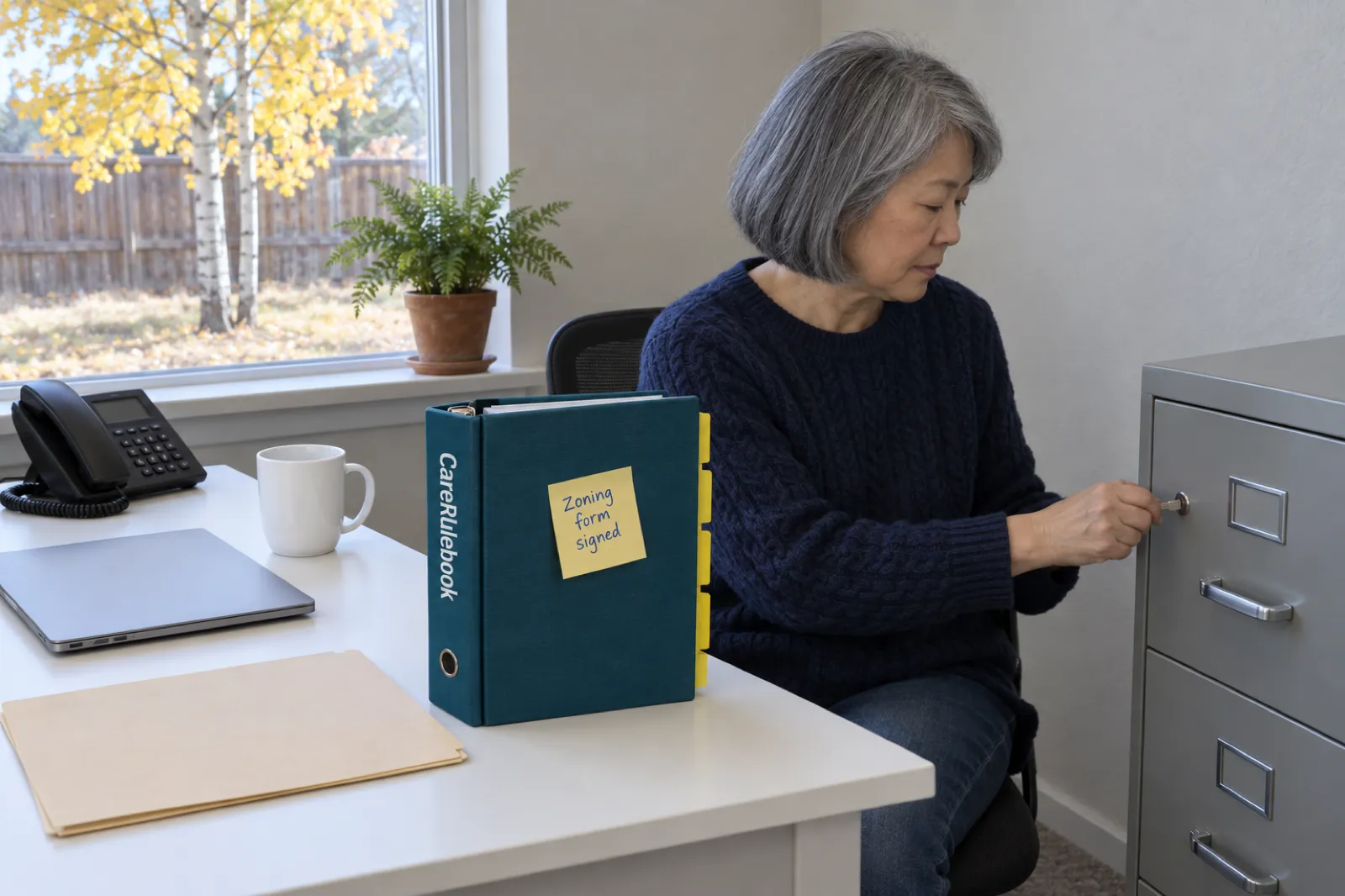
A woman with a grey bob in a navy cable-knit sweater turns a key in a grey metal filing cabinet beside a white desk with a CareRulebook binder carrying a sticky note reading Zoning form signed, a closed laptop and a desk phone, with yellow aspen leaves outside the window

Quick answer

Chapter 26 says "Every HCA providing services within the state shall have a physical business office capable of conducting day-to-day business as an HCA within Colorado" (Ch. 26, 5.1), and the governing body or designee must "provide and maintain a fixed office location that provides for consumer confidentiality and a safe working environment" (7.1(C)(7)).

A home or apartment office. CDPHE’s checklist says: "If the office location is in a residential home or apartment, please ensure the lease agreement does not include language that strictly prohibits the lessee from running a business from that leased space." "Landlord approval will be required if a residential lease explicitly states that no business can be operated from the space, no signage can be hung, and no clients can visit the property." (CDPHE checklist, Lease Agreement). Separately, your city or county must sign CDPHE’s zoning form: "Written evidence of compliance with local zoning codes must be obtained prior to issuance of a state license" (CDPHE zoning form). By our reading CDPHE does not rule out a home office on those terms; no source we found says one is approved as such.

Post your license, a complaints notice naming the agency, CDPHE and the DORA oversight board, and a records-access statement. Records must start reaching a surveyor within 30 minutes of a request (Ch. 26, 4.6(A)(1)(b)), and consumer records are kept five years after discharge (5.15(D)).

Branches and workstations each carry CDPHE fees. Moving needs 30 days’ notice, and a time with zero clients counts as a temporary closure that CDPHE must be told about (Ch. 2, 2.14.4(A)).
What the rules ask of the office

Chapter 26 says little about the office itself: no minimum size, no separate entrance, no set opening hours. Most of what follows is about where it is, what it holds and what it shows. Each card says where it comes from.

An office in Colorado

Every agency serving Colorado has a physical business office in the state that can run the agency day to day.

"Every HCA providing services within the state shall have a physical business office capable of conducting day-to-day business as an HCA within Colorado"

Ch. 26, 5.1

Fixed, confidential and safe

The governing body or designee provides and maintains it.

"Provide and maintain a fixed office location that provides for consumer confidentiality and a safe working environment"

Ch. 26, 7.1(C)(7)

The address on the application

Chapter 2 asks every applicant for the physical address and, if different, where records are kept for CDPHE.

"The address(es) of the physical location where services are delivered, as well as, if different, where records are stored for Department review."

Ch. 2, 2.3.3(F)

A lease, if you lease

A copy goes with the application and shows who is responsible for the property’s physical condition. CDPHE’s checklist asks for one when the agency does not own the office.

"REQUIRED if the agency (licensee) does not own the building or physical office location where the business will be operated."

Ch. 2, 2.3.3(J); CDPHE checklist

Local zoning sign-off

Your city or county zoning department signs CDPHE’s zoning form before the license is issued.

"Written evidence of compliance with local zoning codes must be obtained prior to issuance of a state license"

CDPHE zoning form

Email and internet

Kept and used for CDPHE business, including COHFI.

"Each licensee shall have and maintain electronic business communication tools, including, but not limited to, internet access and a valid e-mail address."

Ch. 2, 2.9.1

No fire safety certificate for the building. Other facility types need a Department of Public Safety fire safety Certificate of Compliance for their building before CDPHE issues or renews the license; Chapter 2 sets that aside for home care agencies: "This requirement does not apply to out-patient hospice or home care agency licenses because they do not provide services on their own premises." (Ch. 2, 2.8.1(A)). Chapter 2 also says "Each facility or agency shall be in compliance with all applicable local zoning, housing, fire, and sanitary codes and ordinances of the city, city and county, or county where it is situated, to the extent that such codes and ordinances are consistent with federal law" (Ch. 2, 3.2.1); by our reading that applies to a home care office too, since nothing in Chapter 26 sets it aside.

Your name on the door. "Each licensee shall be identified by this distinctive name on stationery, billing materials, and exterior signage that clearly identifies the licensed entity." "Exterior signage shall conform to the applicable local zoning requirements." (Ch. 2, 2.3.3(A)(4)) The rule does not say whether an office must have an exterior sign.

An office in your home or apartment

CDPHE’s application checklist addresses this under the lease documents. Its exact words:

  • "If the office location is in a residential home or apartment, please ensure the lease agreement does not include language that strictly prohibits the lessee from running a business from that leased space."
  • "Landlord approval will be required if a residential lease explicitly states that no business can be operated from the space, no signage can be hung, and no clients can visit the property."

(CDPHE, Home Care Agencies Initial Application Checklist, updated July 23, 2026, Lease Agreement)

Our reading: CDPHE does not rule out an office in a home or apartment, provided the lease does not strictly prohibit business use (or the landlord approves) and your local zoning department signs off. CDPHE does not say a home office is approved as such, and the office must still meet every rule above. Neither Chapter 26 nor Chapter 2 mentions a home office.

What applies wherever your office is

  • Zoning first. The zoning sign-off comes before the license (below). Our suggestion: speak to your zoning department before you sign a lease or set up at home, because a home business may need its own local permit.
  • A lease, if the agency does not own the space. "REQUIRED if the agency (licensee) does not own the building or physical office location where the business will be operated." (CDPHE checklist) By our reading, if your agency is a company and the home belongs to you personally, the company does not own it, so CDPHE may expect a lease between you and the company. Ask CDPHE.
  • The lease must be in effect before the survey. "The initial survey will be conducted at the physical address listed on your application. The lease needs to be effective prior to that survey." (CDPHE guidance) CDPHE’s checklist also asks that a lease give start and end dates and the leased address, be active during the license period, be signed by both parties, and say who is responsible for the property’s physical condition (CDPHE checklist; Ch. 2, 2.3.3(J)).
  • CDPHE comes to that address. "The Department and any duly authorized representatives thereof shall have the right to enter upon and into the premises of any licensee or applicant in order to determine the state of compliance with the statutes and regulations" (Ch. 2, 2.10.1). Routine unannounced inspections happen only between 7 a.m. and 7 p.m. (2.10.1(A)).
  • Confidential and safe. In a shared home, our suggestion is a lockable cabinet for paper records, password-locked devices, and calls about consumers where household members cannot overhear. CareRulebook’s manual sets these out (Policy 1.4); they are our choices, not rule text.
  • Postings in a public place. The license, complaints notice and records-access statement go where clients who come in can see them (below).

Questions to put to CDPHE

These are open in what we read. Our suggestion is to ask CDPHE’s licensing team in writing and keep the answers with your license papers:

  • Does a residential office need anything beyond the zoning sign-off and a lease that allows business use, such as a separate entrance, an exterior sign or a room used only for the agency?
  • If the founder owns the home and the agency is a company, does CDPHE expect a lease between them?
  • Does "fixed office location" exclude a shared office or a virtual office?

Zoning comes before the license

CDPHE’s zoning form opens: "Written evidence of compliance with local zoning codes must be obtained prior to issuance of a state license" "Contact the city or county department in your area and have the director or designee sign below." (CDPHE, HCA zoning form, rev. 10-19-2022)

  • With every initial application. CDPHE’s checklist lists the zoning form among the documents required for all initial applications. It "must be signed by your local zoning authority", and "CDPHE does not sign this form." (CDPHE checklist, HCA Zoning Form)
  • Yes or no. The zoning department ticks whether the agency meets the requirements for zoning approval and explains a "no" on a separate attachment (zoning form, Section C).
  • Not only at the start. The form’s purposes are an initial license, adding a branch location, a change of location and a change of branch location (zoning form, Section A). It has no box for a workstation, and we found nothing saying whether a workstation needs a zoning sign-off.

The form does not say what the zoning department checks, and that varies by city and county. Our suggestion: ask the zoning office what it needs from you (for example a home occupation permit) before you sign anything.

What to display and post at the office

WhatWhereRule
Your CDPHE licenseA conspicuous place readily visible to clients who come in at the licensed addressCh. 2, 2.9.2
Where to complain: the agency, CDPHE and the appropriate DORA oversight boardA public location in the agency; contact details on requestCh. 2, 7.1.4
How to get records, and the right to appeal access grievances to CDPHEConspicuous public places on the premises; also given to each client on admissionCh. 2, 6.1.2
License conditions, only if CDPHE issues a conditional licenseA conspicuous public placeCh. 2, 2.8.3(E)

The license. CDPHE issues it as a PDF in COHFI, and it "is required to be displayed in a conspicuous location, readily visible to clients who enter at the address that appears on the license." (CDPHE guidance, step 7). "No licensee shall display a license after it has been invalidated." (Ch. 2, 2.14.3)

The complaints notice. "Each facility or agency shall post a clear and unambiguous notice in a public location in the facility or agency specifying that complaints may be registered with the facility or agency, the Department, and with the appropriate oversight board at the Department of Regulatory Agencies (DORA)." "Upon request, the facility or agency shall provide the client and any interested person with contact information for registering complaints." (Ch. 2, 7.1.4) CDPHE’s consumer rights form gives its complaint numbers as "303-692-2910 or 1-800-842-8826" (CDPHE rights notice). The rule does not say which DORA board a Class B agency should name when its staff hold no DORA license; ask CDPHE. CareRulebook’s manual leaves that line for you to fill in (Policy 1.4).

The records-access statement. "A statement of the facility's or agency’s procedures for obtaining records, and the right to appeal grievances regarding access to records to the Department of Public Health and Environment shall be posted in conspicuous public places on the premises and made available to each client upon admission to the facility or agency." (Ch. 2, 6.1.2) CareRulebook’s manual has the statement in Policy 5.2, posted beside the complaints notice and given with the start-of-service notices.

The rules do not say what counts as a public place in an office clients rarely visit. Our suggestion: by the entrance or wherever visitors are met.

Records and surveyors

  • Within 30 minutes. "The consumer file and administrative records, including but not limited to, census and demographic information, complaint and incident reports, meeting minutes, quality assurance, and annual program review documents shall be provided to the inspector commencing within thirty (30) minutes of request". The time can be extended at CDPHE’s discretion (Ch. 26, 4.6(A)(1)(b)).
  • Within 2 hours for papers in the home. Consumer documents kept in the home and not in the agency’s permanent record "shall be made available to the Department within two (2) hours of request if the last visit occurred fourteen (14) or more days prior to the request" (4.6(A)(1)(a)).
  • Not in clients’ homes without consent. "Inspections shall not be conducted in a home care consumer’s home without the consumer’s consent." (4.6(A)(2))
  • Where records are kept. Your application gives the address where records are stored for CDPHE’s review if it differs from the office (Ch. 2, 2.3.3(F)). A workstation may not store consumer records (Ch. 26, 2.33).
  • Paper or electronic. The agency runs a paper or electronic information management system that protects privacy and uses standard formats without pre-filled future documentation, with extra controls for electronic records (5.15(A)-(B)).
  • Clients see their own records within 3 business days normally (10 after discharge), with no charge for inspection (Ch. 2, 6.1.3-6.1.5).

Our suggestion: keep a short index of where each kind of record is (paper or electronic), so whoever is in the office, or the acting manager, can start producing records within the 30 minutes. If records are electronic, make sure someone on site can log in. CareRulebook’s manual covers this in Policy 5.1 and Policy 1.6.

How long to keep records

RecordHow longRule
Consumer recordsFive years after discharge, unless state law requires longer, including if the agency stops operatingCh. 26, 5.15(D)
Complaint record, log or fileAt least two years, available for audit and inspectionCh. 26, 5.7(A)(5)
Influenza immunization proof and medical exemptionsThree years, for CDPHE’s random auditsCh. 2, 11.2.3(C)
Personnel files, minutes, quality and evaluation recordsNo period in Chapter 26 or Chapter 2Ch. 26, 5.9(B)

No period for personnel files. Chapter 26 lists what personnel records hold but sets no retention period, and neither does Chapter 2 (Ch. 26, 5.9(B)). Chapter 2 says records are kept in line with all applicable state and federal laws (Ch. 2, 6.1.7); employment, tax and payroll laws set their own periods, which we did not review. CareRulebook’s manual keeps personnel files at least one year after a person leaves, because a returning employee’s training exemption depends on the old records, and suggests five years as recommended practice (Policy 5.3). Those periods are the manual’s choices.

If the agency closes. "When an HCA discontinues operation, it shall inform the state agency of where clinical records will be maintained." (Ch. 26, 5.15(D)(1)(b)) On surrendering the license, the licensee tells CDPHE its storage plan within 10 days before closing, tells every client in writing within 10 days of closing how to get their records, and stores them securely (Ch. 2, 2.14.6). Chapter 26, 5.15(D)(1)(a) refers permanent closures to "Part 2.14.4", which is the temporary closure rule; by our reading 2.14.6 is meant (Ch. 26, 5.15(D)(1)(a)).

If the agency is sold. "When an HCA has a change of ownership, the existing owner shall provide the new owner with all consumer records." (5.15(D)(3))

Branches and workstations

Branch office

Part of the agency, in your service area

"“Branch office” means a location or site from which a home care agency provides services within a portion of the total geographic area served by the parent agency." It shares administration, supervision, personnel and services with the parent, offers only the parent’s services, and the parent supervises it every day.

Ch. 26, 2.2; 5.2

Workstation

Only for direct care staff

A site that operates solely for the convenience of direct care staff, inside your service area, so they travel less. It may hold phones, supplies, policies and forms. "The workstation shall not be used to accept referrals; conduct marketing, administrative activities, or personnel training; or store consumer records." It is not staffed to serve the public, and no sign invites the public in.

Ch. 26, 2.33

What a branch needs

  • Notice in advance with a description of its services, the area it will serve (within the parent’s area) and how the parent will supervise it every day (Ch. 26, 5.2(A)), with the branch fee (4.5(C)(2)).
  • Close enough to supervise. The parent shares administration, supervision, personnel and services with the branch every day, keeps backup coverage ready for every scheduled consumer, and makes an on-site visit as your policy sets (5.2(C)-(E), (H)).
  • A supervisor during branch hours. For a personal care agency, "personnel that meet the qualifications of a supervisor shall be available during all operating hours" (5.2(E)(1)).
  • Policies and records. A copy of all agency policies at the branch, and consumer records readily accessible to all staff giving care (5.2(F)-(G)).
  • Same governance. CDPHE’s checklist adds: "Branch locations must have the same governing body and management staff" (CDPHE checklist, Branch Location).
  • From the start. "The Application to add a Branch must be submitted alongside the initial licensure application, including the fee." The same goes for a workstation (CDPHE checklist).

The rules do not set a distance limit for a branch. They do not say whether CDPHE’s license lists branch addresses or whether a copy of the license is displayed at a branch; ask CDPHE.

Medicaid sites

CDPHE’s checklist sets an exception for Medicaid: "Each physical site providing services under the HCBS waivers programs must be separately licensed, as separate certifications are required for each physical site providing services." (CDPHE checklist, Branch Exception). It speaks of the HCBS waiver programs. Whether it also applies to Community First Choice personal care, which moved out of the waivers, is not stated in what we read; ask CDPHE before a branch serves Medicaid clients. Medicaid in the guide →

CDPHE’s fees for branches and workstations

These are CDPHE’s fees on its 2026/27 schedule (July 1, 2026 to June 30, 2027), paid to the state. They are not CareRulebook prices, and they change every July 1.

CDPHE feeAmountSource
Adding a branch location$247.30CDPHE fee schedule
Each branch, at every renewal$247.30CDPHE fee schedule
Adding a workstation$61.83CDPHE fee schedule
Each workstation, at every renewal$61.83CDPHE fee schedule

The schedule says branch and workstation fees are added after any renewal discount on the base fee (CDPHE fee schedule). CDPHE’s Class B initial license fee is $2,720.30 on the same schedule. All CDPHE fees →

Moving or adding locations

The license is tied to its premises: it is not "valid for any premises other than those for which it was originally issued" (Ch. 2, 2.9.3). Each change below has its own notice.

Moving your office

Notify CDPHE 30 days before. You keep the license only if the new office is in your existing service area, with the same governing body and administrator; otherwise apply for a new license. CDPHE’s fee schedule asks for an update application in COHFI at least 30 days ahead, with its $92.74 change of address fee, and the zoning form has a "Change of Location" box.

Ch. 26, 4.2(E)CDPHE fee scheduleCDPHE zoning form

Opening a branch

Notify CDPHE in advance with the services, the area within your service area and how you will supervise it every day, with CDPHE’s $247.30 branch fee. The zoning form has an "Addition of Branch Location" box.

Ch. 26, 5.2(A); 4.5(C)(2)CDPHE zoning form

Changing a branch

Notify CDPHE 30 days before any change to a branch’s physical address or organization. The zoning form has a "Change of Branch Location" box.

Ch. 26, 4.2(F)CDPHE zoning form

Adding a workstation

CDPHE’s 2026/27 fee schedule lists $61.83 for adding a workstation, and $61.83 for each workstation at every renewal. Chapter 26 sets no notice period for adding a workstation; ask CDPHE how much notice it wants.

CDPHE fee scheduleCh. 26, 4.5(C)(3)

Changing the counties you serve

A letter of intent at least 30 days ahead, and CDPHE’s approval before the change.

Ch. 2, 2.9.6(B)(5)

Changing the agency’s name

A letter of intent at least 30 days ahead and CDPHE’s approval; CDPHE’s $92.74 change of name fee. Your licensed name goes on stationery, billing materials and any exterior sign.

Ch. 2, 2.9.6(B)(6)CDPHE fee schedule

Moving and a new manager. The move rule asks for the same governing body and administrator, and Chapter 26 uses "manager" and "administrator" for the same role (Ch. 26, 4.2(E)(1); 2.15). By our reading, changing manager around the time of a move could mean a new license; ask CDPHE before you plan both. When the manager changes →

CareRulebook’s manual keeps a CDPHE notice log for every change and sets out the move, branch and workstation steps in Policy 1.5 and Policy 1.4.

Temporary closure and zero census

Chapter 2 says "“temporary closure” shall include any time the facility or agency drops to a zero client census for any reason." (Ch. 2, 2.14.4(A)). A license becomes invalid when the licensee "drops to a zero client census for any reason and has failed to notify the Department per Part 2.14.4, Temporary Closures" (2.14.1(B)(4)), or "suspends operation for longer than the 90 days allowed for temporary closure under 6 CCR 1011-1, Section 2.14.4(B)" (2.14.1(B)(3)).

To keep the license through a temporary closure, the licensee sends CDPHE a detailed written notice for its approval:

  • Planned: "the closure shall be reported at least thirty (30) days prior to the suspension of operation". The license may be kept if the closure is 90 days or less, clients are not discharged, and the agency plans to reopen at the same location with the same services (2.14.4(B)(1)).
  • Unplanned, non-emergency: as soon as practicable and no more than 7 calendar days after the event, with the same 90-day limit, no current client discharged, and the agency working to fix the cause (2.14.4(B)(2)).
  • Not reopening by day 90: contact CDPHE at least 14 calendar days before the 90th day (2.14.4(C)).

What the rule leaves open

The rule says "any time" and "for any reason". It does not say whether that includes the time between a new agency’s license and its first client, or a gap of a few days between one client’s discharge and the next admission. CDPHE has not said in anything we read.

Our reading, and how the manual handles it: treat any drop to zero clients as a temporary closure. CareRulebook’s manual sends CDPHE the written notice no more than 7 calendar days after the census drops to zero, even if a client has started again by then, and has the manager ask CDPHE in writing, when the license is issued, whether a notice is needed until the first client is admitted. If CDPHE has not answered, its recommended practice is to send the notice anyway (Policy 1.5). Those are the manual’s choices, made because the rule is silent.

What the sources do not cover

In Chapter 26, Chapter 2, C.R.S. 25-27.5 and CDPHE’s checklist, guidance, zoning form and fee schedule, we found nothing on:

  • whether a home office is approved as such, beyond the checklist’s lease wording;
  • a minimum office size, a separate entrance, an exterior sign for a home office, or set office hours;
  • whether a shared or virtual office counts as a "fixed office location";
  • what the zoning department checks, or whether a workstation needs a zoning sign-off;
  • a distance limit for a branch, or whether the license is displayed at a branch;
  • which DORA board the complaints notice should name for a Class B agency;
  • a retention period for personnel files;
  • whether the time before a new agency’s first client counts as a zero census.

For zoning and home business rules, ask your city or county. For how CDPHE applies its rules to your setup, ask CDPHE.

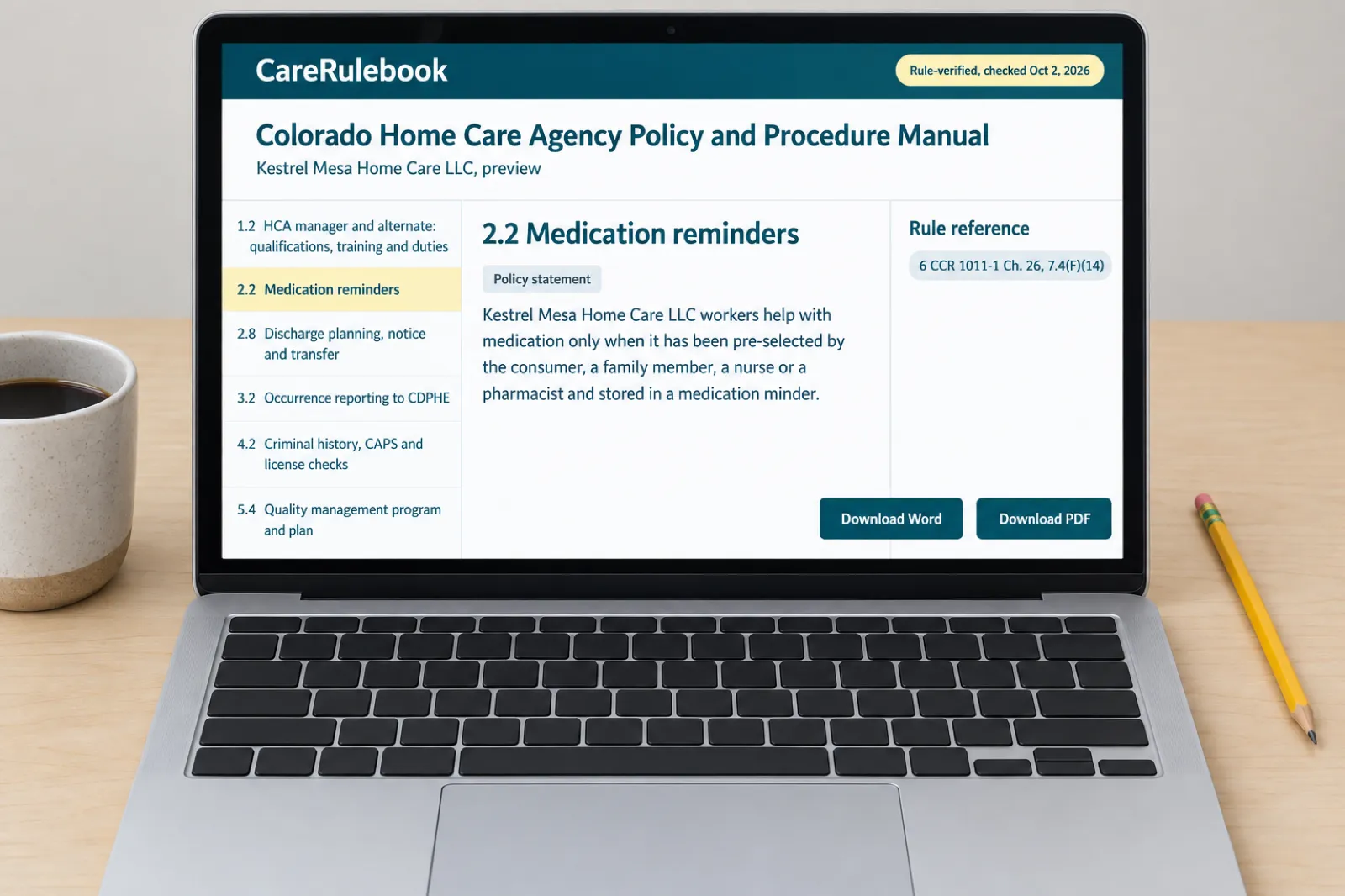
The CareRulebook Colorado manual preview on a laptop: policy 2.2 on medication reminders for a sample agency, citing 6 CCR 1011-1 Ch. 26, 7.4(F)(14), with policy 1.2 on the HCA manager and alternate in the contents

CareRulebook

Your office, postings and records, written into your manual

CareRulebook’s Colorado manual includes Policy 1.4, office, workstations and branch offices, with the posting checklist and complaints notice; Policy 1.5, license, insurance, renewal, changes and closure; Policy 5.1, consumer records, service notes and information management; and Policy 5.3, keeping and disposing of records.

  • 33 policies, 155 requirements mapped
  • Posting checklist and complaints notice
  • Rule quoted under each policy
  • Editable Word and PDF
Preview your manual

$199CareRulebook founding price for the first 50 Colorado agencies, then $249. Not a CDPHE fee.

Myths about Colorado home care offices

Can I run a Class B agency from my home?

It depends. Possibly. Chapter 26 requires a fixed office in Colorado that protects consumer confidentiality and is safe to work in, and CDPHE surveys at the address on your application. CDPHE’s checklist addresses offices in a residential home or apartment: the lease must not strictly prohibit running a business there, and the landlord must approve if the lease bars business, signage and client visits. Your city or county zoning department must also sign CDPHE’s zoning form.

"If the office location is in a residential home or apartment, please ensure the lease agreement does not include language that strictly prohibits the lessee from running a business from that leased space."

Can I keep client files at a workstation?

No. A workstation is a site that operates only for the convenience of direct care staff, so they can travel less. Chapter 26 says consumer charts are not kept there, and it may not be used to accept referrals, for marketing, administration or personnel training, or to serve the public. It may hold phones, office supplies, policies, procedures and forms. Each workstation carries a CDPHE fee.

"The workstation shall not be used to accept referrals; conduct marketing, administrative activities, or personnel training; or store consumer records."

Does my license move with me if I move the office?

It depends. Only if you tell CDPHE 30 days before the move and the new office is in your existing service area, with the same governing body and administrator. Otherwise Chapter 26 says you apply for a new license. CDPHE’s fee schedule lists a change of address fee ($92.74 in 2026/27, a CDPHE fee) requested in COHFI at least 30 days ahead, and its zoning form has a "Change of Location" option for the new address.

"To retain the current license, the new physical location shall be relocated within the existing geographic service area and retain the same governing body and administrator."

Frequently asked questions

Can I run a Colorado home care agency from my home?

CDPHE’s application checklist addresses an office in a residential home or apartment. It says: "If the office location is in a residential home or apartment, please ensure the lease agreement does not include language that strictly prohibits the lessee from running a business from that leased space." and "Landlord approval will be required if a residential lease explicitly states that no business can be operated from the space, no signage can be hung, and no clients can visit the property." Your city or county zoning department must also sign CDPHE’s zoning form before the license is issued. By our reading CDPHE does not rule out a home office on those terms, but no source we found says a home office is approved as such. The office must still be a fixed office in Colorado that keeps consumer information confidential and is safe to work in, and CDPHE surveys at that address. Ask CDPHE and your zoning department before you commit.

Do I need a lease if I own my home?

CDPHE’s checklist asks for a lease when "the agency (licensee) does not own the building or physical office location". If your agency is a company and the home belongs to you personally, the company does not own it, so by our reading CDPHE may expect a lease between you and the company. CDPHE has not said; ask before you apply.

When do I need the zoning sign-off?

Before the license is issued, and CDPHE’s checklist lists the signed zoning form among the documents for every initial application. The form says written evidence of compliance with local zoning codes must be obtained before a state license is issued, and the city or county zoning department’s director or designee signs it. CDPHE does not sign it. Our suggestion: speak to your zoning department before you sign a lease or set up at home.

What do I have to post at the office?

Your CDPHE license, where clients who come in can see it (Chapter 2, 2.9.2); a notice that complaints may be made to the agency, CDPHE and the appropriate oversight board at the Department of Regulatory Agencies (DORA) (7.1.4); and a statement of how to get records and the right to appeal access grievances to CDPHE (6.1.2). If CDPHE ever issues a conditional license, the conditions are posted too (2.8.3(E)). The rules do not say which DORA board a Class B agency should name; ask CDPHE.

How fast must I produce records for a CDPHE surveyor?

Consumer files and administrative records (census and demographic information, complaint and incident reports, minutes, quality assurance and annual program review documents) must start reaching the surveyor within 30 minutes of a request. Documents kept in a consumer’s home and not in the agency’s file must be produced within 2 hours if the last visit was 14 or more days before the request. CDPHE may allow more time (Chapter 26, 4.6(A)(1)).

How much does a branch or workstation cost in Colorado?

On CDPHE’s 2026/27 schedule, adding a branch costs $247.30 and each branch adds $247.30 at renewal; adding a workstation costs $61.83 and each workstation adds $61.83 at renewal. These are CDPHE’s fees, paid to the state, not CareRulebook prices. The schedule changes every July 1.

Can a branch serve Medicaid clients?

CDPHE’s checklist says that for the Medicaid home and community based services (HCBS) waiver programs, each physical site must be separately licensed, as separate certifications are required for each site, rather than run as a branch. Whether that applies to Community First Choice personal care since it moved out of the waivers is not stated in what we read; ask CDPHE before a branch serves Medicaid clients.

What happens if I have no clients for a while?

Chapter 2 says a temporary closure includes any time the agency drops to a zero client census for any reason, and a license becomes invalid if the census drops to zero and CDPHE was not notified under the temporary closure rule. Planned closures are reported at least 30 days ahead; unplanned ones within 7 calendar days, and a temporary closure is limited to 90 days. Whether the time before a new agency’s first client counts is not stated; ask CDPHE when your license is issued.

Get Colorado rule-change alerts

CDPHE has proposed changes to Chapter 2 (comments due November 12, 2026), and the home care law is due for review before September 1, 2028. Leave your email and we will tell you when a Colorado change affects your office, your records or your policies.

No spam. Only emails about Colorado home care rule changes. How we use your email.

Keep reading

Sources

  1. 6 CCR 1011-1 Chapter 26, Home Care Agencies (effective July 1, 2025) · Colorado Secretary of State, Code of Colorado Regulations · retrieved October 2, 2026
  2. 6 CCR 1011-1 Chapter 2, General Licensure Standards (effective September 14, 2025) · Colorado Secretary of State, Code of Colorado Regulations · retrieved October 2, 2026
  3. Initial Health Facility/Agency Licensure: Guidance and Instructions (All License Types), updated September 11, 2025 · Colorado Department of Public Health and Environment, HFEMSD · retrieved October 2, 2026
  4. Home Care Agencies (HCA/HHA): Initial Application Checklist, updated July 23, 2026 · Colorado Department of Public Health and Environment, HFEMSD · retrieved October 2, 2026
  5. Home Care Agencies: 7/1/2026 to 6/30/2027 Fee Schedule · Colorado Department of Public Health and Environment, HFEMSD · retrieved October 2, 2026
  6. Written Notice of Home Care Consumer Rights (CDPHE form) · Colorado Department of Public Health and Environment · retrieved October 2, 2026
  7. Home Care Agency Zoning Department sign-off form (rev. 10-19-2022) · Colorado Department of Public Health and Environment, HFEMSD · retrieved October 2, 2026
Build your Colorado manualfrom $199