Skip to content
CareRulebook
MenuClose

What do you run?

Home care in the US19 states with a manual, 6 with a free guide
ColoradoManual
ConnecticutPack
DelawareManual
GeorgiaManual
IllinoisManual
IndianaManual
KansasManual
MaineManual
MarylandManual
MinnesotaManual
NevadaManual
North CarolinaManual
OklahomaManual
OregonManual
South CarolinaManual
TennesseeManual
TexasManual
VirginiaManual
WashingtonManual
CaliforniaGuideFloridaGuideNew JerseyGuideNew YorkGuideOhioGuidePennsylvaniaGuideAll US home care states →
Care homes in the USCalifornia, Michigan, Minnesota; more states coming
Home care in the UKEngland, Scotland, Wales
Free toolsChecklists, calculators and templates

California · Assisted living (RCFE) · HSC 1569.625 and 22 CCR 87411

California RCFE staff training: 40 hours, then 20 a year

California RCFE staff who help residents with daily living get 40 hours of training, then 20 hours a year, with dementia care built in. Staff who help with medications add medication training and an exam, everyone learns to recognize and report elder abuse, and the administrator holds a CDSS certificate earned through an 80-hour course and exam. Here is each requirement, quoted from the RCFE Act, Title 22 and CDSS’s training guide.

  • Rule-verified November 13, 2026
  • Quoted from HSC 1569.625, 1569.69 and 22 CCR 87411
  • With CDSS’s training guide
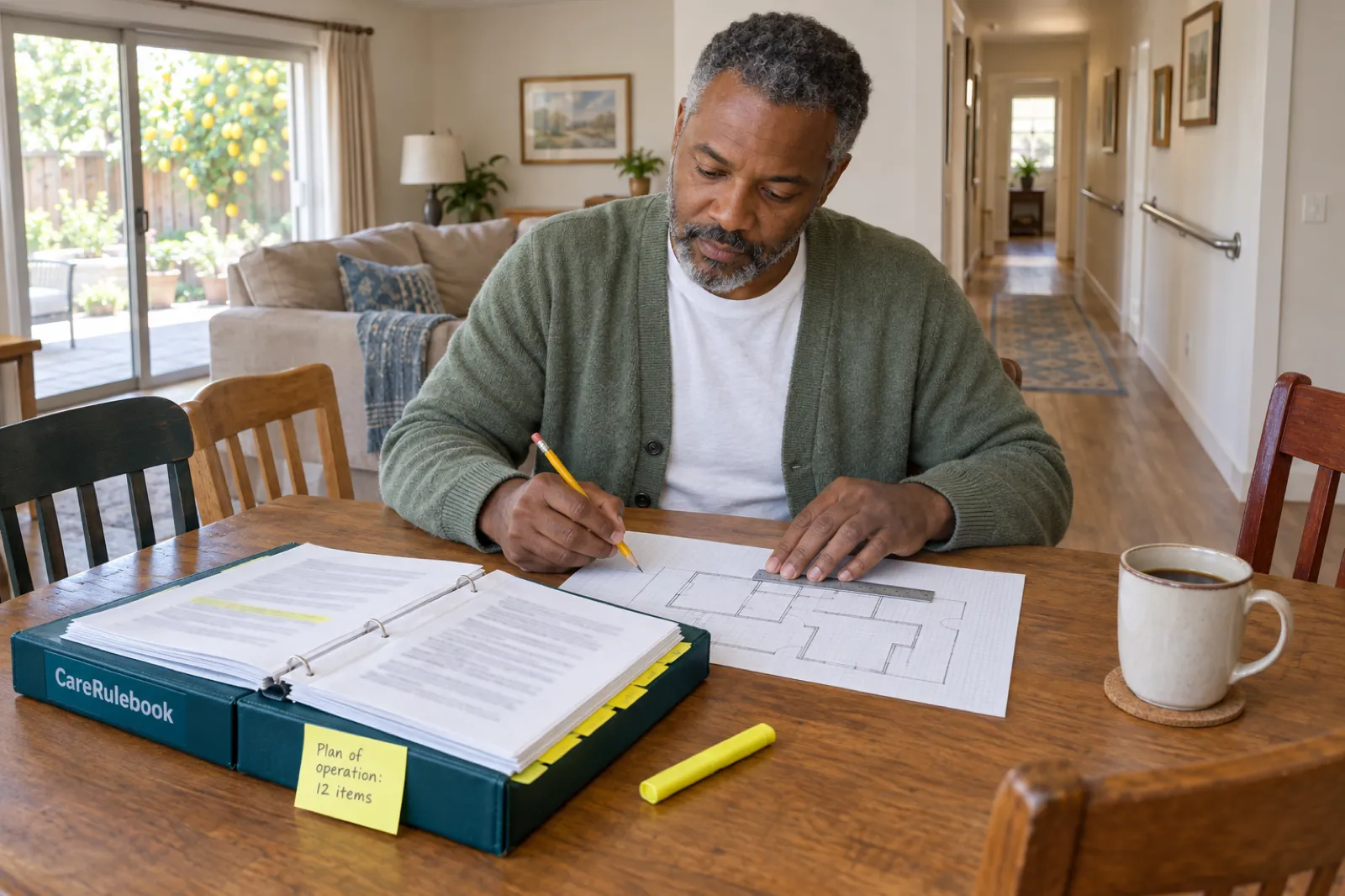
A man in a sage green cardigan at a dining table in a single-story California house measures a hand-drawn floor plan with a ruler, beside an open teal CareRulebook binder with yellow tabs, a highlighter, a mug of coffee and a sticky note reading Plan of operation: 12 items, with a lemon tree outside the patio door

Quick answer

Staff who help residents with personal activities of daily living get the training the statute sets: "This training shall consist of 40 hours of training." (HSC 1569.625(b)(1)), then "an additional 20 hours annually, eight hours of which shall be dementia care training" ((b)(2)). The rules apply this to "All RCFE staff who assist residents with personal activities of daily living" (22 CCR 87411(c)).

The administrator completes "a minimum of 80 hours of coursework" and CDSS’s exam (HSC 1569.616(c)(1)), and the facility makes sure "at least one staff member who has cardiopulmonary resuscitation (CPR) training and first aid training is on duty and on the premises at all times" (HSC 1569.618(c)(3)).

40

hours of initial training for direct care staff, 20 of them before working alone

HSC 1569.625(b)(1)

20

hours a year after that, 8 of them on dementia care

HSC 1569.625(b)(2)

12

hours of dementia care training in the first four weeks

HSC 1569.626(a)(1)

80

hours in the administrator certification course

HSC 1569.616(c)(1)

Who needs what

CDSS’s Reference Guide to RCFE training groups the requirements by role (CDSS training guide, January 2025). The duties come from the statute and regulations each row cites.

California RCFE training requirements by role
WhoWhatSource
Administrator80-hour certification course and CDSS exam before working as administrator; 40 hours of continuing education every two years, at least 8 on dementiaHSC 1569.616
Designated substituteTrained to work with emergency personnel, including giving them a resident’s medical recordsHSC 1569.618(b)(3)
Every staff memberElder abuse recognition and reporting within 60 days; the disaster plan on hire and yearly; PPE before being around residents and yearly; residents’ rightsCDSS training guide, section 3
Direct care staff (help with daily living)40 hours: 20 before working on their own, 20 within four weeks; then 20 hours a yearHSC 1569.625(b)
Staff who help with medications10 hours and an exam in facilities of 15 or fewer (24 hours at 16 or more); then 8 hours a yearHSC 1569.69
Staff with specialized dutiesRestricted health conditions, hospice and bedridden residents: training specific to the resident or the careCDSS training guide, section 6
VolunteersTrained in the proper use of required PPE before being around residents and yearly22 CCR 87470(b)(2)(C)

CDSS’s guide adds: "Licensees remain responsible for always being knowledgeable about current training requirements in statute and regulations." (CDSS training guide)

Direct care staff: 40 hours, then 20 a year

Before working alone

20 hours

Including 6 on dementia care and 4 on postural supports, restricted health conditions and hospice care.

HSC 1569.625(b)(1)

Within four weeks

20 more

Including 6 more on dementia care.

HSC 1569.625(b)(1)

Every year after

20 hours

Including 8 on dementia care and 4 on postural supports, restricted health conditions and hospice care.

HSC 1569.625(b)(2)

Of the 40 hours, 16 are hands-on (CDSS training guide).

  • What it covers. At least: physical limitations and needs of the elderly; personal care techniques; residents’ rights; medication policies; psychosocial needs; building and fire safety and emergencies; dementia care, including antipsychotics and psychotropic drugs; the needs of people with Alzheimer’s disease and dementia, with person-centered approaches; and cultural competency for underserved aging LGBT residents. (HSC 1569.625(c)) The rules also list the aging process, personal care including infection control, and "Recognizing signs and symptoms of dementia in individuals" (22 CCR 87411(c)(3)).
  • How it is given. The initial coursework may use lectures, instructional videos and interactive online courses, with 16 hours hands-on (HSC 1569.625(b)(1)). The annual training "shall be administered on the job, or in a classroom setting, or both, and may include online training" (HSC 1569.625(b)(2)).
  • Licensed and certified staff. Certified nurse assistants, licensed vocational nurses and registered nurses do not take the 40 hours; they get eight hours on resident characteristics, records and facility practices before giving direct care, and a CNA also gets the 12 hours of dementia training and the annual training. (HSC 1569.625(d))
  • On the job. All personnel get on-the-job training, or have related experience, in nutrition and food, housekeeping and sanitation, resident care and communication, safely assisting with self-administered medications, recognizing early signs of illness, and community resources, as their job needs. (22 CCR 87411(d))

Dementia training

  • Initial. "Twelve hours of dementia care training, six of which shall be completed before a staff member begins working independently with residents", the rest within the first four weeks (HSC 1569.626(a)(1)). These hours sit inside the 40.
  • Yearly. "Eight hours of in-service training per year on the subject of serving residents with dementia." It is developed with people or organizations with dementia care expertise (HSC 1569.626(a)(2)).
  • Methods. "The facility may utilize various methods of instruction, including, but not limited to, preceptorship, mentoring, and other forms of observation and demonstration." (HSC 1569.626(a)(1))
  • Residents diagnosed with dementia. Facilities caring for them train staff on dementia care, behavioral triggers and medication effects under 87705 (22 CCR 87705(b)). If you advertise dementia special care, CDSS reviews your plan of operation, training logs and marketing (HSC 1569.33(h)).

Postural supports, restricted conditions and hospice

  • Every direct care worker. Direct care staff get four hours on the care and needs of residents with postural supports, restricted health conditions and hospice care before giving direct care, then four hours a year. (HSC 1569.696(a)) These hours also count toward the 40 and the 20.
  • Restricted health conditions. Staff who meet a resident’s restricted health condition needs are trained by a licensed professional, hands-on, in general and resident-specific procedures, before they provide the care. (CDSS training guide, section 6)
  • Hospice. "Training specific to the current and ongoing needs of the individual resident receiving hospice care, to be completed before hospice care to the resident begins." (CDSS training guide, section 6)
  • Bedridden residents. "Staff records must include documentation of staff training specific to Care of Bedridden Residents." (CDSS training guide, section 6)

Medication training and the exam

Medication assistance training in a California RCFE by facility size
Facility sizeHands-on shadowing, before helpingOther trainingSource
15 or fewer6 hours4 hours within two weeksHSC 1569.69(a)(2)
16 or more16 hours8 hours within four weeks (see note)HSC 1569.69(a)(1)

HSC 1569.69(a)(1) gives four weeks for the 8 hours in larger facilities, but (a)(3) says "The training and instruction described in this subdivision shall be completed, in their entirety, within the first two weeks of employment" (HSC 1569.69(a)(3)). Our reading: finish it within two weeks to meet both.

  • The exam. "each employee shall pass an examination that tests the employee’s comprehension of, and competency in, the subjects listed in paragraph (4)" (HSC 1569.69(a)(5))
  • The topics. The role and limits of staff who help with self-administration; medication terms; types of orders; basic rules and precautions; forms and routes; procedures in and out of the facility and the documentation system; centrally stored medications; ordering, refills and receipt from the pharmacy; and side effects, errors and the risks of psychotropic and antipsychotic drugs for residents with dementia. (HSC 1569.69(a)(4))
  • Every year. Staff who keep helping with medications "complete eight hours of in-service training on medication-related issues in each succeeding 12-month period" (HSC 1569.69(b)).
  • Starting again. The medication training is repeated if an employee comes back to the same licensee after more than 180 consecutive days away, or starts helping with medications for another licensee. (HSC 1569.69(a)(8))
  • Materials. The medication training materials and exam are developed by, or with, a licensed nurse, pharmacist or physician, and the facility keeps a record of each consultant. (HSC 1569.69(d))
  • Licensed staff. "The requirements set forth in subdivisions (a) and (b) do not apply to persons who are licensed medical professionals." (HSC 1569.69(c))

Staff assist with medications residents self-administer: "Facility staff, except those authorized by law, shall not administer injections, but staff designated by the licensee may assist persons with self-administration as needed." (22 CCR 87465(a)(5)) And the statute says "Nothing in this section authorizes unlicensed personnel to directly administer medications." (HSC 1569.69(h))

Training for every staff member

  • Elder abuse. "Training in recognizing and reporting elder and dependent adult abuse, as prescribed" by the Department of Justice, within 60 days of starting (CDSS training guide, section 3). "As part of the training, facilities shall provide to all staff being trained a written copy of the reporting requirements and a written notification of the staff’s confidentiality rights."
  • The disaster plan. "A facility shall provide training on the plan to each staff member upon hire and annually thereafter." (HSC 1569.695(b))
  • Infection control and PPE. "The licensee shall ensure all staff and volunteers are trained in the proper use of all required PPE prior to being around residents and annually thereafter." (22 CCR 87470(b)(2)(C))
  • Residents’ rights. "Initial and ongoing training to ensure that residents’ rights are fully respected and implemented." (CDSS training guide, section 3)
  • CPR and first aid on every shift. At least one staff member with CPR and first aid training is on duty and on the premises at all times (HSC 1569.618(c)(3)), and "Staff providing care shall receive appropriate training in first aid from persons qualified by such agencies as the American Red Cross." (22 CCR 87411(c)(1)). LIC 281 asks for the applicant’s and administrator’s first aid cards with the application (LIC 281, B16).
  • The designated substitute. The person in charge when the administrator is away has "training to effectively interact with emergency personnel in the event of an emergency call, including an ability to provide a resident’s medical records to emergency responders" (HSC 1569.618(b)(3)).

CareRulebook

Plan item 6, the training plan, written for your facility

The plan of operation must include a plan for training staff, and LIC 281 asks for an in-service training plan with the application. CareRulebook’s California RCFE manual writes it as Policy 1.6: who gets which hours and when, the dementia, health-conditions and medication training, elder abuse, PPE and disaster training, trainer routes and the training record. Policy 4.1 covers the administrator’s certificate and renewal.

  • 41 policies and documents mapped to 111 requirements
  • A CDSS application copy for your LIC 281 packet, with page-numbered indexes
  • Editable Word and print-ready PDF, with 12 months of updates
Preview your manual

$299CareRulebook founding price for the first 50 California facilities, then $349. Not a CDSS fee.

Administrator certification: course, exam and renewal

"All individuals shall be residential care facility for the elderly certificate holders prior to being employed as an administrator." (22 CCR 87406(a))

  1. The course. "An administrator certification training program for residential care facilities for the elderly shall require a minimum of 80 hours of coursework, which shall include at least 60 hours of instruction conducive to learning" (HSC 1569.616(c)(1)). CDSS’s administrator certification FAQ: "80 hours, 20 of which may be completed using the self-paced format" (CDSS FAQ). Thirteen areas: laws, regulations and procedures; business operations; managing and supervising staff; psychosocial needs; community and support services; physical needs; medication management; admission, retention and assessment; dementia care; cultural competency for underserved aging LGBT residents; residents’ rights; the physical environment; and postural supports, restricted health conditions and hospice care. (HSC 1569.616(c)(1)(A)-(M))
  2. The exam. Applicants pass a CDSS exam within 60 days of finishing the course, within three attempts, or retake the course. (CDSS) CDSS "shall ensure the test consists of at least 100 questions and allows an applicant to have access to the California Residential Care Facilities for the Elderly Act and related regulations during the test." (HSC 1569.616(c)(3))
  3. The certificate application. After passing the exam, the applicant sends CDSS the certificate application and documents within 30 days of being told they passed. (HSC 1569.616(c)(2)) It needs fingerprints, though CDSS may waive them for someone with a current clearance or exemption on file (HSC 1569.616(d)(5)); see background checks for administrators.
  4. CDSS’s fees. $100 for the exam, for up to three attempts (HSC 1569.616(l)(2)), and $140 for the certificate application or a renewal (CDSS fees). The course is priced by the vendor. These are CDSS’s and vendors’ fees, not CareRulebook prices. All the costs and the timeline.
  5. Renewal every two years. The certificate is renewed every two years with 40 hours of continuing education, at least eight on dementia; at most half may be self-paced. (CDSS training guide; HSC 1569.616(f))
  6. Nursing home administrators. A licensed nursing home administrator completes 12 hours of interactive instruction for the initial RCFE certificate and 20 hours of continuing education to renew. (CDSS training guide)

40 or 80 hours? CDSS’s LIC 281 still says "Proof of registration in a 40-hour certification program should be submitted with the application." (LIC 281, B2). Our reading: the form is out of date; the statute and CDSS’s certification pages say 80, so plan on 80.

Who may train your staff

  • General training. "All training shall be conducted by a person who is knowledgeable in a subject that is relevant to the subject area in which training is to be provided" and who has a four-year degree with two years’ relevant experience, a California health care license, or at least two years in the last eight as a California RCFE administrator with a record of substantial compliance (22 CCR 87411(c)(4)).
  • Medication training. A medication trainer has at least five hours of education (or three semester units) on medication management, plus two years’ recent relevant experience (as a medication consultant, a compliant RCFE administrator or a medication-assisting direct care provider) or a medical professional license. The facility keeps each trainer’s details and what, when and how long they taught. (HSC 1569.69(e))
  • Materials. "Training may include use of books, video instruction tapes, interactive CD-ROMs and similar materials, upon the approval of that material by a trainer" who meets the criteria (22 CCR 87411(c)(5)).
  • First aid. From people qualified by agencies such as the American Red Cross (22 CCR 87411(c)(1)).

Training records, and the training plan CDSS reads

  • In the personnel file. "The licensee shall maintain documentation pertaining to staff training in the personnel records", and on-the-job training notes say what was covered and which trainer route the trainer meets (22 CCR 87411(c)(6)).
  • Older numbers in the rules. 22 CCR 87412(c)(1)(A) still says "there shall be documentation of at least ten hours of initial training within the first four weeks of employment, and at least four hours of training annually thereafter" (22 CCR 87412(c)(1)(A)). The statute sets 40 and 20 (HSC 1569.625(b)), and 87411(c) applies the statute’s hours (22 CCR 87411(c)), so keep records showing the full 40 and 20.
  • What each record shows. Each training record shows the trainer’s full name, the subjects, the dates and the hours per subject, with course completion notices, transcripts or certificates as proof. (22 CCR 87412(c)(2))
  • The plan. The plan of operation includes a "Plan for training staff, as required by Health and Safety Code sections 1569.625, 1569.626, and 1569.69" (22 CCR 87208(a)(6)), and LIC 281 says the applicant "must establish a plan for in-service training for staff and submit the plan to the licensing agency at the time of application" (LIC 281, B6). More in the California RCFE plan of operation.
  • At inspections. CDSS’s entrance checklist asks for staff records with on-the-job training verification, dementia training where it applies, and proof of training and first aid training (LIC 9242). What inspectors ask for.

Myths about RCFE training

Is the California RCFE administrator course 40 hours?

No. It is at least 80 hours, including at least 60 hours of interactive instruction, then a state exam within 60 days (up to three attempts). A licensed nursing home administrator does 12 hours instead. CDSS’s LIC 281 application instructions still mention a 40-hour program; the statute and CDSS’s certification pages say 80.

"An administrator certification training program for residential care facilities for the elderly shall require a minimum of 80 hours of coursework"

Can RCFE caregivers give residents their medications?

It depends. They can assist with medications residents self-administer, within the rule’s limits, after medication training (10 hours in homes of 15 or fewer, six of them shadowing, plus an exam). They may not force or hide medication, and except those authorized by law they do not give injections. PRN medications need a signed physician order with dose limits.

"Facility staff, except those authorized by law, shall not administer injections, but staff designated by the licensee may assist persons with self-administration as needed."

Frequently asked questions

How many training hours do California RCFE caregivers need?

Staff who help residents with activities of daily living get 40 hours of initial training: 20 hours before working on their own (including 6 on dementia care and 4 on postural supports, restricted health conditions and hospice care) and 20 more within four weeks (including 6 more on dementia). Sixteen of the 40 are hands-on. After that, 20 hours a year, including 8 on dementia care and 4 on postural supports, restricted health conditions and hospice care.

What medication training does RCFE staff need?

In a facility licensed for 15 or fewer, staff who help residents with self-administered medications complete 10 hours: 6 hours of hands-on shadowing before helping anyone and 4 more within two weeks. In a facility for 16 or more, it is 24 hours (16 shadowing, then 8 more; the statute gives both four weeks and two weeks, so plan on two). Each employee passes an exam, then does 8 hours of medication training a year. Licensed medical professionals are exempt.

Do CNAs need the 40 hours in a California RCFE?

No. Certified nurse assistants, licensed vocational nurses and registered nurses get eight hours on resident characteristics, resident records and facility practices before giving direct care. A CNA also gets the 12 hours of dementia care training and the 20 hours a year.

Can RCFE training be done online?

Partly. The initial coursework may use lectures, instructional videos and interactive online courses, with 16 hours hands-on (HSC 1569.625(b)(1)). The annual direct care training may be given on the job, in a classroom or both, and may include online training. The rules allow books, videos and similar materials once a qualified trainer approves them. The 16 hands-on hours and the medication shadowing hours are hands-on by definition.

How long is the RCFE administrator course in California?

At least 80 hours, including at least 60 hours of interactive instruction, from a CDSS-approved vendor. Then you pass CDSS’s exam within 60 days (up to three attempts, $100) and apply for the certificate within 30 days of passing ($140). CDSS’s LIC 281 application instructions still mention a 40-hour program; the statute and CDSS’s own certification pages say 80.

Who can teach RCFE staff training?

Someone knowledgeable in the subject who has a four-year degree and two years’ relevant experience, a California health care license, or two years in the last eight as a compliant California RCFE administrator. Medication trainers have their own requirements: five hours of medication management education plus relevant experience or a medical license, and the materials and exam are developed with a licensed nurse, pharmacist or physician.

Get California RCFE rule-change alerts

CDSS updates its training guide and the RCFE rules change through new laws and regulations. Leave your email and we will tell you when a California change affects your training plan or your policies.

No spam. Only emails about California assisted living (RCFE) rules. How we use your email.

Keep reading

Sources

  1. 22 CCR Division 6, Chapter 8, Residential Care Facilities for the Elderly (CDSS Manual of Policies and Procedures version, files updated 01/01/25, 07/14/26, 07/22/25 and 05/18/26) · California Department of Social Services, Community Care Licensing Division · retrieved November 13, 2026
  2. California Residential Care Facilities for the Elderly Act, Health and Safety Code 1569 to 1569.889 (Public.Law copy; Public.Law marks each section verified against leginfo on November 11, 2026) · California Legislature (Public.Law copy; Public.Law marks each section verified against leginfo on Nov. 11, 2026) · retrieved November 13, 2026
  3. LIC 281 (11/25), Application Instructions for a Facility License (Sections A and B) · California Department of Social Services, Community Care Licensing Division · retrieved November 13, 2026
  4. CDSS licensing forms: LIC 200, 308, 309, 311F, 401, 403, 500, 602A, 604, 604A, 606, 610E, 613C-2, 625, 9123, 9165, 9242, 9282 and 9283 · California Department of Social Services, Community Care Licensing Division · retrieved November 13, 2026
  5. Reference Guide to RCFE Administrator, Staff, and Volunteer Training Requirements (updated January 2025) · California Department of Social Services, Adult and Senior Care Program · retrieved November 13, 2026
  6. Administrator Certification Bureau pages (fees, how to become a certified administrator, renewal, FAQ, exams) · California Department of Social Services, Community Care Licensing Division · retrieved November 13, 2026

Free sample, no email needed

Read a full policy before you buy

Policy 1.12, Infection Control Plan, as it prints in the California assisted living manual, filled in for a fictional facility. The rule text it rests on is quoted word for word under Rule basis.

PDF · 18 pages · 178 KB · Rule-verified November 13, 2026

Collecting answers for a facility or a client? The intake questionnaire lists all 101 questions the builder asks, what each decision changes in the manual, and a completed example: Word · PDF.How consultants use CareRulebook.

Download the sample (PDF)
Or email it to me

We send the link once. Nothing else unless you tick the box. Privacy notice.

Build your California RCFE manualfrom $299