Skip to content
CareRulebook
MenuClose

What do you run?

Home care in the US19 states with a manual, 6 with a free guide
ColoradoManual
ConnecticutPack
DelawareManual
GeorgiaManual
IllinoisManual
IndianaManual
KansasManual
MaineManual
MarylandManual
MinnesotaManual
NevadaManual
North CarolinaManual
OklahomaManual
OregonManual
South CarolinaManual
TennesseeManual
TexasManual
VirginiaManual
WashingtonManual
CaliforniaGuideFloridaGuideNew JerseyGuideNew YorkGuideOhioGuidePennsylvaniaGuideAll US home care states →
Care homes in the USCalifornia, Michigan, Minnesota; more states coming
Home care in the UKEngland, Scotland, Wales
Free toolsChecklists, calculators and templates

Michigan · Adult foster care · MCL 400.701 and R 400.601

How to open an adult foster care home in Michigan (the AFC license, 2026)

To open an adult foster care (AFC) home in Michigan, you need a license from LARA, the Department of Licensing and Regulatory Affairs. One set of rules has applied to every AFC home since November 3, 2025. Your written policies must be complete before LARA recommends a license, a licensing consultant inspects the home, and your first license is temporary for 6 months. No nurse is required. This guide walks through each step, quoted from the AFC Act, the rules and LARA’s own checklist.

  • Rule-verified November 13, 2026
  • Quoted from MCL 400.701 and R 400.601
  • 27 sources
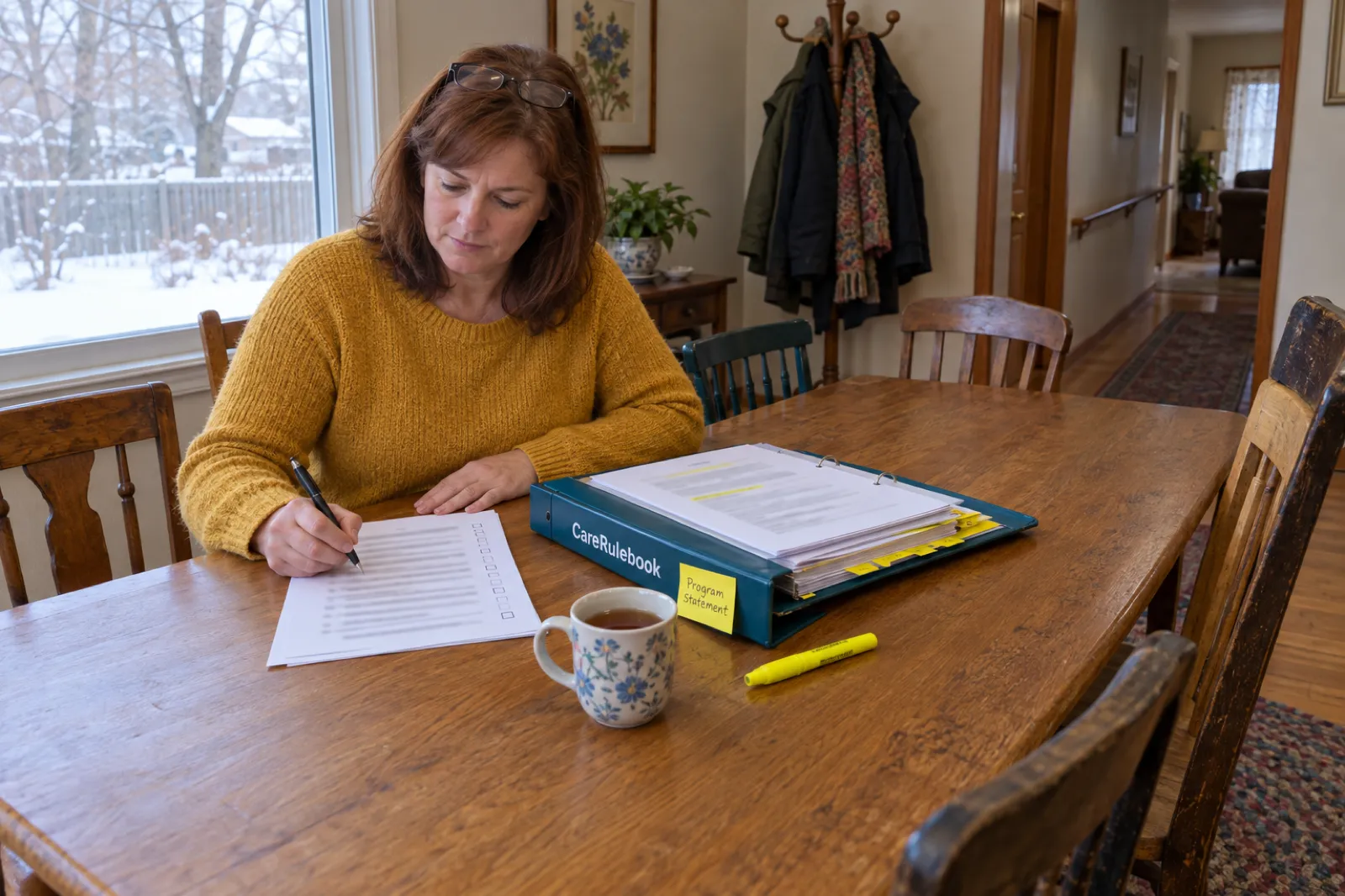
A woman in a mustard sweater at an oak dining table in a Michigan house ticks off a printed checklist beside an open teal CareRulebook binder with yellow tabs, a sticky note reading Program statement, a mug of tea and a highlighter, with a snowy backyard through the window

Quick answer

In Michigan, a person, company or public body "shall not establish or maintain an adult foster care facility unless licensed by the department" (MCL 400.713(1)). The department is LARA, and since November 3, 2025 one rule set, Licensing Adult Foster Care Facilities (R 400.601 to R 400.745), applies to every home (2023-71 LR).

LARA’s fee is $150 for a small group home of 3 to 6 (MCL 400.713a). Before it recommends a license, LARA’s leaflet lists the "Required policies & procedures" among the things that must be complete (LARA FAQ leaflet (archived March 2025)), and LARA must decide within 6 months of a completed application (MCL 400.713(14)).

3,888

AFC licenses on LARA’s list, November 13, 2026 (our count)

LARA facility list

363

New AFC license numbers in the year to November 13, 2026, about 240 at new addresses (our count)

LARA facility list

$150

LARA’s fee for a small group home of 3 to 6 (a state fee, not our price)

MCL 400.713a(3)(b)

Nov 3, 2025

One AFC rule set replaced six old ones

2023-71 LR

Direct answers

Who licenses adult foster care homes in Michigan?

The Michigan Department of Licensing and Regulatory Affairs (LARA), Bureau of Community and Health Systems, Adult Foster Care Licensing Division, under the Adult Foster Care Facility Licensing Act (1979 PA 218) and one rule set, R 400.601 to R 400.745, in force since November 3, 2025.

MCL 400.713(1); R 400.603

How much does an AFC license cost in Michigan?

LARA’s application fee for a temporary or renewal license is $100 for a family home, $150 for a small group home of 3 to 6, $200 for 7 to 12 and $500 for a large group home. These are state fees set by the Act, not CareRulebook prices.

MCL 400.713a(3)(b)

Do I need written policies before LARA licenses my home?

Yes. LARA’s applicant leaflet says the required policies and procedures must be completed before a recommendation for licensure, and LARA publishes a checklist of what each must contain. LARA’s technical assistance manual says the licensing consultant may review documents such as the program statement and procedures, and you make any document LARA needs available on request.

LARA FAQ leaflet (archived March 2025); R 400.605(1)

Does an adult foster care home need a nurse?

No. The rules do not require a nurse on staff. Trained licensees, administrators or direct care staff supervise medications as prescribed, and a home may not admit or keep a resident who needs continuous nursing care.

R 400.675(3); R 400.685(1)

Interactive check

Do you need a Michigan AFC license?

Where will the adults you care for live?

Pick the option closest to your plan.

Who needs an adult foster care license

The license turns on foster care: "Foster care" means the provision of supervision, personal care, and protection in addition to room and board, for 24 hours a day, 5 or more days a week, and for 2 or more consecutive weeks for compensation provided at a single address. (MCL 400.704(8)). AFC homes serve "adults who are aged, mentally ill, developmentally disabled, or physically disabled who require supervision on an ongoing basis but who do not require continuous nursing care" (MCL 400.703(4)).

  • Calling it a tenancy does not help. "Providing room under a landlord and tenant arrangement does not, by itself, exclude a person from the licensure requirement under this act." (MCL 400.704(8))
  • Operating without a license, after LARA has told you to apply and you have not applied within 30 days, is a misdemeanor punishable by up to 2 years in prison or a fine of up to $50,000, or both. A further violation after a conviction is a felony (MCL 400.713(12)-(13)).
  • No assisted living license. LARA says: "The State of Michigan does not license assisted or independent living facilities." An AFC or home for the aged license may be needed, depending on the care given (LARA).
  • Not a nursing home. A home may not accept or keep a resident who needs continuous nursing care (R 400.685(1)), and may not use a name that suggests it provides nursing care (MCL 400.726(1)).

What is not adult foster care

"Adult foster care facility does not include any of the following": nursing homes, homes for the aged, hospitals, state psychiatric and developmental disability facilities, county infirmaries, some child caring institutions and foster family homes, substance use disorder rehabilitation centers and a few other settings (MCL 400.703(4)). Three exclusions matter most to new operators:

  • Small CMH-monitored residences. "A private residence with the capacity to receive at least 1 but not more than 4 adults who all receive benefits from a community mental health services program if the local community mental health services program monitors the services being delivered in the residential setting." (MCL 400.703(4)(k))
  • Rooms with no care. The exclusions include "a hotel or rooming house that does not provide or offer to provide foster care" (MCL 400.703(4)(h)).
  • Homes for the aged. A separate license under the Public Health Code (MCL 400.703(4)(b)). MDHHS describes one as serving "21 or more unrelated, non-transient individuals 55 years of age or older" (MDHHS). This guide does not cover it.

Family, small group and large group homes

There is one AFC license, issued for a home type and a capacity. The rules in parts 1 and 2 apply to every home (R 400.603(1)); what changes is who can hold the license, who runs the home, who inspects fire safety and the fee.

Michigan adult foster care home types and what changes with each
RuleFamily homeSmall group home, 3 to 6Small group 7 to 12, large group 13 to 20Source
Capacity3 to 6 adults3 to 6 adults7 to 12 (small group), 13 to 20 (large group)MCL 400.703(5)-(7)
Who holds itA licensee who lives in the home as a member of the householdAn individual, partnership, corporation or LLC; a company names one licensee designeeMCL 400.703(5) LARA
AdministratorNot requiredRequired; the licensee may be the administratorR 400.699 R 400.625 R 400.601(1)(b)
R 400.701 personnel policiesOur reading: if you employ staff, yes. LARA’s Key Highlights say so; R 400.603(3) names only group and congregate homesRequiredR 400.603(3) LARA
Fire safetyInspected by LARA staffBureau of Fire Services certificate of approval before any license, under its own fire rulesMCL 400.711(3) 400.720(1) R 400.18101
Local rulesThe Act’s zoning approval rule names homes for more than 6. For every size, the Act supersedes local rules aimed specifically at AFC homes, but local construction codes for private residences still applyZoning approval or a special or conditional use permit where the ordinance requires one, before the temporary licenseMCL 400.716(2) 400.733
Minimum staffing1 direct care staff to 12 residents1 to 12 in a small group home; 1 to 15 awake and 1 to 20 asleep in a large group homeR 400.633(1)
LARA fee$100$150$200 (7 to 12), $500 (13 to 20)MCL 400.713a

Fees are LARA’s, set by the Act, for a temporary or renewal license. Congregate facilities (more than 20) are licensed only to replace an existing one (MCL 400.715).

  • LARA’s list uses codes. Its facility list codes family homes AF, small group homes of 1 to 6 AS and of 7 to 12 AM, large group homes AL and congregate facilities AG (LARA record description). The Act’s ranges start at 3.
  • Growing past 6. "Any increase beyond 6 in the number of persons to be received for foster care at 1 time in a small group home requires application for a temporary license pursuant to sections 14 and 16." (MCL 400.719(4))
  • Family homes and small homes. Parts 7 and 8 of the rules (fire safety: construction, finishes, exits, heating and smoke alarms) apply to family homes and small group homes of 6 or fewer (R 400.603(5)).

The November 2025 rules: one rule set for every home

LARA rewrote the AFC rules. "The new rule set will replace the following six rule sets, which will be rescinded": the family home, small group home, large group home, congregate facility, specialized program and small-home fire safety rules (2023-71 LR). The new rules were filed with the secretary of state on November 3, 2025 and took effect that day (2023-71 LR). LARA’s report to the legislature’s rules committee lists no comments of opposition (JCAR report).

Old copies are everywhere. The 1994 small group home rules (R 400.14101 to R 400.14601) were rescinded in the same filing (2023-68 LR), but other websites still show them. Quote only the current rules, R 400.601 to R 400.745.

What changed, in LARA’s words and the rules

LARA published a Key Highlights summary, noting that it "does not include all the changes" (LARA Key Highlights). The changes most likely to touch your written policies:

  • Program statement: Alzheimer’s information. The program statement gains a fifth item: the MCL 400.726b information when a home markets Alzheimer’s or dementia care. The other four items were already in the group home rules; family homes, whose old rules had no program statement definition, now keep one with all five (our comparison of the rescinded rules). (R 400.601(1)(x)(v))
  • Emergency preparedness plan. The emergency plan now covers extended utility outages and where residents go if the home is uninhabitable. (R 400.619(1))
  • AFC New Provider Training. New licensees and administrators complete LARA’s AFC New Provider Training within 6 months. (R 400.627(2))
  • Visitation policy. A written visitation policy, including overnight visitors, is now required. (R 400.687(3))
  • Resident funds limit. The limit on a resident’s funds held outside bank accounts rose from $200 to $400. (R 400.637(7))
  • Resident funds forms. You may now use your own forms instead of LARA’s Resident Funds I and II forms (LARA Key Highlights).
  • TB testing. "R 400.631(5) replaces blanket TB testing with a risk-based health screening" (LARA Key Highlights). Homes document a baseline communicable disease screening at hire (R 400.631(5)).
  • Staff aged 16 and 17. They can now count toward ratios, with a parent’s consent to the background check, on-site adult supervision, training first, and no medication or transport duties (LARA Key Highlights; R 400.629(2)).
  • Drills and instruction. Staff are instructed on hire and retrained every quarter on the emergency plan and fire equipment, and the plan is practised every quarter on each of the three shifts, with records kept 2 years (R 400.619(7)-(8)).
  • Food and menus. Meals follow the Dietary Guidelines for Americans 2020-2025, menu records are kept 90 days instead of 1 year (LARA Key Highlights), and opened or prepared food carries a discard date no more than 7 days on under R 400.665(7) (LARA Key Highlights).
  • Furnishings and smoke alarms. Residents may bring their own bedroom furnishings under R 400.661(3) (LARA Key Highlights). In family homes and small group homes of 6 or fewer, R 400.727(7) accepts a wireless smoke alarm system meeting NFPA 72 for new construction, conversions and license type changes (LARA Key Highlights).

New duties for family homes

  • A written admission and discharge policy, available to residents and their representatives, under R 400.687(1) (LARA Key Highlights).
  • Training for direct care staff in the nine areas of R 400.629(5) (LARA Key Highlights), and a record for each staff member under R 400.639(1) (LARA Key Highlights).
  • If you employ staff, LARA’s Key Highlights say R 400.701 "now requires Family Home licensees who employ staff to have specific written policies and procedures, as well as Job Descriptions" (LARA Key Highlights). Our reading: R 400.603(3) applies R 400.701 to group and congregate homes only, so this is LARA’s position rather than the rule’s text; follow LARA, and ask your consultant if unsure.
  • Ramps at 2 approved exits from the first floor if residents regularly use wheelchairs, under R 400.725(5) (LARA Key Highlights).

Already licensed?

The rules apply to every home, not just new ones (R 400.603(1)). If your policies cite any of the six rescinded rule sets, they cite old rules: family homes (R 400.1401 to 1442), small group homes (R 400.14101 to 14601), large group homes (R 400.15101 to 15411), congregate facilities (R 400.2401 to 2475), small-home fire safety (R 400.2201 to 2376) or specialized programs (R 330.1801 to 1809) (2023-71 LR). Start with what is new for every home: the visitation policy, the emergency plan’s extended utility outage and relocation parts, and the program statement’s Alzheimer’s item. For family homes, whose old rules had no program statement definition or refund agreement, those two are new as well (our comparison of the rescinded rules). Then work through LARA’s checklist.

LARA’s Required Policies, Procedures, and Information Checklist

LARA publishes a checklist of required policies, procedures and information that lists, rule by rule, the items each required policy must contain, with a Yes/No column for each. Two versions were on LARA’s site when we checked on November 13, 2026: the Word file titled "Required Policies and Procedures Compliance Checklist", footed “Rev. 01/09/2025” though it cites the new rule numbers (LARA checklist (Word)), and a newer PDF, "REQUIRED POLICIES, PROCEDURES, AND INFORMATION CHECKLIST", footed 4/9/2026, which adds the written description of Alzheimer’s services (LARA checklist (PDF)). The headings are the same written documents the rules require; we follow the newer PDF.

Requirements for all homes

LARA checklist: written documents required for every adult foster care home
Checklist headingWhat it coversRule
Program statementPopulation served; goals, services and community resources; services and the staff competencies they need; any contract agreements; and the Alzheimer’s information if you market dementia care.R 400.601(1)(x); R 400.611(1)(a); R 400.617(1)(b)
Admission policyPurpose, eligibility, fees and how to apply. LARA’s rows add: no continuous nursing care, assessment, compatibility, no residents needing isolation or restraint, care agreement and health care appraisal, grievances, refunds and visitation.R 400.601(1)(c); R 400.611(1)(a); R 400.617(1)(a)
Discharge policy30 days’ written notice with reasons; emergency discharge only on documented risk, with 24 hours’ written notice; never to a hospital emergency department or a setting without an address.R 400.617(1)(c); R 400.687(1), (4)-(7)
Personnel policiesEvery home except a family home that employs no staff. LARA suggests each states its purpose, scope, steps and who maintains it.R 400.611(1)(b); R 400.617(1)(i)
Job descriptionsOne for each position, with its tasks, duties and responsibilities. LARA suggests reporting line, qualifications and skills too. Not needed by a family home that employs no staff (LARA’s checklist).R 400.611(1)(c); R 400.701(3)
Standard or routine proceduresThe repeatable steps staff follow for daily care and safety. LARA suggests a title, purpose, scope, definitions and steps for each.R 400.611(1)(d)
Organizational chartLARA suggests names and titles, key responsibilities, reporting lines and departments.R 400.611(1)(f)
Floor planEach level and the basement, the layout, room uses, the number of beds and floor dimensions.R 400.611(1)(h)
Emergency preparedness planFire, medical, weather, extended utility outage and other emergencies, including where residents will receive care if the home cannot be lived in.R 400.611(1)(k); R 400.619(1)-(2)
Written fire safety planAlarms, calling the fire department, isolating a fire, evacuation, closing doors and using extinguishers.R 400.619(3)
Refund agreementWhen unused charges are refunded, including the cases the rule sets, prorated by days, and what happens to belongings left behind.R 400.637(15)-(18)

Additional requirements for small group, large group and congregate homes

R 400.701 asks for six written policies and procedures, given to staff and volunteers at hire, with proof of receipt kept in their personnel record (R 400.701(2)), plus a written job description for each position, given to each staff member and volunteer, with proof of receipt kept (R 400.701(3)). LARA’s Key Highlights extend these to family homes that employ staff (see above).

LARA checklist: R 400.701 policies for group and congregate homes
PolicyWhat it coversRule
Mandatory reportingReporting abuse, neglect, exploitation and mistreatment, when to call police or adult protective services, and staff training.R 400.701(1)(a)
Resident care related prohibited practicesThe R 400.641(6) list. LARA also suggests covering personal cellphone use, alcohol or drugs at work and smoking in the home.R 400.701(1)(b); R 400.641(6)
ConfidentialityResident records kept confidential in line with MCL 400.712(3).R 400.701(1)(c); MCL 400.712(3)
Direct care staff trainingThe Act and rules, the nine training areas, first aid and CPR to national standards, and how training is documented.R 400.701(1)(d)
Resident rightsIn line with R 400.681: the listed rights, a copy at admission and complaint contacts.R 400.701(1)(e); R 400.681
Review of rules and ActHow you review the licensing statute and rules with staff.R 400.701(1)(f)

Summarized from LARA’s checklist and the rules it cites. Some rows are LARA’s suggestions, marked “Suggested” on the checklist; the rule text is what a consultant can cite.

Alzheimer’s or dementia care. A group home that "advertises or markets the facility as providing specialized Alzheimer's or dementia care services" gives prospective residents a written description of its philosophy, admission and discharge criteria, care planning, staff training, environment, activities and extra fees (MCL 400.726b). The newer checklist has it as its last heading.

LARA’s free templates

LARA publishes free templates on its AFC licensees page, under “Example Policies, Procedures, and Templates”: the program statement, admission, discharge, confidentiality, direct care staff training, mandatory reporting, prohibited practices, resident rights, review of rules and Act, and resident refund agreement, five medication policies, a sample verbal and telephone orders policy, and example job descriptions and record outlines. LARA’s technical assistance manual says: "Applicant licensees may choose to use the Admission Policy Template and Program Statement Template to create their admission policy and program statement." (LARA technical assistance manual)

They are a sound place to start. They come one policy at a time, so you still fill each in for your own home, and LARA’s list of example policies and templates has none for several checklist headings: personnel policies, standard or routine procedures, the organizational chart, the floor plan, the emergency preparedness plan and the written fire safety plan (LARA offers a fire drill record).

What each heading must say, with a rule-by-rule crosswalk: Michigan AFC policies and procedures.
Other written documents the rules require

The checklist does not head everything. The rules also ask for:

  • A visitation policy that says whether overnight visitors are allowed (R 400.687(3)). LARA’s checklist lists visitation under the admission policy.
  • A written assessment plan before admission, signed at admission and every year (R 400.685(2), (4)), and a resident care agreement on LARA’s form or your own with the same information (R 400.685(7)). LARA’s current form is BCHS-3266, footed "BCHS-3266 (Rev. 4-26) Previous editions obsolete." (BCHS-3266).
  • Resident funds held as a trust, recorded and kept separate (R 400.637), with a $400 limit on funds held outside bank accounts (R 400.637(7)).
  • Medication handling. Staff who supervise medication are trained and keep an individual medication log (R 400.675(4)).
  • Incidents and elopement. Notify the resident’s representative within 48 hours of set events (R 400.693(1)), call police if a missing resident is not found within 30 minutes (R 400.693(2)), and send LARA an incident report within 24 hours when asked (R 400.693(4)).
  • A written stand-in for the licensee or administrator when they are away, made known to all staff (R 400.623(7)).
  • Records. A resident register, resident records kept 2 years after discharge, staff records with 2 reference checks, and a daily work schedule kept 90 days (R 400.691(3); R 400.639).

The rules also require a proposed staffing pattern, copies of agreements with other organizations, and proof of the right to occupy the home, plus corporate papers for a company (R 400.611(1)(e); R 400.611(1)(g); R 400.611(1)(i)-(j)).

What LARA checks before the temporary license

"Before issuing or renewing a license, the department shall investigate the activities and standards of care of the applicant and shall make an on-site evaluation of the facility." (MCL 400.713(3)) In practice:

  1. Your documents. "An applicant or licensee shall make available to the department any document necessary to determine compliance with the act and these rules." (R 400.605(1)) LARA’s family home page puts it plainly: "It is the applicant's responsibility to review the rules and statutory requirements and demonstrate compliance to the department." (LARA)
  2. The program statement. "The licensing consultant may review the program statement submitted for completeness, consistency with the home's house rules (if available) and admission policy, and the licensee/administrator's qualifications, training, and experience." (LARA technical assistance manual)
  3. Your procedures. "Consultants may review the licensee’s standard or routine procedures to ensure they do not conflict with administrative rules." (LARA technical assistance manual)
  4. Everything on LARA’s list. Before a recommendation for licensure: the required policies and procedures, qualifying information on the applicant and administrator, physical plant fixes, a fully equipped home ready to accept residents, full fire safety approval and full environmental health approval (LARA FAQ leaflet (archived March 2025)).

Our reading: the online application takes the form and fee, and the clearance forms go by mail; the policies are not uploaded with it. The consultant asks for more once assigned, and LARA’s application tutorial says that for group homes, the initial inspection report "may include identification of missing required policy & procedure documents" (LARA application tutorial). It is on our list of questions for LARA.

Every kind of visit, LARA’s practice worksheets, renewal inspections and corrective action plans: Michigan AFC inspections.

Completeness counts. LARA’s October 2026 technical assistance manual lists "Policies and procedures that comply with applicable licensing requirements" among the evidence of administrative capability (R 400.635, technical assistance), and says: "If a documented pattern of missing or noncompliant submissions demonstrates that the applicant lacks the required administrative capability, the Division may refuse to issue an original AFC license." (R 400.623(1), technical assistance)

Practice first. "The following forms will help you to prepare for your on-site inspection": LARA’s seven practice inspection worksheets for facility, employee, resident, licensee and household records, the physical plant, fire safety in homes of 6 or fewer and special certification (LARA worksheets).

CareRulebook

Your licensing consultant reviews your policies on site, and LARA counts compliant policies as evidence of administrative capability.

CareRulebook’s Michigan adult foster care manual answers LARA’s required policies checklist heading by heading, adds the standard or routine procedures, the emergency preparedness plan and the written fire safety plan, and is written to the rules in force since November 3, 2025. Your home’s details go in throughout, and the rule each part meets is quoted under it.

  • Program statement, admission, discharge, visitation and refund policies, and filled-in attachments for LARA’s resident care agreement form (BCHS-3266). Have a Michigan lawyer review your fee terms before residents sign
  • The six R 400.701 personnel policies, job descriptions, staffing pattern, organizational chart and staff records
  • A LARA checklist index with the page in your manual for each of its 92 rows, and a resident admission packet for each new resident
  • Already licensed? Policy 1.4 adds a What changed checklist for the November 2025 rules
  • 41 policies and documents mapped to 102 requirements, in Word and PDF, with 12 months of updates
Preview your manual

$299CareRulebook founding price for the first 50 Michigan homes, then $349. Not a LARA fee.

Free sample, no email needed

Read a full policy before you buy

Policy 6.1, Emergency preparedness policy and plan, as it prints in the Michigan adult foster care manual, filled in for a fictional home. The rule text it rests on is quoted word for word under Rule basis.

PDF · 14 pages · 151 KB · Rule-verified November 13, 2026

Collecting answers for a home or a client? The intake questionnaire lists all 100 questions the builder asks, what each decision changes in the manual, and a completed example: Word · PDF.How consultants use CareRulebook.

Download the sample (PDF)
Or email it to me

We send the link once. Nothing else unless you tick the box. Privacy notice.

How a new AFC home gets licensed, step by step

Tick steps off as you go. Your progress is saved in this browser only.

  1. Take LARA’s pre-licensing course and read the rules

    Before applying

    LARA points prospective applicants to its Adult Foster Care Pre-Licensing Training Course (LARA applicants page), and tells applicants to read the AFC rules and the Act before completing the online application.

    LARA group home page
  2. Choose the home type and the property

    Before applying

    Decide the size and whether you will live there: if not, LARA’s leaflet says you may only apply for a group home license. A company forms its corporation or LLC and gets a federal EIN first, and names one licensee designee on the application.

  3. Call LARA’s Licensing Unit

    Before applying

    Once submitted, you cannot add or remove a licensee name or change the facility type without a new application and a new fee. LARA strongly recommends calling the Licensing Unit on 1-866-685-0006 first, so you file the right application.

    LARA group home page
  4. Apply online with the fee

    Day 0

    Through MiLogin, paying by card (LARA has a paper application, BCAL-1047, for family home applicants without a card). LARA’s fee is $100 for a family home, $150 for 3 to 6, $200 for 7 to 12 and $500 for a large group home (state fees).

    MCL 400.713a(3)(b); LARA
  5. Mail the clearance forms together

    With the application

    The Licensing Record Clearance Request (BCAL-1326A-FP) with fingerprints for the applicant or licensee designee, a Licensing Information Request (BCHS-AFC 100) for the administrator and adult household members, and a physician’s Medical Clearance Request (BCHS 3704-AFC). LARA does not process the application until these are in. The medical clearance cannot be dated more than 6 months before the license is issued, so LARA suggests waiting until you have spoken to a consultant.

  6. A licensing consultant is assigned

    After processing

    Once the application, fee and record clearances are processed, the application goes to a field office and a licensing consultant, who contacts you. Floor plans go to the consultant for approval before any new construction starts.

    LARA group home page
  7. Fire, health and zoning

    During review

    For 6 or fewer, LARA staff inspect fire safety. For 7 or more, the Bureau of Fire Services approves building plans and must issue a certificate of approval before any license, and the temporary license needs local zoning approval or a permit where the ordinance requires one. A private well or septic system is inspected by the local health authority, arranged by LARA.

  8. Finish your policies and ready the home

    Before the inspection

    Before LARA recommends a license, the required policies and procedures, the qualifying information on the applicant and administrator, physical plant fixes, a fully equipped home ready to accept residents and full fire safety approval and full environmental health approval must all be complete. What the policies must contain.

  9. On-site evaluation

    Before the license

    LARA investigates the applicant’s activities and standards of care and makes an on-site evaluation of the home before issuing a license. LARA publishes practice inspection worksheets to help you prepare.

    MCL 400.713(3)
  10. Local clerk notified

    At least 45 days before the license

    LARA tells the city, village or township clerk at least 45 days before it issues a license for a proposed home.

    MCL 400.732(1)
  11. Temporary license for 6 months

    Months 0 to 6

    A new home’s first license is temporary, for its first 6 months of operation, and cannot be renewed. Licensees and administrators complete LARA’s free AFC New Provider Training within 6 months of the first license or of being hired.

  12. Regular license, renewed every 2 years

    From month 6

    After the temporary period, LARA issues a regular or provisional license, or refuses. A regular license is valid for 2 years, with the same state fee at each renewal.

    MCL 400.714, 400.719(2)

How long it takes. "The department shall issue an initial or renewal license not later than 6 months after the applicant files a completed application." The clock stops while LARA waits for missing information or a corrective action plan (MCL 400.713(14)), and if LARA is late it returns the fee and cuts your next renewal fee by 15% (MCL 400.713(16)). We found no published average processing time.

LARA’s fees, other costs, fire safety and zoning for 7 or more, and what can stall an application: cost and timeline. For a list tailored to your home, use the free Michigan AFC license checklist.

Buying an existing home? "A license shall be issued to a specific person for a facility at a specific location and is nontransferable." (MCL 400.713(7)) A buyer applies for a new license.

Licensee and administrator: qualifications and training

Every home except a family home has an administrator, who may be the licensee (R 400.625; R 400.601(1)(b); R 400.699). The licensee and administrator:

  • Education and experience. "A licensee and administrator shall have a high school diploma or general education diploma or equivalent and not less than 1 year of direct experience working with individuals that are aged or have been diagnosed with a mental illness, developmental disability, physical disability, traumatic brain injury, or Alzheimer’s disease." (R 400.623(4)) The experience should match the population named in your program statement and admission policy. The education requirement does not apply to family or congregate homes licensed before the rules and continuously licensed since (R 400.623(4)).
  • Ten competencies. Nutrition, first aid, CPR, foster care, safety and fire prevention, financial and administrative management, the needs of the population served, resident rights, communicable disease prevention and medication administration (R 400.623(2)).
  • AFC New Provider Training. "A licensee and administrator shall complete the department training titled “AFC New Provider Training” within 6 months of the initial license being issued or within 6 months of being hired as applicable." (R 400.627(2)) LARA runs it free and online (LARA trainings).
  • 16 hours a year. LARA-accepted training relevant to your admission policy and program statement, or 6 college credit hours (R 400.627(1)).
  • Background and character. The applicant (if an individual), the licensee designee and owners or directors with regular direct access or on-site responsibilities give fingerprints for state and FBI checks (MCL 400.713(21)), and LARA may not license an applicant who lacks good moral character (R 400.1151(1)).
  • Health. A physician’s statement on the licensee’s and administrator’s health, signed no more than 6 months before the temporary license (R 400.631(2)).
  • Guardianship. The licensee, administrator and staff may not be the legal guardian or conservator of a resident, with narrow exceptions (R 400.623(8)).

Tell LARA in writing within 10 business days after a change to anything you gave with the application (R 400.611(4)).

Staff: training, ratios and checks

Nine areas before working alone

  • Reporting requirements; first aid; CPR with hands-on demonstration
  • Personal care, supervision and protection; resident rights
  • Safety and fire prevention; communicable disease
  • Food safety; nutrition and special diets
R 400.629(5)

Who trains, and how you show it

  • The licensee or administrator may train, using videos or other resources, except CPR
  • LARA expects a method to assure competency and written records in each staff file
  • LARA offers free videos, quizzes or virtual training on several of the areas
LARA TA manual LARA TA manual (competency) R 400.629(7) LARA trainings
  • Age. "Direct care staff shall be at least 18 years of age and able to complete required reports and follow written and oral instructions that are related to the care and supervision of residents." Staff aged 16 or 17 may count only under the rule’s conditions (R 400.629(1)-(2)).
  • Medication. Staff who supervise medication are "trained in the proper handling and administration of medication" (R 400.675(4)(a)). LARA runs a free medication administration training (LARA trainings).
  • Emergency instruction. On hire and every quarter, with records kept 2 years (R 400.619(7)).
  • Staffing. Enough direct care staff on duty at all times for supervision, personal care and protection, never below 1 to 12 in family and small group homes (R 400.633(1)).
  • Criminal history checks first. Under the Act, "an adult foster care facility shall not employ or independently contract with an individual who has direct access to residents until the adult foster care facility or staffing agency has conducted a criminal history check in compliance with this section", with a limited conditional-employment route (MCL 400.734b(2)). Staff agree in writing to report an arraignment or conviction for listed offenses (MCL 400.734b(12)).
  • Health. A physician’s statement for staff and household members within 30 days of starting, a yearly health review and a baseline communicable disease screening at hire (R 400.631).
  • Reporting abuse. LARA’s technical assistance manual names AFC staff as mandated reporters (LARA TA manual). Reports go to adult protective services immediately (MCL 400.11a(1)); MDHHS takes them on 855-444-3911, any time (MDHHS).

In detail: Michigan AFC staff training and Michigan AFC background checks.

LARA’s license fees

LARA’s adult foster care license fees
LARA fee (state fee)AmountWhen
Family home (state fee, temporary or renewal license)$100application (temporary or 2-year renewal) MCL 400.713a(3)(b)
Small group home, 3 to 6 (state fee)$150application (temporary or 2-year renewal) MCL 400.713a(3)(b)
Small group home, 7 to 12 (state fee)$200application (temporary or 2-year renewal) MCL 400.713a(3)(b)
Large group home, 13 to 20 (state fee)$500application (temporary or 2-year renewal) MCL 400.713a(3)(b)

These are the State of Michigan’s fees, set by the Act from January 1, 2022, not CareRulebook prices. LARA’s application tutorial says the environmental health and fire safety inspections it requests are at no charge to the applicant (LARA tutorial). We did not price fingerprinting, medical clearances, building work or Bureau of Fire Services plan review. More on AFC license cost and timeline.

  • Fees do not move. "Fees are non-transferable." A changed licensee name or facility type needs a new application and a new fee (LARA).
  • Late decisions. If LARA misses the time limit, it returns the fee and cuts the next renewal fee by 15% (MCL 400.713(16)).
  • A pending bill would let LARA raise fees each year; see rule changes.

Specialized programs for people with developmental disabilities or mental illness

A specialized program is "a program of services or treatment provided in an adult foster care facility licensed under this act that is designed to meet the unique programmatic needs of the residents of that home as set forth in the assessment plan for each resident and for which the facility receives special compensation" (MCL 400.707(5)). It is not a separate license: a licensed home applies to LARA for special certification, and since November 3, 2025 those rules are parts 5 and 6 of the AFC rules (R 400.603(4)). More than half of Michigan’s AFC homes hold one (our count).

  • Applying. The application gives the license number, current and proposed capacity, the certification type, the staff ratio on each shift and the residents and services (R 400.703(1)). LARA inspects the program and reinspects at least every two years (MCL 400.711(5)).
  • Temporary certification first. Up to 6 months, not renewable (R 400.703(2)(c)). Tell LARA when residents reach half the licensed capacity, and LARA reviews the program on site (R 400.705(1)).
  • Staff training. Before working alone, staff are trained in community residential services, carrying out individual plans of service, residents’ special needs, rights under chapter 7 of the Mental Health Code and non-aversive techniques (R 400.707(1)), from trainers acceptable to the placing agency (R 400.707(2)).
  • Fire safety. Evacuation assessments within 30 days of each admission and yearly (R 400.715(4)), and an interconnected smoke detection system in certified homes for 4 to 6 (R 400.715(1)).

This guide covers LARA’s licensing and certification rules only. Contracts with a community mental health services program, individual plans of service and Medicaid requirements are set outside the AFC rules and are not covered here.

Rule changes: what licensed AFC homes should know

The changes we track, newest first:

  • Proposed: House Bills 6320 to 6322 of 2026: AFC enhanced standards. Would add a resident satisfaction survey, semiannual pharmacist or RN medication reviews where unlicensed staff give medication, a written pre-admission disclosure, an internal complaint policy with 7-business-day written responses and a complaint log, posted complaint contacts, new resident rights, a written training plan, set courses within 120 days of hire and 8 hours of yearly continuing education. When we checked on November 13, 2026, the bill pages showed the three bills introduced on August 27, 2026 and referred to the House Committee on Families and Veterans on September 1, 2026, with no later action. The bills are tie-barred to each other. HB 6320
  • Proposed: Senate Bill 567 of 2025: AFC license fund and fee increases. Would create an Adult Foster Care Facility Licenses Fund and let LARA raise license fees each year by up to the average civil service pay increase. When we checked on November 13, 2026, the bill page showed the bill introduced and referred to the Senate Committee on Appropriations on September 18, 2025, with no later action, though the Senate Fiscal Agency’s analysis is headed “as discharged”. The fee section of the Act (MCL 400.713a) is unchanged. SB 567
  • In force: Single AFC rule set replaces six old rule sets. Licensing Adult Foster Care Facilities (R 400.601 to R 400.745) replaced the family home, small group home, large group home, congregate facility, specialized program and small-home fire safety rules on November 3, 2025. Proposed rules and the hearing notice were published in the Michigan Register on July 1, 2025, and no comments were received. Policies that cite the old rule numbers need updating. When we checked on November 13, 2026, the Administrative Rules System listed the new rule set, and the six rescissions, as filed and effective November 3, 2025. Rule set 2023-71 LR

Bills can change before they pass, and none of these bills is law. All states’ open changes are on our rule changes page, and you can get Michigan AFC alerts by email.

How many adult foster care homes does Michigan have?

LARA publishes a statewide list of licensed homes. Our counts from it, on November 13, 2026:

  • By type. 3,888 AFC licenses: 2,486 small group homes of 1 to 6, 425 small group homes of 7 to 12, 554 large group homes, 419 family homes and 4 congregate facilities, with 31,775 licensed beds (LARA list, our count).
  • Status. 3,650 regular, 175 temporary and 62 first provisional licenses, and 1 with no status listed (our count).
  • New homes. Against LARA’s list of November 14, 2025: 363 new license numbers, while 360 left the list. About 240 of the new numbers were at addresses not on the earlier list (243 in our count: 204 small group homes of 1 to 6, 19 large group homes, 17 family homes and 3 small group homes of 7 to 12), after allowing for spelling differences in street names and cities (our comparison). A new number also follows a change of owner or license type.
  • Specialized programs. 2,279 of the 3,888 AFC homes (59%) held a special certification for developmental disabilities or mental illness on November 13, 2026 (2,169 DD, 1,834 MI); 2,055 were flagged as serving the aged and 946 as serving people with Alzheimer’s (our count; a home can carry several flags). (LARA list)
  • Owners. 1,972 licensee names: 1,453 hold one home, and 127 hold five or more, together 1,441 homes (our count of exact names). LARA says "Most of the state-licensed AFC facilities are operated by large business entities with multiple facilities in the state." (LARA impact statement).

LARA’s impact statement for the rule-making said: "There are 3,826 state licensed AFC facilities, including 494 family homes and 2,320 small group homes" (LARA impact statement).

The CareRulebook manual for Michigan AFC homes

CareRulebook’s Michigan adult foster care policy and procedure manual is written for family homes, small group homes and large group homes, to the AFC Act and the rules in force since November 3, 2025 (R 400.601 to R 400.745). It has 41 policies and documents in seven sections: the manual and the home’s records; then LARA’s checklist headings grouped by topic (program statement, admission, discharge and residents’ money; staffing and personnel; the six R 400.701 policies); the standard or routine procedures; the emergency and fire safety plans; and, for certified homes, the specialized program rules. Your home’s details go in throughout, and the rule each one meets is quoted under it.

With it come a LARA checklist index (all 92 rows of LARA’s checklist, each with its pages in your manual; LARA has not approved it) and a resident admission packet, the policies you give each new resident with LARA’s care agreement form. For specialized programs it covers LARA’s certification rules only, not your community mental health services program contract or each resident’s individual plan of service. Already licensed? Policy 1.4 adds a What changed checklist for the November 2025 rules.

Every quote in it is checked against the official text we saved, and it is not legal advice. The care agreement attachments and refund agreement were written from the Michigan rules they cite: have a Michigan lawyer review your fee terms before residents sign. For 12 months after you buy, you can download it again after a rule change.

Writing your own instead? Work through LARA’s checklist heading by heading, start from LARA’s free templates where they exist, write the procedures and plans it does not template for your own home, and check that every AFC licensing rule you cite falls between R 400.601 and R 400.745 (homes for 7 or more also cite the Bureau of Fire Services rules, R 400.18101 to R 400.18702).

Preview your manual

$299 CareRulebook founding price for the first 50 Michigan homes, then $349. Not a LARA fee.

Michigan AFC myths, checked against the source

Nine common questions, each with the law or guidance it rests on.

Do I need an assisted living license in Michigan?

No. Michigan has no assisted living license. Homes giving supervision, personal care and protection with room and board to adults are licensed as adult foster care (or, for 21 or more aged residents, as homes for the aged).

"The State of Michigan does not license assisted or independent living facilities."

Does a family home need the six personnel policies?

It depends. R 400.603(3) applies the six named policies in R 400.701 to group homes, and LARA’s Key Highlights of the new rules say family homes that employ staff now need them too. Every home keeps a program statement, admission and discharge policies, a refund agreement and an emergency plan; a family home that employs staff also keeps personnel policies.

"Personnel policies and procedures, excluding family homes that do not employ staff."

Can I just add a seventh bed to my small group home?

No. Going above 6 in a small group home needs a new temporary license application, and homes for more than 6 need Bureau of Fire Services approval and local zoning approval where the local ordinance requires it.

"Any increase beyond 6 in the number of persons to be received for foster care at 1 time in a small group home requires application for a temporary license pursuant to sections 14 and 16."

Frequently asked questions

How long does it take to get an AFC license in Michigan?

The Act gives LARA 6 months from a completed application to issue or deny a license, with the clock stopped while LARA waits for missing information, and LARA refunds the fee if it is late. We found no published average time. LARA must notify the local clerk at least 45 days before issuing, and homes for 7 or more also wait for Bureau of Fire Services approval.

Can I open an adult foster care home in my own house?

Yes, if the house meets the rules. A family home is a private residence for 3 to 6 adults where the licensee lives as a member of the household; you can also license your house as a small group home. For more than 6 adults, the Act requires local zoning approval or a special or conditional use permit where the ordinance needs one before a temporary license. The Act supersedes local rules aimed specifically at AFC homes, but local construction codes for private residences still apply. LARA inspects the home before licensing.

Do I send my policies to LARA with the application?

The online application takes the form and fee, and the clearance forms go by mail. Our reading: the policies are not uploaded with it. The licensing consultant asks for more information once assigned and may review documents such as the program statement and procedures; LARA’s application tutorial says the initial inspection report for a group home may list missing required policy and procedure documents. The policies must be complete before LARA recommends a license.

Does LARA give free policy templates?

Yes. LARA’s licensees page has free templates for the program statement, admission, discharge, confidentiality, staff training, mandatory reporting, prohibited practices, resident rights, review of rules and the Act, the refund agreement and several medication policies, plus example job descriptions. They are a good place to start. You still write the other checklist items, such as standard procedures, the emergency and fire safety plans, the org chart and the floor plan.

What is the difference between an AFC home and a home for the aged?

A home for the aged is a separate license under the Public Health Code, which the AFC Act excludes. MDHHS describes it as providing 24-hour room, board and supervised personal care to 21 or more unrelated people aged 55 or older. AFC homes serve up to 20 adults in a new home. Michigan has no assisted living license.

Does Medicaid pay AFC homes?

MDHHS says AFC and home for the aged providers who want the Medicaid personal care supplement must first be licensed by LARA and enrolled in SIGMA and Bridges. Many homes also serve residents placed through community mental health programs under specialized program contracts, which this guide does not cover.

I already have an AFC license. What do I need to do?

Check your written policies against the rules in force since November 3, 2025. Policies that cite rule numbers from the six rescinded rule sets (R 400.1401 to 1442, R 400.14101 to 14601, R 400.15101 to 15411, R 400.2401 to 2475, R 400.2201 to 2376 or R 330.1801 to 1809) need updating. The new rules add a written visitation policy, the Alzheimer’s item in the program statement, an emergency plan that covers extended utility outages and where residents go if the home cannot be lived in, and AFC New Provider Training. Family homes also now need a written admission and discharge policy, staff training and staff records, and (our comparison of the old rules) a program statement and refund agreement.

Does CareRulebook sell a Michigan adult foster care manual?

Yes. The Michigan adult foster care policy and procedure manual is written for family homes, small group homes and large group homes, whether you are applying, buying a licensed home or already licensed: every row of LARA’s required policies checklist answered, with a LARA checklist index in LARA’s order, the standard or routine procedures, the emergency preparedness plan and the written fire safety plan, written to the rules in force since November 3, 2025, with your home’s details throughout and the rule quoted under each one. It comes with a page-numbered LARA checklist index and a resident admission packet. The fee terms are not legal advice: have a Michigan lawyer review them before residents sign. You can preview it free before you buy, and this guide stays free.

Get Michigan AFC rule-change alerts

We will email you when LARA changes the adult foster care rules or forms, or when the AFC Act changes, with what it means for your home.

No spam. Only emails about Michigan adult foster care rules. How we use your email.

Keep reading

Sources

  1. Adult Foster Care Facility Licensing Act, 1979 PA 218, MCL 400.701 to 400.737 (Michigan Compiled Laws, complete through PA 114 of 2026) · Michigan Legislature · retrieved November 13, 2026
  2. Licensing Adult Foster Care Facilities, Mich. Admin. Code R 400.601 to R 400.745 (2025 AACS) · Michigan Office of Administrative Hearings and Rules (Administrative Code, for LARA Bureau of Community and Health Systems) · retrieved November 13, 2026
  3. Rule sets 2023-65 to 2023-71 LR: request for rulemaking, regulatory impact statement, JCAR report and final rules (single AFC rule set; six old rule sets rescinded), filed November 3, 2025 · Michigan Office of Administrative Hearings and Rules (ARS) · retrieved November 13, 2026
  4. Rule sets 2023-65 to 2023-70 LR: final text of the six rescinded AFC rule sets, struck through · Michigan Office of Administrative Hearings and Rules (ARS) · retrieved November 13, 2026
  5. Adult Foster Care Facilities fire safety rules, R 400.18101 to R 400.18702 (homes for 7 or more) · LARA Bureau of Fire Services (Michigan Administrative Code) · retrieved November 13, 2026
  6. Adult Foster Care Home Required Policies and Procedures Compliance Checklist (Rev. 01/09/2025) · LARA Bureau of Community and Health Systems, Adult Foster Care Division · retrieved November 13, 2026
  7. AFC Home Practice Inspection Worksheets (facility records, employee records, resident records, licensee and household, physical plant, special certification; revised 1/7/2026) and the worksheets page · LARA Bureau of Community and Health Systems, Adult Foster Care Division · retrieved November 13, 2026
  8. Adult Foster Care Administrative Licensing Rules Technical Assistance Manual, revised October 7, 2026 · LARA Bureau of Community and Health Systems, Adult Foster Care Division · retrieved November 13, 2026
  9. Adult Foster Care Administrative Licensing Rules Technical Assistance Manual, revised June 3, 2026 (superseded by the October 7, 2026 revision; copy hosted by the Health Care Association of Michigan) · LARA Bureau of Community and Health Systems, Adult Foster Care Division · retrieved November 13, 2026
  10. Adult Foster Care Homes Required Policies, Procedures, and Information Checklist (PDF footed 4/9/2026) · LARA Bureau of Community and Health Systems, Adult Foster Care Division · retrieved November 13, 2026
  11. Key Highlights of the New AFC Licensing Ruleset · LARA Bureau of Community and Health Systems, Adult Foster Care Division · retrieved November 13, 2026
  12. AFC Resident Forms Starter Packet and BCHS-3266 Resident Care Agreement (Rev. 4-26) · LARA Bureau of Community and Health Systems, Adult Foster Care Licensing · retrieved November 13, 2026
  13. BCHS-414 Corrective Action Plan (11-25) and BCHS-2320AFC AFC Home Weekly Menu · LARA Bureau of Community and Health Systems, Adult Foster Care Division · retrieved November 13, 2026
  14. LARA example policies and templates for AFC licensees: policy templates (program statement, admission, discharge, confidentiality, training, mandatory reporting, resident rights, prohibited practices, review of rules and act, refund agreement), medication templates, sample verbal and telephone order policy, example job descriptions, record outlines, and optional forms (baseline screening, annual health review, reference check, fire drill record, corrective action plan, six rights poster) · LARA Bureau of Community and Health Systems, Adult Foster Care Division · retrieved November 13, 2026
  15. LARA AFC page "Appendix F Life Safety Code" (a procedure for determining evacuation capability) · LARA Bureau of Community and Health Systems, Adult Foster Care Division · retrieved November 13, 2026
  16. LARA AFC web pages: AFC home, applicants, licensees (example policies and templates), trainings, license application packet, group home and family home application instructions, rules and statutes, resident forms (Internet Archive copies, 2026) · LARA Bureau of Community and Health Systems · retrieved November 13, 2026
  17. Adult Foster Care Division FAQ leaflet for applicants (Internet Archive copy, March 23, 2025) · LARA Bureau of Community and Health Systems, Adult Foster Care Division · retrieved November 13, 2026
  18. Statewide text file of adult foster care and homes for the aged facilities (afc_sw.txt, November 13, 2026, and the Internet Archive copy of November 14, 2025) and its record description · LARA Bureau of Community and Health Systems · retrieved November 13, 2026
  19. Good Moral Character rules, R 400.1151 to R 400.1153 · Michigan Administrative Code (LARA Bureau of Community and Health Systems) · retrieved November 13, 2026
  20. MDHHS Medicaid providers page: Adult Foster Care (AFC) and Homes for the Aged (HFA) (Internet Archive, May 13, 2026), and Adult Services Manual items ASM 040 to 060 · Michigan Department of Health and Human Services · retrieved November 13, 2026
  21. House Bills 6320, 6321 and 6322 of 2026 (adult foster care enhanced standards): bill pages, introduced text and House Fiscal Agency analysis (complete to September 22, 2026) · Michigan Legislature; House Fiscal Agency · retrieved November 13, 2026
  22. Senate Bill 567 of 2025 (adult foster care license fees): bill page, introduced text and Senate Fiscal Agency analysis · Michigan Legislature; Senate Fiscal Agency · retrieved November 13, 2026
  23. Social Welfare Act, 1939 PA 280, sections 11 to 11f (adult protective services, added by 1982 PA 519), MCL 400.11 to 400.11f (complete through PA 114 of 2026) · Michigan Legislature · retrieved November 13, 2026
  24. Michigan Penal Code, vulnerable adult abuse, MCL 750.145m to 750.145r (complete through PA 114 of 2026) · Michigan Legislature · retrieved November 13, 2026
  25. Child Protection Law, 1975 PA 238, MCL 722.622, 722.623, 722.625 and 722.633 (complete through PA 114 of 2026) · Michigan Legislature · retrieved November 13, 2026
  26. MDHHS Adult Protective Services, APS mandated reporters and Abuse & Neglect pages (Internet Archive copies, May 16, October 17 and October 22, 2026) · Michigan Department of Health and Human Services · retrieved November 13, 2026
  27. Michigan Long Term Care Ombudsman Program: contact page and home page · Michigan Long Term Care Ombudsman Program (Michigan Elder Justice Initiative) · retrieved November 13, 2026
Build your Michigan AFC manualfrom $299