Written appointments
A document showing the appointed administrator and one showing the appointed alternate. The governing body appoints the administrator in writing.
KDHE Instruction Guide, Governing Body (3)-(4); Administrators (4)-(5)Where are you starting?
Kansas · Who runs the agency · K.A.R. 28-51-103 and -117
A Kansas supportive care agency needs a governing body, an administrator, an alternate administrator who meets the same requirements, and a manager who supervises the caregivers. No nurse is allowed. Here are the qualifications, where they must live, what KDHE asks you to upload, the manager’s duties, and what to tell KDHE when someone changes.

Quick answer
Every Kansas home health agency has a governing body that must "employ a qualified administrator and alternate administrator" (K.A.R. 28-51-103(a)(2)). For an agency licensed only for supportive care, the administrator must be at least 21, have at least one year of experience as an employee of a home health agency or in a related health care service, and hold a bachelor’s degree, an associate degree or a certificate from a KDHE-approved administrator course (K.A.R. 28-51-103(b)(4)). "The administrator shall reside within the service area." (.103(b)(2)) "The alternate administrator shall meet all the requirements of an administrator." (.103(c))
The manager does much of what a registered nurse does in states such as Maryland: assesses each client, writes the plan of care and the caregivers’ assignments, is on call, and visits each client every three months to supervise the caregivers (K.A.R. 28-51-104(c)(3); 28-51-117(f)). The manager needs at least one year of experience providing home health services, HCBS or supportive care services (K.A.R. 28-51-100(aa)).
There is no nurse: "A person that applies for a license to provide only supportive care services shall not provide nursing services." (K.A.R. 28-51-105(e))
1 year
Experience the administrator, the alternate and the manager each need
K.A.R. 28-51-103(b)(4)(B); 28-51-100(aa)(2)200 miles
Radius of the service area both administrators must live in
K.A.R. 28-51-100(vv); KDHE Governing Body (6)-(7)KDHE’s letter for applicants sums it up: "An Administrator and Alternate Administrator are required." and "A Supervisor or Manager function is required." (KDHE Letter of Introduction, Option 2). In a small agency one person may hold more than one of these posts (see below).
| Role | Who it is | What the rules ask | Source |
|---|---|---|---|
| Governing body | The owners or board with legal authority to operate the agency (K.A.R. 28-51-103(a)) | Bylaws or an operating agreement renewed every year; employs the administrator and alternate; adopts, revises and approves policies; discloses owners and past home health agency ownership | K.A.R. 28-51-103(a)(1)-(6) |
| Administrator | Appointed by the governing body, directly responsible for management and day-to-day operations (K.A.R. 28-51-100(a)) | At least 21; one year in a home health agency or related health care service; a bachelor’s or associate degree or a KDHE-approved course certificate; lives within the service area | K.A.R. 28-51-103(b) |
| Alternate administrator | Covers whenever the administrator is not available (K.A.R. 28-51-103(c)) | Meets all the requirements of an administrator | K.A.R. 28-51-103(c) |
| Manager | An employee who supervises the caregivers and is available to them for consultation whenever services are provided (K.A.R. 28-51-100(aa)) | At least one year of experience providing home health services, HCBS or supportive care services. Assesses clients, writes plans of care and assignments, is on call, visits every client every three months | K.A.R. 28-51-104(c)(3); 28-51-117(e)-(f) |
| Supportive care worker | An employee who provides supportive care services (K.S.A. 65-5101(l)) | Shows competency before working without the manager present, then yearly; no certification or set hours | K.A.R. 28-51-117(c) |
| Registered nurse | None. The license allows no nursing services | KDHE’s attestation says no nurse may supervise, assign, delegate or oversee | K.A.R. 28-51-105(e); attestation |
"Each home health agency shall have a governing body having legal authority to operate the home health agency." (K.A.R. 28-51-103(a)) For a one-owner LLC, by our reading, the governing body is the owner or owners. The rule gives it six duties:
The administrator is then "an individual who is appointed by the governing body and is directly responsible for the management and day-to-day operations of a home health agency" (K.A.R. 28-51-100(a)). KDHE adds: "The Administrator must be “appointed” by the Governing Body, and this must be in writing." (KDHE Instruction Guide, Administrators)
K.A.R. 28-51-103(b)(1) gives every administrator at least these responsibilities (K.A.R. 28-51-103(b)(1)):
Where KDHE wants them written. "The Administrator and the Alternate Administrator shall have the following responsibilities documented in the job description and either in agency policy or in the appointment letter from the Governing Body" (KDHE Instruction Guide, Governing Body). "Please note that these are minimum responsibilities of the Administrators. Additional responsibilities may be listed in the Job Description if the agency desires." (Administrators (3))
A reporting duty that names the agency head. Kansas’s adult abuse reporting law lists "the chief administrative officer of a licensed home health agency" among the people who must report suspected abuse, neglect or financial exploitation of an adult to DCF (K.S.A. 39-1431(a)(1)(Q)). By our reading that is the administrator, or the alternate while covering.
"For each home health agency providing only supportive care services, the administrator shall meet the following requirements", and they are lighter than for an agency licensed for home health services or HCBS (K.A.R. 28-51-103(b)(4); (b)(3)):
| Requirement | Supportive care only (103(b)(4)) | Home health services or HCBS (103(b)(3)) |
|---|---|---|
| Minimum age | At least 21 | At least 21 |
| Education | One of: a bachelor’s degree, an associate degree, or a certificate from a KDHE-approved home health administrator course | A bachelor’s degree |
| Experience | At least one year as an employee of a home health agency or in a related health care service | One of: a year as an administrator; a physician; a registered nurse; or another Kansas-licensed qualified health professional with two years of direct care and one year of supervisory experience |
| Where they live | Within the service area | Within the service area |
| Alternate | Meets all the same requirements | Meets all the same requirements |
Drafted, not in force. KDHE’s draft rewrite would raise the bar. For supportive care: at least 21, one year of supervisory experience in personal care as an HHA employee, plus an undergraduate degree in health care services, any undergraduate degree with two years delivering personal care, or home health aide certification with one year of personal care and a KDHE-approved administrator course. KDHE said current administrators keep their eligibility while they stay in the same post with the same agency. (KDHE Summary of Changes, 2025). No official text has been published for comment; see the rule rewrite status.
"The administrator shall reside within the service area." (K.A.R. 28-51-103(b)(2)) The service area is "a geographic region within a 200-mile radius of a home health agency’s parent office" (K.A.R. 28-51-100(vv)). KDHE asks for evidence that the administrator and the alternate each live within a 200-mile radius of the parent office (KDHE Instruction Guide, Governing Body (6)-(7)).
The Kansas border. In its April 2026 answers to providers, KDHE said: "The current regulations require that the administrator and alternate administrator live within the service area, which is a 200-mile radius from the parent office." It added that the service area is also defined by the Kansas borders (KDHE Questions and Feedback, p. 16). The rule text itself does not mention the border, so treat this as KDHE’s reading: plan on an administrator and alternate who live in Kansas.
Drafted, not in force. KDHE’s draft rewrite would let an administrator live outside Kansas in a neighboring county of another state, within 60 minutes of the parent office. Not published or in force. (KDHE Questions and Feedback, p. 16)
KDHE does not list which documents it accepts as evidence of where someone lives. By our reading, a current document showing the home address, such as a driver’s license, lease or utility bill, with account numbers covered, should do.
"An alternate administrator shall be available at any time the administrator is not available and be responsible for all duties of the administrator in the administrator’s absence." (K.A.R. 28-51-103(c)) The applicant attests: "I will appoint and utilize an administrator and an alternate administrator (a person designated to act in the absence of the administrator) who meet the requirements of the Kansas Administrative Regulations" (Attestation Form, p. 1).
KDHE reviews your documents before it licenses you, folder by folder (Instructions, Initial Applications 4). For the administrator and alternate, the Governing Body and Administrators folders ask for:
A document showing the appointed administrator and one showing the appointed alternate. The governing body appoints the administrator in writing.
KDHE Instruction Guide, Governing Body (3)-(4); Administrators (4)-(5)Evidence that the administrator, and separately the alternate, lives within a 200-mile radius of the parent office.
KDHE Instruction Guide, Governing Body (6)-(7)For an administrator or alternate who is not a qualified health professional, KDHE asks for a resume or CV with proof of education that meets the rule, such as transcripts, diplomas or course certificates.
KDHE Instruction Guide, Administrators (2)If a qualified health professional fills either post, KDHE asks for proof of a current Kansas license and official college transcripts.
KDHE Instruction Guide, Administrators (1)For the administrator and the alternate, with the responsibilities in the rule, plus a separate one for the supervisor or manager.
KDHE Instruction Guide, Administrators (3); Personnel Policies (1)-(3)Applicants upload 10 employees’ personnel records, including the administrator, alternate administrator and supervisors, with a staff roster cross-walked to the folders; fewer if the agency has fewer staff (note it on the roster). No I-9s, W-4s or Social Security cards.
KDHE Instruction Guide, Personnel RecordsEach degree in a personnel record must be supported by official transcripts (K.A.R. 28-51-103(d)(3)). The application itself asks for both administrators’ names, emails and phone numbers (Application, items C-D). Every folder KDHE lists is on our Kansas policies and procedures guide.
The rules define a manager as an employee of a supportive care agency who "provides supervision and is available to supportive care workers for consultation at all times that supportive care services are provided" and "has at least one year of experience providing home health services, HCBS, or supportive care services" (K.A.R. 28-51-100(aa)). No degree, license or course is set. KDHE’s letter says "Training and supervision are required, and supervision and oversight are provided by the Supervisor or Manager." (Letter of Introduction, Option 2)
Most of the client-facing duties a registered nurse would hold in other states sit with the manager in Kansas:
| The manager’s duty | How often | Rule |
|---|---|---|
| Assess each client and use it to develop the plan of care | At admission | K.A.R. 28-51-104(c)(3)(C) |
| Complete the dated admission note: diagnoses, health history, home safety and social factors, nutrition, medications and treatments, functional status | After the first assessment | K.A.R. 28-51-100(b) |
| Write the plan of care from the client’s status and immediate and long-range needs | Reviewed at least every 60 days | K.A.R. 28-51-100(pp)(2); 104(c)(3)(F) |
| Write each caregiver’s assignments and instructions: procedures, when to report to the supervisor, documenting every visit | Reviewed every 3 months or sooner | K.A.R. 28-51-117(f) |
| Be there whenever a caregiver who has not yet shown competency serves a client (the agency re-checks every caregiver’s competency yearly) | Until competency is shown | K.A.R. 28-51-117(c) |
| Be on call to help staff, and available to caregivers for questions at all times | Whenever services are provided | K.A.R. 28-51-104(c)(3)(J); 117(e)(1) |
| Visit each client to supervise each caregiver, including client satisfaction and adherence to the plan of care | Every 3 months | K.A.R. 28-51-104(c)(3)(K); 117(e)(2) |
| Receive caregivers’ immediate reports when medications are taken too often, not often enough or at the wrong time | As it happens | K.A.R. 28-51-117(g)(1)(B) |
| Keep in touch with everyone serving the same client so all services support the plan of care | Ongoing | K.A.R. 28-51-104(c)(3)(I) |
| Sign the discharge summary | At discharge | K.A.R. 28-51-100(q)(2) |
| Receive ongoing training on the services and equipment, documented in the manager’s own file | At least yearly | K.A.R. 28-51-117(d) |
How caregivers show competency and are re-checked each year: Kansas caregiver training. What caregivers may and may not do on those assignments is set out in the 16 task areas of K.A.R. 28-51-117(g): Kansas supportive care assigned duties.
On call. The agency provides "a manager, who shall be on-call to assist staff providing supportive care services for clients" (K.A.R. 28-51-104(c)(3)(J)), and the rules define on-call as "being available for consultation to the staff whenever home health services, HCBS, or supportive care services are provided" (K.A.R. 28-51-100(gg)). Separately, the agency must "employ a manager who is available to a supportive care worker for questions at all times" (K.A.R. 28-51-117(e)(1)). KDHE asks for "A Policy for On-Call" (Provision of Services (7)).
Not settled: whether "at all times" means 24 hours a day or only while services are being provided, and whether trained office staff may take calls for the manager. The rules do not say. By our reading, if caregivers work evenings or weekends, a qualified manager must be reachable then. KDHE’s draft would specify "specified on-call support requiring a manager to be available at all times and on-call after business hours" (Summary of Changes, 2025), which is not in force.
Supervisory visits. The agency provides "a visit by the manager to each client every three months to provide supervision to each supportive care worker" (K.A.R. 28-51-104(c)(3)(K)), and on-site supervision of each caregiver at least every three months, including an assessment of client satisfaction and the caregiver’s adherence to the plan of care (K.A.R. 28-51-117(e)(2)). The date of each visit goes in the client record (K.A.R. 28-51-110(c)(7)). KDHE says its draft keeps this frequency: "The proposed regulations did not change the frequency for supervisory visits of supportive care workers, which remain at 90 days." (KDHE Questions and Feedback, p. 69)
Not settled: whether "on-site supervision" means watching the caregiver give care, or whether a home visit with the client’s feedback and a record review is enough, and whether every caregiver who serves a client must be seen at that client’s visit. KDHE’s personnel folder asks for supervisory visit records in each file (KDHE Instruction Guide, Personnel Records), so by our reading, plan visits when a caregiver is there.
CareRulebook’s manual keeps a qualified manager on call 24 hours a day with a named backup (Policy 4.7) and tracks a visit for every client and every caregiver at least every three months (Policy 4.10). The 24-hour cover and the tracker are the manual’s choices.
Supportive care services are, by statute, services that "do not require supervision by a healthcare professional, such as a physician assistant or registered nurse" (K.S.A. 65-5101(k)). The rule goes further: "A person that applies for a license to provide only supportive care services shall not provide nursing services." (K.A.R. 28-51-105(e)) And KDHE’s attestation says "Nursing services of any kind are prohibited with a Supportive Care Services license. This includes a nurse providing supervisory, assignment, delegation, oversight, medication administration/set-up, wound care", treatments or assessments (Attestation Form, p. 2).
So the manager supervises the caregivers, not a nurse. If you want nursing, Medicaid waiver work or Veterans Affairs clients, you need the Skilled Services license instead (Letter of Introduction; Option 2), where a registered nurse is available or on call during all hours home health services are provided (K.A.R. 28-51-104(c)(1)(J)).
Not settled: whether someone who holds a nursing license may work as your manager or a caregiver if they never use nursing skills. The rules and KDHE’s forms do not say. Ask KDHE in writing before you hire on that basis.
A new agency may start with only two or three people. What the sources say and do not say:
Tick steps off as you go. Your progress is saved in this browser only.
Bylaws or an operating agreement, renewed every year. KDHE asks for a complete, dated and signed copy that names the six governing body duties.
Each is at least 21, has a year of home health or related health care experience, and has a degree or a KDHE-approved administrator course certificate. Both live within the service area.
The governing body appoints the administrator in writing. KDHE says the alternate may be appointed by the governing body or selected by the administrator, and you send evidence of each appointment.
The eight administrator duties go in the job description, and also in either agency policy or the appointment letter. The same for the alternate.
An employee with at least one year of experience providing home health services, HCBS or supportive care services, who will supervise and be on call. KDHE asks for a supervisor or manager job description.
A resume or CV with transcripts, diplomas or course certificates; proof of a Kansas license if either administrator holds one; evidence that both live within 200 miles of the parent office.
KDHE’s application asks for the administrator’s and alternate’s names, emails and phone numbers. The attestation commits you to appointing and using both.
KDHE asks for 10 personnel files, which must include the administrator, the alternate and the supervisory positions.
The whole application, form by form: the Kansas license application.
The rule: “Each licensee shall notify the department, in writing, within five days following the effective date of a change of administrator or alternate administrator. The notification shall include the name, address, and qualifications of the new administrator or alternate administrator.”
K.A.R. 28-51-101(e)Applicants attest that they will tell KDHE in writing within five days of changes in the agency’s name, address, administrator, ownership, area served and other material circumstances, including closure.
Attestation Form, p. 2If there is a new administrator or alternate administrator that coincides with the renewal application, please include the Personal Release of Information form. KDHE also asks for the administrator’s license verification, if the administrator holds a license.
Application instructions; KDHE License RenewalNo rule we found requires a notice to KDHE when the manager changes. The new manager must meet the definition, and the job description, chart and on-call schedule should change with them.
K.A.R. 28-51-100(aa)A license is not transferable. On a sale, transfer or substantial change in corporate status the license is voided; the new owner applies before the effective date and may get a temporary operating permit of up to 90 days.
K.S.A. 65-5104(e)KDHE’s application has an amended application route with a letter of intent for changes such as address or name. Whether KDHE wants one for a new administrator is not stated. Ask KDHE and keep the answer.
Application, Amended Applications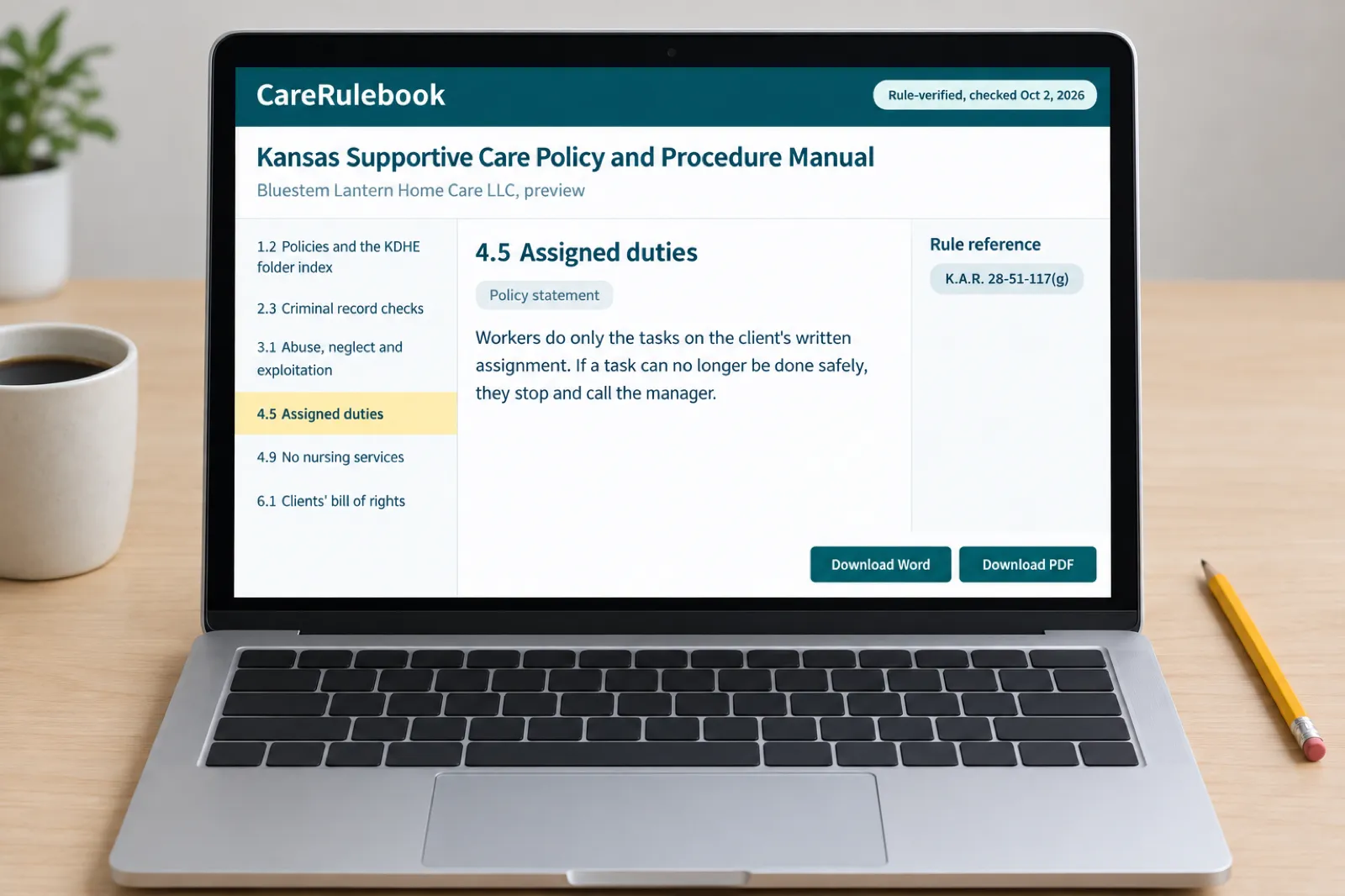
CareRulebook
CareRulebook’s Kansas manual includes Policy 1.1, governing body, bylaws and appointments; Policy 1.3, administrator and alternate administrator; Policy 4.3, client assessment, admission note and plan of care; Policy 4.4, written assignments; and Policy 4.7, manager on call.
$199CareRulebook founding price for the first 50 Kansas agencies, then $249. Not a KDHE fee.
No. For an agency licensed only for supportive care services, the administrator must be at least 21, have at least one year of experience as an employee of a home health agency or in a related health care service, and hold a bachelor’s degree, an associate degree or a certificate from a KDHE-approved home health administrator course. The alternate administrator must meet the same requirements. A nurse may hold the post, but the agency still may not provide nursing services of any kind.
"For each home health agency providing only supportive care services, the administrator shall meet the following requirements:"
No. A supportive-care-only agency needs an administrator, an alternate administrator and a manager, not a nurse. In fact it may not provide nursing services of any kind, and KDHE’s attestation says that includes a nurse supervising or delegating. If you want to offer nursing or Medicaid waiver services, or be paid by Veterans Affairs, you need the Skilled Services license, which requires a registered nurse clinical manager.
"A person that applies for a license to provide only supportive care services shall not provide nursing services."
For an agency licensed only for supportive care services, the administrator must be at least 21, have at least one year of experience as an employee of a home health agency or in a related health care service, and have a bachelor’s degree, an associate degree or a certificate from a home health administrator course approved by KDHE. The administrator must also live within the service area. The alternate administrator must meet all the same requirements (K.A.R. 28-51-103(b)(2), (b)(4) and (c)).
Yes, but only for the education part. The rule asks for one of a bachelor’s degree, an associate degree or a certificate from a KDHE-approved home health administrator course, and separately for a year of experience in a home health agency or related health care service. KDHE’s web page names a KDHE-approved Kansas Home Health Administrator course from Relias Academy and encourages getting KDHE’s pre-approval before enrolling in any other course.
Yes. K.A.R. 28-51-103(c) says the alternate administrator shall meet all the requirements of an administrator, must be available whenever the administrator is not, and is responsible for all the administrator’s duties in the administrator’s absence. KDHE asks for evidence that both live within 200 miles of the parent office.
Not under KDHE’s reading of the current rule. In its April 2026 answers KDHE said the administrator and alternate must live within the service area, a 200-mile radius of the parent office, and that the service area is also defined by the Kansas borders. KDHE’s draft rewrite would let an administrator live in a neighboring county of another state within 60 minutes of the parent office, but that draft is not published or in force.
The manager assesses each client and writes the admission note and plan of care, reviews the plan at least every 60 days, writes each caregiver’s assignments and reviews them every three months, is on call to help caregivers whenever services are provided, visits each client every three months to supervise the caregivers, and signs the discharge summary. Caregivers must show competency before working without the manager present. The manager needs at least one year of experience providing home health services, HCBS or supportive care services.
No, and under this license the manager may not act as a nurse. The rules ask only for an employee who supervises and is available to caregivers whenever services are provided, with at least one year of experience providing home health services, HCBS or supportive care services. KDHE’s attestation says nursing of any kind is prohibited with a supportive care license, including a nurse supervising, assigning, delegating or overseeing. The rules do not say whether someone who holds a nursing license may work as the manager if they never use nursing skills; ask KDHE.
The rules do not say either way. The roles have different qualifications: the administrator needs a degree or approved course plus a year of home health or related health care experience, and the manager needs a year of experience providing home health services, HCBS or supportive care services. KDHE asks for separate job descriptions for the administrator, the alternate and the supervisor or manager. By our reading one qualified person can hold both posts if both job descriptions and the organizational chart say so, but the administrator and the alternate must be two different people. Ask KDHE before you rely on it.
In writing, within five days after the change takes effect, with the new administrator’s or alternate’s name, address and qualifications (K.A.R. 28-51-101(e)). If the change coincides with your yearly renewal, KDHE asks for the Personal Release of Information form with the renewal application. KDHE’s application has an amended application route with a letter of intent for changes; whether KDHE wants an amended application for a new administrator is not stated, so ask.
KDHE has drafted a rewrite of K.A.R. 28-51 that would raise the qualifications for supportive care administrators and spell out the manager’s on-call duty. No official text has been published yet. Leave your email and we will tell you when a Kansas change affects who runs your agency.
No spam. Only emails about Kansas home care rule changes. How we use your email.
Kansas
How to start a home care agency in Kansas
The KDHE supportive care license, why no nursing is allowed, and the 13 folders KDHE reviews.
Kansas
Kansas supportive care assigned duties
The 16 task areas, medication reminders only, transfers and lifts, and when a client needs a skilled agency.
Kansas
The Kansas license application
KDHE’s form, the attestation, the fee and the upload folders.
Kansas
Kansas policies and procedures
Every policy KDHE asks for, folder by folder.
Kansas
Kansas home health vs home care
The Supportive Care and Skilled Services licenses, including the people each one needs.
Manual
Build your Kansas policy manual
Including Policy 1.3 on the administrators and Policy 4.10 on supervision.
Nevada
Nevada administrator and designee
An administrator aged 18 with a diploma or a long-term care administrator license, a designee with access to all records, and no nurse.
Colorado
Colorado manager and supervisor
An HCA manager with set qualifications, an 8-hour course and quarterly supervision.
Tennessee
Who runs a Tennessee PSSA
No set qualifications for the person responsible, and what TDMHSAS checks instead.
Washington
Washington administrator and supervisor
Qualifications your policies set, written alternates and 10 hours of training.
Texas
Texas home care administrator requirements
An administrator, an alternate and 24 hours of training.