Your policies, reviewed and approved
DOH says the policies make up a manual it must review and approve before the license is issued, and that its survey office asks for it after you apply.
DOH 505-109Where are you starting?
Washington · In-home services agency license, home care · Chapter 246-335 WAC
DOH says the policies chapter 246-335 WAC requires make up a manual it must review and approve before it issues your license. Its surveyors work from a published checklist with 60 tags. Here is every tag mapped to the CareRulebook policy that answers it, how DOH wants policies written, the DOH review copy, what the initial survey looks at, and where DOH’s 2018 tools read differently from the rules.
Quick answer
Chapter 246-335 WAC requires a Washington home care agency to have written policies, and the rule says they "must clearly demonstrate compliance with the applicable chapter requirements" (WAC 246-335-320(2)(g)). DOH’s license requirements sheet says they make up a manual "DOH must review and approve before your license can be issued", and that you do not send it with the application: its survey office asks for it later (DOH 505-109).
DOH’s surveyors use the Home Care Policy and Procedure Checklist (DOH 505-141), with 60 tags covering the plan of operation, delivery of services and personnel policies (DOH 505-141). Write the policies in your own words: DOH says they may not be the WAC or RCW copied word for word, and the rule says they may not reference Medicare requirements.
The initial survey, which you must pass to be licensed, focuses on reviewing and approving your policies, sample employee and client files, and your knowledge of the rules (DOH, Survey Program). DOH’s survey tools date from May 2018 and in places read differently from the rules in force; we list each difference below.
DOH explains why it asks for policies: "Well-written P&Ps allow employees to clearly understand their roles and responsibilities within predefined limits." (DOH, Survey Program). From the rule, DOH’s survey page and its license requirements sheet:
The 60 tags stop at WAC 246-335-425. The rest of the home care rules (personnel records, the bill of rights, plans of care, supervision, client records and quality improvement) are on DOH’s deficiency checklist, which runs from Z0325 to Z0985 (DOH 346-099), and DOH’s bill of rights checklist lists each of the 19 bill of rights statements with its tag (DOH 505-145). Other laws add caregiver training, the DSHS background check steps and abuse reporting. Our suggestion: have a policy for each of these too, since DOH says its surveyors use the whole set of tools.
Personnel records
4.8 Personnel, contractor and volunteer records
WAC 246-335-430Client bill of rights
3.1 Client bill of rights
WAC 246-335-435Plan of care and one-time visits
3.2 Plan of care and one-time visits
WAC 246-335-440Supervision of care and the six-month client contact
3.3 Supervisor of direct care services and supervision of care
WAC 246-335-445Client records, release and retention
3.4 Client records: contents, filing, confidentiality and release3.5 Keeping and disposing of records
WAC 246-335-450Quality improvement, complaints and client satisfaction
7.1 Quality improvement program7.2 Complaints7.3 Client satisfaction
WAC 246-335-455Caregiver training and home care aide certification
4.6 Caregiver training and home care aide certification
RCW 74.39A.074; chapter 246-980 WACDSHS background check steps
4.3 Background checks and disclosure statements
RCW 74.39A.056; DOH Updated RulesAbuse, neglect and exploitation reporting
5.1 Mandatory reporting: abuse, neglect, exploitation, abandonment and rule noncompliance
RCW 74.34.035Worker conduct and powers of attorney
5.2 Worker conduct: gifts, money, powers of attorney and photos
RCW 70.127.150; WAC 246-980-150How the CareRulebook manual handles it
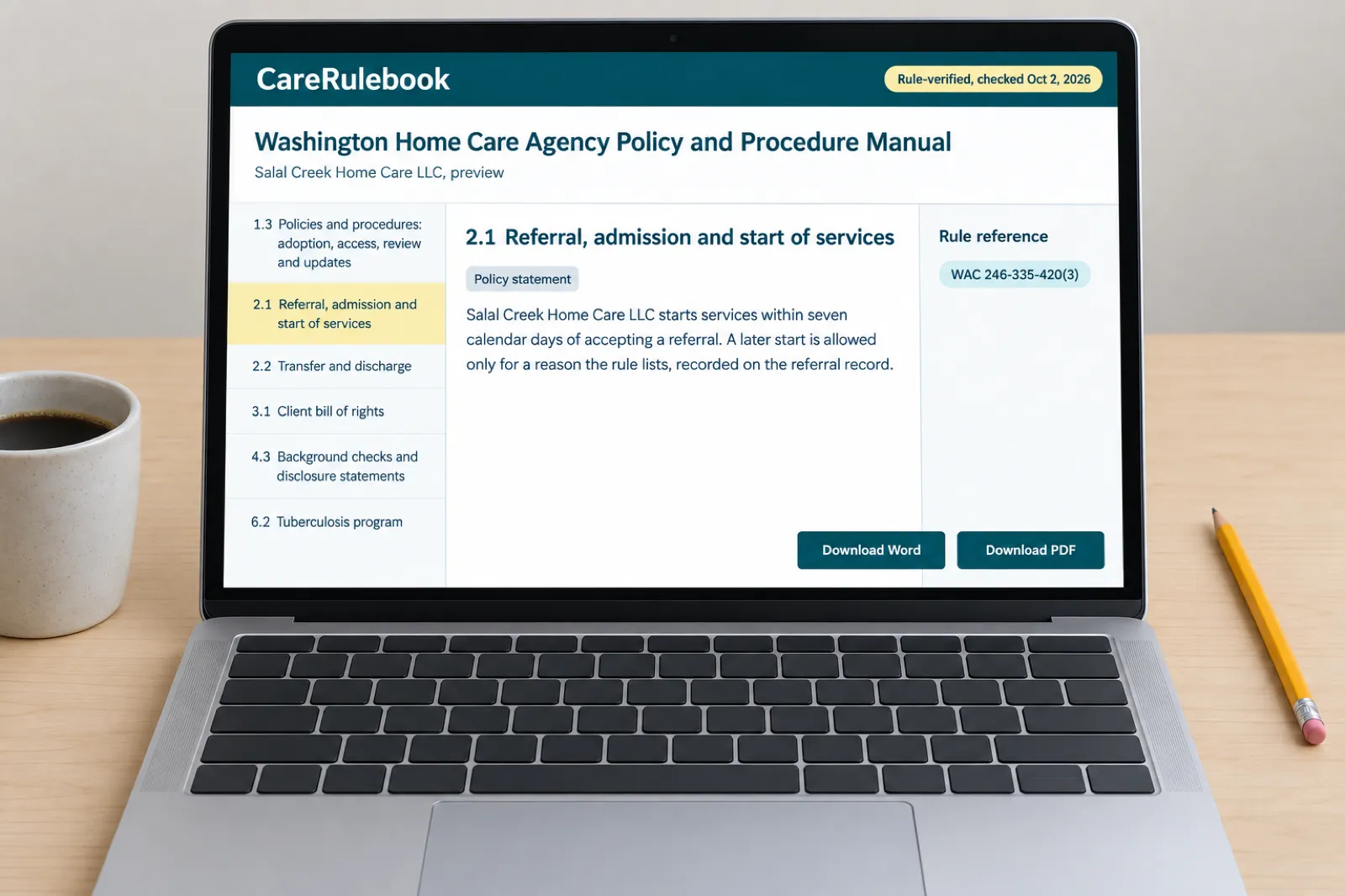
The full CareRulebook manual ends each policy with a "Rule basis" section that quotes the rule text it meets, and closes with a crosswalk of all 154 requirements. That is useful in your own files, but DOH says policies may not be the WAC or RCW copied word for word. So the Washington manual comes with a second download, the DOH review copy:
Our suggestion: send the review copy when DOH’s survey office asks for your manual, unless DOH asks for something else, and keep the full manual on file. DOH has not said whether brief rule quotes inside a policy are acceptable; the review copy avoids the question by leaving the quotes out.
Filter by topic or manual section. Rows citing DOH’s survey page, DOH 505-109 or DOH’s Updated Rules, or DSHS guidance, are what those agencies say; the rest cite the statutes and rules. 7 rows are marked Recommended practice: options the rules allow, protections and duties that fall on workers, or DSHS rules whose reach to a private-pay agency is unclear.
154 rows
| Rule | What it requires | Policy in your manual |
|---|---|---|
| WAC 246-335-415(1) | Plan of operation: organizational structure Describe how the agency is organized (an organizational chart or narrative of key positions). "The applicant or licensee must develop and implement a plan of operation which includes: (1) A description of the organizational structure;" | 1.1 Plan of operation and management across approved counties |
| WAC 246-335-415(2) | Plan of operation: job descriptions Include personnel job descriptions that meet WAC 246-335-425(2). "Personnel job descriptions according to WAC 246-335-425(2);" | 1.1 Plan of operation and management across approved counties4.2 Job descriptions |
| WAC 246-335-415(3) | Plan of operation: contractor and volunteer responsibilities State what contractors and volunteers are responsible for (or that the agency uses none). "Responsibilities of contractors and volunteers;" | 1.1 Plan of operation and management across approved counties1.5 Contractors, volunteers and students |
| WAC 246-335-415(4) | Plan of operation: services List the services the agency provides. "Services to be provided;" | 1.1 Plan of operation and management across approved counties2.3 Home care services and the tasks workers do and do not do |
| WAC 246-335-415(5) | Plan of operation: days and hours State the agency’s days and hours of operation. "The days and hours of agency operation; and" | 1.1 Plan of operation and management across approved counties |
| WAC 246-335-415(6)(a) | Management across service areas: intake and plan of care Describe how intake and the plan of care are completed in every approved county. "How the initial intake and development of the plan of care will be completed per WAC 246-335-440;" | 1.1 Plan of operation and management across approved counties3.2 Plan of care and one-time visits |
| WAC 246-335-415(6)(b) | Management across service areas: supervision Describe how staff and volunteers are supervised and contractors monitored in every approved county. "How supervision of personnel and volunteers and monitoring of services provided by contractors will occur which meet the requirements of WAC 246-335-445;" | 1.1 Plan of operation and management across approved counties3.3 Supervisor of direct care services and supervision of care |
| WAC 246-335-415(6)(c) | Management across service areas: evaluations Describe how performance evaluations and contractor evaluations are done in every approved county. "How performance evaluations for personnel and volunteers and evaluation of services provided by contractors will be conducted per WAC 246-335-425 (13) and (14); and" | 1.1 Plan of operation and management across approved counties4.7 Annual performance and contractor evaluations |
| WAC 246-335-415(6)(d) | Management across service areas: quality improvement Describe how the quality improvement program applies in every approved county. "How the quality improvement program required in WAC 246-335-455 will be applied throughout all approved service areas." | 1.1 Plan of operation and management across approved counties7.1 Quality improvement program |
| WAC 246-335-415(7) | Informing clients of alternatives Have a process to tell clients about alternative services before closing, or when the agency cannot meet their needs. "A process to inform clients of alternative services prior to ceasing operation or when the licensee is unable to meet the client’s needs;" | 2.2 Transfer and discharge1.7 License, office, insurance, renewal, changes and closing |
| WAC 246-335-415(8) | Preserving records on closure Plan how records are preserved, or disposed of, before the agency ceases operation. "A plan for preserving records, including the process to preserve or dispose of records prior to ceasing operation according to WAC 246-335-450 (7) and (8);" | 3.5 Keeping and disposing of records1.7 License, office, insurance, renewal, changes and closing |
| WAC 246-335-415(9) | Time frames for filing client documents Set how soon visit notes and other documents are filed in client records. "Time frames for filing documents in the client records;" | 3.4 Client records: contents, filing, confidentiality and release |
| WAC 246-335-415(10) | Emergency preparedness Plan service delivery when disasters, man-made incidents or public health emergencies stop normal operation: risk assessment and planning, a communication plan, coordination with emergency personnel for clients’ urgent needs, and staff training. "Include, at minimum: Risk assessment and emergency planning, communication plan, coordination of service delivery with emergency personnel to meet emergent needs of clients, and staff training;" | 1.6 Emergency preparedness |
| WAC 246-335-415(11) | Administrator qualifications Name an administrator who is a home care employee, and set in policy the education and experience the role needs. "The applicant or licensee must identify an administrator. The administrator must be a home care employee and possess education and experience required by the agency’s policies." | 1.2 Administrator and alternate administrator4.2 Job descriptions |
| WAC 246-335-415(11)(a)-(b), (e), (g) | Administrator: day-to-day operation The administrator oversees daily operation and fiscal affairs, implements the plan of operation, arranges necessary services and is the liaison between the licensee, staff, contractors and volunteers. "Oversee the day-to-day operation and fiscal affairs of the agency; ... Arrange for necessary services; ... Serve as a liaison between the licensee, personnel, contractors and volunteers;" | 1.2 Administrator and alternate administrator |
| WAC 246-335-415(11)(c) | Administrator: written alternate Designate in writing who acts when the administrator is absent. "Designate in writing an alternate to act in the administrator’s absence;" | 1.2 Administrator and alternate administrator |
| WAC 246-335-415(11)(d) | Administrator: management across service areas The administrator manages and supervises services throughout all approved counties. "Provide management and supervision of services throughout all approved service areas according to subsection (6) of this section;" | 1.2 Administrator and alternate administrator1.1 Plan of operation and management across approved counties |
| WAC 246-335-415(11)(f) | Administrator: contracts current Keep contractor contracts current and consistent with the contracting policy. "Keep contracts current and consistent with WAC 246-335-425(4);" | 1.2 Administrator and alternate administrator1.5 Contractors, volunteers and students |
| WAC 246-335-415(11)(h) | Administrator: current Washington credentials Make sure staff, contractors and volunteers hold current Washington credentials where their work needs one. "Ensure personnel, contractors and volunteers are currently credentialed by the state of Washington, when appropriate, according to applicable practice acts and consistent with WAC 246-335-425(5);" | 1.2 Administrator and alternate administrator |
| WAC 246-335-415(11)(i)-(k) | Administrator: policy compliance, quality and records Make sure everyone follows the agency’s policies, implement quality improvement and manage recordkeeping. "Ensure personnel, contractors and volunteers comply with the licensee’s policies and procedures;" | 1.2 Administrator and alternate administrator1.3 Policies and procedures: adoption, access, review and updates7.1 Quality improvement program |
| WAC 246-335-415(11)(l) | Supplies and equipment Make sure supplies and equipment needed for client care are available, maintained and working. "Ensure supplies and equipment necessary to client care are available, maintained, and in working order;" | 1.2 Administrator and alternate administrator6.1 Infection control: standard precautions, protective equipment and annual review |
| WAC 246-335-415(11)(m) | Accurate public information Make sure brochures, websites and adverts are accurate (and use "home care" only as licensed). "Ensure the accuracy of public information materials; and" | 1.4 Public information, advertising and the “home care” name1.2 Administrator and alternate administrator |
| WAC 246-335-415(11)(n) | Policies accessible to staff Keep current written policies accessible to staff, contractors and volunteers during operating hours. "Ensure current written policies and procedures are accessible to personnel, contractors, and volunteers during hours of operation." | 1.3 Policies and procedures: adoption, access, review and updates1.2 Administrator and alternate administrator |
| WAC 246-335-415(12) | Keep the plan of operation current Update the plan of operation as practice, services and laws change. "The licensee must continue to update its plan of operation to reflect current practice, services provided by the agency, and state and local laws." | 1.1 Plan of operation and management across approved counties1.3 Policies and procedures: adoption, access, review and updates |
| WAC 246-335-420(1) | Admission, transfer, discharge and referral Write and follow procedures for admitting, transferring, discharging and referring clients. "The applicant or licensee must develop and operationalize delivery of services policies and procedures that describe: (1) Admission, transfer, discharge, and referral processes:" | 2.1 Referral, admission and start of services2.2 Transfer and discharge |
| WAC 246-335-420(1)(a) | 48-hour discharge notice Give at least 48 hours’ written or verbal notice before discharge and document it in the client record. "In order to minimize the possibility of client abandonment, clients must be given at least a forty-eight hour written or verbal notice prior to discharge that will be documented in the client record;" | 2.2 Transfer and discharge |
| WAC 246-335-420(1)(b) | When 48 hours’ notice is not needed No 48-hour notice is required where worker safety, significant client noncompliance or non-payment is the reason. "Forty-eight hour notice is not required if home care agency worker safety, significant client noncompliance, or client’s failure to pay for services rendered are the reason(s) for the discharge;" | 2.2 Transfer and discharge |
| WAC 246-335-420(1)(c) | Self-report on a concerning dischargeif the agency discharges a client whose ongoing care and safety concern it When discharging a client whose ongoing care and safety concern the agency, it may self-report to the appropriate state agencies with the reasons and the steps taken. "A home care agency discharging a client that is concerned about their ongoing care and safety may submit a self-report to appropriate state agencies" | 2.2 Transfer and discharge5.1 Mandatory reporting: abuse, neglect, exploitation, abandonment and rule noncompliance |
| WAC 246-335-420(1)(d), (3)(d) | DSHS or AAA contract time framesif the agency has a DSHS or AAA contract Agencies with a DSHS or AAA contract may follow the contract’s discharge notice and start-of-service time frames. "Home care agencies under contract with DSHS or the AAA may follow different time frames for notice of discharge as established in the terms of the contract." | 2.2 Transfer and discharge2.1 Referral, admission and start of services |
| WAC 246-335-420(2) | Nonmedical services available Describe the specific nonmedical services available to meet client or family needs in the plan of care. "Specific nonmedical services available to meet client, or family needs as identified in the plan of care;" | 2.3 Home care services and the tasks workers do and do not do |
| WAC 246-335-420(3) | Start services within seven days Start services within seven calendar days of accepting a referral; a longer time is allowed only when requested or agreed (for example to hire the right caregiver) or the agency could not reach the client, and the reason is documented. "Home care services starting within seven calendar days of receiving and accepting a referral for services. Longer time frames are permitted when one or more of the following is documented:" | 2.1 Referral, admission and start of services |
| WAC 246-335-420(4) | Medication self-administration with assistance Describe what staff, contractors and volunteers may and may not do when helping clients take their own medications. "Agency personnel, contractor, and volunteer roles and responsibilities related to medication self-administration with assistance;" | 2.4 Medication self-administration with assistance |
| WAC 246-945-714 | Medication assistance scope Medication help is limited to reminding, handing, opening, enablers (no hand-over-hand), placing in the hand, setting up diabetic devices and handing injectables; transferring between containers and altering medication only on a practitioner’s direction; no IV or injectable administration. "A nonpractitioner shall only perform the medication assistance described in subsection (1)(h) and (i) of this section, where a practitioner has determined and communicated orally or by written direction that such medication preparation assistance is necessary and appropriate." | 2.4 Medication self-administration with assistance |
| WAC 246-945-718 | Medication assistance restrictions Help only clients cognitively aware they are taking medication, immediately before they take it; otherwise it must be administered by someone legally authorized. "If an individual is not able to administer a medication to themselves independently or with assistance, then the medication must be administered to the individual by a person legally authorized to do so." | 2.4 Medication self-administration with assistance |
| WAC 246-335-420(5) | Coordination of care Describe coordination with the agency’s own home health or hospice services (if licensed for them) and with other agencies when care affects the client’s health. "Coordination of care, including: (a) Coordination among services being provided by a licensee having an additional home health or hospice service category; and (b) Coordination with other agencies when the care being provided impacts client health;" | 2.5 Coordination of care and communication needs |
| WAC 246-335-420(6) | Communication needs Describe how the agency meets client and family communication needs (language, hearing, vision, cognition). "Actions to address client, or family communication needs;" | 2.5 Coordination of care and communication needs |
| WAC 246-335-420(7) | Emergency care of the client Describe what staff do in a client medical emergency. "Emergency care of the client;" | 2.6 Client medical emergencies and death of a client |
| WAC 246-335-420(8) | Back-up care Describe how substitute care is provided when scheduled care cannot be; ADL help only by credentialed or exempt workers, non-credentialed staff only for IADLs or emergencies. "Providing back-up care to the client when services cannot be provided as scheduled. Back-up care which requires assistance with client ADLs must be provided by staff with minimum credentialing or workers who meet the exemption criteria in chapter 246-980 WAC." | 2.7 Back-up care when a visit cannot happen as scheduled |
| WAC 246-335-420(9) | Death of a client Describe what staff do when a client dies or is found dead. "Actions to be taken upon death of a client;" | 2.6 Client medical emergencies and death of a client |
| WAC 246-335-420(10) | Advance directives Describe what the agency does when a client has a signed advance directive. "Actions to be taken when client has a signed advanced directive;" | 2.8 Advance directives and POLST |
| WAC 246-335-420(11) | POLST Describe what staff do when a client has a signed POLST, including giving it to emergency personnel in a medical emergency; an incomplete section means full treatment. "Actions to be taken if a client has a signed POLST form. Any section of the POLST form not completed implies full treatment for that section." | 2.8 Advance directives and POLST2.6 Client medical emergencies and death of a client |
| WAC 246-335-420(12)(a) | Vital signs: informational helpif the agency offers help with taking vital signs If offered, workers only assist clients to take their own vital signs, for information, with electronic digital devices, and pass readings to the client or representative. "Home care agency workers may only assist clients in the process of taking their own vital signs." | 2.9 Help taking vital signs, for information only |
| WAC 246-335-420(12)(b) | Vital signs that guide medicationif the agency helps take vital signs that decide medication If readings decide whether or how much medication to take, contract an RN to decide if nurse delegation is appropriate and to train workers. "Agencies must contract with a registered nurse to determine if nurse delegation is appropriate and train agency worker(s) on taking specific vital signs and to understand how the readings relate to the medications that the client needs to take;" | 2.9 Help taking vital signs, for information only2.11 Nurse delegation and vital signs that guide medication: not offered |
| WAC 246-335-420(13)(a)-(b), (d) | Range of motion: therapist’s planif the agency offers passive range of motion If offered, get a copy of the client’s passive range of motion plan from a PT, OT or qualified RN, dated within 12 months and stating maintenance only; otherwise direct the client to get a new plan. The client gives the agency an updated plan at least yearly. "The plan must clearly state that the passive range of motion is for maintenance purposes only. Passive range of motion for purposes of restoring joint function is outside the scope of a home care agency to provide;" | 2.10 Passive range of motion exercises for maintenance |
| WAC 246-335-420(13)(c) | Range of motion: skills checkif the agency offers passive range of motion Verify and document assigned workers’ range of motion skills before they start. "Ensure and document passive range of motion skills verification of assigned agency workers, consistent with WAC 246-335-425(9), prior to the provision of these services" | 2.10 Passive range of motion exercises for maintenance4.5 Orientation, skills verification and ongoing training |
| WAC 246-335-420(14) | Nurse delegationif the agency provides nurse delegation If offered: only for stable and predictable clients, through a contracted RN delegator (or DSHS/AAA for Medicaid clients), with workers holding DSHS core delegation training. Agencies that do not offer it need no policy. "A licensee with an approved home care service category only may provide nurse delegation in the following ways: (i) Contract with a registered nurse for any client needing nurse delegation;" | 2.11 Nurse delegation and vital signs that guide medication: not offered |
| WAC 246-335-420(14)(d) | Nurse delegation trainingif the agency provides nurse delegation Credentialed workers complete DSHS core delegation training before taking part in delegation. "Home care agency credentialed workers must complete the core delegation training from DSHS prior to participating in the delegation process." | 2.11 Nurse delegation and vital signs that guide medication: not offered4.6 Caregiver training and home care aide certification |
| WAC 246-980-130(6)-(8) | Delegated tasks: consent and exclusionsif the agency provides nurse delegation Delegated tasks are done only for that client, with consent, never injections other than insulin, sterile procedures, central lines or nursing judgment. "Only for the specific patient for whom those tasks are delegated;" | 2.11 Nurse delegation and vital signs that guide medication: not offered |
| WAC 246-335-425(1) | Non-discrimination in employment Set employment criteria consistent with the Washington Law Against Discrimination (chapter 49.60 RCW). "The applicant or licensee must develop and operationalize personnel, contractor, and volunteer policies and procedures that describe: (1) Employment criteria regarding discrimination consistent with chapter 49.60 RCW;" | 4.1 Hiring: employment criteria, references and credential checks |
| WAC 246-335-425(2) | Job descriptions Write job descriptions with responsibilities that fit each credential’s scope of practice. "Job descriptions that contain responsibilities and are consistent with health care professional credentialing and scope of practice as defined in relevant practice acts and rules;" | 4.2 Job descriptions |
| WAC 246-335-425(3) | References Check references for staff, contractors and volunteers. "References for personnel, contractors and volunteers;" | 4.1 Hiring: employment criteria, references and credential checks |
| WAC 246-335-425(4) | Contractingif the agency uses contractors If contractors are used: a contract describing their duties and stating the contractor withholds their own taxes; contractors meet the same rules as staff. "The contract should include, at minimum, a description of the duties the contractor will perform, and a statement indicating that the contractor, not the employer, is responsible for withholding any necessary taxes." | 1.5 Contractors, volunteers and students |
| WAC 246-335-425(5) | Credentials current Verify health care professionals’ credentials are current and in good standing. "Credentials of health care professionals that are current and in good standing;" | 4.1 Hiring: employment criteria, references and credential checks |
| WAC 246-335-425(6) | Background checks and disclosure statements Run Washington State Patrol checks and get DOH-approved disclosure statements for everyone associated with the agency who has contact with children under 16, people with developmental disabilities or vulnerable persons; renew every two years. "Criminal history background checks and disclosure statements for personnel, contractors, volunteers, students, and any other individual associated with the licensee having direct contact with children under sixteen years of age, people with developmental disabilities or vulnerable persons according to RCW 43.43.830 through 43.43.842" | 4.3 Background checks and disclosure statements |
| WAC 246-335-425(6)(a)-(c) | WSP processing, DOH disclosure form, two-year renewal Checks go through the Washington State Patrol, disclosure statements are on DOH’s approved form, and both are renewed within two years. "Criminal history background checks must be processed through the Washington state patrol (WSP); (b) Disclosure statements must be approved by the department" | 4.3 Background checks and disclosure statements |
| DOH Updated Rules guidance | Initial checks through DSHS BCCU DOH says home care agencies run initial hiring checks through DSHS BCCU (which satisfies -425(6)) and two-year rechecks through WSP. "Processing background checks through the BCCU satisfies the requirement in WAC 246-335-425(6)." | 4.3 Background checks and disclosure statements |
| RCW 74.39A.056(1); DSHS private HCA guidance | Fingerprint checks for caregivers Long-term care workers need a state and FBI fingerprint check at initial hire; a worker cleared on the name check may work up to 120 days while fingerprints are pending. "All long-term care workers shall be screened through state and federal background checks in a uniform and timely manner to verify that they do not have a history that would disqualify them from working with vulnerable persons." | 4.3 Background checks and disclosure statements |
| DSHS private HCA guidance | Fingerprint results within 120 days If fingerprint results have not arrived within 120 days of hire the worker cannot keep working unsupervised. "The applicant’s fingerprint results MUST be received by the HCA within 120-days of hire- no exceptions." | 4.3 Background checks and disclosure statements |
| RCW 43.43.834(4); DSHS background check result guidance | Give workers a copy of results Tell the applicant of the Washington State Patrol response within 10 days of receiving it and give them a copy (RCW 43.43.834(4), which covers the two-year WSP rechecks). DSHS’s instructions say the same for BCCU result notifications: keep a copy and give the applicant a copy within 10 days. "The business or organization shall notify the applicant of the state patrol’s response within ten days after receipt by the business or organization. The employer shall provide a copy of the response to the applicant and shall notify the applicant of such availability." | 4.3 Background checks and disclosure statements4.8 Personnel, contractor and volunteer records |
| RCW 43.43.832(5) | Conditional employment pending checks Where the law requires a state or national check, a person may be engaged on a conditional basis pending completion. "persons may be employed or engaged as volunteers or independent contractors on a conditional basis pending completion of the state background investigation" | 4.3 Background checks and disclosure statements |
| RCW 43.43.842(1) | Disqualifying history People with unsupervised access may not have disqualifying convictions or findings, or be the respondent in an active vulnerable adult protection order; they disclose in writing under penalty of perjury. "These additional requirements shall ensure that any person associated with a licensed agency or facility having unsupervised access with a vulnerable adult shall not be the respondent in an active vulnerable adult protection order" | 4.3 Background checks and disclosure statements |
| RCW 74.39A.056(2) | Registry and findings bar Do not employ in care with unsupervised access anyone on the vulnerable adult abuse registry or with a qualifying founded finding. "A provider may not be employed in the care of and have unsupervised access to vulnerable adults if:" | 4.3 Background checks and disclosure statements |
| WAC 246-335-425(7) | Character, competence and suitability Make and document a determination for anyone whose check shows non-disqualifying convictions, pending charges or negative actions, weighing ability to meet care needs, client vulnerability, behavior since, patterns, time elapsed, self-disclosure and other safety concerns. "Factors to consider when making a determination include, but are not limited to: (a) Whether there is a reasonable, good faith belief that they would be unable to meet the care needs of the client;" | 4.4 Character, competence and suitability decisions4.3 Background checks and disclosure statements |
| WAC 246-335-425(8)(a) | Reporting noncompliance to DOH Staff report failures to comply with the rules or statute to DOH on DOH’s forms within 14 calendar days. "Mandatory reporters shall report failure to comply with the requirements of chapters 246-335 WAC and 70.127 RCW to the department. The report must be submitted on department forms." | 5.1 Mandatory reporting: abuse, neglect, exploitation, abandonment and rule noncompliance |
| WAC 246-335-425(8)(b) | Reporting abuse, neglect and exploitation Staff report suspected abandonment, abuse, financial exploitation or neglect immediately to DSHS and to law enforcement. "Mandatory reporters shall report suspected abandonment, abuse, financial exploitation, or neglect of a person in violation of RCW 74.34.020 or 26.44.030 to the department of social and health services and the proper law enforcement agency." | 5.1 Mandatory reporting: abuse, neglect, exploitation, abandonment and rule noncompliance |
| RCW 74.34.035(2)-(3) | Sexual and physical assault reports Suspected sexual assault goes immediately to law enforcement and DSHS; physical assault or acts causing fear of imminent harm go immediately to DSHS and law enforcement. "When there is reason to suspect that sexual assault has occurred, mandated reporters shall immediately report to the appropriate law enforcement agency and to the department." | 5.1 Mandatory reporting: abuse, neglect, exploitation, abandonment and rule noncompliance |
| RCW 74.34.035(5) | Suspicious death If abuse, neglect or abandonment is suspected in a death, report to the medical examiner or coroner, DSHS and local law enforcement. "When there is reason to suspect that the death of a vulnerable adult was caused by abuse, neglect, or abandonment by another person, mandated reporters shall" | 5.1 Mandatory reporting: abuse, neglect, exploitation, abandonment and rule noncompliance2.6 Client medical emergencies and death of a client |
| RCW 74.34.035(8) | What a report contains Reports give as much as possible of: reporter, the vulnerable adult and the agency, guardian, what happened, history, alleged perpetrator and other helpful information. "Each report, oral or written, must contain as much as possible of the following information:" | 5.1 Mandatory reporting: abuse, neglect, exploitation, abandonment and rule noncompliance |
| RCW 74.34.035(7) | No policy may block reporting Agency policies may not interfere with staff’s direct duty to report (for example, by requiring permission first). "may develop policies or procedures that interfere with the reporting requirements of this chapter" | 5.1 Mandatory reporting: abuse, neglect, exploitation, abandonment and rule noncompliance |
| RCW 74.34.180 | No retaliation Whistleblowers who report in good faith have remedies against reprisal, and retaliation against clients who complain is presumed within a year. "An employee or contractor who is a whistleblower and who as a result of being a whistleblower has been subjected to workplace reprisal or retaliatory action, has the remedies provided under chapter 49.60 RCW." | 5.1 Mandatory reporting: abuse, neglect, exploitation, abandonment and rule noncompliance7.2 Complaints |
| WAC 246-335-425(9) | In-person orientation and skills verification Give in-person orientation to current policies and verify skills or training (written test, observation, prior training) before anyone gives care independently. "In-person orientation to current agency policies and procedures and verification of skills or training prior to independently providing client care." | 4.5 Orientation, skills verification and ongoing training |
| WAC 246-335-425(10) | Ongoing training Provide ongoing training relevant to clients’ care needs. "Ongoing training pertinent to client care needs;" | 4.5 Orientation, skills verification and ongoing training |
| WAC 246-335-425(11) | Food safety Safe food storage, preparation and handling following the FDA’s "food safety at home" guidance, and no homemade food for clients. "Safe food storage, preparation and handling practices consistent with the United States Food and Drug Administration’s recommendations for "food safety at home"" | 6.5 Food safety |
| WAC 246-335-425(12)(a) | Standard precautions Hand hygiene, respiratory hygiene and cough etiquette, and personal protective equipment. "Standard precautions such as hand hygiene, respiratory hygiene and cough etiquette, and personal protective equipment;" | 6.1 Infection control: standard precautions, protective equipment and annual review |
| WAC 246-335-425(12)(b) | PPE available Make PPE and other equipment needed for each plan of care available. "Availability of personal protective equipment and other equipment necessary to implement client plans of care;" | 6.1 Infection control: standard precautions, protective equipment and annual review |
| WAC 246-335-425(12)(c)(i) | TB risk assessment at hire Assess every new employee with DOH’s TB risk assessment form and test as the form recommends. "Conducting a TB risk assessment for all new employees upon hire. Agencies must use a tuberculosis risk assessment form provided by the department." | 6.2 Tuberculosis program |
| WAC 246-335-425(12)(c)(ii) | Annual TB risk assessment Reassess all employees for new TB risk factors every year on DOH’s form; retest only those who tested negative and have new risks. "Conducting an annual assessment of new TB risk factors for all employees." | 6.2 Tuberculosis program |
| WAC 246-335-425(12)(c)(iii) | TB training Train workers on TB at hire or orientation using DOH’s TB program materials. "Ensuring workers receive TB related training and education at the time of hire or during new employee orientation." | 6.2 Tuberculosis program4.5 Orientation, skills verification and ongoing training |
| DOH Updated Rules guidance; DOH 343-144 | Use DOH’s Adult TB Risk Assessment DOH says to use its Adult TB Risk Assessment form and test if any of the three boxes is checked. "Agencies must use the department’s Adult TB Risk Assessment form (PDF) and conduct TB testing if any of the three boxes are checked." | 6.2 Tuberculosis program |
| WAC 246-335-425(12)(d) | Communicable disease Say what to do when staff or clients show or report symptoms of a communicable disease in an infectious stage, following chapters 246-100 and 246-101 WAC. "Actions to take when personnel, volunteers, contractors, or clients exhibit or report symptoms of a communicable disease in an infectious stage" | 6.3 Communicable disease symptoms in staff and clients |
| WAC 246-335-425(12)(e)(i) | Bloodborne pathogens risk assessment Assess occupational exposure risk in staff’s working environments (per L&I chapter 296-823 WAC), let it shape policy and training, and check yearly whether a new assessment is needed. "Conducting an initial risk assessment of the environment in which personnel, volunteers, and contractors perform their assigned duties to determine occupational exposure." | 6.4 Bloodborne pathogens and Hepatitis B vaccine |
| WAC 246-335-425(12)(e)(ii) | Hepatitis B vaccine offer If exposure is reasonably anticipated, offer the Hepatitis B series at the agency’s expense; workers may decline. "If the risk assessment concludes that workers have a reasonably anticipated risk of occupational exposure to blood and other potentially infectious materials, agencies must offer workers the Hepatitis B vaccine series at the agency’s expense." | 6.4 Bloodborne pathogens and Hepatitis B vaccine |
| WAC 246-335-425(12)(f) | Annual infection control review Document a yearly review of state and federal health authority guidance on infection control, testing and vaccination, and update training and policies. "Agencies must document an annual review of applicable state and federal health authority recommendations related to infection control practices, communicable disease testing, and vaccinations and update trainings and policies and procedures as necessary." | 6.1 Infection control: standard precautions, protective equipment and annual review1.3 Policies and procedures: adoption, access, review and updates |
| WAC 246-335-425(13) | Annual performance evaluations Evaluate every staff member and volunteer who gives direct care each year, including on-site observation of care and skills. "Annual performance evaluations of all personnel and volunteers providing direct client care, including on-site observation of care and skills specific to the care needs of clients" | 4.7 Annual performance and contractor evaluations |
| WAC 246-335-425(14) | Annual contractor evaluationsif the agency uses direct care contractors Evaluate direct care contractors’ services each year. "Annual evaluations of services provided by contractors providing direct client care." | 4.7 Annual performance and contractor evaluations1.5 Contractors, volunteers and students |
| WAC 246-335-430(1) | Records: credential or exemption Keep each worker’s current credential, or documentation that a non-credentialed long-term care worker meets a chapter 246-980 WAC exemption. "Current practice certification, credential, licensure, or documentation that noncredentialed long-term care workers meet the exemption criteria in chapter 246-980 WAC, as applicable;" | 4.8 Personnel, contractor and volunteer records4.6 Caregiver training and home care aide certification |
| WAC 246-335-430(2)-(5) | Records: references, orientation, contracts, skills Keep reference checks, evidence of orientation, contracts and skills or training verification. "Documentation of references; (3) Evidence of orientation to current agency policies and procedures; (4) Contracts when using contractors; (5) Verification of personnel, contractor, and volunteer skills or training specific to meeting the care needs of clients;" | 4.8 Personnel, contractor and volunteer records |
| WAC 246-335-430(6) | Records: background checks Keep evidence of initial and later background checks and disclosure statements. "Evidence of initial and subsequent criminal history background checks and disclosure statements according to RCW 43.43.830 through 43.43.842 and this chapter;" | 4.8 Personnel, contractor and volunteer records4.3 Background checks and disclosure statements |
| WAC 246-335-430(7) | Records: policy training Keep records of training on current and revised policies, including client care issues. "Training on current and revised agency policies and procedures, including client care issues;" | 4.8 Personnel, contractor and volunteer records |
| WAC 246-335-430(8) | Records: food handlingif staff prepare food for clients independently For staff who prepare food for clients independently: food worker card, equivalent FDA training, or home care aide certification. "Documentation for personnel, contractors, and volunteers who prepare food for the client independent of the client’s assistance, including:" | 4.8 Personnel, contractor and volunteer records6.5 Food safety |
| WAC 246-335-430(9) | Records: testing and vaccination Keep communicable disease testing and vaccination records as current health authority guidance recommends. "Communicable disease testing and vaccination according to current state and federal health authority recommendations; and" | 4.8 Personnel, contractor and volunteer records6.2 Tuberculosis program |
| WAC 246-335-430(10) | Records: evaluations Keep documentation of performance and contractor evaluations. "Documentation of performance evaluations of personnel and volunteers providing direct client care and evaluations of services provided by contractors providing direct client care" | 4.8 Personnel, contractor and volunteer records4.7 Annual performance and contractor evaluations |
| RCW 74.39A.074(1) | Entry-level training within 120 days Non-exempt long-term care workers complete 75 hours of DSHS-approved training within 120 days of hire, 5 hours (orientation and safety) before giving any care. "all persons hired as long-term care workers must meet the minimum training requirements in this section within one hundred twenty calendar days after the date of being hired." | 4.6 Caregiver training and home care aide certification |
| WAC 246-980-020, -030, -040 | Home care aide certification Non-exempt direct care employees apply for certification within 14 days of hire and must stop giving care if training is not done in 120 days or certification in 365 days (425 provisional), the 2025 to 2027 timelines. "A long-term care worker is no longer eligible to provide care without a credential under the following circumstances:" | 4.6 Caregiver training and home care aide certification |
| WAC 246-980-025 | Documenting exemptions Know which workers are exempt (nurses, CNAs, limited-hour, family-only, pre-2012 workers, CNA trainees) and document the basis. "Long-term care workers who are exempt from obtaining a home care aide certification may be required to complete minimum training requirements under RCW 74.39A.074 or 74.39A.076." | 4.6 Caregiver training and home care aide certification4.8 Personnel, contractor and volunteer records |
| RCW 74.39A.341; WAC 246-980-110 | Continuing education Track 12 hours of continuing education a year for long-term care workers; home care aides need it to renew. "A home care aide shall demonstrate completion of 12 hours of continuing education per year as required by RCW 74.39A.341." | 4.6 Caregiver training and home care aide certification |
| WAC 388-71-0971 | Verify training and certification before hiring DSHS’s rule says the employer reviews and verifies a worker’s highest training or certification (and continuing education for the hiring year) before hiring. It cites a "home care agency" definition no longer in RCW 74.39A.009, so whether it binds private-pay agencies is unclear; treat as good practice. "must review and verify the highest level of training or certification achieved by the individual." | 4.6 Caregiver training and home care aide certification4.1 Hiring: employment criteria, references and credential checks |
| WAC 388-71-0970(2) | Keep training certificates DSHS’s rule says a home care agency keeps a copy of each worker’s training certificate or transcript on file. "A home care agency must keep a copy of the proof of completion as specified in subsection (1) of this section on file." | 4.6 Caregiver training and home care aide certification4.8 Personnel, contractor and volunteer records |
| WAC 388-71-0980(1) | Rehiring workers who never finished training Do not employ a former long-term care worker who never completed required training or certification unless their date of hire is reset under DSHS’s rule. "a home care agency or consumer directed employer must not employ the individual to work as a LTC worker until the individual has completed the required training certification unless the date of hire has been reset" | 4.6 Caregiver training and home care aide certification4.1 Hiring: employment criteria, references and credential checks |
| WAC 246-980-150 | Caregiver standards of practice Long-term care workers may not borrow from or solicit clients, accept gifts above twice the hourly minimum wage, take client drugs or alcohol, work impaired, hold power over client finances or decisions, be the client’s landlord, or photograph clients without written permission. These bind each worker; the manual should say so. "A long-term care worker must demonstrate behavior which maintains and respects client or resident rights and safety." | 5.2 Worker conduct: gifts, money, powers of attorney and photos |
| RCW 70.127.150 | No power of attorney for clients No owner, contractor or employee may hold a durable power of attorney for a client. "No licensee, contractee, or employee may hold a durable power of attorney on behalf of any individual who is receiving care from the licensee." | 5.2 Worker conduct: gifts, money, powers of attorney and photos3.1 Client bill of rights |
| WAC 246-335-435 | Written bill of rights at admission Give each client (or family member or legal representative) a written bill of rights at admission. "A home care agency at the time of admission must provide each client, designated family member, or legal representative with a written bill of rights affirming each client’s right to:" | 3.1 Client bill of rights |
| WAC 246-335-435(1)-(3) | Rights: quality care and planning Quality services under the plan of care, appropriately trained or credentialed staff, and ongoing participation in developing the plan of care. "Receive quality services from the home care agency for services identified in the plan of care; (2) Be cared for by appropriately trained or credentialed personnel, contractors and volunteers with coordination of services;" | 3.1 Client bill of rights |
| WAC 246-335-435(4) | Rights: choice of agency Access to DOH’s list of licensed home care agencies and the right to choose any licensee, subject to payment arrangements. "A statement advising of the right to have access to the department’s listing of licensed home care agencies and to select any licensee to provide care" | 3.1 Client bill of rights |
| WAC 246-335-435(5)-(7) | Rights: services, refusal, supervisor A list of all services offered and those provided, the right to refuse specific services, and the name and contact details of the person supervising the client’s care. "The name of the individual within the home care agency responsible for supervising the client’s care and the manner in which that individual may be contacted;" | 3.1 Client bill of rights3.3 Supervisor of direct care services and supervision of care |
| WAC 246-335-435(8)-(11) | Rights: respect, safety, property, privacy Courtesy, respect and privacy; freedom from abuse, neglect, exploitation and discrimination; respect for property; confidentiality of personal and health information. "Be free from verbal, mental, sexual, and physical abuse, neglect, exploitation, and discrimination;" | 3.1 Client bill of rights |
| WAC 246-335-435(12)-(13) | Rights: charges and billing What the agency charges, what insurance or public programs may pay, what the client pays, and an itemized bill on request (not required for managed care plans). "Be informed of what the home care agency charges for services, to what extent payment may be expected from care insurance, public programs, or other sources, and what charges the client may be responsible for paying;" | 3.1 Client bill of rights |
| WAC 246-335-435(14) | Rights: advance directives and POLST Information about advance directives and POLST and the agency’s scope of responsibility. "Be informed about advanced directives and POLST, and the agency’s scope of responsibility;" | 3.1 Client bill of rights2.8 Advance directives and POLST |
| WAC 246-335-435(15)-(16) | Rights: discharge and back-up care policies The agency’s policies on when it may discharge a client and on back-up care. "Be informed of the agency’s policies and procedures regarding the circumstances that may cause the agency to discharge a client;" | 3.1 Client bill of rights2.2 Transfer and discharge2.7 Back-up care when a visit cannot happen as scheduled |
| WAC 246-335-435(17) | Rights: complaint process How clients and family complain to the agency and have complaints addressed without retaliation. "A description of the agency’s process for clients and family to submit complaints to the home care agency about the services and care they are receiving and to have those complaints addressed without retaliation;" | 3.1 Client bill of rights7.2 Complaints |
| WAC 246-335-435(18)-(19) | Rights: DOH and End Harm hotlines DOH’s complaint hotline number and DSHS’s End Harm hotline number. "Be informed of the department’s complaint hotline number to report complaints about the licensed agency or credentialed health care professionals; and (19) Be informed of the DSHS end harm hotline number" | 3.1 Client bill of rights7.2 Complaints5.1 Mandatory reporting: abuse, neglect, exploitation, abandonment and rule noncompliance |
| WAC 246-335-435(20) | Rights implemented and updated Make sure the rights are carried out and the document kept up to date. "The home care agency must ensure that the client rights under this section are implemented and updated as appropriate." | 3.1 Client bill of rights |
| WAC 246-335-440(1) | Written plan of care Develop and follow a written plan of care for each client, with the client’s (or family’s or representative’s) input and written approval. "Develop and implement a written home care plan of care for each client with input and written approval by the client, designated family member, or legal representative;" | 3.2 Plan of care and one-time visits |
| WAC 246-335-440(2) | Plan from an on-site visit Plans are developed by trained or credentialed staff, list requested or recommended services, and are based on an on-site visit, following agency policy. "Ensure each plan of care is developed by appropriately trained or credentialed agency personnel, lists services requested or recommended to meet client needs, and is based on an on-site visit and according to agency policies and procedures;" | 3.2 Plan of care and one-time visits |
| WAC 246-335-440(3) | Plan of care contents Functional limitations; nutrition needs and food allergies; relevant equipment and supplies; whether there is a signed advance directive or POLST; nurse delegation tasks if any; the specific nonmedical services and how often. "Ensure the home care plan of care includes: (a) The client’s functional limitations; (b) Nutritional needs and food allergies for meal preparation;" | 3.2 Plan of care and one-time visits |
| WAC 246-335-440(3)(c)-(f) | Plan of care: equipment, directives, delegation, services The plan also lists equipment, directive or POLST status, delegated tasks and the services with their frequency. "Specific nonmedical services to be provided and their frequency." | 3.2 Plan of care and one-time visits |
| WAC 246-335-440(4)(a) | Review every 12 months Review the plan on-site, update it and get it signed by staff and the client every 12 months and whenever care needs change significantly. "Ensure the plan of care is reviewed on-site, updated, approved and signed by appropriate agency personnel and the client, designated family member, or legal representative every twelve months" | 3.2 Plan of care and one-time visits |
| WAC 246-335-440(4)(b) | Reporting condition changes Have a system so the supervisor learns of changes in a client’s condition that need a plan update. "Inform the supervisor of direct care services regarding changes in the client’s condition that indicate a need to update the plan of care." | 3.2 Plan of care and one-time visits3.3 Supervisor of direct care services and supervision of care |
| WAC 246-335-440(5) | One-time visitsif the agency provides one-time visits For a one-time visit, record name, age, address and phone, confirmation the bill of rights was given, consent, and services provided, instead of a full plan. "Home care agencies providing a one-time visit for a client may provide the following written documentation in lieu of the home care plan of care requirements" | 3.2 Plan of care and one-time visits |
| WAC 246-335-440(6) | DSHS CARE assessment as the planif the agency has an AAA contract for Medicaid clients AAA-contracted agencies may use the DSHS CARE assessment details and service summary as the plan of care if it covers every required item. "may use the DSHS CARE assessment details and service summary, or successor assessment tool, as the plan of care if it covers all items in subsection (3) of this section" | 3.2 Plan of care and one-time visits |
| WAC 246-335-445(1)-(2) | Supervisor and alternate Employ a supervisor of direct care services, who names a similarly qualified alternate in writing. "The supervisor of direct care services must designate in writing a similarly qualified alternate to act in the supervisor’s absence;" | 3.3 Supervisor of direct care services and supervision of care4.2 Job descriptions |
| WAC 246-335-445(3) | Supervisor: 10 hours training a year The supervisor and alternate each complete and document at least ten hours of relevant training a year (in-services, classes, conferences, emergency duties). "Training must be documented and maintained in the personnel files." | 3.3 Supervisor of direct care services and supervision of care4.5 Orientation, skills verification and ongoing training |
| WAC 246-335-445(4) | Supervisor available during care hours The supervisor or designee is available whenever clients are receiving care. "The supervisor or designee must be available during all hours of client care;" | 3.3 Supervisor of direct care services and supervision of care |
| WAC 246-335-445(5)(a)-(e) | Supervisor duties Supervise all care by staff and volunteers, evaluate contractors, coordinate and revise written client care policies, coordinate with other providers, and ensure care follows the plan. "Coordination, development, and revision of written client care policies;" | 3.3 Supervisor of direct care services and supervision of care1.3 Policies and procedures: adoption, access, review and updates |
| WAC 246-335-445(5)(f) | Workers report changes All direct care workers observe and report changes in a client’s condition and needs to the supervisor or designee. "All direct care personnel, contractors, and volunteers observe and recognize changes in the client’s condition and needs, and report any changes to the supervisor of direct care services or the designee;" | 3.3 Supervisor of direct care services and supervision of care2.6 Client medical emergencies and death of a client |
| WAC 246-335-445(5)(g) | Workers start emergency procedures All direct care workers initiate emergency procedures under agency policy. "All direct care personnel, contractors, and volunteers initiate emergency procedures according to agency policy;" | 2.6 Client medical emergencies and death of a client |
| WAC 246-335-445(5)(h) | Workers read the plan first Each worker reviews the plan of care and any written instructions before giving care and whenever the plan changes. "Each home care agency worker reviews the plan of care and any additional written instructions for the care of each client prior to providing home care services and whenever there is a change in the plan of care" | 3.2 Plan of care and one-time visits3.3 Supervisor of direct care services and supervision of care |
| WAC 246-335-445(5)(i) | Medication help follows policy Each worker assists with medications only as agency policy and the rules allow. "Each home care agency worker assists with medications according to agency policy and this chapter." | 2.4 Medication self-administration with assistance3.3 Supervisor of direct care services and supervision of care |
| WAC 246-335-445(6) | Six-monthly client contact The supervisor contacts each client by phone or visit every six months to check the plan is followed and the client is satisfied, and documents it. "The supervisor of direct care services must conduct and document client contact by phone or visit every six months to evaluate compliance with the plan of care and to assess client satisfaction with care." | 3.3 Supervisor of direct care services and supervision of care7.3 Client satisfaction |
| WAC 246-335-450(1) | A current record for each client Keep a current record for each client consistent with the health care information law (chapter 70.02 RCW). "Maintain a current record for each client consistent with chapter 70.02 RCW;" | 3.4 Client records: contents, filing, confidentiality and release |
| WAC 246-335-450(2)(a)-(g) | How records are kept Accessible at the office to staff and DOH, legible in permanent ink or electronic, on standard forms, legally acceptable, confidential, chronological, and fastened together if on paper. "Accessible in the licensee’s office location for review by appropriate direct care personnel, volunteers, contractors, and the department;" | 3.4 Client records: contents, filing, confidentiality and release |
| WAC 246-335-450(2)(h) | Records kept current per policy File documents within the time frames the agency’s policy sets. "Kept current with all documents filed according to agency time frames per agency policies and procedures." | 3.4 Client records: contents, filing, confidentiality and release |
| WAC 246-335-450(3) | Record contents Name, age, address and phone; consent; payment source and client responsibility; plan of care; signed, dated visit notes for every contact; supervision records; anything else the chapter requires. "Signed or electronically authenticated and dated notes documenting and describing services provided during each client contact;" | 3.4 Client records: contents, filing, confidentiality and release |
| WAC 246-335-450(5) | Client access to records Records belong to the agency, but clients may access their own. "Consider the records as property of the licensee and allow the client access to his or her own record; and" | 3.4 Client records: contents, filing, confidentiality and release |
| WAC 246-335-450(6) | Information on transfer On request and under agency policy, give client information or a care summary when a client transfers or is discharged to another provider. "Upon request and according to agency policy and procedure, provide client information or a summary of care when the client is transferred or discharged to another agency or facility." | 2.2 Transfer and discharge3.4 Client records: contents, filing, confidentiality and release |
| WAC 246-335-450(7) | Retention periods Adults: three years after services end; minors: three years after age 18 or five years after discharge, whichever is longer; deceased clients: three years. "Minors - Three years after attaining age eighteen, or five years following discharge, whichever is longer" | 3.5 Keeping and disposing of records |
| WAC 246-335-450(8) | Security, release and closure Store records securely against loss and unauthorized use, release them only under chapter 70.02 RCW, and after closing keep or dispose of them confidentially for the retention period. "Store client records in a safe and secure manner to prevent loss of information, to maintain the integrity of the record, and to protect against unauthorized use;" | 3.4 Client records: contents, filing, confidentiality and release3.5 Keeping and disposing of records |
| WAC 246-335-455 | Quality improvement program Run a quality improvement program across all approved counties. "Every home care licensee must develop and operationalize a quality improvement program to ensure the quality of care and services provided throughout all approved service areas" | 7.1 Quality improvement program |
| WAC 246-335-455(1) | Complaint procedure A procedure for receiving, investigating and resolving complaints about services. "A complaint process that includes a procedure for the receipt, investigation, and disposition of complaints regarding services provided;" | 7.2 Complaints |
| WAC 246-335-455(2) | Finding and fixing problems A method to identify, monitor, evaluate and correct problems raised by clients, families, staff, contractors or volunteers. "A method to identify, monitor, evaluate, and correct problems identified by clients, families, personnel, contractors, or volunteers; and" | 7.1 Quality improvement program |
| WAC 246-335-455(3) | Client satisfaction A system to assess client satisfaction with the agency’s overall services. "A system to assess client satisfaction with the overall services provided by the agency." | 7.3 Client satisfaction7.1 Quality improvement program |
| WAC 246-335-320(2)(g) | Policies demonstrate compliance Policies cover the chapter for the home care category and clearly show compliance; no Medicare references. "Policies and procedures addressing the content of this chapter for the service category(ies) to be provided." | 1.3 Policies and procedures: adoption, access, review and updates1.8 DOH surveys and plans of correction |
| DOH Survey Program guidance | Policies in the agency’s own words DOH says policies may not be the WAC or RCW copied word for word. "P&Ps may not consist of the WAC or RCW copied word for word" | 1.3 Policies and procedures: adoption, access, review and updates |
| DOH 505-109 (April 2026) | Review templates before submission Applicants who used AI or templates review the documents thoroughly for legal accuracy, WAC applicability and fit with their actual workflows before submitting. "This includes verifying legal and regulatory accuracy, Washington Administrative Code provisions and applicability, and ensuring the facility’s workflows and staff responsibilities reflect the current practice." | 1.3 Policies and procedures: adoption, access, review and updates1.8 DOH surveys and plans of correction |
| WAC 246-335-335(2)-(3) | In-state office and license display Keep at least one Washington office holding the records, and display the license there. "Maintain at least one in-state office location where records are kept, secured, and accessible;" | 1.7 License, office, insurance, renewal, changes and closing |
| WAC 246-335-335(4) | Cooperate with surveys Cooperate with DOH surveys, including record review and home visits with client consent. "Cooperate with the department during surveys which may include reviewing licensee records and conducting on-site visits with client or patient consent;" | 1.8 DOH surveys and plans of correction |
| WAC 246-335-335(5) | Notify DOH within 30 days Tell DOH in writing within 30 days of a new administrator or supervisor, opening or closing an office, ceasing home care, or reducing service areas. "Changes of administrator, director of clinical services, or supervisor of direct care services;" | 1.7 License, office, insurance, renewal, changes and closing |
| WAC 246-335-335(6) | Approval before serving new counties File an amended application and get approval before serving a new county. "Request approval to expand state licensing home care, home health, or hospice service areas, by submitting an amended application" | 1.7 License, office, insurance, renewal, changes and closing1.1 Plan of operation and management across approved counties |
| WAC 246-335-325 | Renewal package At least 30 days before expiry: renewal application, insurance evidence, FTE worksheet, current checks and disclosure statements for the administrator and supervisor (renewed within two years), organizational structure and fee. "Copies of the most current criminal history background checks and disclosure statements for the administrator, director of clinical services, or supervisor of direct care services" | 1.7 License, office, insurance, renewal, changes and closing |
| WAC 246-335-320(2)(b), -325(2) | Insurance kept in force Keep commercial general liability cover of $1 million per occurrence or $2 million combined, with evidence at renewal. "Evidence of continuing insurance coverage according to WAC 246-335-320 (2)(b);" | 1.7 License, office, insurance, renewal, changes and closing |
| WAC 246-335-330(6)-(7) | Change of ownership noticeif ownership changes At least 30 days before the change, the current licensee files DOH’s change of ownership form, and the prospective new owner files a change of ownership application with DOH’s change of ownership fee ($500 per licensed service category, a state fee set in WAC 246-335-990). "At least thirty days prior to changing ownership of an in-home services agency, the licensee must submit to the department a change of ownership form as provided by the department." | 1.7 License, office, insurance, renewal, changes and closing |
| WAC 246-335-345(2), (6) | Plan of correctionif DOH issues a statement of deficiencies Submit a signed plan of correction within ten working days of a statement of deficiencies and finish corrections within 60 days. "The licensee shall sign and return the completed plan of correction or directed plan of correction to the department on or before the required date." | 1.8 DOH surveys and plans of correction |
| WAC 246-335-355(6) | Keep approved exemptionsif DOH has granted an exemption Keep a copy of any DOH-approved exemption available at all times. "The licensee must retain a copy of each approved exemption and have them available at all times." | 1.7 License, office, insurance, renewal, changes and closing |
| RCW 70.127.030(3)-(4) | Use of "home care" in names and adverts Use "home care" or "in-home services" in the name or advertising only for licensed services; do not advertise home health or hospice without those categories. ""Home care agency," "home care services," or "home care" in its corporate or business name, or advertise using such words unless licensed to provide those services under this chapter" | 1.4 Public information, advertising and the “home care” name |
The rule says "An initial announced survey conducted by the department will confirm the applicant meets the requirements of this chapter." (WAC 246-335-320(3)), and DOH says "Applicants must pass the survey process in order for their license to be issued." (DOH, License Requirements). DOH’s surveyors are registered nurses with home care, home health and hospice experience (DOH, Survey Program).
DOH says the policies make up a manual it must review and approve before the license is issued, and that its survey office asks for it after you apply.
DOH 505-109DOH’s personnel survey tool lists what it looks for in a staff file, from credentials, references and orientation to background checks, disclosure statements, training on your policies, TB and Hepatitis B records. DOH also publishes a client record review.
DOH 655-014DOH says the initial survey looks at your demonstrated knowledge of the in-home services rules and of how care is delivered to clients.
DOH Survey ProgramDOH’s own words: "Initial licensure surveys focus primarily on reviewing and approving an applicant’s policies and procedures, sample employee and client/patient files, and demonstrated knowledge of the in-home services rules and client/patient delivery of care." (DOH, Survey Program)
An applicant with no clients yet. We did not find DOH guidance on what sample client files should be before you serve anyone. CareRulebook’s Policy 1.8 has a complete personnel file ready for each person already hired and a full set of blank client forms, and has the administrator ask DOH’s survey office when the survey is scheduled. That is our approach, not a DOH instruction.
If surveyors find problems. You send a written plan of correction within ten working days of receiving the statement of deficiencies and complete corrections within 60 days unless DOH allows longer (WAC 246-335-345(2)). DOH’s survey page says "The POC must describe: How each deficiency will be or was corrected; what measures or monitors will be put in place to ensure the deficiencies do not recur; who is responsible for correcting each deficiency; and when each deficiency will be or has been corrected." (DOH, Survey Program). DOH may charge $5,000 for an on-site follow-up survey it deems necessary to complete the survey process (WAC 246-335-990(6)); that is DOH’s fee, not a CareRulebook charge. All of this sits inside the nine months the rule gives you to finish every step (WAC 246-335-320(4)).
After licensing, "Initial surveys are scheduled and announced; on-going surveys are unannounced." DOH says ongoing surveys focus mainly on how care is delivered, interviews with clients and staff, and randomly selected files (DOH, Survey Program).
DOH’s home care survey tools are all dated May 2018. Since then, rules on caregiver certification have changed, and in a few places the tools use wording from other service categories or point to other subsections. These are differences between the documents, as we read them; we found no DOH statement on which to follow.
| Tool and place | What the tool says | What the rules or DOH’s guidance say |
|---|---|---|
| Policy checklist (DOH 505-141)Z0395 to Z0440 | The administrator is a "home health employee". DOH 505-141, Z0395 to Z0440 | A home care employee (WAC 246-335-415(11)). The checklist itself says "home care employee" from Z0445. |
| Policy checklist (DOH 505-141)Z0355 to Z0370 | Management and supervision of "home health services" across service areas. DOH 505-141, Z0355 to Z0370 | Home care services (WAC 246-335-415(6)). |
| Policy checklist (DOH 505-141)Z0355 | How the "initial assessment" and plan of care are completed. DOH 505-141, Z0355 | How the initial intake and plan of care are completed (WAC 246-335-415(6)(a)). |
| Policy checklist (DOH 505-141)Z0375 to Z0385 | "Patients" and "patient records". DOH 505-141, Z0375 | Clients and client records (WAC 246-335-415(7)-(9)). |
| Policy checklist (DOH 505-141)Z0365 | Evaluations "per WAC 246-335-425 (16) and (17)". DOH 505-141, Z0365 | WAC 246-335-425(13) and (14) are the evaluation subsections. |
| Personnel tool (DOH 655-014)Z0655 | Rows for an "Initial WSP" criminal background check and a WSP recheck every two years. DOH 655-014, Z0655 | DOH’s Updated Rules page sends a home care agency’s initial hiring checks through DSHS’s Background Check Central Unit, and the two-year rechecks through WSP. |
| Personnel tool (DOH 655-014)Z0950 | A "CPR" column. DOH 655-014, page 1 | By our search, no home care rule requires CPR, and DOH’s deficiency checklist uses Z0950 for client record documentation. |
| Long-term care worker checklist (DOH 346-097)Type 1 | Certification within 200 days of the date of hire. DOH 346-097, Type 1 | 365 days, or 425 with a provisional certificate, for applications submitted by December 31, 2027 (WAC 246-980-030(2)(b)). The statute’s 200 days returns after that. |
Our reading: write your policies to the rule text in force, use DOH’s tag numbers to show where each tag is answered, and if a surveyor raises a difference, point to the rule and ask DOH. That is what CareRulebook’s manual does: Policy 1.3 says so, and the caregiver policies follow the current certification deadlines (WAC 246-980-030(2)(b)) and DOH’s current background check guidance (DOH, Updated Rules).
Whichever manual you use, including ours, check these 6 things first.
Does every one of the 60 tags have a policy?
Including the optional services: a policy for each one you offer, and a clear statement for each one you do not. DOH 505-141
Is it in your agency’s own words?
Each policy should say who does what, when and how it is recorded, and cite the rule, not reproduce it. DOH says policies may not be the WAC or RCW copied word for word. DOH Survey Program page
Is it free of Medicare and accreditation references?
The rule allows no reference to federal Medicare requirements, and a reference to an accrediting organization’s requirements only if you are accredited by it. Watch for manuals written for home health agencies. WAC 246-335-320(2)(g)(i)
Does it say "client" and "home care", not "patient" and "home health"?
A manual that copies the wording of DOH’s 2018 checklist, or of a home health manual, can end up describing the wrong kind of agency. DOH 505-141
Does it follow the current caregiver deadlines?
14 days to apply for certification, 75 hours of training within 120 days, and certification within 365 days (425 with a provisional certificate) for applications submitted by December 31, 2027. WAC 246-980-030
Does it describe what you will really do?
DOH asks anyone who used AI tools or templates to check that the workflows and staff responsibilities match current practice before submitting. DOH 505-109
CareRulebook
Answer a few questions and CareRulebook writes the Washington policies and forms for your agency, in your agency’s name, with each policy built on the rule it cites. Recommended practice goes in the full manual only if you choose it, and never in the DOH review copy. Read every policy before you adopt it: DOH asks anyone who used a template to review it before submitting.
$199CareRulebook founding price for the first 50 Washington agencies, then $249. Not a DOH fee; DOH’s $5,000 initial license fee is separate.
No. DOH’s survey page says policies may not consist of the WAC or RCW copied word for word. Write what your agency does, who does it and how it is recorded, and cite the rule it meets.
"P&Ps may not consist of the WAC or RCW copied word for word"
No. The checklist covers three rule sections (WAC 246-335-415, -420 and -425). The rules on the bill of rights, plans of care, supervision, client records and quality improvement (-435 to -455) also set duties your agency must carry out, and DOH’s deficiency checklist covers them. Caregiver training, the DSHS background check steps and abuse reporting come from other laws.
"Develop and implement a written home care plan of care for each client with input and written approval by the client, designated family member, or legal representative;"
No. The rule says home care agencies that do not provide nurse delegation do not need a policy for it. DOH’s checklist still lists the tag (Z0535), so CareRulebook’s manual includes a short policy saying the agency does not offer it and what it would do before it did. That is our choice, not a rule.
"Home care agencies are not required to provide nurse delegation services and do not need a policy if they do not provide these services"
It depends. DOH says applicants may buy generic manuals, but the policies must clearly demonstrate compliance with chapter 246-335 WAC, must not reference Medicare requirements, and must not simply copy the WAC word for word. DOH says it reviews and approves the manual before licensing, so by our reading a generic manual needs rewriting for Washington and for how your agency actually works.
"Home care agency policies and procedures will not reference federal medicare requirements"
Yes. Chapter 246-335 WAC requires a plan of operation and policies on the delivery of services and on personnel, contractors and volunteers, and the rule says policies and procedures must clearly demonstrate compliance with the chapter (WAC 246-335-320(2)(g)). DOH’s license requirements sheet says the policies together make up a manual that DOH must review and approve before it issues your license.
No. DOH’s license requirements sheet (DOH 505-109, April 2026) says not to submit the manual with the application, and that its survey office will request it later in the licensing process.
DOH publishes the Home Care Policy and Procedure Checklist (DOH 505-141, May 2018). It has 60 survey tags, Z0330 to Z0625, one for each policy element of WAC 246-335-415 (plan of operation), -420 (delivery of services) and -425 (personnel, contractors and volunteers), with a column for the agency administrator’s verification and a signature line. DOH encourages agencies to use its survey tools to prepare.
DOH says applicants can write the policies themselves, buy generic manuals online or hire consultants. Its license requirements sheet adds that if AI tools or templates were used, the documents must be thoroughly reviewed by the applicant before submission: legal and regulatory accuracy, the WAC provisions and whether they apply, and whether the workflows and staff responsibilities match current practice. The policies also may not be the WAC or RCW copied word for word, and may not reference Medicare requirements.
The rule says a home care agency that does not provide nurse delegation does not need a policy for it (WAC 246-335-420(14)(b)), and the vital signs and passive range of motion rules apply "if the home care agency chooses to offer" them. Because DOH’s checklist still lists those tags, CareRulebook’s manual prints a short statement for each service you do not offer. That is our choice, so the reviewer sees why the service is absent.
If surveyors find noncompliance they may issue a statement of deficiencies. You send a written plan of correction within ten working days and complete corrections within 60 days unless DOH allows longer (WAC 246-335-345(2)). DOH may charge its $5,000 fee for an on-site follow-up survey needed to complete the survey process (WAC 246-335-990(6)); that is a DOH fee, not a CareRulebook charge.
DOH says initial surveys look at sample employee and client files, but we did not find DOH guidance on what an applicant with no clients should show. CareRulebook’s Policy 1.8 has a complete personnel file ready for each person already hired and a full set of blank client forms, and asks DOH’s survey office when the survey is scheduled. That is our approach, not DOH’s instruction.
DOH is considering changes to chapter 246-335 WAC, including how background checks work, and the home care aide certification deadlines are set to change after December 31, 2027. Leave your email and we will tell you when a Washington change affects your policies.
No spam. Only emails about Washington home care rule changes. How we use your email.
Washington
How to start a home care agency in Washington
The DOH in-home services license, the orientation class, the paper application and the initial survey.
Washington
Washington license cost and timeline
DOH’s $5,000 initial fee, renewal bands, other costs and the nine-month limit.
Manual
Build your Washington policy manual
All 60 tags answered, with a DOH review copy. Preview it free.
Indiana
Indiana home care policies and procedures
The nine policies and seven forms IDOH asks for.
Illinois
Illinois home care policies and procedures
The same map for Part 245.
Virginia
Virginia home care policies and procedures
The same map for 12VAC5-381.
Georgia
Georgia home care policies and procedures
The same map for Chapter 111-8-65.
Texas
Texas home care policies and procedures
The same map for Chapter 558.
Trust
How we verify rules
Every quote checked against the official text.