Every employee
Chapter 129 covers all employees, not only caregivers, so office staff and schedulers need an MBCC check too.
Ch. 129 § 4(B)(1)What do you run?
Coming next: Maryland (assisted living), Georgia (personal care homes)
All care home guides →Maine · Hiring · Ch. 129 § 4(B) · 22 M.R.S. ch. 1691
A Maine personal care agency runs a Maine Background Check Center (MBCC) check on every employee, owner and administrator, and separately confirms each employee has no substantiated APS or CPS finding, which MBCC cannot check. Here is each step for a new hire, what MBCC checks and what it does not, results and waivers, conditional employment, rechecks and the records to keep.

Quick answer
"All employees and the owner(s) and administrators must be eligible for employment as evidenced by successful completion of a background check completed by the Maine Background Check Center (MBCC) under 22 MRS Ch. 1691." (Ch. 129 § 4(B)(1)) Personal care agencies are mandatory users of the Maine Background Check Center (22 M.R.S. § 9054(7)), and the employer receives a final report before a direct access worker starts, unless the worker is conditionally employed (22 M.R.S. § 9057).
Separately, "The agency must determine that each employee has no history of substantiated incidents of abuse, neglect, or misappropriation of property by either Maine Adult Protective Services or Maine Child Protective Services." (Ch. 129 § 4(B)(2)) MBCC says it does not perform those checks (MBCC home page).
5 years
Rap back monitoring of each worker’s criminal record after a check
30 days
Owners’ State Bureau of Identification results, at most this old when you apply
Chapter 129 covers all employees, not only caregivers, so office staff and schedulers need an MBCC check too.
Ch. 129 § 4(B)(1)The owners and administrators must be eligible for employment through an MBCC check as well. Owners also send State Bureau of Identification results with the application. The owners’ checks.
Ch. 129 § 4(B)(1), § 2(F)(3)The agency must also confirm each employee has no substantiated APS or CPS finding. MBCC cannot run those checks. How to plan for them.
Ch. 129 § 4(B)(2)Before hiring a CNA, direct care worker or their immediate supervisor, a personal care agency checks the CNA and Direct Care Worker Registry. Chapter 129 says the MBCC check fulfills that duty.
22 M.R.S. § 1717(3-A); Ch. 129 § 4(B)(1)A lifetime ban. "A certified nursing assistant, a registered direct care worker or an immediate supervisor with a notation of a substantiated finding on the registry is banned for life from employment as a certified nursing assistant, a direct care worker or an immediate supervisor." (22 M.R.S. § 1812-G(13))
MBCC reports; you decide. "MBCC does not make hiring or contracting decisions." (MBCC FAQs) The rule asks for a written screening policy that covers "completion of screening of owners and employees, including determination of eligibility for employment" (Ch. 129 § 5(A)(1)(d)(v)).
Chapter 129, the MBCC Act and the MBCC rule in order. Tick steps off as you go; progress is saved in this browser only.
MBCC’s employer packet tells the applicant the position is offered contingent on a clear background check.
Give the worker MBCC’s notice and get their signed authorization and release, on the Department’s forms, before you request the check. Keep a copy.
Full name and all previous names, date of birth, current address and an ID number. Complete and keep a Form I-9 and the identity documents you relied on.
Request the comprehensive check in the Maine Background Check Center. MBCC’s fee is $56 a check.
MBCC says to contact OADS for an APS check and OCFS for a CPS check. We found no published request form, so ask each office how it wants requests made. APS and CPS checks.
Receive a final background check report before the worker starts direct access work, unless you meet every condition of conditional employment. Starting before the final report.
Tell each worker their result and record the date. No disqualifying offense: they may work. A non-disqualifying offense: you decide and document the decision. A disqualifying conviction: only with a DHHS waiver. A disqualifying listing, such as on a sex offender registry or an exclusion list, cannot be waived. Results, waivers and errors.
Keep the result, date and printout of every check in the background check file, the signed MBCC forms, and the results in the person’s record.
MBCC’s rule asks for a master list of all direct access workers with the date and result of each check, updated within 30 calendar days of someone leaving.
A free look first. "Quick Check is a FREE feature of the MBCC that allows providers and applicants to perform a check of the online registries. This is not a criminal history check" (MBCC FAQs). It can show a registry problem early, but it does not replace the comprehensive check.
Name changes. Tell MBCC in writing within 10 business days of learning of a worker’s legal name change, with proof (10-144 C.M.R. Ch. 60 § 3(C)(4)).
MBCC’s FAQ lists its searches: Maine licensing and CNA/DCW registry, Maine excluded providers, Maine and national sex offender registries, the OIG list and Maine criminal history (MBCC FAQs).
Our reading: because MBCC searches Maine criminal history, not national criminal records, an applicant who has lived elsewhere may have a record MBCC does not see. Nothing in Chapter 129 asks for more, but some agencies choose to ask about other states in the interview. The MBCC rule says: "Comparable convictions for similar crimes in this and other jurisdictions result in disqualification as in the Table above." (10-144 C.M.R. Ch. 60 § 3(I)(2)) So if you learn of an out-of-state conviction, ask MBCC how to handle it, and take employment law advice before acting on information outside the MBCC report.
The rule: "The agency must determine that each employee has no history of substantiated incidents of abuse, neglect, or misappropriation of property by either Maine Adult Protective Services or Maine Child Protective Services." (Ch. 129 § 4(B)(2)) MBCC: "In order to perform a CPS check, you must contact the Office of Child and Family Services, and for an APS check you must contact the Office of Aging and Disability Services." (MBCC home page)
MBCC’s result letters say one of three things: no disqualifying offense found, a non-disqualifying offense, or a disqualifying offense, for which the waiver process must be used if the employer still wants to hire (MBCC FAQs). Whatever the result, "the employer shall notify each direct access worker of the results of the MBCC or approved alternate vendor comprehensive background check report", and record the date (10-144 C.M.R. Ch. 60 § 4(A), (A)(1)).
The person may work in a direct access position, subject to your APS and CPS checks and the rest of your hiring process.
MBCC reports a crime that is not on the disqualifying list. MBCC says "The authorized entity must determine whether or not the applicant can work in a position with direct access to vulnerable populations by: (1) considering the character, competence, and suitability of the applicant; and (2) documenting the decision." (MBCC FAQs). Keep that written decision in the background check file.
CareRulebook
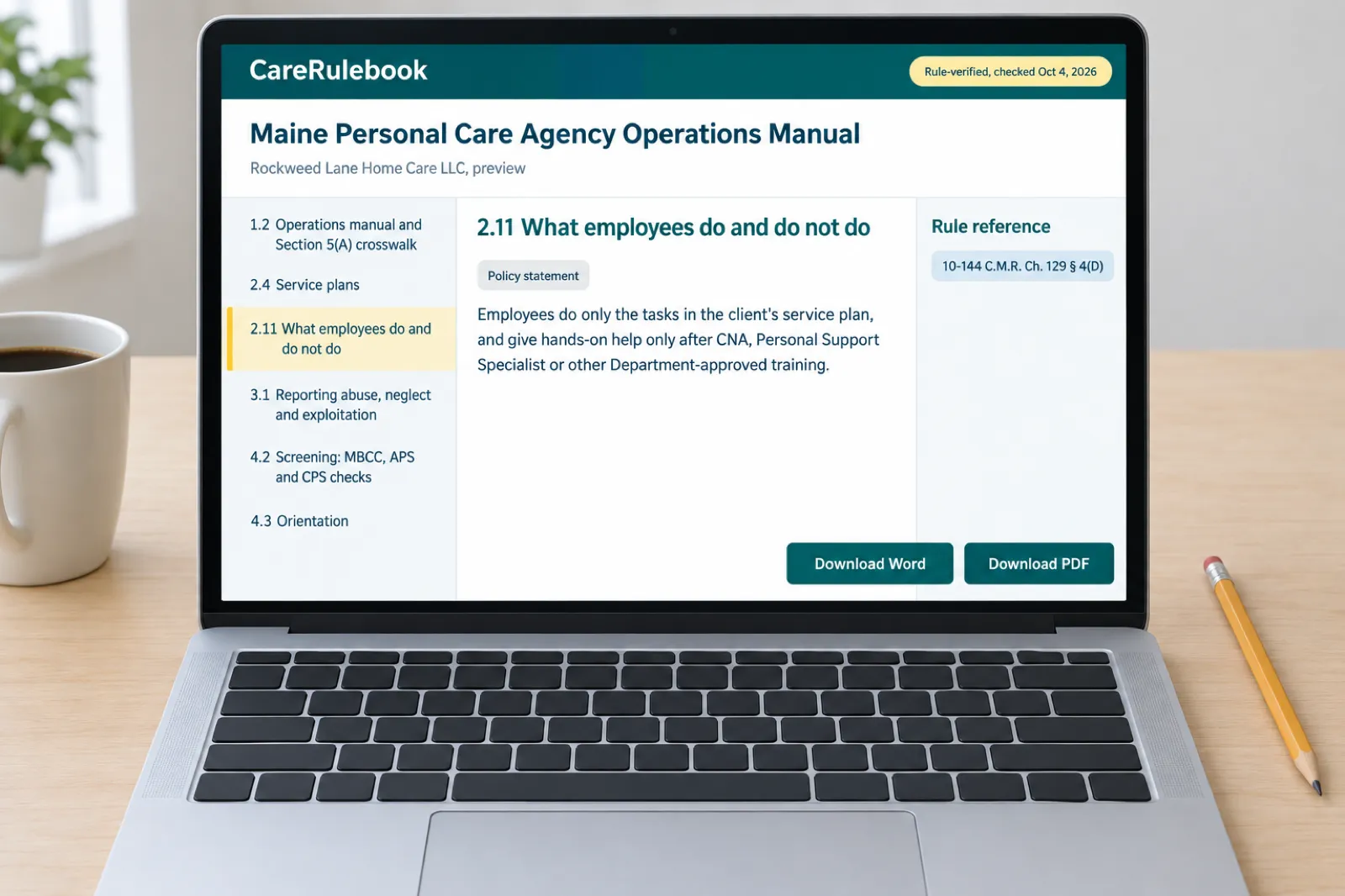
CareRulebook’s Maine manual includes Policy 4.2 (Screening owners and employees: MBCC, APS and CPS checks, registry, background file): MBCC checks for every employee, owner and administrator, the separate APS and CPS checks, the registry, eligibility decisions, waivers and errors, conditional employment and the background check file. Policy 4.7 sets what goes in each owner and employee record, and Policy 4.5 covers direct personal supervision during conditional employment.
$199CareRulebook founding price for the first 50 Maine agencies, then $249. Not a DLC fee.
The statute says "an employer may employ an individual as a direct access worker on a conditional basis for up to 60 calendar days before the employer receives a final background check report" (22 M.R.S. § 9057(4)). Every condition must be met:
Our reading. MBCC says fingerprint-based checks are delayed (MBCC home page), so it is not clear how an employer meets the biometric condition today. Ask MBCC before you let anyone start on a conditional basis; otherwise wait for the final report. In clients’ homes, direct personal supervision is also hard to show, which is why Policy 4.5 has the administrator ask MBCC before relying on it. And the statute says: "An employer is subject to the penalties under paragraph A if that employer conditionally employs an individual before receiving verification that the individual has met the requirements of conditional employment described in this chapter." (22 M.R.S. § 9062(2)(B))
Our reading: keep MBCC’s 2022 notice on file, rely on rap back for now, and watch for MBCC’s fingerprint rollout, which would bring the five-year recheck back into play. Sign up below and CareRulebook will email you when the rule changes.
Owners are checked twice. With the application: "The applicant must provide the results of a criminal background check for all owners obtained from the State Bureau of Identification, completed not more than 30 calendar days prior to the submission of the application." (Ch. 129 § 2(F)(3)) And, like every employee and administrator, an MBCC check (§ 4(B)(1)). When it decides on a license, DLC may consider any criminal, child protective or adult protective record of the applicant and administrator (§ 2(B)), and "no license will be issued if the applicant/licensee refuses to authorize or consent to the release of information listed under § 2 (B)(1)(b) to the Department." (§ 2(B)). The whole application: the Maine license application.
Fees and timing for the whole license: Maine license cost and timeline.
It depends. Only conditionally, for up to 60 days, and only if you have entered them in the Maine Background Check Center as conditionally employed, they are not already disqualified, they sign a statement, they have submitted their biometric data, you have verified and documented that submission and their identity and work-eligibility documents, and they work under direct personal supervision. MBCC says fingerprint checks are delayed, so ask MBCC how to meet the biometric condition before relying on it. The MBCC does not run APS or CPS checks: you must get those separately.
"an employer may employ an individual as a direct access worker on a conditional basis for up to 60 calendar days before the employer receives a final background check report"
It depends. For hands-on care (bathing, dressing, toileting, transfers and other ADLs), a caregiver must be an active CNA or have completed, or enrolled within 60 days of hire in, the state’s Personal Support Specialist course or another approved program, and finish within nine months. Everyone who gives direct care also needs your agency orientation before working alone with a client. Staff who only help with meals, money, shopping, light housework and communication do not need the PSS course.
"The employee must complete the training within nine months of hire."
Every employee, every owner and every administrator, through the Maine Background Check Center (MBCC). Chapter 129 covers all employees, so office staff need one too. The agency must also confirm each employee has no substantiated Adult Protective Services or Child Protective Services finding, which MBCC does not check.
MBCC’s FAQ says the fee is $56 per background check and that a check is good for five years. The statute keeps the MBCC user fee between $25 and $150. This is the Maine Background Check Center’s fee, not a CareRulebook price.
Only on a conditional basis, for up to 60 calendar days, and only if you meet every condition in 22 M.R.S. § 9057(4): the worker is entered in MBCC as conditionally employed, is not already disqualified, agrees to the steps needed, signs a statement, has submitted biometric data that you verify and document along with their identity and work-eligibility documents, and works under direct personal supervision. MBCC says fingerprint checks are delayed, so ask MBCC how to meet the biometric condition before relying on it; otherwise wait for the final report.
No. MBCC says it does not perform APS or CPS checks, and that you contact the Office of Aging and Disability Services for an APS check and the Office of Child and Family Services for a CPS check. Chapter 129 still requires the agency to determine that each employee has no substantiated APS or CPS history.
Not when we checked on November 6, 2026. MBCC lists Maine criminal history, Maine licensing and the CNA and Direct Care Worker Registry, Maine excluded providers, the Maine and national sex offender registries and the federal OIG list, and says it is working on adding a fingerprint-based FBI check. Its May 2026 notice, still its latest on the subject then, says fingerprint-based checks are delayed while the MBCC Act is revised.
The statute requires a recheck every five years for criminal history checks that use a biometric identifier, the MBCC rule asks for a new comprehensive check at least every five years, and MBCC’s FAQ says a check is good for five years. But MBCC’s April 2022 notice, which cites both the statute and the rule, says DLC will not pursue enforcement of the five-year recheck because MBCC does not yet access federal conviction data, and rap back monitoring continues. On our reading, keep that notice on file and watch for MBCC’s fingerprint rollout.
With a disqualifying conviction, you may employ the person only if DHHS grants a waiver you sponsor. There is no waiver for a disqualifying listing, such as on a sex offender registry, an exclusion list or the annotated CNA and Direct Care Worker Registry. If the person believes the record is wrong, they correct it with the agency that holds it; if it is not corrected by the end of 60 days of conditional employment, you may not keep employing them without a waiver.
DHHS plans to amend the Maine Background Check Center rule for biometric (fingerprint) checks and an updated disqualifying-crimes list. Leave your email and we will tell you when a Maine change affects your hiring checks or your policies.
No spam. Only emails about Maine home care rules. How we use your email.
Maine
How to start a home care agency in Maine
The Personal Care Agency license, PSS training, abuse reporting and the operations manual.
Manual
Build your Maine operations manual
Including Policy 4.2 on screening owners and employees.
Maine
Maine policies and procedures
The 17 Section 5(A) topics, including the screening policy.
Maine
Maine caregiver training
CNA or PSS for hands-on care, orientation before working alone, and supervision.
Maine
Maine home care inspections
Where DLC checks the background file, and the $500-a-day penalty schedule.
Maine
The Maine license application
The owners’ State Bureau of Identification checks and the rest of the application.
Compare
Background checks by state
How Maine’s MBCC check compares with other states.
Nevada
Nevada background checks
Fingerprints within 10 days through NABS, and the disqualifying crimes.
Tennessee
Tennessee background checks
The criminal check, the Abuse Registry and the Sex Offender Registry.
Free sample, no email needed
Policy 2.9, Grievances and complaints to DLC, as it prints in the Maine manual, filled in for a fictional agency. The rule text it rests on is quoted word for word under Rule basis.
PDF · 7 pages · 96 KB · Rule-verified October 4, 2026
Collecting answers for an agency or a client? The intake questionnaire lists all 39 questions the builder asks, what each decision changes in the manual, and a completed example: Word · PDF.How consultants use CareRulebook.