| NRS 449B.100 | Hold the license before operating No services before the license is issued; operating unlicensed is a misdemeanor. |
| NAC 449.3972(1) | Keep records at the licensed location Client, attendant, staff and operations records are kept at the location named on the license, including when the agency uses work stations. |
| NAC 449.3972(2) | Responsible person on the license The person designated as responsible for the agency is named on the license. |
| NAC 449.3972(3)-(4); NRS 449B.185 | Liability coverage and surety bond Keep proof of adequate liability coverage and of the surety bond (or approved deposit) sized to the number of employees; the license is suspended while there is no bond. |
| NRS 449B.185(1) | Bond amount by employee count $5,000 under 7 employees, $25,000 for 7 to 25, $50,000 over 25, filed with each application and renewal. Our suggestion: review the amount when headcount changes. |
| NAC 449.0114(1) | Display the license Display the license in a conspicuous place. |
| NAC 449.0114(4)-(5) (as amended by R089-24) | Report changes Report a new administrator within 30 days, and changes of ownership, location or services immediately; amendments go through CLICS. |
| NRS 449B.210; NAC 449.0116 | Renew every year Renew before the license expires (an expired license cannot be renewed, NAC 449.0116(3)) with the fee and statements of compliance with the background check and elder abuse training rules; late renewal costs an extra charge. |
| NRS 449B.475 | Accurate name and advertising The agency name, signs and listings must not mislead about services. |
| NRS 449B.125(2) | Policies that protect clients Practices and policies must provide adequately for the health, safety and well-being of each client. |
| NAC 449.3973(1) (as amended by R089-24) | Administrator qualifications At least 18; high school diploma or equivalent, or a Nevada long-term care administrator license; mature; understands the rules and statute; English literacy. HCQC wants a resume, diploma and ID proving age. |
| NAC 449.3973(2), (2)(g) | Appoint a designee for absences The administrator represents the licensee day to day and designates one or more employees to be in charge when absent. |
| NAC 449.3973(3) | Designee can access records The designee has access to all records, except confidential information the administrator keeps separately (see also NAC 449.3976(4)). |
| NAC 449.3973(2)(a)-(b) | Qualified, trained staff only Employ qualified staff, ensure all required training, and ensure only trained attendants serve clients, following the assessment, service plan and policies. |
| NAC 449.3973(2)(c) | Accounting and reporting system Develop and implement an accounting and reporting system showing the agency’s finances. |
| NAC 449.3973(2)(d) | Contracted services Negotiate contracted services lawfully and under agency policy. |
| NAC 449.3973(2)(e) | Oversight of staff Provide oversight and direction so clients receive needed services. |
| NAC 449.3973(2)(f) | Develop and implement policies The administrator develops and implements the agency’s policies, including on terminating services. |
| NAC 449.3973(2)(h); 449.3981(3)(a) | Resources and capability Show the Division on request that the agency can meet each service plan, and check capacity before starting or changing services. |
| NAC 449.3974 | Keep, review and revise written policies Keep written policies on staff qualifications, responsibilities and conditions of employment; review and revise them as needed. |
| NAC 449.3974 | Give policies to staff on hire and on change Make the policies available to attendants and staff when hired and whenever revised. |
| HCQC workbook (12.2024), PCS Policies & Procedures/Form/Document Checklist | Map policies to HCQC’s checklistRecommended practice HCQC’s initial inspection workbook ends with a 55-tag policy, form and document checklist. Keeping a crosswalk from each tag to a policy or form makes the prelicensure survey easier (HCQC expectation, not rule text). |
| NAC 449.3974(1) | Attendant duties and responsibilities Describe attendants’ duties and responsibilities. HCQC asks for job descriptions for each position (P0035). |
| NAC 449.3974(2) | Prohibited activities List activities attendants may not engage in, at least: personal long-distance calls on the client’s phone or while on duty; lending, borrowing or accepting gifts of money or items; accepting money or tips other than for the client’s groceries or medication; becoming the client’s guardian or attorney-in-fact. |
| NAC 449.3974(2)(b)-(c) | No gifts, loans or gratuities No loaning, borrowing or accepting gifts of money or personal items; no money or gratuities except money for the client’s groceries or medication. |
| NAC 449.3974(3) | Client rights in policy Set out the rights of clients. |
| NAC 449.3974(4) | Ethics and confidentiality Set out ethics requirements for staff, including confidentiality of client information. HCQC looks for a confidentiality or HIPAA form (P0050). |
| NAC 449.3974(5) | Infection prevention, control and investigation Provide for preventing, controlling and investigating infections and communicable diseases. |
| NAC 449.3974(6) | Services offered Describe the personal care services the agency provides. |
| NAC 449.3974(7) | Assigning and supervising attendants Describe how attendants are assigned to clients and any supervision provided. |
| NAC 449.3974(8) | Documenting needs and services Provide for documenting each client’s needs and the services provided (HCQC: include the initial screening and service plan forms, P0070). |
| NAC 449.3974(9) | Emergency responses Set out the agency’s responses to medical and nonmedical emergencies. |
| NAC 449.3974(10) | Coordination with community agencies Set out the agency’s role and coordination with other community service agencies (HCQC: include a list of community resources, P0080). |
| NAC 449.3974(11) | Performance evaluations Provide for periodic performance evaluations of attendants and staff (HCQC: include the evaluation form, P0085). |
| NAC 449.3974(12) | Current personnel records Keep current personnel records that confirm the policies are followed. |
| NAC 449.3974(13) | Special populations Set out any specific information needed for the special populations served (HCQC: include examples, P0095). |
| NAC 449.3975(1)-(5) | Attendant qualifications At least 18; mature; understands the rules; communicates effectively with clients; able to meet clients’ needs. |
| NAC 449.3975(6) | 8 hours of training a year Each attendant receives at least 8 hours a year of training on clients’ needs. |
| NAC 449.3976(1) | Attendant personnel file contents Name, address, phone; start date; TB tests and health certificate; reference checks; background check evidence; first aid and CPR within 6 months; proof of age; auto insurance if driving clients; training and evaluations. |
| NAC 449.3976(1)(c); NAC 441A.375 | Health certificate and TB tests Before work: a physical exam or provider certificate of good health free of active TB, and a TB test within 12 months; then yearly TB tests unless a documented risk assessment allows less; chest X-ray route for past positives. |
| NAC 449.3976(1)(f) (as amended by R089-24); R089-24 section 2 | First aid and CPR within 6 months Proof of first aid and CPR certification within 6 months of starting, with live (not prerecorded) skills practice or verification. First aid and CPR are also part of the initial training program (NAC 449.3977(1)(c)(5)), so the manual has attendants certified before their first client. |
| NAC 449.3976(1)(h) | Auto insurance for attendants who drive clientsif attendants transport clients Keep proof of at least the state minimum liability insurance for attendants who transport clients. |
| NAC 449.3976(1)(i), (2) | Training records For each course: content, date, hours, instructor name and signature, and a completion certificate. |
| NAC 449.3976(3) | Evaluate competency of trained hires Evaluate competency in each required area when an attendant brings proof of earlier training; further training can target gaps. |
| NAC 449.3976(4) | Secure personnel files, open to the Division Files may be locked with restricted access but must be available to the Division on request (HCQC checks secured filing, P0145). |
| NAC 449.3977(1)(a) | Give attendants the rules Give each attendant a copy of the licensing rules before they serve clients; they gain a working knowledge (HCQC: acknowledgement form, P0150). |
| NAC 449.3977(1)(b) | Training program with supervised on-the-job instruction Complete a training program, including on-the-job instruction supervised by the administrator or designee, before working independently. |
| NAC 449.3977(1)(c) | Required training topics Documentation and time records; client rights and confidentiality; aging and disability needs; communication skills; first aid and CPR; and service-specific topics: duties and techniques, emergencies, adverse behaviors, nutrition, bowel and bladder care, skin care, preventing skin breakdown, contractures and falls, hand washing and infection control, body mechanics and transfers, clean and safe environment. |
| NAC 449.3977(2) | Competency in every training area Each attendant is evaluated and found competent in the required training areas (HCQC: competency evaluation or exam after initial training, P0155). |
| NAC 449.3977(3) | Training within 12 months before first care Evidence of the full training program completed within the 12 months before the attendant first provides care. |
| NAC 449.39735 | Agency pays for training Provide or arrange required training; pay course and travel costs and wages for training and travel time; keep completion documents in the personnel file. |
| NAC 449.39775(1)-(3), (5), (7)-(8); NRS 449B.130 | Vital signs, glucose tests and weighingif attendants take vital signs, run blood glucose tests or weigh clients Only after task training (before, yearly and on device change) by a qualified trainer covering infection control, interpreting results and actions to take; follow manufacturer instructions and CLIA; one glucose meter per person; weigh only with consent. HCQC checks for a CLIA waiver and consent forms (P0320, P0340). |
| NAC 449.39775(3) | One glucose meter per personif attendants run blood glucose tests A blood glucose meter is never used on more than one person. |
| NAC 449.39775(4) | Insulin by auto-injector onlyif attendants assist with insulin Pharmacist-furnished insulin by FDA-approved auto-injector, client stable per physician, PA or APRN, maintenance dose with no sliding scale. |
| NAC 449.39775(7) | Who may train tasksif attendants perform tasks under NAC 449.39775 A physician, PA or licensed nurse; a pharmacist for insulin and glucose tasks; or an employee trained by one of them with a year of experience and shown competency (HCQC P0350). |
| NAC 449.39775(6)(a) (as amended by R089-24) | Nail care limitsif the agency offers nail care Attendants may trim nails unless the provider restricts toenail care to a podiatrist or nail technologist; consult the provider first for clients with diabetes. |
| NAC 449.39775(6)(b) (as amended by R089-24) | Exercise assistance limitsif the agency offers exercise assistance No exercises the client’s provider has said the client should not do. |
| NAC 449.39775(6)(c)-(d) (as amended by R089-24) | Appointments and sharing health informationif attendants accompany clients to appointments or communicate with providers Attendants may help with appointments and pass information to and from providers and the client’s representatives, within the laws on protected health information. |
| NAC 449.3978 (as amended by R089-24) | Prohibited services The administrator keeps attendants within their scope and professional; attendants must not provide the listed skilled services (HCQC: list specific prohibited services, P0165; reviewed with each client, P0220). |
| NAC 449.3978(2) | The prohibited list Catheter insertion or irrigation; body cavity irrigation; prescription or aseptic dressings; injections except as allowed; physical assessments; specialized feeding; digital rectal exams; massage; skilled nursing tasks beyond CNA scope. |
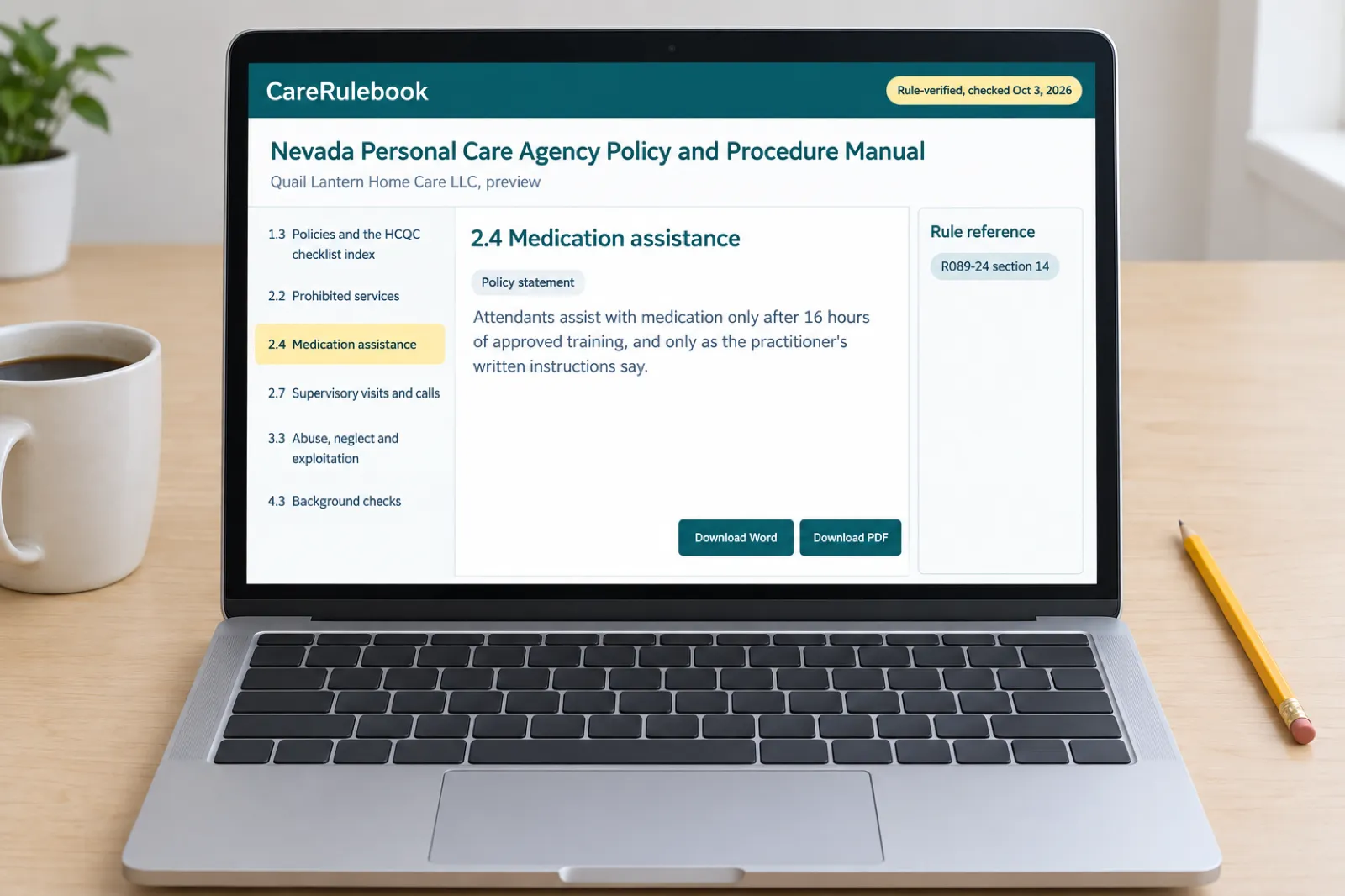
| R089-24 section 14(1) | When attendants may assist with medicationif attendants assist with medication Written agreement where NRS 453.375 or 454.213 requires one; completed medication training; medication prescribed or ordered and given per written instructions. NAC 449.3978 limits still apply. |
| R089-24 section 14(2) | Medication trainingif attendants assist with medication 16 hours from a Division-approved course with a certificate before assisting, then 8 hours a year with evidence to the agency. |
| R089-24 section 14(3) | Medication training program and recordsif attendants assist with medication A program ensuring the training, and a medication record per client: type, date and time, refusals or missed doses, current instructions. |
| NRS 453.375(1)(g) | Written agreement for controlled substancesif attendants assist with medication A controlled substance may be handled by a person the ultimate user designates in a written agreement. |
| NAC 449.3979(1) | Written disclosure statement Give each new client a written disclosure statement, have it signed, and file a copy (HCQC P0175). |
| NAC 449.3979(2)(a) | Disclose that unstable conditions are out of scope An easy-to-understand statement that managing unstable or unpredictable medical conditions is outside the license. |
| NAC 449.3979(2)(b) | Disclose attendant qualifications and training State the qualifications and training requirements for attendants. |
| NAC 449.3979(2)(c)-(d) | Charges, billing and price increase policy Charges; billing methods, payment systems and due dates; the policy for notifying clients of price increases. |
| NAC 449.3979(2)(e) | Termination criteria and notice policy The criteria for ending services and the policy for notifying clients. |
| NAC 449.3979(2)(f) | Contacting the administrator; on-call policy How to reach the administrator or designee during all service hours, and the on-call policy. |
| NAC 449.3979(2)(g) | Rights and grievance procedure in the disclosure Information on client rights and the grievance procedure. |
| NAC 449.398(1) | Clients may speak with advocates No client is stopped from speaking with an advocate for clients’ rights (HCQC P0185). |
| NAC 449.398(2) | Grievance, incident and complaint procedure Administrator or designee notified of each grievance, incident or complaint, investigates personally and promptly, and tells the client the action taken or why none (HCQC: policy, report form and tracking, P0190). |
| NAC 449.398(3); NRS 449A.100 to 449A.118 | Comply with the patients’ rights law The administrator ensures compliance with NRS 449A.100 to 449A.118. |
| NRS 449A.118(1) | Tell clients their statutory rights on admission Inform each client or representative on admission of the rights in NRS 449A.100 and 449A.106 to 449A.115 (information, billing explanation, considerate care, refusing treatment, privacy, confidentiality and others). |
| NRS 449A.115 | No bequests to owners or administrators Owners and administrators may not take money or property under a client’s will or life insurance (unless spouse, guardian or next of kin). |
| NAC 449.398(4)-(5) | Written rights with six statements, signed receipt Written description of rights with the six required statements, given at the start of the service plan, signed and dated receipt in the record (HCQC P0195). |
| NAC 449.398(5)(c)-(d) | Bureau phone number and record access notice The rights statement gives the Bureau’s complaint phone number and notice that the Division may examine client records. |
| NRS 449B.270 | Privacy and confidentiality duties Confidentiality of sexual orientation, transgender status and HIV status; no non-care staff present during unclothed care without permission; visual barriers; right to refuse educational observation. |
| NAC 449.3981(1)-(2) | Initial screening and service plan Administrator or designee screens each prospective client and develops or accepts a service plan; documented, dated and signed (HCQC P0210). |
| NAC 449.3981(3)(b) | Review the plan with the client before starting Review the schedule, the procedure if an attendant does not deliver the plan, hiring and training policies, agency responsibilities, the grievance procedure and the prohibited services (HCQC P0220). |
| NAC 449.3981(3)(c) | No-show and extra visit procedures Review with the client what happens if an attendant does not arrive and how an additional visit is arranged (HCQC: no-show policy, P0220). |
| NAC 449.3981(3)(d) | Services assist with daily living Confirm requested services assist with activities of daily living before starting and on each plan change. |
| NAC 449.3981(3)(e) | Coordinate with other providers Coordinate the agency’s services with care from other organizations and people. |
| NAC 449.3982(1) | Supervisory visits or calls Administrator or designee makes supervisory home visits or calls to each client; HCQC expects the policy to state frequency and who does them (P0225). |
| NAC 449.3982(2) | Five-point supervisory record Each visit or call documented, dated and signed, evaluating safe techniques, plan followed, plan meeting needs, attendant training and needed follow-up. |
| NAC 449.3977(1)(c)(1) | Documentation and time records Attendants are trained to document services and verify time records, so the agency needs a visit and time record system. |
| NRS 449B.460 | Dietitian after hospital dischargewhen a client comes home from hospital Consult a dietitian as appropriate when a hospital discharges a patient home to the agency’s care. |
| NRS 449B.480 | No referrals to unlicensed or unsuitable group homes Never refer a person to an unlicensed residential facility for groups or one that does not suit their condition. |
| NRS 449A.100 | Explain transfers and alternatives Provide needed services or arrange transfer to a provider that can; explain the need for transfer and the alternatives, unless the client’s condition needs an immediate transfer to a higher level of care and the client cannot understand the explanation. |
| NAC 449.011916 | Discharge and service policies blind to payer Transfer, discharge and service policies do not discriminate by payment source (HCQC P0600). |
| NAC 449.3973(4)(a) | Protect clients from abuse The administrator ensures clients are not abused, neglected or exploited by staff, or by visitors while staff are present (HCQC: elder abuse recognition, prevention and reporting policy, P0030). |
| NAC 449.3973(4)(b) (as amended by R089-24); NRS 200.5093 | Report suspected abuse within 24 hours Every owner and employee reports suspected abuse, neglect, exploitation, isolation or abandonment of an older or vulnerable person to ADSD, police or ADSD’s toll-free line within 24 hours. |
| NRS 200.5093(1)(a), (2) | Where reports go Local ADSD office, police or sheriff, or ADSD’s toll-free service; if ADSD or police are involved in the abuse, report to a different agency. |
| NRS 200.5093(6) | Deaths from abuse or neglect If a reporter believes an older or vulnerable person died from abuse, neglect, isolation or abandonment, report it to the medical examiner or coroner. |
| NRS 632.4725 | Work assignment records for nursing staffif the agency employs a nurse, nursing assistant or medication aide - certified Keep a record of the work assignments of each nurse, nursing assistant or medication aide - certified the agency employs, for at least 5 years. |
| NRS 632.472(1)(d) | Report nursing licensee misconduct Report in writing to the State Board of Nursing any conduct of a Board licensee or certificate holder (nurse, nursing assistant, medication aide) that violates the nursing law. |
| NRS 432B.220(1), (4)(f), (8) | Child abuse reportingif the agency serves clients under 18 Our reading: when serving a child, staff report suspected child abuse or neglect to child welfare or police within 24 hours, and the agency informs each new employee in writing and keeps their acknowledgement. |
| NRS 449B.225(4)-(8) | Elder abuse training Administrator before care begins and yearly; each care employee before their first client and yearly; topics include recognizing and responding to abuse and the relevant laws; the agency pays (HCQC P0099). |
| NRS 449B.260(1)-(2)(a); NAC 449.011913 | Anti-discrimination policies Develop and carry out policies to prevent the prohibited types of discrimination, including indirect discrimination and harassment or bullying (HCQC P0405). |
| NRS 449B.260(2)(b) | Website non-discrimination statementif the agency markets on a website Post the statutory statement prominently on any website used to market the agency (HCQC P0410). |
| NAC 449.011926 (as amended by R004-24) | Complaint policy and discrimination complaint log A written policy on how complaints may be filed and will be documented, investigated and resolved, and a log of discrimination complaints and actions (HCQC P0620). |
| NAC 449.011943 (as amended by R004-24); NRS 449B.290 | Preferred names and pronouns Policies to address clients by preferred name and pronoun; adapt records where practicable (HCQC P0700). |
| NAC 449.011946 | Notices in appropriate languages and formats Non-discrimination statements and notices in English and other appropriate languages, with reasonable accommodations for clients who cannot read, are blind, have communication impairments or do not read English. |
| NRS 449B.280; NAC 449.011931 (as amended by R004-24) | Cultural competency training Approved course within 90 days of hire and at least 2 hours every two years for staff with weekly direct client contact and their supervisors; proof in the personnel file (HCQC P0640). |
| NAC 449.011931(3)-(4) (as amended by R004-24) | Proof of cultural competency training or exemption Keep proof of completion, or of the professional license that makes a staff member exempt, in the personnel file or electronic system. |
| NRS 449B.220(3)(c)-(d) | Written infection control plan, updated yearly, given to all Develop and annually update a written plan for the control of infectious diseases; give a copy to each employee, contractor and client. |
| R063-21 section 5 | What the plan must contain A coordinator; evidence-based policies (for example CDC) fitting the services; procedures to find and correct lapses; review of activities; investigating and reporting communicable diseases under chapter 441A; an outbreak strategy covering staffing, admissions and protecting clients. Our reading: these contents apply because R063-21 was adopted for the same statutory plan now in NRS 449B.220 (see R063-21 section 5(2)). |
| NRS 449B.220(1), (3)(a)-(b); R063-21 section 4 | Annual infection control training for caregivers Each unlicensed caregiver completes the annual training on the six topics, gives proof to the administrator, and it is documented in the personnel file; best practices are put in place (HCQC P0950). |
| NAC 449.01065 | PPE supply, supplier contract and tracking Use PPE per the adopted publications; keep a 30-day supply (or document shortage attempts); contract with a supplier and track stock and usage (HCQC P0910, P0915). |
| NAC 449.0109, as applied in HCQC workbook tags P0920 to P0945 | Infection control program reviewed yearly (HCQC expectation) HCQC’s workbook expects an infection control program and policy based on national guidelines and reviewed every year, with a named responsible person and designee who complete 15 hours of training within 3 months and yearly, at the agency’s cost. The rule text names facilities for the dependent; we treat this as HCQC’s survey expectation. |
| NAC 449.0109(1)(c), (6), as applied in HCQC workbook tag P0920 | Emergency preparedness plan (HCQC expectation) A plan covering internal and external, local and widespread emergencies, including emerging infectious diseases. |
| NRS 449B.310(1) | Background check within 10 days of hire Signed conviction statement, oral and written confirmation, license or certificate proof, fingerprints with written authorization submitted to the Central Repository, and screening on the state website where one exists; for employees, temporary agency workers and contractors (HCQC: through NABS). |
| NRS 449B.310(4) | Complete checks and repeat every 5 years Complete the investigation as soon as practicable and repeat at least every 5 years. |
| NRS 449B.330 | Keep background check records Fingerprint copy or electronic submission proof, written authorization and other documentation, kept for the length of employment and available to the Division (HCQC adds the signed waiver and NABS clearance letter). |
| NRS 449B.340(1)-(2) | Disqualifying results End employment or the contract of a person convicted of a listed crime; if the person disputes the result, first allow at least 30 days to correct it; tell temporary agencies their worker is ineligible. |
| NAC 449.0113 | Undetermined results and pending charges Notify the person within 10 working days to supply information within 30 days; protect clients meanwhile (leave, direct supervision or investigation); terminate a person who willfully fails to comply. |
| NRS 449B.340(3)(a) | No unsupervised child contact before resultsif the agency serves clients under 18 Before results arrive, a new worker may not have unsupervised contact with a child. |
| NRS 449B.320(2) | Temporary staffing agreementsif the agency uses temporary staffing services Require any temporary employment service to prove continuous employment since each worker’s last check and to tell the agency if a check is more than 5 years old. |
| NAC 449.3963; NRS 449B.465 | Contracted attendantsif the agency uses contracted attendants Attendants may be employees or contractors; contractors meet the same qualification, check, training and file rules. |
| NRS 449B.350, 449B.360 | Allow inspections at any time Division staff may enter and inspect at any time, with or without notice; ADSD designees may investigate complaints. |
| NAC 449.9987; 449.0118(5) | Plan of correction within 10 days Submit a plan of correction with specific actions and timeframes within 10 days of a statement of deficiencies. |
| NAC 449.0118(6) | Cooperate with investigations Refusing to cooperate fully with an investigation or inspection is a ground for denial, suspension or revocation. |
| MSM 3503(3) | EVV for Medicaid visitsif the agency bills Nevada Medicaid Medicaid personal care services are recorded in a Cures Act compliant EVV system. |
| MSM 3503(5)-(6) | 24-hour phone line and backup caregiversif the agency bills Nevada Medicaid A phone line available 24 hours a day for recipients, and a backup mechanism when the regular caregiver is absent. |
| MSM 3503(16) | Serious occurrence reportsif the agency bills Nevada Medicaid Serious Occurrence Report to the Medicaid district office (or the waiver case manager’s ADSD office) within 24 hours of discovery. |
| NAC 449.398(2) (recommended practice) | Incident log and reviewRecommended practice Recommended: log incidents alongside grievances and complaints with investigation and outcome, so the administrator can show the procedure works. |