Every direct care worker
Orientation before providing services to a consumer, and the competency test before providing care and every year after.
3345-4.5.1; 4.5.3What do you run?
Coming next: Maryland (assisted living), Georgia (personal care homes)
All care home guides →Delaware · Caregivers · 16 DE Admin. Code 3345-4.5, 8.3 and 9.3
Delaware sets topics, not hours. Before serving any consumer, every direct care worker at a personal assistance services agency (PASA) completes the agency’s own orientation on 24 topics plus the disaster plan, then passes a competency test. The test is repeated every year, with infection control in-service for all staff and, if you serve people with dementia, annual dementia training. DHCQ reads your teaching material and test in the binder before it licenses you.
Quick answer
"All direct care workers are required to complete an orientation program given by the Agency before providing services to a consumer." (16 DE Admin. Code 3345-4.5.1) The program covers 24 listed topics, and all staff are also oriented to the disaster preparedness plan: DHCQ counts "currently a total of 25 orientation topics" (review guide, p. 13).
"All direct care workers must pass a competency test prior to providing care to consumers and annually thereafter." (3345-4.5.3) DHCQ’s general guideline for a passing grade is 80% (review guide, p. 14). There are no set hours for PASA workers (DHCQ matrix).
Delaware also checks the training before you open: the binder must hold "A copy of the test to be given to each direct care worker, as required by subsection 4.5" (3345-2.2.2.7), and DHCQ wants the actual teaching material for every orientation topic (review guide, p. 16).
Orientation before providing services to a consumer, and the competency test before providing care and every year after.
3345-4.5.1; 4.5.3Individuals providing services under contract must meet the same requirements as the agency’s own direct care workers, and DHCQ’s guide says the orientation policy should cover their orientation and training.
3345-3.8; review guide p. 14A PASA may hire a CNA, who works as a direct care worker. DHCQ’s FAQ says direct care workers are oriented by their agencies.
DHCQ FAQOrientation at the time of employment and annual in-service education on the infection prevention and control program, and orientation to the disaster preparedness plan.
3345-8.3; 9.3An owner working shifts. DHCQ’s FAQ says an owner or director may work as a direct care worker while establishing the business (DHCQ FAQ). By our reading, they complete the same orientation and pass the same test before serving a consumer.
Not the home health aide rules. These rules are for PASA direct care workers. DHCQ’s licensure matrix lists a 75-hour course and 12 hours of training a year for aides at skilled and aide-only home health agencies, which are separate licenses (DHCQ matrix, for contrast). Delaware’s nursing assistant course is 150 hours, DHCQ’s FAQ says (DHCQ FAQ, for contrast), but rule 3345 does not ask PASA workers to be CNAs (our reading). How the three licenses differ: Delaware home health vs home care.
The training duties in the order a new worker meets them. The hiring checks run alongside, and the pre-hire records must be in place before care: Delaware caregiver background checks. Tick steps off as you go; progress is saved in this browser only.
The rule asks for an orientation policy and procedure for all direct care workers. DHCQ’s guide says it must state that orientation is completed and the competency test passed before any client care is assigned.
The agency’s own orientation program, with teaching material for each topic, before the worker provides services to any consumer. The topics.
Every staff member is oriented to the infection prevention and control program when employed, and to the disaster preparedness plan, with attendance records kept for 6 years.
A test with questions on every orientation topic. DHCQ’s general guideline for a passing grade is 80%. The test.
DHCQ’s guide asks how training is handled for a new hire who does not complete orientation or does not pass the test. Your policy answers it; the worker gives no care in the meantime.
Every direct care worker passes the competency test annually.
Annual infection prevention in-service for all staff, annual dementia-specific training for every direct care worker if you serve people with dementia, and a written performance evaluation for everyone. Every year.
"The orientation program shall include but not be limited to" the 24 topics below (3345-4.5.2). The 25th is the rule that "All agency staff must be oriented to the disaster preparedness plan(s)" (3345-8.3), which DHCQ’s guide counts with them (review guide, p. 13). The last column is the CareRulebook module that teaches each topic.
| # | Topic | Rule | Manual |
|---|---|---|---|
| 1 | Organizational structure of the agency | 4.5.2.1 | 4.1 |
| 2 | Agency consumer care policies and procedures | 4.5.2.2 | 4.2 |
| 3 | Philosophy of consumer care | 4.5.2.3 | 4.3 |
| 4 | Description of consumer population and geographic location served | 4.5.2.4 | 4.4 |
| 5 | Consumer rights | 4.5.2.5 | 4.5 |
| 6 | Agency personnel and administrative policies | 4.5.2.6 | 4.6 |
| 7 | Principles of good nutrition | 4.5.2.7 | 4.7 |
| 8 | Process of growth, development and aging | 4.5.2.8 | 4.8 |
| 9 | Principles of infection control | 4.5.2.9 | 4.9 |
| 10 | Observation, reporting and documentation of consumer status | 4.5.2.10 | 4.10 |
| 11 | Maintaining a least restrictive environment | 4.5.2.11 | 4.11 |
| 12 | Verbal/non-verbal communication skills | 4.5.2.12 | 4.12 |
| 13 | Principles of body mechanics | 4.5.2.13 | 4.13 |
| 14 | The needs of the elderly and persons with disabilities | 4.5.2.14 | 4.14 |
| 15 | Activities of daily living | 4.5.2.15 | 4.15 |
| 16 | Introduction to common assistive technology | 4.5.2.16 | 4.16 |
| 17 | Meal planning, food purchasing and preparation of meals, including special diets | 4.5.2.17 | 4.17 |
| 18 | Information on the emotional and physical problems accompanying illness, disability or aging | 4.5.2.18 | 4.18 |
| 19 | Principles and practices in maintaining a clean, healthy, pleasant and safe environment that encourages morale building and self-help | 4.5.2.19 | 4.19 |
| 20 | Items requiring referral to the personal assistance services agency, including changes in the consumer's condition or family situation | 4.5.2.20 | 4.20 |
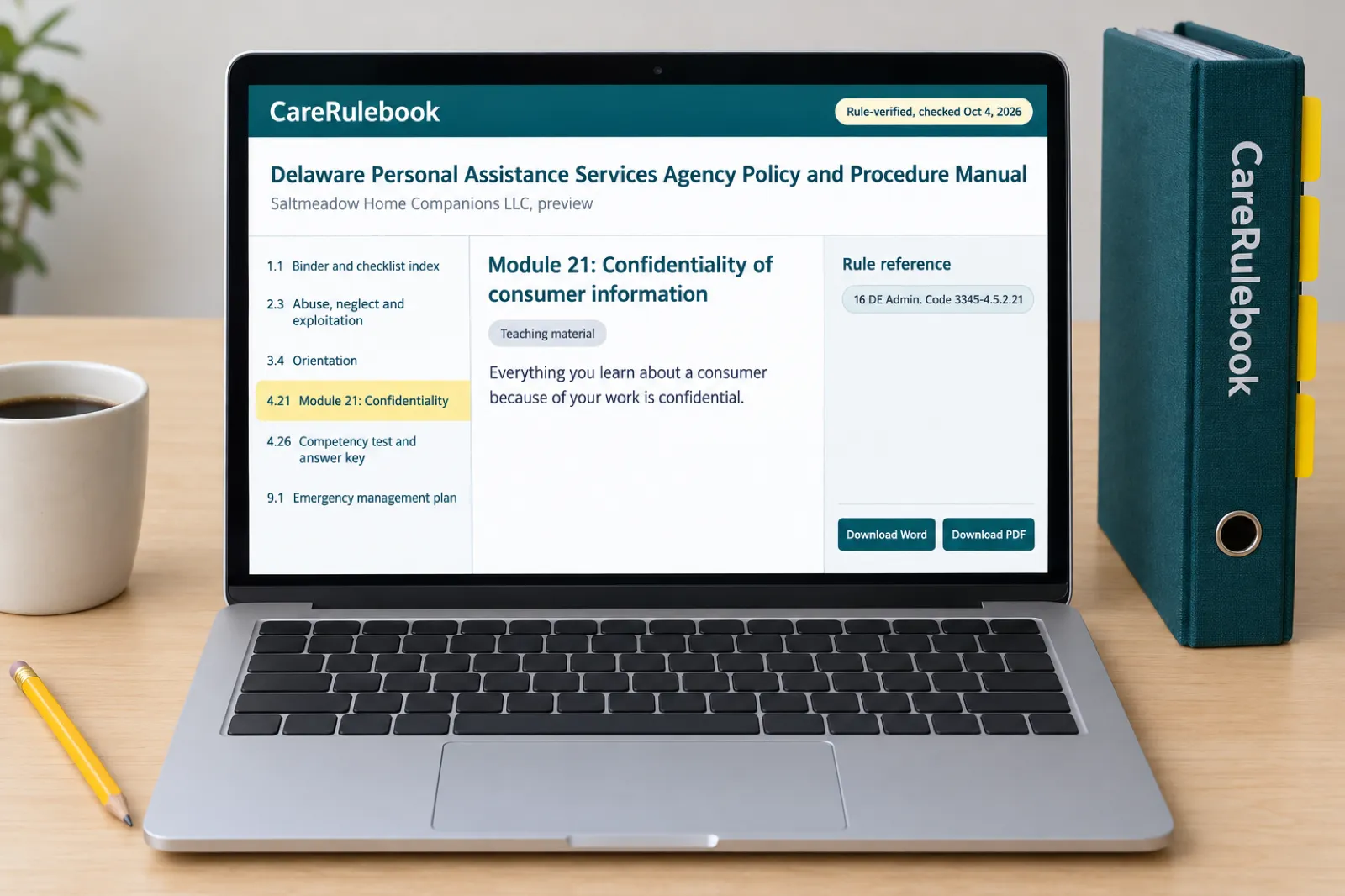
| 21 | Confidentiality of consumer information | 4.5.2.21 | 4.21 |
| 22 | Service plan specific description | 4.5.2.22 | 4.22 |
| 23 | Applicable state regulations governing the delivery of personal assistance services to consumers | 4.5.2.23 | 4.23 |
| 24 | Dementia-specific training: communicating with people with Alzheimer’s disease or other dementias, their psychological, social and physical needs, and safety measures | 4.5.2.24 | 4.24 |
| 25 | Orientation to the disaster preparedness plan (all staff) | 8.3 | 4.25 |
Topics 1 to 23 in the rule’s words; topics 24 and 25 summarized.
In Delaware, DHCQ reads your training before licensing, not only your policies. Its binder review guide says:
CareRulebook’s 25 orientation modules (Policies 4.1 to 4.25) are that teaching material, one module per topic, in the rule’s order. They are training material written by CareRulebook from the public sources listed at the end of each module and from Delaware’s rules. They are not rule text, and they have not been reviewed by a nurse, a trainer or DHCQ, so read them before you adopt them. The binder’s other policies and the full binder layout: Delaware PASA policies and procedures.
The rule does not say whether the annual test must differ from the one at hire, and DHCQ has not said either (our reading; it is on our list of questions for DHCQ). CareRulebook’s test in Policy 4.26 has 80 multiple-choice questions on every topic in module order, with the answer key in the same order on its own page; it is training material, not reviewed by a nurse, a trainer or DHCQ. Policy 3.5 (Competency testing at hire and every year) gives it in writing and closed book, uses the pass mark you choose in the builder (DHCQ’s 80%, or 85% or 90%), reteaches the modules behind missed questions before a retest, and adds a skills check the trainer watches, because the written test checks what a worker knows and the skills check what they can do.

CareRulebook
CareRulebook’s Delaware binder includes 25 orientation modules and an 80-question competency test with its answer key, in DHCQ’s checklist order, plus Policy 3.4 (Orientation policy and procedure), Policy 3.5 and Policy 3.6 with the orientation checklist, test, skills check, retraining, in-service and evaluation forms. The modules and test are training material, not reviewed by a nurse, a trainer or DHCQ.
$199CareRulebook founding price for the first 50 Delaware agencies, then $249. Not a DHCQ fee.
TB training. DHCQ’s slides list annual in-service training, naming mandatory annual dementia training and mandatory TB training (DHCQ slides, slide 25), and "Annually you are required to have a TB Education for all employees (See CDC)" (slide 33). The slides do not repeat the rule’s condition for dementia training (only agencies serving people with dementia, 3345-4.5.4), and rule 3345 does not name TB education: its annual in-service is on the infection prevention and control program (9.3), so our reading is to include TB education in that session. CareRulebook’s Policy 3.6 does exactly that, and keeps a staff development in-service schedule, which DHCQ’s slides list among the items a binder should include (slide 18).
The rule says "annually" without defining it. Our reading, used in the manual, is within 12 months of the last test or session, so no year is missed; a worker who misses the date is not scheduled for consumer care until they catch up. Policy 3.6 (Annual performance review and annual training) holds the probationary review, the annual evaluation, the in-service schedule and the in-service attendance record, and the dementia training follows your builder answer on whether you serve people with dementia.
CareRulebook’s binder has Policy 6.1 for reminders and the attestation, and, if you choose administration in the builder, Policy 6.2, which has the director confirm a program’s approval with DHCQ in writing and keep a medication training verification record for each worker. Transfers are limited too: help with a transfer only when the consumer can physically assist, so transfer boards and mechanical lifts are not permitted (3345-1.0), and CareRulebook’s body mechanics module (Module 13) teaches that limit.
CareRulebook’s Policy 3.4 has an orientation schedule, an orientation checklist and attendance record with a line for each of the 25 modules and the test score, and the disaster plan orientation attendance record; Policy 3.5 has the competency test record, the skills check record and the retraining record. The director signs the checklist before the worker may be scheduled for consumer care. Survey and renewal steps: the Delaware license application; what the surveyor checks: the Delaware PASA survey.
CareRulebook’s Policy 2.7 also includes bloodborne pathogens training for staff with occupational exposure, written to the federal OSHA standard it cites, and the director reviews the modules and test each year as part of the program review in Policy 3.7.
No. Rule 3345 sets topics, not hours: orientation on the 24 topics in 4.5.2 plus the disaster plan, and a competency test before care and every year. DHCQ’s licensure matrix lists orientation and a competency test at hire and annually for PASA workers, and a 75-hour course and 12 hours a year only for aides at home health agencies.
"Competency test at hire and"
No. The rule requires all direct care workers to complete the agency’s own orientation before providing services and to pass the competency test before providing care. DHCQ’s FAQ says a PASA may hire a CNA, but the CNA works as a direct care worker, and that direct care workers are oriented by their agencies.
"All direct care workers are required to complete an orientation program given by the Agency before providing services to a consumer."
No. DHCQ’s binder review guide says it will not review video links, and that each orientation topic needs the teaching material you use to instruct new employees. If you teach with a video, send a detailed summary, preferably a transcript.
"LINKS TO TRAINING VIDEOS ARE NOT TO BE SUBMITTED AS TRAINING MATERIAL, THE DEPARTMENT WILL NOT REVIEW VIDEO LINKS."
It depends. By default, no: a PASA worker gives medication reminders only, a verbal prompt with no contact with the medication. Medication administration is allowed only if an adult consumer’s responsible caregiver enters an agreement with the agency, prepackages and labels each dose, the worker has completed a Department-approved training program, and the route and drug are not excluded (no injections or IV therapy, feeding tubes, catheters, rectal or vaginal routes, or Schedule II or IV drugs). Your binder must say which way you go.
"A medication reminder does not include the administration of or any physical contact with the medication."
Rule 3345 sets no hours. Every direct care worker completes the agency’s orientation program on the 24 topics in 3345-4.5.2 plus the disaster plan before serving a consumer, and passes a competency test before providing care and every year after. DHCQ’s licensure matrix lists orientation and a competency test at hire and annually for PASA workers; the 75-hour course and 12 hours a year it lists apply to aides at home health agencies.
The rule does not set one. DHCQ’s binder review guide says the general guideline for a passing grade is 80%, and that the annual test should have a passing grade (80%) and say how a worker who does not complete or pass it is handled.
Not as the teaching material DHCQ reviews. Its binder review guide says it will not review links to training videos; if you teach with a video, you submit a detailed summary, preferably a transcript. Each orientation topic needs the teaching material you use to instruct new employees.
Rule 3345 does not require CPR or first aid certification for PASA direct care workers (our reading of the saved rule; it mentions CPR only as an emergency measure when it limits feeding). Orientation does cover items to report to the agency and the disaster plan.
Every direct care worker covers dementia in orientation: communicating with people with Alzheimer’s disease or other dementias, their psychological, social and physical needs, and safety measures. If the agency serves anyone diagnosed with Alzheimer’s disease or another dementia, it also gives annual dementia-specific training to all direct care workers.
The agency gives the orientation program itself. The rule sets no qualifications for the trainer (our reading), and no nurse is required. DHCQ reviews the teaching material and the test in your binder before licensing, and surveyors expect someone at the survey with access to the orientation material and the competency test.
Not on orientation alone. Orientation prepares workers for medication reminders, a spoken prompt with no contact with the medication. A direct care worker may administer medication only after successfully completing a Department-approved administration of medications training program, under a responsible caregiver’s agreement and the rule’s other limits. When the rule was adopted in 2020 the Department said no programs were approved yet and agencies could submit their own for review.
We will email you when Delaware changes its home care rules or DHCQ updates its training guidance, with what it means for your orientation program and competency test.
No spam. Only emails about Delaware home care rules. How we use your email.
Delaware
How to start a home care agency in Delaware
The PASA license, the binder, the 90-day initial license and the survey.
Delaware
Delaware caregiver background checks
The Background Check Center, drug screens and registries before hire.
Delaware
Delaware PASA policies and procedures
DHCQ’s 57 checklist rows, including the 24 orientation rows and the test.
Delaware
The Delaware PASA license application
The binder, Part 2, the 90-day initial license and the survey.
Delaware
Delaware PASA license cost and timeline
The state’s fees, insurance and each step to the annual license.
Delaware
The Delaware PASA survey
The unannounced survey, where training records and the test are checked.
Delaware
Delaware home health vs home care
The PASA license next to the aide-only and skilled home health licenses, and where a PASA has to stop.
Manual
Build your Delaware policy binder
25 orientation modules and the competency test, with your agency’s details.
Maryland
Maryland caregiver training
Seven COMAR topics, a skills demonstration and dementia training hours.
Illinois
Illinois caregiver training
10 hours to start, a competency check, then 10 hours every year.
Compare
Home care caregiver training by state
Every state we cover, side by side.
Free sample, no email needed
Policy 2.3, Abuse, neglect, mistreatment and financial exploitation: prevention and reporting, as it prints in the Delaware manual, filled in for a fictional agency. The rule text it rests on is quoted word for word under Rule basis.
PDF · 8 pages · 110 KB · Rule-verified October 4, 2026
Collecting answers for an agency or a client? The intake questionnaire lists all 48 questions the builder asks, what each decision changes in the manual, and a completed example: Word · PDF.How consultants use CareRulebook.