Certified home health aide
Completes an OSDH-approved course of at least 75 hours and a competency exam given by a registered nurse, and is on OSDH’s registry within four months of starting with you.
OAC 310:677-9-4, 9-5; 63 O.S. 1-1962(C)(1)What do you run?
Coming next: Maryland (assisted living), Georgia (personal care homes)
All care home guides →Oklahoma · Caregivers · 63 O.S. 1-1962, OAC 310:662 and 310:677
Unless they hold a health care license, Oklahoma home care caregivers who give personal care take one of three routes: a certified home health aide (a 75-hour course and an exam), a certified nurse aide, or a worker trained by your agency’s registered nurse to a written plan, with an RN visit at least every three months. All staff are oriented to your policies and take part in in-service, and certified aides have 12 hours of in-service a year.

Quick answer
In the Home Care Act, a home health aide is "an individual who provides personal care to clients in their temporary or permanent place of residence for a fee" (63 O.S. 1-1961(7)), whatever the job title. So, unless they are licensed health professionals, your personal care staff are certified home health aides, certified nurse aides (63 O.S. 1-1951(D)), or workers who meet every condition of the RN-trained route, including that the worker "has demonstrated competency in a written training plan developed by a registered nurse employed by the home care agency" (63 O.S. 1-1962(D)(9)(e)). The title does not mean skilled care: Oklahoma home health vs home care.
The aide course is at least 75 hours, and certified aides then have at least 12 hours of in-service each calendar year (OAC 310:677-9-1(a)). The RN-trained route has no set hours, but an RN trains the worker for each client and visits on site at least every three months. Every agency’s written personnel policies cover "Orientation of all personnel to the policies and objectives of the agency, and participation by all personnel in appropriate employee in-service programs" (OAC 310:662-3-4(e)(2)).
Oklahoma has one home care agency license, and even a personal-care-only agency works with a supervising RN or physician (OAC 310:662-3-4(d)). Training depends on which route each caregiver takes. You can use more than one. A licensed health professional, such as an LPN, needs no aide certification (63 O.S. 1-1962(C)(1)).
Completes an OSDH-approved course of at least 75 hours and a competency exam given by a registered nurse, and is on OSDH’s registry within four months of starting with you.
OAC 310:677-9-4, 9-5; 63 O.S. 1-1962(C)(1)Deemed to meet the home health aide requirements. A CNA listed only as a long term care aide first passes a home care skills exam and has 16 hours of orientation to your clients.
63 O.S. 1-1951(D); OAC 310:677-9-2(b)Employed by your agency only for personal care, trained continuously by an RN, competent in your RN’s written training plan, and visited on site by an RN at least every three months. Needs no aide certification.
63 O.S. 1-1962(D)(9); OAC 310:662-2-1(e)(9)The training duties in the order a new caregiver meets them. Some apply only to one route. Tick steps off as you go; progress is saved in this browser only.
OK-SCREEN registry screening and fingerprint check before the person regularly has direct contact with clients. The one exception is a conditional hire: the check requested at hiring, a signed statement, at most 60 days and direct on-site supervision (63 O.S. 1-1947(L)). Caregiver background checks.
For a certified aide or CNA, consult OSDH’s Nurse Aide Registry: listed, and no confirmed findings of abuse, neglect or misappropriation of client property. For an RN-trained worker, confirm every condition of 63 O.S. 1-1962(D)(9).
Orientation of all personnel to your policies and objectives. The rule sets no hours and no timing; CareRulebook’s manual completes it before the first client.
The worker shows competency in the written training plan of an RN employed by your agency, covering at least seven topics. The seven topics.
Continuous training by a registered nurse in the care specific to the needs of the client receiving it. The statute sets no timing; the manual does it before the worker’s first visit to each client and whenever the plan of care changes.
A person listed only as a long term care aide passes an OSDH-approved home care skills exam and has at least 16 hours of orientation specific to your clients.
No one works as a home health aide for more than four months unless certified and on the registry, or a licensed health professional. CareRulebook’s manual is stricter: certification is verified before the first visit.
An RN on-site visit at least every three months for RN-trained workers, sooner after a significant change in the client’s health. For every client who gets only aide or personal care services, a physician or licensed nurse makes a supervisory home visit at least every six months.
At least 12 hours of in-service each calendar year and an annual performance review for each home care aide, with in-service generally supervised by an experienced RN.
The course must include "At least seventy-five (75) hours of training or the equivalent", with at least 16 hours of classroom training before any supervised practical training and at least 16 hours of supervised practical training (OAC 310:677-9-4(a)).
The statute’s four-month window: "No employer or contractor, except as otherwise provided by this subsection, shall employ or contract with any individual as a home health aide for more than four (4) months", unless they are a licensed health professional or have met the requirements for certification and the registry (63 O.S. 1-1962(C)(1)). CareRulebook’s manual does not use that window: in Policy 2.4, a person gives personal care as a certified aide only after the administrator has checked their certification on the registry. The manual assumes you hire aides who are already certified; it does not set up an aide training program.
A worker outside aide certification under 63 O.S. 1-1962(D)(9) must meet all five conditions (63 O.S. 1-1962(D)(9)(a)-(e)):
| Topic | The plan includes, at a minimum |
|---|---|
| (1) | Observation, reporting and documentation of client status and of the help or other services given |
| (2) | Keeping a clean, safe and healthy environment |
| (3) | Recognizing an emergency, and the emergency procedures |
| (4) | Safe techniques for help with bathing, grooming and toileting |
| (5) | Help with meal preparation, and safe food handling and storage |
| (6) | Client rights and responsibilities, and respect for the client and the client’s privacy and property |
| (7) | Basic infection control, including at least hand hygiene and standard precautions |
From 63 O.S. 1-1962(D)(9)(e)(1)-(7), repeated in OAC 310:662-2-1(e)(9)(E).
It sets no hours, no pass mark and no form, and does not say how competency is shown. CareRulebook’s manual has the RN teach each topic, then check it: demonstrated skills (the worker performs the task while the RN watches, on training equipment or with a staff member acting as the client, never for the first time on a client) and questions for knowledge items. The RN adds an eighth topic for the other tasks on your caregiver task list that clients’ plans of care call for, such as dressing, walking with a client and transfers. That method is the manual’s, not OSDH’s.
An employed RN. The plan is developed by "a registered nurse employed by the home care agency". Our reading: a nurse working under contract may not count, and OSDH has not said. If your supervising RN is a contractor, the manual has the plan written, and competency signed, by a registered nurse you employ.
Visits. The three-month visit is always by a registered nurse. The statute does not say whether it is counted per worker or per client; the manual takes the cautious reading, a visit for each RN-trained worker at each client they serve, made while the worker is giving care (Policy 3.7).
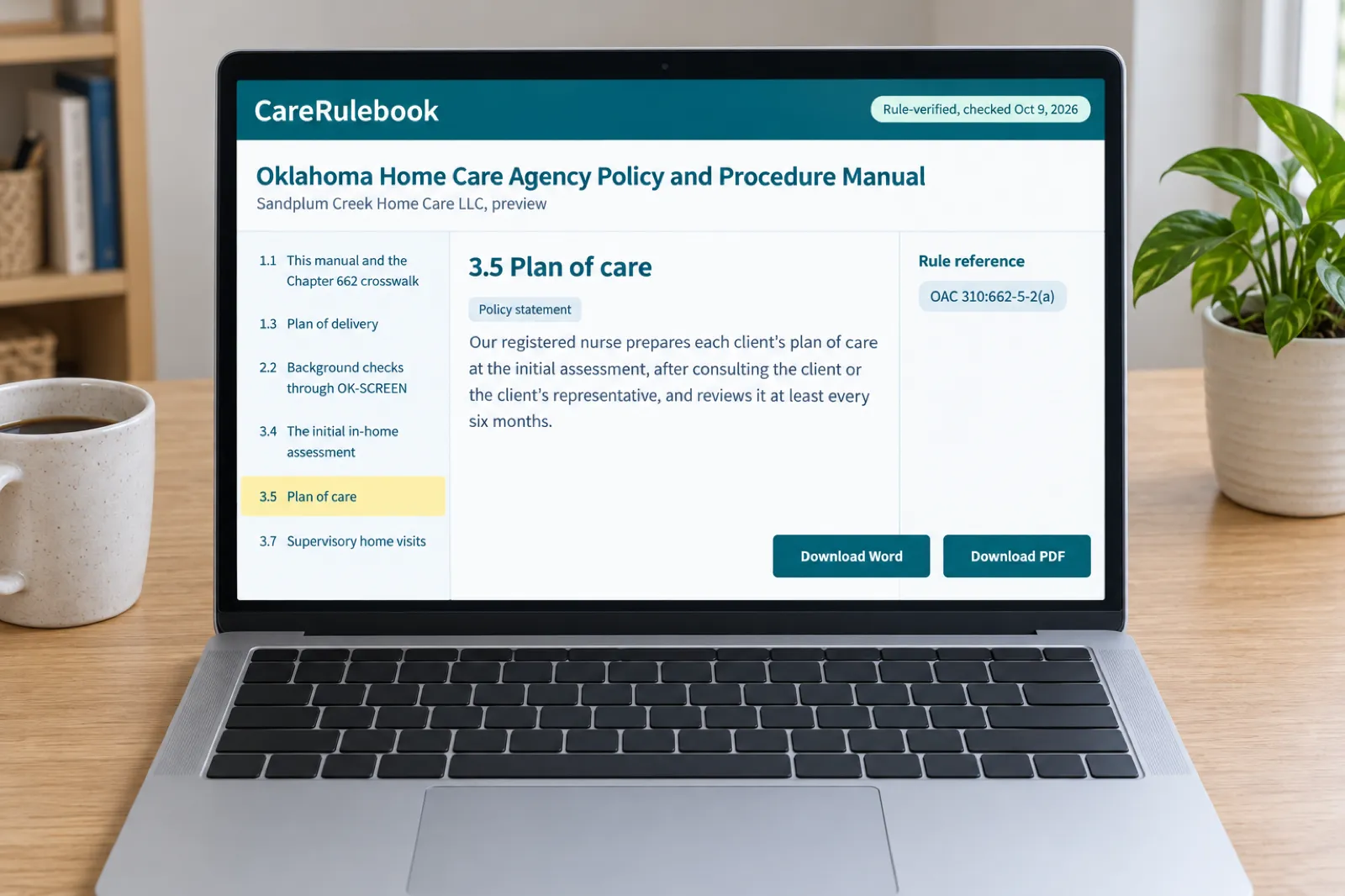
CareRulebook
CareRulebook’s Oklahoma manual includes Policy 2.4 (Who may give personal care: certified aides, CNAs and RN-trained caregivers), with a caregiver route record, a registry verification log and a long term care aide crossover record, and Policy 2.5 (Orientation, in-service training and the RN training plan), with an orientation checklist, a training calendar, an in-service log, the RN’s written training plan, competency checklists for each topic and a continuous training record. In the builder you choose which routes you use.
$199CareRulebook founding price for the first 50 Oklahoma agencies, then $249. Not an OSDH fee.
Chapter 662 makes orientation and in-service part of your written personnel policies: "Orientation of all personnel to the policies and objectives of the agency, and participation by all personnel in appropriate employee in-service programs" (OAC 310:662-3-4(e)(2)). The administrator ensures adequate staff in-service, continuing education and evaluations (OAC 310:662-3-4(c)).
The aide rules define in-service education as activities that help the aide gain, keep or increase competence in their assigned responsibilities, specific to the employer’s expectations, and orientation as the training for a particular job activity given to a new employee. (OAC 310:677-1-2)
Influenza education. The annual influenza vaccination program includes educating all employees and workers about influenza vaccination, non-vaccine influenza control measures, and the symptoms, transmission and potential impact of influenza. (OAC 310:662-3-4(e)(7)(C)) The rule sets no hours or format for it.
What Chapter 662 leaves to you. Apart from that influenza education, it sets no hours, topics, timing or trainer for orientation or for in-service outside the aide rules. CareRulebook’s manual orients every person before they work with any client or client information, with a checklist covering your objectives and services, who to call, client rights, confidentiality, abuse reporting, infection control, emergencies and, for caregivers, the plan of care and the caregiver task list. Each January the administrator and the supervising RN set the year’s training calendar, which always includes the yearly influenza education and yearly TB education for all staff (Policy 2.7). The orientation topics, timing and calendar are the manual’s choices, not OSDH’s.
Before using someone as a nurse aide, the employer consults the Oklahoma Nurse Aide Registry to see whether the person is listed and has no confirmed findings of abuse, neglect or misappropriation of client property. (OAC 310:677-1-3(b)) OSDH’s Nurse Aide Registry page links its Verify A Nurse Aide search and the Nurse Aide and Nontechnical Services Worker Abuse Registry, with the renewal, reciprocity and training exception forms. (OSDH Nurse Aide Registry page)
If you employ certified aides or CNAs, an allegation of abuse, neglect, mistreatment or misappropriation against one of them is reported to OSDH by telephone within 24 hours and in writing within five working days (OAC 310:677-1-4). The hiring checks that run alongside training are on Oklahoma caregiver background checks.
"Personnel records shall include, but not be limited to qualifications, employment history, records of orientation and in-service provided, verification that health screening was performed as required" (OAC 310:662-3-4(f)), plus evaluations, discipline and current license or certification checks. The rules set no training form. OSDH’s initial licensure survey checks whether the agency meets the minimum requirements for a license (OSDH FAQ), and we found no OSDH list of common training deficiencies.
CareRulebook’s manual files every training record in the personnel record (Policy 2.8): signed orientation checklists, in-service records, each aide’s and CNA’s in-service log for each calendar year, registry printouts, and for RN-trained workers their signed competency checklists and continuous training record. The registered nurse signs and dates each version of the written training plan, and the agency keeps the current and past versions (Policy 2.5).
No. The 75-hour course, with its competency exam, is the route to home health aide certification, and a certified nurse aide already counts as a home health aide. A worker employed by a licensed agency only for personal care can instead be trained by the agency’s RN and show competency in the RN’s written training plan on at least seven set topics, with RN on-site supervision at least every three months. The statute sets no hours for that route.
"has demonstrated competency in a written training plan developed by a registered nurse employed by the home care agency"
It depends. Not always. A home health aide must be certified and on OSDH’s registry within four months of starting. Since 2021 a worker employed only for personal care can instead be trained continuously by the agency’s RN, show competency in an RN-written training plan on seven set topics, and be supervised by the RN on site at least every three months (sooner after a hospital stay or surgery). Certified nurse aides also count. Either way, the RN carries the training and supervision.
"is supervised by a registered nurse via an on-site visit at least once every three (3) months or sooner if the client experiences a significant change in health condition"
Yes. If you provide hands-on personal care. Oklahoma has one home care agency license, and even an agency providing personal care only must employ or contract with a supervising registered nurse or physician (on call is allowed), name an alternate in writing, have the RN (or a physician or other licensed practitioner) assess each client at home and write the plan of care, have the RN review the plan at least every six months, and have a nurse or physician visit at least every six months. OSDH asks for both nurses’ licenses with the application. A companion or sitter service with no hands-on care needs no nurse.
"An agency providing personal care only shall employ or contract with a supervising physician or registered nurse who shall be available to the agency to advise the client care staff whenever personal care is provided."
It depends. Only conditionally. The employer requests the check when hiring, the person signs a statement that they are not disqualified, and the provisional period may not exceed 60 days with direct on-site supervision. In home care that means working alongside a supervisor, so, on our reading, many agencies wait for OSDH’s eligibility determination.
"The period of provisional employment shall not exceed sixty (60) days pending the completion of the required background check. During this time the employee shall be subject to direct on-site supervision."
It depends on the route. A certified home health aide completes a course of at least 75 hours, with at least 16 hours in the classroom before at least 16 hours of supervised practice, then an exam given by a registered nurse. A worker on the RN-trained route has no set hours: they show competency in the agency RN’s written training plan on at least seven topics and are trained continuously by an RN for each client. Certified aides then have at least 12 hours of in-service each calendar year.
Not always. The Home Care Act calls anyone who gives personal care for a fee a home health aide, and an aide must be certified and on OSDH’s registry within four months. A certified nurse aide already counts. Since 2021 a worker employed by a licensed agency only for personal care can instead be trained and supervised by the agency’s RN under 63 O.S. 1-1962(D)(9), which the rules have repeated since August 11, 2025.
At least: observation, reporting and documentation of the client’s status and the help given; a clean, safe and healthy environment; recognizing an emergency and the emergency procedures; safe help with bathing, grooming and toileting; meal preparation and safe food handling and storage; client rights and responsibilities, with respect for the client’s privacy and property; and basic infection control, including hand hygiene and standard precautions. A registered nurse employed by the agency writes it.
At least 12 hours each calendar year, with an annual performance review. The in-service is generally supervised by a registered nurse with at least two years of nursing experience, at least one of them in home care. The agency also makes sure every certification is current and not expired.
Yes, after two steps. A person listed on the nurse aide registry as a long term care aide passes an OSDH-approved home care skills exam and completes at least 16 hours of orientation specific to the agency’s clients. OSDH then lists them as a certified home health aide. That is the rule; whether the statute deeming CNAs to meet the aide requirements (63 O.S. 1-1951(D)) makes the exam unnecessary is a question we have not seen OSDH answer.
We found nothing in Chapter 662, the home health aide rules or the Home Care Act about caregivers helping with medication, and no medication training for them. Oklahoma’s certified medication aide rules list the employers a medication aide may work for, and home care agencies are not among them (OAC 310:677-13-2). CareRulebook’s manual covers verbal reminders only, if you choose them, and says this limit is the agency’s own reading until OSDH or the Board of Nursing says what caregivers may do.
We found no CPR, first aid or dementia training requirement in Chapter 662, the home health aide rules or the Home Care Act. The aide course and the RN training plan both cover recognizing an emergency and the emergency procedures. A Medicaid waiver program may set its own training standards.
OSDH’s advisory council has had further Chapter 662 changes on its agenda. Leave your email and we will tell you when an Oklahoma change affects your caregivers’ training or your policies.
No spam. Only emails about Oklahoma home care rules. How we use your email.
Oklahoma
How to start a home care agency in Oklahoma
The license, the supervising RN, the caregiver routes and the initial survey.
Manual
Build your Oklahoma policy manual
Including Policies 2.4 and 2.5 on caregiver routes, orientation, in-service and the RN training plan.
Oklahoma
Oklahoma caregiver background checks
OK-SCREEN, fingerprints and the 60-day conditional hire.
Oklahoma
Oklahoma policies and procedures
Every item Chapter 662 names, including the orientation and in-service policy.
Oklahoma
Oklahoma home care surveys
What an OSDH surveyor can check, including personnel and training records.
Oklahoma
Oklahoma license cost and timeline
Every state fee, and the deadlines the rules fix.
Tool
Oklahoma license checklist
Every step to an OSDH license, tailored to your agency.
Compare
Caregiver training by state
How Oklahoma’s routes compare with other states’ training rules.
Kansas
Kansas caregiver training
Competency in 10 areas before working without the manager present.
Colorado
Colorado caregiver training
Homemaker and personal care worker topics, competency checks and supervision.
Free sample, no email needed
Policy 3.1, Client rights and responsibilities, and client autonomy, as it prints in the Oklahoma manual, filled in for a fictional agency. The rule text it rests on is quoted word for word under Rule basis.
PDF · 10 pages · 125 KB · Rule-verified October 9, 2026
Collecting answers for an agency or a client? The intake questionnaire lists all 48 questions the builder asks, what each decision changes in the manual, and a completed example: Word · PDF.How consultants use CareRulebook.