Quick answer
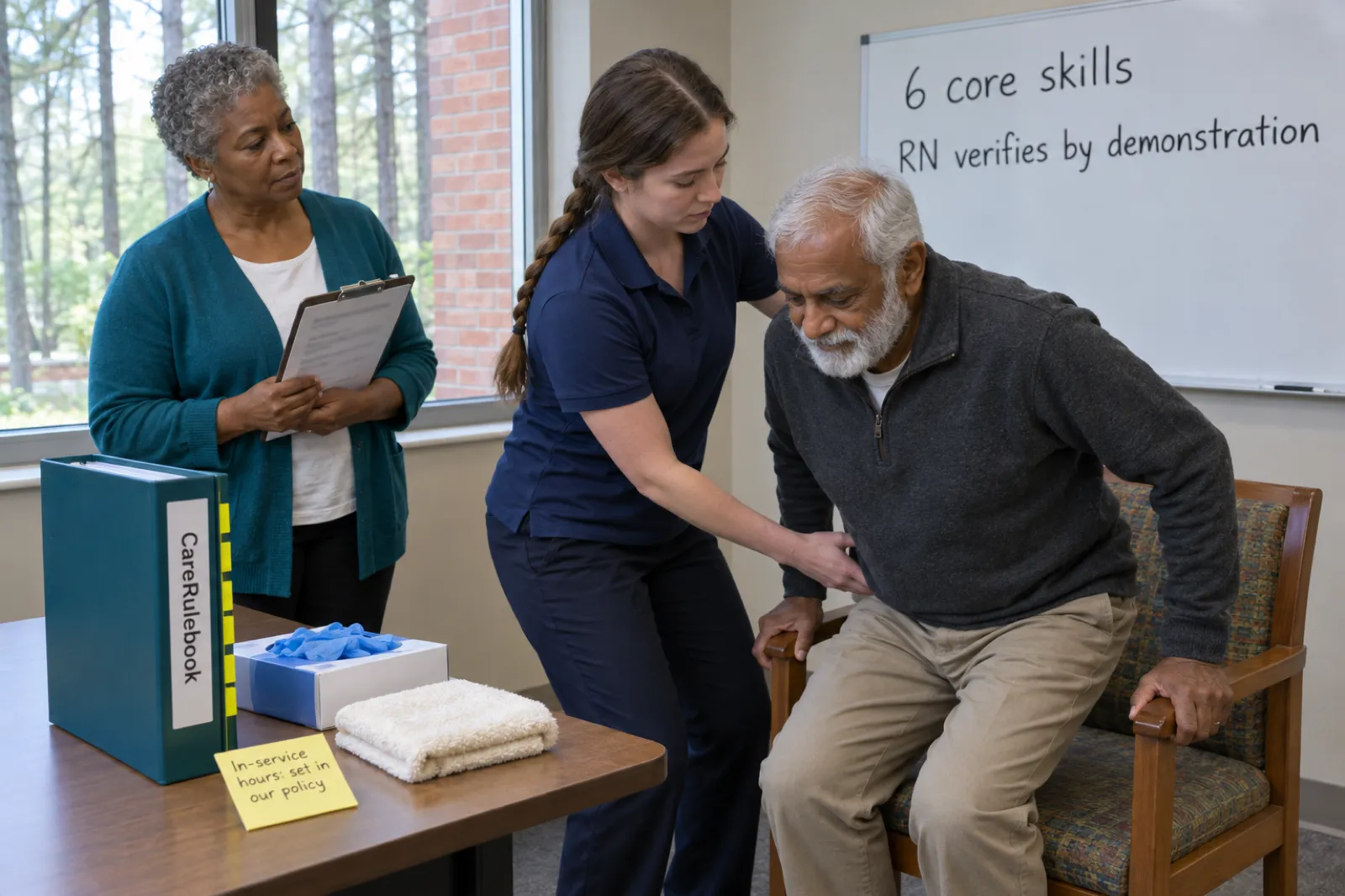
We found no training-hour minimum for in-home aides in 10A NCAC 13J. Instead, "Each agency shall document that its in-home caregivers are competent to perform client care tasks or activities that they are assigned." and "Meeting competency includes a demonstration of tasks to the health care practitioner." (13J .1110(a)). For in-home aides not listed on the Nurse Aide Registry, personnel records include a registered nurse’s verification of six core personal care skills (.1003(g)).
Your written policies must cover orientation and in-service education (.1003(d)), and DHSR says "The agency In-Service Education policy should specify the number of in-service hours employees are required to complete." (FAQ 54). Hands-on care staff get airborne and bloodborne pathogen training, including annual updates (.1003(f)(6)).
Aides giving extensive assistance must be on the Nurse Aide Registry (.1107(b)). The rules define companion, sitter and respite staff as people who spend time with clients or provide non-hands-on care services, and define those services as ones that do not require training or verification of skills by a registered nurse (.1501(1); .1501(2)). The agency still documents that companions and sitters are competent (.1504(1)).
6
Core personal care skills an RN verifies for aides not on the registry
13J .1003(g)Your policy
sets the in-service hours, DHSR says
DHSR FAQ 54Yearly
bloodborne pathogen training update for hands-on staff
13J .1003(f)(6)90 days
between supervisory visits to each aide’s client
13J .1110(c)CareRulebook
Training and competency records, written for your agency
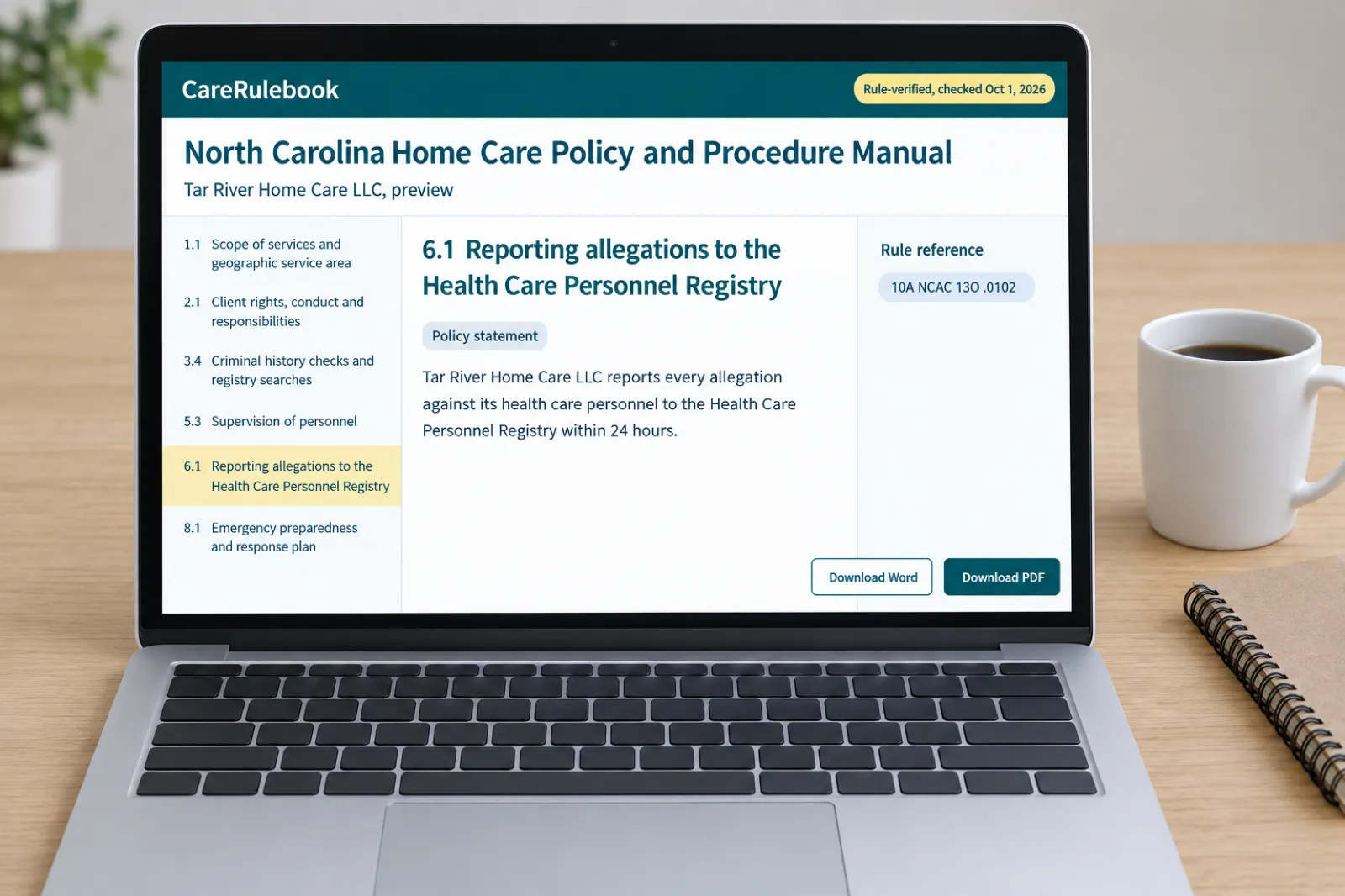
CareRulebook’s North Carolina manual includes Policy 4.2 with an RN skills checklist covering the six core skills, Policy 4.1 with your in-service hours, Policy 5.3 (Supervision of personnel), Policy 3.2 (Personnel records) and Policy 3.3 (Annual performance evaluation).
- 32 policies, 48 rule requirements mapped
- All 32 items on DHSR’s Initial Survey Checklist
- Editable Word and PDF, with the rule quoted under each policy
Preview your manual$199CareRulebook founding price for the first 50 North Carolina agencies, then $249. Not a DHSR fee.
Frequently asked questions
How many hours of training do home care aides need in North Carolina?+
We found no training-hour minimum for in-home aides in 10A NCAC 13J. The rules ask for documented competency, shown by demonstrating tasks to the health care practitioner; written orientation and in-service education policies; and airborne and bloodborne pathogen training with annual updates for hands-on care staff. DHSR says your in-service education policy should specify the number of in-service hours. NC Medicaid’s Policy 3L lists training content areas for aides who provide Medicaid personal care services, not hours.
Do in-home aides have to be CNAs in North Carolina?+
Not always. The rule requires a Nurse Aide Registry listing when a client’s plan of care requires the aide to give extensive assistance. An aide giving only limited assistance is not required to be listed, but for aides not on the registry, personnel records must include a registered nurse’s verification of core competencies, including six core personal care skills for aides hired after April 1, 2009.
Who verifies an aide’s competency?+
Rule .1110 says meeting competency includes a demonstration of tasks to the health care practitioner, and DHSR says the RN validates the competency of in-home caregivers. For aides not on the Nurse Aide Registry, .1003(g) names a registered nurse for the six core skills. DHSR’s FAQ says competencies must be verified by a demonstration: performing the task or activity being assigned.
Do companions and sitters need training from a nurse?+
By our reading, no. The rules define companion, sitter and respite staff as people who spend time with clients or provide non-hands-on care services, and define those services as ones that do not require training or verification of skills by a registered nurse. The agency still needs documentation that companions and sitters are competent for the tasks they are assigned, and they work under a supervisor designated by agency policy.
Can caregiver training be done online?+
Rule 13J does not say how training is delivered, by our reading. Competency, though, includes a demonstration of tasks to the health care practitioner, so an online course alone does not show an aide is competent for a hands-on task. OSHA’s bloodborne pathogens standard has its own training rules; CareRulebook’s manual allows in-service education in person or online when attendance and time can be documented.
How often is bloodborne pathogen training needed?+
Rule .1003(f)(6) asks for airborne and bloodborne pathogen training for hands-on care employees, including annual updates. OSHA’s standard requires it at no cost to the employee and during working hours, at the time of initial assignment to tasks where occupational exposure may take place, and at least annually after that.
What training does DHSR check before licensing?+
Its Initial Survey Checklist lists a competency verification and skills validation or checklist policy, an in-service training policy, an orientation policy and a bloodborne pathogen policy that includes training and updates. Its personnel record review lists competency verification, proof of bloodborne pathogen training and proof of orientation.
Does the six-skill RN check apply to aides hired before April 1, 2009?+
The six-skill list in .1003(g) is written for in-home aides hired after April 1, 2009. By our reading, the general duty in .1110 still applies to every in-home caregiver: the agency documents competency for all assigned tasks, shown by demonstration to the health care practitioner. By our reading, an aide not on the registry who was hired before that date still needs an RN’s verification of core competencies; the rule just does not list the skills for them.
Get North Carolina rule-change alerts
The Medical Care Commission makes the home care rules and DHSR updates its checklist and FAQ. Leave your email and we will tell you when a change affects your training or your policies.
No spam. Only emails about North Carolina home care rule changes. How we use your email.
Keep reading
US
Caregiver training requirements by state →
How North Carolina’s aide training compares with the other states we cover: hours, competency checks, orientation and yearly training.
North Carolina
How to start a home care agency in North Carolina →
The license, DHSR’s 32-item checklist, staffing and supervision.
North Carolina
North Carolina policies and procedures →
The 11 policies in .1001(a) and DHSR’s 32 checklist items, mapped.
North Carolina
North Carolina caregiver background checks →
The criminal history check and both registries.
North Carolina
Agency director and RN →
The RN who verifies competency and supervises aides.
North Carolina
NC Medicaid personal care services →
Policy 3L: enrollment, referrals, EVV and quality rules.
North Carolina
North Carolina survey and inspections →
The personnel records DHSR reviews before licensing.
Manual
Your North Carolina policy manual →
Including Policy 4.2 on competency and Policy 4.1 on orientation and in-service.
Tennessee
Tennessee caregiver training →
Competency in seven areas before work, then training every year.
Colorado
Colorado caregiver training →
Homemaker and personal care worker topics, competency checks and supervision.
Maryland
Maryland caregiver training →
Seven COMAR topics, a skills demonstration and dementia training hours.
Sources
- 10A NCAC 13J, The Licensing of Home Care Agencies · NC Office of Administrative Hearings · retrieved October 1, 2026
- N.C. General Statutes Chapter 131E, Article 6 (home care agency licensure and home care clients’ bill of rights) · North Carolina General Assembly · retrieved October 1, 2026
- Home Care Initial Survey Checklist (rev. 9/21) · NC DHSR · retrieved October 1, 2026
- Home Care Frequently Asked Questions (rev. 5/30/25) · NC DHSR · retrieved October 1, 2026
- 10A NCAC 13O, Health Care Personnel Registry · NC Office of Administrative Hearings · retrieved October 1, 2026
- 29 CFR 1910.1030, Bloodborne pathogens · eCFR (OSHA) · retrieved October 1, 2026
- NC Medicaid Clinical Coverage Policy 3L, State Plan Personal Care Services (PCS) in In-Home Settings (amended January 1, 2026) · NC Medicaid, Division of Health Benefits · retrieved October 1, 2026