Skip to content
CareRulebook
MenuClose

Where are you starting?

United StatesTexas, North Carolina, Georgia, Virginia, Indiana, Ohio, New York, Illinois, Washington, Colorado, Tennessee, Maryland, Kansas, South Carolina, Nevada
TexasManual
North CarolinaManual
GeorgiaManual
VirginiaManual
IndianaManual
OhioGuideNew YorkGuide
IllinoisManual
WashingtonManual
ColoradoManual
TennesseeManual
MarylandManual
KansasManual
South CarolinaManual
NevadaManual
All US states →
United KingdomEngland
Free toolsChecklists, calculators and templates

Kansas · Home Health Agency license, supportive care · K.A.R. 28-51

Kansas home care policies and procedures: KDHE’s 13 folders

KDHE reads a Kansas supportive care agency’s policies before it issues the license. They go into 13 folders in its file transfer system, one numbered folder for each item in its Instruction Guide, and nothing may say "Not Applicable". Here is what the rules require, what KDHE’s checklist adds, all 70 numbered items with the policy that answers each, and all 130 requirements mapped to a policy.

  • Rule-verified October 2, 2026
  • 130 requirements quoted verbatim
  • From K.A.R. 28-51 and KDHE’s Instruction Guide
A woman with auburn hair and glasses, in a mustard cardigan, slides a printed page into a row of manila folders in a wire organizer at an oak table, beside an upright CareRulebook binder with yellow tabs, a cream mug, a yellow highlighter, a closed laptop and two sticky notes reading 13 folders and 70 numbered items, with a white fence, a yellow-leaved tree and stubble fields outside the window

Quick answer

The rule makes your policies part of the application. Each initial application includes "a copy of the policies and procedures applicable to the home health agency as required by K.A.R." 28-51-103, -104, -117 and -118 (K.A.R. 28-51-101(a)(1)(C)). After KDHE has your application and fee, you upload them into its file transfer system, and "When all required documents have been reviewed and meet the requirements, KDHE will issue a license and notify you of your license approval." (KDHE application)

Two layers ask for policies. The rule text names 13 written duties, such as admission criteria, the 16 assigned duties and abuse reporting. KDHE’s Instruction Guide adds more: by our count it has 70 numbered items in 13 folders, and 42 of them ask for a policy (Instruction Guide). Some, like hiring and interviewing, have no rule behind them, but KDHE reviews against the guide before it licenses you, so treat them as required.

Nothing may say "Not Applicable". "Make sure that there are no areas that are left blank or indicate “See Attached” or “Not Applicable.”" (Instruction Guide, Additional Help) So a supportive care agency, which may not provide nursing, still writes a nursing services policy saying what it does instead.

13

Upload folders in KDHE’s file transfer system

Instruction Guide, Important

70

Numbered items outside Personnel Recs (our count)

Instruction Guide

42

Of those items that ask for a policy (our count)

Instruction Guide

130

Requirements mapped to 31 CareRulebook policies

K.A.R. 28-51; K.S.A. 65-5101 to 65-5117

What the rules require, and what KDHE’s checklist adds

Layer one: the rule text. K.A.R. 28-51 and the Home Health Agency Act call for these written policies or documents in so many words. Most sit in K.A.R. 28-51-103, -104 and -117, the sections the application rule names.

Written duty in the rulesSourceCareRulebook policy
The governing body adopts, revises and approves policies and proceduresK.A.R. 28-51-103(a)(3)1.1 Governing body, bylaws and appointments1.2 Adopting, revising and approving policies; the KDHE folder index
Written personnel policies and procedures and job descriptions, available to all employeesK.A.R. 28-51-103(b)(1)(D)2.1 Job descriptions, organizational chart, staff roster and personnel files2.2 Hiring, interviewing, reference checks and credentials
Admission criteria, consistent with the definition of supportive care servicesK.A.R. 28-51-117(a); 28-51-104(c)(3)(A)4.1 Client acceptance and admission criteria
The supportive care worker’s scope of practice and the training each needsK.A.R. 28-51-117(b); 28-51-104(c)(3)(B)4.2 Provision of supportive care services and the supportive care worker’s scope of practice
How supportive care services are providedK.A.R. 28-51-104(c)(3)(E)4.2 Provision of supportive care services and the supportive care worker’s scope of practice
Workers do not set up medications or give medication administrationK.A.R. 28-51-104(c)(3)(H)4.8 Medications: reminders only, no set-up or administration
Everyone serving a client keeps the manager informedK.A.R. 28-51-104(c)(3)(I)4.6 Communication with the manager and changes in a client’s condition
Assigned duties: the 16 task areasK.A.R. 28-51-117(g)4.5 Assigned duties: the 16 task areas
The process for reporting abuse, neglect and exploitationK.A.R. 28-51-103(g)(2)3.1 Abuse, neglect and exploitation: reporting, training and investigation
Periodic employee health assessments, as the agency’s policy setsK.A.R. 28-51-103(d)(7)2.5 Employee health assessments and TB testing
Use and removal of client record documents, and release of informationK.A.R. 28-51-110(e)5.1 Client records: contents, notes, retention, safeguarding and release
A clients’ bill of rights, set by the governing bodyK.A.R. 28-51-111(a)6.1 Clients’ bill of rights and acknowledgment
Written contracts with hourly or per-visit contractors, if you use themif the agency uses hourly or per-visit contractorsK.A.R. 28-51-103(f)2.7 Hourly and per-visit contract personnel

Layer two: KDHE’s Instruction Guide. KDHE’s Application Submission Requirements and Instruction Guide (reviewed/revised 03/2024) is the list KDHE reviews against. It tells applicants: "Use this form as a checklist to ensure you have included all required information." (Instruction Guide, Additional Help) It also warns that its notes are not the whole story: "This is not an all-inclusive list. Please review the regulations and your agency’s policies for additional requirements." (Instruction Guide, Important)

We sorted each of the guide’s 70 numbered items by what stands behind it. By our reading:

  • 11 items are policies the rule text itself calls for.
  • 29 items are policies on a duty the rules set, where the rules do not ask for a written policy but KDHE does. For example, the rule requires reference checks before employment; KDHE asks for a reference check policy and template (K.A.R. 28-51-103(d)(5)).
  • 2 items, hiring procedures and interviewing, are KDHE’s checklist with no rule duty behind them that we found (Instruction Guide, Personnel Policies (8)-(9)).
  • 28 items are documents or forms rather than policies: bylaws, appointment letters, disclosures, job descriptions, the staff roster, the signed rights acknowledgment, the offense list and the Misc folder’s letters.

One edge case: Govern Body 10 asks for the agency’s process for reporting abuse, neglect and exploitation. The manual answers it with Policy 3.1, but the guide does not call it a policy, so we count it with the documents. Count it as a policy and the total is 43.

The rule also asks, in general terms, for "provide written personnel policies and procedures and job descriptions that are made available to all employees" (K.A.R. 28-51-103(b)(1)(D)), without naming topics. KDHE says the personnel policies should "serve to document your agency’s personnel policies and the intended practices concerning Human Resources (HR) matters", and that the documents may include "policies, templates, cited resources, etc." (Instruction Guide, Personnel Policies)

KDHE’s 13 folders, item by item

"Each Section below corresponds to a folder location on the file transfer system." The numbered folders inside each one "correspond to a number in parenthesis behind each required document", and each must hold at least one document (Instruction Guide, Important). If one document covers several sections, it must be uploaded in each section, because each section is reviewed separately. (Instruction Guide, Instructions 3) A numbered folder may hold more than one document, as long as each supports the requirement being reviewed. (Instruction Guide, Important)

Folder names below are KDHE’s labels; the wording of each item is shortened from the guide. The kind of item and the last column are ours: the policy or form that answers each item in the CareRulebook manual’s KDHE folder index (Policy 1.2). The Personnel Recs folder, which holds a roster and ten personnel files, comes after the table.

Rule names the policy: 11Rule duty, KDHE asks for the policy: 29KDHE’s checklist only: 2Document or form: 28

Govern Body (Governing Body)

10 items
No.KDHE asks for (shortened)Rule or KDHE sourceAnswered in the manual
1

Bylaws or an operating agreement, complete, dated and signed

Document or form

K.A.R. 28-51-103(a)(1)Your document: Bylaws or operating agreementPolicy 1.1: Governance addendum and yearly renewal record
2

Policy on adopting, revising and approving policies

Rule duty, KDHE asks for the policy

K.A.R. 28-51-103(a)(3)KDHE Instruction Guide, Governing Body (2)Policy 1.2, Adopting, revising and approving policies; the KDHE folder indexPolicy 1.2: Signed adoption resolution
3

Document showing the appointed administrator

Document or form

KDHE Instruction Guide, AdministratorsPolicy 1.1: Appointment of the administrator
4

Document showing the appointed alternate administrator

Document or form

KDHE Instruction Guide, AdministratorsPolicy 1.1: Appointment of the alternate administrator
5

Name and address of each officer, director and owner

Document or form

K.A.R. 28-51-103(a)(4)-(6)Policy 1.1: Ownership and management disclosure
6

Evidence the administrator lives within 200 miles of the parent office

Document or form

K.A.R. 28-51-103(b)(2); KDHE Instruction Guide, Governing Body (6)-(7)Your document: Proof of addressPolicy 1.3: Evidence cover sheet
7

Evidence the alternate lives within 200 miles of the parent office

Document or form

K.A.R. 28-51-103(b)(2); KDHE Instruction Guide, Governing Body (6)-(7)Your document: Proof of addressPolicy 1.3: Evidence cover sheet
8

Corporate ownership interests over five percent

Document or form

K.A.R. 28-51-103(a)(4)-(6)Policy 1.1: Ownership and management disclosure
9

Past home health agency ownership or management

Document or form

K.A.R. 28-51-103(a)(4)-(6)Policy 1.1: Ownership and management disclosure
10

The agency’s process for reporting abuse, neglect and exploitation

Document or form

K.A.R. 28-51-103(g)(2)Policy 3.1, Abuse, neglect and exploitation: reporting, training and investigation

Admin (Administrators)

5 items
No.KDHE asks for (shortened)Rule or KDHE sourceAnswered in the manual
1

Current Kansas licensure, if applicable

Document or form

K.A.R. 28-51-103(d)(3); KDHE Instruction Guide, Personnel Policies (11)Your document: License verification, or "none held" on the cover sheet
2

Resume or CV with proof of educational training

Document or form

K.A.R. 28-51-103(b)(4)Your document: Resumes, transcripts or course certificatesPolicy 1.3: Evidence cover sheet
3

Administrator and alternate job descriptions with the duties the rule lists

Document or form

K.A.R. 28-51-103(b)(1)Policy 2.1: Job descriptions A and BPolicy 1.3, Administrator and alternate administrator
4

Document showing the appointed administrator

Document or form

KDHE Instruction Guide, AdministratorsPolicy 1.1: Appointment of the administrator
5

Document showing the appointed alternate administrator

Document or form

KDHE Instruction Guide, AdministratorsPolicy 1.1: Appointment of the alternate administrator

Personnel Policies

18 items
No.KDHE asks for (shortened)Rule or KDHE sourceAnswered in the manual
1

Job description: administrator

Document or form

K.A.R. 28-51-103(d)(2)Policy 2.1: Job description A
2

Job description: alternate administrator

Document or form

K.A.R. 28-51-103(d)(2)Policy 2.1: Job description B
3

Job description: supervisor or manager

Document or form

K.A.R. 28-51-103(d)(2)Policy 2.1: Job description C
4

Job description: supportive care worker

Document or form

K.A.R. 28-51-103(d)(2)Policy 2.1: Job description D
5

Job descriptions: all other positions

Document or form

K.A.R. 28-51-103(d)(2)Policy 2.1: Job description E
6

Organizational chart

Document or form

KDHE Instruction Guide, Personnel Policies (6)-(7)Policy 2.1: Organizational chart
7

Staff roster

Document or form

KDHE Instruction Guide, Personnel Policies (6)-(7)Policy 2.1: Staff roster
8

Hiring procedures

KDHE’s checklist only

KDHE Instruction Guide, Personnel Policies (8)-(9)Policy 2.2, Hiring, interviewing, reference checks and credentials
9

Interviewing

KDHE’s checklist only

KDHE Instruction Guide, Personnel Policies (8)-(9)Policy 2.2, Hiring, interviewing, reference checks and credentials
10

Reference checks (policy and template)

Rule duty, KDHE asks for the policy

K.A.R. 28-51-103(d)(5)Policy 2.2, Hiring, interviewing, reference checks and credentials
11

Validation of credentials and licenses

Rule duty, KDHE asks for the policy

K.A.R. 28-51-103(d)(3); KDHE Instruction Guide, Personnel Policies (11)Policy 2.2, Hiring, interviewing, reference checks and credentials
12

Background checks

Rule duty, KDHE asks for the policy

K.S.A. 65-5117(e)Policy 2.3, Criminal record checks and provisional employment
13

Performance evaluations

Rule duty, KDHE asks for the policy

K.A.R. 28-51-103(d)(4)Policy 2.4, Performance evaluations
14

Health record

Rule names the policy

K.A.R. 28-51-103(d)(6)(A)-(B)K.A.R. 28-51-103(d)(7)Policy 2.5, Employee health assessments and TB testing
15

TB testing and screening (policy and template)

Rule duty, KDHE asks for the policy

K.A.R. 28-51-103(d)(6)(C)Policy 2.5, Employee health assessments and TB testing
16

Competency (policy and template)

Rule duty, KDHE asks for the policy

K.A.R. 28-51-117(c)Policy 2.6, Orientation, training and competency
17

Required contents of personnel files

Rule duty, KDHE asks for the policy

K.A.R. 28-51-103(d)KDHE Instruction Guide, Personnel Policies (17)Policy 2.1, Job descriptions, organizational chart, staff roster and personnel files
18

Provisional employment

Rule duty, KDHE asks for the policy

K.A.R. 28-51-103(e); K.S.A. 65-5117(e)Policy 2.3, Criminal record checks and provisional employment

Contracts

1 item
No.KDHE asks for (shortened)Rule or KDHE sourceAnswered in the manual
1

Policy on personnel under hourly or per-visit contracts, with all seven elements

Rule duty, KDHE asks for the policy

K.A.R. 28-51-103(f)KDHE Instruction Guide, Contracts (1)Policy 2.7, Hourly and per-visit contract personnel

ANE (Abuse, Neglect and Exploitation)

3 items
No.KDHE asks for (shortened)Rule or KDHE sourceAnswered in the manual
1

Abuse, neglect and exploitation policy: every employee reports, the K.S.A. 39-1430 definitions, KDHE’s hotline

Rule names the policy

K.A.R. 28-51-103(g)(2)KDHE Instruction Guide, Abuse, Neglect and Exploitation (1)Policy 3.1, Abuse, neglect and exploitation: reporting, training and investigation
2

Sample client rights form with a signed, dated acknowledgment

Document or form

KDHE Instruction Guide, Client Rights (2); ANE (2)Policy 6.1: Clients’ bill of rights and acknowledgment
3

Abuse, neglect and exploitation training at hire or contract and yearly

Rule duty, KDHE asks for the policy

K.A.R. 28-51-103(g)(1)Policy 3.1, Abuse, neglect and exploitation: reporting, training and investigationPolicy 2.6: Training record

Provision of Svcs (Provision of Services)

13 items
No.KDHE asks for (shortened)Rule or KDHE sourceAnswered in the manual
1

Client acceptance and admission criteria

Rule names the policy

K.A.R. 28-51-117(a); 28-51-104(c)(3)(A)Policy 4.1, Client acceptance and admission criteria
2

Provision of services

Rule names the policy

K.A.R. 28-51-104(c)(3)(E)Policy 4.2, Provision of supportive care services and the supportive care worker’s scope of practice
3

Plan of care: developing, following and reviewing

Rule duty, KDHE asks for the policy

K.A.R. 28-51-100(pp)(2)K.A.R. 28-51-104(c)(3)(F)Policy 4.3, Client assessment, admission note and plan of care
4

Written assignments

Rule duty, KDHE asks for the policy

K.A.R. 28-51-117(f)(1)-(2)Policy 4.4, Written assignments
5

Assigned duties

Rule names the policy

K.A.R. 28-51-117(g)Policy 4.5, Assigned duties: the 16 task areas
6

Communication to support the plan of care

Rule names the policy

K.A.R. 28-51-104(c)(3)(I)Policy 4.6, Communication with the manager and changes in a client’s condition
7

On-call

Rule duty, KDHE asks for the policy

K.A.R. 28-51-104(c)(3)(J); 28-51-100(gg)KDHE Instruction Guide, Provision of Services (7)Policy 4.7, Manager on call
8

Scope of practice of a supportive care worker

Rule names the policy

K.A.R. 28-51-117(b); 28-51-104(c)(3)(B)Policy 4.2, Provision of supportive care services and the supportive care worker’s scope of practice
9

Medications and administration

Rule names the policy

K.A.R. 28-51-104(c)(3)(H)Policy 4.8, Medications: reminders only, no set-up or administration
10

Nursing services

Rule duty, KDHE asks for the policy

K.A.R. 28-51-105(e)KDHE Instruction Guide, Non-Skilled (2); Provision of Services (10)Policy 4.9, Nursing services (not provided) and no prefilling of insulin syringes
11

Client assessment (policy and template)

Rule duty, KDHE asks for the policy

K.A.R. 28-51-104(c)(3)(C)Policy 4.3: Client assessment
12

Training documents or templates for managers and supportive care workers

Document or form

K.A.R. 28-51-104(c)(3)(D)Policy 2.6: Training outline
13

Competency checklist template and policy

Rule duty, KDHE asks for the policy

K.A.R. 28-51-117(c)Policy 2.6: Competency checklist

Supervision

1 item
No.KDHE asks for (shortened)Rule or KDHE sourceAnswered in the manual
1

Supervision policy

Rule duty, KDHE asks for the policy

K.A.R. 28-51-104(c)(3)(K)KDHE Instruction Guide, Supervision (1)Policy 4.10, Supervision of supportive care workers

Client Recs (Client Records)

10 items
No.KDHE asks for (shortened)Rule or KDHE sourceAnswered in the manual
1

Client records

Rule duty, KDHE asks for the policy

K.A.R. 28-51-110(a)Policy 5.1, Client records: contents, notes, retention, safeguarding and release
2

Contents of the client record

Rule duty, KDHE asks for the policy

K.A.R. 28-51-110(c)Policy 5.1, Client records: contents, notes, retention, safeguarding and release
3

Client record retention

Rule duty, KDHE asks for the policy

K.A.R. 28-51-110(d)Policy 5.1, Client records: contents, notes, retention, safeguarding and release
4

Safeguarding client records against loss or unauthorized review or use

Rule names the policy

K.A.R. 28-51-110(e)Policy 5.1, Client records: contents, notes, retention, safeguarding and release
5

Use, removal and release of information

Rule names the policy

K.A.R. 28-51-110(e)K.A.R. 28-51-110(e)Policy 5.1, Client records: contents, notes, retention, safeguarding and release
6

Admission notes

Rule duty, KDHE asks for the policy

K.A.R. 28-51-100(b)Policy 4.3, Client assessment, admission note and plan of carePolicy 5.1, Client records: contents, notes, retention, safeguarding and release
7

Documentation of supportive care services provided

Rule duty, KDHE asks for the policy

K.A.R. 28-51-110(c)(5)Policy 5.1, Client records: contents, notes, retention, safeguarding and release
8

Progress notes

Rule duty, KDHE asks for the policy

K.A.R. 28-51-104(c)(3)(G); 28-51-100(rr)Policy 5.1, Client records: contents, notes, retention, safeguarding and release
9

Supervision

Rule duty, KDHE asks for the policy

K.A.R. 28-51-110(c)(7)Policy 4.10, Supervision of supportive care workersPolicy 5.1, Client records: contents, notes, retention, safeguarding and release
10

Discharge summary

Rule duty, KDHE asks for the policy

K.A.R. 28-51-100(q)(2); 28-51-110(c)(8)Policy 4.11, Discharge, transfer and referralPolicy 5.1, Client records: contents, notes, retention, safeguarding and release

Client Rights

2 items
No.KDHE asks for (shortened)Rule or KDHE sourceAnswered in the manual
1

Client rights policy

Rule names the policy

K.A.R. 28-51-111(a)Policy 6.1, Clients’ bill of rights and acknowledgment
2

Sample client rights form with a signed, dated acknowledgment

Document or form

KDHE Instruction Guide, Client Rights (2); ANE (2)Policy 6.1: Clients’ bill of rights and acknowledgment

Non-Skilled (Non-Skilled Services)

2 items
No.KDHE asks for (shortened)Rule or KDHE sourceAnswered in the manual
1

Prefilling insulin syringes

Rule duty, KDHE asks for the policy

K.S.A. 65-5116(b); KDHE Instruction Guide, Non-Skilled (1)Policy 4.9, Nursing services (not provided) and no prefilling of insulin syringes
2

Nursing services (not providing)

Rule duty, KDHE asks for the policy

K.A.R. 28-51-105(e)KDHE Instruction Guide, Non-Skilled (2); Provision of Services (10)Policy 4.9, Nursing services (not provided) and no prefilling of insulin syringes

Bkrnd Chk (Background Checks)

2 items
No.KDHE asks for (shortened)Rule or KDHE sourceAnswered in the manual
1

Background check policy under K.S.A. 65-5117

Rule duty, KDHE asks for the policy

K.A.R. 28-51-103(d)(8)KDHE Instruction Guide, Background Checks (1)-(2)Policy 2.3, Criminal record checks and provisional employment
2

Current State of Kansas list of offenses

Document or form

KDHE Instruction Guide, Background Checks (1)-(2)Policy 2.3: Kansas list of prohibited offenses

Misc (Miscellaneous)

3 items
No.KDHE asks for (shortened)Rule or KDHE sourceAnswered in the manual
1

A completed copy of KDHE’s Instruction Guide

Document or form

KDHE’s processYour document: KDHE’s guide, checked off (the folder index helps)
2

Any other document, with a letter of intent

Document or form

KDHE’s processPolicy 1.2: Letter of intent, only if needed
3

The signed "Begin Review Process" letter on letterhead

Document or form

KDHE’s processPolicy 1.2: Begin Review Process letter, uploaded last

Personnel Recs: a roster and ten files

Applicants upload 10 employees’ personnel records, including the administrator, alternate administrator and supervisors, with a staff roster cross-walked to the folders; fewer if the agency has fewer staff (note it on the roster). No I-9s, W-4s or Social Security cards. (Instruction Guide, Personnel Records) "Each Numbered Folder should contain the contents of ONLY ONE person’s personnel file." (Instruction Guide, Personnel Records (A)) Each file shows: Application, resume, signed job description, credential checks, interview and reference checks before hire, evaluations, health history, health assessment, TB test, criminal record check evidence, orientation, competency, supervisory visit and ANE training records (Instruction Guide).

These are your documents. In the manual, Policy 2.1 gives the staff roster with a folder column for item A and a personnel file checklist to assemble each file; Policies 2.2 to 2.6 give the forms that go in them. The KDADS check and training and competency have their own guides.

Item kinds are our reading of the rules against the guide. Where an item’s kind is "Rule duty, KDHE asks for the policy", the rule sets what you must do and KDHE asks you to write down how you do it.

No "Not Applicable": policies for what you do not do

KDHE’s rule on blanks is short: "Make sure that there are no areas that are left blank or indicate “See Attached” or “Not Applicable.”" It adds: "Citations must be specific, and all documentation must be present for the section." (Instruction Guide, Additional Help) For a supportive care agency, three items are about things you must not do, or may not do:

  • Nursing services (Provision of Svcs 10 and Non-Skilled 2). "A person that applies for a license to provide only supportive care services shall not provide nursing services." (K.A.R. 28-51-105(e)) KDHE’s attestation goes further: nursing of any kind is prohibited under the supportive care license, including a nurse supervising, assigning, delegating, overseeing, giving or setting up medication, wound care, treatments or assessments. (attestation form)
  • Prefilling insulin syringes (Non-Skilled 1). "No unlicensed person employed by a home health agency, in the course of employment with a home health agency, shall prefill insulin syringes for any patient served by the home health agency." Doing so is a class C misdemeanor (K.S.A. 65-5116(b)-(c)).
  • Contract personnel (Contracts 1), if you use employees only. The rule requires written contracts only with hourly or per-visit contractors (K.A.R. 28-51-103(f)), but KDHE’s checklist lists the policy with no exception, so by our reading every applicant needs one (Instruction Guide, Contracts (1)).

The same applies inside a policy. If your caregivers will not use lift devices or change oxygen tanks, the assigned duties policy says so, rather than leaving those task areas out. In the manual: Policy 4.9 covers nursing and insulin, with a staff acknowledgment; Policy 2.7 is included for every agency; and Policies 4.5 and 2.6 have a version for each answer to the lift and oxygen questions in the builder, each stating what workers do and do not do.

The assigned duties policy (Provision of Svcs 5)

This is the policy that most separates a Kansas supportive care manual from a generic one. "Each licensee shall include the following requirements in written policies and procedures for use by a supportive care worker", and the rule then sets out 16 task areas (K.A.R. 28-51-117(g)). The policy has to carry each area’s limits, because they mark the line between supportive care and skilled care.

(1)Medication

Help only with medications preselected by the client, family, a nurse or a pharmacist into reminder containers marked with the day and time: ask whether they were taken, prompt, hand over the container, and open it if the client is physically unable. Applies to prescription and non-prescription medications.

(2)Skin care

Skin care only on unbroken skin with no active chronic skin problems; no medication, wound care or dressing changes.

(3)Ambulation

Help with walking for a client who can balance and bear weight, if a qualified health professional has found the client independent with an assistive device.

(4)Bathing

Help with bathing; a client whose wounds need bandage changes around bathing must be served by an agency licensed for home health services.

(5)Dressing

Ordinary clothing and over-the-counter support stockings only; no elastic bandage wraps or prescription anti-embolic or pressure stockings.

(6)Exercise

Normal body movement as tolerated; no help with exercise prescribed by a professional, though workers may encourage the client to follow it.

(7)Feeding

Only if the client chews and swallows without difficulty and stays upright; no syringe, tube or IV feeding; high choking or aspiration risk means a licensed home health agency.

(8)Hair care

Shampoo not needing a prescription, drying, combing and styling.

(9)Mouth care

Denture care and basic oral hygiene; not for clients who are unconscious, have swallowing difficulty, choking or aspiration risk, or recent mouth surgery.

(10)Nail care

Soaking, pushing back cuticles without utensils and filing; no nail trimming.

(11)Positioning

Simple alignment in bed, wheelchair or other furniture if the client can indicate when a change is needed; not if skin care is needed with it.

(12)Shaving

Electric or safety razor only.

(13)Toileting

To and from the bathroom; bedpans, urinals, commodes; incontinence hygiene and pads; emptying catheter and ostomy bags; no catheter insertion or removal, external catheter care, suppositories or enemas.

(14)Transfers

By written assignment, for clients with enough balance and strength to stand, pivot and assist; no transfer at all, with or without a lift, for a client who is unable to assist with it. Adaptive equipment only if worker and client are trained and the client or family can direct the transfer; gait belts with training.

(15)Respiratory care

Respiratory care is skilled and not performed by supportive care workers.

(16)Masks and oxygen flowif the agency serves clients who use oxygen

Remove and replace a cannula or mask to wash or shave; set oxygen flow by written instructions when changing tanks only after specific training and demonstrated competency.

Two tasks need training and demonstrated competency first: lift-device transfers (K.A.R. 28-51-117(g)(14)) and setting oxygen flow by written instructions when changing tanks (K.A.R. 28-51-117(g)(16)). Medication help also has a reporting duty: workers report immediately to the manager when medications are taken too often, not often enough or at the wrong time (K.A.R. 28-51-117(g)(1)(B)).

Lifts and clients who cannot assist. The rule allows a trained, competent worker to assist a lift transfer, and also says "A supportive care worker shall not perform assistance with a transfer if the client is unable to assist with the transfer." (K.A.R. 28-51-117(g)(14)). By our reading, the second sentence has no exception, so a worker helps with no transfer, with or without a lift, for a client who cannot assist with it at all. That reading is on our list of questions for KDHE.

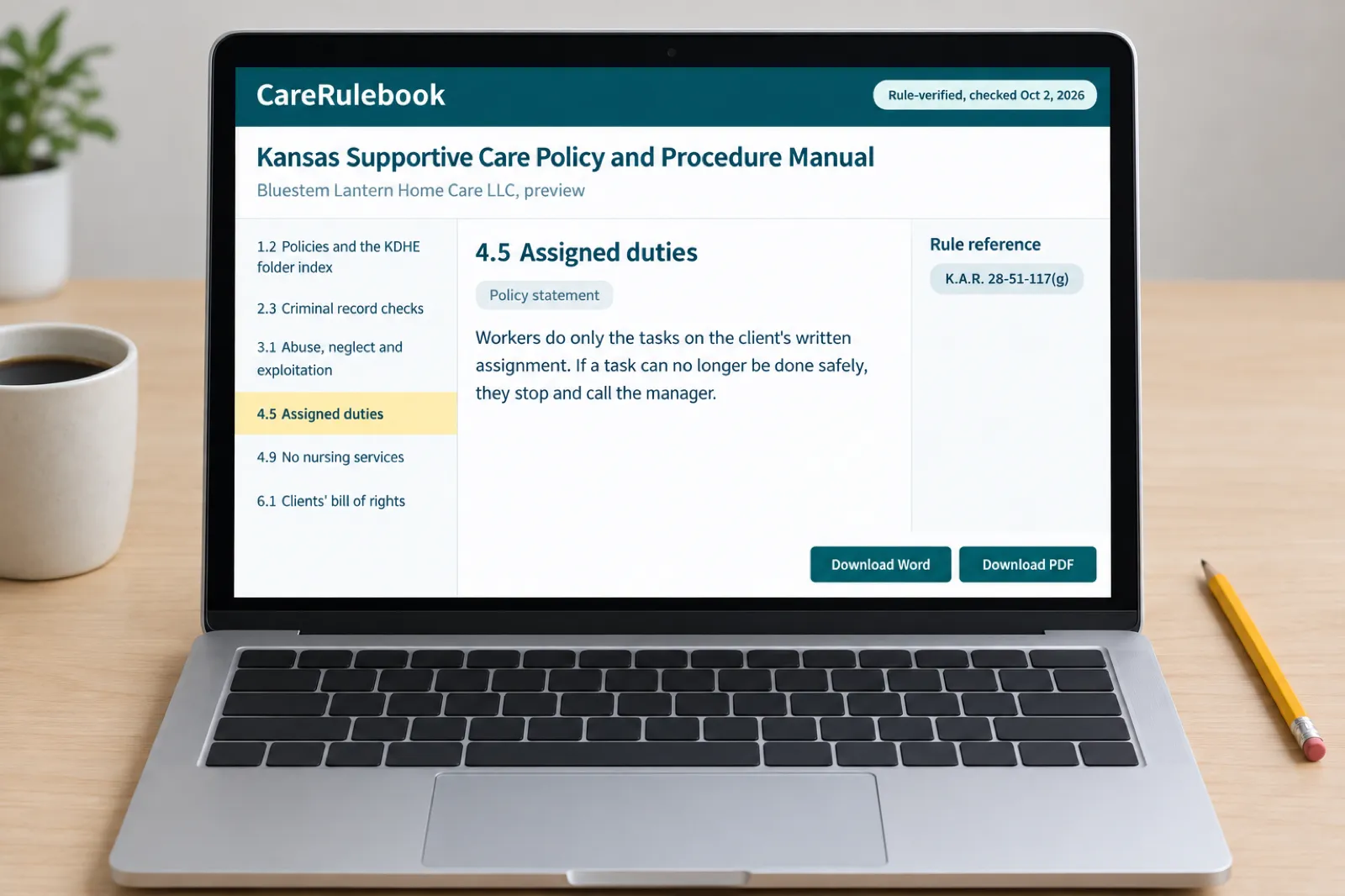
In the manual: Policy 4.5 takes the 16 areas in the rule’s order and, for each one, says what a worker may do, may not do, and when to stop and call the manager. It ends with a quick reference card for caregivers. The training and competency checks for lifts and oxygen sit in Policy 2.6, and medication reminders in Policy 4.8. Each of the 16 duties, what a worker may and may not do.

What KDHE checks in each document

  • Kansas, and your licensed name. "All policies and references must be specifically for Kansas and under the named Home Health Agency listed on the application" (Instruction Guide), on the agency’s letterhead in its own policy template (Instruction Guide, Additional Help).
  • Board approval. "It must be clear that submitted policies have been approved by the governing board and are enacted." (Instruction Guide, Additional Help)
  • Administrator duties in two places. KDHE asks for the administrator’s and alternate’s duties from the rule to be written in their job descriptions and either in agency policy or in the governing body’s appointment letter. (Instruction Guide, Governing Body) KDHE says the governing body must appoint the administrator in writing, while the alternate may be appointed by the governing body or simply selected by the administrator. Evidence of both appointments is uploaded. (Instruction Guide, Administrators) Who qualifies as administrator and manager.
  • Real job descriptions. KDHE describes a job description as a broad, general written statement of a job that generally includes its duties, purpose, responsibilities, scope and working conditions, its title, and who the employee reports to. (Instruction Guide, Administrators) Each employee’s file holds "a signed and dated job description that includes the qualifications for the position" (K.A.R. 28-51-103(d)(2)).
  • A sentence KDHE wants word for word. "There must be the inclusion in client record policy that “the client’s or guardian’s written consent shall be required for the release of information if that release is not required by law.”" (Instruction Guide, Client Records)
  • The abuse policy’s content. KDHE asks that the policy make every employee responsible for reporting, say how to report, include the K.S.A. 39-1430 definitions of abuse, neglect and financial exploitation, and name KDHE’s hotline, 1-800-842-0078 (Instruction Guide, ANE (1)).
  • Templates are fine. "Many policy templates or ideas about content may be found on the internet but it is up to the individual applicant to determine which templates to use that best meet your need." (KDHE application)

Timing. KDHE’s March 2024 letter to applicants waiting when it restarted processing says: "Please do not send any documents to KDHE for review until a reviewer has contacted you." (KDHE update letter, March 11, 2024) Upload only after KDHE sends your login, check every folder first, because KDHE says you cannot open a file again once it is uploaded (Instruction Guide, Important), and file the "Begin Review Process" letter last. The application, step by step.

Every Kansas requirement, mapped to a policy

All 130 rows, filterable by topic or manual section. Each row quotes K.A.R. 28-51, the Home Health Agency Act, the abuse reporting statutes, or the KDHE document named. Rows citing KDHE’s Instruction Guide are KDHE’s checklist, not rule text. 7 rows apply only in the situation shown, and 3 rows are marked Recommended practice because no rule requires them.

130 rows

RuleWhat it requiresPolicy in your manual
K.A.R. 28-51-103(a)(1)

Bylaws or operating agreement, renewed yearly

A governing body with legal authority to operate the agency, with bylaws or an operating agreement renewed annually (KDHE wants a complete, dated and signed copy).

"Have bylaws or an operating agreement, which shall be renewed annually;"

1.1 Governing body, bylaws and appointments
K.A.R. 28-51-103(a)(2)

Employ an administrator and alternate

The governing body employs a qualified administrator and alternate administrator.

"employ a qualified administrator and alternate administrator;"

1.1 Governing body, bylaws and appointments1.3 Administrator and alternate administrator
K.A.R. 28-51-103(a)(3)

Governing body adopts and revises policies

The governing body adopts, revises and approves the agency’s policies and procedures as needed.

"adopt, revise, and approve policies and procedures for the operation and administration of the home health agency as needed;"

1.1 Governing body, bylaws and appointments1.2 Adopting, revising and approving policies; the KDHE folder index
K.A.R. 28-51-103(a)(4)-(6)

Ownership and history disclosures

Give KDHE the name and address of each officer, director and owner; disclose corporate ownership interests of 5% or more; disclose past home health agency ownership or management (name, location, current status).

"disclose past home health agency ownership or management, including the name of the home health agency, its location, and current status, to the department."

1.1 Governing body, bylaws and appointments
KDHE Instruction Guide, Governing Body (2)

Policy on adopting and revising policies

KDHE checklist item: a policy on how the agency adopts, revises and approves its policies.

"Policy regarding adopting, revising, and approving policies. (2)"

1.2 Adopting, revising and approving policies; the KDHE folder index
KDHE Instruction Guide, Administrators

Written appointment of the administrators

KDHE checklist item: the governing body appoints the administrator in writing; the alternate is appointed by the governing body or chosen by the administrator. Evidence of both appointments is uploaded.

"The Administrator must be “appointed” by the Governing Body, and this must be in writing."

1.1 Governing body, bylaws and appointments1.3 Administrator and alternate administrator
KDHE Instruction Guide, Personnel Policies (6)-(7)

Organizational chart and staff roster

KDHE checklist item: an organizational chart and a staff roster (name, license if any, position, status, hire date).

"Organizational Chart (6)"

1.1 Governing body, bylaws and appointments2.1 Job descriptions, organizational chart, staff roster and personnel files
K.A.R. 28-51-104(e)

Keep a copy of every policy

Keep a copy of each policy and all policies and procedures the article requires.

"Each licensee shall maintain a copy of each policy and the policies and procedures required by this article"

1.2 Adopting, revising and approving policies; the KDHE folder index
KDHE Instruction Guide, Additional Help

Show board approval on submitted policies

KDHE checklist expectation: policies on the agency’s letterhead, under its licensed name, Kansas-specific, and clearly approved by the governing board and in effect.

"It must be clear that submitted policies have been approved by the governing board and are enacted."

1.2 Adopting, revising and approving policies; the KDHE folder index
K.A.R. 28-51-103(b)(1)

Administrator responsibilities

Organize and direct operations; liaise between governing body and staff; employ qualified staff to job descriptions; provide written personnel policies and job descriptions; keep records and policies; provide orientation and in-service; complete required reports; give each client the bill of rights in writing. KDHE wants these in the job description and in policy or the appointment letter.

"Organize and direct the home health agency’s ongoing functions;"

1.3 Administrator and alternate administrator
K.A.R. 28-51-103(b)(4)

Administrator qualifications

At least 21; one year as an employee of a home health agency or related health care service; a bachelor’s or associate degree or a KDHE-approved administrator course certificate. Proof (resume, transcripts or certificates) goes to KDHE.

"have at least one year of experience as an employee of a home health agency or in a related health care service"

1.3 Administrator and alternate administrator
K.A.R. 28-51-103(b)(2); KDHE Instruction Guide, Governing Body (6)-(7)

Administrator lives in the service area

The administrator resides within the service area; KDHE asks for evidence that the administrator and alternate live within 200 miles of the parent office.

"The administrator shall reside within the service area."

1.3 Administrator and alternate administrator
K.A.R. 28-51-103(c)

Alternate covers absences

The alternate administrator meets all the administrator’s requirements, is available whenever the administrator is not, and takes over all duties then.

"An alternate administrator shall be available at any time the administrator is not available and be responsible for all duties of the administrator in the administrator’s absence."

1.3 Administrator and alternate administrator
K.A.R. 28-51-101(e)

Report administrator changes in 5 days

Notify KDHE in writing within five days of a change of administrator or alternate, with name, address and qualifications.

"The notification shall include the name, address, and qualifications of the new administrator or alternate administrator."

1.3 Administrator and alternate administrator1.5 License, renewal, changes, ownership and closure
K.A.R. 28-51-103(b)(1)(F)

Orientation and in-service education

Orientation for new staff, regularly scheduled in-service education, and opportunities for continuing education.

"provide orientation for new staff, regularly scheduled in-service education programs, and opportunities for continuing education of the staff;"

2.6 Orientation, training and competency
K.A.R. 28-51-103(b)(1)(D)

Written personnel policies for all staff

Written personnel policies and procedures and job descriptions made available to all employees.

"provide written personnel policies and procedures and job descriptions that are made available to all employees;"

2.1 Job descriptions, organizational chart, staff roster and personnel files2.2 Hiring, interviewing, reference checks and credentials
K.A.R. 28-51-103(b)(1)(H)

Every client gets the bill of rights in writing

The administrator ensures every client admitted receives the bill of rights in writing.

"ensure that each patient or client admitted to the home health agency receives, in writing, the patients’ and clients’ bill of rights"

6.1 Clients’ bill of rights and acknowledgment
K.A.R. 28-51-101(d)(2); 28-51-104(b)

Only the services on the application

Offer only the supportive care services named on the initial or renewal application.

"Each home health agency shall be limited to the home health services, HCBS, and supportive care services specified by the home health agency’s initial application or renewal application."

1.5 License, renewal, changes, ownership and closure4.1 Client acceptance and admission criteria
K.A.R. 28-51-101(b); K.S.A. 65-5104(b)-(c)

Renew every year

File the renewal application (annual report), attestation and fee at least 30 days before expiry, with a statement of changes; the license is canceled automatically 30 days after the expiration date without them.

"A completed renewal application on forms provided by the department; and"

1.5 License, renewal, changes, ownership and closure
K.A.R. 28-51-101(l)

Stay "in-operation"

Serve at least 5 clients in the past 12 months and 1 in the latest 3 months to be eligible to renew.

"Each licensee shall maintain in-operation status to be eligible for license renewal."

1.5 License, renewal, changes, ownership and closure
K.A.R. 28-51-101(f)

Tell KDHE before moving or changing phone

Notify KDHE before establishing a new parent office location or changing the phone number.

"Each licensee shall notify the department before establishing a new location of the parent office"

1.5 License, renewal, changes, ownership and closure1.4 Parent office, office hours and service area
K.A.R. 28-51-101(g)

Name or address change in 5 days

Notify KDHE in writing within five days of a change of address or name and return the old license for an amended one (KDHE uses an amended application with a letter of intent).

"The home health agency shall forward the previously issued license to the department with a request for an amended license reflecting the new address or new name."

1.5 License, renewal, changes, ownership and closure
K.A.R. 28-51-101(h); K.S.A. 65-5104(e)

Change of ownership

A new owner files a license application (before the effective date under the statute) and may request a temporary operating permit.

"Each new owner of a home health agency shall file an application for a license with the department upon the effective date of the sale, transfer, or change in corporate status."

1.5 License, renewal, changes, ownership and closure
K.A.R. 28-51-101(k)(1), (4)-(5)

Closure notice

Written notice to KDHE at least 30 days before closing with the reason, date, record location and custodian; mail the license back on the last day of service; do not operate after the closing date.

"The notice shall include the reason for the closure, the date the home health agency is closing, the location of active and inactive patient or client records, and the name and address of the custodian of the records."

1.5 License, renewal, changes, ownership and closure
K.A.R. 28-51-101(k)(3)

Clients on closure

If closing with current clients, notify each client and guardian, make a discharge or transfer plan, and send a copy of the client record to the receiving agency.

"develop an effective discharge or transfer plan in coordination with the needs outlined in the patient’s or client’s plan of care"

1.5 License, renewal, changes, ownership and closure4.11 Discharge, transfer and referral
K.A.R. 28-51-101(k)(2); 28-51-110(d)

Keep records after closing

Arrange for client records to be kept if the agency closes.

"If the home health agency closes, the licensee shall make provision for the retention of clinical records or client records."

5.1 Client records: contents, notes, retention, safeguarding and release1.5 License, renewal, changes, ownership and closure
K.S.A. 65-5104(d)

Post the license

Post the license in a conspicuous place in the main office.

"Licenses shall be posted in a conspicuous place in the main offices of the licensed home health agency."

1.5 License, renewal, changes, ownership and closure1.4 Parent office, office hours and service area
K.S.A. 65-5104(e)

Statistical reports

Submit the statistical reports KDHE requires.

"The secretary shall require all licensed home health agencies to submit statistical reports."

1.5 License, renewal, changes, ownership and closure
K.A.R. 28-51-101(i)

Records to surveyors within 30 minutes

Produce client records and administrative records (complaints, meeting minutes, quality assurance and annual program review documents) within 30 minutes of a surveyor’s request.

"including all complaints, meeting minutes, quality assurance, and annual program review documents"

1.6 Surveys, records for surveyors and plans of correction
K.A.R. 28-51-101(i)

Accurate information to surveyors

Give KDHE accurate and truthful information during inspections.

"The licensee shall provide accurate and truthful information to the department during inspections."

1.6 Surveys, records for surveyors and plans of correction
K.S.A. 65-5105(b)

Let surveyors in

Allow KDHE surveyors onto the premises during normal business hours.

"Each home health agency shall allow the secretary or the authorized representatives of the secretary to enter upon the premises of the home health agency during normal business hours"

1.6 Surveys, records for surveyors and plans of correction
K.A.R. 28-51-101(c)

Plans of correction

Submit an acceptable plan of correction for any deficiencies cited at an inspection.

"The applicant shall submit an acceptable plan of correction for any deficiencies cited during an inspection."

1.6 Surveys, records for surveyors and plans of correction
K.S.A. 65-5106

Survey report copies on request

Give anyone who asks a copy of the latest survey report and related documents for a reasonable copying charge.

"provided the person requesting such report agrees to pay a reasonable charge to cover copying costs"

1.6 Surveys, records for surveyors and plans of correction
K.A.R. 28-51-104(d)(2)

Documents kept for surveyors

Keep a client record for each client and personnel records showing training, qualifications, evaluations and background check clearance, available to surveyors.

"The documents maintained by each home health agency providing supportive care services shall include the following:"

1.6 Surveys, records for surveyors and plans of correction5.1 Client records: contents, notes, retention, safeguarding and release2.1 Job descriptions, organizational chart, staff roster and personnel files
K.A.R. 28-51-100(hh)

Parent office staffed in posted hours

A parent office with a local street address and phone, continuously staffed during posted and advertised hours; no PO box.

"No post office box shall be used as the location of a parent office."

1.4 Parent office, office hours and service area
K.A.R. 28-51-100(hh)

Post office hours

Post office hours conspicuously for public view.

"The office hours shall be conspicuously posted for public view."

1.4 Parent office, office hours and service area
K.A.R. 28-51-101(m)

Serve only within the service area

Serve clients only within 200 miles of the parent office (service area exceptions are for home health services only).

"Each licensee shall provide home health services, HCBS, or supportive care services only to patients or clients in the service area of the home health agency."

1.4 Parent office, office hours and service area4.1 Client acceptance and admission criteria
K.A.R. 28-51-104(a)

Accept only clients whose needs can be met

Serve a client only when the agency reasonably expects to meet the client’s needs adequately at home.

"Each home health agency shall provide home health services, HCBS, and supportive care services to a patient or client only when the home health agency reasonably expects"

4.1 Client acceptance and admission criteria
K.A.R. 28-51-117(a); 28-51-104(c)(3)(A)

Written admission criteria

A written admission criteria policy consistent with the statutory definition of supportive care services and K.A.R. 28-51-117 (KDHE: "A Policy for Client Acceptance/Admission Criteria").

"Each person that applies to provide supportive care services shall have a written policy that addresses admission criteria consistent with the definition of "supportive care services""

4.1 Client acceptance and admission criteria
K.A.R. 28-51-117(b); 28-51-104(c)(3)(B)

Scope of practice and training of workers

Written policies describing the supportive care worker’s scope of practice, consistent with the statutory definition and 28-51-117, and the training each worker needs.

"Each licensee providing supportive care services shall have written policies and procedures describing the appropriate scope of practice for a supportive care worker"

4.2 Provision of supportive care services and the supportive care worker’s scope of practice
K.A.R. 28-51-104(c)(3)(E)

Policy on providing supportive care

Written policies and procedures on how supportive care services are provided (KDHE: "A Policy for Provision of Services").

"written policies and procedures regarding the provision of supportive care services;"

4.2 Provision of supportive care services and the supportive care worker’s scope of practice
K.A.R. 28-51-104(c)(3)(C)

Manager assesses each client

The manager assesses each client and uses it to develop the plan of care (KDHE wants the policy and the assessment template).

"an assessment of the client by a manager used to develop a plan of care for the client based upon the client’s needs;"

4.3 Client assessment, admission note and plan of care
K.A.R. 28-51-100(b)

Admission note by the manager

A dated admission note after the initial assessment, by the manager, covering diagnoses, health history, home environment and safety, nutrition, medications and treatments, functional status and physical and mental functioning.

"environmental, safety, and social factors of the client’s or patient’s home;"

4.3 Client assessment, admission note and plan of care5.1 Client records: contents, notes, retention, safeguarding and release
K.A.R. 28-51-100(pp)(2)

Plan of care by the manager

The manager develops a written plan of care from the client’s status and immediate and long-range needs.

"For supportive care services, the plan of care shall be developed by a manager"

4.3 Client assessment, admission note and plan of care
K.A.R. 28-51-104(c)(3)(F)

Plan reviewed every 60 days

The manager reviews each plan of care at least every 60 days.

"a plan of care for the client, which shall be reviewed by the manager at least every 60 days;"

4.3 Client assessment, admission note and plan of care
K.A.R. 28-51-104(c)(3)(D)

Training to deliver the plan of care

Train managers and workers to deliver the plan of care, including competency in communication (hearing loss, dementia), observation and documentation, infection control, body functions and reporting changes, a clean and safe environment, emergencies, clients’ needs, respect and privacy, and hygiene and grooming. KDHE asks for the training documents or templates.

"training of managers and supportive care workers to deliver the plan of care in accordance with the home health agency regulations"

2.6 Orientation, training and competency
K.A.R. 28-51-104(c)(3)(G); 28-51-100(rr)

Progress notes

Progress notes for each visit (worker, date and time, service, response, functional status, next visit), signed by the client, kept in the client record.

"progress notes for the client, which shall be kept as part of the client record;"

5.1 Client records: contents, notes, retention, safeguarding and release
K.A.R. 28-51-100(rr)(2)

Client signs each progress note

Notes are clear and specific, compare functional status with other visits, and are signed by the client.

"Each progress note shall be clear and specific and shall indicate the client’s or patient’s functional status and abilities compared to other visits."

5.1 Client records: contents, notes, retention, safeguarding and release
K.A.R. 28-51-104(c)(3)(H)

No medication set-up or administration

Policies stating that workers do not set up medications or give medication administration (KDHE: "A Policy regarding Medications and administration").

"policies and procedures indicating that medications shall not be set up by supportive care workers"

4.8 Medications: reminders only, no set-up or administration
K.A.R. 28-51-104(c)(3)(I)

Staff keep the manager informed

Everyone serving the same client keeps in touch with the manager so all services support the plan of care (KDHE: "A Policy for Communication to support the plan of care").

"all personnel providing supportive care services to the same client shall maintain communication with the manager"

4.6 Communication with the manager and changes in a client’s condition
K.A.R. 28-51-104(c)(3)(J); 28-51-100(gg)

Manager on call

A manager on call to help staff whenever supportive care services are provided.

"a manager, who shall be on-call to assist staff providing supportive care services for clients"

4.7 Manager on call
KDHE Instruction Guide, Provision of Services (7)

On-call policy

KDHE checklist item: a written on-call policy.

"A Policy for On-Call (7)"

4.7 Manager on call
K.A.R. 28-51-104(c)(3)(K)

Manager visits each client every 3 months

The manager visits each client every three months to supervise each supportive care worker.

"a visit by the manager to each client every three months to provide supervision to each supportive care worker"

4.10 Supervision of supportive care workers
K.A.R. 28-51-117(e)

On-site supervision with client satisfaction

Employ a manager available to workers at all times; supervise each worker on site at least every three months, including client satisfaction and adherence to the plan of care.

"provide on-site supervision of each supportive care worker, at least every three months, including an assessment of client satisfaction"

4.10 Supervision of supportive care workers
KDHE Instruction Guide, Supervision (1)

Supervision policy

KDHE checklist item: a supervision policy covering the 3-monthly visits, client satisfaction and recording visit dates in the client record.

"A Policy for Supervision (1)"

4.10 Supervision of supportive care workers
K.A.R. 28-51-117(f)(1)-(2)

Written assignments

The manager writes assignments and instructions from the plan of care, covering procedures, when to report to the supervisor, and documenting each visit.

"Written assignments and instructions for supportive care workers shall be prepared by a manager based on the plan of care."

4.4 Written assignments
K.A.R. 28-51-117(f)(3)

Review assignments every 3 months

The manager reviews written assignments every three months or sooner when the client’s status or needs change.

"Each manager shall review the written assignments and instructions every three months or more frequently as changes in the client’s status and needs occur."

4.4 Written assignments
K.A.R. 28-51-117(g)

Assigned duties in written policy

Written policies for workers covering the 16 task areas in 28-51-117(g): medication help, skin care, ambulation, bathing, dressing, exercise, feeding, hair care, mouth care, nail care, positioning, shaving, toileting, transfers, respiratory care, and masks and oxygen flow (KDHE: "A Policy for Assigned Duties").

"Each licensee shall include the following requirements in written policies and procedures for use by a supportive care worker:"

4.5 Assigned duties: the 16 task areas
K.A.R. 28-51-117(g)(1)

Medication help limits

Help only with medications preselected by the client, family, a nurse or a pharmacist into reminder containers marked with the day and time: ask whether they were taken, prompt, hand over the container, and open it if the client is physically unable. Applies to prescription and non-prescription medications.

"Assistance shall be limited to the following:"

4.8 Medications: reminders only, no set-up or administration4.5 Assigned duties: the 16 task areas
K.A.R. 28-51-117(g)(1)(B)

Report medication errors to the manager

Workers report immediately to the manager when medications are taken too often, not often enough or at the wrong time.

"Each supportive care worker shall report immediately to the manager whenever medications are taken too often, not taken often enough, or not taken at the correct time"

4.8 Medications: reminders only, no set-up or administration4.6 Communication with the manager and changes in a client’s condition
K.A.R. 28-51-117(g)(2)

Skin care

Skin care only on unbroken skin with no active chronic skin problems; no medication, wound care or dressing changes.

"Each supportive care worker performing skin care assistance shall provide skin care assistance only if the client’s skin is unbroken and the client does not have active chronic skin problems."

4.5 Assigned duties: the 16 task areas
K.A.R. 28-51-117(g)(3)

Ambulation

Help with walking for a client who can balance and bear weight, if a qualified health professional has found the client independent with an assistive device.

"Any supportive care worker may assist a client with ambulation who can balance and bear weight if a qualified health professional determines that the client is independent with an assistive device."

4.5 Assigned duties: the 16 task areas
K.A.R. 28-51-117(g)(4)

Bathing

Help with bathing; a client whose wounds need bandage changes around bathing must be served by an agency licensed for home health services.

"If a client has wounds requiring changes to bandages before, during, or after bathing, the client shall be in the care of a home health agency licensed to provide home health services."

4.5 Assigned duties: the 16 task areas
K.A.R. 28-51-117(g)(5)

Dressing

Ordinary clothing and over-the-counter support stockings only; no elastic bandage wraps or prescription anti-embolic or pressure stockings.

"A supportive care worker shall not assist with the application of an elastic bandage wrap or anti-embolic or pressure stockings that can be purchased only with a prescription."

4.5 Assigned duties: the 16 task areas
K.A.R. 28-51-117(g)(6)

Exercise

Normal body movement as tolerated; no help with exercise prescribed by a professional, though workers may encourage the client to follow it.

"The assistance shall not include assistance with exercise prescribed by a qualified health professional, including a physical therapist or occupational therapist"

4.5 Assigned duties: the 16 task areas
K.A.R. 28-51-117(g)(7)

Feeding

Only if the client chews and swallows without difficulty and stays upright; no syringe, tube or IV feeding; high choking or aspiration risk means a licensed home health agency.

"Any supportive care worker may assist a client with feeding if the client can independently chew and swallow without difficulty and maintain an upright position."

4.5 Assigned duties: the 16 task areas
K.A.R. 28-51-117(g)(8)

Hair care

Shampoo not needing a prescription, drying, combing and styling.

"Hair care may include shampooing with a shampoo that does not require a physician’s prescription and drying, combing, and styling hair."

4.5 Assigned duties: the 16 task areas
K.A.R. 28-51-117(g)(9)

Mouth care

Denture care and basic oral hygiene; not for clients who are unconscious, have swallowing difficulty, choking or aspiration risk, or recent mouth surgery.

"Any supportive care worker may assist with and perform mouth care for a client, including denture care and basic oral hygiene."

4.5 Assigned duties: the 16 task areas
K.A.R. 28-51-117(g)(10)

Nail care

Soaking, pushing back cuticles without utensils and filing; no nail trimming.

"Any supportive care worker may assist a client with nail care, including soaking nails, pushing back cuticles without utensils, and filing nails."

4.5 Assigned duties: the 16 task areas
K.A.R. 28-51-117(g)(11)

Positioning

Simple alignment in bed, wheelchair or other furniture if the client can indicate when a change is needed; not if skin care is needed with it.

"Positioning shall not be performed if skin care is required in conjunction with the positioning."

4.5 Assigned duties: the 16 task areas
K.A.R. 28-51-117(g)(12)

Shaving

Electric or safety razor only.

"Any supportive care worker may assist a client with shaving only with an electric or a safety razor."

4.5 Assigned duties: the 16 task areas
K.A.R. 28-51-117(g)(13)

Toileting

To and from the bathroom; bedpans, urinals, commodes; incontinence hygiene and pads; emptying catheter and ostomy bags; no catheter insertion or removal, external catheter care, suppositories or enemas.

"A supportive care worker shall not insert suppositories or administer an enema."

4.5 Assigned duties: the 16 task areas
K.A.R. 28-51-117(g)(14)

Transfers

By written assignment, for clients with enough balance and strength to stand, pivot and assist; no transfer at all, with or without a lift, for a client who is unable to assist with it. Adaptive equipment only if worker and client are trained and the client or family can direct the transfer; gait belts with training.

"A supportive care worker shall not perform assistance with a transfer if the client is unable to assist with the transfer."

4.5 Assigned duties: the 16 task areas
K.A.R. 28-51-117(g)(14)

Lift-device transfersif workers assist with lift-device transfers

Only workers with training and demonstrated competency assist a transfer involving a lift device, and only for a client who can still assist with the transfer (the draft rewrite would remove this task).

"Any supportive care worker with training and demonstrated competency may assist a client in a transfer involving a lift device."

4.5 Assigned duties: the 16 task areas2.6 Orientation, training and competency
K.A.R. 28-51-117(g)(15)

No respiratory care

Respiratory care is skilled and not performed by supportive care workers.

"Respiratory care shall be considered a skilled care service and shall not be performed by a supportive care worker."

4.5 Assigned duties: the 16 task areas
K.A.R. 28-51-117(g)(16)

Masks and oxygen flowif the agency serves clients who use oxygen

Remove and replace a cannula or mask to wash or shave; set oxygen flow by written instructions when changing tanks only after specific training and demonstrated competency.

"if the supportive care worker has been specifically trained and has demonstrated competency for setting a client’s oxygen flow"

4.5 Assigned duties: the 16 task areas2.6 Orientation, training and competency
K.A.R. 28-51-105(e)

No nursing services

A supportive-care-only agency provides no nursing services (KDHE asks for a "Nursing Services (not providing)" policy).

"A person that applies for a license to provide only supportive care services shall not provide nursing services."

4.9 Nursing services (not provided) and no prefilling of insulin syringes4.2 Provision of supportive care services and the supportive care worker’s scope of practice
KDHE Instruction Guide, Non-Skilled (2); Provision of Services (10)

Policy stating nursing is not provided

KDHE checklist item: a nursing services policy saying the agency does not provide nursing.

"A Policy for Nursing Services (not providing, see below) (2)"

4.9 Nursing services (not provided) and no prefilling of insulin syringes
K.S.A. 65-5116(b); KDHE Instruction Guide, Non-Skilled (1)

No prefilling insulin syringes

No unlicensed employee prefills insulin syringes; KDHE asks for a policy on it.

"shall prefill insulin syringes for any patient served by the home health agency"

4.9 Nursing services (not provided) and no prefilling of insulin syringes4.8 Medications: reminders only, no set-up or administration
K.A.R. 28-51-117(c)

Competency before working alone, re-checked yearly

Each worker demonstrates competency before serving a client without the manager present and is re-evaluated annually in 10 areas, including the clients’ bill of rights and use of equipment (KDHE wants the policy and competency checklist template).

"shall reevaluate each supportive care worker on an annual basis in the following subject areas:"

2.6 Orientation, training and competency
K.A.R. 28-51-117(d)

Annual ongoing training, documented

Ongoing training for managers and workers at least annually, on the services provided and equipment used, with subject and date in each file.

"The subject matter and date of the ongoing training provided shall be documented in each manager’s and supportive care worker’s file."

2.6 Orientation, training and competency
K.A.R. 28-51-117(c)(6); 28-51-104(c)(3)(D)(vi)

Emergency procedures

Workers are trained and checked on recognizing emergencies and on the agency’s emergency procedures, so the agency needs written emergency procedures.

"recognizing emergencies and knowledge of the home health agency’s emergency procedures;"

4.12 Emergency procedures2.6 Orientation, training and competency
K.A.R. 28-51-117(c)(3)

Basic infection control

Workers are trained and checked on basic infection control procedures.

"basic infection control procedures;"

4.13 Infection control2.6 Orientation, training and competency
K.A.R. 28-51-110(a)

A client record for each client

Keep a client record with pertinent past and current findings, to accepted professional standards (KDHE wants policies on client records, contents, retention, safeguarding, use and release, admission notes, service documentation, progress notes, supervision and discharge summaries).

"A clinical record or client record containing pertinent past and current findings shall be maintained in accordance with accepted professional standards"

5.1 Client records: contents, notes, retention, safeguarding and release
K.A.R. 28-51-110(c)

What the client record contains

Plan of care; name of the client’s physician, NP, CNS or PA; physician orders for drugs, diet, treatment and activity; signed and dated admission notes; services with check-in and check-out times and confirmation; progress notes; supervision visit dates; discharge summary.

"physician orders for drugs, diet, treatment, and activity;"

5.1 Client records: contents, notes, retention, safeguarding and release
K.A.R. 28-51-110(c)(5)

Visit times and confirmation of service

Record the services given, the worker’s check-in and check-out times, and a confirmation that services were provided.

"the date and time the provider of supportive care services checked in and out"

5.1 Client records: contents, notes, retention, safeguarding and release
K.A.R. 28-51-110(c)(7)

Supervision visit dates in the record

Record the date of each on-site supervision visit in the client record.

"the date of each on-site visit for supervision required by K.A.R. 28-51-117"

5.1 Client records: contents, notes, retention, safeguarding and release4.10 Supervision of supportive care workers
K.A.R. 28-51-100(q)(2); 28-51-110(c)(8)

Discharge summary signed by the manager

A concise discharge summary signed by the manager, showing the client’s response to the plan of care and final disposition at discharge.

"For supportive care services, the discharge summary report is signed by a manager"

4.11 Discharge, transfer and referral5.1 Client records: contents, notes, retention, safeguarding and release
K.A.R. 28-51-110(d)

Keep records 5 years

Keep client records in retrievable form for at least five years after the last discharge.

"retained in a retrievable form for at least five years after the date of the last discharge"

5.1 Client records: contents, notes, retention, safeguarding and release
K.A.R. 28-51-110(e)

Use, removal and release of records

Written policies on using and removing documents from the client record and the conditions for releasing information.

"Written policies and procedures shall be developed regarding the use and removal of documents from the patient record or client record and the conditions for release of information."

5.1 Client records: contents, notes, retention, safeguarding and release
K.A.R. 28-51-110(e)

Written consent to release

The client’s or guardian’s written consent for any release not required by law; KDHE wants this sentence in the records policy.

"The patient’s, client’s, or guardian’s written consent shall be required for release of information not required by law."

5.1 Client records: contents, notes, retention, safeguarding and release6.1 Clients’ bill of rights and acknowledgment
K.A.R. 28-51-111(a)

Clients’ bill of rights (15 rights)

The governing body establishes a bill of rights with the 15 listed rights, equally applicable to all clients (KDHE wants a client rights policy and the signed acknowledgment form). KDHE’s Instruction Guide for this license also lists the three K.A.R. 28-51-111(b) rights, written for patients, under Client Rights.

"Each governing body shall establish a bill of rights that shall be equally applicable to all patients and clients."

6.1 Clients’ bill of rights and acknowledgment
KDHE Instruction Guide, Client Rights (2); ANE (2)

Signed rights acknowledgement

KDHE checklist item: a sample client rights form showing the client’s or representative’s signed and dated acknowledgement of receipt.

"Sample Copy of the Client Rights form given to each client/responsible party indicating the acknowledgement of receipt by the client or the designee, including signature and date."

6.1 Clients’ bill of rights and acknowledgment
K.A.R. 28-51-111(a)(14)

KDHE complaint number in writing

Tell clients in writing about KDHE’s toll-free complaint number.

"the right to be advised in writing of the availability of the department’s toll-free complaint telephone number"

6.1 Clients’ bill of rights and acknowledgment6.3 Grievances and complaints
K.A.R. 28-51-111(a)(10)

Grievances without reprisal

Clients may voice grievances and suggest changes in services or staff without fear of reprisal or discrimination; the agency needs a way to receive and handle them.

"the right to voice grievances and suggest changes in home health services, HCBS, and supportive care services or the staff providing"

6.3 Grievances and complaints6.1 Clients’ bill of rights and acknowledgment
K.A.R. 28-51-111(a)(11)

Policies and charges explained before care

Before care, tell clients the agency’s policies and charges, third-party payment eligibility and how much the client may have to pay.

"Each patient and client shall be informed of the extent to which payment could be required from the patient or client"

6.2 Service agreement, charges and payment6.1 Clients’ bill of rights and acknowledgment
K.A.R. 28-51-111(a)(2), (6)

Client takes part in the plan of care

Clients take part in planning their care, get instruction about it, and are told in advance of any change.

"the right to be advised in advance of any change in the plan of care before the change is made"

4.3 Client assessment, admission note and plan of care6.1 Clients’ bill of rights and acknowledgment
K.A.R. 28-51-111(a)(9)

Referral if services are denied

A client denied services for any reason has the right to be referred to another home health agency.

"the right to be referred to another home health agency if the patient or client is denied home health services, HCBS, or supportive care services for any reason"

4.11 Discharge, transfer and referral4.1 Client acceptance and admission criteria6.1 Clients’ bill of rights and acknowledgment
K.A.R. 28-51-111(a)(15)

No restraints

Clients have the right to be free from restraints at home; the manual bans restraint use by staff.

"the right to be free from the use of restraints in the home setting"

6.1 Clients’ bill of rights and acknowledgment
K.A.R. 28-51-111(a)(4)-(5)

Safe care and continuity

Services only if the agency can give safe care at the intensity needed, and reasonable continuity of care (ties to staffing and caseload decisions).

"the right to reasonable continuity of care"

4.1 Client acceptance and admission criteria6.1 Clients’ bill of rights and acknowledgment
K.A.R. 28-51-103(g)(1)

Abuse training at hire and yearly

In-service on signs and symptoms of abuse, neglect and exploitation for employees and contractors at hire or contract and annually, documented in each personnel file (KDHE also wants a policy on this training).

"document all training provided in each personnel file"

3.1 Abuse, neglect and exploitation: reporting, training and investigation2.6 Orientation, training and competency
K.A.R. 28-51-103(g)(2)

Written reporting process

Written policies and procedures that include the process for reporting abuse, neglect and exploitation.

"develop written policies and procedures that include the reporting process for reporting abuse, neglect, and exploitation"

3.1 Abuse, neglect and exploitation: reporting, training and investigation
K.A.R. 28-51-103(g)(3)

Report immediately

Report immediately when there is reasonable cause to believe a client is being or has been abused, neglected or exploited or needs protective services, under the agency’s policy and K.S.A. 39-1431.

"immediately report if there is reasonable cause to believe that a patient or client is being or has been abused, neglected, or exploited or is in need of protective services"

3.1 Abuse, neglect and exploitation: reporting, training and investigation
KDHE Instruction Guide, Abuse, Neglect and Exploitation (1)

Every employee reports; definitions and KDHE number

KDHE checklist item: the policy makes every employee responsible for reporting, explains how, quotes the K.S.A. 39-1430 definitions of abuse, neglect and financial exploitation, and names the KDHE hotline 1-800-842-0078.

"The policy must require that each employee is responsible for reporting suspected abuse, neglect, and exploitation and the policy should outline how they make the report."

3.1 Abuse, neglect and exploitation: reporting, training and investigation
K.S.A. 39-1431(a)

Mandated report to DCF

The agency’s chief administrative officer promptly reports suspected abuse, neglect or financial exploitation of an adult, or need for protective services, to DCF (law enforcement when DCF is closed).

"such person shall promptly report the matter as provided by the provisions of this section"

3.1 Abuse, neglect and exploitation: reporting, training and investigation
K.S.A. 39-1431(c)

What the report contains

Reporter’s name and address; caretaker’s and adult’s names and addresses; nature and extent of the harm; next of kin if known; anything else helpful.

"The report made pursuant to this section shall contain the name and address of the person making the report and of the caretaker caring for the involved adult"

3.1 Abuse, neglect and exploitation: reporting, training and investigation
K.S.A. 39-1432(b)

No sanctions for reporting

No firing or other sanction against an employee for reporting or cooperating with an investigation.

"No employer shall terminate the employment of, prevent or impair the practice or occupation of or impose any other sanction on any employee"

3.1 Abuse, neglect and exploitation: reporting, training and investigation
K.S.A. 39-1402(c)

Clients living in adult care homesif the agency serves clients who live in an adult care home

For a client who lives in an adult care home (for example assisted living), report suspected abuse to KDADS as K.S.A. 39-1402 provides (the 39-1431 duty does not cover these residents). Recommended practice.

"having reasonable cause to suspect or believe that a resident is being or has been abused, neglected or exploited"

3.1 Abuse, neglect and exploitation: reporting, training and investigation
K.S.A. 38-2223(a)(2), (c)

Suspected child abuseif the agency serves children or works in homes with children

Report suspected child abuse or neglect to DCF, or law enforcement when DCF is closed. Supportive care staff are not on the mandatory list (licensed nurses are); the manual makes reporting agency policy. Recommended practice.

"Reports made pursuant to this section shall be made to the secretary, except as follows:"

3.1 Abuse, neglect and exploitation: reporting, training and investigation
KDHE HHA Reporting Form (rev. 4/2018)

Investigation report to KDHE

KDHE’s form asks for the agency’s completed investigation with witness statements and corrective action within 5 working days. Not in the rule text; recommended practice.

"Corrective Actions taken in response to this incident"

3.1 Abuse, neglect and exploitation: reporting, training and investigation
K.A.R. 28-51-103(d)

Current personnel record for each employee

Position title; signed, dated job description with qualifications; license or certification evidence and official transcripts for degrees; evaluations; reference checks; health record; KDADS eligibility request; check results and registry findings.

"Current personnel records shall be maintained for each employee."

2.1 Job descriptions, organizational chart, staff roster and personnel files
K.A.R. 28-51-103(d)(2)

Signed job descriptions

A signed and dated job description with the position’s qualifications for each employee (KDHE wants job descriptions for administrator, alternate, manager, supportive care worker and every other role).

"a signed and dated job description that includes the qualifications for the position;"

2.1 Job descriptions, organizational chart, staff roster and personnel files
KDHE Instruction Guide, Personnel Policies (17)

Policy on personnel file contents

KDHE checklist item: a policy stating what the agency keeps in a personnel file.

"Required Contents of Personnel Files (Policy stating what the agency requires in a personnel file) (17)"

2.1 Job descriptions, organizational chart, staff roster and personnel files
K.A.R. 28-51-103(d)(3); KDHE Instruction Guide, Personnel Policies (11)

Credential checks

Evidence of license or certification where required, official transcripts for degrees (KDHE: a policy on validating credentials and licenses).

"Each degree shall be supported by official transcripts."

2.2 Hiring, interviewing, reference checks and credentials2.1 Job descriptions, organizational chart, staff roster and personnel files
KDHE Instruction Guide, Personnel Policies (8)-(9)

Hiring and interviewing policies

KDHE checklist items: hiring procedures and an interviewing policy (not in the rule text).

"Hiring Procedures/Process (8)"

2.2 Hiring, interviewing, reference checks and credentials
K.A.R. 28-51-103(d)(5)

Reference checks before employment

Document reference checks before employment (KDHE wants a policy and template; KDHE reads "checks" as more than one).

"documentation of reference checks for each employee before employment;"

2.2 Hiring, interviewing, reference checks and credentials
K.A.R. 28-51-103(d)(4)

Evaluations at 6 months and yearly

Performance evaluations within six months of employment and annually after.

"performance evaluations made within six months of employment and annually thereafter;"

2.4 Performance evaluations
K.A.R. 28-51-103(d)(6)(A)-(B)

Health history and assessment before client contact

Self-reported health history, and a health assessment by a physician, NP, CNS, PA or RN certifying fitness for the job before working with clients.

"A self-reported health history;"

2.5 Employee health assessments and TB testing
K.A.R. 28-51-103(d)(6)(C)

Two-step TB skin test

A current two-step TB skin test following CDC health care worker guidelines before working with clients (KDHE wants a TB policy and template).

"a current two-step tuberculosis skin test"

2.5 Employee health assessments and TB testing4.13 Infection control
K.A.R. 28-51-103(d)(7)

Periodic health assessments

Periodic health assessments as the agency’s policy sets, and at least every two years or after a significant health event.

"a subsequent periodic health assessment performed by a physician, nurse practitioner, clinical nurse specialist, physician assistant, or registered nurse in accordance with home health agency policies and procedures"

2.5 Employee health assessments and TB testing
K.A.R. 28-51-103(d)(8)

KDADS request on file

Keep a copy of the eligibility determination request sent to KDADS in each personnel record.

"a copy of the eligibility determination request submitted to the department for aging and disability services"

2.3 Criminal record checks and provisional employment2.1 Job descriptions, organizational chart, staff roster and personnel files
K.A.R. 28-51-103(d)(9)

Check results and registry findings on file

Keep the state and national criminal history results and any state or national registry findings in each personnel record.

"results of the state and national criminal history record check pursuant to K.S.A. 65-5117"

2.3 Criminal record checks and provisional employment2.1 Job descriptions, organizational chart, staff roster and personnel files
K.S.A. 65-5117(e)

Request a KDADS determination

Request an eligibility determination about adult and juvenile convictions and adjudications from KDADS for each applicant.

"shall request from the Kansas department for aging and disability services an eligibility determination"

2.3 Criminal record checks and provisional employment
K.S.A. 65-5117(b)

Do not employ prohibited persons

No one with adverse registry findings or a prohibiting conviction or adjudication works for the agency, unless the six-year period has passed or KDADS grants a waiver.

"has been convicted of or has been adjudicated a juvenile offender because of having committed an act that if done by an adult would constitute the commission of capital murder"

2.3 Criminal record checks and provisional employment
K.A.R. 28-51-103(e); K.S.A. 65-5117(e)

Provisional employment, once, 60 days, supervised

Provisional hire on a one-time basis for 60 calendar days pending KDADS results, supervised by an employee who has completed all required training (KDHE wants a provisional employment policy).

"Each applicant provisionally hired by a home health agency shall be supervised by an employee who has completed all training required by federal regulations, department regulations, and the home health agency’s policies and procedures."

2.3 Criminal record checks and provisional employment
K.S.A. 65-5117(d)(3)-(4)

Fingerprints within 20 days when authorizedwhen KDADS requires a fingerprint-based check

When KDADS requires fingerprints, the applicant submits them within 20 calendar days of authorization; the employer pays KDADS’s fee.

"The current or prospective employer of an applicant shall pay a reasonable fee for criminal history record information to the department for each applicant submitted."

2.3 Criminal record checks and provisional employment
KDHE Instruction Guide, Background Checks (1)-(2)

Background check policy with the offense list

KDHE checklist item: a background check policy showing checks are done under K.S.A. 65-5117 and including the current Kansas list of prohibited offenses.

"The policy must also include the current State of Kansas list of offenses, KSA 39-970 and 65-5117"

2.3 Criminal record checks and provisional employment
KDHE Instruction Guide, Background Checks; K.S.A. 65-5117(a)(1), (a)(6)

Checks for agency and contract staffif the agency uses staffing agency or contract workers

Workers supplied by staffing agencies or independent contractors are checked through KDADS too.

"Staffing agencies who supply employees to work in an adult care home or home health agency must also submit criminal record checks."

2.3 Criminal record checks and provisional employment2.7 Hourly and per-visit contract personnel
K.A.R. 28-51-103(f)

Written contracts with hourly or per-visit contractorsif the agency uses hourly or per-visit contractors

A written contract with any individual or business working under hourly or per-visit arrangements, with the seven listed provisions (services by the agency, description, follow agency policies, plan of care participation, agency control and evaluation, progress notes and scheduling, charges and reimbursement).

"There shall be a written contract between the home health agency and personnel any individuals or businesses who contract with the home health agency under hourly or per visit arrangements."

2.7 Hourly and per-visit contract personnel
KDHE Instruction Guide, Contracts (1)

Policy on contract personnel

KDHE checklist item: a policy on hourly or per-visit contract personnel that includes all seven required elements. The checklist lists it with no exception and says no item may be left “Not Applicable”, so by our reading every applicant needs one, even one that uses only employees.

"A policy addressing personnel who work under an “hourly” or “per visit” contract and includes all required elements. (1)"

2.7 Hourly and per-visit contract personnel

Every policy by manual section

The manual follows KDHE’s folder order. Beside each policy: how many of the 130 requirements it meets, counted from the crosswalk, and the numbered KDHE items it answers. A requirement can be met by more than one policy.

1Governing body, administrators and the license

  • 1.1 Governing body, bylaws and appointments6 requirementsKDHE items: Govern Body 1, Govern Body 3, Govern Body 4, Govern Body 5, Govern Body 8, Govern Body 9, Admin 4, Admin 5
  • 1.2 Adopting, revising and approving policies; the KDHE folder index4 requirementsKDHE items: Govern Body 2, Misc 2, Misc 3
  • 1.3 Administrator and alternate administrator7 requirementsKDHE items: Govern Body 6, Govern Body 7, Admin 2, Admin 3
  • 1.4 Parent office, office hours and service area5 requirementsNo numbered KDHE item; carries rule duties checked at surveys
  • 1.5 License, renewal, changes, ownership and closure12 requirementsNo numbered KDHE item; carries rule duties checked at surveys
  • 1.6 Surveys, records for surveyors and plans of correction6 requirementsNo numbered KDHE item; carries rule duties checked at surveys

2Personnel

  • 2.1 Job descriptions, organizational chart, staff roster and personnel files9 requirementsKDHE items: Admin 3, Personnel Policies 1, Personnel Policies 2, Personnel Policies 3, Personnel Policies 4, Personnel Policies 5, Personnel Policies 6, Personnel Policies 7, Personnel Policies 17
  • 2.2 Hiring, interviewing, reference checks and credentials4 requirementsKDHE items: Personnel Policies 8, Personnel Policies 9, Personnel Policies 10, Personnel Policies 11
  • 2.3 Criminal record checks and provisional employment8 requirementsKDHE items: Personnel Policies 12, Personnel Policies 18, Bkrnd Chk 1, Bkrnd Chk 2
  • 2.4 Performance evaluations1 requirementKDHE items: Personnel Policies 13
  • 2.5 Employee health assessments and TB testing3 requirementsKDHE items: Personnel Policies 14, Personnel Policies 15
  • 2.6 Orientation, training and competency9 requirementsKDHE items: Personnel Policies 16, ANE 3, Provision of Svcs 12, Provision of Svcs 13
  • 2.7 Hourly and per-visit contract personnel3 requirementsKDHE items: Contracts 1

3Abuse, neglect and exploitation

  • 3.1 Abuse, neglect and exploitation: reporting, training and investigation10 requirementsKDHE items: Govern Body 10, ANE 1, ANE 3

4Provision of services

  • 4.1 Client acceptance and admission criteria6 requirementsKDHE items: Provision of Svcs 1
  • 4.2 Provision of supportive care services and the supportive care worker’s scope of practice3 requirementsKDHE items: Provision of Svcs 2, Provision of Svcs 8
  • 4.3 Client assessment, admission note and plan of care5 requirementsKDHE items: Provision of Svcs 3, Provision of Svcs 11, Client Recs 6
  • 4.4 Written assignments2 requirementsKDHE items: Provision of Svcs 4
  • 4.5 Assigned duties: the 16 task areas18 requirementsKDHE items: Provision of Svcs 5
  • 4.6 Communication with the manager and changes in a client’s condition2 requirementsKDHE items: Provision of Svcs 6
  • 4.7 Manager on call2 requirementsKDHE items: Provision of Svcs 7
  • 4.8 Medications: reminders only, no set-up or administration4 requirementsKDHE items: Provision of Svcs 9
  • 4.9 Nursing services (not provided) and no prefilling of insulin syringes3 requirementsKDHE items: Provision of Svcs 10, Non-Skilled 1, Non-Skilled 2
  • 4.10 Supervision of supportive care workers4 requirementsKDHE items: Supervision 1, Client Recs 9
  • 4.11 Discharge, transfer and referral3 requirementsKDHE items: Client Recs 10
  • 4.12 Emergency procedures1 requirementNo numbered KDHE item; carries rule duties checked at surveys
  • 4.13 Infection control2 requirementsNo numbered KDHE item; carries rule duties checked at surveys

5Client records

  • 5.1 Client records: contents, notes, retention, safeguarding and release13 requirementsKDHE items: Client Recs 1, Client Recs 2, Client Recs 3, Client Recs 4, Client Recs 5, Client Recs 6, Client Recs 7, Client Recs 8, Client Recs 9, Client Recs 10

6Client rights

  • 6.1 Clients’ bill of rights and acknowledgment11 requirementsKDHE items: ANE 2, Client Rights 1, Client Rights 2
  • 6.2 Service agreement, charges and payment1 requirementNo numbered KDHE item; carries rule duties checked at surveys
  • 6.3 Grievances and complaints2 requirementsNo numbered KDHE item; carries rule duties checked at surveys

7 policies answer no numbered item: the office and service area, license maintenance, surveys, emergency procedures, infection control, charges and grievances. The rules still require what they cover. For example, caregivers are checked on "recognizing emergencies and knowledge of the home health agency’s emergency procedures" and basic infection control (K.A.R. 28-51-117(c)), and administrative records go to a surveyor within 30 minutes of a request (K.A.R. 28-51-101(i)). How KDHE surveys an agency.

Requirements that depend on what you do

Where the rules are silent, and how the manual handles it

A policy still has to say what your agency does where the rules and KDHE’s guide leave it open. In each of these places the CareRulebook manual sets out a process and labels it as the agency’s own choice or reading, so you know what you are free to change and what a KDHE answer could change.

What counts as proof of board approval

KDHE says it must be clear that submitted policies have been approved by the governing board and are enacted, but its guide does not say what evidence it accepts.

In the manual: Policy 1.2 shows approval three ways: a signed governing body resolution listing every policy and its effective date, the adoption date printed on each policy, and a revision log. A copy of the signed resolution goes in Govern Body folder 2.

Instruction Guide, Additional Help

How often policies are reviewed

The governing body adopts, revises and approves policies "as needed". No rule sets a review interval. The bylaws or operating agreement, though, must be renewed every year.

In the manual: Policy 1.2 has the governing body review the whole manual each year in the month it renews the bylaws (Policy 1.1), recorded on the revision log even when nothing changes.

K.A.R. 28-51-103(a)(1), (3)

Ten client records policies, or one

Client Recs asks for ten policies (items 1 to 10), and KDHE says a document that applies to several sections goes in each. It does not say whether one policy may sit in several numbered folders of the same section.

In the manual: Policy 5.1 has a headed part for each Client Recs item and is placed in each folder the index names, with Policies 4.3, 4.10 and 4.11 where they answer an item. Whether KDHE wants separate documents is on our list of questions for KDHE.

Instruction Guide, Instructions 3

Policies for things you do not do

KDHE asks for a nursing services policy and a policy on prefilling insulin syringes, and says no area may say "Not Applicable". A supportive care agency may not provide nursing, and no unlicensed employee may prefill insulin syringes.

In the manual: Policy 4.9 is a full written policy: what the agency does not do, what staff do instead (decline kindly, tell the manager before leaving the home, offer a referral), and a staff acknowledgment form.

K.A.R. 28-51-105(e); K.S.A. 65-5116(b)

A contracts policy with no contractors

The rule requires written contracts only with people or businesses working under hourly or per-visit arrangements. KDHE’s checklist lists the contracts policy with no exception.

In the manual: Policy 2.7 is included for every agency. With employees only, it says so and keeps the contract template, with the seven provisions, for later use.

K.A.R. 28-51-103(f); Instruction Guide, Contracts (1)

Fewer than ten personnel files

KDHE asks for ten employees’ personnel records, and says to note it on the staff roster if you have fewer than ten employees. A new agency may have only its administrator, alternate and manager.

In the manual: Policy 2.1 has the administrator note the number of employees and files on the roster, with a line written for it.

Instruction Guide, Personnel Records

The "current list of offenses"

KDHE wants the background check policy to include the current State of Kansas list of offenses. The KDADS list we found is effective July 1, 2018, and we found no newer one.

In the manual: Policy 2.3 carries a Kansas list of prohibited offenses that follows K.S.A. 65-5117(b) and KDADS’s 2018 list, and the administrator compares it with KDADS’s current list at each yearly review.

Instruction Guide, Background Checks

Investigating an allegation

No current rule tells a supportive care agency how to investigate. KDHE’s HHA Reporting Form asks for the completed investigation within 5 working days.

In the manual: Policy 3.1 offers it as Recommended practice: when the suspected person works for the agency, the administrator investigates and sends KDHE the form within 5 working days. It says KDHE has not said a supportive care agency must use the form.

KDHE HHA Reporting Form

Physician details for a client who needs no orders

The client record lists the client’s physician and "physician orders for drugs, diet, treatment, and activity", yet KDHE says a physician order is not required for supportive care.

In the manual: Policies 4.3 and 5.1 record the provider the client names and any orders the client already has, or "none", and say this is the agency’s reading.

K.A.R. 28-51-110(c)(2)-(3)

Sources for the notes above: KDHE Letter of Introduction (no physician order); KDADS prohibited offenses list, effective 7.1.18; K.S.A. 65-5116(b); K.A.R. 28-51-103(f).

Included with the Kansas manual

The KDHE folder download

Because KDHE reviews each folder separately and wants a document repeated in every section it supports, the Kansas manual comes with a second download arranged for KDHE’s file transfer system:

  • A ZIP in KDHE’s 13 folders, named as the guide names them, with the numbered folders inside.
  • Each policy and form as its own file, PDF or Word, placed in every numbered folder that asks for it. The appointment letters, for example, sit in both Govern Body and Admin; the rights acknowledgment in both ANE and Client Rights.
  • Room for your own documents. Folders only you can fill, such as the ten personnel files and the checked-off Instruction Guide, are left empty; folders such as bylaws, proof of address and resumes hold the manual’s addendum or cover sheet for you to add your document beside.
  • A read-me first, listing every numbered item, the file placed in it, the forms to sign and the documents only you can supply.

Inside the manual, Policy 1.2 prints the same KDHE folder index with a column for page numbers, and the "Begin Review Process" letter in KDHE’s wording. Two cautions: KDHE has not said whether it wants one policy repeated across numbered folders of the same section or a separate document in each, and the "current list of offenses" may need KDADS’s latest list attached. Both are on our list of questions for KDHE. Read every file before you upload it; KDHE says you cannot open a file again once it is uploaded (Instruction Guide, Important).

Drafted changes that would add policies

KDHE has drafted a rewrite of K.A.R. 28-51. It must still go through formal public comment; KDHE says it will tell agencies when the Notice of Public Hearing appears in the Kansas Register. None was found by October 2, 2026. (KDHE Summary of Changes Guide) In April 2026 KDHE said the proposed regulations were in the early phases of the process and that it would give an implementation period suited to the final changes. (KDHE answers, April 2026) We could not search the new rules.ks.gov site, which asks for a captcha, so we checked the Secretary of State’s future effective regulations page instead: it listed only an Attorney General regulation on October 2, 2026, nothing from KDHE. (Secretary of State). None of this is in force. The parts that touch your policies:

  • New required policies. Admission policy (service types, duration, frequency, updated annually), care capacity policy (staffing, caseload, skills), transfer and discharge, on-call, and abuse investigation policies and plans. (K.A.R. 28-51-103 (proposed))
  • Abuse investigations. Investigation requirements, policies and plans for handling investigations, and investigation reporting. (K.A.R. 28-51-103 (proposed))
  • Background re-checks. Criminal history and background checks every two years or after an abuse, neglect or exploitation allegation. (K.A.R. 28-51-103 (proposed))
  • Restraints banned. No home health agency may use any form of restraint. (K.A.R. 28-51-103 (proposed))
  • Narrower supportive care tasks. Clients who need cues to use an assistive device would need a skilled agency; tub or shower help only if the client can balance and bear weight; no passive range of motion; no nail care; positioning limited to alignment; no ostomy bag changes; no lift-device transfers; no setting or adjusting oxygen flow. In April 2026 KDHE said over-the-counter compression stockings would stay allowed with training, the lift change was under further review and turning would be clarified. (K.A.R. 28-51-117(g) (proposed))
  • Signed rights notice. Each client and guardian is notified of, given and signs for the bill of rights. (K.A.R. 28-51-111 (proposed))
  • Client records. Supportive care client records would no longer need physician orders or progress notes, and the sentence requiring provision for keeping records if the agency stops operating would be removed. (K.A.R. 28-51-110 (proposed))

In the manual: each affected policy follows the rule in force and describes the draft under "Proposed changes". A few drafted items, such as a care capacity statement and background re-checks every two years, are offered under Recommended practice, labeled as drafted by KDHE and not yet a rule. The drafted rewrite on the Kansas guide.

Checking a Kansas policy manual before you upload it

Whichever manual you use, including ours, check these 7 things first.

  1. 1

    Is it written for supportive care, with no nurse anywhere?

    Manuals written for skilled home health describe nurse supervision, assessments and medication set-up. KDHE’s attestation says nursing of any kind is prohibited under this license, including a nurse supervising or delegating. KDHE attestation form

  2. 2

    Does it answer every numbered item in KDHE’s folders?

    KDHE reviews the upload folder by folder, and every numbered folder needs at least one document. By our count that is 70 numbered items, 42 of them policies, plus the personnel files. Instruction Guide

  3. 3

    Does it say what you do not do, instead of "Not Applicable"?

    KDHE says no area may be left blank or say "See Attached" or "Not Applicable". Nursing and insulin need real policies. Instruction Guide, Additional Help

  4. 4

    Is it Kansas-specific and in your licensed name?

    On your letterhead, under the name on the application, and specific to Kansas even if your group works in other states. Instruction Guide

  5. 5

    Does the assigned duties policy follow 117(g) exactly?

    Including limits that are easy to miss: no medication set-up, no wound care, no nail trimming, and no help with a transfer for a client who is unable to assist with it. K.A.R. 28-51-117(g)

  6. 6

    Does the abuse policy carry what KDHE names?

    Every employee responsible for reporting, how to report, the K.S.A. 39-1430 definitions, and KDHE’s hotline, 1-800-842-0078. Instruction Guide, ANE (1)

  7. 7

    Does it describe what you will really do?

    The policies are reviewed before you are licensed and checked again at surveys. Our suggestion: read every policy before your governing body adopts it, and change anything that does not match how you will work. K.A.R. 28-51-103(a)(3)

The CareRulebook Kansas manual preview on a laptop: policy 4.5 on assigned duties for a sample agency, citing K.A.R. 28-51-117(g), with six of the manual’s policies listed beside it

CareRulebook

Your Kansas manual, in KDHE’s folder order

Answer a few questions and CareRulebook writes the Kansas supportive care policies and forms for your agency, in your agency’s name, with each policy built on the rule it quotes, the KDHE folder index, and a folder download ready for KDHE’s file transfer system. Where the rules are silent, the policy says the process is your agency’s own. You choose whether to include Recommended practice. Read every policy before you adopt it.

  • 31 policies in 6 sections, 130 requirements mapped
  • Every numbered item in KDHE’s Instruction Guide answered by a policy, a form or a document only you can supply, none marked "Not Applicable"
  • No nursing anywhere: a manager, not a nurse, assesses and supervises
  • Editable Word and PDF when you pay; download again free for 12 months
Preview your manual

$199CareRulebook founding price for the first 50 Kansas agencies, then $249. Not a KDHE fee; KDHE’s own license fee ($250 under 100 unique clients a year) is separate.

Kansas policy myths, checked against the source

Can I mark KDHE’s folder items I do not need as "Not Applicable"?

No. KDHE’s guide says no area may be left blank or say "See Attached" or "Not Applicable", and each folder needs at least one document. A service you will not provide, such as nursing or prefilling insulin syringes, still needs a written policy saying you do not provide it.

"Make sure that there are no areas that are left blank or indicate “See Attached” or “Not Applicable.”"

Are the policies in KDHE’s Instruction Guide optional when the Kansas rules do not name them?

No. Not in practice. Some items, such as hiring, interviewing, on-call and the ten client records policies, come from KDHE’s checklist rather than the rule text. But KDHE tells applicants to use the guide as a checklist of required information, and it issues the license only when all required documents have been reviewed and meet the requirements. By our reading, treat every numbered item as required.

"Use this form as a checklist to ensure you have included all required information."

Can I upload my Kansas policy manual to KDHE once, as one file?

No. Not the way KDHE describes its review. Each numbered folder in KDHE’s file transfer system must hold at least one document, each section of the upload is considered separately, and a document that applies to several sections must be included in each one. So a policy that answers items in two folders goes in both. KDHE also says you cannot open a file again once it is uploaded, so gather and check everything first.

"If an item (document) applies to multiple sections-it needs to be included in each section for consideration and review."

Do the Kansas rules require me to review my policies every year?

No. Not in those words. K.A.R. 28-51-103 has the governing body adopt, revise and approve policies "as needed" and sets no review interval. What it does make yearly is the bylaws or operating agreement, which must be renewed annually. Our suggestion: review the policies at the same meeting, as your agency’s own choice.

"Have bylaws or an operating agreement, which shall be renewed annually;"

Can I use policy templates for my Kansas home health agency application?

Yes. KDHE says many templates are available and it is up to the applicant to choose. But every policy must be specific to Kansas, under the licensed agency’s name, on its letterhead and clearly approved by the governing body, and KDHE reviews each folder against the rules before issuing the license.

"Many policy templates or ideas about content may be found on the internet but it is up to the individual applicant to determine which templates to use that best meet your need."

Can my caregivers fill pill organizers for clients in Kansas?

No. Supportive care workers may not set up medications or take part in medication administration. They may help only with medicines that the client, family, a nurse or a pharmacist has already sorted into marked reminder containers: asking whether they were taken, prompting, handing over the container and opening it. They may not prefill insulin syringes.

"policies and procedures indicating that medications shall not be set up by supportive care workers"

Frequently asked questions

What policies does a Kansas supportive care agency need?

Two layers. K.A.R. 28-51 itself calls for written policies on, among others, admission criteria, the supportive care worker’s scope of practice, how services are provided, no medication set-up, communication with the manager, the 16 assigned duties, abuse reporting, client record release and a clients’ bill of rights. KDHE’s Instruction Guide then lists 70 numbered items in 13 upload folders, 42 of which ask for a policy by our count, including hiring, interviewing, on-call, supervision, ten client records policies, nursing services and prefilling insulin. KDHE reviews against the guide before it licenses you.

Do I send my policies to KDHE before I am licensed?

Yes. The rule makes a copy of your policies part of the initial application. In practice, after KDHE receives the application and fee, it emails a login to its file transfer system, where you upload your policies, templates and personnel files into its folders and then file a signed "Begin Review Process" letter. KDHE issues the license when all required documents have been reviewed and meet the requirements.

Do I need a nursing policy if my agency provides no nursing?

Yes. KDHE’s guide asks for "A Policy for Nursing Services (not providing)" and a policy on prefilling insulin syringes, and says no area may be left blank or marked "Not Applicable". Write a real policy: the agency provides no nursing of any kind, no one prefills insulin syringes, and here is what staff do instead.

Do I need a contract personnel policy if I only hire employees?

By our reading, yes. The rule requires written contracts only if you use hourly or per-visit contractors, but KDHE’s checklist lists the contract personnel policy with no exception, and no item may say "Not Applicable". The policy can say the agency uses employees only and set out what any future contract must contain.

How do I show KDHE that my governing body approved the policies?

KDHE says it must be clear that submitted policies have been approved by the governing board and are enacted, but does not say what evidence it accepts. By our reading, a signed resolution listing the policies and the adoption date, with an approval or adoption line on each policy, shows it. Ask KDHE if you are unsure.

Can I use policy templates in Kansas?

Yes. KDHE says many templates are available and it is up to the applicant to decide which to use. Every policy must still be specific to Kansas, under the licensed agency’s name, on its letterhead and clearly approved by the governing body.

Can one document answer several KDHE items?

Across sections, KDHE says a document that applies to several sections must be included in each, because each section is considered separately. Within one section, such as the ten Client Recs folders, KDHE’s guide does not say whether one policy may sit in several numbered folders. It does say a folder may hold more than one document. Ask KDHE before relying on one document for several numbers.

Get Kansas rule-change alerts

KDHE has drafted a rewrite of K.A.R. 28-51 that would add required policies and narrow the supportive care task list. No official text has been published yet. Leave your email and we will tell you when a Kansas change affects your policies.

No spam. Only emails about Kansas home care rule changes. How we use your email.

Keep reading

Kansas

How to start a home care agency in Kansas

The supportive care license, why no nursing is allowed, and how KDHE licenses you.

Manual

Build your Kansas policy manual

Every requirement on this page, written for your agency, with the KDHE folder download.

Kansas

The Kansas license application

The application email, the attestation, the upload and the "Begin Review Process" letter.

Kansas

Kansas license cost and timeline

KDHE’s $250 fee, renewal, other costs and each step to the license.

Kansas

Kansas administrator and manager

Who qualifies for the posts behind the Governing Body and Administrators folders, and the manager’s duties.

Kansas

Kansas supportive care assigned duties

The 16 task areas behind the assigned duties policy, with what a worker may and may not do.

Kansas

Kansas caregiver background checks

The KDADS check behind Personnel Policies 12 and 18 and the Bkrnd Chk folder.

Kansas

Kansas caregiver training

The competency, training and abuse training items, and the health record and TB test.

Kansas

Kansas home health agency surveys

How the policies are checked again on site, and plans of correction.

Tool

Kansas license checklist

Every step to a KDHE supportive care license, tailored to your agency, emailed to you.

South Carolina

South Carolina home care policies and procedures

Every section of R.60-122 with its Class mark, and the drug testing policy DPH receives.

Nevada

Nevada home care policies and procedures

The 13 topics and HCQC’s 55 survey tags.

Tennessee

Tennessee home care policies and procedures

The 17 items and 8 topics TDMHSAS reads at its desk audit.

Maryland

Maryland home care policies and procedures

The 23 items OHCQ indexes by document and page in the application.

Washington

Washington home care policies and procedures

DOH’s policy checklist, mapped.

Indiana

Indiana home care policies and procedures

The nine policies and seven forms IDOH asks for.

Texas

Texas home care policies and procedures

The same map for Chapter 558.

Trust

How we verify rules

Every quote checked against the official text.

Sources

  1. K.A.R. 28-51-100 to 28-51-118, Home Health Agency Licensure (as amended or adopted in Kansas Register Vol. 41, No. 18, May 5, 2022, effective May 20, 2022; 28-51-108 and 28-51-114 to -116 from the Cornell LII mirror) · Kansas Secretary of State, Kansas Register (KDHE regulations); Cornell Legal Information Institute mirror · retrieved October 2, 2026
  2. K.S.A. 65-5101 to 65-5117, Home Health Agency Act (65-5101 as amended by L. 2025, ch. 85) · Kansas Office of Revisor of Statutes · retrieved October 2, 2026
  3. K.S.A. 39-1430 to 39-1434, abuse, neglect or financial exploitation of certain adults (reporting to DCF) · Kansas Office of Revisor of Statutes · retrieved October 2, 2026
  4. HHA Letter of Introduction, with Two Options for State of Kansas HHA Licensure and Packet Submission Requirements (reviewed/revised 03/2024) · Kansas Department of Health and Environment, Bureau of Facilities and Licensing · retrieved October 2, 2026
  5. Update Letter to Existing Non-Medical HHA (March 11, 2024) · Kansas Department of Health and Environment, Bureau of Facilities and Licensing · retrieved October 2, 2026
  6. Kansas Home Health Agency Application, Non-Medical, with instructions (reviewed/revised 03/2024) · Kansas Department of Health and Environment, Bureau of Facilities and Licensing · retrieved October 2, 2026
  7. Home Health Agency Non-Medical Supportive Care Services Application Submission Requirements and Instruction Guide (reviewed/revised 03/2024) · Kansas Department of Health and Environment, Bureau of Facilities and Licensing · retrieved October 2, 2026
  8. Home Health Agency Non-Medical Supportive Care Services Attestation Form (reviewed/revised 03/2024) · Kansas Department of Health and Environment, Bureau of Facilities and Licensing · retrieved October 2, 2026
  9. HHA Reporting Form (abuse, neglect and exploitation investigation report; rev. 4/2018), linked as "Report Abuse & Neglect" on KDHE’s home health pages · Kansas Department of Health and Environment, Health Facilities Program · retrieved October 2, 2026
  10. 2025 Home Health Agency Regulations Summary of Changes Guide (September 8, 2025), with the October 9, 2025 Supportive Care listening session slides and KDHE’s answers to feedback (April 2026) · Kansas Department of Health and Environment, Bureau of Facilities and Licensing · retrieved October 2, 2026
  11. HHA Listening Sessions Questions and Feedback (KDHE responses; PDF dated April 14, 2026) · Kansas Department of Health and Environment, Bureau of Facilities and Licensing · retrieved October 2, 2026
  12. Criminal Record Check Prohibited Offenses, effective 7.1.18 (adult care homes, home health agencies and HCBS), Internet Archive copy · Kansas Department for Aging and Disability Services · retrieved October 2, 2026
  13. Future Effective Kansas Administrative Regulations (legacy Kansas Register page) · Kansas Secretary of State · retrieved October 2, 2026
Build your Kansas manualfrom $199