Route 1
Supervisory experience
At least one year of documented supervisory experience in the provision of personal care services.
Ch. 26, 7.2(B)(1)Where are you starting?
Colorado · Manager and supervisor · 6 CCR 1011-1 Ch. 26, 7.1-7.8
A Colorado Class B home care agency needs someone to govern it, an HCA manager who meets set qualifications, and supervisors whose experience your own policy defines. Here is what Chapter 26 says about each role, the manager course, the acting manager, availability during care hours, fingerprints, and what happens when the manager changes.

Quick answer
Every Class B agency is run by a governing body or one designated individual, who appoints an HCA manager (Ch. 26, 7.1(A); 7.2(A)). The manager must be at least 21, with a high school diploma or GED and one of three experience routes: a year of documented supervisory experience in personal care, a healthcare degree plus a year of health care work, or any degree plus two years of health care work, with the degree routes counting work in the previous ten years (7.2(B)(1)).
The manager completes an 8-hour agency manager course, or shows documented and confirmed equivalent experience or education, and then 12 hours of related training in the first year and every year after (7.2(B)(3)). The manager names an acting manager in writing, and the manager or a designee is available for all hours that staff are giving services (7.2(C)(7)-(8)).
Supervisors are agency employees, at least 18, trained in personal care, with the experience or training your own policy sets, and available to workers whenever care is given (7.7; 7.8(A)(1)). No rule in Parts 4, 5 or 7 requires a nurse for Class B (7.2, 7.7). Owners of 50% or more and the manager are fingerprinted through the Colorado Bureau of Investigation (4.2(D)).
Whether one person can be both the manager and a supervisor is not addressed in the rules. Ask CDPHE before you plan on it.
The governing body or designee holds final responsibility, the HCA manager runs the agency day to day, and supervisors oversee each worker’s care. Chapter 26 puts each in its own part.
| Governing body or designee | HCA manager | Supervisor | |
|---|---|---|---|
| Where the rule is | Ch. 26, 7.1 (rule) | Ch. 26, 7.2 (rule) | Ch. 26, 7.7-7.8 (rule) |
| Who | A governing body with legal authority for the agency, or one individual designated to carry out every Part 7.1 task | Appointed by the governing body or designee to supervise the provision of services | An agency employee in a designated supervisory capacity |
| Minimum age | None stated | 21 | 18 |
| Education and experience | At least one member, or the designee, has knowledge of home care agency operations | High school diploma or GED, plus one of three experience routes | Experience or training in home care or closely related personal care, as your policy sets, and completed personal care training |
| Training each year | None stated | 12 hours of related training, after an 8-hour course (or documented equivalent) | At least six topics every 12 months, as for direct care staff |
| Availability | None stated | The manager or a designee, for all hours personnel are providing services | Available to the worker at all times care is being given |
| CBI fingerprints | Only as an owner (50% or more) | Yes, with the application or within 10 days of a change | Not in the license rules; checked as any job applicant is |
Sources for the rows: Ch. 26, 7.1(A)-(B); 7.2(B); 7.2(C)(8); 7.7(A); 7.8(A)(1); 7.4(C)(4); 4.2(D); 5.9(C).
Chapter 26 defines a governing body as "the board of trustees, directors, or other governing entity in whom the ultimate authority and responsibility for the conduct of the home care agency is vested" (Ch. 26, 2.9). A Class B agency does not have to convene one: "An HCA may choose to convene a governing body that shall have legal authority and responsibility for the conduct of the HCA. ... the HCA shall designate an individual who shall have responsibility for all tasks as set forth in this Part 7.1." (Ch. 26, 7.1(A)). Either way, "At least one (1) member of the governing body or designee shall have knowledge of HCA operations." (7.1(B)).
The governing body or designee must:
The rule says "keep minutes of all meetings" without saying how one designee does that. CareRulebook’s manual has a single designee keep a dated, signed record of each meeting or decision instead, and labels that as the agency’s reading (Policy 1.1). The rule sets no other qualification for the designee, such as ownership; whether the designee may also be the manager is not stated (below).
Chapter 26 uses one definition for both words: "“Manager” or “administrator” means any person who is responsible for and supervises or offers or attempts to oversee and supervise the day-to-day operations of a home care agency or home care placement agency" (Ch. 26, 2.15). For a Class B agency, the governing body or designee "shall appoint an HCA manager to supervise the provision of the HCA’s services" (7.2(A)).
The baseline. "Be at least twenty-one (21) years of age, possess a high school diploma or GED, and have at least one (1) year documented supervisory experience in the provision of personal care services." (7.2(B)(1)) A manager without that year of supervising personal care can use one of two degree routes instead.
Route 1
At least one year of documented supervisory experience in the provision of personal care services.
Ch. 26, 7.2(B)(1)Route 2
A college degree in healthcare services plus at least one year of work experience in health care during the previous ten years.
Ch. 26, 7.2(B)(1)(a)(i)Route 3
A college degree in any field plus two years of work experience in health care during the previous ten years.
Ch. 26, 7.2(B)(1)(a)(ii)Every route also needs the age (21) and the diploma or GED. Two more qualifications apply whatever the route:
"Documented." The rule asks for documented supervisory experience but does not say what documents count. Our suggestion: a letter from each employer giving dates and the supervisory role, or for the degree routes a diploma or transcript and proof of the health care work, kept in the manager’s personnel file. CDPHE’s guidance lists "Proof of administrator/manager training and qualifications, as applicable" among what must be ready at the initial survey (CDPHE guidance, step 6).
The manager is personnel too. Chapter 26 defines personnel as individuals employed by or working under the direction of the agency, "including but not limited to: managers, administrators, staff, employees, contractors, students, interns, or volunteers" (2.21). By our reading the manager’s file therefore follows the personnel record rule: references, dates of employment, qualifications, orientation, a job description and an annual evaluation (5.9(B)).
The manager must "have successfully completed an eight (8) hour agency manager training course. Additional related annual training that equals twelve (12) hours shall be required in the first year and annually thereafter" (Ch. 26, 7.2(B)(3)). "Any person commencing service as an HCA manager shall meet the minimum training requirements approved by the Department pursuant to Part 7.2(D) of this chapter", or "provide documented and confirmed previous job related experience or related education equivalent to successful completion of such program". "The Department may require additional training to ensure that all the required components of the training curriculum are met." (7.2(B)(3)(a)) And: "A copy of the certificate of completion shall be retained in the HCA manager’s personnel file." (7.2(B)(3)(b))
A manager course is approved if it is "conducted by an accredited college, university, or vocational school or by an organization, association, corporation, group, or agency with specific expertise in that area and the curriculum includes at least eight (8) actual hours of training" (7.2(D)(1)). The instruction must cover at least: a home care overview (other agency types, coordination, and the limits of personal care versus health care); regulatory compliance (consumer rights, governing body or designee duties, quality management plans, occurrence reporting, complaint investigation and resolution); personnel qualifications, competency, evaluations, training and supervision; the needs of fragile, ill and disabled people in the community; and behavior management techniques (7.2(D)(2); our summary).
CDPHE’s list. CDPHE says "A list of training providers whose courses have already been reviewed and approved by CDPHE are available in the List of Approved Trainings." We counted eleven providers on that list, two of them for their own employees only (CDPHE, approved educational opportunities). The list adds: "CDPHE cannot guarantee that the information provided in the courses is always accurate and in accordance with regulatory requirements or professional standards of practice." (CDPHE, List of Approved Trainings)
A page written for Class A. CDPHE’s page about the list describes the 24 clock hours of training in 6.4(D), which is the rule for a first-time Class A administrator, and cites Chapter 26 sections 7.6(D) and 8.3(D)(1), which do not match the current chapter (CDPHE page). The Class A rule is 6.4 (Ch. 26, 6.4(B), (D)); the Class B rule is the 8-hour course in 7.2(B)(3). Our suggestion: ask the provider in writing whether its course meets 7.2(B)(3) and 7.2(D), keep the course outline with the certificate, and ask CDPHE if the answer is unclear.
The rule says 12 hours of "additional related annual training" in the first year and every year after. It does not say what counts as related, who may provide it, or whether the year runs from the start date or another date. CDPHE’s approved-education page lists, as approved offerings, courses from accredited colleges and universities, courses accredited by ACCME, ACPE or ANCC, and "all educational offerings that apply to the individual’s position responsibilities in home care provided by recognized national and state home care and health care professional associations" (CDPHE page). That page sets them out under first-time administrator training, so whether they define "related" training for the Class B 12 hours is not stated. CareRulebook’s manual counts each year from the manager’s start date and logs every session with proof, and says that counting choice is the agency’s (Policy 1.2).
Chapter 26, 7.2(C) makes the HCA manager responsible for ensuring each of these. The wording below is our summary; the citation opens the rule.
Compliance (1)
The agency complies with all applicable federal, state and local laws.
Reports to CDPHE (2)
Reports and records CDPHE requires are completed, kept and sent.
Liaison (3)
Ongoing liaison with the governing body or designee, staff and the community.
Organizational chart (4)
A current chart showing lines of authority down to the consumer level.
Records and policies (5)
Personnel, bookkeeping and administrative records, and the agency’s policies and procedures, are kept.
Orientation and in-service (6)
New personnel are oriented, with regular in-service education and continuing education opportunities.
Acting manager (7)
A qualified staff member is designated in writing to act in the manager’s absence.
Availability (8)
The manager or a designee is available for all hours personnel are providing services.
Marketing (9)
Marketing and advertising accurately represent the agency and the services it can provide.
Infection prevention (10)
A coordinated agency-wide infection prevention and control program, part of the quality management program.
Training program (11)
The training program for homemakers and personal care workers is implemented and monitored, managed or delegated.
The manager also has hands-on duties elsewhere in Part 7: "Prior to assignment, the HCA manager or supervisor shall conduct a proof of competency evaluation" for personal care workers, covering help with daily living, medication reminders, adaptive equipment and other hands-on tasks (7.4(C)(3)(a)).
The manager is responsible for "designating in writing the qualified staff member to act in the absence of the manager" (Ch. 26, 7.2(C)(7)). The rule does not say what "qualified" means here, what the written designation must contain, or whether the acting manager must meet the manager qualifications in 7.2(B).
CareRulebook’s manual uses a designation form signed and dated by the manager and the acting manager, replaced whenever either changes, and reads "qualified" as a staff member who knows the manual, the consumers and the workers and whom the manager judges able to act for a short time. It suggests, as recommended practice, choosing someone who also meets the manager qualifications so a longer absence does not leave the agency without a qualified person in charge (Policy 1.2). Those are the manual’s choices, not the rule’s.
Two rules cover availability, one for the manager and one for supervisors:
Both follow your care hours, not your office hours. If a worker is in a consumer’s home at 8 p.m. or on a Sunday, someone acting for the manager and a supervisor must be available then. Neither rule says whether "available" means on site or by phone, or how quickly a call must be answered, and "designee" is not defined.
CareRulebook’s manual offers two after-hours set-ups: the manager, supervisor or their backups answering in turns, or designated staff on a written on-call schedule, with whoever answers reaching the manager or acting manager at once for a manager’s decision and putting a worker through to the supervisor on duty (Policies 1.2 and 4.7). Those set-ups are the manual’s choices.
Chapter 26, 7.7 says the supervisor shall:
Your policy sets the experience. "In accordance with HCA policy" means the standard is the one you write down, and by our reading a surveyor can compare each supervisor with it (7.7). The rule sets no number of years, no credential and no nurse. We found no rule setting how many supervisors you need or how many workers each may supervise. CareRulebook’s builder suggests a starting standard (at least one year of paid experience giving or supervising personal care in a home care agency, assisted living residence or similar setting) that you can change; that suggestion is ours, not CDPHE’s (Policy 4.1).
An employee, designated. The supervisor is an employee of the agency in a designated supervisory capacity (7.8(A)(1)). By our reading that rules out a contractor as supervisor, and CareRulebook’s manual never uses one.
Branches. For a branch of an agency giving only personal care, "personnel that meet the qualifications of a supervisor shall be available during all operating hours" (5.2(E)(1)). Branches and workstations →
More on worker training and supervision is in the guide (training and supervision).
The sources do not answer this. What they do say:
Nothing in Chapter 26, Chapter 2 or CDPHE’s application checklist and guidance says the manager and a supervisor must be different people, or that the designee may not be the manager, and nothing says they may be combined. Ask CDPHE’s licensing team before you build your plan around one person.
If one person does hold more than one role, CareRulebook’s manual has them meet the qualifications of each, shows each role on the organization chart, and names other people as the acting manager and the backup supervisor; it also tells the manager to ask CDPHE at licensing (Policy 1.2, item 14). That is the manual’s approach, not a CDPHE ruling.
The new manager submits fingerprints to CBI within 10 calendar days of the change. The checklist describes Form 1 for initial applications; the sources we saved do not say how CDPHE sends instructions after a change, so ask CDPHE as soon as you know the date.
Ch. 26, 4.2(D)The manager’s name, contact details and date of appointment are part of the application (Ch. 2, 2.3.3(G)), and changes to application information go to CDPHE as soon as practicable. By our reading a new manager is one of those changes. Ask CDPHE whether it wants this through a COHFI update.
Ch. 2, 2.9.6(A)Chapter 2’s list of changes that need 30 days’ notice and CDPHE’s approval first covers licensed capacity, the management company, license category or classification, scope of services, service area and legal name. A change of manager is not on it. CDPHE’s 2026/27 fee schedule lists no fee for a change of manager (fee schedule).
Ch. 2, 2.9.6(B)The new manager meets 7.2(B), including the course or documented equivalent, on starting, with the certificate in their file.
Ch. 26, 7.2(B)(3)(a)To keep the license after a move, the new office must be in the existing service area with the same governing body and administrator. By our reading, changing manager around the time of a move may mean the move does not meet that condition, which would mean a new license. Ask CDPHE before you plan both.
Ch. 26, 4.2(E)A current organizational chart (7.2(C)(4)) and a new written acting manager designation if either person changes. Tell staff who to call.
Ch. 26, 7.2(C)(4), (7)CareRulebook’s manual covers the notices and a CDPHE notice log in Policy 1.5, the fingerprint steps and the new designation in Policy 1.2, and the organization chart in Policy 1.1.
CareRulebook
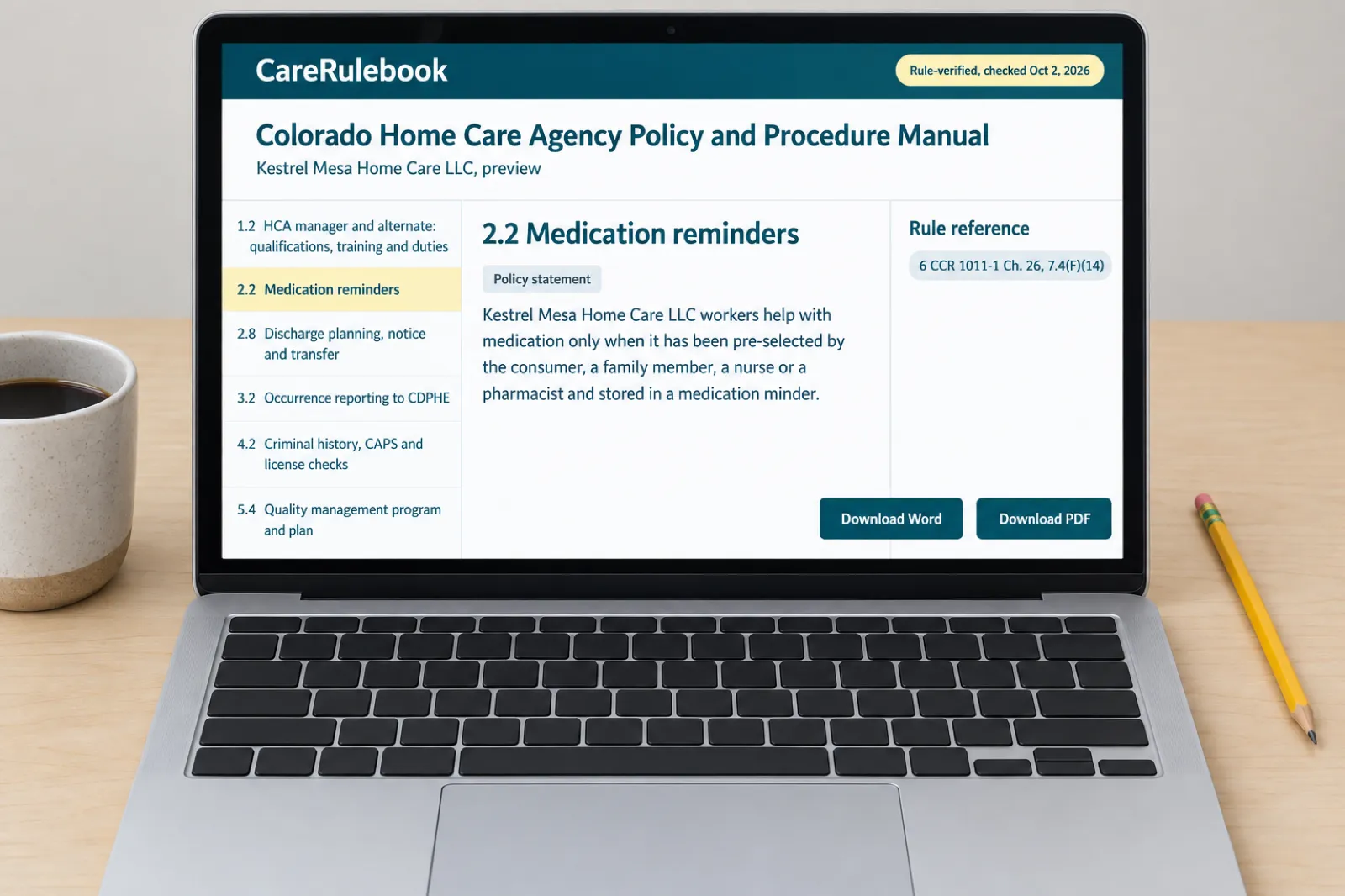
CareRulebook’s Colorado manual includes Policy 1.1, governing body or designee, bylaws and annual review of operations; Policy 1.2, HCA manager and alternate: qualifications, training and duties; Policy 4.1, job descriptions, qualifications and competence; and Policy 4.7, supervisors and supervision of homemakers and personal care workers.
$199CareRulebook founding price for the first 50 Colorado agencies, then $249. Not a CDPHE fee.
No. The 24 clock hours in the first 12 months is the Class A rule for a first-time administrator (Chapter 26, 6.4). A Class B HCA manager completes an 8-hour agency manager course, or shows documented and confirmed equivalent experience or education, and then 12 hours of related training in the first year and every year after. CDPHE’s approved-education page describes the 24-hour Class A training, so check which rule a course is written for before you pay for it.
"Have successfully completed an eight (8) hour agency manager training course. Additional related annual training that equals twelve (12) hours shall be required in the first year and annually thereafter;"
No. Chapter 26 says the supervisor of homemakers and personal care workers is at least 18, has completed training in personal care services, and has appropriate experience or training in home care or closely related personal care services "in accordance with HCA policy". Your own policy sets that standard. The supervisor must also be an agency employee in a designated supervisory role, available to workers whenever care is given. No rule requires the supervisor to be a nurse.
"Have appropriate experience or training in the home care industry or closely related personal care services in accordance with HCA policy; and"
No. A Class B agency needs an HCA manager (21 or older, high school diploma or GED, one year of documented supervisory experience in personal care or a degree-plus-experience alternative, and an 8-hour manager course) and supervisors whose experience is set by your own policy. A nurse is needed for Class A skilled care, and an HCPF memo that expired on June 2, 2026 required a registered nurse for In-Home Support Services agencies (check HCPF’s current rules), but the Class B license itself does not.
"Be at least twenty-one (21) years of age, possess a high school diploma or GED, and have at least one (1) year documented supervisory experience in the provision of personal care services;"
For a Class B agency, Chapter 26, 7.2(B) sets them: at least 21, a high school diploma or GED, and one of three experience routes (one year of documented supervisory experience in personal care; a healthcare degree plus one year of health care work in the previous ten years; or any college degree plus two years of health care work in the previous ten years). The manager also communicates effectively with consumers, families and other providers, using translators when needed, knows the laws that apply, and completes an 8-hour agency manager course (or shows documented and confirmed equivalent experience or education), then 12 hours of related training in the first year and every year after.
In Chapter 26 the two words name one role: it defines "manager" or "administrator" as any person responsible for and supervising the day-to-day operations of the agency (2.15). Part 7 calls the Class B role the HCA manager. CDPHE’s application checklist asks for HCA Form 1 to be signed by the "Administrator"; by our reading, for a Class B agency that is your HCA manager. Class A agencies have a separate administrator rule with 24 hours of training (6.4).
Chapter 26, 7.2(D) says a course is approved if it is run by an accredited college, university or vocational school, or an organization with specific expertise, includes at least eight actual hours, and covers the listed topics. CDPHE publishes a List of Approved Trainings (we counted eleven providers, two for their own employees only). CDPHE’s page about that list describes the 24-hour Class A administrator training and cites older rule numbers, so ask the provider, and CDPHE if unsure, whether a course meets the Class B 8-hour course in 7.2(B)(3) before you pay.
No. Chapter 26, 7.7 says the supervisor of homemakers and personal care workers is at least 18, has completed training in personal care services, and has the home care experience or training your own policy sets. Nothing in Parts 4, 5 or 7 requires a nurse for a Class B agency. An HCPF memo that expired on June 2, 2026 required a registered nurse on staff at In-Home Support Services agencies; that was a Medicaid program rule, not a Class B license rule, so check HCPF’s current rules if you plan to offer that program.
The rules do not address owners directly. The governing body or designee must "designate and employ" an HCA manager (7.1(C)(2)), so by our reading the manager is employed by the agency. How that applies to a sole proprietor, or an owner who takes draws rather than wages, is not stated; ask CDPHE. An owner who is the manager meets the manager qualifications like anyone else, and owners of 50% or more are fingerprinted either way.
The rules do not say. Chapter 26 describes the manager (7.2) and the supervisor (7.7, 7.8) separately, and nothing in Chapter 26, Chapter 2 or CDPHE’s application materials we read says the roles must be held by different people, or that they may be combined. Ask CDPHE before you plan on one person holding both, and on the same person also being the governing body designee.
The new manager submits fingerprints to the Colorado Bureau of Investigation within 10 calendar days of the change (Ch. 26, 4.2(D)). The manager’s name, contact details and date of appointment are part of the license application (Ch. 2, 2.3.3(G)), and Chapter 2 asks for changes to application information as soon as practicable (2.9.6(A)); by our reading a new manager is one of those changes. A change of manager is not on Chapter 2’s list of changes that need 30 days’ notice and CDPHE’s approval first. Ask CDPHE how it wants the change sent and how it will send fingerprint instructions.
The rule says the manager or a designee must be available for all hours that personnel are providing services (7.2(C)(8)). It does not say whether that means in the office or reachable by phone. If care runs in the evening or at weekends, someone acting for the manager must be available then.
CDPHE has proposed changes to Chapter 2 (comments due November 12, 2026), and the home care law is due for review before September 1, 2028. Leave your email and we will tell you when a Colorado change affects your manager, your supervisors or your policies.
No spam. Only emails about Colorado home care rule changes. How we use your email.
Colorado
How to start a home care agency in Colorado
The Class B license, CDPHE’s fee, the COHFI application and the initial survey with zero deficiencies.
Colorado
Colorado office and premises rules
Home offices, the zoning form, what to post, records for surveyors, branches and workstations.
Manual
Build your Colorado policy manual
Including Policy 1.2 on the HCA manager and Policy 4.7 on supervision.
Washington
Washington administrator and supervisor
Qualifications your policies set, written alternates, the six-month contact and 10 hours of training.
Texas
Texas home care administrator requirements
An administrator, an alternate and 24 hours of training.
Virginia
Virginia administrator and RN
Administrator qualifications and RN supervision at least every 90 days.
Georgia
Georgia administrator and RN
The administrator, the RN on every application and supervisors.
North Carolina
North Carolina agency director and RN
Director qualifications, the RN for aides and 90-day visits.
Illinois
The Illinois agency manager
Attachment E, the manager’s duties, the written alternate and supervisors.
Indiana
The Indiana PSA manager
No qualifications in the statute, written designees and the 24-hour phone.