Every policy and procedure
The governing body is empowered and responsible to determine all policies and procedures, and to ensure compliance with the rules.
111-8-65-.04Where are you starting?
Georgia · Administrator, RN and supervisors · 111-8-65-.04, .09, .10
A Georgia private home care provider needs a governing body, an administrator it appoints with full authority, and, for DCH’s application, a registered nurse, whatever services you offer. Then each service needs the right supervisor, with home visits every 92 or 122 days. Here is who does what, and what DCH asks to see.

Quick answer
Georgia’s rules start at the top: "The governing body shall appoint an administrator who shall have full authority and responsibility for the operation of the private home care provider." Chapter 111-8-65 sets no education, license or experience requirement for the administrator. DCH’s application asks for their signed job description, evidence they completed the orientation in the rules, and a satisfactory GCHEXS fingerprint letter.
DCH also requires a registered nurse on every initial application: "Regardless of the service level provided, an RN is required for the initial application." The RN can also be the administrator or the owner.
After that, each service needs a supervisor: a Georgia RN for nursing; a qualified supervisor for personal care, with an RN or LPN for medically frail clients; and any qualified supervisor, the administrator included, for companion and sitter tasks. Supervisory home visits come at least every 92 days for personal care and every 122 days for companion care.
"Each private home care provider shall have a governing body empowered and responsible to determine all policies and procedures and to ensure compliance with these rules." 111-8-65-.04
The governing body is empowered and responsible to determine all policies and procedures, and to ensure compliance with the rules.
111-8-65-.04It appoints the administrator and gives them full authority and responsibility for running the agency.
111-8-65-.09(3)A duly authorized representative of the governing body signs the notarized affidavit confirming the required policies are in place.
DCH Affidavit of ComplianceIf the governing body keeps offices in more than one location, each location is licensed separately.
111-8-65-.05(2)(a)Chapter 111-8-65 does not say who must sit on the governing body. In a small agency it may be the owner alone, or the members or board of the company. Our suggestion, not rule text: write down who the governing body is, and record its decisions (adopting policies, appointing the administrator) with a date, so you can show a surveyor who decided what.
A change to the governing body matters to DCH: "No license issued under these rules is assignable or transferable. Each license or provisional license shall be returned to the department in cases of changes in name, location, ownership or governing body" 111-8-65-.05(2)(c) A change of ownership has its own process, with at least 30 days’ notice to DCH. DCH CHOW FAQ See the Georgia license application.
There is one administrator, appointed by the governing body, with "full authority and responsibility for the operation of the private home care provider". 111-8-65-.09(3) That is the whole of the role description in the rules: Georgia does not list the administrator’s duties one by one or set training hours just for administrators.
The rules set no education, license or experience requirement. The rule as printed lists three minimum qualifications. The first is a statement at application that the person has never been shown by credible evidence to have abused, neglected or exploited anyone. The other two read: "Participate in the orientation and training required by these rules" and "Not have made any material false statements concerning qualifications requirements either to the department or the provider." 111-8-65-.09(3)(a) .09(3)(a)1
Qualifications matter for the whole license: "In order to obtain or retain a license or provisional license, the provider's administrator and its employees must be qualified, as defined in these rules, to direct or work in a program." DCH "may require additional reasonable verification of the qualifications of the administrator and employees either at the time of application for a license or provisional license or at any time during the license period". 111-8-65-.05(2)
The administrator takes part in the same orientation every employee gets before working with clients. DCH asks for evidence of it with the application, and the evidence must cover all four items, "signed and dated by the Administrator". DCH checklist, item 10
Because item 1 is your own written policies, the policies need to exist before the administrator can be oriented on them, which fits DCH’s reminder that "all policies and procedures must be established as part of the requirements for regulations and readily available upon request." DCH checklist, p. 1 After the first year, the administrator, like every employee, gets at least eight clock hours of training a year. 111-8-65-.09(6)(b)
DCH’s checklist sends administrator and contact information updates to the Private Home Care Team at hfrd.phcp@dch.ga.gov. DCH checklist, p. 1 A new administrator needs their satisfactory fingerprint determination before they start, because the 30-day grace period never applies to an administrator. 111-8-12-.06(3)(a)
DCH’s July 2026 checklist opens this part of the application with one line: "The Administrator and a Registered Nurse (RN) are required to open a PHCP." DCH checklist, p. 2 Then four items cover them:
Item 8
Including a copy of any professional license, if the administrator has one. The job description must give full authority and responsibility for running the agency, and be signed and dated by the administrator.
DCH checklist, item 8Item 9
From DCH’s fingerprint-based background check, dated within 12 months of submitting the application.
DCH checklist, items 7 and 9Item 10
Covering all four orientation items in 111-8-65-.09(6)(a), signed and dated by the administrator.
DCH checklist, item 10Item 11
A copy of a current Georgia registered nurse license, whatever services you will offer.
DCH checklist, item 11The job description is a good place to be specific. Our suggestion, not rule text: quote the full-authority wording from 111-8-65-.09(3), then list what the administrator does day to day in your agency, who covers when they are away, and who they report to on the governing body. Every document DCH asks for is on the Georgia license application page.
DCH’s checklist already asks for fingerprints at application: "All administrators and individual owners with 10% or more ownership interest must complete a fingerprint-based background check through GCHEXS." The satisfactory determination letter must be dated within 12 months of submitting the application. DCH checklist, items 7 and 9 Chapter 111-8-12 also puts the administrator on the list for registry checks before the criminal background check. 111-8-12-.04(1)
Adopted July 9, 2026 · effective date not confirmed
Administrators need a satisfactory fingerprint determination under Chapter 111-8-12, replacing the misconduct statement. The amended rule reads: "Any administrator employed by the provider must meet the following minimum qualifications: 1. Obtain a satisfactory fingerprint records check determination" Amended 111-8-65-.09(3)(a)1
The wording of who it covers changes too. The rule as printed applies to "Any administrator employed after the effective date of these rules"; the amendment says "Any administrator employed by the provider". The orientation and false-statement qualifications stay.
DCH told the Board the background check changes were not substantive, and its checklist already asks for an administrator’s GCHEXS letter. DCH has not published an effective date we could confirm, so confirm with the Private Home Care Team before relying on either version. Until then, our suggestion is to keep both a written misconduct statement and a satisfactory GCHEXS letter in the administrator’s file, which covers either version. DCH Board minutes, May 14, 2026
This one is easy to miss. DCH’s checklist says: "Regardless of the service level provided, an RN is required for the initial application." It applies to a companion-only agency as much as one offering nursing, and the checklist asks for a "Copy of current Georgia Registered Nurse License". DCH checklist, p. 2 and item 11
The RN does not have to be a separate hire: "An RN is permitted to hold the positions of Administrator, Owner, and Certified Nursing Assistant." DCH checklist, p. 2 A nurse founder can be the owner, the administrator and the RN at once.
It is a DCH application requirement, not a line in Chapter 111-8-65. DCH’s 2022 packet said only: "The Administrator and at least one other employee is required to open a PHCP." Older guides may not mention the RN. DCH 2022 application packet, item 9 If you are unsure how it applies to your agency, confirm with the Private Home Care Team at hfrd.phcp@dch.ga.gov.
CareRulebook
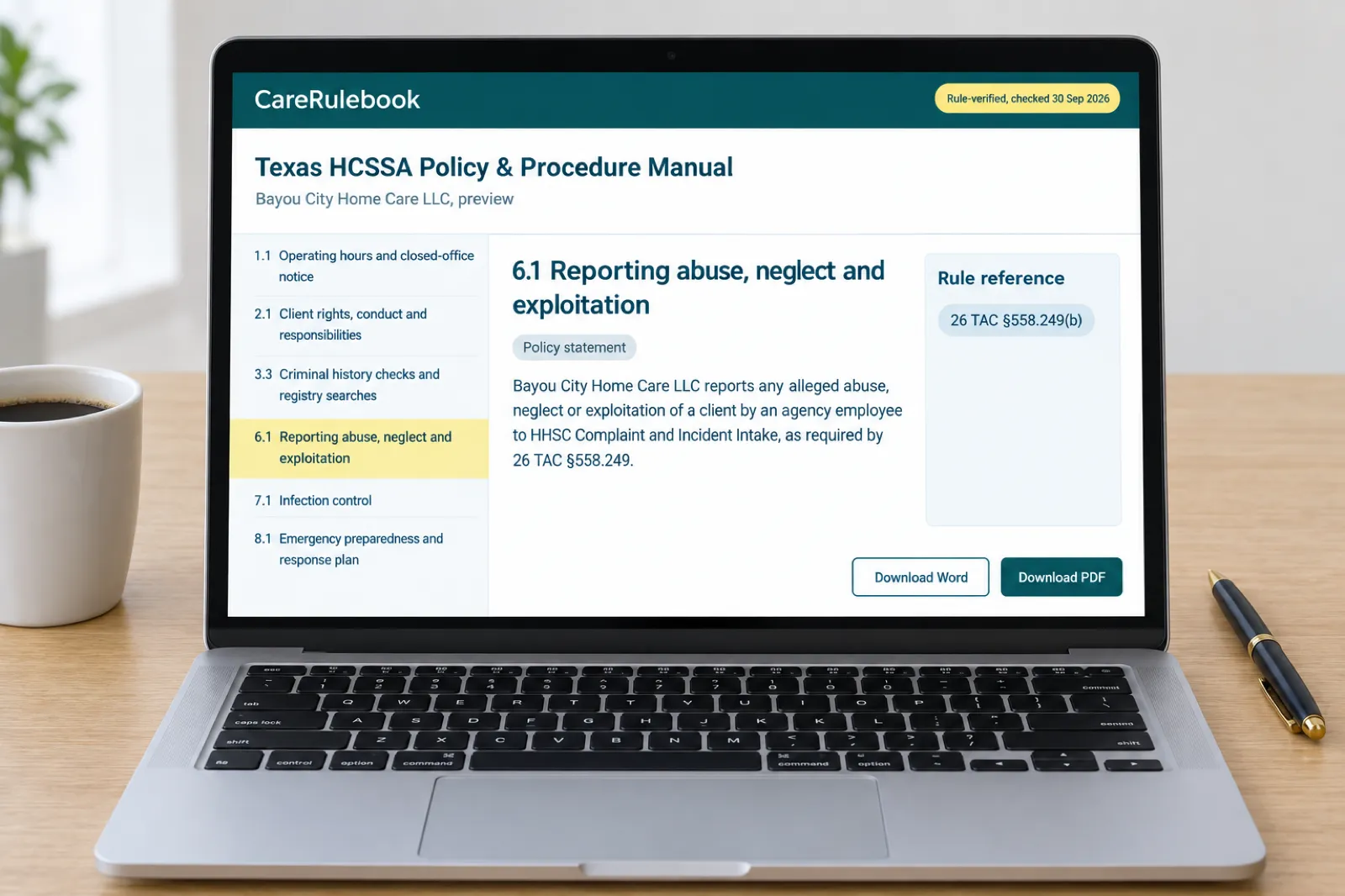
CareRulebook writes every policy Chapter 111-8-65 requires, for the services you offer, with your agency’s details and the rule quoted under each one. Policy 1.1 covers the governing body and administrator, 1.2 your lines of authority and 5.2 supervision of each service.
$199CareRulebook founding price for the first 50 Georgia agencies, then $249. Not a DCH fee.
"Services shall be supervised by qualified staff of the provider." 111-8-65-.10(2) Who counts as qualified depends on the service:
A fully licensed Georgia registered nurse
A supervisor qualified by education, training and experience
Any qualified supervisor, including the administrator
"Medically frail or medically compromised client" means a client whose health status, as determined by appropriate provider staff in accordance with accepted standards of practice, is likely to change or has changed because of a disease process, injury, disability or advanced age and underlying disease process(es). 111-8-65-.03(l) Your staff make that call, so your policy should say who decides and how it is recorded.
"Such supervisor may perform other duties provided he or she is able to fulfill the supervisory responsibilities described in these rules." 111-8-65-.10(2)(a)-(b) In a small agency the RN who is also the administrator can supervise every category, as long as the visits and plans get done on time.
If contracted nurses give services for you, the rule is clear: "The services must be supervised, as outlined in rule .10(2) (Supervision of Services), by a supervisor of the licensed provider." 111-8-65-.09(7)
Personal care
Every 92 days
At least every 92 days from the first service in the home, or more often as the level of care requires. The visit covers "assessment of the client's general condition, vital signs, a review of the progress being made, the problems encountered by the client and the client's satisfaction with the services being delivered by the provider's staff", and whether the level of service is right.
Companion or sitter
Every 122 days
At least every 122 days from the first service in the home, and also when a complaint raises a serious question about the services. The visit covers the same ground without vital signs: general condition, progress, problems and the client’s satisfaction.
Visits are made in the client’s home and documented in the client file or service plan. .10(2)(b)2, (c)2 The limit is a number of days, not a calendar quarter: two visits in consecutive quarters can be close to six months apart. Our suggestion: book the next visit at the end of each one, and diary it a week or two before the 92 or 122 days run out.
The service supervisor completes the plan within seven working days after services start in the home.
111-8-65-.11(2)The supervisor completes the plan in coordination with the staff who will provide the client’s services.
111-8-65-.10(2)(a)An RN completes the initial plan. An LPN supervising the client may make later revisions, which the responsible RN reviews in a timely manner.
111-8-65-.10(2)(b)1Service plans for nursing services are reviewed and updated at least every 62 days.
111-8-65-.11(2)Personal care and companion plans are reviewed and updated at each supervisory visit, and revised whenever the client’s needs change.
111-8-65-.11(2)The service plan comes after the service agreement, which is due by the second visit or within 7 calendar days of starting, whichever is earlier. 111-8-65-.09(2)(b) What each plan must contain is set out in 111-8-65-.11(1) and in our Georgia policies and procedures guide.
When aides give personal care to medically frail or compromised clients, "the provider shall have a representative on call and accessible who shall be able to contact a nurse supervisor by telephone or other means" to give the aides appropriate consultation on the client’s medical needs. The rule asks for a representative who can reach a nurse supervisor; it does not say the representative must be a nurse.
Each employee’s file holds a written evaluation showing a supervisor personally observed them perform their job tasks competently.
"Each staff member providing services to a client shall be evaluated in writing by his or her supervisor, at least annually", by direct observation or demonstration.
Supervisors also keep anyone exposed to or diagnosed with tuberculosis or hepatitis away from clients until they are found not to be contagious. 111-8-65-.10(2) The Georgia survey guide covers how surveyors check these records.
No. Not under Chapter 111-8-65. The rule’s minimum qualifications are a statement at application that the person has never been shown to have abused, neglected or exploited anyone (a satisfactory fingerprint determination under the 2026 amendment), taking part in the orientation and training the rules require, and no material false statements about qualifications. DCH asks for a copy of a professional license only if the administrator has one. Separately, DCH requires an RN on every initial application, and the RN can be the administrator.
"Any administrator employed after the effective date of these rules must meet the following minimum qualifications ... Participate in the orientation and training required by these rules ... Not have made any material false statements concerning qualifications requirements either to the department or the provider."
Yes. To apply. DCH’s current application checklist requires an RN for every initial application, whatever services you offer. The RN can also be the owner or administrator. The rules themselves let the administrator supervise companion work, so this is a DCH application requirement rather than rule text.
"Regardless of the service level provided, an RN is required for the initial application."
No. It depends on the service. Personal care clients need a supervisory home visit at least every 92 days. Companion and sitter clients need one at least every 122 days, or sooner after a serious complaint. Nursing service plans are reviewed every 62 days.
"The appropriate supervisor shall make a supervisory home visit to each client's residence at least every 92 days"
Anyone the governing body appoints who meets the minimum qualifications in Ga. Comp. R. & Regs. 111-8-65-.09(3)(a). As printed, those are a statement at application that they have never been shown by credible evidence to have abused, neglected or exploited anyone, taking part in the orientation and training the rules require, and no material false statements about their qualifications. The rules set no education, license or experience requirement. DCH’s checklist also asks for a GCHEXS fingerprint letter for every administrator.
No. But DCH requires a registered nurse on every initial application, whatever services you offer, and its checklist says an RN is permitted to hold the positions of administrator, owner and certified nursing assistant. So one person who is an RN can be both.
Chapter 111-8-65 does not require the administrator to be someone other than the owner. DCH’s checklist says an RN may hold the positions of administrator and owner. Whoever it is, the governing body appoints them with full authority, they sign a job description saying so, and they need a satisfactory GCHEXS fingerprint letter.
The orientation in 111-8-65-.09(6)(a): your policies on scope of services, client rights and complaints; their duties; reporting progress and problems and handling medical emergencies; and the duty to report exposure to TB or hepatitis. DCH asks for evidence covering items 1 through 4, signed and dated by the administrator.
Yes, to apply. DCH’s current checklist says an RN is required for the initial application regardless of the service level. The rules themselves let any qualified supervisor, including the administrator, supervise companion and sitter work, so this is a DCH application requirement rather than rule text.
At least every 92 days for personal care clients, with a check of condition, vital signs, progress, problems and satisfaction. At least every 122 days for companion or sitter clients, and also after a complaint that raises a serious question about the services. Nursing service plans are reviewed every 62 days.
A licensed RN or LPN. If an LPN supervises, they report to an RN, who stays responsible for the service plan. An RN completes the client’s initial service plan; an LPN may make later revisions, which the RN reviews in a timely manner.
DCH adopted changes to Chapter 111-8-65 on July 9, 2026, including a fingerprint qualification for administrators. Leave your email and we will tell you when they take effect and what changes in your policies.
No spam. Only emails about Georgia home care rule changes. How we use your email.
Georgia
How to start a home care agency in Georgia
The license, service categories, fees and the 2026 rule change.
Georgia
The Georgia license application
Every document DCH asks for, GAHLES, fees and the provisional license.
Georgia
The Georgia home care survey
The initial survey, re-licensure surveys and plans of correction.
Georgia
Georgia caregiver background checks
Registry checks, GCHEXS fingerprints and the records to keep.
Georgia
Georgia home care policies and procedures
Every rule that asks for a written policy, mapped to the policy that meets it.
Tool
Georgia license checklist
Every step, tailored to your agency, emailed to you.
Manual
Georgia policy manual
Every policy Chapter 111-8-65 requires, written for your agency.
Texas
Texas home care administrator requirements
How Texas does it: an alternate, 24 hours of training and yearly CE.
North Carolina
North Carolina agency director and RN
Director qualifications, the RN for aides and 90-day visits.
Virginia
Virginia administrator and RN
Administrator experience, the designated RN and 90-day supervision.