| 22 M.R.S. § 1717(2-A); Ch. 129 § 2(A)(1) | Hold the license before serving anyone No services and no payment for services until DLC issues the license. "No PCA may provide services or accept any payment for services unless first licensed by the Department." | Policy in your manual1.3 License, renewal, changes, ownership, sites, inspections, waivers and plans of correction |
| Ch. 129 § 2(A)(2) | No home health or health care advertising Never advertise as a home health agency or as offering health services that need a licensed professional. "No PCA may advertise that they are a home health agency or that they provide any type of “health” or “healthcare” services that require the services of a licensed medical professional." | Policy in your manual1.1 Agency overview: services, Maine site, office hours, insurance, organization and business records2.11 What our employees do and do not do, and medication reminders |
| Ch. 129 § 2(A)(6); § 1 "Site" | Physical site in Maine Keep a site in Maine: a business-zoned non-residential building, or a separate, confidential space in a home with locked record storage. No virtual or shared sites. "A PCA must have a physical site in Maine, in a non-residential building that is zoned for business or, if operating out of a private home or residential setting, located in a separate and distinct space which ensures confidentiality and contains locked storage for records." | Policy in your manual1.1 Agency overview: services, Maine site, office hours, insurance, organization and business records |
| Ch. 129 § 3(A)(1) | Phone, email, administrator and posted office hours Have a dedicated phone line and email address, a designated administrator, and office hours posted at the site entrance (with a contact number if nobody is in). "Designated office hours that are posted on the entrance of the site containing the office space." | Policy in your manual1.1 Agency overview: services, Maine site, office hours, insurance, organization and business records |
| Ch. 129 § 3(A)(2); § 2(H) | Tell DLC about contact changes in 7 days Report a change of phone number or email address within seven calendar days. "The agency must inform the Department of any changes in contact information within seven calendar days of the change." | Policy in your manual1.3 License, renewal, changes, ownership, sites, inspections, waivers and plans of correction |
| Ch. 129 § 3(A)(3); § 2(F)(2) | Liability insurance Keep general and professional liability insurance adequate to protect clients from personal injury. "The agency must maintain general and professional liability insurance adequate to protect clients in the event of personal injury." | Policy in your manual1.1 Agency overview: services, Maine site, office hours, insurance, organization and business records |
| Ch. 129 § 3(B) | Post the license Post the license where business is done (both licenses if dually licensed). "The agency license must be conspicuously posted in the area where business is conducted." | Policy in your manual1.3 License, renewal, changes, ownership, sites, inspections, waivers and plans of correction |
| Ch. 129 § 2(H)(1)-(3) | Notify DLC of changes in time Name or address: 14 days before. Administrator resigning: 14 days before the last day; fired: within 7 business days; leave: within 14 days. New site: 60 days before. File a change application and fee for name, site or location changes. "Intent to add a new site: At least 60 calendar days prior to the opening a new site; and" | Policy in your manual1.3 License, renewal, changes, ownership, sites, inspections, waivers and plans of correction |
| Ch. 129 § 2(I) | Change of ownership Give DLC 60 days’ written notice of a sale; the buyer files a new application at least 45 days before. The old license is void on the change. "The agency must notify the Department, in writing, of the intent to change ownership at least 60 days prior to the anticipated date of the transaction." | Policy in your manual1.3 License, renewal, changes, ownership, sites, inspections, waivers and plans of correction |
| Ch. 129 § 2(J) | Adding a site if the agency opens a second site Apply before opening a new site, with its address, hours and how the main location will supervise it. "A summary of how the main location will provide supervision and direction over the new site." | Policy in your manual1.3 License, renewal, changes, ownership, sites, inspections, waivers and plans of correction |
| Ch. 129 § 2(J)(3) | Comply at every listed site if the agency has more than one site The agency must meet the rule at every site listed on its license. "The agency is responsible for compliance with this rule at all sites listed on the agency license." | Policy in your manual1.3 License, renewal, changes, ownership, sites, inspections, waivers and plans of correction |
| Ch. 129 § 2(G)(1) | Renew 60 days ahead File the renewal at least 60 calendar days before the license expires. "The agency must file an application with the Department for renewal of its license at least 60 calendar days prior to the expiration of the current license." | Policy in your manual1.3 License, renewal, changes, ownership, sites, inspections, waivers and plans of correction |
| Ch. 129 § 10(A); 22 M.R.S. § 1717(9) | Allow inspections; do not obstruct them DLC may enter at any reasonable hour and copy records; never impede an inspection or investigation. "An agency may not impede or obstruct a Department inspection." | Policy in your manual1.3 License, renewal, changes, ownership, sites, inspections, waivers and plans of correction |
| Ch. 129 § 10(F)(3), (G) | Plans of correction in 10 business days Answer every statement of deficiencies with a signed plan of correction within 10 business days, even if an informal conference is requested. "A Plan of Correction (POC) must be submitted to the Department within ten (10) business days of the organization’s receipt of an SOD." | Policy in your manual1.3 License, renewal, changes, ownership, sites, inspections, waivers and plans of correction1.7 Quality Improvement Plan |
| Ch. 129 § 10(G)(4)(a) | Revised plan of correction in 5 days If DLC rejects a plan of correction, submit an acceptable one that addresses the reasons within five calendar days of the notice. "The agency must submit an acceptable POC that addresses the reasons for rejection of the initial POC within five calendar days of the date of notice." | Policy in your manual1.3 License, renewal, changes, ownership, sites, inspections, waivers and plans of correction1.7 Quality Improvement Plan |
| Ch. 129 § 10(C) | No retaliation for complaints Never retaliate against a client or representative who complains to DLC. "The provider may not retaliate against any client or his/her representative for filing a complaint." | Policy in your manual2.9 Grievances and complaints to DLC2.3 Agency expectations (what clients can expect from us) |
| Ch. 129 § 2(K) | Policy for transferring clients on involuntary closure Have a policy to transfer every client to another provider if DLC refuses, revokes, suspends or voids the license, including notifying the Long Term Care Ombudsman. "The agency must have a policy to address transfer of services for all current clients to another provider if the Department refuses to renew a license under Section 10 of this rule or the Department revokes, suspends, or voids a license." | Policy in your manual1.6 Contingency planning and closing the agency |
| Ch. 129 § 2(K)(2) | Ombudsman notice in the closure policy The involuntary closure policy includes notifying the Long Term Care Ombudsman. "The policy must include a process to notify the Long Term Care Ombudsman of the involuntary closure." | Policy in your manual1.6 Contingency planning and closing the agency |
| Ch. 129 § 2(L) | Voluntary closure notices Give DLC, the Office of MaineCare Services, OADS and the Ombudsman 90 days’ written notice, and clients at least 60 days’; submit a transition plan if asked; return the license. "Notify all current clients and/or legal representatives in writing as soon as possible, but no later than 60 calendar days in advance of the anticipated date of closure." | Policy in your manual1.6 Contingency planning and closing the agency |
| Ch. 129 § 2(K)(3), 2(L)(1)(d) | Return the license on closure On closure, voluntary or not, return any license in the agency’s possession to DLC immediately. "Upon closure, the agency must immediately surrender any license in its possession to the Department." | Policy in your manual1.6 Contingency planning and closing the agency |
| Ch. 129 § 2(L)(2) | Emergency that prevents the closure steps Tell DLC in writing of any emergency that prevents the agency from meeting the voluntary closure requirements. "The agency must notify the Department, in writing, of any emergency situation which prevents compliance with the requirements above." | Policy in your manual1.6 Contingency planning and closing the agency |
| Ch. 129 § 5(A)(1) | Operations manual Keep an operations manual with, at a minimum, the contents in 5(A)(1)(a)-(d). "The agency must have a manual that includes, at a minimum, the following:" | Policy in your manual1.2 Our operations manual and the Section 5(A) crosswalk |
| Ch. 129 § 5(A)(1)(a); § 9(D)(3) | Organizational diagram An organizational diagram showing lines of responsibility and accountability. "An organizational diagram delineating the lines of responsibility and accountability;" | Policy in your manual1.1 Agency overview: services, Maine site, office hours, insurance, organization and business records1.2 Our operations manual and the Section 5(A) crosswalk |
| Ch. 129 § 5(A)(1)(b) | Job descriptions for all positions A job description for every position, signed by each employee for their file. "Job descriptions for all positions within the agency;" | Policy in your manual1.4 Job descriptions for all positions |
| Ch. 129 § 5(A)(1)(c) | Description of the orientation program Describe the orientation program, including mandated reporting. "A description of the orientation program, including but not limited to mandated reporting requirements;" | Policy in your manual4.3 Orientation and the description of our orientation program |
| Ch. 129 § 5(A)(1)(d) | Policies comply with the law Policies on at least the 17 listed topics; where the rule or a statute covers a topic, the policy must comply with it. "Policies and procedures on topics that are addressed by this rule or by statutes applicable to the agency must comply with the relevant law." | Policy in your manual1.2 Our operations manual and the Section 5(A) crosswalk |
| Ch. 129 § 5(A)(1)(d)(i) | Policy: infection control Infection control in the office and in clients’ homes. "Infection control in the office and in private homes;" | Policy in your manual3.3 Infection control in the office and in clients’ homes |
| Ch. 129 § 5(A)(1)(d)(ii) | Policy: referral for a higher level of care How the agency seeks a referral or reassessment when a client may need more care than it provides. "A policy for seeking a referral/reassessment when a client may require higher level of care;" | Policy in your manual2.7 Referral or reassessment when a client may need a higher level of care |
| Ch. 129 § 5(A)(1)(d)(iii) | Policy: verifying qualifications before hire Check CNA registry status, PSS certificates and other qualifications before employment. "Verification of qualifications prior to employment;" | Policy in your manual4.1 Direct care qualifications and verifying them before hire |
| Ch. 129 § 5(A)(1)(d)(iv) | Policy: confidentiality, transport and storage of records Confidentiality of records and services, including carrying and storing records. "Confidentiality of records and services, including transportation and storage of records;" | Policy in your manual3.4 Confidentiality of records and services, devices, and transporting and storing records |
| Ch. 129 § 5(A)(1)(d)(v) | Policy: screening owners and employees Screening of owners and employees and deciding eligibility for employment. "Completion of screening of owners and employees, including determination of eligibility for employment;" | Policy in your manual4.2 Screening owners and employees: MBCC, APS and CPS checks, registry, background file |
| Ch. 129 § 5(A)(1)(d)(vi) | Policy: in-service training In-service training, including confidentiality and service planning. "In-service training, including confidentiality and service planning for clients;" | Policy in your manual4.4 Annual training, in-service training and mandated reporter training |
| Ch. 129 § 5(A)(1)(d)(vii) | Policy: performance management Discipline and annual performance reviews. "Performance management, including disciplinary measures and annual performance reviews;" | Policy in your manual4.6 Performance management, discipline and annual performance reviews |
| Ch. 129 § 5(A)(1)(d)(viii) | Policy: supervision, call-outs, smoking, alcohol and drugs Supervision of staff, including absences and call-outs, and smoking, alcohol or illegal drug use while giving care. "Supervision of staff, including staff absences/call outs and smoking, alcohol, or illegal drug use while providing client care;" | Policy in your manual4.5 Supervision, call-outs, and smoking, alcohol and illegal drugs |
| Ch. 129 § 5(A)(1)(d)(ix) | Policy: ethical business relationships, gifts and loans Restrict staff accepting gratuities, loans or gifts from clients and families. "Ethical business relationships with clients, including a restriction on the acceptance of gratuities, loans, and/or gifts from clients and family members;" | Policy in your manual1.8 Ethical business relationships, gifts and loans |
| Ch. 129 § 5(A)(1)(d)(x) | Policy: client referrals How referrals are received and accepted. "Client referrals;" | Policy in your manual2.1 Client referrals and admissions |
| Ch. 129 § 5(A)(1)(d)(xi) | Policy: service plans, documentation and client emergencies Client service plans, documenting services given, and emergency procedures for clients. "Client service plans, including documentation of services provided and emergency procedures related to the client;" | Policy in your manual2.4 Service plans2.5 Documenting services at each visit2.8 Client emergencies |
| Ch. 129 § 5(A)(1)(d)(xii) | Policy: grievance procedures The client grievance process. "Grievance procedures;" | Policy in your manual2.9 Grievances and complaints to DLC |
| Ch. 129 § 5(A)(1)(d)(xiii) | Policy: reporting and investigating abuse, neglect and misappropriation How allegations are reported and investigated. "Reporting and investigation of allegations of abuse, neglect, or misappropriation of client property;" | Policy in your manual3.1 Reporting abuse, neglect, exploitation and misappropriation of client property3.2 Investigating allegations |
| Ch. 129 § 5(A)(1)(d)(xiv) | Policy: discontinuing services Ending services, including involuntary discharge. "Discontinuing of services, including involuntary discharge;" | Policy in your manual2.10 Discontinuing services and involuntary discharge |
| Ch. 129 § 5(A)(1)(d)(xv) | Policy: contingency planning and closure Plans for emergencies that affect service delivery, including closing the agency. "Contingency planning, including agency closure;" | Policy in your manual1.6 Contingency planning and closing the agency3.7 Emergency and disaster plan |
| Ch. 129 § 5(A)(1)(d)(xvi) | Policy: record retention, including after closure Keeping client and business records while operating and after closing. "Client and business record retention while operating and after closure; and" | Policy in your manual3.6 Keeping client and business records, while operating and after closure |
| Ch. 129 § 5(A)(1)(d)(xvii) | Policy: communicating policy changes How new and changed policies reach every employee. "Communicating new policies and policy changes with all employees." | Policy in your manual1.5 Communicating new policies and policy changes |
| Ch. 129 § 5(A)(2) | Follow the policies Implement and follow every policy, including the plan for communicating changes. "Agency policies and procedures must be implemented and followed by the agency, including the plan for communicating policy changes with all employees." | Policy in your manual1.5 Communicating new policies and policy changes1.2 Our operations manual and the Section 5(A) crosswalk |
| Ch. 129 § 5(E) | Data-driven Quality Improvement Plan Develop, implement and maintain a QI plan on outcome and quality-of-life indicators, use data to spot trends and prevent adverse events, and document corrective actions. "The agency must develop, implement, and maintain a data-driven Quality Improvement Plan that focuses on indicators of the outcomes of care and quality of life." | Policy in your manual1.7 Quality Improvement Plan |
| Ch. 129 § 5(E)(3) | Document improvement work Keep evidence of corrective actions and improvement activities and their evaluation. "The agency shall have documentation demonstrating the development, implementation, and evaluation of corrective actions or performance improvement activities." | Policy in your manual1.7 Quality Improvement Plan |
| Ch. 129 § 3(C)(1) | Admissions record Log each client’s name, start date and, if services end, the end date and reason. "The agency must keep a record of all admissions that includes the following:" | Policy in your manual2.1 Client referrals and admissions |
| Ch. 129 § 3(C)(3) | Admit only when staffed Show enough staff to meet client needs before admitting. "The agency must demonstrate sufficient staffing to meet client needs when admitting clients for services." | Policy in your manual2.1 Client referrals and admissions |
| Ch. 129 § 3(D)(1) | Involuntary discharge only for listed reasons Document efforts to prevent involuntary discharge; discharge only for the seven listed reasons. "The agency must show documented evidence of strategies used to prevent involuntary discharges." | Policy in your manual2.10 Discontinuing services and involuntary discharge |
| Ch. 129 § 3(D)(2) | Record threats For a discharge over a threat to others, record the date, the nature of the threat and who was involved. "If services are being discontinued because of a direct threat to the health or safety of others, there must be documented evidence of the following:" | Policy in your manual2.10 Discontinuing services and involuntary discharge |
| Ch. 129 § 3(D)(3) | Discharge notice in 5 business days Send the client a written reason for involuntary discharge within five business days, with the Long Term Care Ombudsman’s contact details. "A discharge notice describing the reason for the involuntary discharge must be sent to the client or their legal representative within five business days." | Policy in your manual2.10 Discontinuing services and involuntary discharge |
| Ch. 129 § 3(E)(1) | Written contract with every client A written business contract with each client or representative showing the costs the client pays. "For all clients, the agency must have a written business contract with the client or legal representative which will include, at a minimum, any cost(s) for which the client will be responsible." | Policy in your manual2.2 Client contract and notice of price changes |
| Ch. 129 § 3(E)(1)(a) | 30 days’ notice of price changes Give at least 30 calendar days’ notice of any change in costs. "A notice must be given to the client or legal representative if there is any change in costs for any service at least 30 calendar days prior to the change." | Policy in your manual2.2 Client contract and notice of price changes |
| Ch. 129 § 7(A)(1) | Agency expectations (client rights) Meet the 12 expectations: staff qualifications on request, freedom from abuse, involvement in planning, services as planned, language, missed-day notice, record access and copies, confidentiality, grievance and DLC complaint routes, inspection results on request, and protection and advocacy contacts. "Inform clients of their state protection and advocacy rights, including but not limited to providing contact information for the Division of Licensing and Certification, Adult Protective Services and the Maine Long Term Care Ombudsman Program." | Policy in your manual2.3 Agency expectations (what clients can expect from us) |
| Ch. 129 § 7(A)(2)-(3) | Give and keep a signed copy of the expectations Give the client the expectations when the contract is signed, and keep a signed copy in the record. "The client must be given a copy of these agency expectations at the time of signing a contract with the agency." | Policy in your manual2.3 Agency expectations (what clients can expect from us)2.2 Client contract and notice of price changes |
| Ch. 129 § 7(A)(1)(j) | Tell clients how to complain to DLC Verbally and in writing, in a language the client understands; a DLC complaint can be instead of or as well as a grievance. "Inform clients, verbally and in writing, and in a language understood by the client, of how to file a complaint with the Department and that this complaint may be filed instead of or in addition to a grievance;" | Policy in your manual2.3 Agency expectations (what clients can expect from us)2.9 Grievances and complaints to DLC |
| Ch. 129 § 7(A)(1)(g) | Client access to records Give clients access to their records and paper copies on request (a reasonable cost-based fee is allowed); log oral requests. "If the request for paper copies is made orally, the agency must document the date the request was received in the client record" | Policy in your manual3.5 Client records and client access to records2.3 Agency expectations (what clients can expect from us) |
| Ch. 129 § 7(B)(1)-(2) | Grievance process and log A way for clients to raise concerns, and a record of every grievance with name, date and nature. "The agency must have a process for clients to raise issues or concerns about the manner and quality of services or other grievances with the agency." | Policy in your manual2.9 Grievances and complaints to DLC |
| Ch. 129 § 7(B)(3)-(5) | Investigate and answer in 7 days Investigate every grievance, document it in the client record, and give a written resolution within seven calendar days. "The agency must provide a written resolution to the client within seven calendar days and a copy must be kept in the client’s record." | Policy in your manual2.9 Grievances and complaints to DLC |
| Ch. 129 § 8(B)(3) | Staff record client concerns Caregivers write down any grievance a client voices and report it under the agency policy. "If the client expresses any grievances regarding his/her services, the employee must document these concerns in the client’s record and report the concerns in accordance with the agency policy." | Policy in your manual2.9 Grievances and complaints to DLC2.5 Documenting services at each visit |
| Ch. 129 § 8(A)(1) | Service plan before any service Develop a written plan with the client or representative before services start. "A written service plan must be developed, in coordination with the client and/or legal representative, prior to any services being provided." | Policy in your manual2.4 Service plans |
| Ch. 129 § 8(A)(2) | Service plan contents Date, participants, services, frequency of each service, and the client’s signature. "The client’s and/or legal representative’s signature attesting to their involvement and agreement with the plan." | Policy in your manual2.4 Service plans |
| Ch. 129 § 8(A)(3) | Update on significant change, with signature Update the plan whenever function or status changes significantly; the client signs each update. "The service plan must be updated whenever there is a significant change in client function or status." | Policy in your manual2.4 Service plans2.7 Referral or reassessment when a client may need a higher level of care |
| Ch. 129 § 8(A)(4)-(5) | Annual review; follow the plan Review the plan with the client at least yearly and implement it as written. "A review of the service plan, with the client and/or legal representative, must be conducted at least annually." | Policy in your manual2.4 Service plans |
| Ch. 129 § 8(B)(1)-(2) | Document every visit At each visit the caregiver records the services given, signs and dates it. "At each visit, the employee must document what services were provided to the client." | Policy in your manual2.5 Documenting services at each visit |
| Ch. 129 § 4(C)(1) | Tell clients before a missed visit If a visit cannot happen, tell the client before the visit and why. "If the agency is not able to provide services on a scheduled day, the client and/or legal representative must be notified before the scheduled visit and informed of the reason services cannot be provided as scheduled." | Policy in your manual2.6 Missed visits |
| Ch. 129 § 4(C)(2) | Log missed visits Record every date services could not be provided and the reason. "A record must be kept of any date on which the agency was unavailable to provide scheduled services to a client and the reason why services could not be provided." | Policy in your manual2.6 Missed visits |
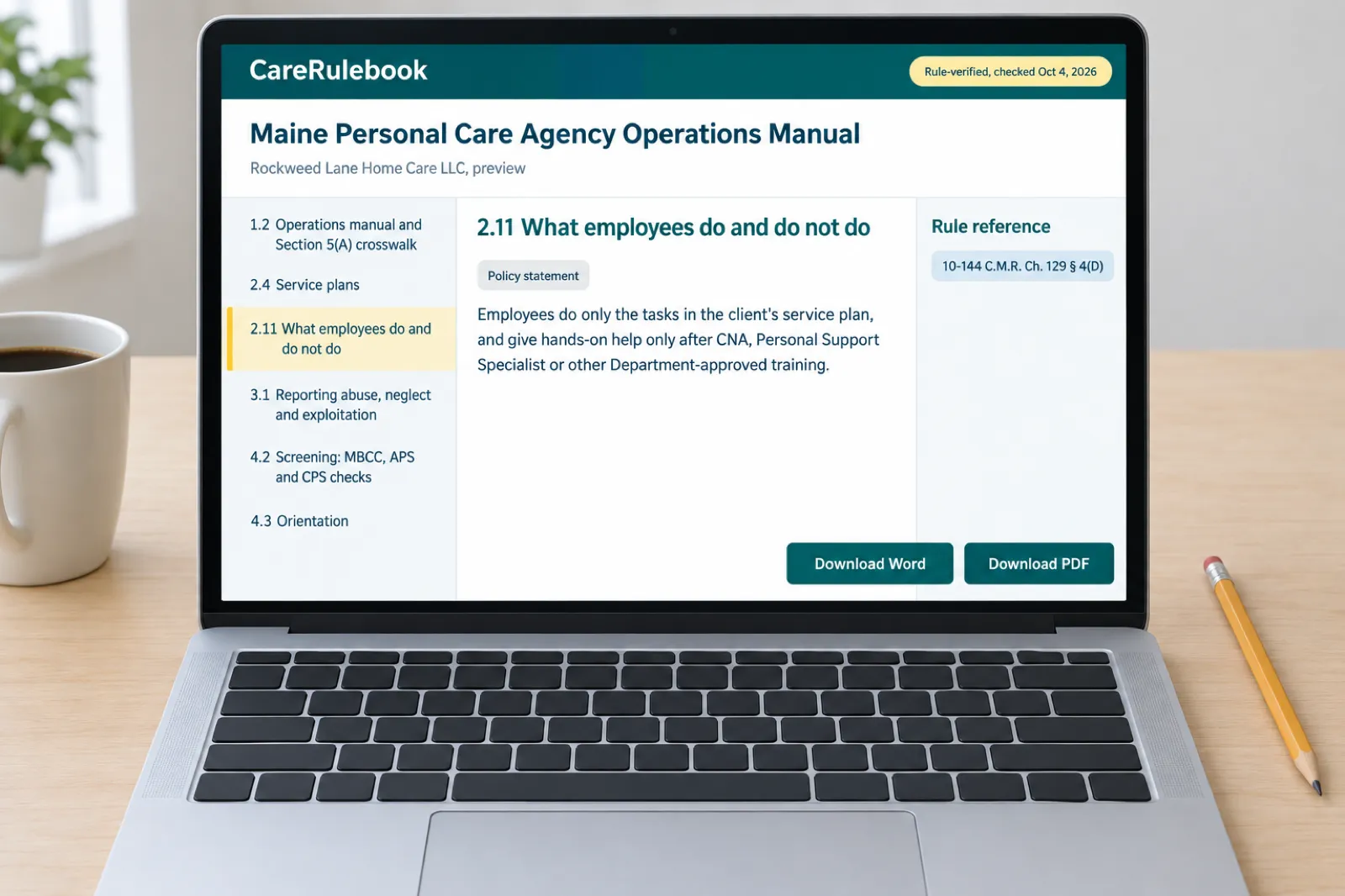
| Ch. 129 § 4(D) | Only trained duties Caregivers do only the duties their CNA, PSS or approved training covers. "Employees providing direct care to clients may only complete duties which they have been trained to perform through a state-approved Certified Nursing Assistant program or a Department-approved program related to the provision of care" | Policy in your manual2.11 What our employees do and do not do, and medication reminders |
| Ch. 129 § 6(A)(1) | Written abuse reporting policy A written policy and procedure for reporting abuse, neglect and misappropriation that does not conflict with the APS or child protection reporting laws. "The agency must have a written policy and procedure to address the reporting of abuse, neglect, and/or misappropriation of client property. The policy may not conflict with 22 MRS §3477 or 22 MRS §4011-A." | Policy in your manual3.1 Reporting abuse, neglect, exploitation and misappropriation of client property |
| Ch. 129 § 6(A)(2) | Report immediately to four places Allegations involving agency staff go immediately to the administrator, APS (adults) or CPS (under 18), and DLC. "All allegations of client abuse, client neglect, exploitation, and/or misappropriation of client property involving agency staff must be reported immediately, to the following:" | Policy in your manual3.1 Reporting abuse, neglect, exploitation and misappropriation of client property |
| Ch. 129 § 6(A)(3)-(4) | Written report to DLC within 48 hours After a phone or voicemail report, DLC must receive a written report (online form or DHHS form) within 48 hours. "Must be received by the Department within 48 hours of the verbal report." | Policy in your manual3.1 Reporting abuse, neglect, exploitation and misappropriation of client property |
| Ch. 129 § 6(A)(5) | Report contents Agency details, client name and address, nature of the allegation, alleged perpetrator, and reporter’s name and number. "All reports to the Division of Licensing and Certification, both verbal and written, must indicate, at a minimum, the following:" | Policy in your manual3.1 Reporting abuse, neglect, exploitation and misappropriation of client property |
| 22 M.R.S. § 3477(1)-(2) | Caregivers report suspected adult abuse directly to APS Anyone caring for an incapacitated or dependent adult reports immediately by phone, directly to DHHS (APS); supervisors may not impede it. "Any person who has assumed full, intermittent or occasional responsibility for the care or custody of the incapacitated or dependent adult, regardless of whether the person receives compensation;" | Policy in your manual3.1 Reporting abuse, neglect, exploitation and misappropriation of client property |
| 22 M.R.S. § 4011-A(1) | Report suspected child abuse Homemakers and home health aides report suspected child abuse or neglect immediately; agency staff notify the person in charge (or report directly), and report directly if they get no confirmation within 24 hours. "If the notifying person does not receive the confirmation from the institution, agency or facility within 24 hours of the notification, the notifying person immediately shall make a report directly to the department." | Policy in your manual3.1 Reporting abuse, neglect, exploitation and misappropriation of client property |
| Ch. 129 § 6(B)(1) | Investigation file Dates, nature of the allegation, notification times, reporter and alleged perpetrator, time removed from duty, interviews, conclusion and action plan. "Documented interviews with the client, all individuals with possible knowledge of the alleged incident, and the alleged perpetrator;" | Policy in your manual3.2 Investigating allegations |
| Ch. 129 § 6(B)(2) | Accused employee off client work An accused employee may not work with any client until the investigation is complete. "The alleged perpetrator, if an employee, may not work with any client until an investigation has been completed." | Policy in your manual3.2 Investigating allegations |
| Ch. 129 § 6(B)(3) | Investigation report to DLC in 7 days Send the investigative report by close of business on the seventh calendar day after the alleged incident. "The investigative report containing information listed in Section 6(B)(1)(a-h) must be submitted to the Department no later than the close of business on the seventh calendar day after the alleged incident." | Policy in your manual3.2 Investigating allegations |
| Ch. 129 § 6(B)(4) | Report suspected crimes to police Serious bodily injury: within two hours. Other suspected crimes against a client: within 24 hours. "Any event that caused reasonable suspicion and resulted in serious bodily injury to a client must be reported immediately, but not later than two hours after forming the suspicion." | Policy in your manual3.2 Investigating allegations3.1 Reporting abuse, neglect, exploitation and misappropriation of client property |
| Ch. 129 § 6(B)(5) | No interference with DLC investigations Never limit client or staff participation in a DLC investigation. "The agency may not interfere with, impede or obstruct an investigation by the Department, including but not limited to influencing or limiting client or staff participation in Department investigative activities." | Policy in your manual3.2 Investigating allegations |
| Ch. 129 § 9(A)(1) | Secure records and devices Store all records securely; personal devices used for client information need software that blocks unauthorized access. "Personal electronic devices used to store or transmit client information must be equipped with software and/or applications to ensure that the information cannot be accessed by unauthorized individuals." | Policy in your manual3.4 Confidentiality of records and services, devices, and transporting and storing records |
| Ch. 129 § 9(A)(2); § 7(A)(1)(h) | Follow confidentiality laws Records confidential under state or federal law meet those laws. "Records or information that is confidential pursuant to state or federal law must meet the confidentiality requirements of those applicable statutes." | Policy in your manual3.4 Confidentiality of records and services, devices, and transporting and storing records |
| Ch. 129 § 9(B)(1) | Client record contents Name, address, phone, emergency contact, admission and start dates, service plans, visit documentation, signed contract, concerns, discharge summary, releases (updated yearly), and any non-payment or safety letter. "An individualized record must be maintained for each client. These records may be paper records or electronic records." | Policy in your manual3.5 Client records and client access to records |
| Ch. 129 § 9(B)(2) | Records available to DLC All client records available to DLC on request. "All client records must be accessible to Department representatives upon request." | Policy in your manual3.5 Client records and client access to records |
| Ch. 129 § 3(C)(2) | Keep client records 5 years Keep client records at least five years. "The agency must retain client records for no less than five years." | Policy in your manual3.6 Keeping client and business records, while operating and after closure |
| Ch. 129 § 9(D) | Business records on site Articles of incorporation (if incorporated), insurance policies and an organizational chart on site. "The organization must have the following current business records on site for review:" | Policy in your manual1.1 Agency overview: services, Maine site, office hours, insurance, organization and business records3.6 Keeping client and business records, while operating and after closure |
| Ch. 129 § 5(C)(1)(f); § 5(B)(2) | Emergency and disaster policies Emergency and disaster policies, taught in orientation and every year. "Emergency and disaster policies; and" | Policy in your manual3.7 Emergency and disaster plan2.8 Client emergencies |
| Ch. 129 § 4(A)(1)-(2) | Hands-on caregivers: CNA or PSS if staff help with ADLs (not needed for meals, money, shopping, light housework and communication only) For ADL care, use only active CNAs or people who have completed, or enrolled within 60 days of hire in, PSS or another approved program; training done within nine months or they stop hands-on care. "If an individual does not complete the program within nine months of hire, they will no longer meet the qualifications to provide direct care and may not provide personal care services until they have completed the program." | Policy in your manual4.1 Direct care qualifications and verifying them before hire |
| Ch. 129 § 4(B)(1); 22 M.R.S. §§ 9054, 9057 | MBCC checks for staff, owners and administrators A successful MBCC check for every employee, owner and administrator; final report before starting, unless conditionally employed. "An employer that has made a contingent offer of employment to a direct access worker shall secure a background check and receive a final background check report prior to allowing the individual to commence employment as a direct access worker, except where the individual is conditionally employed as described in this chapter." | Policy in your manual4.2 Screening owners and employees: MBCC, APS and CPS checks, registry, background file |
| 22 M.R.S. § 9057(4) | Conditional employment rules if the agency lets anyone start before the final MBCC report Up to 60 days only if entered in MBCC as conditional, not already disqualified, signed statement, biometrics submitted, and under direct personal supervision. "The individual is subject to direct personal supervision during the course of the conditional employment as described in rules adopted pursuant to this chapter." | Policy in your manual4.2 Screening owners and employees: MBCC, APS and CPS checks, registry, background file |
| 22 M.R.S. § 1717(3-A) | Registry check before hire Check the CNA and Direct Care Worker Registry for disqualifying notations before hiring a CNA, caregiver or immediate supervisor (the MBCC check covers it). "Prior to hiring a certified nursing assistant, a direct care worker or an immediate supervisor of a certified nursing assistant or direct care worker, a personal care agency shall check the Maine Registry of Certified Nursing Assistants and Direct Care Workers" | Policy in your manual4.2 Screening owners and employees: MBCC, APS and CPS checks, registry, background file |
| Ch. 129 § 4(B)(2) | APS and CPS substantiation checks Confirm each employee has no substantiated APS or CPS findings (separately from MBCC). "The agency must determine that each employee has no history of substantiated incidents of abuse, neglect, or misappropriation of property by either Maine Adult Protective Services or Maine Child Protective Services." | Policy in your manual4.2 Screening owners and employees: MBCC, APS and CPS checks, registry, background file |
| Ch. 129 § 4(B)(3); 22 M.R.S. § 9060 | Background check file Keep every check result with its date and a printout or source documentation. "The agency must maintain a file which contains the result of all background checks. This file must contain the date each check was conducted and a printout from the databases checked or documentation from the source that performed the check." | Policy in your manual4.2 Screening owners and employees: MBCC, APS and CPS checks, registry, background file4.7 Owner and employee records |
| 10-144 C.M.R. Ch. 60 § 3(B)(2) | Keep signed MBCC forms Keep copies of every signed MBCC notice, authorization and release form. "Employers must maintain copies of all signed notice, authorization and release forms." | Policy in your manual4.2 Screening owners and employees: MBCC, APS and CPS checks, registry, background file4.7 Owner and employee records |
| Ch. 129 § 5(B)(1) | Orientation before working alone Every direct care employee completes orientation before working independently with a client. "All employees providing direct care to clients must receive agency orientation prior to working independently with any client." | Policy in your manual4.3 Orientation and the description of our orientation program |
| Ch. 129 § 5(B)(2) | Thirteen orientation topics Mandated reporting, abuse policy, agency expectations, grievances, job duties, performance management, service plans, documentation, contingency planning, infection control, training requirements, client emergencies, confidentiality. "Mandated reporting requirements as stated in 22 MRS §3477 and 22 MRS §4011-A;" | Policy in your manual4.3 Orientation and the description of our orientation program |
| Ch. 129 § 5(C) | Annual training for every employee Yearly: mandated reporting statutes, abuse policy, grievances, agency expectations, infection control, emergency and disaster policies, confidentiality. "Each employee must receive annual training, including but not limited to:" | Policy in your manual4.4 Annual training, in-service training and mandated reporter training |
| 22 M.R.S. § 3477(8); § 4011-A(9) | Mandated reporter training every 4 years Staff who are listed mandated reporters complete DHHS-approved training at least every four years. "A person required to make a report under subsection 1, paragraph A shall complete at least once every 4 years mandated reporter training approved by the department." | Policy in your manual4.4 Annual training, in-service training and mandated reporter training |
| Ch. 129 § 5(D) | Designate qualified supervisors Name one or more supervisors: an LPN or RN, a PSS with a year’s experience, a CNA, or five years’ related education or experience. "Have a combination of at least five years of education and/or experience in a related field." | Policy in your manual4.5 Supervision, call-outs, and smoking, alcohol and illegal drugs |
| Ch. 129 § 5(D) | On-site supervision every 30 days for 3 months Supervise each new direct care employee on site, during care, at least every 30 days for the first three months. "The supervisor must provide on-site supervision at least once every 30 days to each employee assigned direct care duties, for the first three months of employment." | Policy in your manual4.5 Supervision, call-outs, and smoking, alcohol and illegal drugs |
| Ch. 129 § 5(D) | Document supervisory visits Record services observed, competency issues, the action plan and the client’s view of the care and plan. "An interview with the client and/or legal representative regarding his/her satisfaction with the services the staff is providing to the client and whether the service plan is being followed." | Policy in your manual4.5 Supervision, call-outs, and smoking, alcohol and illegal drugs |
| Ch. 129 § 5(D) | Annual performance review The supervisor completes a yearly review on the hire anniversary and files it. "The supervisor must complete an annual performance review, based on the employee’s date of hire." | Policy in your manual4.6 Performance management, discipline and annual performance reviews |
| Ch. 129 § 9(C) | Owner and employee records Owners: name, contact, SSN or date of birth, MBCC/APS/CPS results. Employees: also hire date, signed job description, first direct care date, training evidence or enrolment date, orientation and training records, annual reviews, supervisory visits. "An individualized record must be kept at the agency for owners and all employees." | Policy in your manual4.7 Owner and employee records |