| Minn. Stat. 144A.471, subd. 1 | Hold a license before serving or advertising No home care services and no advertising as a home care provider without a temporary or current MDH license. "A home care provider may not open, operate, manage, conduct, maintain, or advertise itself as a home care provider or provide home care services in Minnesota without a temporary or current home care provider license issued by the commissioner of health." | Policy in your manual1.3 Temporary license, notice of first client, surveys, correction orders, renewal, changes and change of ownership |
| Minn. Stat. 144A.471, subd. 2; 144A.43, subd. 4 | Provide at least one service directly Deliver at least one home care service through your own employees (not by contract), for a fee, as a regular part of the business. "Direct home care service" means a home care service provided to a client by the home care provider or its employees, and not by contract. | Policy in your manual1.2 Agency overview: services, office, agent, managerial official, organization and job descriptions |
| Minn. Stat. 144A.471, subd. 6 | Stay within the basic scope basic license A basic licensee provides only the assistive tasks in subd. 6: no nursing, delegated tasks, medication management, hands-on transfers or treatments. "Home care services that can be provided with a basic home care license are assistive tasks provided by licensed or unlicensed personnel that include:" | Policy in your manual1.4 Scope of a basic license and the statement of home care services |
| Minn. Stat. 144A.471, subd. 1a | No sleeping accommodations Do not provide housing with services; that needs an assisted living license. "A home care licensee must not provide sleeping accommodations as a provision of home care services." | Policy in your manual1.4 Scope of a basic license and the statement of home care services |
| Minn. Stat. 144A.479, subd. 1 | Display the license Original in the principal office, copies in branch offices, a copy to anyone who asks. "The home care provider must provide a copy of the license to any person who requests it." | Policy in your manual1.3 Temporary license, notice of first client, surveys, correction orders, renewal, changes and change of ownership |
| Minn. Stat. 144A.479, subd. 2 | No misleading advertising No false, fraudulent or misleading advertising, in any medium. "Home care providers shall not use false, fraudulent, or misleading advertising in the marketing of services." | Policy in your manual1.2 Agency overview: services, office, agent, managerial official, organization and job descriptions1.4 Scope of a basic license and the statement of home care services |
| Minn. Stat. 144A.473, subd. 2(c) | Notify MDH within five days of the first client temporary licensee Mail or email MDH within five days of starting services; $1,000 fine if late. "Within five days of beginning the provision of services, the temporary licensee must notify the commissioner that it is serving clients." | Policy in your manual1.3 Temporary license, notice of first client, surveys, correction orders, renewal, changes and change of ownership |
| Minn. Stat. 144A.473, subd. 2(a) | Comply in full from the temporary license temporary licensee Temporary licensees must meet all of 144A.43 to 144A.482 from day one. "Temporary licensees must comply with sections 144A.43 to 144A.482." | Policy in your manual1.3 Temporary license, notice of first client, surveys, correction orders, renewal, changes and change of ownership |
| Minn. Stat. 144A.472, subd. 6 | Report changes in ten working days Tell MDH in writing within ten working days of any change to application information (owners and managerial officials at renewal). "The temporary licensee or licensee shall notify the commissioner in writing within ten working days after any change in the information required in subdivision 1" | Policy in your manual1.3 Temporary license, notice of first client, surveys, correction orders, renewal, changes and change of ownership |
| Minn. Stat. 144A.472, subd. 3 | Renew yearly, 30 days ahead File the renewal at least 30 days before expiry with the revenue-based fee, evidence of services in the past 12 months and verification that policies are current. "submits an application for renewal in the format provided by the commissioner at least 30 days before expiration of the license;" | Policy in your manual1.3 Temporary license, notice of first client, surveys, correction orders, renewal, changes and change of ownership |
| Minn. Stat. 144A.472, subd. 3(a)(6) | Keep policies current for renewal Each renewal verifies that all subd. 1 policies are current (and subd. 2 policies for comprehensive). "provides verification that all policies under subdivision 1 are current;" | Policy in your manual1.1 This manual: adoption, keeping it current, the application verification and the survey crosswalk1.3 Temporary license, notice of first client, surveys, correction orders, renewal, changes and change of ownership |
| Minn. Stat. 144A.472, subd. 5 (paragraph (d) added by Laws 2026, c. 95, art. 3, sec. 6) | Change of ownership if ownership changes A buyer applies for a new license before acquiring control; staff carried over keep their training status, but must be trained on any changed policies within 90 days. Since 2026 the new licensee is responsible for outstanding fines and fines assessed after the change, and must complete existing corrections and conditions. "a new owner of a home care provider business must ensure that employees of the provider receive and complete training and testing on any provisions of policies that differ from those of the previous owner within 90 days after the date of the change in ownership." | Policy in your manual1.3 Temporary license, notice of first client, surveys, correction orders, renewal, changes and change of ownership |
| Minn. Stat. 144A.474, subd. 5 | Accurate information to MDH Give accurate and truthful information during surveys, investigations and licensing. "The home care provider shall provide accurate and truthful information to the department during a survey, investigation, or other licensing activities." | Policy in your manual1.3 Temporary license, notice of first client, surveys, correction orders, renewal, changes and change of ownership |
| Minn. Stat. 144A.474, subd. 6 | Client list for surveyors On request, give surveyors a list of current and past clients with contact details. "Upon request of a surveyor, home care providers shall provide a list of current and past clients or client representatives that includes addresses and telephone numbers and any other information requested about the services to clients within a reasonable period of time." | Policy in your manual1.3 Temporary license, notice of first client, surveys, correction orders, renewal, changes and change of ownership3.4 Client records: contents, security, disclosure, transfer and retention |
| Minn. Stat. 144A.474, subd. 8(b)-(c) | Correction orders on file and documented Keep each correction order on file and document the action taken by the correction date. "By the correction order date, the home care provider must document in the provider’s records any action taken to comply with the correction order." | Policy in your manual1.3 Temporary license, notice of first client, surveys, correction orders, renewal, changes and change of ownership1.5 Quality management |
| Minn. Stat. 144A.475, subd. 5 | Client transfer plan on suspension, revocation or non-renewal Within three calendar days of notice, give MDH, lead agencies, county adult protection, case managers and the ombudsman client lists and contacts, and transfer clients safely. Within three calendar days of the final action, tell each client (or their representative or emergency contact) by giving them a copy of MDH’s notice. "The process of suspending, revoking, or refusing to renew a license must include a plan for transferring affected clients’ care to other providers by the home care provider, which will be monitored by the commissioner." | Policy in your manual1.8 Closing the agency, license actions and transferring clients |
| Minn. Stat. 144A.4791, subd. 10(b) | Voluntary closure notices If you stop serving all clients, notify MDH, lead agencies and the ombudsman for long-term care about your clients, and give each client a termination notice. "When the home care provider voluntarily discontinues services to all clients, the home care provider must notify the commissioner, lead agencies, and ombudsman for long-term care about its clients and comply with the requirements in this subdivision." | Policy in your manual1.8 Closing the agency, license actions and transferring clients |
| Minn. Stat. 144A.479, subd. 3 | Quality management Periodically review client services, complaints and other issues and decide whether services, staffing or procedures must change; keep documentation two years and show it at survey or renewal. "The home care provider shall engage in quality management appropriate to the size of the home care provider and relevant to the type of services the home care provider provides." | Policy in your manual1.5 Quality management |
| Minn. Stat. 144A.4791, subd. 12 | Written disaster and emergency plan A written plan to manage clients’ care through floods, storms and other emergencies that disrupt services, with staff orientation and training on it. "The home care provider must have a written plan of action to facilitate the management of the client’s care and services in response to a natural disaster, such as flood and storms, or other emergencies that may disrupt the home care provider’s ability to provide care or services." | Policy in your manual1.6 Disaster and emergency preparedness plan |
| Minn. Stat. 144A.4791, subd. 12 | Emergency preparedness training Orient and train staff on emergency preparedness. "The licensee must provide adequate orientation and training of staff on emergency preparedness." | Policy in your manual1.6 Disaster and emergency preparedness plan2.4 Orientation to home care and to each client |
| Minn. Stat. 144A.479, subd. 4 | No powers of attorney, guardianships or representative roles The provider and staff may not accept powers of attorney, guardianships or conservatorships, and the provider may not be a client’s representative. "A home care provider cannot serve as a client’s representative." | Policy in your manual1.7 Client money and property, gifts, and no powers of attorney or representative roles |
| Minn. Stat. 144A.479, subd. 5(a) | Handling client money Help with budgeting, bills and purchases only; give receipts for every transaction (or document it) and keep records. "A home care provider must provide a client with receipts for all transactions and purchases paid with the client’s funds." | Policy in your manual1.7 Client money and property, gifts, and no powers of attorney or representative roles |
| Minn. Stat. 144A.479, subd. 5(b)-(c) | No borrowing client property; gifts of minimal value only Staff may not borrow or take client money or property; gifts of minimal value are allowed. "A home care provider or staff may not borrow a client’s funds or personal or real property, nor in any way convert a client’s property to the home care provider’s or staff’s possession." | Policy in your manual1.7 Client money and property, gifts, and no powers of attorney or representative roles |
| Minn. Stat. 144A.479, subd. 8 | Labor market reporting Comply with DHS labor market reporting under 256B.4912, subd. 1a. "A home care provider shall comply with the labor market reporting requirements described in section 256B.4912, subdivision 1a." | Policy in your manual1.2 Agency overview: services, office, agent, managerial official, organization and job descriptions |
| Minn. Stat. 144A.472, subd. 1(14)(i) | Policy: reporting maltreatment of minors and vulnerable adults Policies and procedures for chapter 260E and section 626.557 reporting. "requirements in chapter 260E, reporting of maltreatment of minors, and section 626.557, reporting of maltreatment of vulnerable adults;" | Policy in your manual2.1 Reporting maltreatment of vulnerable adults and minors |
| Minn. Stat. 144A.472, subd. 1(14)(ii) | Policy: background studies Conducting and handling background studies on employees. "conducting and handling background studies on employees;" | Policy in your manual2.3 Background studies |
| Minn. Stat. 144A.472, subd. 1(14)(iii) | Policy: orientation, training, competency and performance Orientation, training and competency evaluations of staff, and a process for evaluating performance. "orientation, training, and competency evaluations of home care staff, and a process for evaluating staff performance;" | Policy in your manual2.4 Orientation to home care and to each client2.5 Training and competency evaluation of unlicensed personnel2.6 Annual training2.8 Evaluating staff performance |
| Minn. Stat. 144A.472, subd. 1(14)(iv) | Policy: complaints about staff or services Handling complaints from clients, family members or representatives. "handling complaints from clients, family members, or client representatives regarding staff or services provided by staff;" | Policy in your manual2.9 Client complaints and the complaint notice |
| Minn. Stat. 144A.472, subd. 1(14)(v) | Policy: initial evaluation of needs and ability to serve Evaluating a prospective client’s needs and whether the agency can meet them. "conducting initial evaluation of clients’ needs and the providers’ ability to provide those services;" | Policy in your manual2.10 Initial evaluation and accepting clients |
| Minn. Stat. 144A.472, subd. 1(14)(vi) | Policy: ongoing evaluations and changes in condition Initial and ongoing evaluations, and how changes in condition are identified, managed and communicated. "conducting initial and ongoing client evaluations and assessments and how changes in a client’s condition are identified, managed, and communicated to staff and other health care providers as appropriate;" | Policy in your manual2.11 Client review and monitoring: at home within 30 days, then at least every 90 days2.12 Changes in a client’s condition, incidents and referrals |
| Minn. Stat. 144A.472, subd. 1(14)(vii) | Policy: bill of rights Orientation to and implementation of the home care bill of rights. "orientation to and implementation of the home care client bill of rights;" | Policy in your manual2.13 Home care bill of rights: notice, orientation and implementation |
| Minn. Stat. 144A.472, subd. 1(14)(viii) | Policy: infection control Infection control practices. "infection control practices;" | Policy in your manual2.14 Infection control |
| Minn. Stat. 144A.472, subd. 1(14)(ix) | Policy: reminders for medications, treatments or exercises if the agency gives medication, treatment or exercise reminders Reminders, if the agency provides them. "reminders for medications, treatments, or exercises, if provided; and" | Policy in your manual2.15 Medication, treatment and exercise reminders |
| Minn. Stat. 144A.472, subd. 1(14)(x) | Policy: TB screening of staff Screenings, or documentation of prior screenings, showing staff are free of TB, to current CDC standards. "conducting appropriate screenings, or documentation of prior screenings, to show that staff are free of tuberculosis, consistent with current United States Centers for Disease Control and Prevention standards;" | Policy in your manual2.16 Tuberculosis infection control program and staff screening |
| Minn. Stat. 144A.472, subd. 1(14) | Implement the policies and keep them current Have the policies in place at application, implement them once licensed, and keep them current. "verification that the applicant has the following policies and procedures in place so that if a license is issued, the applicant will implement the policies and procedures and keep them current:" | Policy in your manual1.1 This manual: adoption, keeping it current, the application verification and the survey crosswalk |
| Minn. Stat. 144A.4791, subd. 1(a) | Bill of rights before services start Give the client or representative the written bill of rights before the first service, in a language they understand where reasonable. "The home care provider shall provide the client or the client’s representative a written notice of the rights under section 144A.44 before the date that services are first provided to that client." | Policy in your manual2.13 Home care bill of rights: notice, orientation and implementation |
| Minn. Stat. 144A.4791, subd. 1(b) | Complaint statement in the notice Add the statutory statement on complaining to the Office of Health Facility Complaints and the ombudsman offices, their contact details, your own contact person and a no-retaliation statement. "It must also include a statement that the home care provider will not retaliate because of a complaint." | Policy in your manual2.13 Home care bill of rights: notice, orientation and implementation2.9 Client complaints and the complaint notice |
| Minn. Stat. 144A.4791, subd. 1(c) | Signed acknowledgment Get written acknowledgment of receipt (or document why not) and keep it in the client record. "The home care provider shall obtain written acknowledgment of the client’s receipt of the home care bill of rights or shall document why an acknowledgment cannot be obtained." | Policy in your manual2.13 Home care bill of rights: notice, orientation and implementation |
| Minn. Stat. 144A.44, subd. 1(c) | Help clients exercise their rights Encourage the exercise of rights, give advocacy contacts, help with payment questions, accommodate communication needs and use plain language. "encourage and assist in the fullest possible exercise of these rights;" | Policy in your manual2.13 Home care bill of rights: notice, orientation and implementation |
| Minn. Stat. 144A.44, subd. 1(d) | No waiver of rights Never ask a client to waive any right, including as a condition of starting services. "No provider may require or request a client or resident to waive any of the rights listed in this section at any time or for any reasons, including as a condition of initiating services or entering into an assisted living contract." | Policy in your manual2.13 Home care bill of rights: notice, orientation and implementation |
| Minn. Stat. 144A.4791, subd. 3 | Statement of home care services Before services start, give a written statement of the license level, what you can and cannot provide, and get written acknowledgment. "Prior to the date that services are first provided to the client, a home care provider must provide to the client or the client’s representative a written statement which identifies if the provider has a basic or comprehensive home care license, the services the provider is authorized to provide, and which services the provider cannot provide under the scope of the provider’s license." | Policy in your manual1.4 Scope of a basic license and the statement of home care services2.10 Initial evaluation and accepting clients |
| Minn. Stat. 144A.44, subd. 1(a)(3), (6), (7) | Tell clients before services start Before services start, tell the client the types of staff and how often they will visit, other choices and the consequences of refusing services, any limits to the services available, and what the provider charges and what payment may be expected from insurance, public programs or the client. "be told before services are initiated what the provider charges for the services" | Policy in your manual2.10 Initial evaluation and accepting clients3.1 Service plans and contingency plans |
| Minn. Stat. 144A.4791, subd. 2 | Dementia training description if the agency serves clients with dementia If you serve clients with dementia, give a written description of your dementia training program to anyone who asks. "The home care provider that provides services to clients with dementia shall provide in written or electronic form, to clients and families or other persons who request it, a description of the training program and related training it provides" | Policy in your manual2.7 Dementia training and the training description |
| Minn. Stat. 144A.4791, subd. 4 | Accept only clients you can staff Accept a client only with enough qualified, competent staff for the agreed services within your scope. "No home care provider may accept a person as a client unless the home care provider has staff, sufficient in qualifications, competency, and numbers, to adequately provide the services agreed to in the service plan and that are within the provider’s scope of practice." | Policy in your manual2.10 Initial evaluation and accepting clients |
| Minn. Stat. 144A.4791, subd. 5 | Referrals to other services When a client needs another health or social service, learn their preference and tell them about known resources. "determine the client’s preferences with respect to obtaining the service; and" | Policy in your manual2.12 Changes in a client’s condition, incidents and referrals |
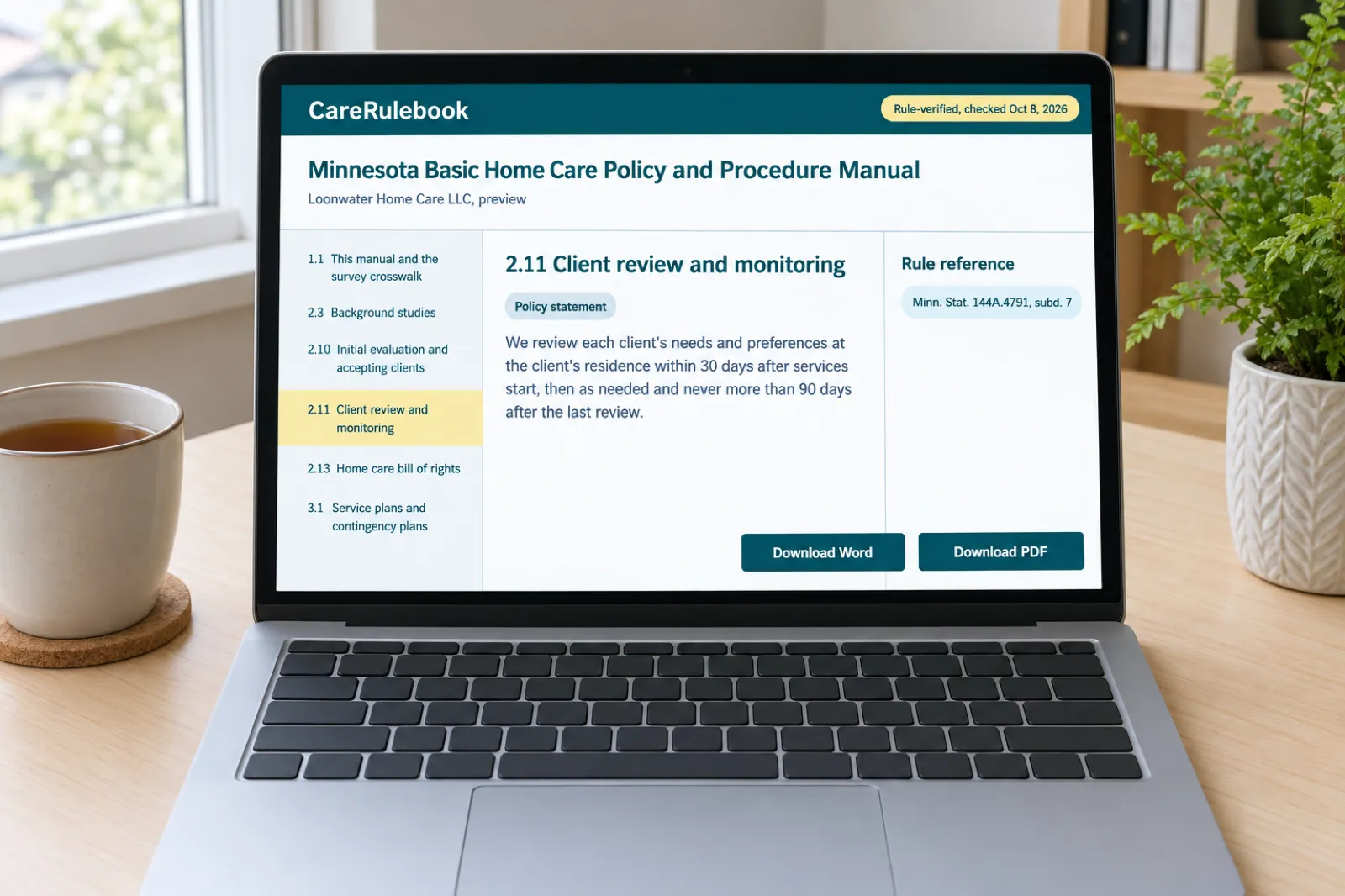
| Minn. Stat. 144A.4791, subd. 7(a) | Initial review at home within 30 days basic services For basic services, an individualized review of needs and preferences at the client’s residence within 30 days of the first service. "When services being provided are basic home care services, an individualized initial review of the client’s needs and preferences must be conducted at the client’s residence with the client or client’s representative." | Policy in your manual2.11 Client review and monitoring: at home within 30 days, then at least every 90 days |
| Minn. Stat. 144A.4791, subd. 7(b) | Review at least every 90 days basic services Monitor and review as needs change and at most 90 days apart, at home or by telecommunication. "Client monitoring and review must be conducted as needed based on changes in the needs of the client and cannot exceed 90 days from the date of the last review." | Policy in your manual2.11 Client review and monitoring: at home within 30 days, then at least every 90 days |
| Minn. Stat. 144A.4791, subd. 9(a)-(e) | Written service plan within 14 days Finalize a signed service plan within 14 days, revise it after reviews, implement it, keep it in the record and tell staff about it. "The service plan and any revisions must include a signature or other authentication by the home care provider and by the client or the client’s representative documenting agreement on the services to be provided." | Policy in your manual3.1 Service plans and contingency plans |
| Minn. Stat. 144A.4791, subd. 9(b) | Fee changes and ombudsman contact Tell the client about fee changes and how to contact the Office of the Ombudsman for Long-Term Care. "The provider must provide information to the client about changes to the provider’s fee for services and how to contact the Office of the Ombudsman for Long-Term Care." | Policy in your manual3.1 Service plans and contingency plans |
| Minn. Stat. 144A.4791, subd. 9(c) | Provide every planned service Implement and provide all services in the current service plan. "The home care provider must implement and provide all services required by the current service plan." | Policy in your manual3.1 Service plans and contingency plans |
| Minn. Stat. 144A.4791, subd. 9(f) | Service plan contents Services, fees and frequency; staff who provide them; schedule and methods for client reviews and staff monitoring; and a contingency plan. "a description of the home care services to be provided, the fees for services, and the frequency of each service, according to the client’s current review or assessment and client preferences;" | Policy in your manual3.1 Service plans and contingency plans |
| Minn. Stat. 144A.4791, subd. 9(f)(5) | Contingency plan for missed services and emergencies What happens if a visit cannot be made, how to reach the agency, emergency contacts, and when EMS should not be called (health care directives). "the action to be taken by the home care provider and by the client or client’s representative if the scheduled service cannot be provided;" | Policy in your manual3.1 Service plans and contingency plans1.6 Disaster and emergency preparedness plan |
| Minn. Stat. 144A.4791, subd. 10(a) | Written termination notice When ending a service plan for a client who still needs care: effective date, reason, ombudsman contact (18+), nearby licensed providers, coordinated transfer, and a contact person. "If a home care provider terminates a service plan with a client, and the client continues to need home care services, the home care provider shall provide the client and the client’s representative, if any, with a written notice of termination which includes the following information:" | Policy in your manual3.2 Ending services: notice and coordinated transfer |
| Minn. Stat. 144A.44, subd. 1(a)(16)-(18) | Ten days’ notice and a coordinated transfer At least ten calendar days’ notice of termination (except for conduct, unsafe environment or emergencies), a reason, and a coordinated transfer. "a coordinated transfer when there will be a change in the provider of services;" | Policy in your manual3.2 Ending services: notice and coordinated transfer |
| Minn. Stat. 144A.4791, subd. 11(a) | Written complaint policy and system A written policy and system to receive, investigate, report and resolve complaints, with a no-retaliation statement and accommodations. "The home care provider must have a written policy and system for receiving, investigating, reporting, and attempting to resolve complaints from its clients or clients’ representatives." | Policy in your manual2.9 Client complaints and the complaint notice |
| Minn. Stat. 144A.4791, subd. 11(b) | Complaint records for two years Document each complaint, investigation and resolution; keep for two years and show MDH. "The home care provider must document the complaint, name of the client, investigation, and resolution of each complaint filed." | Policy in your manual2.9 Client complaints and the complaint notice |
| Minn. Stat. 144A.4791, subd. 11(c) | Written complaint notice to clients Tell each client in writing: the right to complain, whom to contact, how to complain, and that retaliation is prohibited. "The required complaint system must provide for written notice to each client or client’s representative that includes:" | Policy in your manual2.9 Client complaints and the complaint notice |
| Minn. Stat. 144A.4791, subd. 11(d) | No retaliation Take no action against a client because of a complaint or concern. "A home care provider must not take any action that negatively affects a client in retaliation for a complaint made or a concern expressed by the client or the client’s representative." | Policy in your manual2.9 Client complaints and the complaint notice |
| Minn. Stat. 144A.4791, subd. 13 | Requests to stop life-sustaining treatment Staff take no action and tell their supervisor; the agency informs the client and prescriber and works under the Health Care Directive Act. "shall take no action to discontinue the treatment; and" | Policy in your manual3.3 Requests to stop life-sustaining treatment, and health care directives |
| Minn. Stat. 144A.479, subd. 6(a) | Written procedure so every case is reported Comply with 260E and 626.557 and keep a written procedure that ensures all suspected maltreatment is reported. "Each home care provider must establish and implement a written procedure to ensure that all cases of suspected maltreatment are reported." | Policy in your manual2.1 Reporting maltreatment of vulnerable adults and minors |
| Minn. Stat. 626.557, subd. 3(a) | Immediate report to the common entry point Mandated reporters report suspected maltreatment or an unexplained injury to the common entry point (MAARC) immediately, within 24 hours. "A mandated reporter who has reason to believe that a vulnerable adult is being or has been maltreated, or who has knowledge that a vulnerable adult has sustained a physical injury which is not reasonably explained shall immediately report the information to the common entry point." | Policy in your manual2.1 Reporting maltreatment of vulnerable adults and minors |
| Minn. Stat. 626.557, subd. 4a | Internal reporting: written notice within two working days If staff report internally, tell them in writing within two working days whether the agency reported, that they may report externally, and that retaliation is prohibited. "A facility with an internal reporting procedure that receives an internal report by a mandated reporter shall give the mandated reporter a written notice stating whether the facility has reported the incident to the common entry point." | Policy in your manual2.1 Reporting maltreatment of vulnerable adults and minors |
| Minn. Stat. 626.557, subd. 4a(d) | Never block external reports Do not prohibit external reporting or retaliate against a good-faith reporter. "A facility may not prohibit a mandated reporter from reporting externally, and a facility is prohibited from retaliating against a mandated reporter who reports an incident to the common entry point in good faith." | Policy in your manual2.1 Reporting maltreatment of vulnerable adults and minors |
| Minn. Stat. 626.557, subd. 3a(2) | Record aggression and self-abusive behavior Record incidents of aggression between clients and of self-abusive behavior so licensing and county agencies can review them (they are not abuse unless they cause serious harm). "The operator of the facility or a designee shall record incidents of aggression and self-abusive behavior to facilitate review by licensing agencies and county and local welfare agencies." | Policy in your manual2.1 Reporting maltreatment of vulnerable adults and minors2.12 Changes in a client’s condition, incidents and referrals |
| Minn. Stat. 260E.06, subd. 1 | Child maltreatment reports if the agency serves clients under 18 Suspected maltreatment of a client under 18 is reported immediately to the county or tribal agency or police; no policy may discourage reporting. "must not have any policies, written or otherwise, that prevent or discourage a mandatory or voluntary reporter from reporting suspected or alleged maltreatment of a child in accordance with this section." | Policy in your manual2.1 Reporting maltreatment of vulnerable adults and minors |
| Minn. Stat. 144A.479, subd. 6(b); 626.557, subd. 14(b) | Individual abuse prevention plan for every client For each vulnerable adult or minor served: susceptibility to abuse, risk of abusing others, and specific measures (abuse includes self-abuse). "Each home care provider must develop and implement an individual abuse prevention plan for each vulnerable minor or adult for whom home care services are provided by a home care provider." | Policy in your manual2.2 Individual abuse prevention plans |
| Minn. Stat. 144A.4798, subd. 3 | Infection control program An effective infection control program meeting accepted health care, medical and nursing standards. "A home care provider must establish and maintain an effective infection control program that complies with accepted health care, medical, and nursing standards for infection control." | Policy in your manual2.14 Infection control |
| Minn. Stat. 144A.4798, subd. 2 | Communicable disease rules Follow state rules on preventing, controlling and reporting communicable diseases. "A home care provider must follow current state requirements for prevention, control, and reporting of communicable diseases as defined in Minnesota Rules, parts 4605.7040, 4605.7044, 4605.7050, 4605.7075, 4605.7080, and 4605.7090." | Policy in your manual2.14 Infection control |
| Minn. Stat. 144A.4798, subd. 1 | TB infection control program and plan A TB program and plan to current CDC guidelines covering paid and unpaid staff, contractors, students and volunteers, with written evidence of compliance. "This program must include a tuberculosis infection control plan that covers all paid and unpaid employees, contractors, students, and volunteers." | Policy in your manual2.16 Tuberculosis infection control program and staff screening |
| Minn. Stat. 144A.4798, subd. 1(b) | Written TB evidence Keep written evidence of TB compliance. "The home care provider must maintain written evidence of compliance with this subdivision." | Policy in your manual2.16 Tuberculosis infection control program and staff screening |
| MDH FAQ: Tuberculosis (MDH guidance under Minn. Stat. 144A.4798, subd. 1) | Annual TB education MDH says all health care personnel should receive TB education every year (exposure risk factors, signs and symptoms, the agency’s TB procedures). MDH guidance, not statute text. "All Minnesota health care personnel should receive TB education annually." | Policy in your manual2.16 Tuberculosis infection control program and staff screening2.6 Annual training |
| Minn. Stat. 144A.4794, subd. 1(a) | Client records: current and authenticated A record for each client; entries current, legible, permanent, dated and signed with name and title. "Entries in the client records must be current, legible, permanently recorded, dated, and authenticated with the name and title of the person making the entry." | Policy in your manual3.4 Client records: contents, security, disclosure, transfer and retention |
| Minn. Stat. 144A.4794, subd. 1(b) | Written records security procedures Protect records from loss, tampering and unauthorized disclosure; written procedures on use, storage, security and release. "The home care provider shall establish and implement written procedures to control use, storage, and security of client’s records and establish criteria for release of client information." | Policy in your manual3.4 Client records: contents, security, disclosure, transfer and retention |
| Minn. Stat. 144A.4794, subd. 2 | Records available to staff and easy to retrieve Keep records readily available to authorized employees and contractors, and maintained so they can be accessed, printed or sent in good time. "Client records must be maintained in a manner that allows for timely access, printing, or transmission of the records." | Policy in your manual3.4 Client records: contents, security, disclosure, transfer and retention |
| Minn. Stat. 144A.4794, subd. 1(c) | Limits on disclosure Disclose client information only as the law requires, to those who need it for care, with written authorization, or to MDH surveyors. "The home care provider may not disclose to any other person any personal, financial, medical, or other information about the client, except:" | Policy in your manual3.4 Client records: contents, security, disclosure, transfer and retention |
| Minn. Stat. 144A.4794, subd. 3 | Client record contents The 15 listed items, including assessments and plans, services given, incidents, bill of rights and statement of services receipts, complaints and discharge summary. "documentation that the client has been provided the statement of disclosure on limitations of services under section 144A.4791, subdivision 3;" | Policy in your manual3.4 Client records: contents, security, disclosure, transfer and retention |
| Minn. Stat. 144A.4794, subd. 4 | Record transfer On request, send a copy or summary of the record for a coordinated transfer. "shall take steps to ensure a coordinated transfer including sending a copy or summary of the client’s record to the new home care provider, the facility, or the client, as appropriate." | Policy in your manual3.4 Client records: contents, security, disclosure, transfer and retention |
| Minn. Stat. 144A.4794, subd. 5 | Keep client records five years Keep each client record at least five years after discharge, with secure storage arrangements if the business closes. "Arrangements must be made for secure storage and retrieval of client records if the home care provider ceases business." | Policy in your manual3.4 Client records: contents, security, disclosure, transfer and retention1.8 Closing the agency, license actions and transferring clients |
| Minn. Stat. 144A.476, subd. 1(a) | Owner and managerial official studies Owners and managerial officials complete a background study before the temporary license, a change of ownership license or renewal; no disqualified person may manage the provider. "No person may be involved in the management, operation, or control of a home care provider if the person has been disqualified under chapter 245C." | Policy in your manual2.3 Background studies |
| Minn. Stat. 144A.476, subd. 2; 144.057 | Staff, contractor and volunteer studies Employees, contractors and volunteers are subject to a DHS background study and may be disqualified under chapter 245C. "Employees, contractors, and volunteers of a home care provider are subject to the background study required by section 144.057, and may be disqualified under chapter 245C." | Policy in your manual2.3 Background studies |
| Minn. Stat. 245C.13, subd. 2 | No unsupervised contact before clearance Until DHS issues a notice (cleared, more time needed without removal, set-aside or variance), no direct contact unless under continuous direct supervision. "The subject of a background study may not perform any activity requiring a background study under paragraph (c) until the commissioner has issued one of the notices under paragraph (a)." | Policy in your manual2.3 Background studies |
| Minn. Stat. 144A.4795, subd. 1 | Staff trained, competent and informed of rights All staff are trained and competent to current practice standards and informed of the bill of rights. "All staff providing home care services must: (1) be trained and competent in the provision of home care services consistent with current practice standards appropriate to the client’s needs; and (2) be informed of the home care bill of rights under section 144A.44." | Policy in your manual2.5 Training and competency evaluation of unlicensed personnel2.13 Home care bill of rights: notice, orientation and implementation |
| Minn. Stat. 144A.4795, subd. 3(a) | Unlicensed staff: training and competency evaluation Before giving basic services: a training and competency evaluation on the subd. 7(b) topics, or a written or oral test plus a practical skills test on hygiene, standby and reminders. "successfully completed a training and competency evaluation appropriate to the services provided by the home care provider and the topics listed in subdivision 7, paragraph (b); or" | Policy in your manual2.5 Training and competency evaluation of unlicensed personnel |
| Minn. Stat. 144A.4795, subd. 7(b) | Fifteen training topics for unlicensed staff Documentation, reporting changes, infection control and bloodborne pathogens, safe environment, hygiene and grooming, falls, standby, reminders, nutrition, modified diets, communication and dignity, confidentiality, boundaries, emergencies, equipment. "Training and competency evaluations for all unlicensed personnel must include the following:" | Policy in your manual2.5 Training and competency evaluation of unlicensed personnel |
| Minn. Stat. 144A.4795, subd. 7(a)(1) | Qualified instructors and evaluators (basic) Basic training and competency evaluations are done by people with home care work experience and training. "training and competency evaluations of unlicensed personnel providing basic home care services must be conducted by individuals with work experience and training in providing home care services listed in section 144A.471, subdivisions 6 and 7; and" | Policy in your manual2.5 Training and competency evaluation of unlicensed personnel |
| Minn. Stat. 144A.4795, subd. 5-6 | Contractors and temporary staff meet staff rules if the agency uses individual contractors or staffing agency workers Individual contractors and staffing agency workers meet the same requirements as employees. "When a home care provider contracts with a temporary staffing agency excluded from licensure under section 144A.471, those individuals must meet the same requirements required by this section for personnel employed by the home care provider and shall be treated as if they are staff of the home care provider." | Policy in your manual4.3 Contracted services, individual contractors and temporary staffing agency workers |
| Minn. Stat. 144A.4796, subd. 1 | Orientation before services All staff providing and supervising direct care complete orientation to licensing requirements before serving clients; once per staff member, not transferable. "All staff providing and supervising direct home care services must complete an orientation to home care licensing requirements and regulations before providing home care services to clients." | Policy in your manual2.4 Orientation to home care and to each client |
| Minn. Stat. 144A.4796, subd. 2(a) | Eight orientation topics Statute overview, the provider’s policies, emergencies, maltreatment reporting, bill of rights, complaints (OHFC and the Common Entry Point), advocacy services, and the employee’s services and the license scope. "introduction and review of all the provider’s policies and procedures related to the provision of home care services by the individual staff person;" | Policy in your manual2.4 Orientation to home care and to each client |
| Minn. Stat. 144A.4796, subd. 3 | Orientation evidence in the employee record Keep evidence of each person’s orientation in their employee record. "Each home care provider shall retain evidence in the employee record of each staff person having completed the orientation required by this section." | Policy in your manual2.4 Orientation to home care and to each client4.2 Employee records and retention |
| Minn. Stat. 144A.4796, subd. 4 | Orientation to each client Orient staff to each client and the services to be provided. "Staff providing home care services must be oriented specifically to each individual client and the services to be provided." | Policy in your manual2.4 Orientation to home care and to each client3.1 Service plans and contingency plans |
| Minn. Stat. 144A.4796, subd. 5 | Dementia training if the agency serves clients with Alzheimer’s or related disorders If serving people with Alzheimer’s or related disorders, train direct care staff and supervisors on the disease, challenging behaviors and communication. "For home care providers that provide services for persons with Alzheimer’s or related disorders, all direct care staff and supervisors working with those clients must receive training that includes a current explanation of Alzheimer’s disease and related disorders, effective approaches to use to problem-solve when working with a client’s challenging behaviors, and how to communicate with clients who have Alzheimer’s or related disorders." | Policy in your manual2.7 Dementia training and the training description2.6 Annual training |
| Minn. Stat. 144A.4796, subd. 6(a) | Eight hours of annual training with four required topics Maltreatment reporting, bill of rights review, infection control techniques (hand-washing, PPE, disposal, disinfection, communicable disease reporting), and review of the provider’s policies. "review of the provider’s policies and procedures relating to the provision of home care services and how to implement those policies and procedures." | Policy in your manual2.6 Annual training |
| Minn. Stat. 144A.4796, subd. 7 | Training records Keep documentation of orientation and training in employee records. "A home care provider must retain documentation in the employee records of the staff who have satisfied the orientation and training requirements of this section." | Policy in your manual2.6 Annual training4.2 Employee records and retention |
| Minn. Stat. 144A.4797, subd. 1(a), (c) | Someone available to staff Have a person available for staff consultation, in person or by phone, whenever staff are providing services. "The appropriate contact person must be readily available either in person, by telephone, or by other means to the staff at times when the staff is providing services." | Policy in your manual4.1 Supervision of staff and the person available to staff |
| Minn. Stat. 144A.4797, subd. 2 | Periodic on-site supervision Supervise basic staff periodically where services are given, including direct observation, by someone able to make changes and train; frequency based on competency and performance. "Supervision includes direct observation of unlicensed personnel while the unlicensed personnel are providing the services and may also include indirect methods of gaining input such as gathering feedback from the client." | Policy in your manual4.1 Supervision of staff and the person available to staff |
| Minn. Stat. 144A.4797, subd. 4 | Supervision records Keep documentation of supervision in personnel records. "A home care provider must retain documentation of supervision activities in the personnel records." | Policy in your manual4.1 Supervision of staff and the person available to staff4.2 Employee records and retention |
| Minn. Stat. 144A.479, subd. 7 | Employee record contents Licensure, orientation and training, competency, job description with supervisor, annual reviews, health screenings and background study, for employees, regular volunteers and contractors. "The home care provider must maintain current records of each paid employee, regularly scheduled volunteers providing home care services, and of each individual contractor providing home care services." | Policy in your manual4.2 Employee records and retention |
| Minn. Stat. 144A.479, subd. 7(3) | Current job descriptions A current job description for each person with qualifications, responsibilities and who supervises them. "current job description, including qualifications, responsibilities, and identification of staff providing supervision;" | Policy in your manual4.2 Employee records and retention1.2 Agency overview: services, office, agent, managerial official, organization and job descriptions |
| Minn. Stat. 144A.479, subd. 7(4) | Annual performance reviews Document annual performance reviews identifying improvement and training needs. "documentation of annual performance reviews which identify areas of improvement needed and training needs;" | Policy in your manual2.8 Evaluating staff performance |
| Minn. Stat. 144A.479, subd. 7 | Keep employee records three years Keep each employee record three years after the person leaves, and three years after closure. "If a home care provider ceases operation, employee records must be maintained for three years." | Policy in your manual4.2 Employee records and retention1.8 Closing the agency, license actions and transferring clients |
| Minn. Stat. 144A.4795, subd. 2 | Licensed staff hold Minnesota licenses if nurses or licensed health professionals provide home care services as employees Nurses and licensed health professionals hold a current Minnesota license or registration and are competent to assess, plan, implement and supervise. "Licensed health professionals and nurses providing home care services as an employee of a licensed home care provider must possess a current Minnesota license or registration to practice." | Policy in your manual4.2 Employee records and retention |