The sanctions
A directed plan of correction, a stop on new admissions, a financial penalty, a conditional license, a receiver, refusal to renew, or a court complaint to suspend or revoke.
What do you run?
Coming next: Maryland (assisted living), Georgia (personal care homes)
All care home guides →Maine · Personal care agency inspections · 10-144 C.M.R. Ch. 129 § 10
Maine’s Division of Licensing and Certification (DLC) may inspect a personal care agency before its first license, and its records show it usually does (our count). After that, the law sets monitoring at least every two years, with inspections on complaints, changes and renewals too. Here is when DLC comes, what it can look at, how statements of deficiencies, plans of correction and informal conferences work, and the State’s sanctions.

Quick answer
Chapter 129 says an inspection may occur "Prior to the issuance of a license" (Ch. 129 § 10(B)(1)), and DLC’s license records show an on-site inspection on or before the first license date for 112 of the 130 agencies first licensed since August 20, 2024 (our count). After licensing, "the department shall engage in monitoring activities on at least a biennial basis to ensure that a personal care agency, regardless of its licensure status, is in compliance with applicable laws and rules." (22 M.R.S. § 1717(13-A))
If DLC finds any failure to comply, it sends a statement of deficiencies (SOD). "The licensee must complete a POC which addresses each cited deficiency, sign the plan, and submit it to the Department within ten (10) business days of receipt of the SOD." (Ch. 129 § 10(G)(1)) The rule’s penalty schedule counts ten calendar days instead (§ 10(H)(3)(b)(i)), so our reading is to send it within ten calendar days, which meets both.
DLC inspections
Checked against official sources on October 4, 2026.
112 of 130
New agencies since August 2024 with an on-site inspection by the first license date (our count)
10 days
To send a signed plan of correction after an SOD: business days in § 10(G)(1), calendar days in the penalty schedule
$500
Per day of operation for each violation on the rule’s penalty schedule (the State’s)
"An application for licensure of a personal care agency constitutes permission for entry and inspection to verify compliance with applicable laws and rules." (22 M.R.S. § 1717(9)(A)) The rule’s list of inspections starts with one before a license is issued (Ch. 129 § 10(B)(1)).
What DLC’s records show (our count). We read the license detail page of every personal care agency in DLC’s public license search. Of the 130 agencies first licensed since August 20, 2024, 112 show an on-site inspection on or before the first license date, a median of five to six days before it. “First licensed” uses the first licensure date on each detail page, so agencies registered before 2024 keep their older date (DLC license records, 4 to 8 October 2026).
What we do not know. DLC does not publish what it checks on that visit, or a survey checklist (our reading of its pages). The rule’s list of what an application contains names no policies, but the rule requires an operations manual (Ch. 129 § 5(A)(1)), a physical site in Maine (§ 2(A)(6)) and current business records on site for review (§ 9(D)). Have all of them ready before DLC comes.
The wait. The rule gives DLC 90 working days from a complete application to approve or deny it (§ 2(F)(5)), but DLC says: "DLC is running 6-9 months behind typical processing and inspection timelines." (DLC licensing page)
The application step by step: the Maine personal care agency license application. Fees and timing: Maine license cost and timeline.
Chapter 129 lists seven occasions when an inspection may occur (Ch. 129 § 10(B)):
| An inspection may occur | Ch. 129 |
|---|---|
| Before a license is issued | § 10(B)(1) |
| Before a license is renewed | § 10(B)(2) |
| On a complaint of an alleged violation of the rule | § 10(B)(3) |
| After a change or proposed change in administrator, physical plant or sites | § 10(B)(4) |
| To check a plan of correction or license conditions, or whether cited deficiencies have been corrected | § 10(B)(5) |
| For routine monitoring of client care | § 10(B)(6) |
| To assess whether an agency has violated the rule or is operating without a license | § 10(B)(7) |
CareRulebook’s manual covers these in Policy 2.9 (Grievances and complaints to DLC), Policy 3.1 (Reporting abuse, neglect, exploitation and misappropriation of client property) and Policy 3.2 (Investigating allegations).
An SOD is "a written summary, issued by the Department following a Department conducted inspection or investigation, identifying the provisions of this rule with which a licensee has failed to comply" (Ch. 129 § 1(41)). A plan of correction is "a specific plan completed by the provider that fully addresses the Statement of Deficiencies by detailing the provider’s plan to correct deficiencies, prevent repeat occurrences, and the timeframes (specific dates) for completion" (§ 1(30)).
After an inspection or a complaint investigation that finds any failure to comply, DLC sends an SOD naming the rule provisions not met. It may come with a directed plan of correction.
A signed plan addressing each cited deficiency. The rule says ten business days; its penalty schedule says ten calendar days. Our reading: send it within ten calendar days.
A written request within ten business days of receiving the SOD, naming each deficiency disputed, with a reason and supporting evidence. The plan of correction is still due on time.
The corrective actions and completion dates must be acceptable to DLC. If it rejects the plan, it tells you in writing.
An acceptable plan that addresses the reasons for rejection, within five calendar days of the date of DLC’s notice. If none arrives, DLC may issue sanctions.
The agency is responsible for compliance with an approved plan. DLC may inspect again to check it.
What an acceptable plan contains. How affected clients are put right, how other clients at risk are found, the systemic changes, how the agency will monitor them, and completion dates, and nothing else: the rule says the plan must "be limited to the content above" (§ 10(G)(2)(a)-(f)).
Ten business days or ten calendar days? Section 10(F)(3) and 10(G)(1) say ten business days from receiving the SOD. The penalty schedule lists "Failure to submit a POC within ten calendar days after receipt of a SOD" (§ 10(H)(3)(b)(i)). Our reading: treat ten calendar days as the deadline. It meets both, and CareRulebook’s manual uses it.
CareRulebook
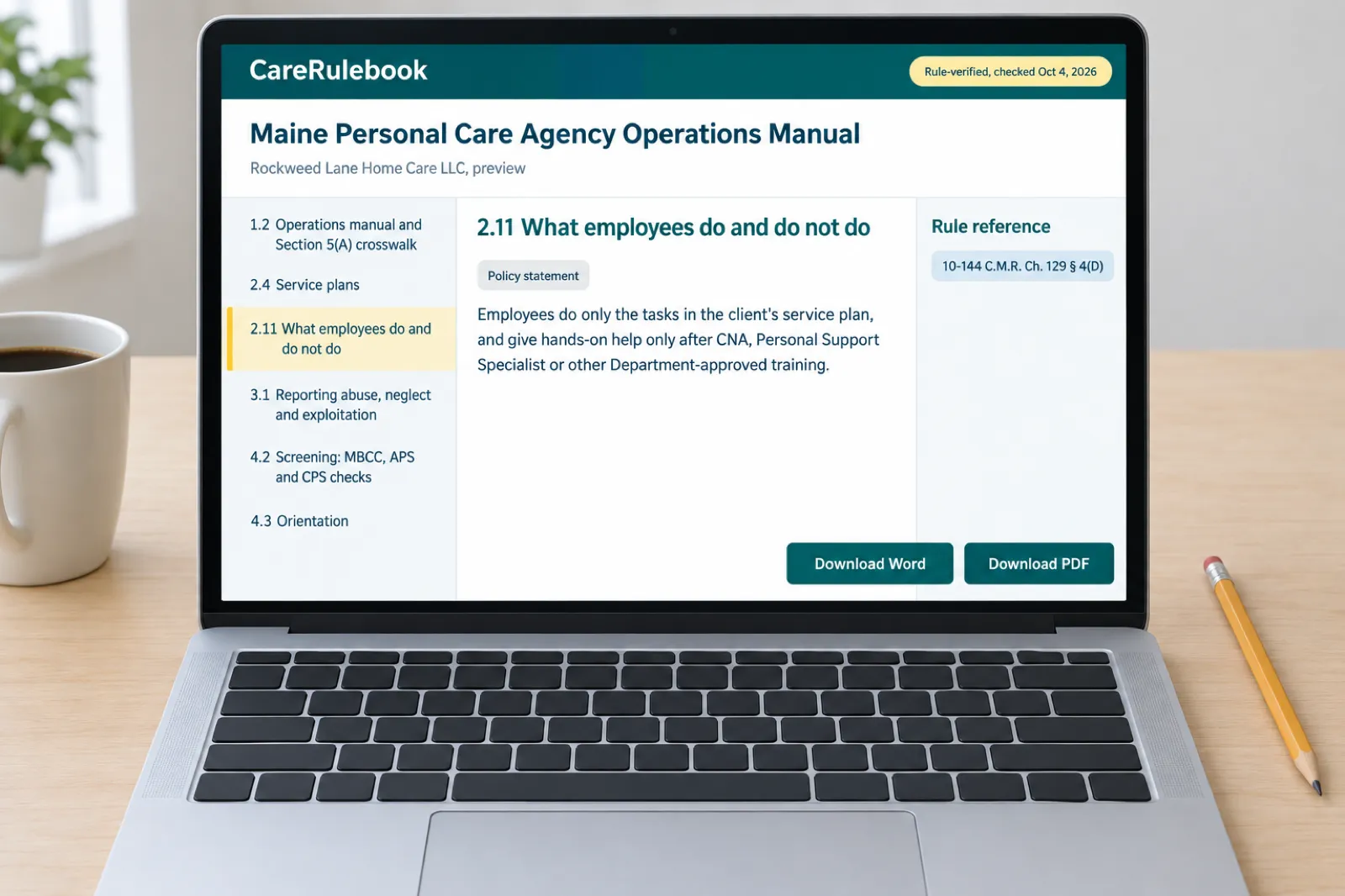
CareRulebook’s Maine manual includes Policy 1.3, License, renewal, changes, ownership, sites, inspections, waivers and plans of correction: entry and access, SODs, informal conferences and plans of correction, with a pre-licensure inspection readiness list, a plan of correction worksheet and an informal conference request checklist. Policy 1.2 has the Section 5(A) crosswalk to show DLC where each required item is.
$199CareRulebook founding price for the first 50 Maine agencies, then $249. Not a DLC fee.
A plan of correction is the usual answer to an SOD. For completeness, this is what Chapter 129 and the statute allow beyond it.
A directed plan of correction, a stop on new admissions, a financial penalty, a conditional license, a receiver, refusal to renew, or a court complaint to suspend or revoke.
A DPOC tells the agency how and when to correct the deficiencies, names the responsible party and sets a deadline; it may include technical assistance and a stop on new admissions.
DLC may impose $500 per day of operation for each of seven listed violations: a plan of correction not submitted within ten calendar days of an SOD; substantiated abuse, neglect or misappropriation; not following a directed plan of correction; impeding an inspection; no background check under the rule; not reporting allegations of abuse or neglect; and operating a site without DLC’s prior approval. These are the State of Maine’s penalties, not CareRulebook charges.
The statute has DHHS set penalties by rule of no less than $500 and no more than $10,000 per day of operation; each day is a separate offense. Operating without a license is a civil violation with a fine of at least $500 per day, up to $10,000 (the State’s penalty).
DLC may issue a conditional license when an agency fails to comply and the Commissioner judges it in the public’s best interest, for up to 12 months. An agency may not add sites while it holds a conditional license.
Grounds include repeated non-compliance, such as repeat deficiencies or failing to carry out a plan of correction, failing to comply with Maine law, or practice detrimental to clients.
When a client’s health or physical safety is in immediate jeopardy, DLC may ask the District Court, under its emergency provisions, to suspend or revoke the license. Outside an emergency, DLC may also file a complaint with the District Court asking it to suspend or revoke a license.
An administrative hearing under the Maine Administrative Procedure Act is available for a denied or unrenewed full license, a denied provisional license, a conditional license, an amended or modified license, and a directed plan of correction, a directive to cease admissions or a financial penalty. The result of an informal conference cannot be appealed.
Background check penalties under the Maine Background Check Center Act are separate: failing to secure a check, or knowingly employing a disqualified person, is a civil violation with a fine of $500 to $10,000 a day; the same penalties apply to employing someone conditionally before receiving verification that they meet the conditions of conditional employment (22 M.R.S. § 9062(2)). Maine caregiver background checks.
DLC’s public license search lists each agency’s inspections with their type and result. Across all 330 license numbers, 316 show an on-site inspection, and 109 show at least one on-site inspection that ended with an accepted plan of correction (our count). Counting inspections rather than agencies, 121 of the 365 recorded ended with an accepted plan of correction and 244 with no deficiencies (our count). So roughly one inspection in three led to a plan of correction.
Which deficiencies? The records show results, not the rules cited, and we found no list of common personal care agency deficiencies published by DLC (our reading). By our reading, the penalty schedule is the best guide to what DLC treats most seriously: late plans of correction, substantiated abuse, neglect or misappropriation, directed plans not followed, impeding an inspection, missing background checks, unreported abuse or neglect allegations, and sites operating without approval (§ 10(H)(3)(b)).
Our practical suggestions, not rule text. Each card links the source it helps you meet and the CareRulebook manual policy that covers it.
DLC does not publish what it checks before licensing, but the rule requires the operations manual, the site and the records set-up before you serve anyone. Have all three ready when DLC comes.
Ch. 129 § 5(A)(1); § 10(B)(1)Manual: Policy 1.2
Articles of incorporation if you are incorporated, your insurance policies and the organizational chart, current and on site for review.
Ch. 129 § 9(D)Manual: Policy 1.1
All client records must be accessible to DLC on request, and owner and employee records are kept at the agency. Know where each one is before DLC asks.
Ch. 129 § 9(B)(2), (C)Manual: Policy 3.5
An MBCC check for every employee, owner and administrator, with APS and CPS results, kept in a file with the date and source of each check. Failing to conduct a background check is on the $500-a-day schedule.
Ch. 129 § 4(B); § 10(H)(3)(b)Manual: Policy 4.2
On-site supervision at least every 30 days for each new employee’s first three months, while they provide care, documented with the client interview.
Ch. 129 § 5(D)Manual: Policy 4.5
Decide who receives an SOD, how its date is recorded, and who writes, signs and sends the plan within ten calendar days.
Ch. 129 § 10(G)Manual: Policy 1.3
Training and supervision records DLC reads: Maine caregiver training. Hiring checks: Maine caregiver background checks.
It is a written process and the forms to follow it. It cannot promise an inspection without findings: DLC checks what your agency actually does.
It depends. The rule sets no desk review of policies: the application it describes asks for payment sources, insurance, owner background checks and the administrator’s details, and DLC’s online form asks for all required documentation as detailed in that form, a list we could not see without starting an application. But an inspection may occur before a license is issued, and DLC’s license records show an on-site inspection just before the first license for most agencies licensed since August 2024 (our count; DLC does not publish what that visit checks). The rule requires the operations manual, so have it ready for that visit and for the survey at the end of your provisional license.
"Prior to the issuance of a license;"
It depends. The law sets a minimum of every two years, not every year: DHHS monitors each personal care agency at least on a biennial basis. Chapter 129 lists other times DLC may inspect, such as before a license or a renewal, on a complaint, after a change of administrator or site, to check a plan of correction, and for routine monitoring of client care. DLC also says it is running 6 to 9 months behind its typical inspection timelines.
"The department shall engage in monitoring activities on at least a biennial basis to ensure that a personal care agency, regardless of its licensure status, is in compliance with applicable laws and rules."
It depends. Chapter 129 says a plan of correction is due within ten business days of receiving the statement of deficiencies, but the rule’s own penalty schedule lists failing to submit one within ten calendar days. Our reading: send it within ten calendar days, which meets both. If DLC rejects the plan, an acceptable revised plan is due within five calendar days of DLC’s notice.
"A Plan of Correction (POC) must be submitted to the Department within ten (10) business days of the organization’s receipt of an SOD."
No. You may ask for one courtesy informal conference to dispute a deficiency, in writing within ten business days of receiving the statement of deficiencies, with the evidence that supports your dispute. The plan of correction is still due on time while you wait.
"The agency may not delay submitting a POC within the required timeframe because an informal conference has been requested."
Usually, in practice. Chapter 129 says an inspection may occur before a license is issued, and an application is permission for DLC to enter and inspect. DLC’s license records show an on-site inspection on or before the first license date for 112 of the 130 agencies first licensed since August 20, 2024, a median of five to six days before it (our count). DLC does not publish what it checks on that visit.
The statute has DHHS monitor every personal care agency at least every two years. Chapter 129 lists other times DLC may inspect: before a renewal, on a complaint, after a change of administrator, physical plant or sites, to check a plan of correction or license conditions, for routine monitoring of client care, and to check for violations or unlicensed operation. DLC says it is running 6 to 9 months behind typical processing and inspection timelines.
Chapter 129 does not say (our reading). It says DLC may enter any licensed site at any reasonable hour to conduct inspection surveys and complaint investigations, and may visit the places where services are provided with the client’s permission. Plan as if an inspection could come on any working day.
DLC sends a statement of deficiencies (SOD), sometimes with a directed plan of correction. You answer with a signed plan of correction addressing each cited deficiency: how affected clients are put right, how other clients at risk are found, the systemic changes, how you will monitor them, and completion dates. The rule says ten business days, but its penalty schedule counts ten calendar days, so our reading is to send it within ten calendar days.
Yes, through one courtesy informal conference per inspection. The written request is due within ten business days of receiving the SOD and must name each deficiency disputed, give a reason and include evidence that supports the dispute, but not evidence that had to be available at the inspection. The plan of correction is still due on time, and the outcome of the conference cannot be appealed.
Yes. The rule lets DLC impose $500 per day of operation for seven listed violations, including a late plan of correction, impeding an inspection, failing to conduct a background check and failing to report allegations of abuse or neglect. The statute sets the range at $500 to $10,000 per day. These are the State of Maine’s penalties. DLC may also issue a directed plan of correction, stop new admissions, issue a conditional license, refuse to renew, or ask a court to appoint a receiver or suspend or revoke the license.
Yes. Policy 1.3 covers inspections, statements of deficiencies, informal conferences and plans of correction, with a pre-licensure inspection readiness list for new agencies, a plan of correction worksheet and an informal conference request checklist. Policy 1.2 has the Section 5(A) crosswalk, which shows DLC the policy that answers each item the rule requires in the manual, and agencies already licensed get a What to do now checklist at the end of it.
DHHS plans to revise Chapter 129 to clarify some provisions. We will email you when it proposes changes, or when DLC changes its inspection guidance, with what it means for your agency.
No spam. Only emails about Maine home care rules. How we use your email.
Maine
How to start a home care agency in Maine
The personal care agency license, the online application and the operations manual.
Maine
The Maine personal care agency license application
What the online application asks for, and the inspection before most first licenses.
Maine
Maine personal care agency policies and procedures
The operations manual and its 17 policy topics, mapped.
Maine
Maine caregiver background checks
MBCC, APS and CPS checks, and the background check file.
Maine
Maine caregiver training
CNA or PSS for hands-on care, 13 orientation topics, 7 yearly topics and supervision.
Manual
Build your Maine operations manual
With the Section 5(A) crosswalk and the plan of correction worksheet.
Delaware
The Delaware PASA survey
DHCQ’s unannounced survey during the 90-day initial license.
Maryland
Maryland RSA inspections
OHCQ surveys, statements of deficiencies and plans of correction.
Compare
Home care survey requirements by state
When each state we cover inspects, side by side.
Free sample, no email needed
Policy 2.9, Grievances and complaints to DLC, as it prints in the Maine manual, filled in for a fictional agency. The rule text it rests on is quoted word for word under Rule basis.
PDF · 7 pages · 96 KB · Rule-verified October 4, 2026
Collecting answers for an agency or a client? The intake questionnaire lists all 39 questions the builder asks, what each decision changes in the manual, and a completed example: Word · PDF.How consultants use CareRulebook.