Skip to content
CareRulebook
MenuClose

Where are you starting?

United StatesTexas, North Carolina, Georgia, Virginia, Indiana, Ohio, New York, Delaware, Maine, Oregon, California, Florida, Pennsylvania, New Jersey, Illinois, Washington, Colorado, Tennessee, Maryland, Kansas, South Carolina, Nevada
TexasManual
North CarolinaManual
GeorgiaManual
VirginiaManual
IndianaManual
OhioGuideNew YorkGuideDelawareGuideMaineGuide
OregonManual
CaliforniaGuideFloridaGuidePennsylvaniaGuideNew JerseyGuide
IllinoisManual
WashingtonManual
ColoradoManual
TennesseeManual
MarylandManual
KansasManual
South CarolinaManual
NevadaManual
All US states →
United KingdomEngland, Scotland, Wales
Free toolsChecklists, calculators and templates

Scotland · Care at home · Care Inspectorate · 2026

How to register a care at home service with the Care Inspectorate (2026)

To run a care at home service in Scotland you register it with the Care Inspectorate as a support service. You apply online with a statement of aims and objectives and the policies the Care Inspectorate lists, an inspector assesses them, and the Care Inspectorate says it will not grant registration until a suitable manager is in post. This guide walks through each step, quoted from the legislation and the Care Inspectorate’s own guidance.

  • Rule-verified 9 October 2026
  • Quoted from the 2010 Act and the 2011 Regulations
  • 38 sources
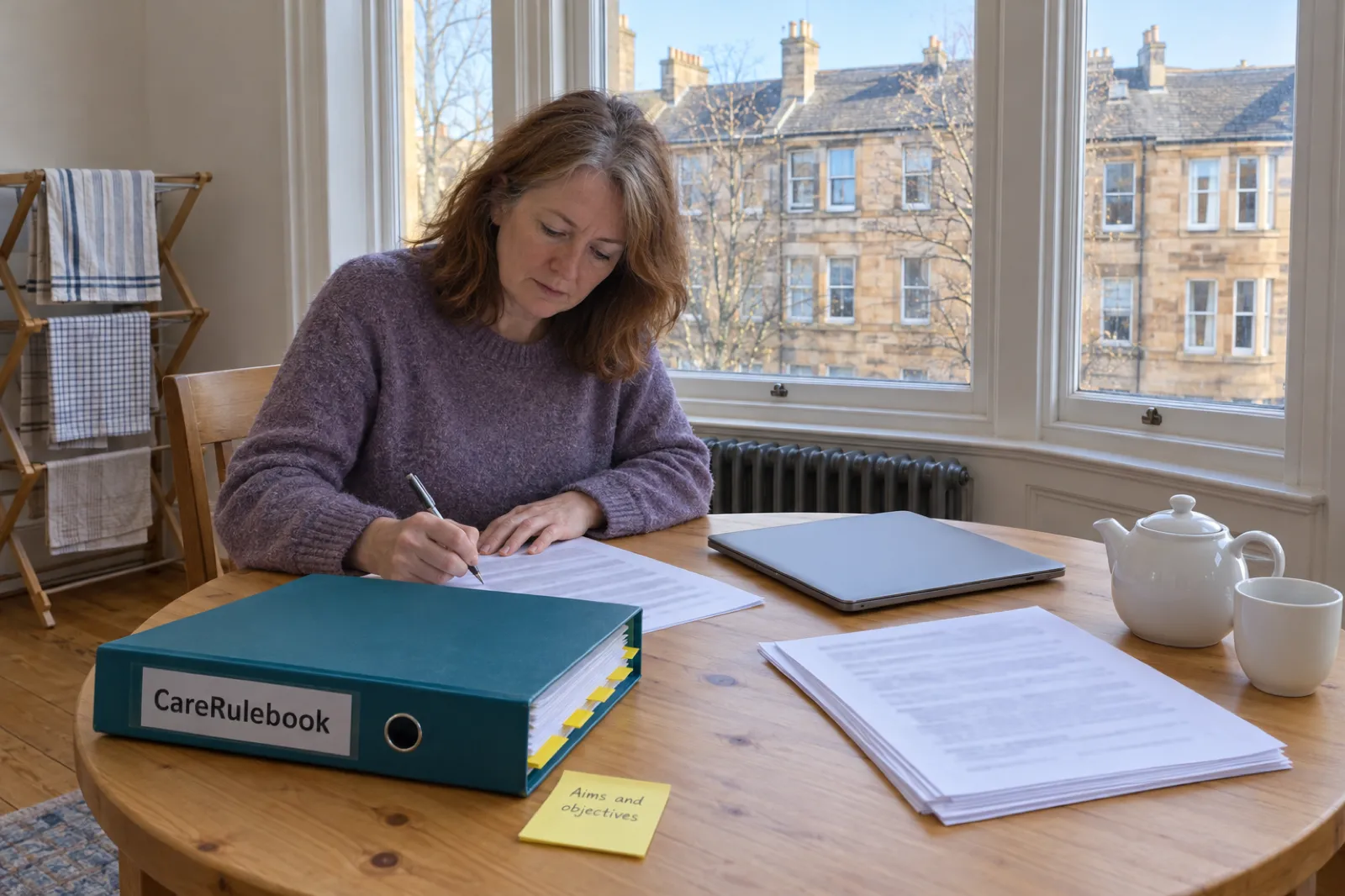
A woman in a heather-purple jumper writes on a printed page at a round pine table in the bay window of a sandstone tenement flat, beside a teal CareRulebook binder and a sticky note reading Aims and objectives, with a white teapot and the sandstone tenement opposite in winter sun

Quick answer

In Scotland, "A person who seeks to provide a care service must apply to SCSWIS for registration of the service." (2010 Act, s.59(1)). SCSWIS (Social Care and Social Work Improvement Scotland) is the Care Inspectorate’s legal name. Care at home is a support service: a service that "includes personal care or personal support" provided by a private or voluntary provider (Sch. 12 para. 1(1)(d)), and an offence is committed by a person who "provides a care service while not registered under this Chapter" (s.80(1)(a)).

You apply on the Care Inspectorate’s digital portal and pay its non-returnable fee, from £1,261 for a small service. With the application go the statement of aims and objectives and the policies the Care Inspectorate lists, which an inspector assesses at stage 2 (Guidance for applicants). The Care Inspectorate says: "We aim to assess applications within six months. However, this presumes that you supply us with a competent and fully detailed application" (Registration process)

1,301

Registered care at home services in the Care Inspectorate’s datastore at 31 August 2026, 9 marked inactive (our count)

Care Inspectorate datastore

£1,261

Care Inspectorate application fee for a small care at home service (its fee, not our price)

Registration fees

6 months

The Care Inspectorate’s aim for assessing an application

Registration process

127

Care at home services registered in 2025 (our count, including services since cancelled)

Care Inspectorate datastore

Direct answers

Who regulates care at home in Scotland?

The Care Inspectorate (legally, Social Care and Social Work Improvement Scotland). Care at home is registered as a support service under the Public Services Reform (Scotland) Act 2010, and providing a care service while not registered is an offence.

2010 Act, s.80(1)(a)

How much does it cost to register a care at home service?

The Care Inspectorate’s application fee depends on size: £1,261 for a small service (up to 3 whole-time equivalent staff), £2,050 for a medium one and £2,798 above 15. Then an annual continuation fee from £676. Application fees are non-returnable. These are the Care Inspectorate’s fees, not CareRulebook prices.

Care Inspectorate, Registration fees

How long does Care Inspectorate registration take?

The Care Inspectorate says it will contact you once it has your completed application, the documents it asked for and the fee, and that it aims to assess applications within six months. The aim presumes a competent and fully detailed application and any additional information it requests. We found no deadline in the legislation.

Care Inspectorate, Registration process

Which policies do I send with the application?

The Care Inspectorate’s applicant guidance (July 2021) lists policies or procedures on complaints, child and/or adult protection, medication, infection control and food and nutrition, plus, where relevant to the service (“service dependant”), promoting positive behaviour and the use of restrictive practices. Where you employ staff it also asks for a safer recruitment policy and procedure, and for every applicant an induction and training programme. An inspector assesses the policies at stage 2.

Guidance for applicants, p.7 and pp.15-16

Interactive check

Do you need to register with the Care Inspectorate?

What will your service do?

Pick the option closest to your plan.

Who must register: care at home, housing support and combined services

"Care at home" is the Care Inspectorate’s name for one kind of support service. In the Act, "A “support service” is a service provided, by reason of a person's vulnerability or need (other than vulnerability or need arising by reason only of that person being of a young age)" (2010 Act, Sch. 12 para. 1(1)), and a service provided by a private or voluntary provider is caught "if it includes personal care or personal support" (para. 1(1)(d)). The fees legislation is where "care at home" is defined: "“care at home service” means a support service ... which provides personal care or personal support ... to a person (“the recipient”) within the recipient’s home" (Fees Order 2011, art. 1(2)).

  • Personal care. Care which "relates to the day to day physical tasks and needs of the person cared for (as for example, but without prejudice to that generality, to eating and washing) and to mental processes related to those tasks and needs (as for example, but without prejudice to that generality, to remembering to eat and wash)" (Sch. 12 para. 20)
  • Personal support. "counselling, or other help, provided as part of a planned programme of care." (Sch. 12 para. 20)

Housing support is a separate service type

"A “housing support service” is a service which provides support, assistance, advice or counselling to a person who has particular needs, with a view to enabling that person to occupy residential accommodation as a sole or main residence" (Sch. 12 para. 19). It has its own registration, with the same Care Inspectorate fee bands as care at home (Registration fees).

Combined services: two applications

Many providers run both. In our count of the Care Inspectorate’s datastore, 762 of the 1,301 registered care at home services it lists are flagged as part of a combined service (datastore, 31 August 2026). The Care Inspectorate says: "If you intend to provide a ‘housing support service’ and a ‘support service – care at home’ these require individual applications even where these are to be operated as a ‘combined service’" (Guidance for applicants, p.6). For a combined application it invoices you, and "in these specific applications you should record the full staff WTE in the housing support application and 0.1 WTE in the support service application" (p.7). Once registered, a combined service may get a discount on the smaller continuation fee (fees).

Self-employed carers working alone: our reading

The private-provider part of the definition has an exception: "paragraph (d) does not apply if the provider is an individual who personally and solely gives the care or support in question." (Sch. 12 para. 1(2)(c)). Our reading: a self-employed carer who gives all the care personally, with no one else helping, is outside the private-provider limb. Once you employ staff or arrange other carers, the exception no longer fits. The Care Inspectorate has not confirmed this reading to us, and it does not settle where the line falls for subcontractors or introductory agencies, so ask the Care Inspectorate before you rely on it (questions to ask first).

The exception covers only the private-provider limb. A service provided under arrangements made by a local authority is a support service under para. 1(1)(b) (Sch. 12 para. 1(1)(b)) whoever provides it, so if a council arranges your work, the exception does not help.

Services outside the definition

  • Excepted services. "There is excepted from the definition of “support service” in paragraph 1 of schedule 12 to the Act any service which consists wholly of one or more of the following": field social work, counselling outside residential care, and help to prepare for, obtain or engage in work (SSI 2012/44, reg. 2).
  • NHS bodies. The private-provider limb does not apply to a health body acting under the National Health Service (Scotland) Act 1978 (Sch. 12 para. 1(2)(b)). Council-run care at home is a support service too: our datastore count includes 156 council services (datastore).
How to register a care at home service, step by step

Tick steps off as you go. Your progress is saved in this browser only.

  1. Check your service type and read the rules

    Before applying

    Decide whether you are care at home, housing support or both (who must register). The Care Inspectorate lists what every registered service must meet: the 2010 Act, SSI 2011/28, SSI 2011/29, SSI 2011/210, the Health and Social Care Standards and the Health and Care (Staffing) (Scotland) Act 2019.

  2. Test the market and the money

    Before applying

    The Care Inspectorate advises your own market research into local need, says there is no guarantee registration will be granted, and may check the financial viability of the service.

  3. Appoint a manager

    Before registration

    A provider that is not an individual, or will not be in full-time day-to-day charge, must appoint a manager. You can apply before one is in post, but registration will not be granted until a suitable manager is in post (manager rules).

  4. Write the aims and objectives and the policies

    Before applying

    The statement of aims and objectives is information the law requires in every application, and the Care Inspectorate lists the policies to enclose (what goes with the application).

  5. Business plan and three-year forecasts

    Before applying

    Applicants other than childminders and councils are asked for a business plan, three-year financial forecasts and a financial declaration. Companies also send their incorporation documents, and information is needed for every director listed at Companies House.

  6. Apply on the digital portal and pay the fee

    Day 0

    The online application lets you upload supporting documents and pay the fee, which must be paid before the application is considered and is non-returnable (£1,261 for a small care at home service; all fees). For a combined care at home and housing support application, the Care Inspectorate invoices you instead (who must register).

  7. First checks: completeness, PVG and references

    After you apply

    The Care Inspectorate checks the application is complete. It acts as countersignatory for your own PVG check, so do not apply to Disclosure Scotland yourself, and it runs online searches of publicly available information. Within 10 working days of processing your documents it tells you which inspector has the application.

  8. Assessment by an inspector

    Stage 2

    At stage 2 an inspector assesses the policies, and may ask for others. The Care Inspectorate assesses whether the applicant and manager are fit, whether any premises are fit, and whether the service will make proper provision for people’s health, welfare, independence, choice, privacy and dignity.

  9. Fire safety checklist confirmation

    Before the decision

    The Care Inspectorate says your application will not be concluded without a completed fire safety checklist, sent to your local fire authority, with a confirmation sent to it. Whether this applies to a care at home service run from an office is a question to ask (questions to ask first).

  10. Decision and certificate

    The Care Inspectorate aims for six months

    Registration is most commonly granted with agreed conditions, for example on numbers. If the Care Inspectorate proposes refusal or conditions you did not agree, you have 14 days to dispute it in writing, and you can appeal to the sheriff. Keep the certificate on display at each premises and the principal office.

What goes with the application, and what the inspector reads

The Care Inspectorate’s Guidance for applicants on applying to register a care service dates from July 2021. It says "We will consider an application to be complete when you have:" paid the correct fee, completed all parts, provided declarations and references for relevant individuals, submitted the financial information, enclosed the aims and objectives, enclosed premises papers where applicable, identified the service type, and "enclosed copies of policies/procedures relating to:" (Guidance for applicants, p.7)

  • complaints
  • child and/or adult protection
  • medication
  • infection control
  • food and nutrition
  • promoting positive behaviour / use of restrictive practices (service dependant)

The Care Inspectorate’s list, in its words. Its list also names recruitment for childminders who employ an assistant. Guidance for applicants, p.7

  • Safer recruitment. "Where you intend to employ staff, you must provide a policy and procedure on safer recruitment." (Guidance for applicants)
  • Induction and training. "You must also provide a programme detailing the induction period and ongoing training and development for staff." (Guidance for applicants)
  • Money. Applicants other than childminders and councils are asked for a business plan, three-year financial forecasts and a financial declaration (Guidance for applicants, pp.9-10). Any business plan or accounts sent "may be reviewed by our financial advisor", and the Care Inspectorate "may also check the financial viability of the service" (Registration process).
  • The legal entity. Companies send articles, memorandum and certificate of incorporation, or confirmation from Companies House; partnerships a formal partnership agreement (p.10). Information is needed for every director listed at Companies House; where any are missing or do not match, the application is returned to be amended or rejected (p.10).

Stage 2: the inspector’s assessment

"The above policies and procedures, along with any other we may subsequently request, will be assessed at stage 2 of the application process by an inspector." (Guidance for applicants, p.7) The Care Inspectorate says it assesses that the applicant and manager are fit, "This includes assessing a potential provider’s integrity, character, and financial background", and that "the proposed service will make all the proper provisions for the health, welfare, independence, choice, privacy, and dignity of everyone using the service" (Registration process). The aims and objectives guidance asks for "an overall statement which describes how the Health and Social Care principles and standards will be met within the particular service" (Aims and objectives guidance, 2019).

A note on the date. The online form shows only the sections and questions relevant to your applicant type and service type (Registration process). The 2021 guidance is the Care Inspectorate’s published list, so check what the form asks for when you start your application.

The Care Inspectorate’s fees

Care Inspectorate application and annual continuation fees for a care at home service, by size
Care at home service sizeApplication feeAnnual continuation feeSource
Small: up to 3 WTE staff£1,261£676Care Inspectorate
Medium: over 3, up to 15 WTE£2,050£1,476Care Inspectorate
Larger ("other"): over 15 WTE£2,798£2,255Care Inspectorate

These are the Care Inspectorate’s fees, not CareRulebook prices. WTE means whole-time equivalent staff who provide and manage the service.

  • Counting size. "A ‘medium’ service is a service that employs more than three but no more than 15 whole-time equivalent persons to provide and manage the service." (Registration fees) For the application, "40 hours per week = 1 WTE staff member" (Guidance for applicants, p.15).
  • Non-refundable. "All application fees are non-returnable." The fee "must be paid before we can consider your application" (Registration fees; Register a care service).
  • The annual continuation fee. The invoice date depends on when you first registered; for example, a service first registered between 1 April and 30 June pays from 1 April each year (Registration fees). There is no refund or discount for cancelling part way through a fee year, and a continuation fee that falls due before you cancel is payable in full (Registration fees).
  • The 15% combined discount. "Combined services can be cheaper for us to administer. If they are, we give a 15% discount on the smaller of their continuation fees." "The discount isn’t automatic and we must be confident that we can make a saving on their administration." (Registration fees) The Care Inspectorate gives no discount where a continuation fee is under £500, which does not affect care at home: its continuation fees start at £676 (Registration fees).
  • Changes and cancelling. There is no fee to add, vary or remove a condition or to cancel, but you still apply. Cancelling needs three months’ notice unless a shorter time is agreed (Registration fees).
  • The legal ceiling. The Fees Order 2011 sets maximum fees. In the Order as made (legislation.gov.uk holds only the original version, as last checked on 9 October 2026), the maximums for care at home are the same as the Care Inspectorate’s current fees in all three bands (Fees Order 2011, Schedule).
  • Other costs. "You must pay an additional fee for the cost of a Protection of Vulnerable Groups (PVG) scheme record checks as appropriate." (Care Inspectorate) Disclosure Scotland’s PVG fees are normally £59 to join and £18 for an existing member (gov.scot). The applicant guidance also says you pay medical reference or declaration fees and any bank reference fees (Guidance for applicants, p.7). SSSC registration fees are set by the SSSC; check its website for the current amounts.

Penalties are not fees. Providing a care service without registration is an offence, and the Act sets the penalty: "liable on summary conviction to a fine not exceeding level 5 on the standard scale or to imprisonment for a term not exceeding three months or to both" (2010 Act, s.80(1)).

The legal duties behind your documents

Several items on the Care Inspectorate’s list rest on duties in the law. These are the main legal duties your documents need to cover:

  • Aims and objectives (SSI 2011/29). The Applications Order lists, as information every application contains, "The aims and objectives of the care service." (SSI 2011/29, Schedule para. 6). The Care Inspectorate adds: "You must give us this statement as part of the original application submission." (Guidance for applicants, p.13).
  • Complaints (regulation 18). "A provider must establish a procedure (“the complaints procedure”) for considering complaints made to the provider." It must be appropriate to the needs of service users, complaints are fully investigated, and the provider tells the complainant what action will be taken "within 20 working days after the date on which the complaint is made, or such shorter period as may be reasonable in the circumstances". Each service user gets a written copy that includes the name and address of the Care Inspectorate, and on request the Care Inspectorate gets a summary of the last 12 months’ complaints (SSI 2011/210, reg. 18).
  • Personal plans (regulation 5). Within 28 days of a person first receiving the service, "prepare a written plan (“the personal plan”) which sets out how the service user’s health, welfare and safety needs are to be met" (reg. 5(1)). Review it when the person or their representative asks, when there is a significant change in their health, welfare or safety needs, and "at least once in every six month period whilst the service user is in receipt of the service" (reg. 5(2)(b)).
  • Infection control (regulation 4(1)(d)). A provider must, "where necessary, have appropriate procedures for the prevention and control of infection." (reg. 4(1)(d))
  • Restraint (regulation 4(1)(c)). A provider must "ensure that no service user is subject to restraint, unless it is the only practicable means of securing the welfare and safety of that or any other service user and there are exceptional circumstances" (reg. 4(1)(c)). The Care Inspectorate lists the related policy as "service dependant".
  • Fitness of employees (regulation 9). "A provider must not employ any person in the provision of a care service unless that person is fit to be so employed." (reg. 9)
  • Duty of candour. The Health (Tobacco, Nicotine etc. and Care) (Scotland) Act 2016 makes care service providers that are not individuals, and individuals who employ or arrange others to help provide the service, "responsible persons" (s.25). "A responsible person must follow the duty of candour procedure set out in section 22 as soon as reasonably practicable" after becoming aware that a person who received the service has had an unintended or unexpected incident of the kind described in section 21(2) (s.21).

Records and notifications: set when you register

Apart from a few duties in the 2011 Requirements Regulations (telling the Care Inspectorate immediately about an insolvency event, the provider becoming unfit, a manager’s conviction or unfitness, or a new manager: regs. 6, 6A-6C, 8 and 17(2)), the records and notifications are not listed in regulations. Instead, on granting registration the Care Inspectorate must notify the provider of "the records the provider must keep and where they must be kept", of the matters to notify to it while the service is registered, and of what goes in the annual return (SSI 2011/28, reg. 4(1)). Its current guidance for adult services is Adult care services: guidance on records you must keep and notifications you must make (March 2025). For a care at home service it includes:

  • Missed and late visits. "You must keep records that detail missed and late visits where the service provides support to people in their own homes or in the community. The record should show an analysis of the information showing cause, effect, and necessary actions taken" (p.10) Missed or late visits with a significant impact on people’s health and wellbeing are notified within 24 hours (Part 3).
  • Notifications within 24 hours. The guidance sets 24 hours for many eForm notifications, including a death (Part 3), a protection concern (p.14) and staff misconduct (Part 3). In notifications, refer to people using the service and staff by their initials only, with the exceptions the guidance notes (guidance).
  • Manager absence. For a planned absence of 28 days or more, "The notification should be submitted no later than 14 days before the proposed absence." After an emergency, within one week (p.20).
  • Contingency plan. "Services must maintain an up-to-date contingency plan to safeguard the safety and wellbeing of people using the service in the event of sudden closure of the service" (p.14)
  • Insurance and quality. "You must keep a record of certificates of public liability insurance, employer’s liability insurance and vehicle insurance." (p.13) "You must keep records to evidence quality assurance activities and how these have informed improvements within the service." (guidance)
  • The annual return. The Care Inspectorate asks providers to complete one each year; the 2026 deadline was 17 February 2026 (Annual returns).

Staffing: the 2019 Act, not regulation 15

Staffing used to sit in regulation 15 of SSI 2011/210. The revised text on legislation.gov.uk records: "Reg. 15 revoked (1.4.2024) by Health and Care (Staffing) (Scotland) Act 2019" (SSI 2011/210, reg. 15). The duty is now in the Health and Care (Staffing) (Scotland) Act 2019:

  • Section 7. "Any person who provides a care service must ensure that at all times suitably qualified and competent individuals are working in the care service in such numbers as are appropriate for" the health, wellbeing and safety of service users, the provision of safe and high-quality care, and, so far as it affects either, the wellbeing of staff (2019 Act, s.7(1)). In deciding what numbers are appropriate, regard is to be had to the nature and size of the service, its aims and objectives, and the number and needs of service users (s.7(2)).
  • Section 8. "Any person who provides a care service must ensure that individuals working in the care service receive" appropriate training for the work they are to perform, and suitable assistance, including time off work, to obtain further qualifications appropriate to their work (s.8(1)).

The Care Inspectorate’s records guidance asks for records showing how you meet these duties: "You must keep records to demonstrate how you are meeting your duties as detailed in The Act and how you have ensured safe and effective staffing arrangements are in place." (Records guidance)

If you are working from the 2021 guidance. The applicant guidance was written before the change, so it still says "To comply with Regulation 15 SSI No. 210, a provider must" (Guidance for applicants, p.14). The Care Inspectorate also lists the 2019 Act among the legislation every registered service must meet (Registration guidance). In your own documents, cite sections 7 and 8 of the 2019 Act for staffing and training.

The manager, SSSC registration and PVG

The manager

  • Who needs one. A provider that is not an individual, or will not be in full-time day-to-day charge of the service, "must appoint an individual to be the manager of the care service." (SSI 2011/210, reg. 17(1)).
  • In post before registration. "Registration will not be granted until such time as an appropriate manager is in post." (Guidance for applicants, p.13)
  • Qualification. The Care Inspectorate expects the proposed manager to "already hold, as a minimum, a level 7 practitioner qualification (meeting SSSC criteria)." (Guidance for applicants, p.6). This is guidance, not a regulation; the regulation says a manager without "the skills, knowledge and experience necessary for managing the care service" is unfit (reg. 7(2)(c)).
  • Checks. "It is your responsibility to ensure that the manager is a PVG Scheme member. You should also ensure that the individual is registered with the SSSC or other professional body, as appropriate." (p.12) Managers of a care at home service are on the list of workers who must register with the Scottish Social Services Council (SSI 2013/227, Schedule).
  • Changes. Tell the Care Inspectorate immediately when you appoint a manager, with the name and the date the appointment takes effect (reg. 17(2)).

SSSC registration for staff

  • Who. Supervisors and support workers in a care at home service are on the same list (SSI 2013/227, Schedule). "A provider of a care service may only employ a social service worker in a care service who complies with regulation 5 or 6." (reg. 3(2))
  • When. A worker applies within 3 months of starting work in a care service (reg. 5(2)) and can work unregistered only "until the expiry of a period of 6 months from the date on which a social service worker starts work as a social service worker in a care service", or until registration is granted if sooner (reg. 5(3)).
  • Qualifications. The SSSC says: "To register you need to hold a relevant qualification or agree to work towards achieving the qualifications required for the job you do." (SSSC, archived copy)
  • The offence. "It is an offence to fail to comply with the requirements of this regulation without reasonable excuse." (reg. 3(4))

PVG membership

  • For the organisation. "It is an offence for an organisation to offer any type of regulated role to an individual unless the organisation has received a Level 2 disclosure" confirming PVG membership (PVG Act 2007, s.45D(1)).
  • For the worker. "It is an offence for an individual to carry out, or to agree to carry out, any type of regulated role unless the individual participates in the Scheme in relation to that type of regulated role." (s.45C(1))
  • Fully in force since July 2025. These offences came in with the Disclosure (Scotland) Act 2020, in stages from 30 September 2024 and 1 April 2025 for specified purposes, and fully from 1 July 2025 (s.45D, annotation).
  • Countersigning. "You can also use an umbrella body to countersign PVG or disclosure checks on behalf of your organisation." (Care Inspectorate) Organisations registered with Disclosure Scotland must "have a written policy describing how they manage disclosure information" (mygov.scot). "PVG scheme membership lasts for five years." (mygov.scot)
  • The fee waiver, for a limited period. "This waiver applies to PVG scheme applications received by Disclosure Scotland between 1 August 2026 and 31 July 2027." It covers workers "in social care commissioned services in the private, voluntary and independent sectors" taking up a new role, and care at home services are one of the eligible service areas (gov.scot). The gov.scot page covers applications received up to 31 July 2027.

Adult support and protection

Under the Adult Support and Protection (Scotland) Act 2007, councils make inquiries about adults at risk (2007 Act, s.4). Adults at risk are adults who "are unable to safeguard their own well-being, property, rights or other interests," who are at risk of harm, and who, because of disability, mental disorder, illness or physical or mental infirmity, are more vulnerable to being harmed (2007 Act, s.3(1)).

  • The Code: no specific duties under the Act for independent providers (apart from the records offence below). The co-operation duties in section 5 apply to listed public bodies, such as councils, the Care Inspectorate, the police and health boards (2007 Act, s.5). The 2022 Code of Practice says: "While independent organisations such as these do not have specific legal duties or powers under the Act, care providers have a responsibility to involve themselves with the Act where appropriate by making referrals, assisting inquiries" (Code of Practice, p.31)
  • Records. "Organisations should comply with requests for examination of records, as it is an offence to fail to do so without reasonable excuse (section 49(2))" (Code of Practice, p.31)
  • Notify the Care Inspectorate within 24 hours. "You must inform us of any protection concerns including where you have made a protection referral to the lead agency using the eForms notification: ‘Protection concern about a person using the service’. You must do this within 24 hours." (Records guidance, p.14) "You must also provide us with an update on the protection concern and referral within one month of the incident occurring." (p.15)
  • Referrals to Disclosure Scotland. "If an organisation has employees or volunteers doing a regulated role, it has a legal duty to report harmful behaviour to Disclosure Scotland." (mygov.scot) Where a concern involves a member of staff, the Care Inspectorate’s guidance also asks for a misconduct eForm and referrals to the professional registration body and Disclosure Scotland as needed (Records guidance, p.15).

In a written procedure, it helps to keep these apart: the Care Inspectorate notification and PVG referrals as the duties, and referral to the council and helping with its inquiries as what the Code of Practice expects. That split is our reading of the sources, not legal advice; a Scottish solicitor can confirm it for your service.

The Health and Social Care Standards

"We assess the quality of services to make sure they meet the Health and Social Care Standards, which are published by the Scottish Government." (Care Inspectorate) "From 1 April 2018 the Standards will be taken into account by the Care Inspectorate, Healthcare Improvement Scotland and other scrutiny bodies in relation to inspections, and registration, of health and care services." (Health and Social Care Standards) Their five principles are dignity and respect, compassion, be included, responsive care and support, and wellbeing (Standards).

Inspectors use A quality framework for support services (care at home, including supported living models of support) (May 2022). Its key questions cover wellbeing, leadership, the staff team and how care and support is planned; "How good is our setting? (not currently assessed for this service type)" (quality framework). "Each quality indicator is assessed on a scale from one to six, where one is unsatisfactory and six is excellent." (Care Inspectorate)

A revision is planned

The Scottish Government’s report of 6 August 2026 says: "We have developed a working draft of a revised set of standards." and "we plan to hold a formal public consultation later in the year." (Co-design Partnership Programme report). We had not seen a consultation draft when we checked on 9 October 2026. Until revised Standards are adopted, the current Standards are the ones the Care Inspectorate assesses against. When they are adopted, aims and objectives and any policy that cites Standard numbers will need checking.

Changes in force, and changes proposed

In force: parts of the Care Reform (Scotland) Act 2025

  • Faster cancellation. Section 22, on cancelling a care service’s registration, came into force on 7 January 2026 (Care Reform (Scotland) Act 2025, s.22). The Cancellation of Registration Order 2026, in force on 21 March 2026, prescribes when the Care Inspectorate may propose cancellation under it: where, within 12 months of confirming in writing that improvement required by an improvement notice was carried out, the Care Inspectorate has reasonable grounds to believe any aspect of it has not been sustained, and "where SCSWIS is no longer satisfied that the provider is fit to provide the care service within the meaning of regulations made under section 78 of that Act" (SSI 2026/64, art. 2).
  • The social care market report. Section 31, in force since 1 April 2026, requires the Scottish Ministers to publish a report on the social care market (support services, care homes, adult placement and housing support) by the end of each three-year reporting period; section 32 lets them require information relevant to it. (2025 Act, ss.31-32)

Proposed, not yet law

  • The Health and Social Care Standards. The Scottish Government plans a formal public consultation "later in the year", in its words of August 2026 (above).
  • Service types and provider fitness. After the Independent Review of Inspection, Scrutiny and Regulation, the Scottish Government’s progress update of 9 June 2025 says a priority workstream was announced on Recommendation 15: that "the list of care service types and set of corresponding definitions as set out in Schedule 12 of the Public Services Reform (Scotland) Act 2010, are assessed for fitness for purpose". It also says "the Scottish Government and the Care Inspectorate have begun work to explore any changes that might be needed to current powers in relation to the fitness of providers." (progress update). Schedule 12 is where support services (which include care at home) and housing support services are defined. We found no draft legislation for either.

We will email rule-change alerts when a proposal is published (sign up below), and every tracked change is on our rule changes page.

How many care at home services are there in Scotland?

The Care Inspectorate says it regulates "around 10,500 care services" of all types (Care Inspectorate). For care at home, we counted the services in its datastore at 31 August 2026. The Care Inspectorate says "All services that are active at the time of the update are included." (datastore)

  • 1,301 registered care at home services, 9 of them marked inactive: 673 private, 457 voluntary or not for profit, 156 council and 15 health board. There are also 1,089 housing support services (4 marked inactive).
  • The 1,301 services are run by 739 providers. The largest council areas are the City of Edinburgh (172), Glasgow City (153), Aberdeen City (71) and Fife (69) (our count).
  • New care at home services registered, counting those since cancelled (from the datastore and the Care Inspectorate’s August 2026 cancelled services file): 78 in 2023, 92 in 2024, 127 in 2025 and 77 from January to August 2026. Of the 125 registered in 2025 and still in the datastore (not cancelled), 111 are private (our count).

These are our counts of the Care Inspectorate’s files, not figures it publishes in this form. We do not have its count of applications refused or withdrawn.

Moving from England? What’s different

CQC registration does not cover a service in Scotland: the Care Inspectorate registers care services there, and providing one while not registered is an offence (2010 Act, s.80). These are the differences that matter most for a new application, side by side.

CQC in England compared with the Care Inspectorate in Scotland for a new care at home service
CQC (England)Care Inspectorate (Scotland)
RegulatorCare Quality Commission, for the regulated activity personal care. HSCA 2008, s.10The Care Inspectorate, for a support service (care at home). 2010 Act, s.80
How you applyEmail the forms and every document together; CQC cannot process an application that arrives in parts. CQC, How to applyOnline through the Care Inspectorate’s digital portal, where you upload documents and pay the fee. Care Inspectorate, Register online
Incomplete applicationsRejected at receipt since 1 July 2025; a corrected resubmission goes to the back of the queue. CQCInaccurate or inadequate information may mean the application is rejected and you start again. Registration process
Core statementA statement of purpose; CQC returns an application sent without one. CQC statement of purposeA statement of aims and objectives, required in every application. SSI 2011/29, Sch. para. 6
Financial documentsA business plan with a 12-month forecast. CQC document guidanceA business plan, three-year financial forecasts and a financial declaration (applicants other than childminders and councils). Guidance for applicants, pp.9-10
Regulator’s feesNo separate application fee; a fee of £239 plus £54.305 per service user, per location, a year CQC feesAn application fee from £1,261 and an annual continuation fee from £676, by size. Care Inspectorate fees
Checks on key peopleEnhanced DBS, no more than 12 months old, CQC-countersigned unless a registered healthcare professional. CQC DBS guidancePVG through the Care Inspectorate as countersignatory; do not apply to Disclosure Scotland yourself. Care Inspectorate, PVG scheme
Manager qualificationCQC gives the Level 5 Diploma in Leadership and Management for Adult Care as an example. CQC registered manager guidanceThe Care Inspectorate expects at least a level 7 practitioner qualification meeting SSSC criteria. Guidance for applicants, p.6
How longCQC says its assessment “can take a few months” and publishes no decision deadline. CQC, After you applyThe Care Inspectorate aims to assess applications within six months. Registration process

Scotland also has rules with no row here: SSSC registration for managers, supervisors and support workers, personal plans within 28 days, and housing support as a separate registration. For the England side, see our guide to registering with CQC; if you are registering in England too, our CQC registration pack writes the documents CQC asks for. It is written to England’s rules, not Scotland’s. For Wales, see our guide to registering with CIW.

Questions to ask the Care Inspectorate first

The guidance leaves some points open. Where this guide gives our reading, check it with the Care Inspectorate (contact centre 0345 600 9527) before you rely on it:

  • Lone self-employed carers. Our reading of Schedule 12 para. 1(2)(c) is that a carer who gives all the care personally needs no registration (above). Ask where the line falls once you take on a subcontractor or an introductory role. The exception covers only the private-provider limb. A service provided under arrangements made by a local authority is a support service under para. 1(1)(b) whoever provides it, so if a council arranges your work, the exception does not help.
  • The fire safety checklist. The Care Inspectorate says "Your application will not be concluded without a completed Fire Safety Checklist." (Fire safety information). Ask whether it applies to a care at home service run from an office or from your home.
  • Combined fees. The guidance says the Care Inspectorate invoices a combined application on the overall staff WTE (p.7). Ask how the fee for each application, and later each continuation fee, will be set.
  • The office. We found nothing in the guidance we read on whether the service can be run from your home, or whether the office is visited before registration. Ask before you sign a lease.
  • The application list. The 2021 guidance is the published list of policies to enclose. Ask whether the portal asks for anything more for care at home, and whether a refreshed version of the guidance is planned.
  • The manager’s qualification. Ask which qualifications meet the level 7 expectation and whether a manager still working towards one can be appointed.

Is there a CareRulebook pack for Scotland?

No. We do not sell a Scotland pack, and this guide is free. A Scottish application rests on different law from England’s: a statement of aims and objectives, the 2011 Regulations, adult support and protection, PVG membership and SSSC registration, and the Health and Social Care Standards, which are being revised.

What we suggest: write your aims and objectives and the policies on the Care Inspectorate’s list against the regulations quoted on this page, keep the March 2025 records guidance beside you, and sign up for Scotland rule-change alerts below. If you are also registering in England, our CQC registration pack covers England.

Care at home registration myths, checked against the source

Eleven common questions, each with the law or guidance it rests on.

Does a self-employed carer working alone need to register with the Care Inspectorate?

It depends. On our reading, not as a private provider. The private-provider part of the support service definition does not apply to an individual who personally and solely gives the care or support. Once you employ or arrange others to help, that exception no longer fits on our reading. The Care Inspectorate has not confirmed this to us, so ask it before relying on it.

"paragraph (d) does not apply if the provider is an individual who personally and solely gives the care or support in question."

Does one registration cover both care at home and housing support?

No. They are different care service types. You make two applications even if you run them as one combined service, though where combined services are cheaper for it to administer, the Care Inspectorate may give 15% off the smaller continuation fee.

"If you intend to provide a ‘housing support service’ and a ‘support service – care at home’ these require individual applications even where these are to be operated as a ‘combined service’"

Should you apply for your own PVG check before applying to register?

No. The Care Inspectorate starts the applicant’s PVG application as countersignatory and asks you to pay the fee. Staff checks are different: you countersign those as a registered body or through an umbrella body.

"it is important that you do not apply directly to Disclosure Scotland for PVG Scheme membership or to undertake checks yourself."

Must care workers be SSSC-registered before their first shift?

No. They must apply within 3 months of starting and be registered within 6 months. They still need PVG membership before starting a regulated role.

"It is important to apply for registration as soon as possible and within three months of starting your role. You must be registered within six months."

Does the Adult Support and Protection Act put a legal reporting duty on private care providers?

No. Not directly. The Act’s co-operation and reporting duties in section 5 fall on listed public bodies, such as councils, the Care Inspectorate, the police and health boards. The Code of Practice says providers have a responsibility to involve themselves, for example by making referrals. The Care Inspectorate’s guidance asks for protection concerns to be notified within 24 hours, and PVG law separately requires referrals to Disclosure Scotland.

"While independent organisations such as these do not have specific legal duties or powers under the Act, care providers have a responsibility to involve themselves with the Act where appropriate by making referrals"

Does Care Inspectorate registration take a few weeks?

No. Plan for longer. The Care Inspectorate aims to assess applications within six months, and that presumes a competent, fully detailed application and any additional information it asks for.

"We aim to assess applications within six months. However, this presumes that you supply us with a competent and fully detailed application, as well as any additional information we request."

Is a 12-month forecast enough for a Scottish application, as in England?

No. The Care Inspectorate asks applicants other than childminders and councils for a business plan with three-year financial forecasts, and says the financial information may be reviewed by its financial adviser.

"We will ask for some financial information i.e. business plan and three-year financial forecasts. ... may be reviewed by our financial advisor."

Frequently asked questions

Do I need to register care at home and housing support separately?

Yes. They are separate care service types, and the Care Inspectorate says they need individual applications even where they are run as a combined service. For a combined application, its guidance says to record the full staff whole-time equivalent on the housing support application and 0.1 WTE on the care at home one, and it invoices you for the fee.

What is a statement of aims and objectives?

It is Scotland’s counterpart to England’s statement of purpose. The aims and objectives of the service are information the law requires in every application (SSI 2011/29), and the Care Inspectorate’s 2019 guidance asks for an overall statement on how the Health and Social Care principles and standards will be met in the service.

Is regulation 15 still the staffing rule?

No. Regulation 15 of SSI 2011/210 was revoked on 1 April 2024. The staffing duty is now in section 7 of the Health and Care (Staffing) (Scotland) Act 2019, and training in section 8. The Care Inspectorate’s 2021 applicant guidance still quotes regulation 15, which is worth knowing if you use it as a model.

When do care workers need to register with the SSSC?

Care at home support workers, supervisors and managers are on the list of workers who must register. A worker applies within 3 months of starting work in a care service and can work unregistered for up to 6 months from starting, or until registration is granted if sooner. Employing a worker outside these rules without reasonable excuse is an offence.

Is the PVG check free for new care workers?

For a limited period, and only for new roles in commissioned services. The Scottish Government pays the PVG fee for eligible new roles in commissioned social care services in the private, voluntary and independent sectors, including care at home, for applications Disclosure Scotland receives between 1 August 2026 and 31 July 2027. Outside the waiver, Disclosure Scotland’s fees are normally £59 to join the scheme and £18 for an existing member.

Do I have to report adult protection concerns?

The 2022 Code of Practice says independent organisations do not have specific legal duties under the Adult Support and Protection (Scotland) Act 2007, but care providers have a responsibility to involve themselves, for example by making referrals and assisting inquiries. The Care Inspectorate’s guidance asks you to notify it of protection concerns within 24 hours, and PVG law requires referrals to Disclosure Scotland where its referral grounds are met.

Does CareRulebook sell a Scotland pack?

No. We do not sell a Scotland pack, and this guide is free. Our CQC registration pack is written to England’s rules. We send free Scotland rule-change alerts, including when the revised Health and Social Care Standards go out to consultation.

Get Scotland rule-change alerts

We will email you when the revised Health and Social Care Standards go out to consultation, or when the Care Inspectorate changes its registration guidance, with what it means for your service.

No spam. Only emails about care at home rules in Scotland. How we use your email.

Keep reading

Sources

  1. Public Services Reform (Scotland) Act 2010, Part 5 · legislation.gov.uk · retrieved 9 October 2026
  2. Public Services Reform (Scotland) Act 2010, Schedule 12 (care services: definitions) · legislation.gov.uk · retrieved 9 October 2026
  3. Social Care and Social Work Improvement Scotland (Requirements for Care Services) Regulations 2011 (SSI 2011/210) · legislation.gov.uk · retrieved 9 October 2026
  4. Social Care and Social Work Improvement Scotland (Registration) Regulations 2011 (SSI 2011/28) · legislation.gov.uk · retrieved 9 October 2026
  5. Social Care and Social Work Improvement Scotland (Applications) Order 2011 (SSI 2011/29) · legislation.gov.uk · retrieved 9 October 2026
  6. Social Care and Social Work Improvement Scotland (Fees) Order 2011 (SSI 2011/27) · legislation.gov.uk · retrieved 9 October 2026
  7. Social Care and Social Work Improvement Scotland (Excepted Services) Regulations 2012 (SSI 2012/44) · legislation.gov.uk · retrieved 9 October 2026
  8. Social Care and Social Work Improvement Scotland (Cancellation of Registration) Order 2026 (SSI 2026/64) · legislation.gov.uk · retrieved 9 October 2026
  9. Care Reform (Scotland) Act 2025 · legislation.gov.uk · retrieved 9 October 2026
  10. Health and Care (Staffing) (Scotland) Act 2019, sections 1, 7 and 8 · legislation.gov.uk · retrieved 9 October 2026
  11. Registration of Social Workers and Social Service Workers in Care Services (Scotland) Regulations 2013 (SSI 2013/227) · legislation.gov.uk · retrieved 9 October 2026
  12. Protection of Vulnerable Groups (Scotland) Act 2007 (as amended by the Disclosure (Scotland) Act 2020) · legislation.gov.uk · retrieved 9 October 2026
  13. Adult Support and Protection (Scotland) Act 2007, sections 3 to 5 · legislation.gov.uk · retrieved 9 October 2026
  14. Health (Tobacco, Nicotine etc. and Care) (Scotland) Act 2016, Part 2 (duty of candour) · legislation.gov.uk · retrieved 9 October 2026
  15. Register a care service (excluding childminders) (page last updated 24 September 2026) · Care Inspectorate · retrieved 9 October 2026
  16. Registration process (page last updated 24 September 2026) · Care Inspectorate · retrieved 9 October 2026
  17. Application to register: decision (page last updated 13 March 2026) · Care Inspectorate · retrieved 9 October 2026
  18. Registration: PVG scheme and registering with Disclosure Scotland (pages last updated 24 September 2026) · Care Inspectorate · retrieved 9 October 2026
  19. Fire safety information (page last updated 24 September 2026) · Care Inspectorate · retrieved 9 October 2026
  20. Registration fees (pages last updated 21 July 2026) · Care Inspectorate · retrieved 9 October 2026
  21. Guidance for applicants on applying to register a care service (13 July 2021) · Care Inspectorate · retrieved 9 October 2026
  22. Guidance for providers and applicants on aims and objectives (16 December 2019) · Care Inspectorate · retrieved 9 October 2026
  23. Guidance for providers on the registration of dispersed services (21 February 2020) · Care Inspectorate · retrieved 9 October 2026
  24. Adult care services: guidance on records you must keep and notifications you must make (March 2025) · Care Inspectorate · retrieved 9 October 2026
  25. Notifications (page last updated 21 July 2026) · Care Inspectorate · retrieved 9 October 2026
  26. Annual returns (page last updated 10 May 2026) · Care Inspectorate · retrieved 9 October 2026
  27. A quality framework for support services (care at home, including supported living models of support) (May 2022) · Care Inspectorate · retrieved 9 October 2026
  28. What to expect when we inspect; what our evaluations mean (pages last updated 17 August 2026) · Care Inspectorate · retrieved 9 October 2026
  29. Datastore (page last updated 8 September 2026; data as at 31 August 2026) · Care Inspectorate · retrieved 9 October 2026
  30. Health and Social Care Standards: my support, my life · Scottish Government · retrieved 9 October 2026
  31. National Care Service: Health and Social Care Standards, Co-design Partnership Programme report (6 August 2026) · Scottish Government · retrieved 9 October 2026
  32. Independent Review of Inspection, Scrutiny and Regulation of Social Care in Scotland: progress update 2025 (9 June 2025) · Scottish Government · retrieved 9 October 2026
  33. Adult Support and Protection (Scotland) Act 2007: Code of Practice (2022) · Scottish Government · retrieved 9 October 2026
  34. Who should register and why (Internet Archive copy of 18 September 2026) · Scottish Social Services Council · retrieved 9 October 2026
  35. Protecting Vulnerable Groups (PVG) scheme (pages last updated 12 June 2026) · mygov.scot (Disclosure Scotland) · retrieved 9 October 2026
  36. Register your organisation with Disclosure Scotland: responsibilities (last updated 18 June 2026) · mygov.scot (Disclosure Scotland) · retrieved 9 October 2026
  37. Making a referral to Disclosure Scotland (last updated 18 June 2026) · mygov.scot (Disclosure Scotland) · retrieved 9 October 2026
  38. Social care PVG scheme applications: fee waiver (updated 18 August 2026) · Scottish Government · retrieved 9 October 2026
Scotland rule-change alertsFree, by email