Common questions, each with the statute or rule it rests on.
Can a Florida companion or homemaker agency help clients bathe or dress?
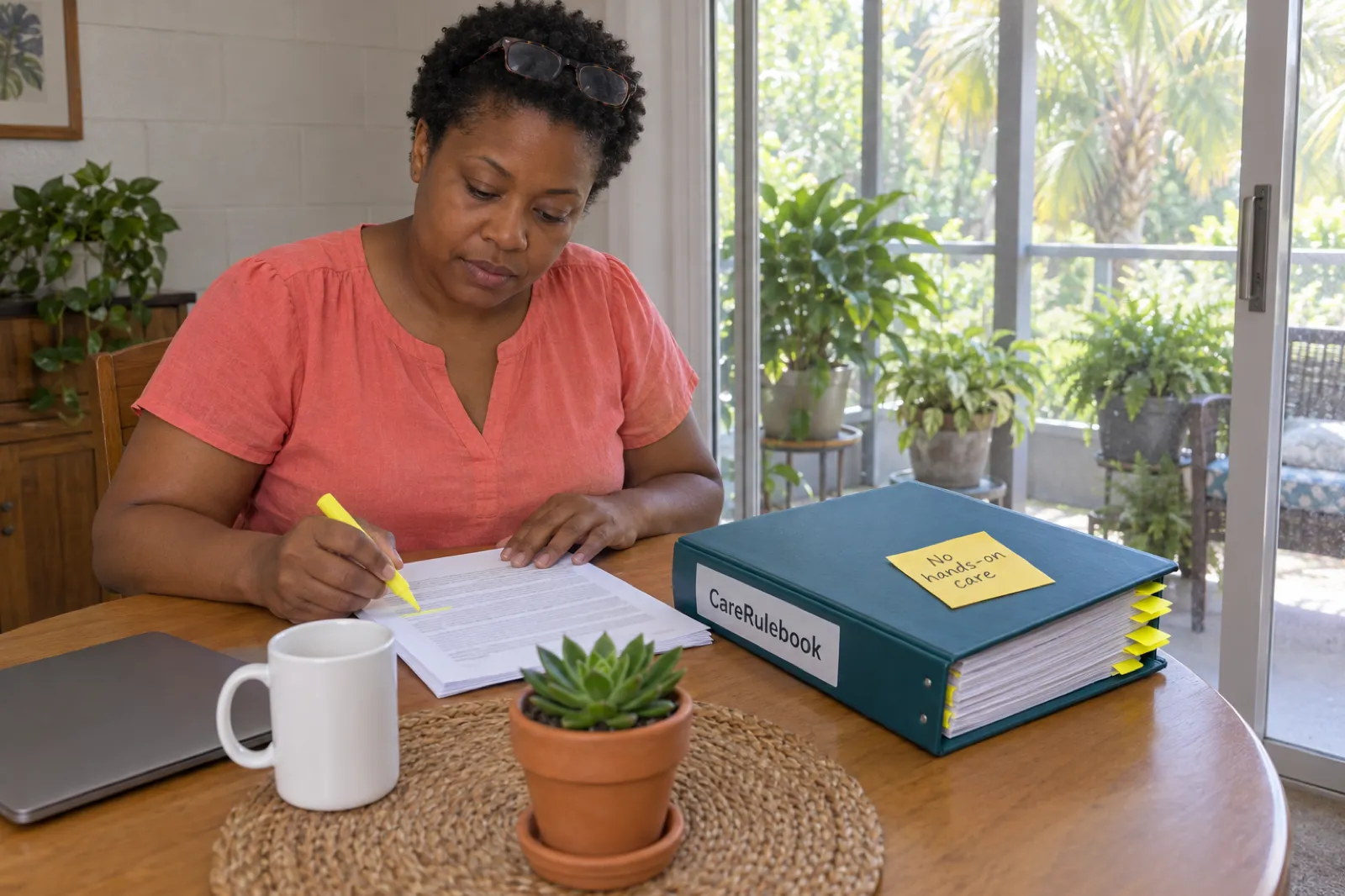
No. Florida’s definitions say a companion and a homemaker “may not provide hands-on personal care to a client”, and AHCA says these providers cannot provide any personal care or nursing. Bathing, dressing, toileting and transfers are personal care. For that work you need a home health agency license, or a nurse registry license to refer certified nursing assistants and home health aides.
"A companion may not provide hands-on personal care to a client."
Is AHCA registration optional for a companion business?
No. A companion or homemaker business is exempt from home health licensure but must register with AHCA. Licensed home health agencies and nurse registries need no separate registration, and an Agency for Persons with Disabilities contractor that provides companion services only to people with a developmental disability is exempt.
"However, any person that provides companion services or homemaker services must register with the agency."
How much does Florida companion and homemaker registration cost?
It depends. The statute sets $50 per two-year period, and AHCA’s current application form shows $50.75, which on our reading reflects the yearly inflation adjustment the law allows. A fee-bearing change during the registration period is $25 on the form. These are the State of Florida’s fees, not CareRulebook prices, and they are not refunded. Background screening costs are extra.
"The amount of the fee shall be $50 per biennium."
Will AHCA inspect my companion agency before registering it?
No. Not as a required step. The general licensing law says no initial inspection is required for companion or homemaker providers. AHCA can still inspect or investigate when it decides to, and its form says surveyors’ site inspections happen during the business hours you list.
"An initial inspection is not required for companion services or homemaker services providers as provided under part III of chapter 400"
Does Florida require a policy manual for a companion agency?
It depends. Not a full manual, on our reading. We found no rule listing policies a companion or homemaker registrant must write. The one policy duty we found is in the general licensing law: policies and procedures for telling clients, on or before the first day of service, how to report complaints, abuse and Medicaid fraud. The statute does not say the policy must be written, but writing it down is the simple way to show it. The rule also sets a confidential client record, checks on the employment history of staff who will have contact with clients in their homes (two documented attempts count as diligent effort when it cannot be verified), and an acceptance standard.
"Each licensee shall establish appropriate policies and procedures for providing such notice to clients."
Do I need a nurse to start a home care business in Florida?
It depends. Not for companion and homemaker registration: we found no nurse role in s. 400.509 or rule 59A-8.025, and these providers may not give hands-on personal care. A home health agency that offers only non-skilled services needs no director of nursing, but it still needs a registered nurse to assign aide work and make supervisory visits. A nurse registry refers caregivers and may not supervise them.
"Each home health agency that provides skilled care or non-skilled care must have an RN provide supervisory visits of unlicensed assistive personnel"
Can a new Florida companion start work before the background screening clears?
No. Not with clients. Chapter 435 lets you hire someone for training and orientation before screening is complete, but they may not have direct contact with vulnerable people until the level 2 screening is complete and shows no grounds to deny employment.
"An employer may hire an employee to a position that requires background screening before the employee completes the screening process for training and orientation purposes."
Do Florida companions need dementia training?
Yes. Staff of a registered companion or homemaker provider must complete the training in s. 430.5025: written information on hire, the Department of Elder Affairs’ free 1-hour online course within 30 days for those who give personal care or have regular contact, and 2 more hours within 7 months for those who give personal care. In that section, personal care includes homemaker or companion services. Section 400.6045 is the hospice rule, not this one.
"A person employed, contracted, or referred by a nurse registry or a person registered with the agency to provide companion or homemaker services must complete the training required under s. 430.5025."
Can a nurse registry supervise and train the caregivers it places?
No. Caregivers a nurse registry refers are independent contractors, and the registry may not monitor, supervise, manage or train them. It must tell the client so when the contract is made. If you want to employ, train and supervise your caregivers, look at a home health agency license instead.
"A nurse registry may not monitor, supervise, manage, or train a registered nurse, licensed practical nurse, certified nursing assistant, companion or homemaker, or home health aide referred for contract under this chapter."
Is a non-skilled home health agency the same as a companion agency?
No. A non-skilled home health agency is a home health license: its aides give hands-on personal care under a registered nurse, it is surveyed before licensing (by AHCA or an accrediting organization), and the application needs CPA-compiled projections and malpractice and liability insurance of at least $250,000 per claim. A companion or homemaker registrant gives no hands-on care and has no initial inspection.
"Home health agencies will be surveyed prior to initial licensure, and at least every 36.9 months on an unannounced basis thereafter."
Do Florida home care workers have to report suspected abuse?
Yes. Any person who knows or has reasonable cause to suspect that a vulnerable adult is being abused, neglected or exploited must report it immediately to the Florida Abuse Hotline, 1-800-96-ABUSE (1-800-962-2873), which takes reports 24/7. Suspected child abuse goes to the same hotline. Call 911 first if someone is in immediate danger.
"Any person, including, but not limited to, any:"