Skip to content
CareRulebook
MenuClose

Where are you starting?

United StatesTexas, North Carolina, Georgia, Virginia, Indiana, Ohio, New York, Illinois, Washington, Colorado, Tennessee, Maryland, Kansas, South Carolina, Nevada
TexasManual
North CarolinaManual
GeorgiaManual
VirginiaManual
IndianaManual
OhioGuideNew YorkGuide
IllinoisManual
WashingtonManual
ColoradoManual
TennesseeManual
MarylandManual
KansasManual
South CarolinaManual
NevadaManual
All US states →
United KingdomEngland
Free toolsChecklists, calculators and templates

Nevada · Attendant tasks · NAC 449.39775 and 449.3978 as amended by R089-24

What Nevada personal care attendants can and cannot do

On February 27, 2026, R089-24 changed what Nevada personal care attendants may do: toenail care, exercise help, medical appointments and medication assistance came off the prohibited list, each with conditions. Here is the list as it now stands, task by task, who may train each one, and when a client needs a nursing agency instead. HCQC’s 2024 workbook has not caught up.

  • Rule-verified October 3, 2026
  • Quoted from R089-24 as filed February 27, 2026
  • And NRS 449B.130 and HCQC’s workbook
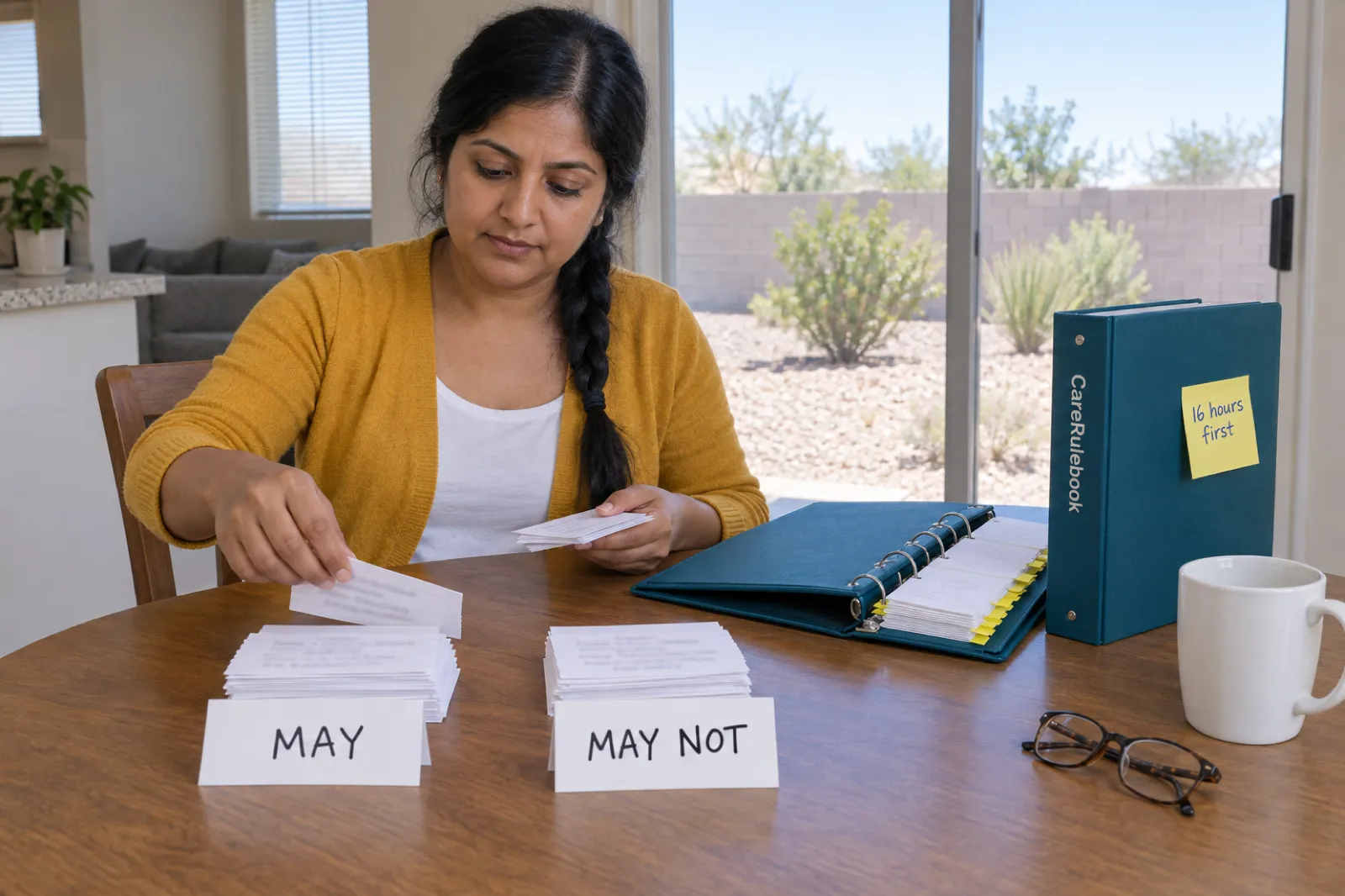
A woman in a mustard cardigan sorts white index cards into two piles behind folded cards reading MAY and MAY NOT at a kitchen table, beside an open teal binder and an upright CareRulebook binder with a sticky note reading 16 hours first, with a gravel yard and a block wall outside the glass door

Quick answer

Nevada attendants may help with daily living and household tasks, and, after task training, check vital signs, test blood glucose, give insulin through an approved auto-injector and weigh clients (NRS 449B.130; NAC 449.39775). Since February 27, 2026 they may also trim nails, help with exercise, go to appointments and share information, and assist with medication after 16 hours of approved training (NAC 449.39775(6), as amended; R089-24 section 14).

They must never provide the nine prohibited services, such as inserting or irrigating catheters, injections other than insulin pens, physical assessments, massage, or "any task identified in chapter 632 of NRS and the regulations adopted by the State Board of Nursing as requiring skilled nursing care, except any services that are within the scope and practice of a certified nursing assistant." (NAC 449.3978(2), as amended).

9

Services on the prohibited list now (13 before R089-24)

NAC 449.3978(2), as amended by R089-24 section 62

4

Items struck from the list on February 27, 2026

R089-24 section 62

16 hours

Approved medication training before an attendant assists, then 8 a year

R089-24 section 14(2)

1 year

Experience an employee needs to train others on a health-related task

NAC 449.39775(7)(c)

How an attendant’s tasks are set

The statute lets an agency provide "nonmedical services related to personal care to elderly persons or persons with disabilities to assist those persons with activities of daily living" (NRS 449B.465), such as toileting (elimination of wastes), dressing and undressing, bathing, grooming, preparing and eating meals, laundry, shopping, cleaning, transportation and other minor personal hygiene needs (NRS 449B.050).

For each client, the service plan is "a plan which includes a written description of the needs of a client for personal care services and which specifies the tasks that an attendant is authorized to provide for the client" (NAC 449.3967). Before services start, the agency must "ensure that the personal care services requested by the client are services which assist the client with the activities of daily living" (NAC 449.3981(3)(d)). Then the administrator ensures that only trained attendants serve the client (NAC 449.3973(2)(b)) and keeps each attendant "working within the attendant’s scope of service and conducts himself or herself in a professional manner" (NAC 449.3978(1)).

So, by our reading, a task is allowed for a given client only if it is a personal care service, it is written into that client’s plan, the attendant is trained for it, and it is not on the prohibited list.

May and may not, task by task

The rules as amended by R089-24. "New" marks tasks allowed since February 27, 2026.

TaskWhat an attendant may doConditions and limitsSource
Daily living and household helpToileting, dressing and undressing, bathing, grooming, preparing and eating meals, laundry, shopping, cleaning, transportation and other minor personal hygiene needs.Must assist with activities of daily living; drivers need at least the state minimum auto liability insurance on file.NRS 449B.050; NAC 449.3981(3)(d), 449.3976(1)(h)
Vital signsCheck, record and report temperature, blood pressure, pulse, respiration or oxygen saturation, with the client’s consent.Task training before, yearly and when the device changes; follow the manufacturer’s instructions.NRS 449B.130(1)(a); NAC 449.39775(1)
Blood glucose testsTest the client’s blood glucose, or help the client test, with an FDA-approved home device.Task training; CLIA where it applies (HCQC asks for a CLIA waiver); a meter is never used on more than one person.NRS 449B.130(1)(c); NAC 449.39775(1)-(3)
InsulinGive pharmacist-furnished insulin through an FDA-approved auto-injector, or help the client self-administer it.Client stable and predictable per a physician, PA or APRN; a maintenance dose with no daily assessment or sliding scale; task training.NRS 449B.130(1)(b); NAC 449.39775(4)
WeighingWeigh the client.Training on accurate weighing and the client’s consent.NAC 449.39775(5)
Nail care (new)Trim or cut fingernails and toenails.Not toenails if the client’s provider says only a podiatrist or licensed nail technologist may; consult the provider first if the client has diabetes.NAC 449.39775(6)(a), as amended
Exercise (new)Help with strength, balance, flexibility, endurance and range of motion exercises.No exercise the client’s provider has said the client should not do.NAC 449.39775(6)(b), as amended
Appointments (new)Help schedule and attend medical and nonmedical appointments; go with the client to the provider.Within federal and state law on protected health information.NAC 449.39775(6)(c)-(d), as amended
Sharing information (new)Give information about the client to the provider, receive it, and share it with the client, their representative or attorney-in-fact.Within federal and state law on protected health information.NAC 449.39775(6)(d), as amended
Medication (new)Assist with prescribed or ordered medication, over-the-counter medicines and dietary supplements.16 hours of approved training first, then 8 a year; a written agreement where the law requires one; the practitioner’s written instructions; a medication record; never anything on the prohibited list.R089-24 section 14

The prohibited list as it stands

NAC 449.3978(2), as amended by R089-24 section 62, lists the services an attendant must not provide to a client, "without limitation" (NAC 449.3978(2), as amended):

ItemNever provided by an attendant
(a)Insertion or irrigation of a catheter
(b)Irrigation of any body cavity, including ear irrigation, enemas and vaginal douches
(c)Dressings involving prescription medication or aseptic techniques, including treating moderate or severe skin conditions
(d)Injections of fluids into veins, muscles or the skin, except as NAC 449.39775 allows (insulin by auto-injector)
(e)Physical assessments
(f)Specialized feeding techniques
(g)Digital rectal examinations
(h)Massage
(i)Any task the nursing law and State Board of Nursing rules say needs skilled nursing care, except tasks within a certified nursing assistant’s scope

"Without limitation". The list is not complete: by our reading, anything that needs a nurse’s judgment is out, even if not named. Item (i) draws the line at a certified nursing assistant’s scope: "Any task identified in chapter 632 of NRS and the regulations adopted by the State Board of Nursing as requiring skilled nursing care, except any services that are within the scope and practice of a certified nursing assistant."

A written list for the surveyor. HCQC’s checklist asks for a written policy listing the specific prohibited services; its workbook says the list does not need to be signed or kept in each employee’s file. (HCQC checklist, P0165; workbook, P0164) Your prohibited activities policy is separate: it covers conduct such as personal calls, gifts and loans (NAC 449.3974(2)).

Tell clients too. The disclosure statement says in plain words that "it is not within the scope of the license of the agency to manage the medical and health conditions of clients should the conditions become unstable or unpredictable" (NAC 449.3979(2)(a)).

What changed on February 27, 2026

LCB File No. R089-24, which rewrote parts of the personal care agency rules, was approved and filed on February 27, 2026. A permanent regulation takes effect when the Legislative Counsel files it with the Secretary of State, unless the regulation sets a later date. R089-24 sets no later date for its personal care sections. (R089-24; NRS 233B.070(1)) R089-24 struck four items from the prohibited list: administration of medication (including rectal suppositories, prescribed skin lotions and eye drops), trimming or cutting toenails, specialized range of motion services, and medical case management such as going with a client to the doctor. (R089-24 section 62)

Old prohibited itemBeforeSince February 27, 2026
Administration of medication (including rectal suppositories, prescribed skin lotions and eye drops)Prohibited, except insulin by auto-injectorStruck from the list; assistance allowed under section 14 after 16 hours of approved training
Trimming or cutting toenailsProhibitedAllowed, with the podiatry and diabetes limits
Specialized services to increase range of motionProhibitedStruck; help with range of motion exercises allowed unless the client’s provider says no
Medical case management, including going with a client to the doctor to give or receive medical informationProhibitedStruck; appointments and sharing information allowed within privacy law

The compiled code on the Legislature’s site is marked "Revised Date: 8-24" and does not show these changes (NAC chapter 449). Read the amended sections in R089-24 itself. Already licensed? The hub’s to-do list for existing agencies covers every R089-24 change.

HCQC’s workbook still shows the old list

HCQC’s 12.2024 workbook, still linked as the initial inspection workbook, prints the prohibited list from before R089-24, including medication, toenail trimming, specialized range of motion and medical case management. Its tag P0164 still reads, for example, "(i) Trimming or cutting toenails;" and "Providing medical case management, including, without limitation" (HCQC workbook (12.2024), P0164). Its health-related task rows also use the pre-2026 subsection numbers (HCQC workbook, P0340 to P0360).

The workbook is HCQC’s survey tool, not the rule, and it predates R089-24. By our reading the amended rule governs. What we suggest:

  • Base your prohibited services list on NAC 449.3978 as amended, and say in the policy that it follows R089-24 section 62.
  • Keep a printed copy of R089-24 sections 14, 61 and 62 with your policy manual for the prelicensure survey.
  • If you offer a new task, ask HCQC at (702) 486-6515 how its surveyors are checking it until the workbook is updated (HCQC).

How HCQC uses the workbook at the prelicensure survey is on our Nevada guide.

Nail care

An attendant may "trim or cut the fingernails or toenails of a client" (NAC 449.39775(6)(a), as amended), with two limits on toenails:

  • A podiatrist only, if the provider says so. Not if the client’s physician or other provider has indicated the toenails must be trimmed only by a licensed podiatrist or "a nail technologist licensed pursuant to chapter 644A of NRS" (NAC 449.39775(6)(a)).
  • Diabetes. "If the client has been diagnosed with diabetes, the attendant shall consult with the client’s physician or other provider of health care before trimming or cutting the toenails of the client." (NAC 449.39775(6)(a))

Not settled: whether one documented consultation covers later trims for a client with diabetes, or the provider must be consulted before every trim. By our reading, document the consultation and renew it when the client’s condition or the advice changes; ask HCQC if you rely on it.

Training. The rule names no special trainer for nail care. The Division said the rule sets no task-specific course for nail care or exercise because NAC 449.3977 already requires attendants to be trained in any service they provide. (Division memo, Jul 17, 2025)

Exercise and range of motion

An attendant may "assist a client with physical exercises, including, without limitation, exercises for strength training and exercises designed to help with balance, flexibility, endurance and range of motion". The limit: "An attendant shall not assist a client with any exercises in which the physician or other provider of health care of the client has determined that the client should not participate." (NAC 449.39775(6)(b), as amended)

This replaces the old ban on "Providing specialized services to increase the range of motion of a client" (R089-24 section 62). Massage stays prohibited (NAC 449.3978(2)(h)). By our reading, if a physical therapist has given the client a program, the attendant may help with it, but not design or change it: changing a program is a clinical judgment.

Appointments and sharing information

An attendant may "assist a client with scheduling and attending medical and nonmedical appointments" (NAC 449.39775(6)(c), as amended). Within federal and state privacy law, an attendant may give information about the client to the client’s provider, receive information from the provider, and share it with the client, the client’s representative or an attorney-in-fact under the client’s power of attorney. (NAC 449.39775(6)(d))

The old rule called this medical case management and banned it, including accompanying a client to the doctor to give or receive medical information (R089-24 section 62).

Privacy. The rule makes this subject to federal and state law on protected health information. By our reading, get the client’s written permission for whom the attendant may share information with, and keep it in the client record. Your confidentiality policy should cover what attendants say and write after an appointment.

Driving. Transportation is a listed personal care service (NRS 449B.050); an attendant who drives clients needs at least the state minimum auto liability insurance on file (NAC 449.3976(1)(h)).

Vital signs, glucose tests, insulin and weighing

The statute tells the Board to let an attendant, with the client’s consent, check vital signs, give insulin by auto-injector and run blood glucose tests (NRS 449B.130(1)). The rule adds weighing (NAC 449.39775(5)).

  • Training first, yearly and on device change. Before doing these tasks, each year after, and whenever the device changes, the attendant is trained and shows understanding, follows the manufacturer’s instructions and meets CLIA rules where they apply. (NAC 449.39775(1)) Task training covers doing the task accurately under nationally recognized infection control guidelines, how to interpret the result, and what action to take, such as notifying a physician. ((8))
  • Blood glucose. If a client with diabetes cannot test their own blood glucose and an attendant does it, the federal CLIA rules are treated as applying. HCQC’s checklist asks for a CLIA waiver if attendants do blood glucose testing. (NAC 449.39775(2); HCQC P0320) A device "is not used on more than one person" ((3)).
  • Insulin. Only if a physician, PA or APRN has found the client’s condition stable and predictable and the insulin dose is a maintenance dose with no daily assessment such as a sliding scale. ((4)) The statute allows the employee to give it "or assist such a person with the self-administration of such insulin" (NRS 449B.130(1)(b)). Any other injection stays prohibited (NAC 449.3978(2)(d)).
  • Weighing. An attendant may weigh a client only after training on accurate weighing and with the client’s consent. HCQC looks for a consent form (HCQC P0340).

Reporting what the attendant finds. Task training must cover how to interpret a reading and what to do next, for example notifying a physician. By our reading, the service plan should say what readings the attendant reports, to whom, and how fast, because the attendant may not assess the client (NAC 449.3978(2)(e)).

Medication assistance

R089-24 section 14 says "an attendant may assist in the administration of medication, including, without limitation, an over-the-counter medication or dietary supplement, to a client if": there is a written agreement where NRS 453.375 and 454.213 require one, the attendant has completed the training, and the medication was prescribed or ordered by a practitioner and is given per that practitioner’s written instructions (R089-24 section 14(1); NRS 453.375).

  • The prohibited list still applies. The section opens: "Except as otherwise provided in NAC 449.3978, an attendant may assist in the administration of medication" (R089-24 section 14(1)).
  • Training. Before assisting with medication, an attendant completes at least 16 hours of medication management training from a Division-approved course and gets a certificate, then at least 8 hours a year. (R089-24 section 14(2)) An approved medication course is taught entirely in English: at least 16 hours (not less than 12 hours of classroom and 4 hours of practical training), or at least 8 hours of refresher training. (R043-22 section 13, as amended by R089-24 section 86)
  • The course. R089-24 ties the attendant medication course to the approved courses for residential facilities for groups (LCB File No. R043-22). HCQC’s medication management page is still written for group homes. (HCQC, Medication Management) R089-24 rewrote the approved course content so it covers an agency’s own medication policies (ordering, refills, storage, destruction and delivery logs) as well as group homes’. (R089-24 section 86) Ask HCQC which listed courses it accepts for personal care attendants before you enroll anyone.
  • Program and record. An agency whose attendants assist with medication develops a training program and keeps a record for each client: medication type, date and time given, refusals or missed doses, and current instructions from the practitioner. (R089-24 section 14(3))
  • Optional. The Division told the State Board of Health that an agency may choose not to offer medication assistance if it does not want the training costs; the regulation does not require it. (Division memo, Jul 17, 2025) If you do not offer it, say so in your services policy and disclosure statement.

Not settled:

  • Routes. The struck item named "the insertion of rectal suppositories, the application of a prescribed topical lotion for the skin and the administration of drops in the eyes". The rules do not say whether section 14 now lets trained attendants assist with each of these. Ask HCQC before you put them on a service plan.
  • Errands. Whether collecting a client’s medication from the pharmacy, with the bag unopened, counts as assisting with medication for an agency that does not offer it. By our reading it is a shopping errand, not assistance.

Who may train each task

TaskWho may train itSource
Daily living tasksYour training program, including on-the-job instruction supervised by the administrator or designeeNAC 449.3977(1)(b)
Vital signs; weighingA physician, physician assistant or licensed nurse, or a qualifying employeeNAC 449.39775(7)(a), (c)
Blood glucose tests; insulin auto-injectorA physician, physician assistant or licensed nurse, a registered pharmacist, or a qualifying employeeNAC 449.39775(7)(a)-(c)
Nail care; exercise; appointmentsNo task trainer is named. The Division said NAC 449.3977 already requires training in any service providedDivision memo, Jul 17, 2025
Medication assistanceA course approved by the Division under R043-22: 16 hours first, then 8 hours a yearR089-24 section 14(2)

The qualifying employee. Besides a physician, PA, licensed nurse or (for insulin and glucose) a pharmacist, an employee may train a task if trained by one of them, with at least a year of experience doing the task and shown competency. The amended text still says an employee "of the residential facility". (NAC 449.39775(7)(c), as amended) By our reading the words "residential facility" were carried over from the group home rules and mean your agency, but HCQC has not said so; ask before an employee trains others. HCQC’s surveyor checks that the trainer meets the requirements (P0350) and that the training topics do (P0360) (HCQC workbook).

Every attendant also completes your training program, with supervised on-the-job instruction, before working alone, and at least 8 hours of training a year (NAC 449.3977(1)(b); 449.3975(6)). The full training picture: Nevada caregiver training.

When a client needs a nursing agency instead

Skilled nursing at home is a different license. Under NRS 449.0015, an agency to provide nursing in the home provides "skilled nursing and assistance and training in health and housekeeping skills", and it is a medical facility under NRS chapter 449 (NRS 449.0015(1), 449.0151(4)). HCQC lists it as "An agency to provide nursing in the home (HHA)" (HCQC Background Check page). An agency to provide nursing in the home must, besides skilled nursing, provide at least one of speech or occupational therapy, nutrition or vocational guidance, physical therapy, pharmaceutical services, or other social or medical services. (NRS 449.248)

How the licenses compare, including intermediary service organizations and employment agencies: Nevada home health vs home care.

By our reading, a client needs a nursing agency (or their own clinicians) for anything on the prohibited list: inserting or irrigating a catheter (routine care of an indwelling catheter drainage system, such as emptying the bag, is an attendant training topic in NAC 449.3977(1)(c)(6)), wound dressings with prescription medication or aseptic technique, injections other than insulin pens, physical assessments, tube or other specialized feeding, or insulin on a sliding scale. A personal care agency may coordinate with that provider; the rules require it to coordinate its services with care from other organizations and people (NAC 449.3981(3)(e)).

Personal assistants. For a person with a disability, a provider of health care may authorize a personal assistant to perform specific simple medical or nursing tasks the person would normally do themselves, if the condition is stable and predictable; the provider notes the authorization in the medical record. (NRS 629.091; NRS 449B.465(1)) By our reading this is a separate route, client by client, and it does not widen the prohibited list for other clients.

Before a task goes on a service plan

Tick steps off as you go. Your progress is saved in this browser only.

  1. Screen the client and write the tasks into the service plan

    Before care starts

    The service plan specifies the tasks an attendant is authorized to provide, and the agency confirms each requested service assists with activities of daily living.

  2. Check the task against the prohibited list

    Before care starts

    Nine services are never allowed, and the medication rule starts with an exception for that list.

  3. Get what the client’s provider must decide

    Before the task

    For insulin, a physician, PA or APRN’s finding that the client is stable; for toenails, whether a podiatrist is required and, with diabetes, a consultation; for exercise, any exercise the client should not do; for medication, the practitioner’s written instructions.

  4. Get consent where the rule asks for it

    Before the task

    The client consents to vital signs, glucose tests and insulin under the statute, and to being weighed under the rule. HCQC looks for a consent form if attendants weigh clients (P0340).

  5. Train the attendant, with the right trainer

    Before the task

    Health-related task training before the task, yearly and when the device changes; 16 hours of approved medication training before medication assistance.

  6. Keep the records

    Ongoing

    Training records in the personnel file, a CLIA waiver if attendants test glucose, consent forms, and for medication a record of each dose, refusal or missed dose with current instructions.

Who screens the client and supervises attendants: the Nevada administrator and designee.

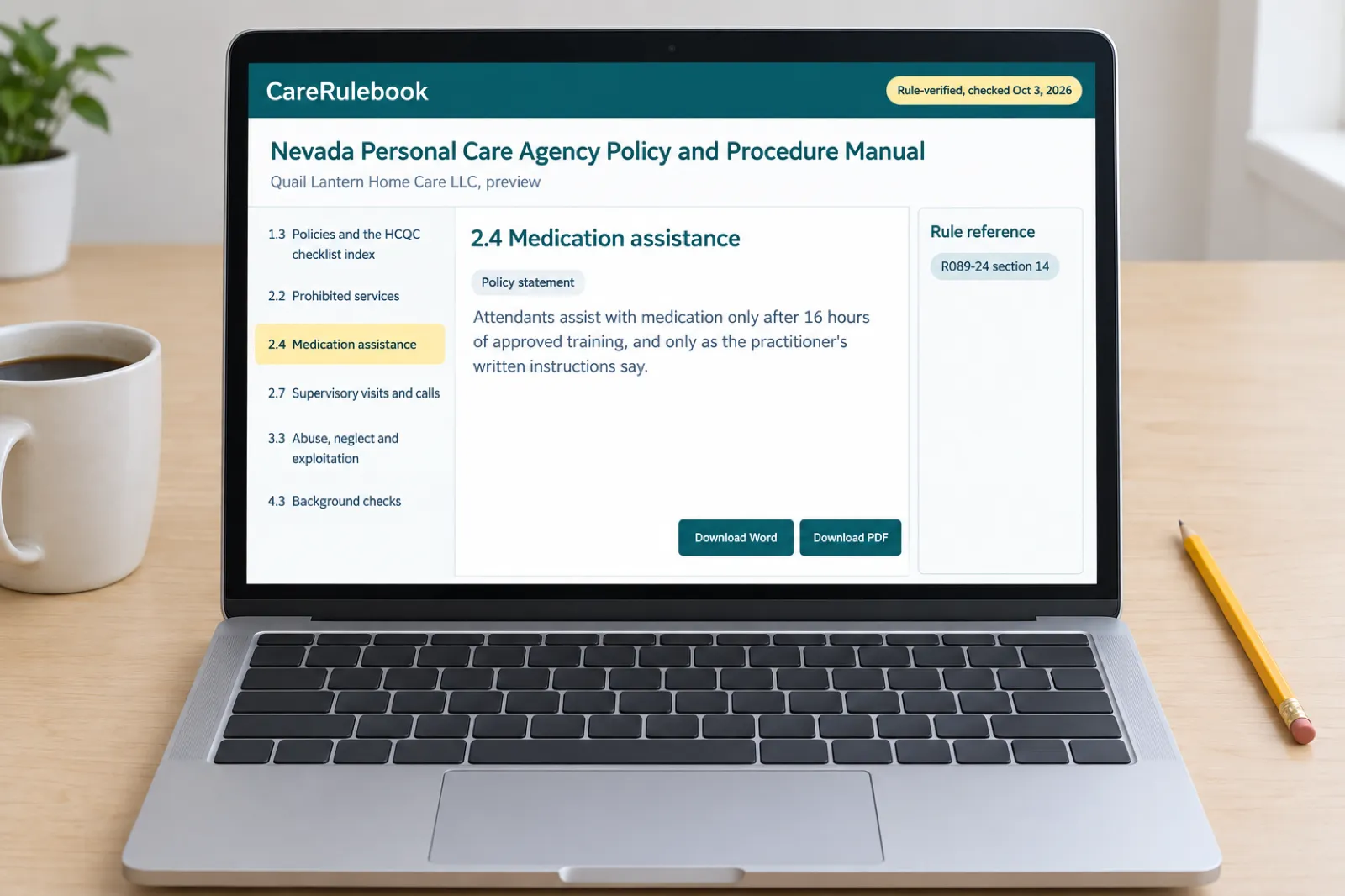
The CareRulebook Nevada manual preview on a laptop: policy 2.4 on medication assistance for a sample agency, citing R089-24 section 14, with six of the manual’s policies listed beside it

CareRulebook

Your attendants’ scope, written on the 2026 rules

CareRulebook’s Nevada manual includes Policy 2.1, personal care services offered; Policy 2.2, prohibited services and the attendant’s scope of service; Policy 2.3 on health-related tasks, nail care and exercise; Policy 2.4, medication assistance; and Policy 4.6, orientation and initial training.

  • 35 policies, 127 requirements mapped to NRS 449B and NAC 449.396 to 449.3982 as amended by R089-24
  • Written on the amended prohibited list, not HCQC’s 2024 workbook
  • Your choice on medication assistance, with the record and training program if you offer it
  • Editable Word and print-ready PDF
Preview your manual

$199CareRulebook founding price for the first 50 Nevada agencies, then $249. Not an HCQC fee.

Myths about attendant tasks in Nevada

Is HCQC’s inspection workbook the current list of what Nevada attendants may not do?

No. HCQC’s workbook is dated 12.2024 and still prints the old prohibited list, including medication, toenail trimming, specialized range of motion and medical case management. R089-24 removed those four items on February 27, 2026. Use the amended NAC 449.3978 and 449.39775, and keep a copy of R089-24 for the surveyor.

"Providing medical case management, including, without limitation,"

Can Nevada personal care attendants give injections?

No. With one exception: insulin prescribed for a client’s diabetes and furnished by a pharmacist, given through an FDA-approved auto-injection device, when a physician, PA or APRN has found the client stable and predictable and the dose is a maintenance dose with no sliding scale. The attendant must be trained on the task first, every year after and whenever the device changes.

"Except as authorized by NAC 449.39775, administration of injections of fluids into veins, muscles or the skin"

Can caregivers trim a client’s toenails in Nevada?

It depends. Yes since February 27, 2026, unless the client’s physician or provider says only a podiatrist or licensed nail technologist may do it. For a client with diabetes, the attendant must consult the client’s provider first. The old rule banned toenail trimming outright.

"If the client has been diagnosed with diabetes, the attendant shall consult with the client’s physician or other provider of health care before trimming or cutting the toenails of the client."

Can a Nevada caregiver take a client to the doctor and talk to the doctor?

Yes. Since R089-24 took effect on February 27, 2026. Attendants may help schedule and attend medical and nonmedical appointments and may give and receive information about the client, within the privacy laws. Before, this counted as medical case management and was banned.

"Assist a client with scheduling and attending medical and nonmedical appointments."

Frequently asked questions

Can a Nevada personal care attendant cut a client’s toenails?

Yes, since R089-24 took effect on February 27, 2026, unless the client’s physician or other provider has said the client’s toenails must be trimmed only by a licensed podiatrist or a licensed nail technologist. If the client has been diagnosed with diabetes, the attendant must consult the client’s physician or other provider before trimming or cutting the toenails. Fingernail trimming is allowed too. Before February 2026, trimming or cutting toenails was on the prohibited list, and HCQC’s 12.2024 workbook still shows it there.

Can Nevada personal care attendants give medication?

Since February 27, 2026, an attendant may assist with medication, including over-the-counter medicines and dietary supplements, if the attendant has completed at least 16 hours of medication management training from a Division-approved course and holds the certificate, the medication was prescribed or ordered by a practitioner and is given per that practitioner’s written instructions, and the client (or a parent, guardian or attorney-in-fact) has entered into a written agreement where NRS 453.375 or 454.213 requires one. Attendants then complete 8 hours a year. The agency runs a training program and keeps a medication record for each client. Injections are still prohibited except insulin by auto-injector. The Division told the Board of Health that agencies may choose not to offer medication assistance.

Can a caregiver take a client to the doctor in Nevada?

Yes. Since R089-24, attendants may help clients schedule and attend medical and nonmedical appointments, go with the client to the provider’s office to give and receive information about the client, and share that information with the client, their representative or an attorney-in-fact under the client’s power of attorney, within federal and state privacy law. Before February 27, 2026, accompanying a client to the doctor to exchange medical information was prohibited as medical case management.

Can personal care attendants give insulin shots in Nevada?

Not by syringe. An attendant may give insulin, or help the client self-administer it, only through an FDA-approved auto-injection device for home use, with insulin prescribed for the client’s diabetes and furnished by a registered pharmacist, when a physician, PA or APRN has found the client stable and following a predictable course and the dose is a maintenance dose that needs no daily assessment such as a sliding scale. The attendant is trained before the task, every year and when the device changes, by a physician, PA, licensed nurse, registered pharmacist or a qualifying employee.

Can Nevada attendants help with range of motion exercises?

Yes, since February 27, 2026. Attendants may help with physical exercises, including strength training and exercises for balance, flexibility, endurance and range of motion, unless the client’s physician or other provider has determined the client should not do them. The old rule banned "specialized services to increase the range of motion of a client". The rule names no special trainer for exercise; the Division said NAC 449.3977 already requires attendants to be trained in any service the agency provides.

Can attendants give eye drops or suppositories now?

Not settled. R089-24 struck the old ban on "administration of medication, including, without limitation, the insertion of rectal suppositories, the application of a prescribed topical lotion for the skin and the administration of drops in the eyes", and the new section 14 lets trained attendants assist with medication. The rules do not say which routes are included, and HCQC has not published guidance. Ask HCQC before you put eye drops, skin lotions or suppositories on a service plan.

What happens if a client needs skilled nursing?

A personal care agency cannot provide it. Attendants may not perform any task the nursing law treats as skilled nursing care, beyond a certified nursing assistant’s scope, and your disclosure statement tells each client that managing unstable or unpredictable medical conditions is outside the license. Skilled nursing in the home is provided by a separately licensed agency to provide nursing in the home (HCQC calls it a home health agency). Coordinate with that provider rather than stretching your attendants’ tasks.

Get Nevada rule-change alerts

R089-24 changed what attendants may do on February 27, 2026, and HCQC’s workbook has not caught up. Leave your email and we will tell you when HCQC updates its guidance or a Nevada rule changes what your attendants may do.

No spam. Only emails about Nevada home care rule changes. How we use your email.

Keep reading

Sources

  1. NRS chapter 449B, Agencies to Provide Personal Care Services and Related Entities (added by AB 519, 2025; page revised 4/15/2026) · Nevada Legislature, Legislative Counsel Bureau (Internet Archive copy) · retrieved October 2, 2026
  2. NAC 449.396 to 449.3982, Agencies to Provide Personal Care Services in the Home (compiled text, NAC-449 revised 8-24, as amended by LCB File No. R089-24, filed February 27, 2026) · Nevada Legislature, Legislative Counsel Bureau (State Board of Health regulations; Internet Archive copies) · retrieved October 3, 2026
  3. LCB File No. R089-24, approved regulation of the State Board of Health (filed February 27, 2026), with the adopted text, informational statement, notice of hearing and Board packet · Nevada Legislature, Legislative Counsel Bureau, Register of Administrative Regulations; Nevada Health Authority · retrieved October 3, 2026
  4. NRS 233B.070, effective date of regulations · Nevada Legislature, Legislative Counsel Bureau (Internet Archive copy) · retrieved October 3, 2026
  5. NRS 629.091, personal assistant services for a person with a disability authorized by a provider of health care · Nevada Legislature, Legislative Counsel Bureau (Internet Archive copy) · retrieved October 3, 2026
  6. NRS 453.375 and 454.213, persons who may possess and administer controlled substances and dangerous drugs · Nevada Legislature, Legislative Counsel Bureau (Internet Archive copy) · retrieved October 3, 2026
  7. Agency to Provide Personal Care Services in the Home (Personal Care Agency), page last updated 07/21/2026 · Nevada Health Authority, Bureau of Health Care Quality and Compliance · retrieved October 2, 2026
  8. Agencies to Provide Personal Care Services in the Home Workbook (12.2024), linked as the Initial Inspection Workbook, with the PCS Policies & Procedures/Form/Document Checklist · Nevada Health Authority, Bureau of Health Care Quality and Compliance · retrieved October 2, 2026
  9. Background Check Requirements and FAQs (page last updated 05/26/2026) · Nevada Health Authority, Bureau of Health Care Quality and Compliance · retrieved October 3, 2026
  10. Training & Education, Cultural Competency, Unlicensed Caregiver Infection Control Training and Medication Management pages · Nevada Health Authority, Bureau of Health Care Quality and Compliance · retrieved October 3, 2026
  11. NRS chapter 449, Medical Facilities and Other Related Entities (449.0015 agency to provide nursing in the home; 449.0151 medical facility; 449.248), page revised 4/15/2026 · Nevada Legislature, Legislative Counsel Bureau (Internet Archive copy) · retrieved October 4, 2026
Build your Nevada manualfrom $199