Keep the office ready to open up
Inspections come without notice, so the primary office needs someone who can let inspectors in and open every record, or a plan for telling DPH when staff will be back.
R.60-122 §202.A-BManual: Policy 1.4
Where are you starting?
South Carolina · Inspections and incidents · R.60-122 §201-205, §501; S.C. Code 43-35
DPH can inspect or investigate any South Carolina in-home care provider without notice. Here is what inspectors can see, how plans of correction, violation classes and penalties work, what DPH’s published orders show so far, and the reporting clocks the 2026 rule set for incidents and abuse: 24 hours or the next business day, then 5 calendar days.
Quick answer
"All providers are subject to inspection and/or investigation without prior notice." R.60-122 §202.A For any noncompliance, the administrator signs a plan of correction and returns it by the date on the report. R.60-122 §202.C Penalties run from $100 to $5,000 per violation, by class and frequency. R.60-122 §205.F
Serious incidents go to the client’s responsible party and to DPH within 24 hours or the next business day, with a written investigation report within five calendar days. R.60-122 §501.B-C Allegations of abuse, neglect or exploitation also go to Adult Protective Services, and each caregiver is personally a mandated reporter. S.C. Code 43-35-25
DPH inspections and incidents
Checked against official sources on October 2, 2026.
DPH "shall utilize inspections, investigations, applications, and other pertinent documentation regarding a proposed or licensed provider in order to enforce this regulation." R.60-122 §201 The rule names three kinds of visit:
Who comes. DPH says "Inspectors are healthcare professionals". DPH, How DPH Inspects
How often. R.60-122 sets no inspection interval, and DPH has not published one for in-home care providers that we could find. Compare home health agencies, which the statute says are inspected at least once a year. S.C. Code 44-69-70 By our reading, an in-home care provider should be ready on any business day.
Before the first license. "An initial license shall not be issued to a proposed provider until the applicant has demonstrated to the Department that the proposed provider is in substantial compliance with the licensing standards." R.60-122 §103.B Because an inspection can be of a "proposed" provider, DPH may visit before licensing, but the rule does not say it always does. How DPH licenses you: the South Carolina guide.
Class I. Section 202, inspections and investigations, is marked (I): failing to allow an unannounced visit or to give access is a Class I violation. Its plan of correction paragraph, 202.C, is marked (II). R.60-122 §202, §205.D
| Point | What the rule or DPH says | Source |
|---|---|---|
| No warning | Every provider is subject to inspection or investigation without prior notice. DPH says its inspections and investigations are unannounced. | R.60-122 §202.A; DPH |
| Staff out of the office | If no staff members are there, you tell DPH when staff are expected back. | R.60-122 §202.A |
| Access to everything | Authorized inspectors get access to all properties, areas, objects and records in a timely manner. Photocopies are used only to enforce the regulations, and confidentiality is kept. | R.60-122 §202.B |
| Records readily accessible | All records must be readily accessible, in a timely manner, for inspections and investigations. The primary office is where all records are kept, secured and accessible. | R.60-122 §601.A.2, §102.S |
| Report of visit | DPH leaves a report of visit after each inspection or investigation, describing any conditions or practices found to break the law or the regulations. | DPH, How DPH Inspects |
| Not a full check | DPH says no single inspection or investigation checks every condition that may exist, or relieves you of meeting every standard. | DPH, How DPH Inspects |
The rule does not say whether electronic records count as "readily accessible" if they are kept off site. It does require a backup for electronic records R.60-122 §601.A.3 and defines the primary office as where all records are kept. R.60-122 §102.S By our reading, anyone at the office should be able to open them for an inspector.
Our practical suggestions, not rule text. Each card links the source it helps you meet and the CareRulebook manual policy that covers it.
Inspections come without notice, so the primary office needs someone who can let inspectors in and open every record, or a plan for telling DPH when staff will be back.
R.60-122 §202.A-BManual: Policy 1.4
Section 301 is marked (II): written policies for each section, accessible to staff at all times, reviewed at least every two years with the administrator’s signature.
R.60-122 §301Manual: Policy 1.1
A copy of the licensing standards is kept at the provider and is accessible to all caregivers.
R.60-122 §103.BManual: Policy 1.1
Criminal record check, registry checks, a negative drug test, the health self-assessment and signed training records for the eight topics. Sections 402, 404 and 406 are Class I standards in whole or part.
R.60-122 §402-406Manual: Policy 2.4
Service agreement (not for Medicaid clients), signed rights form, care services plan within seven business days, weekly visit notes and your disaster plan.
R.60-122 §601, §900, §1001Manual: Policy 4.1
Every incident documented with a review, investigation, evaluation and any corrective action, and kept for five years after the client stops receiving services.
R.60-122 §501.AManual: Policy 3.1
Already licensed before May 22, 2026? The rule applies to every provider with no transition period. R.60-122 §101 The to-do list for existing agencies is on the South Carolina guide.
Section by section: South Carolina policies and procedures, caregiver background checks, caregiver training and client paperwork.
"When there is noncompliance with licensing standards, the provider shall submit an acceptable written plan of correction to the Department that shall be signed by the administrator" and "returned by the date specified on the report of inspection or investigation". R.60-122 §202.C The plan describes:
Our suggestions. Answer each deficiency separately, in the report’s order. Give a real completion date, name who is responsible, and keep the evidence of each correction with your copy of the plan. If a deficiency comes from a policy, revise the policy and have the administrator sign and date the review, as 301.B requires for every review. R.60-122 §301.B DPH weighs your efforts to correct cited violations when it decides on enforcement. R.60-122 §205.E
| Frequency | Class I | Class II | Class III |
|---|---|---|---|
| 1st | $500-1,500 | $300-800 | $100-300 |
| 2nd | $1,000-3,000 | $500-1,500 | $300-800 |
| 3rd | $2,000-5,000 | $1,000-3,000 | $500-1,500 |
| 4th | $5,000 | $2,000-5,000 | $1,000-3,000 |
| 5th | $5,000 | $5,000 | $2,000-5,000 |
| 6th | $5,000 | $5,000 | $5,000 |
R.60-122 §205.F: "Monetary penalties assessed by the Department must be not less than one hundred dollars ($100) nor more than five thousand dollars ($5,000) for each violation of any of the provisions of this regulation."
By our reading: a first citation for missing written policies (a Class II standard) would sit in the $300 to $800 band if DPH chose a monetary penalty. The schedule applies "when a decision is made to impose monetary penalties", so a citation does not always mean a fine. R.60-122 §205.F Before May 22, 2026 the rule also counted each day a violation continued as a subsequent offense; the 2026 text dropped that line. What changed on May 22, 2026.
DPH publishes Healthcare Quality administrative and consent orders in monthly reports that name the party, summarize the inspections, investigations and violations, and list what the party had to do, including any civil monetary penalty. DPH, Healthcare Quality Enforcement Actions So an order against your agency would be published with its name. DPH also says consumers can use inspection reports to compare providers. DPH, How DPH Inspects
Our count. We read all 19 monthly reports from January 2025 to July 2026. DPH’s monthly enforcement reports from January 2025 to July 2026 show two orders against in-home care providers, both $300 consent orders for late renewals. None cites the 2026 rule yet. DPH enforcement reports, July 2025 and February 2026 This is our count, not a DPH statistic. The reports list orders only, so by our reading a citation closed with a plan of correction would not appear in them.
How one late renewal became an order. In the February 2026 order, DPH staff had emailed the provider a renewal fee invoice and reminder before expiry, then a citation by mail imposing a late fee, then notice that the license had expired. A consent order followed with a $300 penalty and a completed renewal application, and DPH agreed to rescind the expiration letter if the provider complied. DPH enforcement report, February 2026 DPH’s fees: $800 to renew, a $200 late fee from the expiry date, and unlicensed if not renewed within 30 days of expiry. R.60-122 §103.J These are DPH’s fees, not CareRulebook prices.
Suspension and revocation. Reinstating a suspended license costs DPH’s $400 fee. R.60-122 §103.K.1 A revoked license is reinstated only by applying again as a new provider with the initial fee; any time left on the revoked license is forfeited. R.60-122 §103.K.2 The Act says sanctions may be appealed under S.C. Code 44-1-60. S.C. Code 44-70-40(8) We have not saved 44-1-60, so this page does not describe the appeal steps.
The reports were read to July 2026, two months after the rewrite took effect. By our reading, it is too early to tell how DPH will enforce the new duties against existing agencies.
CareRulebook
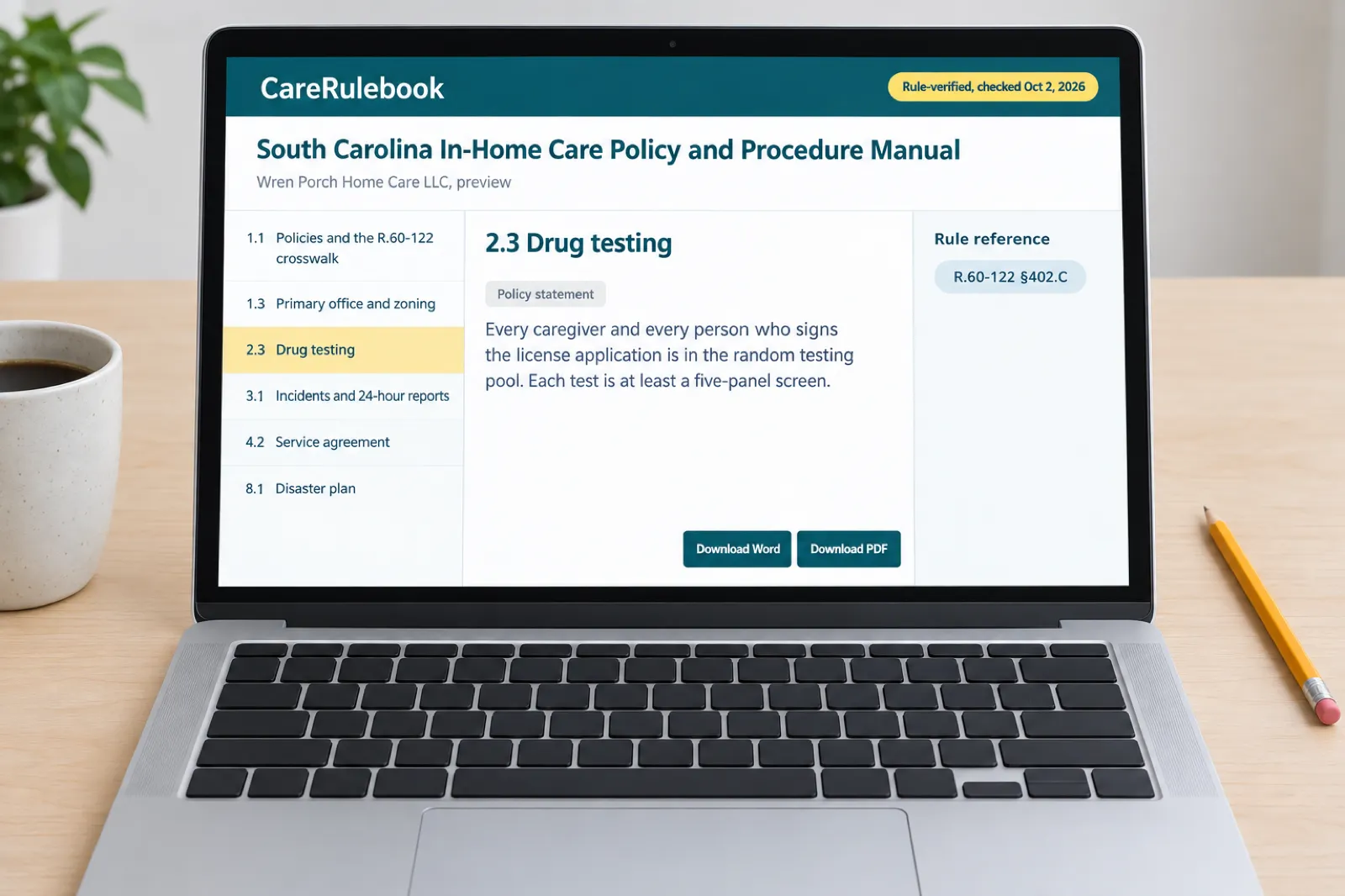
CareRulebook’s South Carolina manual includes Policy 1.4, Inspections, investigations and plans of correction, with an inspection-day checklist, a plan of correction worksheet and a log; Policy 3.1, Incidents: documentation, 24-hour reports and 5-day investigation reports, with an incident record, a 24-hour report checklist, the 5-day investigation report and an incident log; and Policy 3.2, Abuse, neglect and exploitation: prevention and reporting, with a reporting card for caregivers.
$199CareRulebook founding price for the first 50 South Carolina agencies, then $249. Not a DPH fee.
An incident is "An unusual, unexpected adverse event that causes harm, injury, or death to clients." R.60-122 §102.I "The provider shall document every incident, and include an incident review, investigation, and evaluation as well as a corrective action taken, if any." R.60-122 §501.A
The four reportable incident types in 501.B are a minimum; the rule says reportable incidents include, but are not limited to, them. R.60-122 §501.B
The responsible party is a person authorized by law to make decisions for the client, such as a guardian, conservator or someone with a health care or other durable power of attorney. R.60-122 §102.T "The provider shall also notify the Department within twenty-four (24) hours or the next business day from the incident, via the Department’s electronic reporting system or as otherwise determined by the Department." R.60-122 §501.B The 24-hour report collects what is known at the time: at least the type of incident and a brief description, the date it is believed to have happened, any witnesses and the reporter’s contact details. R.60-122 §501.B DPH’s page says "Please complete the online accident/incident form". DPH, Accident/Incident Reporting
"The provider shall submit a separate written investigation report within five (5) calendar days of every incident required to be reported to the Department", containing the provider name, license number, "the date the incident occurred, the client age and sex, witness names, extent and type of injury and how treated, cause of incident", internal investigation results, the other agencies notified and the reporter’s contact details. R.60-122 §501.C
DPH’s page says serious accidents or incidents, as the regulation defines them, need an initial report within 24 hours of occurrence and, once investigated, a full report within 5 days. The rule itself says 24 hours or the next business day, and 5 calendar days. DPH, Accident/Incident Reporting By our reading, follow the stricter of the two for each report: send the first report within 24 hours where you can, and count the five days as calendar days.
Before May 22, 2026, the rule required serious incidents to be phoned to the next of kin or responsible party immediately and reported to the Department in writing within three days. R.60-122 (2014 text) §501 The 2026 rule shortened the clock to DPH, changed the call to the next of kin or responsible party from immediately to within 24 hours or the next business day, added the separate five-day report, and moved reports to DPH’s electronic system.
Section 501 carries no (I) or (II) mark, so by our reading a missed or late incident report is a Class III violation under 205.D. R.60-122 §205.D The event behind the report may break other standards with a higher class, such as the client’s assurance of freedom from abuse, neglect and exploitation in Section 900, which is marked (I). R.60-122 §900.A
In an emergency, a serious injury or a suspected sexual assault, law enforcement must be contacted immediately. Then start the incident record.
For a fracture, a hospital admission or death from an incident, or a confirmed or suspected crime, abuse, neglect or exploitation by a caregiver: the client’s responsible party and DPH, through DPH’s online accident and incident form.
The provider reports any allegation involving a client to DSS Adult Protective Services (or Child Protective Services for a child). A caregiver who has reason to believe it happened makes their own report too.
A separate written investigation report to DPH: provider name, license number, date, client age and sex, witnesses, extent and type of injury and how treated, cause, internal investigation results, other agencies notified and the reporter’s contact details.
Document the review, investigation, evaluation and any corrective action, and keep it for five years after the client stops receiving services.
Three separate duties can apply to one event. The DPH report does not replace the APS report, and the agency’s reports do not replace the caregiver’s own.
| Who and where | What | When | Source |
|---|---|---|---|
| The provider, to DPH | Fractures, hospital admission or death from an incident, and confirmed or suspected crimes, abuse, neglect or exploitation by a caregiver; then the 5-day investigation report. | 24 hours or the next business day; 5 calendar days | R.60-122 §501.B-C |
| The provider, to the responsible party | The same incidents as the DPH report. | 24 hours or the next business day | R.60-122 §501.B |
| The provider, to APS or CPS | Any allegation of abuse, neglect or exploitation of clients, under S.C. Code 43-35-25, or to Child Protective Services as appropriate. | The rule refers to 43-35-25 (24 hours or the next working day) | R.60-122 §501.D |
| Each caregiver, personally | Reason to believe a vulnerable adult has been or is likely to be abused, neglected or exploited. For care in the client’s own home, the report goes to Adult Protective Services. | 24 hours or the next working day | S.C. Code 43-35-25(A), (C)-(D) |
| Anyone, to the police | An emergency, a serious injury or a suspected sexual assault. | Immediately | S.C. Code 43-35-25(G) |
| A reporter who suspects a death | Reasonable suspicion that a vulnerable adult died as a result of abuse or neglect: the death and suspected cause to the coroner or medical examiner. | The Act sets no separate time | S.C. Code 43-35-35(A) |
Non-medical caregivers are not on the list of mandated child abuse reporters, but anyone "may report, and is encouraged to report, in accordance with this section", to the county department of social services or a law enforcement agency. S.C. Code 63-7-310(D)-(E) For mandated child abuse reporters, such as nurses, knowingly failing to report is a misdemeanor with a fine of up to $500, up to six months in prison, or both. S.C. Code 63-7-410 R.60-122 still requires the provider to report allegations involving clients to Child Protective Services as appropriate. R.60-122 §501.D
Complaints about a licensed provider go to DPH’s online form or 1-800-922-6735. DPH, File a Complaint A complaint can lead to an investigation, which DPH can make at a licensed or unlicensed provider. R.60-122 §102.M
R.60-122 has no complaints section, and the client rights list does not mention DPH’s line. Giving clients DPH’s number and your own complaints procedure is our suggestion, not a rule. DPH, File a Complaint Medicaid personal care adds its own complaint information duties through SCDHHS: see Medicaid personal care.
No. Every provider is subject to inspection or investigation without prior notice, and DPH says its inspections and investigations are unannounced. If no staff are at the office when inspectors arrive, you tell DPH when staff are expected back, and inspectors get timely access to all areas and records. Not meeting Section 202 is a Class I violation.
"All providers are subject to inspection and/or investigation without prior notice."
No. Caregivers are mandated reporters under the Omnibus Adult Protection Act, and a person required to report is personally responsible for making the report, within 24 hours or the next working day. The Act bars facilities from procedures that interfere with reporting; it does not name in-home care providers, but by our reading an agency’s procedures should not interfere either. Telling the office is good practice so the agency can make its own reports to DPH and APS, but it does not replace the caregiver’s report.
"A person required to report pursuant to this section is personally responsible for making the report"
No. R.60-122 asks for two separate reports from the provider: suspected abuse, neglect or exploitation by a caregiver goes to DPH within 24 hours or the next business day (with a 5-day investigation report after), and any allegation of abuse, neglect or exploitation of a client goes to DSS Adult Protective Services (or Child Protective Services for a child). The caregiver’s own mandated report under the Omnibus Adult Protection Act is a third duty.
"The provider shall report any allegation of abuse, neglect, or exploitation of clients to the Adult Protective Services Program in the Department of Social Services in accordance with S.C. Code Section"
Yes. The rewritten R.60-122 applies to all in-home care providers from May 22, 2026, and the text has no transition period. Existing agencies need written policies for each section of the rule, a disaster plan given to clients, signed rights forms, service agreements, care services plans, the new incident reporting and a primary office in a commercially zoned or unzoned area (the zoning permit duty names the applicant; by our reading existing licensees should hold one too). DPH has not published guidance on how it will inspect existing agencies against the new rule.
"This regulation will apply to all in-home care providers in South Carolina."
No. R.60-122 says all providers are subject to inspection or investigation without prior notice, and DPH says its inspections and investigations are unannounced. If no staff are in the office, you tell DPH when they are expected back, and inspectors must get timely access to all areas and records. The rule sets no inspection interval, and DPH has not published one for in-home care providers.
The rule does not say. DPH will not issue an initial license until the applicant shows the proposed provider is in substantial compliance with the standards, and the rule’s definition of an inspection includes a visit to a proposed provider. Whether DPH visits every applicant is not stated anywhere we found, so have your policies, staff files and client forms in place before you apply, and ask DPH.
Until the date written on the report of inspection or investigation; the rule sets no fixed number of days. The administrator signs it, and it covers the actions taken to correct each cited deficiency, the actions taken to prevent it happening again, and the actual or expected completion dates. DPH takes plans through its online Plan of Correction form.
From $100 to $5,000 for each violation, using a schedule by class and by how often the violation has happened: a first Class I violation is $500 to $1,500, a first Class II $300 to $800 and a first Class III $100 to $300, rising to $5,000. DPH weighs the impact on clients, your efforts to correct, your compliance history and other pertinent conditions. It can also deny, suspend or revoke a license.
Not in the reports we read. Across DPH’s monthly enforcement reports from January 2025 to July 2026, we counted two orders against in-home care providers, both $300 consent orders for late license renewals (July 2025 and February 2026). None cites the rule as rewritten on May 22, 2026. This is our count of DPH’s published reports, not a DPH statistic.
At least these, to the client’s responsible party and to DPH within 24 hours or the next business day: a bone or joint fracture while in a caregiver’s care; hospital admission or death resulting from an incident while in a caregiver’s care; confirmed or suspected crimes against a client by a caregiver; and confirmed or suspected abuse, neglect or exploitation of a client by a caregiver. The list is "not limited to" these. A separate written investigation report follows within five calendar days.
A caregiver who knowingly and wilfully fails to report abuse, neglect or exploitation of a vulnerable adult commits a misdemeanor under S.C. Code 43-35-85(A), with a fine of up to $2,500 or up to a year in prison. Caregivers are named mandated reporters and are personally responsible for the report, so telling a supervisor does not replace it. A good-faith report is protected from civil and criminal liability.
Yes. Policy 1.4, Inspections, investigations and plans of correction, covers unannounced visits, access to records, the plan of correction and the violation classes, with an inspection-day checklist, a plan of correction worksheet and a log. Policy 3.1 covers incident records, the 24-hour report and the 5-day investigation report, and Policy 3.2 covers abuse, neglect and exploitation reporting, with a reporting card for caregivers.
The rewritten R.60-122 took effect on May 22, 2026, and DPH has not yet published guidance on how it inspects existing agencies against it. Leave your email and we will tell you when DPH changes the rule, its incident reporting or its inspection practice in a way that affects your policies.
No spam. Only emails about South Carolina home care rule changes. How we use your email.
South Carolina
How to start a home care agency in South Carolina
The in-home care provider license, what changed on May 22, 2026 and DPH’s fees.
South Carolina
South Carolina home health vs home care
In-home care, home health and its Certificate of Need, private duty nursing and Medicaid personal care.
Manual
Build your South Carolina policy manual
Including Policy 1.4 on inspections and Policy 3.1 on incidents.
South Carolina
South Carolina administrator and office
The administrator who signs plans of correction, the primary office inspectors visit and the records it must produce.
South Carolina
South Carolina client paperwork
The client records inspectors read: service agreements, care services plans, visit notes, rights forms and the disaster plan.
Kansas
Kansas home health agency surveys
KDHE’s 36-month cycle, records in 30 minutes and plans of correction.
Tennessee
Tennessee PSSA inspections
The electronic desk audit and at least one unannounced inspection a year.
North Carolina
North Carolina survey and inspections
The desk review, inspections at least every 3 years and plans of correction.