Skip to content
CareRulebook
MenuClose

Where are you starting?

United StatesTexas, North Carolina, Georgia, Virginia, Indiana, Ohio, Illinois, Washington, Colorado, Tennessee, Maryland
TexasManual
North CarolinaManual
GeorgiaManual
VirginiaManual
IndianaManual
OhioGuide
IllinoisManual
WashingtonManual
ColoradoManual
TennesseeManual
MarylandGuideAll US states →
United KingdomEngland
Free toolsChecklists, calculators and templates

Colorado · Caregivers · 6 CCR 1011-1 Ch. 26, Part 7

Colorado caregiver training: topics, competency checks and supervision

Colorado sets training topics, not hours. Before working on their own, a homemaker completes interactive training on nine topics and passes a competency evaluation with visual observation. A personal care worker adds five personal care topics and a skills validation, and your manager or a supervisor checks their competency before you assign them. Then four or six topics a year, supervision at least every three months and in person once a year, and extra training for tasks such as support stockings, lifts and oxygen tank changes.

  • Rule-verified October 2, 2026
  • Quoted from 6 CCR 1011-1 Chapter 26, Part 7
  • Class B home care agencies
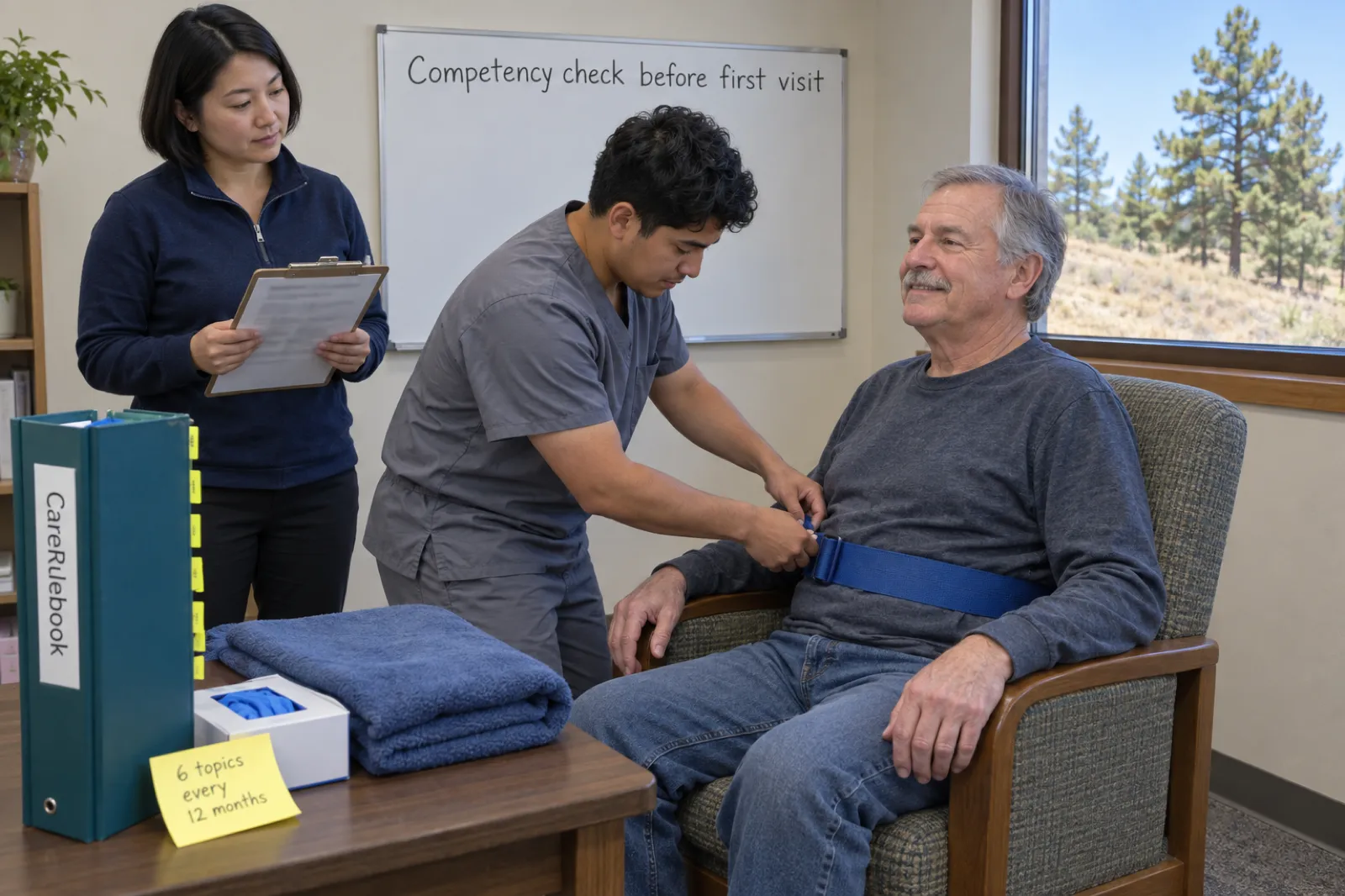
In a small training room, a young caregiver fastens a blue gait belt around an older man seated in an armchair while a woman with a clipboard watches, beside a whiteboard reading Competency check before first visit, a CareRulebook binder and a sticky note reading 6 topics every 12 months, with pine trees on a dry slope outside the window

Quick answer

Chapter 26 sets topics, not hours. A homemaker completes interactive initial training and must "pass a competency evaluation that includes a visual observation and evaluation of relevant skills, prior to providing care to a consumer." (Ch. 26, 7.3(B)). A personal care worker meets every homemaker requirement, covers five more topics, and must "pass a competency evaluation and skills validation, including visual observation, prior to providing care to a consumer." (Ch. 26, 7.4(A)-(B)). Before assignment, the HCA manager or a supervisor conducts a proof of competency evaluation (Ch. 26, 7.4(C)(3)(a)).

After that, personal care workers and supervisors cover at least six topics every 12 months, and homemakers at least four, prorated for months worked (Ch. 26, 7.4(C)(4); 7.3(C)(3)). Each worker is supervised at least every three months, in person or by live video, and in person once a year in a consumer’s home (Ch. 26, 7.8(A)). The HCA manager completes an 8-hour course, then 12 hours a year (Ch. 26, 7.2(B)(3)).
Two kinds of caregiver: homemakers and personal care workers

Ch. 26, 7.3

Homemaker

Duties may include light house cleaning, meal preparation, dishwashing and bed making, help with shopping or laundry, and companionship: "Companionship, including but not limited to: social interaction, conversation, emotional reassurance, encouragement of reading, writing, and activities that stimulate the mind."

"A homemaker shall complete training, in accordance with the following requirements, prior to providing services independently."

Ch. 26, 7.3(A), (F)

Ch. 26, 7.4

Personal care worker

Everything a homemaker may do, plus non-medical help with activities of daily living such as bathing, dressing, toileting, transfers and medication reminders, within the limits in Part 7.4(F).

"A personal care worker must meet all requirements in Part 7.3, Homemaker, in addition to the specific requirements for personal care workers outlined below, prior to providing services independently."

Ch. 26, 7.4(A), (E)-(F)

The supervisors of both are trained too: every supervisor must "have completed training in the provision of personal care services" (Ch. 26, 7.7(A)(3)). The limits on what a Class B worker may do are on the Colorado guide.

Before a new caregiver’s first visit, in order

For a personal care worker who is not exempt. A homemaker follows the same order without steps 5 and 6, which are for personal care. The background checks come first: Colorado caregiver background checks. Tick steps off as you go; progress is saved in this browser only.

  1. Orientation on hire

    On hire

    For all personnel: your policies and procedures, emergency response policies, and emergency contact numbers for the agency and for each consumer assigned, and a description of the services you provide. Each new hire also receives the complete statement of consumer rights, and training on your emergency preparedness plan and infection control policies.

  2. Interactive initial training

    Before working alone

    In person, online or a mix, with the worker demonstrating what they learned. Homemakers cover nine topics; personal care workers cover those and five more. The topics.

  3. Core homemaking competency

    Before initial training ends

    Training and a core competency evaluation of homemaking and housekeeping skills, done before initial training ends: keeping a clean, safe and healthy environment and the right, safe way to do each assigned task.

    Ch. 26, 7.3(C)(1)(i)
  4. Competency evaluation with visual observation

    Before providing care

    A homemaker passes a competency evaluation that includes visual observation and evaluation of relevant skills. A personal care worker passes a competency evaluation and skills validation, including visual observation.

    Ch. 26, 7.3(B); 7.4(B)
  5. Proof of competency before assignment

    Before assignment

    For personal care workers, the HCA manager or a supervisor conducts a proof of competency evaluation on help with activities of daily living, medication reminders, the adaptive equipment the worker will use and any other hands-on task.

    Ch. 26, 7.4(C)(3)(a)
  6. Extra training for special tasks

    Before the task

    Support stockings, over-the-counter medicated shampoo, lift devices, oxygen tank changes and redirecting a consumer who wanders each need their own training, and most a competency check, before the worker does them. The task table.

    Ch. 26, 7.4(F)
  7. Record every session

    As you go

    Date, length, who gave or produced it, a short description and the worker’s signature or proof of attendance, kept in the personnel file with any certificates.

    Ch. 26, 7.6
  8. First supervision within three months

    Within 3 months

    Supervision at least every three months, and in person in a consumer’s home once a year. CareRulebook’s manual counts the first three months from the worker’s first visit to a consumer; the rule does not say when the clock starts.

    Ch. 26, 7.8(A)(2)-(3)

Initial training topics

Initial training must be interactive: "Initial training must be interactive in nature and may be completed through the following modes: in-person, online/virtual, or a hybrid, with demonstration of learned concepts." (Ch. 26, 7.3(C)(1)). The rule lists these topics, in this order.

Every homemaker and personal care worker

  1. Duties and responsibilities, including incident reporting and mandatory reporting
  2. The rules for non-medical care and services in Chapter 26
  3. The differences between homemaker and personal care
  4. Consumer rights, including freedom from abuse or neglect and confidentiality of personal, financial and health information
  5. Basic health and safety: home safety, fall prevention, hand washing and infection control
  6. Assignment and supervision of services
  7. Communication skills
  8. The physical, emotional and developmental needs of the people you serve, how to work with them, and respect for their privacy and property
  9. Homemaking and housekeeping skills, with a core competency evaluation before initial training ends
Ch. 26, 7.3(C)(1)(a)-(i)

Personal care workers, as well

  1. The differences between personal care, nurse aide care and health care in the home, including the limiting factors for personal care (the rule points to Part 7.4(E); the limits themselves are in 7.4(F))
  2. Observing, reporting and documenting the consumer’s status and the services given
  3. Non-medical help with activities of daily living: bathing, skin, hair, nail and mouth care, shaving, dressing, feeding, walking, exercises and transfers, positioning, bladder and bowel care, and protective oversight
  4. Medication reminders
  5. Helping with any specific adaptive equipment the worker will use with consumers
Ch. 26, 7.4(C)(1)(a)-(e)

No hours, but record the length. Neither part sets a minimum number of hours, yet the training record must show the length of each session (Ch. 26, 7.6(A)(1)), so a surveyor can see how long you spent. Meal preparation: where meals are in the service contract, "the homemaker should receive instruction regarding any special diets required to be prepared." (Ch. 26, 7.3(F)(1)(a)). The rule says “should”; CareRulebook’s manual always gives that instruction and records it.

Training every year: four or six topics

  • Homemakers: "The HCA shall ensure that ongoing training of homemakers occurs and shall consist of at least four (4) training topics outlined in Part 7.3(C)(1) above every twelve (12) months" after the starting date of employment or by calendar year, as your policy chooses (Ch. 26, 7.3(C)(3)).
  • Personal care workers and supervisors: "The HCA shall ensure that ongoing supervisory and direct care staff training occurs and shall consist of at least six (6) topics every twelve (12) months", again from the start date or calendar year (Ch. 26, 7.4(C)(4)). The six must include: "Behavior management techniques and the promotion of consumer dignity, independence, self-determination, privacy, choice, and rights, including abuse and neglect prevention and reporting requirements. Disaster and emergency procedures. Infection control using universal precautions. Basic first aid and home safety." (Ch. 26, 7.4(C)(4)(a)-(d))
  • Prorated. "The training requirement shall be prorated in accordance with the number of months the employee was actively working for the HCA." (Ch. 26, 7.3(C)(3); 7.4(C)(4)). The rule does not say how to count months or round. CareRulebook’s manual counts every month with at least one working day and rounds up, so no one does less than their share; that is the manual’s method.
  • For everyone, including office staff: training on your emergency preparedness plan at least once a year and when it changes (Ch. 26, 5.10(D)), and on your infection prevention and control policies at least once a year (Ch. 26, 5.13(A)). For personal care workers and supervisors these match two of the six required items. For homemakers, infection control is one of the initial topics they can count; the emergency plan training is not on their list.

Our reading on homemakers. The six-topic rule speaks of “supervisory and direct care staff” and sits in the personal care worker part of Chapter 26, while homemakers have their own four-topic rule. By our reading, a homemaker who gives no personal care owes four topics. Chapter 26 does not define “direct care staff”, so if you want to be safe, give homemakers the six. A personal care worker must also meet the homemaker rules (Ch. 26, 7.4(A)), so CareRulebook’s manual makes at least four of their six yearly topics ones from the homemaker list.

Who is exempt from initial training

The rule says "Initial orientation or training shall not be required under the following circumstances" in three cases (Ch. 26, 7.5(A)):

WorkerConditionsStill requiredSource
A returning employee, back at the same agency within one year of leavingAll four: completed your required training and competency assessment when first employed; passes your competency assessment on rehire; had no performance issues directly related to consumer care; and all orientation, training and personnel action records from the earlier period are still in the personnel file.The competency assessment on rehire, and yearly training (our reading)Ch. 26, 7.5(A)(1)
An employee moving from one office of the agency to anotherEarlier training is documented, and both offices have the same orientation and training procedures. Each separately licensed agency keeps its own evidence of the initial orientation, training and competency evaluation.Yearly training (our reading)Ch. 26, 7.5(A)(2)
A personal care worker with a current healthcare license or certificationProof of the current license or certification, and personal care task training that is recognized as included in the training for that health discipline.Orientation, a competency evaluation, and by our reading every initial topic other than personal care tasks, and yearly trainingCh. 26, 7.5(A)(3)

Licensed and certified workers, read narrowly. The rule says "A personal care worker with proof of current healthcare related licensure or certification is exempt from initial training in the provision of personal care tasks if such training is recognized as included in the training for that health discipline." and "The HCA shall provide orientation and perform a competency evaluation to ensure the personal care worker is able to differentiate and appropriately perform all personal care worker tasks." (Ch. 26, 7.5(A)(3)). It exempts training “in the provision of personal care tasks” only. Our reading: a certified nursing assistant still takes the other initial topics, including Colorado’s limits on personal care, consumer rights and mandatory reporting, and the yearly training, and the rule does not say who decides that a discipline’s training covers personal care tasks. CareRulebook’s manual records the credential, its DORA check and the orientation and competency dates on an exemption record. A licensed or certified worker still works only as a personal care worker at a Class B agency (Ch. 26, 4.1(A)(2)).

Yearly training. The exemptions speak of initial orientation or training, so by our reading none of them covers the yearly topics. Rehires: the emergency plan and infection control rules require training “upon hire” and “at the time of hire” (Ch. 26, 5.10(D); 5.13(A)). Whether a returning employee needs them again is not stated; CareRulebook’s manual gives both on rehire, which is its reading.

Training from an outside provider

"If the HCA utilizes another entity to provide the training, the HCA must validate that the training program meets the requirements in Part 7.3(C) below and retain evidence of the individual’s successful completion of the training program in the personnel record." (Ch. 26, 7.3(B)(1))

  • Check it before you rely on it. The rule names the homemaker topics in 7.3(C). It has no matching sentence for the personal care topics, so CareRulebook’s manual checks those too, on a validation checklist, before the first worker relies on the course, when the course changes and at least once a year, and teaches any missing topic itself. That checklist and its timing are the manual’s procedure.
  • The competency checks stay with you. For a personal care worker, the proof of competency before assignment is conducted by "the HCA manager or supervisor" (Ch. 26, 7.4(C)(3)(a)), so an outside course does not replace it.
  • Online courses. Allowed for initial training if interactive, with demonstration of learned concepts (Ch. 26, 7.3(C)(1)). Watching videos alone does not meet that, by our reading.

Competency evaluations: what the rule asks, and what it leaves to you

Chapter 26 asks for:

  • a competency evaluation "that includes a visual observation and evaluation of relevant skills" for homemakers (Ch. 26, 7.3(B)), and a core competency evaluation of homemaking and housekeeping skills before initial training ends (Ch. 26, 7.3(C)(1)(i));
  • a competency evaluation and skills validation, including visual observation, for personal care workers, and the manager’s or supervisor’s proof of competency before assignment (Ch. 26, 7.4(B), (C)(3)): "The HCA is responsible for ensuring that the individuals who furnish personal care services on its behalf are competent to carry out all assigned tasks in the consumer’s place of residence.";
  • in each personnel record, qualifications that include an "appropriate, detailed, and observed competency evaluation; and written testing overseen by a person with the same or higher validated qualifications" (Ch. 26, 5.9(B)(2)(a)(i)).

What it leaves to you. Chapter 26 sets no pass mark and no format for these evaluations, and does not say who evaluates a homemaker. CareRulebook’s manual (Policy 4.6) sets its own standard: every step on an observed skills checklist done correctly, and at least 80% on a written test with every wrong answer then gone through until the worker gets it right. The first evaluation happens in the office with training equipment or a colleague playing the client, so no one practises on a consumer, and the manager or a supervisor evaluates. All of that is the manual’s choice. Because the personnel record rule lists written testing, the manual gives every worker the written test as well; that is our reading of 5.9(B)(2)(a)(i).

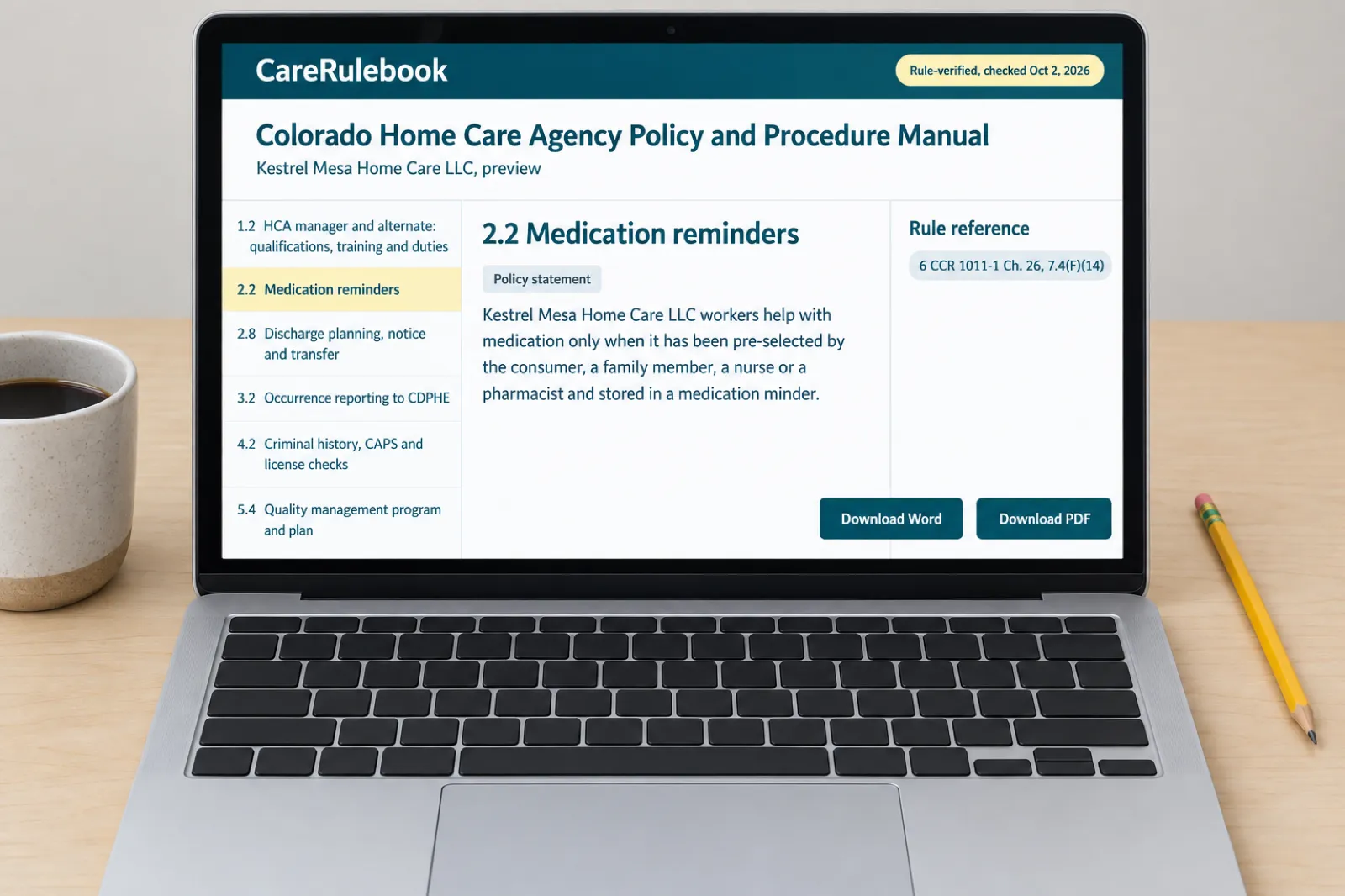
The CareRulebook Colorado manual preview on a laptop: policy 2.2 on medication reminders for a sample agency, citing 6 CCR 1011-1 Ch. 26, 7.4(F)(14), with the manual’s contents listed beside it

CareRulebook

Training, competency and supervision, written for your agency

CareRulebook’s Colorado manual includes Policy 4.4 on orientation, Policy 4.5 with the initial training outline, a yearly plan and an exemption record, Policy 4.6 with a written test, answer key and skills checklists for each task you offer, and Policy 4.7 with a supervisory visit record for the consumer’s file.

  • 33 policies, 155 requirements mapped
  • Written for review at CDPHE’s initial survey
  • Editable Word and PDF, delivered instantly
Preview your manual

$199CareRulebook founding price for the first 50 Colorado agencies, then $249. Not a CDPHE fee.

Tasks that need their own training

Part 7.4(F) lists what a personal care worker may and may not do. Six tasks come with their own training or competency condition. A worker does a task only after meeting it.

TaskWhat the rule allowsTraining and competencyCheck againSource
Support stockingsOrdinary clothing and support stockings, including ace bandages and anti-embolic or pressure stockings sold without a prescription.Training from a qualified individual in the stocking’s proper application; a proof of competency evaluation by the qualified individual before the first application.Every yearCh. 26, 7.4(F)(4)
Medicated shampooOver-the-counter medicated shampoo. Shampoo that needs a physician’s prescription may not be used.Training by your agency in the proper use of the product; a proof of competency evaluation by a qualified individual before the first use.Every yearCh. 26, 7.4(F)(7)(b)-(c)
Lift devicesA transfer involving a lift device: “Personal care workers, with training and demonstrated competency, may assist a consumer in a transfer involving a lift device.” The sentence before it bars transfer help when the consumer is unable to assist; the lift sentence does not repeat that condition, and the rule does not say how the two fit together. The bathing rule makes a lift transfer an exception to its balance and weight-bearing limit.Training and demonstrated competency.Not statedCh. 26, 7.4(F)(3)(a), (13)(d)
Gait belts and adaptive equipmentA gait belt as a safety device when the consumer can assist with the transfer. Equipment such as wheelchairs, tub seats and grab bars when the consumer, a family member or guardian can direct the transfer step by step.The worker properly trained in the gait belt; the consumer and the worker fully trained in other equipment. Help with specific adaptive equipment is an initial training topic and part of the proof of competency.Not statedCh. 26, 7.4(C)(1)(e), (F)(13)(b)-(c)
Oxygen tank changesSetting the oxygen flow by written instruction when changing tanks. Otherwise, adjusting oxygen flow is respiratory care, which is skilled.Specific training and demonstrated competency for the task.Not statedCh. 26, 7.4(F)(15)(a), (c)
WanderingProtective oversight, including for a consumer who needs it to prevent wandering.Training in appropriate intervention and redirection techniques.Not statedCh. 26, 7.4(F)(17)(b)

Who is a “qualified individual”? The support stocking and shampoo rules say a qualified individual conducts the checks, and the stocking rule says "A personal care worker that assists a consumer with application of any support stocking must receive training from a qualified individual in the stocking’s proper application." (Ch. 26, 7.4(F)(4)(b)). Chapter 26 does not define the term. CareRulebook’s manual uses the HCA manager, a supervisor who has been trained in the task and passed the same check, or a licensed health care professional you arrange; that is the manual’s reading. Our suggestion: ask CDPHE if you plan to rely on a supervisor.

Where the rule says “not stated”. For lifts, gait belts, oxygen tank changes and wandering, Chapter 26 sets no yearly recheck. CareRulebook’s manual checks a worker again before any task or device they have not been checked on, after retraining and when supervision shows a need, and suggests repeating task training once a year as Recommended practice. A lift check also happens on each consumer’s own lift, in their home with their consent, before the worker uses it alone; that is the manual’s procedure.

Supervision: every three months, and in person once a year

Who supervises

An agency employee in a designated supervisory role, at least 18, trained in personal care, with the experience or training your own policy sets, and available to the worker whenever care is given.

Ch. 26, 7.7; 7.8(A)(1)

At least every three months

Each supervision includes an assessment of consumer satisfaction with services, the worker’s competence and their adherence to the service plan.

Ch. 26, 7.8(A)(2)

In person once a year

In a consumer’s home, observing the tasks the worker performs and their relationship with the consumer.

Ch. 26, 7.8(A)(3)

In person for some complaints

When a consumer complains about the delivery of care by staff and the concern cannot be addressed remotely through an interactive audiovisual connection.

Ch. 26, 7.8(C)

Supervision by video

"The designated supervisor may evaluate the delivery of care and services required every three (3) months at Part 7.8(A)(2) through an interactive audiovisual connection with the homemaker or personal care worker and consumer." (Ch. 26, 7.9(A)(1)). The supervisor documents the results, and "All other general requirements for supervisory visits, such as documentation and meeting the same standard of care, must be met." (Ch. 26, 7.9(B)). Video is not allowed for the yearly visit or for complaints that need an in-person visit (Ch. 26, 7.9(A)).

The consumer’s right to refuse. "The consumer has the right to refuse to change from an in-person method of delivery of services to a telehealth method of delivery." "If the consumer refuses telehealth, their services shall continue in person." (Ch. 26, 5.3(A)(3)(a)(iii)). The right is written about how services are delivered. CareRulebook’s manual applies it to video supervisory visits too: it asks each consumer before the first one, records the answer in the service plan, and supervises in person for anyone who says no. That is the manual’s reading.

Recording supervision

"Evidence of all supervisory activities must be documented and retained in the consumer’s record." The record shows the date, time, method and location and who was present, the tasks evaluated or observed with the outcome, and any retraining, instruction or support given (Ch. 26, 7.8(B)). Note where it goes: the consumer’s record. Each employee also has an annual performance evaluation in their personnel file (Ch. 26, 5.9(B)(2)(d)); CareRulebook’s manual builds it from the yearly in-person visit and the year’s supervisory records.

Counting the three months. The rule does not say when the first period starts. CareRulebook’s manual sets the first supervision no later than three months after the worker’s first visit to a consumer and the first in-person visit no later than 12 months after it, then counts each from the last, and lets the yearly in-person visit count as that quarter’s supervision when it covers the three points. Those are the manual’s choices.

The HCA manager’s training: 8 hours, then 12 a year

The manager must "have successfully completed an eight (8) hour agency manager training course. Additional related annual training that equals twelve (12) hours shall be required in the first year and annually thereafter" (Ch. 26, 7.2(B)(3)). The rule adds: "A copy of the certificate of completion shall be retained in the HCA manager’s personnel file." (Ch. 26, 7.2(B)(3)(b))

  • Which course. A course is approved if it is "conducted by an accredited college, university, or vocational school or by an organization, association, corporation, group, or agency with specific expertise in that area and the curriculum includes at least eight (8) actual hours of training." and covers a home care overview (including the limits of personal care versus health care), regulatory responsibilities (consumer rights, governing body duties, quality management plans, occurrence reporting and complaints), personnel, the needs of fragile, ill and disabled people, and behavior management (Ch. 26, 7.2(D)). CDPHE publishes a List of Approved Trainings (CDPHE), but its page cites rule numbers that no longer match the chapter and describes the 24-hour Class A training (CDPHE). Our suggestion: ask the provider in writing whether the course meets the Class B 8-hour course in 7.2(B)(3) and 7.2(D).
  • Experience instead. A new manager may instead show documented and confirmed equivalent job experience or education. "The Department may require additional training to ensure that all the required components of the training curriculum are met." (Ch. 26, 7.2(B)(3)(a))
  • 12 hours a year. The rule calls it “additional related annual training”, so by our reading the 8-hour course does not count toward the first year’s 12 hours. It does not say how to count the year; CareRulebook’s manual counts from the date the manager started in the role.
  • Proof at the survey. CDPHE expects "Proof of administrator/manager training and qualifications, as applicable" at the initial survey (CDPHE guidance, step 6).

The manager is also responsible for ensuring "the implementation and monitoring of the HCA’s training program for all homemakers and personal care workers, including managing or delegating employee training and development activities for the HCA" (Ch. 26, 7.2(C)(11)), and makes sure new personnel are oriented and in-service education is provided (Ch. 26, 7.2(C)(6)). The manager’s qualifications are on the manager and supervisor page; CareRulebook’s manual covers them in Policy 1.2.

Training records

"Documented evidence of trainings, competency testing, and skills validation shall be documented with the date of training; length of training; entity or instructor(s) that offered or produced the training; a short description of the content; and staff member's written or electronic signature or proof of attendance." (Ch. 26, 7.6(A)(1)) "The HCA shall maintain evidence of training, competency testing, skills validation, and related certificates along with proof of completion in each individual’s personnel file." (Ch. 26, 7.6(A)(2))

A returning employee can skip initial training only if their earlier orientation, training and personnel action records are still on file (Ch. 26, 7.5(A)(1)(d)), which is a reason to keep a leaver’s file. CareRulebook’s manual keeps one training record per worker, a yearly training log, and a competency record listing the tasks each worker may be assigned and when any yearly check is due, so the supervisor can check it against the service plan before assigning them.

Myths about Colorado caregiver training

Do Colorado home care caregivers need a set number of training hours?

No. Chapter 26 sets topics, not hours, for Class B homemakers and personal care workers. Each completes interactive initial training on the listed topics and passes a competency evaluation with visual observation before working alone, and personal care workers also pass a skills validation. After that, personal care workers and supervisors cover at least six topics every 12 months and homemakers at least four. We have not checked HCPF’s Medicaid provider rules, so check them if you will bill Medicaid.

"shall consist of at least six (6) topics every twelve (12) months after the starting date of employment or calendar year as designated by HCA policy."

Can a certified nursing assistant skip all of my agency’s training?

No. A personal care worker with a current healthcare license or certification is exempt only from initial training in personal care tasks, and only if that training is part of their discipline’s training. Your agency still orients them and evaluates their competency, and by our reading they still take the other initial topics (such as Colorado’s limits on personal care, consumer rights and mandatory reporting) and the yearly training. Check their certification with DORA before they give care.

"The HCA shall provide orientation and perform a competency evaluation to ensure the personal care worker is able to differentiate and appropriately perform all personal care worker tasks."

Can all caregiver supervision be done by video call?

No. The three-monthly supervision may be done through an interactive audiovisual connection with the worker and the consumer, but the yearly evaluation is in person in a consumer’s home, and a care complaint that cannot be resolved remotely needs an in-person visit. A consumer can also refuse a change from in-person services to telehealth.

"With the exception of the annual supervision requirement in Part 7.8(A)(3) and responding to consumer complaints in Part 7.8(C), The HCA may conduct supervisory visits using telehealth"

Is a caregiver’s certificate from an outside course enough on its own?

No. If another organization gives the training, your agency must check that the program meets Chapter 26’s homemaker training requirements and keep proof that the worker completed it. A personal care worker still passes a competency evaluation and skills validation, with visual observation, and your HCA manager or supervisor conducts a proof of competency evaluation before you assign them.

"If the HCA utilizes another entity to provide the training, the HCA must validate that the training program meets the requirements in Part 7.3(C) below and retain evidence of the individual’s successful completion of the training program in the personnel record."

Frequently asked questions

How many hours of training do Colorado home care caregivers need?

Chapter 26 sets topics, not hours, for Class B homemakers and personal care workers. Each completes interactive initial training on the listed topics and passes a competency evaluation with visual observation before working alone. After that, personal care workers and supervisors cover at least six topics every 12 months and homemakers at least four. Records must still show how long each session lasted. We have not checked HCPF’s Medicaid provider rules, so check them if you will bill Medicaid.

What is the difference between homemaker and personal care worker training?

A homemaker, who helps with light housekeeping, meals, errands and companionship, completes nine initial topics and a competency evaluation with visual observation. A personal care worker, who also gives hands-on help with daily living, meets every homemaker requirement and adds five topics (personal care versus nurse aide and health care, observing and reporting, help with activities of daily living, medication reminders and any adaptive equipment), then passes a competency evaluation and skills validation, with a proof of competency by the manager or a supervisor before assignment.

Does a CNA need training to work for a Colorado home care agency?

A personal care worker with a current healthcare license or certification is exempt from initial training in personal care tasks, if that training is part of their discipline’s training. Your agency still orients them and evaluates their competency, to make sure they can tell personal care worker tasks apart and do them correctly. By our reading they still take the other initial topics, such as Colorado’s limits on personal care, consumer rights and mandatory reporting, and the yearly training. They work only as a personal care worker at a Class B agency.

How often must caregivers be supervised in Colorado?

At least every three months, with an assessment of consumer satisfaction, the worker’s competence and their adherence to the service plan, and once a year in person in a consumer’s home, observing the tasks and the worker’s relationship with the consumer. The supervisor must be an agency employee in a designated supervisory role, available whenever care is given, and every supervisory activity is documented in the consumer’s record.

Can supervisory visits be done by video?

The three-monthly supervision can, through an interactive audiovisual connection with the worker and the consumer, documented and held to the same standard as an in-person visit. The yearly visit is in person, and so is a visit to evaluate a care complaint that cannot be resolved remotely. Consumers have the right to refuse a change from in-person to telehealth delivery.

Can I use an online course for caregiver training?

Initial training may be in person, online or a hybrid, but it must be interactive, with demonstration of what was learned. If another organization provides it, your agency must check that the program meets Chapter 26’s homemaker topics and keep proof the worker completed it. The competency evaluations, with visual observation, still come before the worker gives care.

What training does a Colorado home care manager need?

An 8-hour agency manager training course that meets Chapter 26’s criteria, or documented and confirmed equivalent experience or education, with the certificate in the manager’s personnel file. Then 12 hours of related training in the first year and every year after. CDPHE publishes a list of approved courses, and may require additional training.

Get Colorado rule-change alerts

CDPHE has proposed changes to Chapter 2 (comments due November 12, 2026), and the home care law is due for review before September 1, 2028. Leave your email and we will tell you when a Colorado change affects your caregivers’ training or your policies.

No spam. Only emails about Colorado home care rule changes. How we use your email.

Keep reading

Sources

  1. 6 CCR 1011-1 Chapter 26, Home Care Agencies (effective July 1, 2025) · Colorado Secretary of State, Code of Colorado Regulations · retrieved October 2, 2026
  2. Initial Health Facility/Agency Licensure: Guidance and Instructions (All License Types), updated September 11, 2025 · Colorado Department of Public Health and Environment, HFEMSD · retrieved October 2, 2026
  3. Approved educational opportunities for first-time home care agency administrators and managers (page and List of Approved Trainings) · Colorado Department of Public Health and Environment · retrieved October 2, 2026
Build your Colorado manualfrom $199