| 6 CCR 1011-1 Ch. 26, 7.1(A)-(B) | Governing body or designated individual Either convene a governing body with legal authority for the agency, or designate one individual responsible for every Part 7.1 task. At least one member or the designee knows HCA operations. "At least one (1) member of the governing body or designee shall have knowledge of HCA operations." | 1.1 Governing body or designee, bylaws and annual review of operations |
| 6 CCR 1011-1 Ch. 26, 7.1(C)(1) | Bylaws or governing document Keep bylaws or a governing document that names the programs and services offered, reviewed and revised as needed. "Have bylaws or a governing document that shall specify the programs and services offered by the HCA and be reviewed and revised as needed;" | 1.1 Governing body or designee, bylaws and annual review of operations2.1 Services offered and what workers do and do not do |
| 6 CCR 1011-1 Ch. 26, 7.1(C)(2); 7.2(A) | Designate and employ an HCA manager The governing body or designee designates, employs and appoints an HCA manager to supervise services. "Designate and employ an HCA manager;" | 1.1 Governing body or designee, bylaws and annual review of operations1.2 HCA manager and alternate: qualifications, training and duties |
| 6 CCR 1011-1 Ch. 26, 7.1(C)(3) | Adopt policies, review them every year Develop and adopt policies and procedures for operating and administering the agency; review them annually and revise as needed. "Develop and adopt policies and procedures for the operation and administration of the HCA, to be reviewed annually and revised as needed;" | 1.3 Policies and procedures: adoption, staff access and annual review1.1 Governing body or designee, bylaws and annual review of operations |
| 6 CCR 1011-1 Ch. 26, 7.1(C)(4) | Services follow the service plan and policy Every program or service, direct or under arrangement, follows the consumer’s service plan and agency policy. "Ensure any program or service offered by the HCA, directly or under arrangement, shall be provided in accordance with the service plan and HCA policy and procedure;" | 2.3 Admission, intake assessment, service plan and coordination of care1.1 Governing body or designee, bylaws and annual review of operations |
| 6 CCR 1011-1 Ch. 26, 7.1(C)(5)-(6) | Annual review of operations and minutes Review the agency’s operations at least annually and keep minutes of all governing body meetings. "Review the operations of the HCA at least annually;" | 1.1 Governing body or designee, bylaws and annual review of operations5.5 Annual agency evaluation, consumer input and quarterly record review |
| 6 CCR 1011-1 Ch. 26, 7.1(C)(6) | Keep minutes Keep minutes of all meetings of the governing body (or designee decisions). "Keep minutes of all meetings;" | 1.1 Governing body or designee, bylaws and annual review of operations |
| 6 CCR 1011-1 Ch. 26, 7.1(C)(7); 5.1 | Fixed office in Colorado Provide a fixed office in Colorado that protects consumer confidentiality and is a safe place to work, able to run day-to-day business. "Provide and maintain a fixed office location that provides for consumer confidentiality and a safe working environment; and" | 1.4 Office, workstations and branch offices |
| 6 CCR 1011-1 Ch. 26, 7.1(C)(8) | Written organization and lines of authority Set out in writing how services are organized, administrative control and lines of authority down to the consumer care level. "Organize services furnished, administrative control, and lines of authority for the delegation of responsibility down to the consumer care level that are clearly set forth in writing and are readily identifiable." | 1.1 Governing body or designee, bylaws and annual review of operations |
| 6 CCR 1011-1 Ch. 26, 7.1(D)(1)-(2) | Comprehensive annual evaluation At least once a year, evaluate the whole operation; use the findings to check policies are followed, find problems and revise policies, including the quality management program’s findings. "The HCA's governing body or designee shall conduct a comprehensive evaluation of the HCA's total operation at least annually." | 5.5 Annual agency evaluation, consumer input and quarterly record review |
| 6 CCR 1011-1 Ch. 26, 7.1(D)(3) | Ongoing policy and administrative review Run ongoing process improvement and policy review covering scope of services, arrangements with others, admission and discharge policies, supervision and service plans, urgent care, service records and personnel qualifications. "The HCA shall implement a method for ongoing process improvement and policy and administrative review, which includes a review of the scope of services offered, arrangements for services with other agencies or individuals, admission and discharge policies, supervision and service plan, urgent consumer care, service records, and personnel qualifications." | 5.5 Annual agency evaluation, consumer input and quarterly record review1.3 Policies and procedures: adoption, staff access and annual review |
| 6 CCR 1011-1 Ch. 26, 7.1(D)(3)(a)-(b) | Consumer input mechanism Have an ongoing way, set by agency policy, for consumers to comment on services; report findings and consumer input to the governing body at least annually. "The HCA shall implement an on-going mechanism for consumer involvement to provide input and comment regarding services provided by the HCA in accordance with HCA policy." | 5.5 Annual agency evaluation, consumer input and quarterly record review5.4 Quality management program and plan |
| 6 CCR 1011-1 Ch. 26, 7.1(D)(4) | Four evaluation criteria Judge each part of the program on appropriateness, adequacy, effectiveness and efficiency. "In evaluating each aspect of its total program, the HCA shall consider four (4) main criteria:" | 5.5 Annual agency evaluation, consumer input and quarterly record review |
| 6 CCR 1011-1 Ch. 26, 7.1(D)(5) | Document the evaluation Record who carried out the evaluation (names and titles), the criteria and methods used and the actions taken. "Documentation of the annual evaluation shall include the names and titles of the persons carrying out the evaluation, the criteria and methods used to accomplish it, and any action taken by the HCA as a result of its findings." | 5.5 Annual agency evaluation, consumer input and quarterly record review |
| 6 CCR 1011-1 Ch. 26, 7.1(D)(6) | Quarterly consumer record review At least quarterly, qualified staff review a representative sample of active and closed consumer records to check policies are followed and service quality is appropriate. "Appropriate qualified individuals representing the programs and services offered by the HCA shall evaluate the HCA's consumer records on an ongoing basis, but no less than quarterly." | 5.5 Annual agency evaluation, consumer input and quarterly record review5.1 Consumer records, service notes and information management |
| 6 CCR 1011-1 Ch. 26, 7.2(B)(1)-(2), (4) | Manager qualifications The manager is 21 or older with a high school diploma or GED and one year of documented supervisory experience in personal care (or the degree-plus-experience alternatives), communicates effectively, and knows the applicable laws. "Be at least twenty-one (21) years of age, possess a high school diploma or GED, and have at least one (1) year documented supervisory experience in the provision of personal care services;" | 1.2 HCA manager and alternate: qualifications, training and duties4.1 Job descriptions, qualifications and competence |
| 6 CCR 1011-1 Ch. 26, 7.2(B)(3) | Manager course and 12 hours a year Keep proof that the manager completed an approved 8-hour manager course (or documented equivalent) and 12 hours of related training in the first year and every year after; file the certificate. "A copy of the certificate of completion shall be retained in the HCA manager’s personnel file." | 1.2 HCA manager and alternate: qualifications, training and duties4.8 Personnel records and annual performance evaluations |
| 6 CCR 1011-1 Ch. 26, 7.2(C)(1)-(3) | Manager: compliance, reports and liaison The manager ensures legal compliance, completes and submits CDPHE reports and records, and liaises with the governing body or designee, staff and community. "The HCA is in compliance with all applicable federal, state, and local laws;" | 1.2 HCA manager and alternate: qualifications, training and duties |
| 6 CCR 1011-1 Ch. 26, 7.2(C)(4) | Current organizational chart Keep a current organizational chart showing lines of authority down to the consumer. "Maintenance of a current organizational chart to show lines of authority down to the consumer level;" | 1.2 HCA manager and alternate: qualifications, training and duties1.1 Governing body or designee, bylaws and annual review of operations |
| 6 CCR 1011-1 Ch. 26, 7.2(C)(5) | Manager keeps records and policies The manager maintains personnel, bookkeeping and administrative records and the agency’s policies and procedures. "Maintenance of appropriate personnel, bookkeeping, and administrative records and policies and procedures of the HCA;" | 1.2 HCA manager and alternate: qualifications, training and duties1.3 Policies and procedures: adoption, staff access and annual review |
| 6 CCR 1011-1 Ch. 26, 7.2(C)(6) | Orientation and in-service education Ensure new personnel get orientation and that regular in-service education and continuing education opportunities are provided. "Orientation of new personnel, and regularly scheduled in-service education programs and opportunities for continuing education are provided for personnel;" | 4.4 Orientation on hire1.2 HCA manager and alternate: qualifications, training and duties4.5 Homemaker and personal care worker training: initial, annual and exemptions |
| 6 CCR 1011-1 Ch. 26, 7.2(C)(7) | Written designation of an alternate Designate in writing the qualified staff member who acts when the manager is absent. "Designating in writing the qualified staff member to act in the absence of the manager;" | 1.2 HCA manager and alternate: qualifications, training and duties |
| 6 CCR 1011-1 Ch. 26, 7.2(C)(8) | Manager or designee available during all service hours The manager or a designee is available for all hours that personnel are providing services. "Availability of the manager or designee for all hours that personnel are providing services;" | 1.2 HCA manager and alternate: qualifications, training and duties2.7 Scheduling, missed visits and backup coverage |
| 6 CCR 1011-1 Ch. 26, 7.2(C)(9) | Accurate marketing Marketing, advertising and promotional material accurately represents the agency and only the care and services it can provide directly or by contract (no skilled services for Class B). "Marketing, advertising, and promotional information accurately represent the HCA and address the care, treatment, and services that the HCA can provide directly or through contractual arrangement;" | 2.1 Services offered and what workers do and do not do1.2 HCA manager and alternate: qualifications, training and duties |
| 6 CCR 1011-1 Ch. 26, 7.2(C)(10) | Agency-wide infection prevention program Maintain a coordinated, agency-wide infection prevention and control program that is part of the quality management program. "Maintenance of a coordinated HCA-wide program for appropriate infection prevention and control that is an integral part of the HCA’s quality management program; and" | 3.5 Infection prevention and control and personnel health5.4 Quality management program and plan1.2 HCA manager and alternate: qualifications, training and duties |
| 6 CCR 1011-1 Ch. 26, 7.2(C)(11) | Worker training program The manager implements and monitors the training program for homemakers and personal care workers, managing or delegating training and development. "The implementation and monitoring of the HCA’s training program for all homemakers and personal care workers, including managing or delegating employee training and development activities for the HCA." | 1.2 HCA manager and alternate: qualifications, training and duties4.5 Homemaker and personal care worker training: initial, annual and exemptions |
| 6 CCR 1011-1 Ch. 26, 7.3(A)-(C)(1) | Homemaker initial training and competencyif the agency employs homemakers (every personal care worker must also meet Part 7.3) Homemakers complete interactive initial training (duties and incident and mandatory reporting; non-medical rules; homemaker vs personal care; consumer rights; basic health and safety; assignment and supervision; communication; needs of the populations served; homemaking skills competency) and pass a competency evaluation with visual observation before serving consumers. "A homemaker must complete training as specified in Part 7.3(C) and pass a competency evaluation that includes a visual observation and evaluation of relevant skills, prior to providing care to a consumer." | 4.6 Competency evaluations, skills validation and training records4.5 Homemaker and personal care worker training: initial, annual and exemptions |
| 6 CCR 1011-1 Ch. 26, 7.3(B)(1) | Validating outside trainingif the agency uses an outside training provider If another organization trains staff, check the program meets the Part 7.3(C) topics and file proof of completion in the personnel record. "If the HCA utilizes another entity to provide the training, the HCA must validate that the training program meets the requirements in Part 7.3(C) below and retain evidence of the individual’s successful completion of the training program in the personnel record." | 4.5 Homemaker and personal care worker training: initial, annual and exemptions4.6 Competency evaluations, skills validation and training records |
| 6 CCR 1011-1 Ch. 26, 7.3(C)(2); 7.4(C)(2) | Orientation on hire Orient all personnel on hire to agency policies and procedures, emergency response policies, emergency contact numbers for the agency and each assigned consumer, and a description of the agency’s services. "The HCA shall provide orientation for all personnel upon hire that includes, but is not limited to HCA policies and procedures and emergency response policies and emergency contact numbers for the HCA and for the individual consumer(s) assigned." | 4.4 Orientation on hire |
| 6 CCR 1011-1 Ch. 26, 7.3(C)(3) | Homemaker annual trainingif the agency employs homemakers Homemakers complete at least four of the initial training topics every 12 months (from hire date or calendar year, as policy sets), prorated for months worked. "The HCA shall ensure that ongoing training of homemakers occurs and shall consist of at least four (4) training topics outlined in Part 7.3(C)(1) above every twelve (12) months" | 4.5 Homemaker and personal care worker training: initial, annual and exemptions |
| 6 CCR 1011-1 Ch. 26, 7.3(F)(1)(a) | Special diet instructionif meals are prepared Where meal preparation is in the service contract, instruct the homemaker on any special diet (the rule says "should"). "Where meal preparation is provided in accordance with the service contract, the homemaker should receive instruction regarding any special diets required to be prepared." | 2.3 Admission, intake assessment, service plan and coordination of care2.1 Services offered and what workers do and do not do4.5 Homemaker and personal care worker training: initial, annual and exemptions |
| 6 CCR 1011-1 Ch. 26, 7.3(E)(1); 7.4(D)(2) | Workers report changes and hazards Workers report environmental concerns and any observed or stated changes in the consumer’s physical, cognitive or developmental status to the agency. "Reporting any observed environmental concerns or changes in the consumer’s status that may impact the safety and security of the consumer to the HCA." | 2.1 Services offered and what workers do and do not do5.1 Consumer records, service notes and information management |
| 6 CCR 1011-1 Ch. 26, 7.3(E)(2); 2.28 | Service notes with time in and out Workers complete a signed, dated and timed service note for every visit confirming services provided and time in and out, in the form agency policy sets. "Completion of appropriate service notes regarding service provision of each visit, to include confirmation of services provided and the date and time in and out. Such confirmation shall also be according to HCA policy." | 5.1 Consumer records, service notes and information management |
| 6 CCR 1011-1 Ch. 26, 7.4(A)-(C)(1) | Personal care worker training Personal care workers complete the homemaker topics plus personal care vs nurse aide and health care; observing, reporting and documenting; non-medical ADL help (bathing to protective oversight); medication reminders; and any adaptive equipment they will use, then pass a competency evaluation and skills validation with visual observation. "A personal care worker must complete training as specified in Part 7.4(C), personal care worker training, and pass a competency evaluation and skills validation, including visual observation, prior to providing care to a consumer." | 4.6 Competency evaluations, skills validation and training records4.5 Homemaker and personal care worker training: initial, annual and exemptions |
| 6 CCR 1011-1 Ch. 26, 7.4(C)(3) | Competency before assignment Ensure workers are competent for all assigned tasks; before assignment, the manager or supervisor completes a proof of competency evaluation on ADL help, medication reminders, adaptive equipment and other hands-on tasks. "The HCA is responsible for ensuring that the individuals who furnish personal care services on its behalf are competent to carry out all assigned tasks in the consumer’s place of residence." | 4.6 Competency evaluations, skills validation and training records |
| 6 CCR 1011-1 Ch. 26, 7.4(C)(4) | Annual training for workers and supervisors Supervisory and direct care staff complete at least six topics every 12 months (prorated), including behavior management, dignity and rights with abuse and neglect prevention and reporting, disaster and emergency procedures, infection control with universal precautions, and basic first aid and home safety. "Training shall include, but is not limited to, the following items:" | 4.5 Homemaker and personal care worker training: initial, annual and exemptions |
| 6 CCR 1011-1 Ch. 26, 7.4(D)-(E) | Personal care worker duties Workers maintain a safe home environment per the service plan, report status changes, and give non-medical ADL help and other tasks only as included in the service plan. "Assistance with non-medical activities of daily living, personal care, and any other assignments as included in the service plan." | 2.3 Admission, intake assessment, service plan and coordination of care2.1 Services offered and what workers do and do not do |
| 6 CCR 1011-1 Ch. 26, 7.4(F)(1)-(18) | Personal care task limits Keep personal care within the task limits for skin care, ambulation, bathing, dressing, exercise, feeding, hair, mouth and nail care, positioning, shaving, toileting, transfers, medication, respiratory care, accompaniment, protective oversight and respite; refer higher needs to skilled care. "The purpose of this part is to delineate the types of services that can be provided by a personal care worker." | 2.1 Services offered and what workers do and do not do |
| 6 CCR 1011-1 Ch. 26, 7.4(F)(4)(b) | Support stocking competencyif workers apply support stockings Workers who apply support stockings are trained by a qualified individual and pass a proof of competency evaluation before applying them and every year. "Prior to application and on an annual basis, the qualified individual shall conduct a proof of competency evaluation in the correct application of support stockings." | 4.6 Competency evaluations, skills validation and training records2.1 Services offered and what workers do and do not do |
| 6 CCR 1011-1 Ch. 26, 7.4(F)(7)(c) | Over-the-counter medicated shampoo competencyif workers use over-the-counter medicated shampoos Workers using over-the-counter medicated shampoos are trained by the agency, with a proof of competency evaluation before use and every year. "Prior to application and on an annual basis, a qualified individual shall conduct a proof of competency evaluation in the correct use of these products." | 4.6 Competency evaluations, skills validation and training records2.1 Services offered and what workers do and do not do |
| 6 CCR 1011-1 Ch. 26, 7.4(F)(13)(b)-(d) | Transfer equipment trainingif workers use transfer equipment or lift devices Adaptive and safety equipment is used in a transfer only when the consumer and worker are fully trained in it and the consumer, a family member or guardian can direct the transfer step by step; a gait belt only by a trained worker with a consumer able to assist. Workers do not assist with a transfer when the consumer is unable to assist, but with training and demonstrated competency may assist in a transfer involving a lift device (the bathing rule, 7.4(F)(3)(a), treats a lift transfer as an exception to its balance and weight-bearing limit). "Personal care workers, with training and demonstrated competency, may assist a consumer in a transfer involving a lift device." | 4.6 Competency evaluations, skills validation and training records2.1 Services offered and what workers do and do not do |
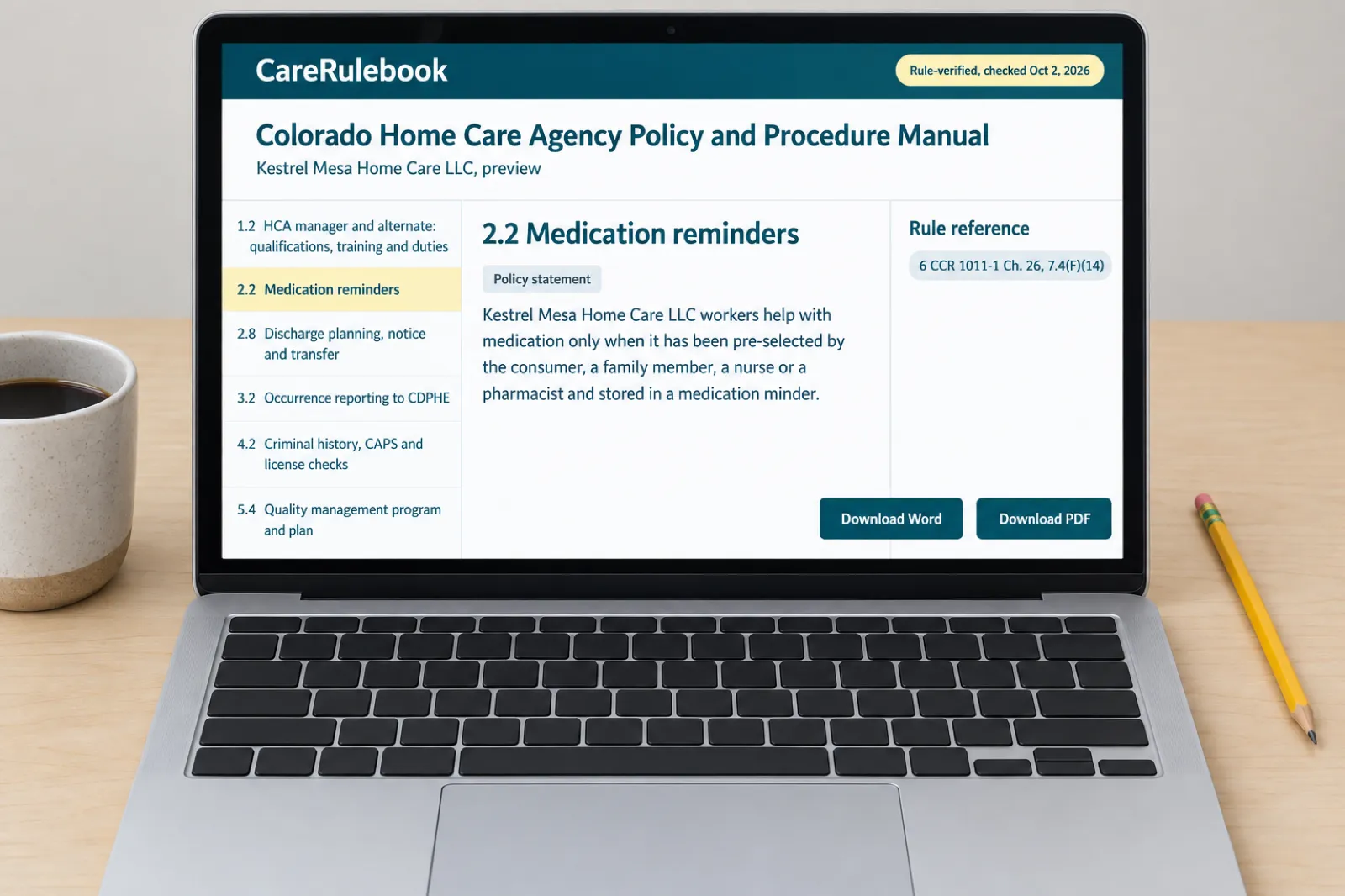
| 6 CCR 1011-1 Ch. 26, 7.4(F)(14) | Medication reminders Medication help is limited to pre-filled, clearly marked medication minders (asking, prompting, handing over, opening if the consumer cannot); irregularities are reported immediately to the supervisor. "Any irregularities noted in the pre-selected medications such as medications taken too often, not often enough, or not at the correct time as marked in the medication minder container, shall be reported immediately by the personal care worker to the supervisor." | 2.2 Medication reminders |
| 6 CCR 1011-1 Ch. 26, 7.4(F)(15)(c) | Oxygen tank changesif workers change oxygen tanks Only specifically trained workers with demonstrated competency set oxygen flow, by written instruction, when changing tanks. "Personal care workers may set a consumer’s oxygen flow according to written instruction when changing tanks, provided the personal care worker has been specifically trained and demonstrated competency for this task." | 4.6 Competency evaluations, skills validation and training records2.1 Services offered and what workers do and do not do |
| 6 CCR 1011-1 Ch. 26, 7.4(F)(17)(b) | Wandering and redirectionif the agency serves consumers who wander Workers giving protective oversight to prevent wandering are trained in intervention and redirection. "When the consumer requires protective oversight to prevent wandering, the personal care worker shall have been trained in appropriate intervention and redirection techniques." | 4.6 Competency evaluations, skills validation and training records2.1 Services offered and what workers do and do not do |
| 6 CCR 1011-1 Ch. 26, 7.4(G) | Prohibited tasks Do not allow personal care workers to perform skilled services, set up medications, or do anything agency policy, regulation or law prohibits. "In addition to the exclusions prescribed in the preceding section, the HCA shall not allow personal care workers to:" | 2.2 Medication reminders2.1 Services offered and what workers do and do not do |
| 6 CCR 1011-1 Ch. 26, 7.5 | Training exemptionsif the agency uses a training exemption Apply the training exemptions only as the rule allows: returning employees within a year (with all four conditions), transfers between offices with the same training, and licensed or certified workers (still oriented and competency-checked). "Initial orientation or training shall not be required under the following circumstances:" | 4.5 Homemaker and personal care worker training: initial, annual and exemptions |
| 6 CCR 1011-1 Ch. 26, 7.6 | Training and competency records Document all training, competency testing and skills validation with date, length, trainer or provider, a short content description and the worker’s signature or proof of attendance, and keep it with certificates in each personnel file. "Documented evidence of trainings, competency testing, and skills validation shall be documented with the date of training; length of training; entity or instructor(s) that offered or produced the training; a short description of the content; and staff member's written or electronic signature or proof of attendance." | 4.8 Personnel records and annual performance evaluations4.6 Competency evaluations, skills validation and training records |
| 6 CCR 1011-1 Ch. 26, 7.7 | Supervisor qualifications in policy Supervisors are 18 or older, have completed personal care training, and have the home care experience or training the agency’s policy specifies. "Have appropriate experience or training in the home care industry or closely related personal care services in accordance with HCA policy; and" | 4.1 Job descriptions, qualifications and competence4.7 Supervisors and supervision of homemakers and personal care workers |
| 6 CCR 1011-1 Ch. 26, 7.8(A)(1) | Supervisor available at all times Supervision is done by an agency employee qualified under 7.7, in a designated supervisory role and available to the worker whenever care is given. "Be performed by an employee of the HCA qualified as a supervisor under Part 7.7, who is in a designated supervisory capacity and available to the worker at all times care and services are being provided;" | 4.7 Supervisors and supervision of homemakers and personal care workers |
| 6 CCR 1011-1 Ch. 26, 7.8(A)(2) | Supervision every three months Supervise each worker at least every three months, in person or by telehealth, assessing consumer satisfaction, the worker’s competence and adherence to the service plan. "Occur at a minimum of every three (3) months and must include an assessment of consumer satisfaction with services and the worker’s competence and adherence to the service plan." | 4.7 Supervisors and supervision of homemakers and personal care workers |
| 6 CCR 1011-1 Ch. 26, 7.8(A)(3) | Annual in-person evaluation Evaluate each worker in person once a year in a consumer’s home, observing tasks and the relationship with the consumer. "Occur, in person, annually for evaluation of each worker providing services in a consumer’s home and shall include observation of tasks performed and relationship with the consumer." | 4.7 Supervisors and supervision of homemakers and personal care workers |
| 6 CCR 1011-1 Ch. 26, 7.8(B) | Supervision records in the consumer record Document every supervisory activity in the consumer’s record: date, time, method, location, people present, tasks evaluated and outcome, and any retraining or support given. "Evidence of all supervisory activities must be documented and retained in the consumer’s record." | 4.7 Supervisors and supervision of homemakers and personal care workers5.1 Consumer records, service notes and information management |
| 6 CCR 1011-1 Ch. 26, 7.8(C) | In-person visit for care complaints Make an in-person supervisory visit to evaluate a complaint about staff care that cannot be resolved by audiovisual connection. "An in-person supervisory visit is required to evaluate consumer complaints related to the delivery of care by staff when such concerns cannot be successfully addressed remotely through an interactive audiovisual connection." | 4.7 Supervisors and supervision of homemakers and personal care workers3.1 Complaints and grievances |
| 6 CCR 1011-1 Ch. 26, 7.9 | Telehealth supervision standardsif the agency supervises by telehealth Telehealth supervisory visits use an interactive audiovisual connection with worker and consumer, are documented by the supervisor, and meet the same standards as in-person visits. "All other general requirements for supervisory visits, such as documentation and meeting the same standard of care, must be met." | 4.7 Supervisors and supervision of homemakers and personal care workers |
| 6 CCR 1011-1 Ch. 26, 5.2(A)-(B) | Branch notice and same servicesif the agency opens a branch office Tell CDPHE in advance before opening a branch (services, area within the parent’s area, daily supervision plan); a branch offers only the parent’s services. "A branch office, as an extension of the parent agency, may not offer services that are different than those offered by the parent agency." | 1.4 Office, workstations and branch offices1.5 License, insurance, renewal, changes and closure |
| 6 CCR 1011-1 Ch. 26, 5.2(C)-(E), (H) | Branch supervision and coverageif the agency has a branch office The parent supervises the branch daily, provides backup coverage, visits it on site as policy sets, keeps a qualified supervisor available during all branch hours and stays aware of branch staffing and census. "The parent agency administrator, manager, or supervisor shall conduct an on-site visit of the branch office in accordance with agency policy." | 4.7 Supervisors and supervision of homemakers and personal care workers1.4 Office, workstations and branch offices |
| 6 CCR 1011-1 Ch. 26, 5.2(F)-(G) | Policies and records at branchesif the agency has a branch office Each branch keeps a copy of all agency policies readily accessible to staff, and consumer records are accessible to all staff giving care. "The branch office shall have a copy of all agency policies available and readily accessible to staff." | 1.3 Policies and procedures: adoption, staff access and annual review1.4 Office, workstations and branch offices |
| 6 CCR 1011-1 Ch. 26, 5.3(A)(1)(a) | Rights statement to all staff on hire Give every new hire a complete statement of consumer rights, including the right to complain to CDPHE. "A complete statement of consumer rights, including the right to file a complaint with the Department, shall be distributed to all personnel upon hire." | 2.5 Consumer rights, including freedom from restraint4.4 Orientation on hire |
| 6 CCR 1011-1 Ch. 26, 5.3(A)(1)(b) | Rights policy minimum contents Policies state that consumers are told their rights effectively, that care is not conditioned on or discriminated by personal, cultural or ethnic preference, disability or advance directive status, and that the agency protects and promotes these rights. "The consumer has the right to be assured that the HCA shall not condition the provision of care, or otherwise discriminate against a consumer, based upon personal, cultural, or ethnic preference, disabilities, or whether the consumer has an advance directive." | 2.5 Consumer rights, including freedom from restraint2.4 Notices at the start of services: disclosure, rights, advance directives, payment and hotline |
| 6 CCR 1011-1 Ch. 26, 5.3(A)(2)(a)-(h) | Respect, safety and confidentiality rights Protect the rights to exercise rights without retaliation, respect for person and property, freedom from neglect, exploitation and abuse, staff identity on request, trained staff, freedom from restraint and confinement, to complain, and to confidentiality. "The consumer has the right to be free from neglect; financial exploitation; and verbal, physical, and psychological abuse, including humiliation, intimidation, or punishment." | 2.5 Consumer rights, including freedom from restraint3.3 Abuse, neglect and exploitation: prevention, investigation and mandatory reports |
| 6 CCR 1011-1 Ch. 26, 5.3(A)(2)(i) | Policy on disclosing clinical information Have, and tell consumers about, the agency’s policies on disclosure of clinical information and records. "The HCA shall advise the consumer of the agency's policies and procedures regarding disclosure of clinical information and records." | 2.5 Consumer rights, including freedom from restraint5.2 Consumer access to records and release of information |
| 6 CCR 1011-1 Ch. 26, 5.3(A)(3)(a) | Informing consumers in advance Tell the consumer in advance about the care, method of delivery and services, and any changes, so they can give informed consent; respect refusals and explain consequences. "The HCA shall inform the consumer or authorized representative, in advance, about the care, method of delivery, and services to be furnished, and of any changes in the care, method of delivery, and services to be furnished, to enable the consumer to give informed consent." | 2.5 Consumer rights, including freedom from restraint2.3 Admission, intake assessment, service plan and coordination of care |
| 6 CCR 1011-1 Ch. 26, 5.3(A)(3)(a)(iii) | Right to refuse telehealth If a consumer refuses a change from in-person to telehealth delivery, continue services in person. "If the consumer refuses telehealth, their services shall continue in person." | 2.5 Consumer rights, including freedom from restraint4.7 Supervisors and supervision of homemakers and personal care workers |
| 6 CCR 1011-1 Ch. 26, 5.3(A)(3)(b) | Participation in planning care Offer the consumer the right to take part in developing the plan, with instruction and education on it, and advise them of this right in advance. "The HCA shall offer the consumer or authorized representative the right to participate in developing the plan of care, and receive instruction and education regarding the plan." | 2.3 Admission, intake assessment, service plan and coordination of care2.5 Consumer rights, including freedom from restraint |
| 6 CCR 1011-1 Ch. 26, 5.3(A)(4) | Prompt care Provide care promptly in line with the care plan. "The consumer has the right to receive prompt care in accordance with the care plan." | 2.3 Admission, intake assessment, service plan and coordination of care2.7 Scheduling, missed visits and backup coverage |
| 6 CCR 1011-1 Ch. 26, 5.3(A)(5)(a)-(b) | Notice of billing changes Give 30 days’ written notice of a scheduled rate increase to all consumers, and explain individual billing changes orally and in writing within 5 business days of learning of them. "The HCA shall advise the consumer of any individual changes, orally and in writing, as soon as possible, but no later than five (5) business days from the date that the HCA becomes aware of a change." | 2.6 Charges, billing changes and consumers’ money |
| 6 CCR 1011-1 Ch. 26, 5.3(A)(5)(c) | No power of attorney or property for services Never take power of attorney or guardianship, require checks endorsed to the agency, or take loans, interests or property in exchange for future services. "require a consumer to endorse checks over to the HCA, or require a consumer to execute or assign a loan, advance, financial interest, mortgage, or other property in exchange for future services." | 2.6 Charges, billing changes and consumers’ money2.5 Consumer rights, including freedom from restraint |
| 6 CCR 1011-1 Ch. 26, 5.3(A)(6); 5.6(E) | State hotline information Tell consumers in writing, on acceptance, about the state’s toll-free home care hotline: its number, hours and that it takes complaints and questions, including about advance directives. "When the HCA accepts the consumer for treatment or care, the HCA shall inform the consumer, in writing, of the telephone number of the home health hotline established by the state, the hours of its operation, and that the purpose of the hotline is to receive complaints or questions about local HCAs." | 2.4 Notices at the start of services: disclosure, rights, advance directives, payment and hotline3.1 Complaints and grievances2.5 Consumer rights, including freedom from restraint |
| 6 CCR 1011-1 Ch. 26, 5.3(A)(7) | Ownership disclosure and change of owner notice On request, give consumers a written list of everyone with ownership or controlling interest; a new owner after a change of ownership writes to every consumer naming the owners and offering continued service or help transferring. "When a change of ownership occurs, the new owner shall send a written notice to all of the HCA’s consumers listing all of the new owners and give the consumer the opportunity to continue services with the HCA or receive assistance in transferring care and services to a different HCA." | 1.5 License, insurance, renewal, changes and closure |
| 6 CCR 1011-1 Ch. 26, 5.3(A)(8); 5.6(F) | Documentation of rights compliance Keep documentation showing the agency met the consumer rights and notice requirements. "The HCA shall maintain documentation showing that it has complied with the requirements of this section." | 2.5 Consumer rights, including freedom from restraint2.4 Notices at the start of services: disclosure, rights, advance directives, payment and hotline |
| 6 CCR 1011-1 Ch. 26, 5.4(A) | Admit only needs the agency can meet Accept consumers only with reasonable assurance the agency can meet their needs at home. "Agencies shall only accept consumers for care or services on the basis of a reasonable assurance that the needs of the consumer can be met adequately by the agency in the individual’s temporary or permanent home or place of residence." | 2.3 Admission, intake assessment, service plan and coordination of care |
| 6 CCR 1011-1 Ch. 26, 5.4(A)(1) | Agreed days and times, updated yearly Document the agreed days and times of service based on the consumer’s needs, and update at least annually. "There shall be initial documentation of the agreed upon days and times of services to be provided, based upon the consumer’s needs, that is updated at least annually." | 2.3 Admission, intake assessment, service plan and coordination of care |
| 6 CCR 1011-1 Ch. 26, 5.4(B) | Referrals for unavailable services If needed services are not available at referral, tell the consumer and primary care provider, and admit only if both agree the services can be delayed or discontinued. "If an agency receives a referral of a consumer who requires care or services that are not available at the time of referral, the agency shall advise the consumer’s primary care provider, if applicable, and the consumer or authorized representative of that fact." | 2.3 Admission, intake assessment, service plan and coordination of care |
| 6 CCR 1011-1 Ch. 26, 5.5(A)-(B) | Discharge plan in every record Keep a specific discharge plan in each consumer record with ongoing discharge planning; document when no improvement or discharge is expected. "There shall be a specific plan for discharge in the consumer record, and there shall be ongoing discharge planning with the consumer." | 2.8 Discharge planning, notice and transfer5.1 Consumer records, service notes and information management |
| 6 CCR 1011-1 Ch. 26, 5.5(C) | Help finding another provider Help consumers who still need care find another agency and document due diligence on continuity of care. "The HCA shall assist each consumer or authorized representative to find an appropriate placement with another agency if the consumer continues to require care and/or services upon discharge." | 2.8 Discharge planning, notice and transfer |
| 6 CCR 1011-1 Ch. 26, 5.5(D) | Efforts before discharge, and notice Do not discontinue or refuse services without documented efforts to resolve the problem; tell the consumer verbally and in writing of the intent to discharge and why. "Once admitted, an HCA shall not discontinue or refuse services to a consumer unless documented efforts have been made to resolve the situation that triggered such discontinuation or refusal to provide services." | 2.8 Discharge planning, notice and transfer |
| 6 CCR 1011-1 Ch. 26, 5.5(E) | Notify CDPHE of unsafe discharges Notify CDPHE before discharging a consumer who needs and wants continuing paid care with no transfer arranged; report emergency discharges made to protect staff within 48 hours. "Emergency discharges necessary to protect the safety and welfare of staff shall be reported to the Department within forty-eight (48) hours of the occurrence." | 2.8 Discharge planning, notice and transfer |
| 6 CCR 1011-1 Ch. 26, 5.6(A) | Agency disclosure notice Within one business day of starting services, give a signed disclosure notice (CDPHE form) stating who is responsible for employment, liability, wages, taxes, insurance, supervision, scheduling, duties, hiring and firing, supplies and training; get it acknowledged, or document a verbal explanation if the consumer will not sign. "Within one (1) business day of the start of services, the HCA shall provide a written disclosure notice to the consumer or authorized representative that specifies the service provided by the HCA and the consumer’s obligation regarding the home care worker." | 2.4 Notices at the start of services: disclosure, rights, advance directives, payment and hotline |
| 6 CCR 1011-1 Ch. 26, 5.6(B) | Notice of consumer rights Within one business day of starting services, give the CDPHE-format rights notice in a way the consumer understands, including options if rights are violated and how to reach the agency’s complaint contact. "The notice shall include information about the consumer’s options if rights are violated, including how to contact an individual employed with the HCA who is responsible for the complaint intake and problem resolution process." | 2.4 Notices at the start of services: disclosure, rights, advance directives, payment and hotline2.5 Consumer rights, including freedom from restraint3.1 Complaints and grievances |
| 6 CCR 1011-1 Ch. 26, 5.6(C) | Advance directives policy Within one business day of starting services (and before care), inform the consumer of the agency’s advance directives policies, including a description of Colorado law. "Within one (1) business day of the start of services, the HCA shall inform the consumer concerning the agency’s policies on advance directives, including a description of applicable state law." | 2.4 Notices at the start of services: disclosure, rights, advance directives, payment and hotline |
| 6 CCR 1011-1 Ch. 26, 5.6(D) | Payment information Within one business day of starting services, tell the consumer orally and in writing what insurance or other sources may pay and what the consumer may owe. "Within one (1) business day of the start of services, the HCA shall inform the consumer or authorized representative, orally and in writing, of the extent to which payment for the HCA services may be expected from insurance or other sources and the extent to which payment may be required from the consumer." | 2.6 Charges, billing changes and consumers’ money2.4 Notices at the start of services: disclosure, rights, advance directives, payment and hotline |
| 6 CCR 1011-1 Ch. 26, 5.7(A)(1)-(2) | Complaint investigation and resolution Policies cover investigating complaints about services or lack of respect, documenting existence, investigation and resolution, and telling the complainant the results and the plan to resolve issues. "The agency shall notify the complainant of the results of the investigation and the agency’s plan to resolve any issue identified." | 3.1 Complaints and grievances |
| 6 CCR 1011-1 Ch. 26, 5.7(A)(3) | Substantiated complaints feed quality Feed substantiated complaint findings into the quality assurance program for systemic changes. "Incorporation of the substantiated findings into the HCA’s quality assurance program in order to evaluate and implement systemic changes, where needed." | 3.1 Complaints and grievances5.4 Quality management program and plan |
| 6 CCR 1011-1 Ch. 26, 5.7(A)(4) | No retaliation statement State explicitly that the agency does not discriminate or retaliate against consumers for complaining. "An explicit statement that the HCA does not discriminate or retaliate against consumers for expressing a complaint or multiple complaints." | 3.1 Complaints and grievances |
| 6 CCR 1011-1 Ch. 26, 5.7(A)(5) | Complaint log Keep a separate complaint log of all activity, investigation and resolution for at least two years, available for inspection. "Maintenance of a separate written or electronic record/log/file detailing all activity regarding complaints received and their investigation and resolution thereof." | 3.1 Complaints and grievances |
| 6 CCR 1011-1 Ch. 2, 7.1.4 | Posted complaint notice Post a clear notice in a public location that complaints may be made to the agency, CDPHE and the relevant DORA board, and give contact details on request. "Each facility or agency shall post a clear and unambiguous notice in a public location in the facility or agency specifying that complaints may be registered with the facility or agency, the Department, and with the appropriate oversight board at the Department of Regulatory Agencies (DORA)." | 3.1 Complaints and grievances1.4 Office, workstations and branch offices |
| 6 CCR 1011-1 Ch. 2, 7.2 | Client grievance mechanism plan (capacity 51+)if the agency’s client capacity is 51 or more (CDPHE to confirm how capacity is measured for home care) Agencies with a client capacity of 51 or more need a written grievance plan with a client care advocate (acknowledge in 3 working days, written response in 15 business days, final outcome in 30 days), filed with CDPHE. How "capacity" applies to home care is unclear; ask CDPHE. "All facilities or agencies that have a client capacity of fifty-one (51) or higher shall have a client grievance mechanism plan that shall be submitted to the Department in the manner and form prescribed by the Department." | 3.1 Complaints and grievances |
| 6 CCR 1011-1 Ch. 26, 5.8(A); Ch. 2, 4.2.1-4.2.2 | Occurrence reporting to CDPHE Report occurrences (unexplained or suspicious deaths, serious injuries, missing consumers, abuse, neglect, misappropriation, drug diversion, equipment malfunction) to CDPHE through COHFI within one business day. "The provisions of 6 CCR 1011-1, Chapter 2, Part 4.2, regarding occurrence reporting requirements shall apply to all HCAs and home care placement agencies." | 3.2 Occurrence reporting to CDPHE |
| 6 CCR 1011-1 Ch. 2, 4.2.5 | Coroner-reportable deaths policy Have a policy defining deaths reportable to the county coroner, consistent with the local coroner’s policy. "Every licensee shall have a policy that defines the deaths reportable to the local county coroner under Section 30-10-606(1), C.R.S., and that is consistent with the local coroner's reporting policy." | 3.2 Occurrence reporting to CDPHE |
| 6 CCR 1011-1 Ch. 2, 4.2.6 | Employees report occurrences to the agency Have a policy requiring employees to report occurrences to the agency. "Every licensee shall have a policy for requiring its employees to report occurrences to it." | 3.2 Occurrence reporting to CDPHE |
| 6 CCR 1011-1 Ch. 2, 4.2.7 | No retaliation against reporters Never discharge, discriminate or retaliate against anyone (clients, staff, relatives) for a good-faith occurrence report or for giving evidence. "No licensee, nor any employee, officer, or any other person with controlling interest in the facility or agency, shall discharge, discriminate, or retaliate against any individual because the individual has made or is about to a make a good faith report pursuant to this Part 4.2" | 3.2 Occurrence reporting to CDPHE3.3 Abuse, neglect and exploitation: prevention, investigation and mandatory reports |
| 6 CCR 1011-1 Ch. 26, 5.8(B) | Investigating occurrences, abuse and misconduct Policies cover timely investigation of alleged neglect, abuse or staff misconduct; investigation of every reportable occurrence with preventive measures; protecting consumers during investigations; and documentation for CDPHE, with a findings report available within 5 working days. "The HCA shall develop and implement policies and procedures regarding the investigation of reportable occurrences and any alleged incidents involving neglect, abuse, or personnel misconduct, including but not limited to:" | 3.3 Abuse, neglect and exploitation: prevention, investigation and mandatory reports3.2 Occurrence reporting to CDPHE |
| 6 CCR 1011-1 Ch. 26, 5.8(B)(3) | Protecting consumers during investigations Set administrative steps to protect consumers while an investigation is under way (for example, removing the accused worker from their care). "Administrative procedures to be implemented to protect the HCA's consumers during the investigation process." | 3.3 Abuse, neglect and exploitation: prevention, investigation and mandatory reports |
| 6 CCR 1011-1 Ch. 2, 7.1.1(I) | Prevent, detect, investigate and respond to abuse Have policies to prevent (adequate staffing, screening, protection during investigations), detect (a reporting system and staff training), investigate and respond to abuse or neglect, with corrective action. "The facility or agency shall develop and implement policies and procedures that prevent, detect, investigate, and respond to incidents of abuse or neglect." | 3.3 Abuse, neglect and exploitation: prevention, investigation and mandatory reports |
| 6 CCR 1011-1 Ch. 26, 5.8(D)(1); C.R.S. 18-6.5-108 | Report abuse of at-risk persons to law enforcement Staff caring for at-risk persons report suspected physical or sexual abuse, exploitation or caretaker neglect to law enforcement within 24 hours (mandatory by statute for at-risk elders 70+ and adults with IDD). "HCA personnel engaged in the care or treatment of at-risk persons shall report suspected physical or sexual abuse, exploitation, and/or caretaker neglect to law enforcement within twenty-four (24) hours of observation or discovery pursuant to Section 18-6.5-108, C.R.S." | 3.3 Abuse, neglect and exploitation: prevention, investigation and mandatory reports |
| 6 CCR 1011-1 Ch. 26, 5.8(D)(2); C.R.S. 19-3-304, -307 | Report child abuseif the agency serves children Staff caring for children report suspected abuse or neglect immediately to the county department, local law enforcement or the child abuse hotline (1-844-CO-4-KIDS); the statute’s required reporters, such as nurses, follow up promptly in writing. "HCA personnel engaged in the care or treatment of children shall report suspected abuse or neglect to the county department, local law enforcement, or to the child abuse reporting hotline pursuant to Section 19-3-304 and 307, C.R.S." | 3.3 Abuse, neglect and exploitation: prevention, investigation and mandatory reports |
| 6 CCR 1011-1 Ch. 26, 5.8(D)(3)-(4) | Staff know the reporting rules Make sure all personnel know the mandatory reporting requirements, and report the incident to CDPHE as an occurrence where applicable. "The HCA shall ensure all personnel have knowledge of these requirements." | 4.4 Orientation on hire3.3 Abuse, neglect and exploitation: prevention, investigation and mandatory reports |
| 6 CCR 1011-1 Ch. 26, 5.9(A)(1) | Define competence and qualifications per service Define the competence, qualifications and experience required of personnel in each program or service. "The HCA shall define the required competence, qualifications, and experience of personnel in each program or service it provides." | 4.1 Job descriptions, qualifications and competence4.8 Personnel records and annual performance evaluations |
| 6 CCR 1011-1 Ch. 26, 5.9(A)(2) | Staff access to policies Ensure all personnel can access and know the agency’s policies and procedures. "The HCA shall ensure that all personnel have access to and are knowledgeable about the HCA’s policies and procedures." | 1.3 Policies and procedures: adoption, staff access and annual review4.4 Orientation on hire |
| 6 CCR 1011-1 Ch. 26, 5.9(B) | Personnel record contents Personnel records hold references, employment and separation dates and reason, current qualifications and licensure (experience, skills, training, education, observed competency evaluation and supervised written testing), orientation, job descriptions and annual performance evaluations. "Personnel records shall include references, dates of employment and separation from the HCA, and the reason for separation." | 4.8 Personnel records and annual performance evaluations |
| 6 CCR 1011-1 Ch. 26, 5.9(B)(2)(a)(i) | Observed competency and written testing Qualifications include a detailed, observed competency evaluation and written testing overseen by someone with the same or higher validated qualifications. "appropriate, detailed, and observed competency evaluation; and written testing overseen by a person with the same or higher validated qualifications;" | 4.6 Competency evaluations, skills validation and training records4.8 Personnel records and annual performance evaluations |
| 6 CCR 1011-1 Ch. 26, 5.9(B)(2)(c)-(d) | Job descriptions and annual evaluations Keep job descriptions for every position and an annual performance evaluation for each employee. "Job descriptions for all positions assigned by the agency; and" | 4.1 Job descriptions, qualifications and competence4.8 Personnel records and annual performance evaluations |
| 6 CCR 1011-1 Ch. 26, 5.9(B)(2)(d) | Annual performance evaluation Evaluate each employee’s performance every year and file it. "Annual performance evaluation for each employee." | 4.8 Personnel records and annual performance evaluations4.7 Supervisors and supervision of homemakers and personal care workers |
| 6 CCR 1011-1 Ch. 26, 5.9(C)(1)-(3); C.R.S. 25-27.5-107 | Criminal history check for applicants Require every job applicant to submit to a criminal history record check (at least a Colorado search) no more than 90 days before employment; the agency or applicant pays. "The HCA shall require any individual seeking employment with the agency to submit to a criminal history record check to ascertain whether the individual seeking employment has been convicted of a felony or misdemeanor" | 4.2 Criminal history, CAPS and license checks |
| 6 CCR 1011-1 Ch. 26, 5.9(C)(4) | Five factors for convictions When an applicant has a conviction, weigh the history of convictions or pleas, nature and seriousness, time elapsed, mitigating circumstances and the nature of the position. "In assessing whether to employ an applicant with a felony or misdemeanor conviction, the HCA shall consider the following factors:" | 4.2 Criminal history, CAPS and license checks |
| 6 CCR 1011-1 Ch. 26, 5.9(C)(5) | Policy on employing people with convictions Have policies on employing anyone with a felony or misdemeanor conviction so they do not pose a risk to consumers. "The HCA shall develop and implement policies and procedures regarding the employment of any individual who is convicted of a felony or misdemeanor to ensure that the individual does not pose a risk to the health, safety, and welfare of the consumer." | 4.2 Criminal history, CAPS and license checks |
| 6 CCR 1011-1 Ch. 26, 5.9(D); Ch. 2, 2.3.6, 2.5.4(B); C.R.S. 26-3.1-111 | CAPS check before direct care Before employing anyone for direct care, request a CAPS check from CDHS (register with the CAPS Check Unit) and show compliance at application and renewal; recheck if hiring is more than 30 days after the result. "Before employing any individual to provide direct consumer care or services, the HCA must show compliance with the Colorado Adult Protective Services Data System (CAPS Check) requirements as set forth in Section 26-3.1-111, C.R.S., and 6 CCR 1011-1, Chapter 2, Part 2.3.6." | 4.2 Criminal history, CAPS and license checks |
| C.R.S. 26-3.1-111(6)(d)-(e) | Keep CAPS results confidential Use CAPS results only in the hiring process and do not release them to anyone not permitted; improper release is a class 2 misdemeanor. "Any person who improperly releases or who willfully permits or encourages the release of data or information obtained through a CAPS check to persons not permitted access to the information pursuant to this article 3.1 commits a class 2 misdemeanor" | 4.2 Criminal history, CAPS and license checks4.8 Personnel records and annual performance evaluations |
| 6 CCR 1011-1 Ch. 26, 5.9(E) | DORA license verification Before employing anyone for direct care, check with DORA whether they hold any license, registration or certification and that it is in good standing; file a copy of the inquiry. "A copy of the inquiry shall be placed in the individual’s personnel file." | 4.2 Criminal history, CAPS and license checks4.8 Personnel records and annual performance evaluations |
| 6 CCR 1011-1 Ch. 26, 5.9(F)(1) | Written contracts with contracted personnelif the agency uses contracted personnel Contracts with contracted personnel state that only the agency accepts consumers, the services, conformity with agency policies and qualifications, role in plans, how the agency controls and evaluates services, note and scheduling procedures, and payment. "If contracted personnel are used by the HCA, the HCA shall have a written contract with such personnel that specifies the following:" | 4.3 Contracted personnel |
| 6 CCR 1011-1 Ch. 26, 5.9(F)(2) | Personnel policies available to contractorsif the agency uses contracted personnel Make personnel policies available to all contracted personnel. "Personnel policies shall be available to all contracted personnel." | 4.3 Contracted personnel1.3 Policies and procedures: adoption, staff access and annual review |
| 6 CCR 1011-1 Ch. 26, 5.10(A) | Emergency risk assessment Assess and document the hazards the agency could face (location of office, branches, workstations and consumers; consumer needs; weather, fire, outages, violence, pandemics), reviewed at least annually. "The HCA shall conduct a risk assessment of the hazards or potential emergency situations the HCA could encounter." | 3.4 Emergency risk assessment and preparedness plan |
| 6 CCR 1011-1 Ch. 26, 5.10(B)-(C) | Written emergency preparedness plan Write and implement an emergency plan based on the assessment to manage consumer care in disasters; review it at least annually and after any emergency response. "The emergency preparedness plan shall be reviewed at least annually or after any emergency response and shall be updated as necessary." | 3.4 Emergency risk assessment and preparedness plan |
| 6 CCR 1011-1 Ch. 26, 5.10(D) | Emergency plan training Train personnel on the plan on hire, at least annually, and whenever procedures or responsibilities change. "Personnel shall be trained on the emergency preparedness plan upon hire and at least annually or when any changes in the emergency preparedness process, procedures, or responsibilities are made." | 3.4 Emergency risk assessment and preparedness plan4.4 Orientation on hire4.5 Homemaker and personal care worker training: initial, annual and exemptions |
| 6 CCR 1011-1 Ch. 26, 5.10(E) | Emergency plan contents The plan covers strategies per identified hazard, responsible staff, contacting staff and consumers, triaging consumers continuously, supply interruptions (water, medicines, PPE), educating consumers and families, protecting and transferring records, and care without record access. "A mechanism for assessing and triaging the needs of its consumers to ensure continuation of necessary care for all consumers during an emergency." | 3.4 Emergency risk assessment and preparedness plan |
| 6 CCR 1011-1 Ch. 26, 5.11 | Coordinating with other agencies Coordinate services with other known home care agencies serving the same consumer and share care information unless the consumer refuses (document any refusal). "Each HCA shall be responsible for the coordination of consumer services with known external HCAs providing care and services to the same consumer." | 2.3 Admission, intake assessment, service plan and coordination of care |
| 6 CCR 1011-1 Ch. 26, 5.12; Ch. 2, 4.1.1 | Quality management program Run a quality management program suited to the agency’s size that evaluates quality and safety, with a client safety component (error patterns) and a client well-being component (continuous improvement). "Every HCA shall establish a quality management program appropriate to the size and type of agency that evaluates the quality of consumer services, care, and safety" | 5.4 Quality management program and plan |
| 6 CCR 1011-1 Ch. 2, 4.1.2 | Quality management plan approved yearly Implement the program through a written quality management plan reviewed and approved yearly by the governing body (or the administrator or designee where there is none). "The program shall be implemented in accordance with a quality management plan that is reviewed and approved annually by the governing body, or if the facility or agency is not required to have a governing body, by the administrator or the administrator’s designee(s)." | 5.4 Quality management program and plan |
| 6 CCR 1011-1 Ch. 2, 4.1.2(A) | Quality plan: what is monitored and how The plan names the errors and potential errors monitored (unexpected outcomes, grievances, deficiencies, occurrences, staff reports), a staff reporting process with training, data collection and trend analysis, reporting to leadership, and how projects and practices are selected. "A process for staff to report service delivery error and potential for error within a prescribed period of time and a plan for how staff will be trained regarding such reporting." | 5.4 Quality management program and plan |
| 6 CCR 1011-1 Ch. 2, 4.1.2(B) | Quality plan: improvement strategies For each improvement strategy, document the intervention design, staffing and training, how effectiveness is evaluated, and timelines with tracking. "There shall be documentation for each improvement strategy that includes:" | 5.4 Quality management program and plan |
| 6 CCR 1011-1 Ch. 26, 5.13(A) | Infection control training Train personnel on the written infection prevention and control policies at hire and at least annually. "The HCA shall provide training for its personnel regarding the agency’s written infection prevention and control policies and procedures at the time of hire and at least annually." | 3.5 Infection prevention and control and personnel health4.4 Orientation on hire4.5 Homemaker and personal care worker training: initial, annual and exemptions |
| 6 CCR 1011-1 Ch. 26, 5.13(B) | Annual infection control review Evaluate the infection control policies at least annually and document any changes. "The HCA shall evaluate the adequacy of its infection prevention and control policies and procedures at least annually, make any necessary substantive changes, and document such changes in writing or electronically." | 3.5 Infection prevention and control and personnel health1.3 Policies and procedures: adoption, staff access and annual review |
| 6 CCR 1011-1 Ch. 26, 5.13(C) | Pre-employment health and work restrictions Have written policies on pre-employment physical evaluations and personnel health, including work restrictions for direct care staff who have, or carry, a communicable illness. "It shall be the responsibility of the HCA to establish written policies concerning pre-employment physical evaluations and personnel health." | 3.5 Infection prevention and control and personnel health4.8 Personnel records and annual performance evaluations |
| 6 CCR 1011-1 Ch. 2, 11.2.3 | Influenza vaccination rate and May 15 report Aim for 90% influenza vaccination of employees and direct contractors (home care personnel are covered), report the rate to CDPHE by May 15 each year, keep proof of immunization or medical exemptions for three years, and have procedures to prevent spread from unvaccinated workers. "By May 15th of every year, report to the Department, in the form and manner specified by the Department, the vaccination rate for employees and direct contractors for the most recent influenza season." | 3.6 Influenza vaccination of employees and contractors3.5 Infection prevention and control and personnel health |
| 6 CCR 1011-1 Ch. 2, 11.2.4(A) | Offer influenza vaccination Ensure employees and direct contractors are offered the chance to get a yearly influenza vaccine. "All other facilities and agencies shall ensure that employees and direct contractors are offered the opportunity to receive an annual influenza immunization." | 3.6 Influenza vaccination of employees and contractors |
| 6 CCR 1011-1 Ch. 2, 11.4 | Below 90%: assessment and written policyif the agency’s vaccination rate is below 90% for a season If the agency misses 90% in a season, assess its situation and write or update an influenza policy (records of immunization or exemption; information on benefits, risks, availability and standard precautions). "Each licensee, other than those identified in Part 11.3, above, that fails to meet the ninety percent (90%) vaccination rate for any given influenza season shall perform an assessment of the facility or agency to assist in the development of a written policy regarding influenza transmission from its employees and direct contractors to clients." | 3.6 Influenza vaccination of employees and contractors |
| 6 CCR 1011-1 Ch. 2, 12.2.1 | Infectious disease mitigation, vaccine and treatment planif CDPHE treats home care agencies as "facilities" for Part 12.2.1 (unconfirmed) Chapter 2 requires "all facilities licensed under this chapter" to keep an infectious disease mitigation, vaccine and treatment plan (vaccine coordinator, vaccine and treatment provider, vaccinating new staff). Whether "facilities" includes home care agencies is unclear; CareRulebook includes a short plan as good practice. "All facilities licensed under this chapter shall establish maintain, and implement an infectious disease mitigation, vaccine, and treatment plan." | 3.5 Infection prevention and control and personnel health3.6 Influenza vaccination of employees and contractors |
| 6 CCR 1011-1 Ch. 26, 5.14(A) | Telling consumers about visits and changes Have a mechanism, set by policy, for informing consumers about scheduled visits; keep documentation and give schedule changes in advance where possible. "The HCA shall have a mechanism for informing the consumer about scheduled visits in accordance with HCA policy." | 2.7 Scheduling, missed visits and backup coverage |
| 6 CCR 1011-1 Ch. 26, 5.14(A)(1) | Coverage for illness, vacation, holidays and turnover Policy covers planning staff coverage for illness, vacation, holidays and sudden resignations or terminations. "The HCA’s policy shall address processes for HCA planning for coverage of personnel illness, vacation, holidays, and unexpected voluntary or involuntary termination of employment." | 2.7 Scheduling, missed visits and backup coverage |
| 6 CCR 1011-1 Ch. 26, 5.14(A)(2) | Consumer does not answer the door If the consumer does not let staff in for a scheduled visit, document every attempt to ensure their safety and its outcome. "If the consumer does not respond to let personnel in the home for the scheduled visit, the HCA’s attempts to ensure the safety of the consumer and the outcome of each attempt shall be documented." | 2.7 Scheduling, missed visits and backup coverage |
| 6 CCR 1011-1 Ch. 26, 5.14(A)(3) | Making up missed visits Provide missed services as agreed between the consumer and the agency. "If there is a missed visit, services missed shall be provided as agreed upon by the consumer and the HCA." | 2.7 Scheduling, missed visits and backup coverage |
| 6 CCR 1011-1 Ch. 26, 5.14(A)(4)-(5) | Backup for time-critical care If consumers need care at set times, employ enough qualified staff or have effective backup plans; backup must not mean calling an ambulance unless one would have been needed anyway. "The back-up plan for scheduled services that cannot be delivered shall not include calling for an ambulance or other emergency services unless emergency services would have been warranted even if the scheduled personnel had been in the home and had delivered services." | 2.7 Scheduling, missed visits and backup coverage |
| 6 CCR 1011-1 Ch. 26, 5.15(A) | Information management system Implement a policy for a paper or electronic information system that captures, stores and retrieves service data, protects privacy, and uses standardized record formats without pre-filled future documentation. "Each HCA shall implement a policy and procedure for an effective information management system that is either paper-based or electronic." | 5.1 Consumer records, service notes and information management |
| 6 CCR 1011-1 Ch. 26, 5.15(A)(2) | No pre-filled documentation Standardized formats must not include pre-filled documentation of future care. "Standardization shall not include pre-filled documentation of future care and services." | 5.1 Consumer records, service notes and information management |
| 6 CCR 1011-1 Ch. 26, 5.15(B) | Electronic record controlsif the agency keeps electronic consumer records For electronic records, have policies validating data entry access and changes, and for recovery: contingency plans for outages, an emergency service plan and a data backup system. "In addition, for electronic consumer records, policies and procedures shall be developed and implemented to ensure:" | 5.1 Consumer records, service notes and information management3.4 Emergency risk assessment and preparedness plan |
| 6 CCR 1011-1 Ch. 26, 5.15(C)(1)-(3) | Consumer record contents Keep a complete, accurate record for each consumer that identifies them, supports their condition, justifies services and supports continuity, including communications (calls, emails) and referrals to other providers. "The record shall contain sufficient information to identify the consumer; support the diagnosis or condition; justify the care, treatment, and/or services delivered; and promote continuity of care internally and externally, where applicable." | 5.1 Consumer records, service notes and information management |
| 6 CCR 1011-1 Ch. 26, 5.15(C)(4) | In person or telehealth noted Record whether each service or visit was in person or by telehealth. "The record shall indicate if the service or visit was provided in person or via telehealth." | 5.1 Consumer records, service notes and information management |
| 6 CCR 1011-1 Ch. 26, 5.15(D) | Retention for five years, including after closure Keep consumer records five years after discharge (longer if law requires); policies provide for retention if the agency closes, including telling the state where records will be; on a change of ownership pass all records to the new owner. "The HCA’s policies shall provide for retention of consumer records even if it discontinues operation." | 5.3 Keeping and disposing of records |
| 6 CCR 1011-1 Ch. 2, 6.3 | Record corrections Any change, correction or deletion to a client record notes the date, time, nature, reason and the name of the person making it. "If any changes/corrections, deletions, or other modifications are made to any portion of a client record, the person who is making the changes must note in the record the date, time, nature, reason, correction, deletion, or other modification, and their name, to each change, correction, deletion, or other modification." | 5.1 Consumer records, service notes and information management |
| 6 CCR 1011-1 Ch. 2, 6.1.2 | Records access statement Post, and give each client on admission, a statement of how to obtain records and the right to appeal access grievances to CDPHE. "A statement of the facility's or agency’s procedures for obtaining records, and the right to appeal grievances regarding access to records to the Department of Public Health and Environment shall be posted in conspicuous public places on the premises and made available to each client upon admission to the facility or agency." | 5.2 Consumer access to records and release of information1.4 Office, workstations and branch offices |
| 6 CCR 1011-1 Ch. 2, 6.1.3-6.1.6 | Record inspection and copies Let clients inspect their records within 3 business days (10 after discharge) or give a written status update; acknowledge requests in writing; no charge for inspection; copies on request at statutory fees, electronically if kept that way. "The client or designated representative shall not be charged for inspection of the client record." | 5.2 Consumer access to records and release of information |
| 6 CCR 1011-1 Ch. 2, 7.1.1-7.1.2 | Chapter 2 client rights policy Adopt a client rights policy covering the Chapter 2 rights (participation, refusal, dignity, staff names and credentials, charges and itemized bills on request, consent, complaints, freedom from abuse and restraint, safe care, confidentiality, financial-interest referrals, advance directives) and disclose it before or at admission. "The facility or agency shall develop and implement a policy regarding client rights." | 2.5 Consumer rights, including freedom from restraint |
| 6 CCR 1011-1 Ch. 2, 7.1.1(F) | Estimated charges and itemized bills on request On request, give the estimated average charge before non-emergency care, the general billing procedures, and an itemized bill by date with a billing contact. "An itemized bill that identifies treatment and services by date." | 2.6 Charges, billing changes and consumers’ money |
| 6 CCR 1011-1 Ch. 2, 7.1.1(O) | Disclose financial interests in referrals Tell clients whether referrals go to entities the agency has a financial interest in. "Disclosure as to whether referrals to other providers are to entities in which the facility or agency has a financial interest." | 2.5 Consumer rights, including freedom from restraint2.3 Admission, intake assessment, service plan and coordination of care |
| 6 CCR 1011-1 Ch. 2, 8.8.2 | Restraint policy statement An agency that does not use restraint or seclusion says so in a written statement in its policies. "A facility or agency that does not use restraint or seclusion shall include a written statement in its policies and procedures to that effect." | 2.5 Consumer rights, including freedom from restraint |
| 6 CCR 1011-1 Ch. 2, 2.9.2 | Display the license Display the license where clients entering the licensed address can see it. "The license shall be displayed in a conspicuous place readily visible to clients who enter at the address that appears on the license." | 1.5 License, insurance, renewal, changes and closure1.4 Office, workstations and branch offices |
| 6 CCR 1011-1 Ch. 2, 2.9.6; Ch. 26, 4.2(E)-(F) | Report changes to CDPHE Report changes to application information as soon as practicable; give 30 days’ notice and get approval before changing management company, category, scope of services, service area, name, office address or branch details. "An HCA shall notify the Department thirty (30) days prior to making any changes to the branch office physical address or organization." | 1.5 License, insurance, renewal, changes and closure |
| 6 CCR 1011-1 Ch. 26, 4.2(D)(4) | Owner conviction notice Owners, applicants and licensees tell CDPHE of any felony or relevant misdemeanor conviction; failure can mean non-renewal or other sanctions. "Failure to advise the Department of a conviction may result in non-renewal or other appropriate sanctions" | 1.5 License, insurance, renewal, changes and closure4.2 Criminal history, CAPS and license checks |
| 6 CCR 1011-1 Ch. 26, 4.2(D) | Fingerprints within 10 days of a new owner or manager A new owner, manager or administrator submits fingerprints to CBI within 10 calendar days of the change. "With the submission of an application for licensure or within ten (10) calendar days after a change in the owner, manager, or administrator" | 1.5 License, insurance, renewal, changes and closure1.2 HCA manager and alternate: qualifications, training and duties |
| 6 CCR 1011-1 Ch. 26, 4.2(B) | Keep liability insurance in force Maintain liability insurance (or a surety bond) of at least $100,000 per occurrence and $300,000 aggregate for the whole license period. "Such coverage shall be maintained for the duration of the license period." | 1.5 License, insurance, renewal, changes and closure |
| 6 CCR 1011-1 Ch. 26, 4.6(A)(1)(a)-(b) | Producing records for surveyors Start producing consumer files and administrative records within 30 minutes of a surveyor’s request, and home-kept documents within 2 hours where the last visit was 14 or more days ago. "The consumer file and administrative records, including but not limited to, census and demographic information, complaint and incident reports, meeting minutes, quality assurance, and annual program review documents shall be provided to the inspector commencing within thirty (30) minutes of request." | 1.6 CDPHE surveys, inspections and plans of correction5.1 Consumer records, service notes and information management |
| 6 CCR 1011-1 Ch. 26, 4.7; Ch. 2, 2.10.4(B) | Plans of correction Answer deficiency notices with a signed plan of correction within 10 calendar days: how each deficiency is fixed (with systemic changes), how it is monitored, and a completion date within 30 days. "A description of how the licensee will monitor the corrective action to ensure each deficiency is remedied and will not reoccur, and" | 1.6 CDPHE surveys, inspections and plans of correction |
| 6 CCR 1011-1 Ch. 2, 2.14.4 | Temporary closure and zero census To keep the license through a temporary closure (including any time with zero clients), notify CDPHE in writing 30 days ahead if planned, or within 7 days if unplanned; closures are limited to 90 days. "If a licensee wants to maintain its current license during a temporary closure, the licensee shall submit a detailed written notification to the Department for the Department’s approval in the following time frames:" | 1.5 License, insurance, renewal, changes and closure |
| 6 CCR 1011-1 Ch. 2, 2.14.6 | Permanent closure On closing, give CDPHE the records storage plan within 10 days before closure, tell every client within 10 days how to get their records, and store records securely. "Within ten (10) calendar days of closure, inform all clients or designated representatives thereof, in writing, how and where to obtain their individual records; and" | 5.3 Keeping and disposing of records1.5 License, insurance, renewal, changes and closure |
| 6 CCR 1011-1 Ch. 2, 2.9.4 | Accurate information to CDPHE Give CDPHE accurate and truthful information in inspections, investigations and licensing. "The licensee shall provide accurate and truthful information to the Department during inspections, investigations, and licensing activities." | 1.6 CDPHE surveys, inspections and plans of correction1.5 License, insurance, renewal, changes and closure |