Skip to content
CareRulebook
MenuClose

What do you run?

Home care in the US19 states with a manual, 6 with a free guide
ColoradoManual
ConnecticutPack
DelawareManual
GeorgiaManual
IllinoisManual
IndianaManual
KansasManual
MaineManual
MarylandManual
MinnesotaManual
NevadaManual
North CarolinaManual
OklahomaManual
OregonManual
South CarolinaManual
TennesseeManual
TexasManual
VirginiaManual
WashingtonManual
CaliforniaGuideFloridaGuideNew JerseyGuideNew YorkGuideOhioGuidePennsylvaniaGuideAll US home care states →
Care homes in the USCalifornia, Michigan, Minnesota; more states coming
Home care in the UKEngland, Scotland, Wales
Free toolsChecklists, calculators and templates

California · Aide training · HSC § 1796.44 and SB 412

California home care aide training: 5 hours before care, 5 hours a year

A California home care organization makes sure each of its aides completes at least 5 hours of entry-level training before being with a client, and at least 5 hours of training every year. From January 1, 2027, the yearly training must also cover the special care needs of clients with dementia. The law sets hours and topics, not a course: you write the training plan, and CDSS checks your records.

  • Rule-verified October 8, 2026
  • Quoted from HSC § 1796.44
  • With SB 412 (2025)
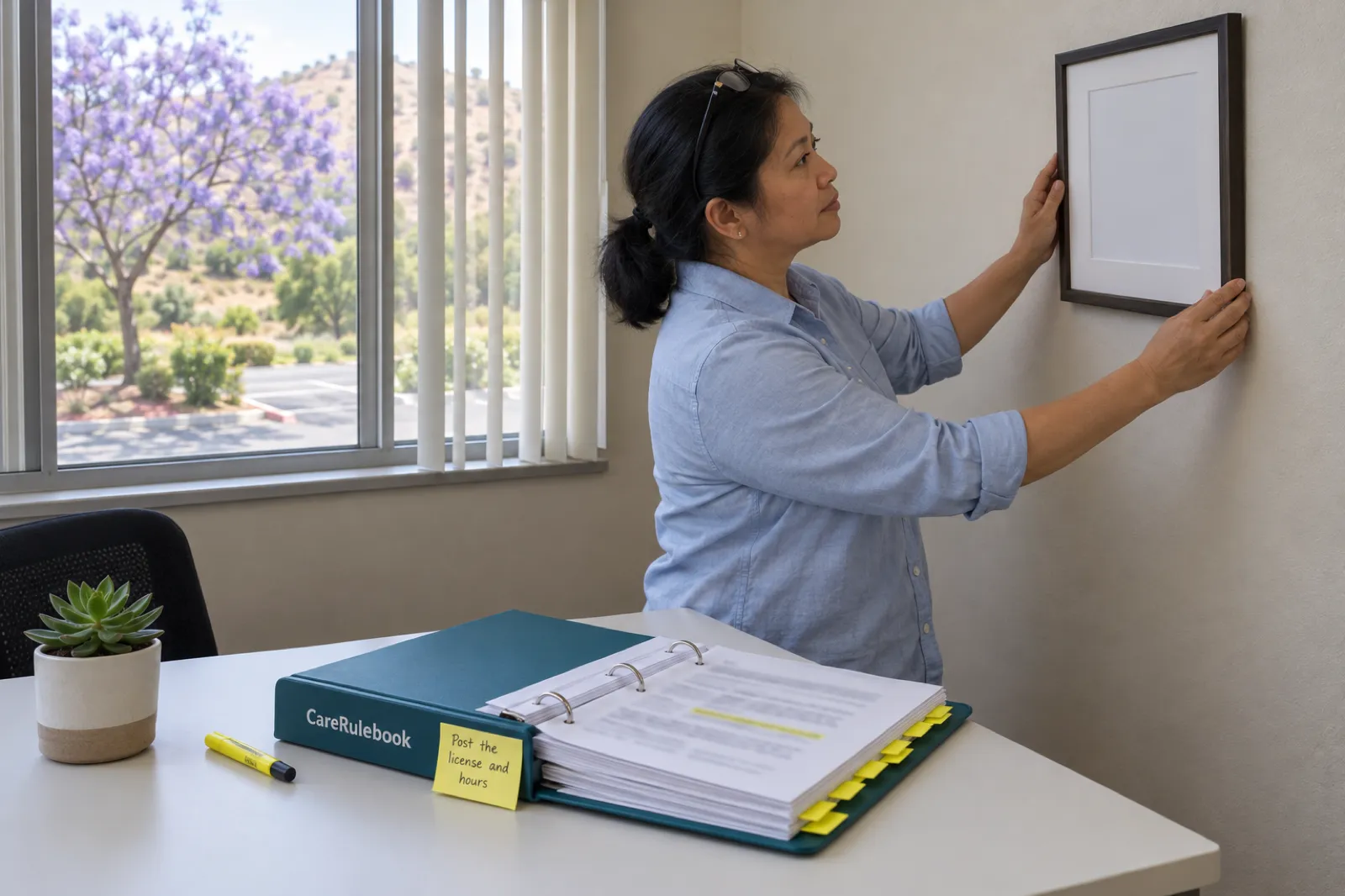
A woman in a light blue shirt hangs an empty picture frame on the wall of a small first office, beside a desk with an open teal CareRulebook binder, a highlighter, a succulent and a sticky note reading Post the license and hours, with a jacaranda tree in bloom outside the window

Quick answer

"A licensee shall ensure that prior to providing home care services, an affiliated home care aide shall complete the training requirements specified in this section." (HSC § 1796.44(a)) That means "a minimum of five hours of entry-level training prior to presence with a client", then "a minimum of five hours of annual training" (§ 1796.44(b)-(c)).

From January 1, 2027, the annual topics add "The special care needs of clients with dementia" (SB 412 (2025)). "The entry-level training and annual training described in subdivisions (b) and (c) may be completed through an online training program." (§ 1796.44(d))

5 hours

of entry-level training before an aide is with a client

HSC § 1796.44(b)

5 hours

of annual training, every year

HSC § 1796.44(c)

10

fields CDSS asks for in a home-made training log

HCS 281, B4

2027

dementia care joins the annual topics on January 1, 2027

SB 412 (2025)

Direct answers

How many training hours do California home care aides need?

At least 5 hours of entry-level training before being with a client (2 hours of orientation and 3 hours of safety training), then at least 5 hours of annual training every year. The home care organization (HCO) makes sure each affiliated aide completes them.

HSC § 1796.44(a)-(c)

Is dementia training required in California?

Yes, from January 1, 2027. SB 412 (2025) adds “the special care needs of clients with dementia” to the annual training topics. The hours stay the same. CDSS calls it an annual requirement and will check the dementia curriculum in applications, at renewal and at inspections; our suggestion is to cover it before an aide’s first client too.

SB 412 (2025); PIN 26-02-HCS

Can the training be done online?

Yes. Both the entry-level and the annual training may be completed through an online training program. CDSS’s training log asks for the website of any online course.

HSC § 1796.44(d)

Who can teach home care aide training in California?

The statute names no trainer qualification (our reading). CDSS’s application instructions ask the HCO’s training plan to say who will conduct each training, and its training log records the trainer’s name for in-person training and the organization delivering it.

HCS 281, B4

The hours and topics at a glance

California home care aide training: entry-level and annual hours and topics
TrainingMinimumTopicsWhen
Entry-level: orientation2 hoursThe aide’s role as a home care aide and the applicable terms of employment § 1796.44(b)(1)Before being with a client
Entry-level: safety training3 hoursBasic safety precautions, emergency procedures and infection control § 1796.44(b)(2)Before being with a client
Annual5 hoursCore competencies, specific to the clients served, including the topics below § 1796.44(c)Every year

From HSC § 1796.44. The hours are minimums: the statute says “a minimum of five hours” for each.

From hire to the first client, and every year after

The statute’s and CDSS’s duties in our suggested order. Tick steps off as you go; progress is saved in this browser only.

  1. Write the training plan

    With your application

    For entry-level and annual training: who will train, written objectives, and each training’s title and duration. A new HCO sends it to CDSS with the application, with a sample training log. The plan and log.

    HCS 281, B4
  2. Register and clear the aide

    Before client contact

    The aide must be cleared on the Home Care Aide Registry before direct contact with clients. Home care aide registration.

    HSC § 1796.43(a)
  3. 2 hours of orientation

    Before being with a client

    On the aide’s role as a home care aide and the applicable terms of employment.

    HSC § 1796.44(b)(1)
  4. 3 hours of safety training

    Before being with a client

    Including basic safety precautions, emergency procedures and infection control.

    HSC § 1796.44(b)(2)
  5. TB clearance too

    Before the first client

    CDSS’s instructions put TB clearance before services alongside the 5 hours. The statute allows the exam up to 7 days after hire, so our reading is to finish it before the first client, which meets both.

  6. Log every session

    As you go

    Record each session on the training log with the date, hours, topics, trainer or provider and location. The ten fields.

    HCS 281, B4
  7. 5 hours of annual training

    Every year

    On core competencies, specific to the clients you serve, covering the listed topics. CDSS’s instructions say within the first year and each year after.

  8. Add dementia care from January 1, 2027

    From 2027

    The special care needs of clients with dementia join the annual topics. Update your annual plan, keep the curriculum on file for CDSS, and (our suggestion) cover dementia before each new aide’s first client too. The 2027 change.

    SB 412; PIN 26-02-HCS

Entry-level training: 5 hours before being with a client

"An affiliated home care aide shall complete a minimum of five hours of entry-level training prior to presence with a client": two hours of orientation "regarding their role as home care aide and the applicable terms of employment", and three hours of safety training, "including basic safety precautions, emergency procedures, and infection control" (HSC § 1796.44(b)).

  • Before, not after. The statute says “prior to presence with a client”, and section 1796.44(a) says the licensee ensures the training is done "prior to providing home care services" (§ 1796.44(a)). CDSS’s instructions say the same: "Home Care Aides are required to be registered on the Home Care Aide Registry, obtain TB clearance, and complete 5 hours of entry-level training before providing services to clients." (HCS 281)
  • CDSS’s outline. CDSS’s application instructions describe the orientation as "Two (2) hours of orientation training regarding the individual’s role as a caregiver and terms of employment" and list the safety topics as basic safety precautions, infection control and emergency procedures (HCS 281, B4).
  • A condition of the job. CDSS asks your hiring policy to tell aides that entry-level and annual training, TB clearance and registration are conditions of employment (HCS 281, B3).
  • Our suggestion. Give the orientation and safety training as separate, logged sessions with their own times, so the log shows at least 2 and 3 hours, and cover how your agency handles emergencies and infection control in clients’ homes.

Annual training: at least 5 hours every year

The statute says "an affiliated home care aide shall complete a minimum of five hours of annual training. The annual training shall relate to core competencies and be population specific", and the topics "shall include, but not be limited to" these areas (HSC § 1796.44(c)):

  1. 1

    Clients’ rights and safety

    § 1796.44(c)(1)
  2. 2

    How to provide for, and respond to, a client’s daily living needs

    § 1796.44(c)(2)
  3. 3

    How to report, prevent and detect abuse and neglect

    § 1796.44(c)(3)
  4. 4

    How to assist a client with personal hygiene and other home care services

    § 1796.44(c)(4)
  5. 5

    If you provide transportation, how to safely transport a client

    § 1796.44(c)(5)
  6. 6

    From January 1, 2027: the special care needs of clients with dementia

    New § 1796.44(c)(6), SB 412
  • Population specific. The training must "relate to core competencies and be population specific" (§ 1796.44(c)). Our reading: if you serve, for example, older adults with limited mobility or clients after a hospital stay, your annual training should speak to those clients, not only the five topics.
  • When it falls due. CDSS’s instructions: "A Home Care Aide must complete a minimum of five (5) hours of annual training within the first year and each year thereafter." (HCS 281, B4) The statute itself does not say whether the year runs from hire or by calendar year (our reading), so set your rule in your training plan and keep to it. Section 1796.44(a) could also be read as putting all of the section’s training, annual topics included, before services; CDSS’s instructions allow the first annual hours within the first year (§ 1796.44(a)).
  • On top of entry-level. The annual hours are "In addition to the requirements in subdivision (b)" (§ 1796.44(c)), so the 5 entry-level hours do not count toward the first year’s annual training (our reading).

Dementia care from January 1, 2027 (SB 412)

SB 412 (Chapter 414, Statutes of 2025) rewrites section 1796.44 from January 1, 2027. The version in force now "shall remain in effect only until January 1, 2027, and as of that date is repealed" (HSC § 1796.44(e)), and the new version adds a sixth annual topic, "The special care needs of clients with dementia", with the same 5 entry-level and 5 annual hours (SB 412, new § 1796.44(c)(6)).

  • CDSS says: action required. "Licensees should be aware that beginning January 1, 2027, the California Department of Social Services (Department) may use any of the oversight and compliance activities currently available to ensure compliance with HCS 1796.44." "The Department will verify compliance with this annual training requirement through the HCO licensing process and inspections." (PIN 26-02-HCS)
  • New applicants. "Applicants who apply for an HCO license on or after January 1, 2027, must include the special care needs of clients with dementia in the annual training plan submitted as part of their HCO application." CDSS "will not prescribe a specific curriculum but will verify that submitted training materials meet the statutory intent and cover essential dementia care competencies" (PIN 26-02-HCS).
  • Existing HCOs. "HCOs must maintain documentation of their dementia training curriculum and ensure it is available for review during the license application, renewal, and inspections." (PIN 26-02-HCS) Our suggestion: add a dementia module to your annual training plan before January 1, 2027, note its objectives, title, duration and trainer as for any other session, and keep the materials with the plan.
  • Annual, by CDSS’s reading. Subdivision (a), unchanged by SB 412, says the licensee ensures that "prior to providing home care services, an affiliated home care aide shall complete the training requirements specified in this section" (§ 1796.44(a)), and the Legislative Counsel’s digest describes the dementia training as due "prior to providing home care and annually thereafter" (SB 412 digest). CDSS’s notice calls it an "annual training requirement" (PIN 26-02-HCS), and its application instructions put the annual hours "within the first year and each year thereafter" (HCS 281, B4). Our suggestion: cover dementia care before an aide’s first client, and again in each year’s annual hours. That meets both readings.

Who teaches it, and online training

  • No trainer qualification in the Act. By our reading of sections 1796.10 to 1796.70, the Act names no trainer credential, approved course or curriculum. CDSS’s instructions ask your plan to name "who will be conducting the training", with a "written description of the objectives" and "the title and duration of the training" (HCS 281, B4).
  • Online. "The entry-level training and annual training described in subdivisions (b) and (c) may be completed through an online training program." (§ 1796.44(d)) The log records the "organization delivering the training" and, if online, the website (HCS 281, B4), so choose courses that give a dated record of hours and topics.
  • In person. The log records the "Instructor/trainer first and last name (if in-person training)" (HCS 281, B4). Our suggestion: use someone who knows your clients and your procedures, and keep their materials with the plan.

The training plan and log CDSS asks for

CDSS’s application instructions, form HCS 281, ask every new HCO for a training plan (item B4): "The Home Care Organization applicant must establish a plan for training for Home Care Aides and submit the plan to CDSS at the time of application." (HCS 281, B4). For both entry-level and annual training, the plan gives who trains, the objectives, and the title and duration of each training. With it goes a sample training verification log: "HCSB has created a sample training log, the Registered Home Care Aide Training Log (HCS 500)", or your own log for approval (HCS 281, B4).

A home-made log must show at least these ten fields (HCS 281, B4):

  1. 1Employee name
  2. 2Hire date
  3. 3Position title
  4. 4Registration date
  5. 5Training title and a brief description of the topics covered
  6. 6Month, day and year the training was completed
  7. 7Training hours received
  8. 8Instructor or trainer first and last name (if in-person training)
  9. 9Organization delivering the training
  10. 10Location of the training (the website, if online)

Summarized from CDSS’s HCS 281 (12/21), item B4. This is CDSS’s form, not a regulation. Applications made on or after January 1, 2027 must include dementia care in the annual plan (PIN 26-02-HCS).

The plan is one of the written documents CDSS asks for with the HCO application; the others are covered in the application and its documents.

Records and what inspectors check

  • Records are inspected. CDSS reminds licensees that "Home Care Aide (HCA) training hours, proof of registration, and tuberculosis (TB) clearances records remain subject to inspection" (PIN 22-03-HCS).
  • The inspection checklist. CDSS’s HCS 9201 lists three training lines for each affiliated aide (HCS 9201 (11/25)):
    • "Complete two hours of orientation training regarding their role as a caregiver and the applicable terms of employment."
    • "Complete three hours of safety training, including basic safety precautions, emergency procedures, and infection control."
    • "Complete a minimum of five hours of annual training."
  • Proof on request. An applicant gives CDSS, on request, a complete list of its affiliated aides "and proof that each satisfies the requirements of Section 1796.43, 1796.44, and 1796.45": clearance, training and TB (HSC § 1796.37(a)(5)).
  • If it is missing. A violation brings a written notice that may require a plan of correction (HSC § 1796.55(b)), and CDSS may fine up to $900 per violation per day until it is corrected (§ 1796.55(c)). See inspections and fines.

Our suggestion for each aide’s training file: the training log, certificates from any online course, the materials or outline for each in-person session, and the date the next annual hours fall due.

Aides who change agencies, independent aides and referral agencies

  • No transfer rule for training. Our reading: the Act lets a TB certificate from a former HCO count, if "the affiliated home care aide can produce a certificate" from the past two years (§ 1796.45(f)), but section 1796.44 has no matching clause for training (our reading). Ask CDSS before counting hours an aide completed elsewhere; giving your own entry-level training is the safe course.
  • Independent aides. Our reading: s. 1796.44 sets training for affiliated aides (aides employed by an HCO). The Act sets no training for independent aides who contract directly with clients. (§ 1796.44(a)) CDSS’s fact sheet says the same in practice: affiliated aides "are required to meet minimum training requirements, be clear of active tuberculosis, and have a background check cleared with CDSS", while "Independent HCAs are required to have a background check cleared with CDSS" (CDSS fact sheet).
  • Referral agencies do not train. Under the Civil Code test for a referral (employment) agency that is not the caregiver’s employer, "The domestic worker does not receive any training from the employment agency with respect to the performance of domestic work" (Civil Code § 1812.5095(b)(4)). Our reading: an agency that trains its caregivers is likely arranging home care and needs the HCO license. HCO or referral agency.
  • What families are told. CDSS’s fact sheet says: "With licensed care, all caregivers must be registered HCAs who have met minimum training requirements" (CDSS fact sheet).

What training cannot add

Training does not widen what an aide may do. "Home Care Organizations are not authorized to arrange for the provision of medical services to a client, and Registered Home Care Aides are not authorized to provide medical services to a client." CDSS also says it "does not have the authority to provide waivers or authorizations which allow Home Care Organizations to provide medical services to clients" (CDSS fact sheet).

  • Medication. Aides may help only with medication the client self-administers, and not where it would need administration or oversight by a licensed health care professional (HSC § 1796.12(n)). CDSS’s examples of allowed help include "Opening the client’s medication bottle/canister/blister pack" and "Reminding the client to take medication" (CDSS fact sheet).
  • Medical tasks. CDSS’s examples of what aides may not do include insulin shots, catheter care, glucose readings, tube feeding, monitoring vital signs, post-surgery wound care and medication administration (CDSS fact sheet). Our suggestion: teach aides to recognize these requests and how to report them, rather than how to do them.

Myths about California aide training

Can California home care aide training be done online?

Yes. Both the 5 hours of entry-level training and the 5 hours of annual training may be completed through an online program. CDSS’s training log asks for the website of any online course.

"The entry-level training and annual training described in subdivisions (b) and (c) may be completed through an online training program."

Is there a state certificate or exam for California home care aides?

No. Not in the Act, by our reading. Registration is a background check listing, and the training rule sets hours and topics, with no state exam, certificate or approved course. The HCO makes sure each aide completes the training and keeps the records for CDSS to inspect.

"A licensee shall ensure that prior to providing home care services, an affiliated home care aide shall complete the training requirements specified in this section."

Can home care aides give medication?

No. Aides may help with medication the client self-administers, such as opening the bottle or reminding them, but not with medication that would need administration or oversight by a licensed health care professional.

"This subdivision shall not authorize a registered home care aide to assist with medication that the client self-administers that would otherwise require administration or oversight by a licensed health care professional."

Frequently asked questions

Do California home care aides need training before they start?

Yes. An affiliated aide completes at least 5 hours of entry-level training before being with a client: 2 hours of orientation on their role and terms of employment, and 3 hours of safety training covering basic safety precautions, emergency procedures and infection control. The HCO must make sure this is done before the aide provides home care services.

When is the annual training due?

The statute requires a minimum of five hours of annual training. CDSS’s application instructions say the 5 hours are completed within the first year and each year after. Section 1796.44(a) could be read more strictly, as putting all of the section’s training before services, but CDSS’s instructions allow the first year. Our suggestion: pick one rule for your agency, such as each aide’s hire anniversary, write it into your training plan and track it on the log.

What changes on January 1, 2027?

SB 412 (Chapter 414, Statutes of 2025) adds the special care needs of clients with dementia to the topics of the annual training. CDSS says applications made on or after that date must include it in the annual training plan, that it will not prescribe a curriculum but will check that the materials cover essential dementia care competencies, and that HCOs must keep their dementia curriculum available at application, renewal and inspections.

Does training from a previous agency count?

The Act does not say. It lets an aide moving between HCOs use a recent TB certificate, but has no matching clause for training (our reading). Ask CDSS before relying on hours completed at another HCO, and log any training you give yourself.

Do independent home care aides need this training?

Not under the Act, by our reading: section 1796.44 sets training for affiliated aides, the aides an HCO employs. Independent aides who contract directly with clients are not covered by it, and CDSS’s fact sheet lists only a cleared background check for them.

Is there a state exam or certificate for home care aides?

Not in the Act, by our reading. Registration is a background check listing, and the training rule sets hours and topics. The HCO keeps the training records, and CDSS checks them at inspections.

Get California rule-change alerts

Dementia care joins California’s annual aide training on January 1, 2027. Leave your email and we will tell you when a California change affects your aides’ training, your training plan or your records.

No spam. Only emails about California home care rules. How we use your email.

Keep reading

Sources

  1. Health and Safety Code ss. 1796.10 to 1796.70, Home Care Services Consumer Protection Act (Division 2, Chapter 13) · California Legislature (text held from the Public.Law mirror, verified against leginfo on Oct. 5, 2026) · retrieved October 8, 2026
  2. SB 412 (2025), Home care aides: enrolled text adding dementia care to annual training from January 1, 2027 (Chapter 414, Statutes of 2025) · California Legislature (Internet Archive copy of leginfo, September 20, 2025) · retrieved October 8, 2026
  3. Civil Code s. 1812.5095, Employment agencies and domestic workers · California Legislature (text held from the Public.Law mirror) · retrieved October 8, 2026
  4. HCS 281 (12/21), Application Instructions for a Home Care Organization License · California Department of Social Services · retrieved October 8, 2026
  5. HCS 9201 (11/25), Home Care Organization Inspection Checklist · California Department of Social Services · retrieved October 8, 2026
  6. Fact sheets: The Home Care Services Consumer Protection Act (April 2022); Home Care Services (November 2023); Licensed Versus Unlicensed Home Care Services (April 2022) · California Department of Social Services · retrieved October 8, 2026
  7. PIN 26-02-HCS: 2025 Chaptered Legislation Affecting Home Care Organizations (March 27, 2026) · California Department of Social Services, Community Care Licensing Division · retrieved October 8, 2026
  8. PIN 22-03-HCS: Home Care Organization License Renewal Process Reminders (February 2, 2022) · California Department of Social Services, Community Care Licensing Division · retrieved October 8, 2026
California rule-change alertsFree, by email