Skip to content
CareRulebook
MenuClose

What do you run?

Home care in the US19 states with a manual, 6 with a free guide
ColoradoManual
ConnecticutPack
DelawareManual
GeorgiaManual
IllinoisManual
IndianaManual
KansasManual
MaineManual
MarylandManual
MinnesotaManual
NevadaManual
North CarolinaManual
OklahomaManual
OregonManual
South CarolinaManual
TennesseeManual
TexasManual
VirginiaManual
WashingtonManual
CaliforniaGuideFloridaGuideNew JerseyGuideNew YorkGuideOhioGuidePennsylvaniaGuideAll US home care states →
Care homes in the USCalifornia, Michigan, Minnesota; more states coming
Home care in the UKEngland, Scotland, Wales
Free toolsChecklists, calculators and templates

Oregon · Caregivers · OAR 333-536-0070

Oregon caregiver training: 4 hours of orientation, 8 of training, 6 every year

Unless an exemption applies, a caregiver at an Oregon in-home care agency completes at least four hours of agency orientation and eight hours of initial training (two before the first shift, the rest within 120 days of hire), and passes a competency evaluation before working alone. Then six hours of education every year. Caregivers who give medication assistance in a Basic agency add four hours of medication training and a return demonstration.

  • Rule-verified October 8, 2026
  • Quoted from OAR 333-536-0070 and 0005
  • And OHA’s training and qualified trainer memos
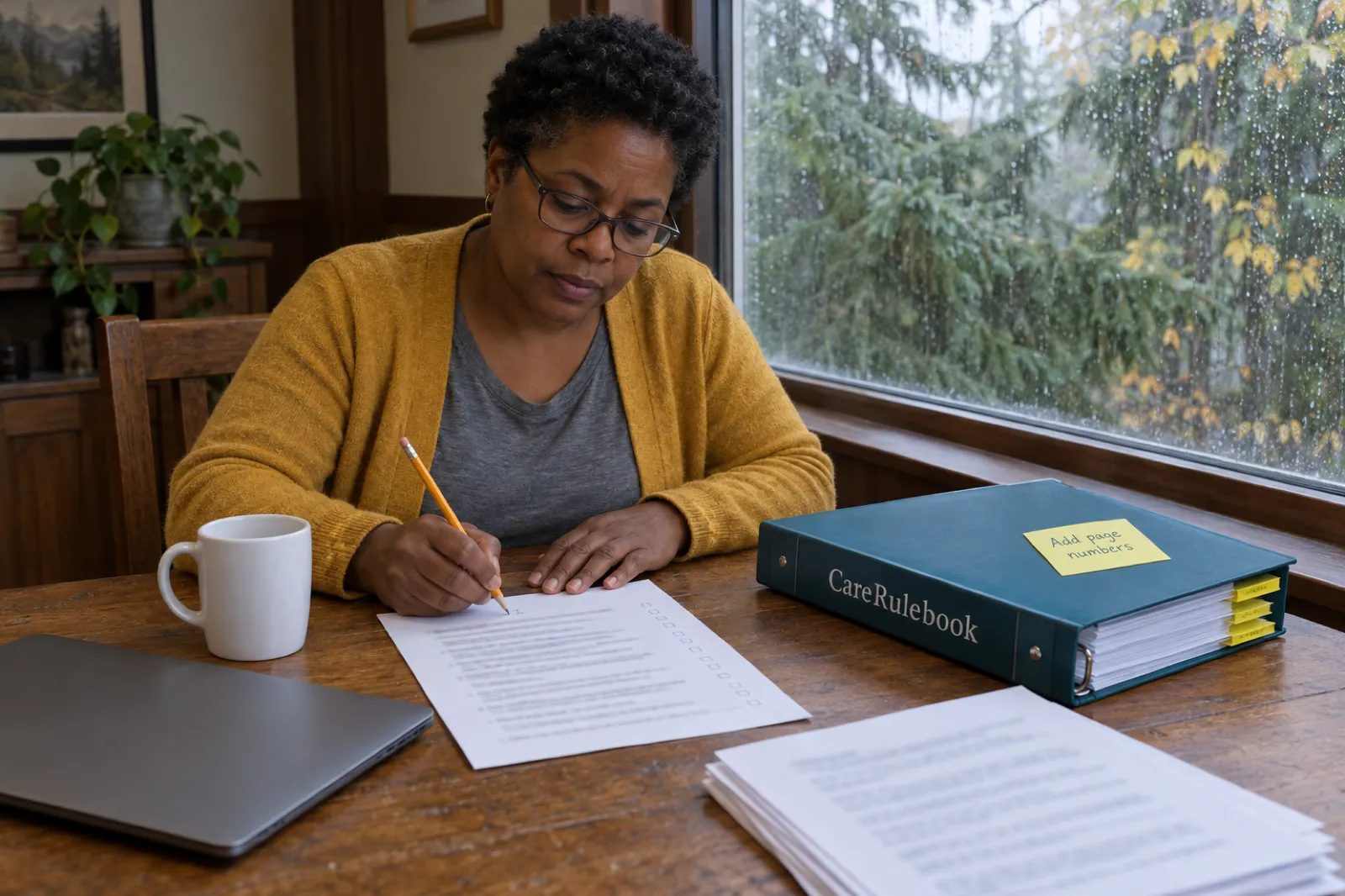
A woman in glasses and a mustard cardigan fills in a printed checklist with a pencil at a wooden table, beside a teal CareRulebook binder with a sticky note reading Add page numbers, with rain on the window and fir trees outside

Quick answer

"Caregivers shall complete an agency-specific orientation, conducted by the agency administrator, administrator's designee, or administrator's delegate before independently providing services to clients." "The orientation shall be a minimum of four hours, obtained online or in person" (OAR 333-536-0070(5)). Then "A caregiver shall receive a minimum of eight hours of initial caregiver training", two hours of it before providing services and the rest within 120 days of hire (0070(7)), and a competency evaluation by the administrator or designee before the caregiver works independently (0070(6)).

Every year: "A caregiver shall receive a minimum of six hours of education from a qualified trainer, qualified individual or qualified entity related to caregiver duties annually" (0070(14)). Medication training applies to Basic agencies and above, not Limited (OHA Table 1). OHA cited caregiver orientation and caregiver training 37 times each in 2025 (OHA, January 2026).

4 hours

of agency orientation, at least, before working independently

OAR 333-536-0070(5)

8 hours

of initial caregiver training, at least: 2 before services

OAR 333-536-0070(7)

120 days

from hire to finish the other 6 hours

OAR 333-536-0070(7)(b)

6 hours

of education every year, plus 1 for medication services

OAR 333-536-0070(14)

From hire to working alone, and every year after

The training duties in the order a new caregiver meets them. The rule’s own words are "before independently providing services to clients" for orientation and competency, and "before providing services" for the first two hours. Tick steps off as you go; progress is saved in this browser only.

  1. Clear the criminal records check

    Before any client contact

    A fitness determination before any direct contact with a client. A preliminary hire can do orientation and training only away from clients. Caregiver background checks.

  2. Hire caregivers aged 18 or older

    At hire

    With enough communication and language skills to do their duties and interact effectively with clients and other staff.

    OAR 333-536-0070(4)
  3. Agency orientation: at least four hours

    Before working independently

    On the ten subjects the rule lists, conducted by the administrator, designee or delegate. The ten subjects.

    OAR 333-536-0070(5)
  4. Two hours of initial caregiver training

    Before providing services

    From a qualified trainer, qualified individual or qualified entity, on the topics that fit your services.

    OAR 333-536-0070(7)(a)
  5. Competency evaluation

    Before working independently

    Direct observation plus written or oral testing, evaluated and documented by the administrator or designee. Up to one hour counts toward the eight.

  6. Medication training and return demonstration (Basic)

    Before any medication service

    At least four hours from a qualified individual or entity, and a successful return demonstration evaluated by a qualified individual. Medication training.

    OAR 333-536-0070(8)
  7. The other six hours of initial training

    Within 120 days of hire

    Before services, or on the job or by another method after services start.

    OAR 333-536-0070(7)(b)
  8. Six hours of education every year

    Every year

    Related to caregiver duties, plus one hour on medication services for caregivers who give them.

    OAR 333-536-0070(14)
  9. Annual performance evaluation

    Every year

    Evidence of a yearly performance evaluation for all agency staff, in the personnel record.

    OAR 333-536-0053(8)

Orientation: at least four hours on ten subjects

Orientation is agency-specific, online or in person, and covers at least these subject areas (OAR 333-536-0070(5)(a)-(j)):

The ten subject areas of an Oregon in-home care agency orientation
ItemSubject area
(a)The caregiver’s job description and requirements
(b)Clients’ rights
(c)Ethics, including confidentiality of client information
(d)An overview of your policies and procedures, stressing travel with a client, client care practices, client notifications, infection control, medical and non-medical emergencies, and medication reminding, assistance and administration
(e)A description of the services your agency provides
(f)Assignment and supervision of services
(g)Documenting clients’ needs and the services provided
(h)The roles of, and coordination with, other community service providers
(i)What medication reminding is, and its specific limits
(j)Other subjects for the needs of the special populations you serve

OHA’s training memo: "Orientation cannot be substituted for required training." (OHA training memo, rev. 06/2024) OHA’s qualified trainer memo adds: "Orientation topics are agency specific and are not included in the qualified entity process." (OHA qualified trainer memo) So an approved entity’s caregiver course does not replace your orientation. From January to July 2026 OHA cited caregiver orientation 19 times (OHA, July 2026).

CareRulebook’s manual runs orientation from a record that lists every subject, with what is taught against each, the start and end times, and the instructor’s and caregiver’s signatures (Policy 6.2). For subject (j), the administrator chooses topics from the needs of current and expected clients, for example dementia, physical disabilities or clients who speak another language.

Initial caregiver training: at least eight hours

The training is "based on the services provided by the agency" and covers these topics, as applicable (OAR 333-536-0070(7)(d)):

The 14 topics of initial caregiver training in Oregon
ItemTopic
(A)Caregivers’ duties and responsibilities
(B)Recognizing and responding to medical emergencies
(C)Dealing with adverse behaviors
(D)Nutrition and hydration, including special diets and meal preparation and service
(E)Safe techniques in personal care tasks, including those in OAR 333-536-0045
(F)Preventing skin breakdown, contractures and falls
(G)Hand washing and infection control
(H)Body mechanics
(I)A clean and safe environment
(J)Fire safety and non-medical emergency procedures
(K)Helping clients with self-directed or representative-directed non-injectable medication
(L)Cultural competence
(M)Abdominal thrust and first aid (CPR is recommended, not required)
(N)Other subjects for special populations, such as vital signs and home medical devices like catheter care, a Hoyer lift and oxygen
  • Timing. "Two hours of initial caregiver training must be obtained before providing services". The other six hours may come before services, or after through on-the-job training or another method, within 120 days of hire (0070(7)(a)-(b)).
  • OHA’s summary is stricter. OHA’s quick reference guide gives the timeframe for caregiver training as "Must be completed prior to providing services to clients independently" (OHA training memo, rev. 06/2024). Our reading: the rule’s 120 days governs, and CareRulebook’s manual follows the rule, with the competency evaluation before any independent work and no services after day 120 until all eight hours are done (Policy 6.3). Our suggestion: where you can, finish all eight hours before a caregiver works alone, so the question never comes up at a survey.
  • Competency time. At most one hour of competency evaluation counts toward the eight hours of initial caregiver training (0070(7)(c)).
  • Enough for the job. Every caregiver receives all the training needed to give, competently, the level of care they will be assigned (0070(2)).
  • Topic (K) in a Limited agency. Limited caregivers give no medication assistance. CareRulebook’s manual teaches what self-directed medication is, what reminding allows, and that caregivers never touch a client’s medication or its containers; that is our reading of how the topic applies to a Limited agency’s services.

The competency evaluation

Caregivers "must have their competency evaluated and documented by the administrator or administrator's designee before independently providing services to clients" (OAR 333-536-0070(6)). "The competency evaluation shall include a combination of both direct observation and written or oral testing."

  • Your method goes in your policy. "Each agency must determine how it will conduct and document competency evaluations for each caregiver and this method of evaluation must be specified in written policies and procedures." (OHA training memo)
  • Online tests are only part of it. OHA’s training memo: written testing done with training, such as an online course test, may be part of the competency evaluation but does not fully satisfy it (OHA training memo).

CareRulebook’s method, in Policy 6.3: the administrator or designee watches the caregiver perform each skill they will use, in a training setting or with a client who agrees while the evaluator is present, and marks it "competent" or "needs more training"; asks written or oral questions on the training topics, writing down each oral question and a summary of the answer; then records whether the caregiver may work independently, and at what level. A caregiver not yet competent in a skill is retrained and evaluated again before working alone on any task that needs it. That method is the manual’s, not OHA’s.

Who may teach what

Who may give each kind of caregiver training in Oregon
TrainingWho may give itSource
Orientation (4 hours)The administrator, designee or delegate. OHA says a qualified trainer can also conduct it.0070(5); OHA memo
Initial caregiver training (8 hours)A qualified trainer, qualified individual or qualified entity.0070(6)
Competency evaluationThe administrator or designee (for earlier-trained caregivers, the delegate too).0070(6), (12)
Medication training (4 hours)A qualified individual or qualified entity. Not a qualified trainer.0070(8)(b); OHA memo
Medication return demonstrationA qualified individual only. OHA’s training memo points to the licensed list: an LIP, RN, LPN, physician associate or pharmacist. Not a qualified entity.0070(8)(c); OHA memos
Annual education (6 hours, plus 1)The rule: a qualified trainer, qualified individual or qualified entity. OHA’s quick reference guide lists a qualified entity or individual.0070(14); OHA guide
  • Qualified trainer. Someone who has completed an OHA-approved program, or whom your agency designates and who "has two or more years of experience working with an agency, a long-term care facility as defined under ORS 442.015, a residential care facility as defined under ORS 443.400, or other health care setting" (OAR 333-536-0005(38)). A designated qualified trainer who is also a caregiver must be current with the caregiver training requirements (0005(38)(b)(B)). OHA says "at this time there are no Authority approved training programs to become a qualified trainer to provide caregiver training" (OHA memo).
  • Qualified individual. Someone who completed an OHA-approved program, a current LIP, RN, LPN, physician associate or pharmacist, or another health professional OHA approves (0005(37)). OHA says "at this time there are no Authority approved training programs to become a qualified individual to provide caregiver or medication training" (OHA memo).
  • Qualified entity. An entity whose training program OHA has approved (0005(36)). OHA’s memo (updated September 16, 2026) lists six: Relias Learning, Oregon Care Partners, CareAcademy and Activated Insights (formerly Home Care Pulse), each approved for caregiver training, medication training and continued education; Nevvon, for caregiver training and continued education on caregiver topics only; and Cornerstone Healthcare Training, for annual continued education only (OHA qualified trainer memo, updated September 16, 2026). "QE courses cannot be mixed between entities, the entire program must be completed for each QE." (OHA memo) Check OHA’s current memo before you choose, as OHA updates it.
  • Proof on file. "An agency shall maintain sufficient information or documentation to demonstrate that the individual(s) or entity providing the training under this rule is a qualified individual, qualified entity or qualified trainer" as the rule defines them (0070(10)).

The annual hours: our reading. The rule allows a qualified trainer, qualified individual or qualified entity for the six annual hours, and its definition lets your designated trainer give "annual caregiver training required by these rules" (0005(38)(b)). OHA’s quick reference guide lists "QE or QI as defined by Rule" for continued education (OHA training memo). The rule allows your own trainer; until OHA confirms, a qualified individual or entity for the annual hours satisfies both. CareRulebook’s builder asks which you use, and Policy 1.5 records each trainer’s qualification on a designation form, a verification form or an entity record, with a trainer register.

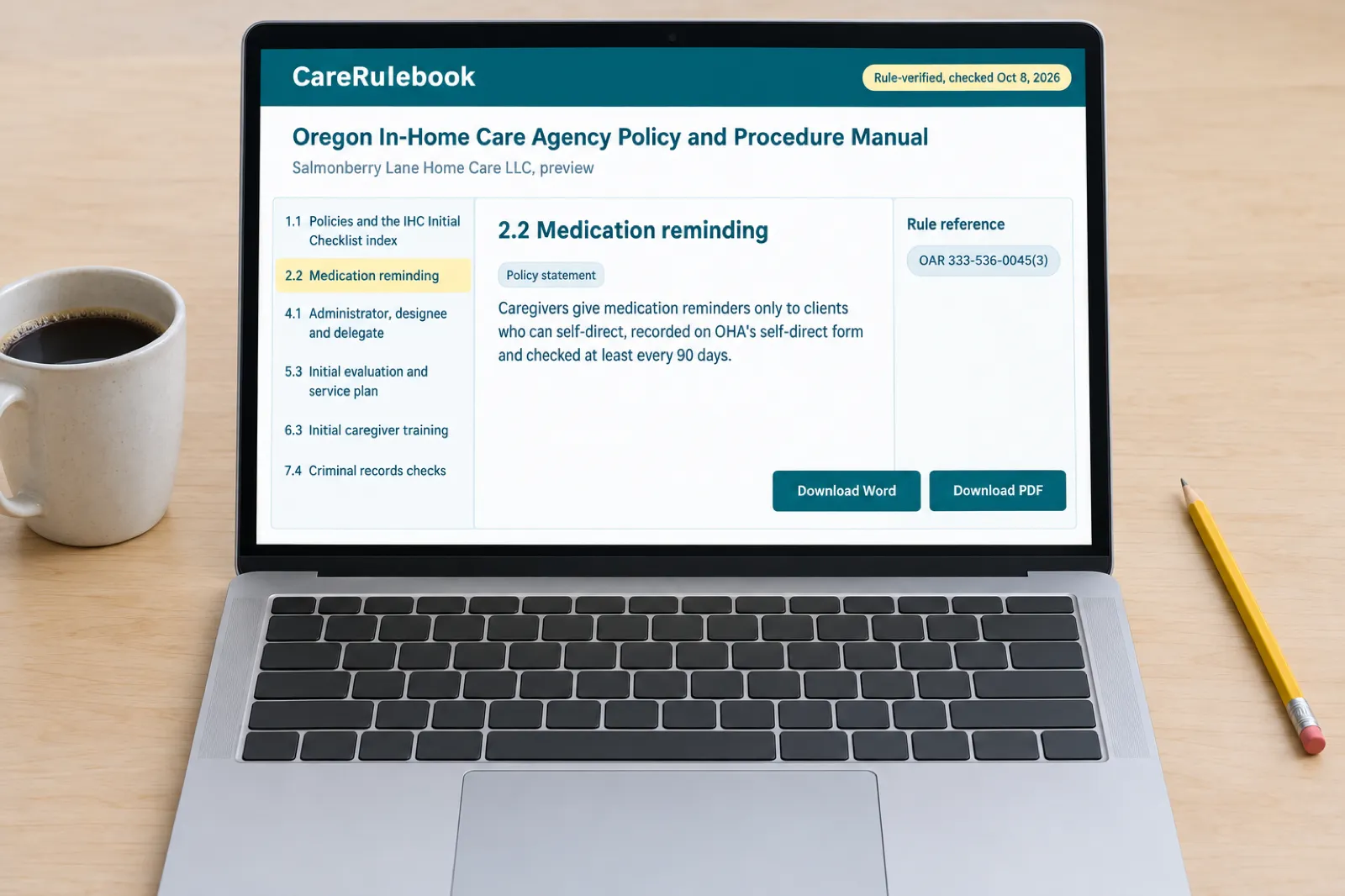
The CareRulebook Oregon manual preview on a laptop: policy 2.2 on medication reminding for a sample agency, citing OAR 333-536-0045(3), with six of the manual’s policies listed beside it

CareRulebook

Training records written for your agency

CareRulebook’s Oregon manual covers the caregiver training items on OHA’s IHC Initial Checklist in Policy 1.5 (Qualified trainers, qualified individuals and qualified entities), Policy 6.1 (Caregiver qualifications, staffing and assignment), Policy 6.2 (Caregiver orientation), Policy 6.3 (Initial caregiver training and competency evaluation), Policy 6.4 (Medication training and return demonstration, Basic only) and Policy 6.5 (Annual caregiver education), each with its forms.

  • 29 policies, 92 requirements mapped
  • Orientation, training and medication training documented separately, as OHA asks
  • Editable Word and print-ready PDF, with an OHA checklist index and page numbers
Preview your manual

$199CareRulebook founding price for the first 50 Oregon agencies, then $249. Not an OHA fee.

Medication training: Basic agencies only

Medication services means medication assistance or medication administration; it does not include medication reminding (OAR 333-536-0005(25)). A Limited agency gives no medication assistance (0007(1)(a)), so its caregivers need no medication training. In a Basic agency:

  • Four hours first. "Caregivers assigned to provide medication services must obtain a minimum of four hours of basic non-injectable medication training before providing the services." (0070(8))
  • The topics. At least: medication abbreviations; reading orders and directions; reading labels and packages, including pharmacy pill packs; giving non-injectable medications in pill, liquid, suppository and topical forms; identifying and reporting adverse reactions, interactions, contraindications and side effects; infection control in medication administration; and safe, accurate techniques. Setting up medication into secondary containers is a topic only for Intermediate and Comprehensive agencies (0070(8)(a)). Learning about every form does not widen what a Basic caregiver may do: see medication reminding and assistance.
  • The return demonstration. The caregiver’s techniques "must be evaluated by a qualified individual through a successful return demonstration" (0070(8)(c)). OHA: a qualified entity cannot conduct the medication return demonstration; a qualified individual must evaluate it (OHA memo).
  • The record. For medication services, the record also holds evidence of successful return demonstrations and a statement from the qualified individual that the caregiver is competent to provide them (0070(9)(d)).
  • Licensed caregivers too. OHA’s training memo: medication training is always required for caregivers who provide medication services, whatever their current license (OHA training memo).
  • Every year. One additional hour of education related to providing medication services (0070(14)).
  • Naloxone. OHA: giving Narcan (naloxone) is medication administration, which neither a Limited nor a Basic agency provides (OHA, January 2026; 0007(1)(b)). OHA: Narcan administration must meet the medication administration rule; agencies may request a waiver, with a training plan and clear service plan documentation, if they expect to need it (OHA, January 2026).

CareRulebook’s Policy 6.4 is included only for Basic agencies. The builder asks whether a qualified entity or a qualified individual gives the four hours; either way, a qualified individual evaluates every return demonstration and signs the competency statement before the caregiver gives any medication assistance.

Earlier training, licenses and transfers

  • Licensed caregivers. "A caregiver with proof of a current Oregon health-care related license or certificate is exempt from in-home caregiver training." (0070(13)) The exemption covers caregiver training only. By our reading they still complete the agency orientation, which section (5) asks of all caregivers, and CareRulebook’s manual has the administrator or designee check their competency on the agency’s tasks as well.
  • Training done elsewhere. "Caregivers who have completed training previously and are current with training requirements, and have documentation of that training, shall have their competency evaluated" by the administrator, designee or delegate, and any further training may be limited to the areas needing improvement (0070(12)). OHA’s training memo points to this section for training portability between agencies (OHA training memo). The manual counts earlier training only if its records show the topics, at least eight hours, the dates and a qualified trainer, individual or entity.
  • Moving between subunits. A caregiver moving from one subunit to another in the same agency needs no further training if their earlier training is current and documented (0070(11)).
  • Housekeeping-only clients. For clients who receive only housekeeping and support services, the agency need not comply with several rules, including the training rule, OAR 333-536-0070 (0045(9)). Our reading: a caregiver who serves any other client needs the full training.

Every year: six hours of education

"A caregiver shall receive a minimum of six hours of education from a qualified trainer, qualified individual or qualified entity related to caregiver duties annually." "If a caregiver provides medication services to a client, one additional hour of education shall be required annually related to providing medication services." (OAR 333-536-0070(14))

  • No year start. The rule does not say when the year starts or list topics. CareRulebook’s manual counts each caregiver’s education year from their date of hire, and orientation and initial training hours do not count toward it.
  • Infection control. The rules require "Education and training on infection control measures to staff, clients, and caregivers", without saying how often (OAR 333-536-0082(4)). The manual makes at least one of the six hours each year about infection control; that is its choice, not OHA’s.
  • Who teaches. See the annual hours, our reading, above.
  • Evaluation. "Evidence of annual performance evaluation for all agency staff" (OAR 333-536-0053(8)).

Records, and what OHA cites

Orientation, caregiver training and medication training are documented in each caregiver’s personnel record with the content of each topic, the dates, times and topics, and the names and signatures of the instructor, qualified individual, qualified entity or qualified trainer (OAR 333-536-0070(9)(a)-(c)). Each personnel record holds evidence of orientation, training, competency evaluations and ongoing education, and clearly identifies the highest level of service the caregiver may provide, including whether they are trained for medication services (OAR 333-536-0053(6)).

  • Separately. "Orientation, Caregiver Training, and Medication Training all need to be separately documented in order to ensure topic, length, and instructor requirements have been met." (OHA training memo)
  • Course transcripts. OHA: a class transcript listing all the required classes is kept in the caregiver’s file as proof the qualified entity’s training was completed (OHA memo).
  • Training on one day. When an agency records all training on a single day, OHA says: "Payroll records must show the full 16 hours of training time required, plus any additional competency evaluation time, completed on that same day." (OHA, April 2026) OHA’s April 2026 update lists 1 day caregiver training among rising trends in survey citations (OHA, April 2026). OHA’s 16 hours is orientation, caregiver training and medication training together (4 + 8 + 4); a Limited agency’s caregivers need no medication training.
  • At the initial survey. OHA expects "At least one caregiver record for staff who has been hired, trained and determined to be competent and ready to provide IHC services", and "these records must contain evidence of all applicable pre-screening, health, qualifications, training, and orientation required by the OARs for IHCs and the agency's own policies and procedures" (OHA FAQ 6).

CareRulebook’s manual keeps the orientation record, the initial training record, the competency evaluation, any medication training record and return demonstration evaluation, and the annual education log in each caregiver’s personnel file (Policy 4.3), each on its own form.

OHA’s most cited training findings

In 2025 OHA cited caregiver orientation (tag 0575) 37 times and caregiver training (tag 0580) 37 times, joint second among its most cited tags (OHA, January 2026). From January 1 to July 1, 2026, caregiver orientation was cited 19 times and caregiver training 18 times (OHA, July 2026; tag 0580). OHA’s causes for caregiver training citations: missing required topics, qualified entity certificates not aligned with the approved modules, and incorrect or missing 8-hour training documentation; for orientation: missing required topics and incorrect or missing 4-hour orientation documentation (OHA, January 2026).

Repeated training failures also count against the license. OHA may impose a civil penalty or deny, suspend or revoke a license when an agency fails to comply with the in-home care statutes or rules (OAR 333-536-0033(1)), and a failure to comply includes "A demonstrated pattern, over the previous five years, of significant and substantiated violations of" caregiver training requirements, among other things (OAR 333-536-0033(3)(d)).

What Oregon does not require

  • CPR certification. "Abdominal thrust and first aid. CPR is recommended but not required." (OAR 333-536-0070(7)(d)(M))
  • Dementia training as such. Oregon’s dementia care training statutes are written for direct care staff in residential care facilities (ORS 443.433) and caregivers in adult foster homes (ORS 443.743); neither names in-home care agencies (ORS 443.433, 443.743). Our reading: division 536 has no separate dementia course, but orientation subject (j) and training topic (N) cover the needs of the special populations you serve.
  • A state certificate for caregivers. The statute leaves training to OHA’s rules: "The training requirements must include a minimum number of hours of orientation and assessment of competency" (ORS 443.011(1)). We found no state caregiver certificate in those rules.
  • A nurse. Limited and Basic agencies need no RN (OHA Table 1). In a Basic agency, a qualified individual such as an RN, LPN or pharmacist is needed for the medication return demonstration, and for the medication training itself unless an OHA-approved entity gives it.

Myths about Oregon caregiver training

Do Oregon in-home caregivers need training?

Yes. At least four hours of agency orientation and eight hours of initial caregiver training (two before the first shift, the rest within 120 days of hire), with a competency evaluation before working independently, then six hours a year. Caregivers who give medication services add four hours of medication training with a return demonstration, and one extra hour a year. Caregivers with a current Oregon health care license or certificate are exempt from the caregiver training; OHA says medication training is still required for medication services.

"A caregiver shall receive a minimum of eight hours of initial caregiver training:"

Can my agency train its own caregivers in Oregon?

Yes. For orientation and caregiver training. You can designate a qualified trainer with two or more years of experience in an agency or care setting, and OHA has no approved trainer course to take. Medication training is different: it must come from a qualified individual (such as an RN, LPN or pharmacist) or an OHA-approved entity, and the return demonstration must be watched by a qualified individual.

"At this time there are no Authority approved training programs to become a qualified trainer to provide caregiver training."

Can my caregivers fill weekly pill organizers in Oregon?

It depends. Only in an Intermediate or Comprehensive agency. OHA says moving medication from the original container into a secondary container is medication administration, and an agency that administers medication employs an RN, gets practitioner orders, keeps medication records and has an RN review each client’s regimen every 90 days. Otherwise, a client representative or family member may fill the containers under a signed agreement with the agency, and caregivers of an agency classified for medication services (Basic and above) may then assist.

"Medication Set-up, moving medication from the original container into a secondary container, is medication administration"

Frequently asked questions

How many hours of training do Oregon in-home caregivers need?

At least four hours of agency orientation and eight hours of initial caregiver training: two hours before providing any services, and the rest within 120 days of hire. A competency evaluation comes before the caregiver works independently. Caregivers in a Basic agency who give medication assistance add four hours of medication training and a return demonstration. Every caregiver then has six hours of education a year, plus one hour on medication services for those who give them.

Can a new Oregon caregiver work before finishing the eight hours?

Yes, once two hours are done, orientation is complete and the administrator or designee has evaluated and documented their competency. The other six hours may be done on the job or by another method within 120 days of hire. OHA’s quick reference guide words it more strictly (training completed before working independently); by our reading the rule’s 120 days governs. CareRulebook’s manual stops scheduling a caregiver whose eight hours are not done by then.

Who can train caregivers for an Oregon in-home care agency?

Orientation is conducted by the administrator, a designee or a delegate. Initial caregiver training comes from a qualified trainer (someone your agency designates with two or more years of experience in an agency or care setting), a qualified individual (such as an RN, LPN or pharmacist) or an OHA-approved qualified entity. Medication training needs a qualified individual or entity, and only a qualified individual can evaluate the return demonstration.

Is online caregiver training allowed in Oregon?

Yes. Orientation may be online or in person, and OHA lists its approved qualified entities by name; its training memo expects online courses with tests. A caregiver must complete every module OHA lists for one entity’s program, without mixing courses between entities, and the class transcript goes in their file. An online test may be part of the competency evaluation but does not fully satisfy it: the administrator or designee still observes the caregiver.

Do licensed or certified caregivers need Oregon’s caregiver training?

A caregiver with proof of a current Oregon health care license or certificate is exempt from in-home caregiver training. By our reading they still complete the agency orientation, which the rule asks of all caregivers, and OHA says medication training is always required for caregivers who give medication services, whatever their license.

What does OHA cite most in caregiver training?

In 2025 OHA cited caregiver orientation and caregiver training 37 times each, joint second among its most cited tags. Its stated causes: missing required topics, qualified entity certificates that do not match the approved modules, and missing or incorrect 4-hour orientation and 8-hour training documentation. OHA also checks payroll when an agency records all training on one day.

Do Oregon in-home caregivers need dementia training?

We found no dementia training duty in the in-home care agency rules. Oregon’s dementia care training statutes are written for residential care facilities and adult foster homes. The rules do ask for orientation and training on the needs of the special populations you serve, so, by our reading, an agency serving clients with dementia covers it there.

Get Oregon rule-change alerts

OHA updates its qualified entity list and training guidance from time to time. Leave your email and we will tell you when an Oregon change affects your caregivers’ training or your policies.

No spam. Only emails about Oregon home care rules. How we use your email.

Keep reading

Sources

  1. OAR chapter 333, division 536, In-Home Care Agencies (OAR 333-536-0000 to 333-536-0125) · Oregon Health Authority, Public Health Division (Oregon Secretary of State, Oregon Administrative Rules Database; text saved from the Cornell LII mirror) · retrieved October 8, 2026
  2. ORS chapter 443 (2025 edition): ORS 443.004, 443.011, 443.013, 443.014 to 443.095 (home health agencies), 443.305 to 443.350 and 443.850 to 443.869 (hospice programs) · Oregon State Legislature, Legislative Counsel · retrieved October 8, 2026
  3. IHC Initial Application FAQs and Information, with the IHC Initial Checklist (updated 08/01/2025) · Oregon Health Authority, In-Home Care program · retrieved October 8, 2026
  4. In-Home Care (IHC) Update, January 2026 (survey activity 2024-25, top citations) · Oregon Health Authority, In-Home Care program · retrieved October 8, 2026
  5. In-Home Care (IHC) Update, April 2026 · Oregon Health Authority, In-Home Care program · retrieved October 8, 2026
  6. In-Home Care (IHC) Update, July 2026 (initial licensure trends) · Oregon Health Authority, In-Home Care program · retrieved October 8, 2026
  7. OAR 333-536-0007 Table 1: In-Home Care License Classification Table (effective October 23, 2023) · Oregon Health Authority, In-Home Care program · retrieved October 8, 2026
  8. IHC Agency Caregiver Orientation, Training, and Competency Evaluation memo and quick reference guide (rev. 06/2024) · Oregon Health Authority, In-Home Care program · retrieved October 8, 2026
  9. IHC Qualified Individual, Qualified Entity, and Qualified Trainer Memo (updated September 16, 2026) · Oregon Health Authority, In-Home Care program · retrieved October 8, 2026

Free sample, no email needed

Read a full policy before you buy

Policy 1.4, Abuse and neglect: recognizing, reporting and cooperating with investigations, as it prints in the Oregon manual, filled in for a fictional agency. The rule text it rests on is quoted word for word under Rule basis.

PDF · 11 pages · 126 KB · Rule-verified October 8, 2026

Collecting answers for an agency or a client? The intake questionnaire lists all 47 questions the builder asks, what each decision changes in the manual, and a completed example: Word · PDF.How consultants use CareRulebook.

Download the sample (PDF)
Or email it to me

We send the link once. Nothing else unless you tick the box. Privacy notice.

Build your Oregon manualfrom $199