Skip to content
CareRulebook
MenuClose

What do you run?

Home care in the US19 states with a manual, 6 with a free guide
ColoradoManual
ConnecticutPack
DelawareManual
GeorgiaManual
IllinoisManual
IndianaManual
KansasManual
MaineManual
MarylandManual
MinnesotaManual
NevadaManual
North CarolinaManual
OklahomaManual
OregonManual
South CarolinaManual
TennesseeManual
TexasManual
VirginiaManual
WashingtonManual
CaliforniaGuideFloridaGuideNew JerseyGuideNew YorkGuideOhioGuidePennsylvaniaGuideAll US home care states →
Care homes in the USCalifornia, Michigan, Minnesota; more states coming
Home care in the UKEngland, Scotland, Wales
Free toolsChecklists, calculators and templates

Michigan · AFC staff training · R 400.623 to R 400.631

Michigan adult foster care staff training

Michigan’s adult foster care rules set no hours for direct care staff: they set nine areas each staff member must be trained and competent in before working alone, with CPR including a hands-on demonstration. The licensee and administrator need ten competencies, 16 hours of training a year and LARA’s free New Provider Training. Here is each requirement, who may teach it, how to show competency, and what LARA’s guidance adds.

  • Rule-verified November 13, 2026
  • Quoted from R 400.623 to R 400.631
  • With LARA’s technical assistance manual
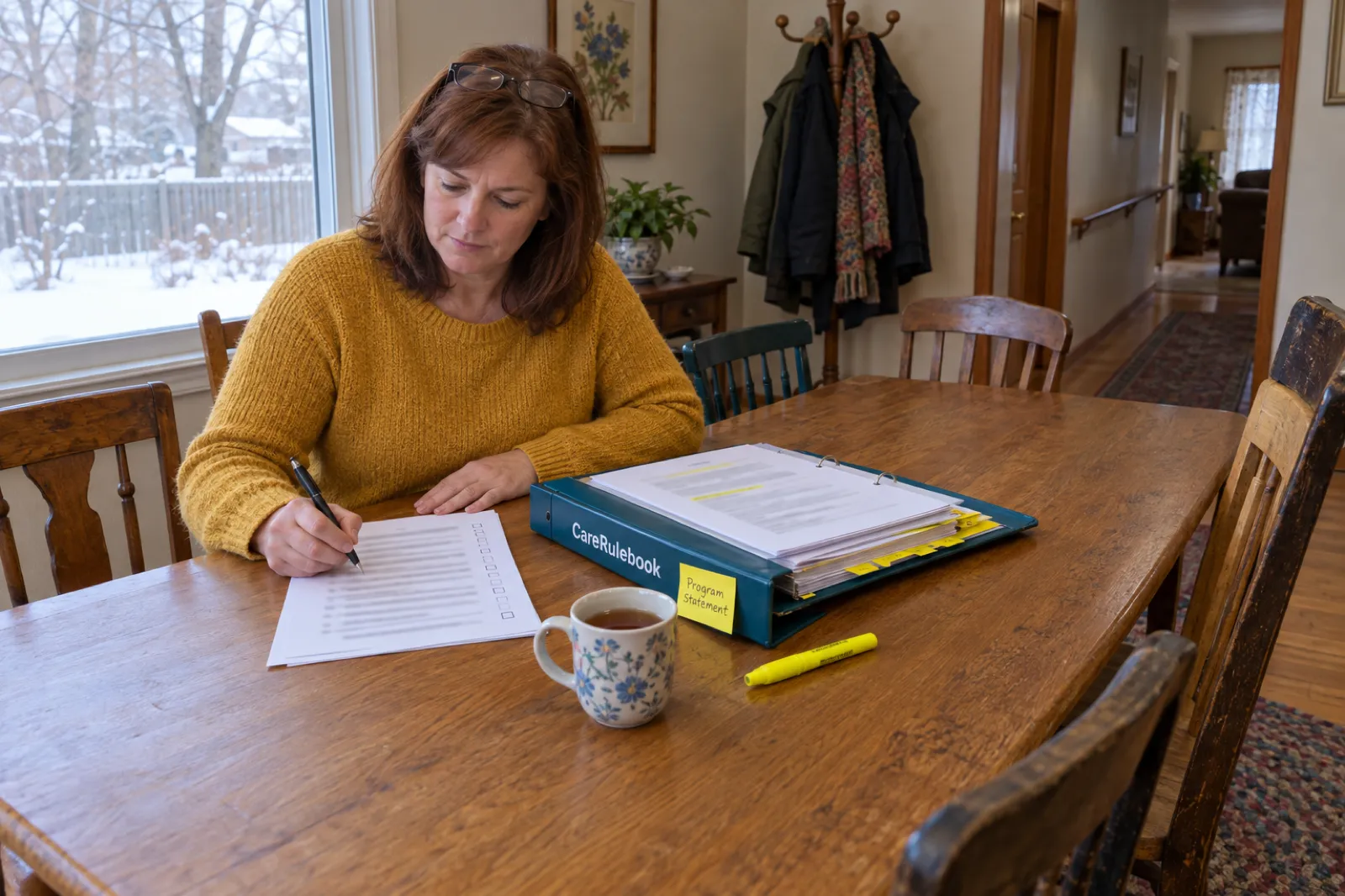
A woman in a mustard sweater at an oak dining table in a Michigan house ticks off a printed checklist beside an open teal CareRulebook binder with yellow tabs, a sticky note reading Program statement, a mug of tea and a highlighter, with a snowy backyard through the window

Quick answer

Staff: "Direct care staff shall be trained and competent in all of the following areas before performing assigned tasks independently:" reporting requirements, first aid, CPR with a hands-on demonstration, personal care, supervision and protection, resident rights, safety and fire prevention, communicable disease, food safety, and nutrition and special diets (R 400.629(5)). The rules set no number of hours.

Licensee and administrator: ten competencies (R 400.623(2)), 16 hours of LARA-accepted training a year or 6 college credit hours (R 400.627(1)), and "A licensee and administrator shall complete the department training titled “AFC New Provider Training” within 6 months of the initial license being issued or within 6 months of being hired as applicable." (R 400.627(2))
9

Areas direct care staff are trained and competent in before working alone

R 400.629(5)

16 hours

Of training a year for the licensee and administrator

R 400.627(1)

6 months

To complete LARA’s free AFC New Provider Training

R 400.627(2)

Quarterly

Emergency duty retraining for staff, with records kept 2 years

R 400.619(7)

From hire to working alone

The order follows R 400.619 to R 400.631, R 400.675 and R 400.701, with LARA’s technical assistance manual. Tick steps off as you go; progress is saved in this browser only.

  1. Check age and ability

    Before hire

    Direct care staff are at least 18 and able to complete reports and follow written and oral instructions. Staff aged 16 or 17 may count only under the rule’s conditions.

    R 400.629(1)-(2)
  2. Background check and health screening

    Before direct access; health statement within 30 days

    The criminal history check before direct access, a baseline screening for communicable diseases at hire, and a physician’s health statement within 30 days. Background checks.

  3. Give them your policies and job description

    At hire

    Group homes, and family homes that employ staff (LARA’s Key Highlights; our reading), give each staff member and volunteer the written policies and their job description at hire, and keep a signed receipt.

    R 400.701(2)-(3)
  4. Emergency duties

    At hire, then quarterly

    Instruct staff on hire in their emergency duties and the fire equipment, then retrain every quarter, with records kept 2 years.

    R 400.619(7)
  5. Train in the nine areas, shadowing meanwhile

    Before working alone

    Train and confirm competency in all nine areas. LARA says a new staff member may shadow a fully trained one, who stays responsible for the tasks, but is never left alone with residents.

  6. CPR and first aid before working alone

    Before working alone

    LARA’s technical assistance manual says staff cannot work alone in the home until they are competent in CPR and first aid, and the CPR skills part is done in person.

    LARA TA manual
  7. Medication training, if they will pass medications

    Before passing medications

    Staff who supervise residents taking medication are trained in its proper handling and administration and keep an individual medication log.

    R 400.675(4)
  8. Confirm competency and file the record

    Before working alone

    Use your method to assure competency, and keep written verification of the training in the staff member’s record.

The nine staff training areas

"Direct care staff shall be trained and competent in all of the following areas before performing assigned tasks independently" (R 400.629(5)). The licensee or administrator provides the training, or makes it available through other sources.

The nine training areas for Michigan adult foster care direct care staff
AreaWhat LARA or the rules addSource
Reporting requirementsLARA’s technical assistance manual says this training must include the Adult Protective Services Act, and covers incident, medication and property damage reporting.LARA TA manual
First aidFrom a trainer trained in and following nationally recognized standards.R 400.629(6)
CPR, with a hands-on demonstrationLARA says the knowledge part can be online but the skills part must be in person.LARA TA manual
Personal care, supervision and protectionWhere the program statement includes residents with Alzheimer’s or related conditions, LARA points to MCL 400.726b: a group home that markets dementia care describes its staff training and continuing education in writing to prospective residents.LARA TA manual
Resident rightsThe rights in R 400.681.R 400.629(5)(e)
Safety and fire preventionPlus instruction in emergency duties on hire and every quarter.R 400.619(7)
Prevention and containment of communicable diseases, including recognizing signs of illnessR 400.629(5)(g)
Food safety: storage, preparation, distribution and servingR 400.629(5)(h)
Nutrition and special dietsR 400.629(5)(i)
  • Family homes too. Family home licensees must now train their direct care staff, or make training available, in the nine R 400.629(5) areas. (LARA Key Highlights)
  • Agency temps and volunteers. LARA’s technical assistance manual says that when temporary agency staff or volunteers do direct care work, the licensee makes sure they meet every employee requirement for training, competency and criminal history checks. (LARA technical assistance manual)
  • Cooks and others. LARA’s technical assistance manual says staff who do not perform direct care responsibilities are not required to be competent in the direct care areas. (LARA technical assistance manual) A home licensed for 7 or more has at least one staff member qualified to be responsible for food preparation (R 400.663(8)).

Who may teach, and where to find training

  • You, except CPR. "Training can be provided by the licensee or administrator, and they can use relevant training videos or other training resources. Exception is CPR." (LARA technical assistance manual)
  • First aid and CPR trainers. "The individual providing the training shall be trained in and follow nationally recognized standards." (R 400.629(6)) LARA’s technical assistance manual lists videos, local public health departments, hospitals, the American Red Cross, physicians, nurses, EMTs and physician assistants among acceptable sources of first aid training. (LARA technical assistance manual)
  • LARA’s free videos and quizzes. LARA offers training videos, quizzes or virtual training on the starred staff and licensee training areas, and an attestation form to track them. (LARA trainings page)
  • Other sources LARA names. LARA’s trainings page names local public health departments, cooperative extension services, community colleges, and nutrition training from LARA or MDHHS among acceptable training sources. (LARA trainings page)

Showing competency

The rule asks for staff who are trained and competent. LARA’s technical assistance manual says: "The licensee must have a method to assure competency." (LARA technical assistance manual)

  • Methods LARA suggests. LARA’s technical assistance manual gives examples of ways to assure competency after training: skills demonstration and competency checklists, short tests or quizzes, performance evaluations, and shadowing and mentoring with experienced staff. (LARA technical assistance manual)
  • Shadowing. LARA’s technical assistance manual says new staff may shadow a fully trained staff member, who stays responsible for the tasks, as long as the untrained person is never left alone with residents. (LARA technical assistance manual)
  • CPR and first aid first. "Staff cannot work alone in the facility without being competent in CPR and first aid." (LARA technical assistance manual)

CareRulebook

A training policy, plan and records that match LARA’s worksheets

CareRulebook’s Michigan adult foster care manual includes Policy 4.4, training for the licensee, administrator, direct care staff and volunteers, written to R 400.623 to R 400.631 and LARA’s technical assistance manual, with a training plan, a competency checklist for direct care staff, a staff training record, a licensee record checklist and an annual training log. Your home’s details go in throughout, with the rule quoted under each policy.

  • 41 policies and documents, 102 requirements mapped
  • The R 400.701 direct care staff training policy LARA’s checklist asks for
  • Editable Word and PDF; download again free for 12 months
Preview your manual

$299CareRulebook founding price for the first 50 Michigan homes, then $349. Not a LARA fee.

Medication training

  • The rule. A licensee, administrator or direct care staff member who supervises a resident taking medication is "trained in the proper handling and administration of medication" and keeps an individual medication log (R 400.675(4)). Medication administration is also one of the licensee’s and administrator’s ten competencies (R 400.623(2)(j)).
  • LARA’s free course. LARA says staff who complete its free virtual medication administration training, the post-training quiz and the Medication Administration Skills Training and Competency Checklist meet R 400.623(2)(j) and R 400.675(4)(a). (LARA trainings page)
  • No nurse required. The AFC rules do not require a nurse on staff: medication is handled by trained licensees, administrators or direct care staff following the prescriber’s directions. A health care appraisal can be signed by a physician, physician assistant or RN. (R 400.675(3))

Age and health screening

  • Age. "Direct care staff shall be at least 18 years of age and able to complete required reports and follow written and oral instructions that are related to the care and supervision of residents." (R 400.629(1)) Staff aged 16 or 17 count as direct care staff only under the on-site supervision of a fully trained adult, never transporting residents or giving medication, fully trained for their duties, and with a parent’s consent for the background check. (R 400.629(2))
  • Health statements. A physician’s statement on the physical health of the licensee, staff and household members; the licensee’s and administrator’s are signed no more than 6 months before the temporary license, staff and household within 30 days of starting. (R 400.631(2)) Staff and household health is reviewed every year, with the verification kept 2 years (R 400.631(4)).
  • Baseline screening, not blanket TB tests. "R 400.631(5) replaces blanket TB testing with a risk-based health screening." (LARA Key Highlights) LARA’s technical assistance manual describes the baseline screening for communicable diseases as the health check at hire for signs, symptoms or known exposure to infectious illness, which may include influenza, tuberculosis, measles, mumps and hepatitis. LARA’s technical assistance manual says the physician’s signed health statement may record that the baseline screening was done; otherwise the licensee screens staff at hire. (LARA technical assistance manual)

The licensee and administrator

  • Education and experience. "A licensee and administrator shall have a high school diploma or general education diploma or equivalent and not less than 1 year of direct experience working with individuals that are aged or have been diagnosed with a mental illness, developmental disability, physical disability, traumatic brain injury, or Alzheimer’s disease." (R 400.623(4)) The diploma requirement does not apply to family or congregate homes licensed before the rules and continuously licensed since (R 400.623(4)).
  • Ten competencies. Applicants, licensees and administrators must be competent in nutrition, first aid, CPR, foster care, safety and fire prevention, financial and administrative management, the needs of the population served, resident rights, communicable disease prevention and medication administration. (R 400.623(2))
  • 16 hours a year. Licensees and administrators complete 16 hours of LARA-accepted training a year (or 6 college credit hours) relevant to the admission policy and program statement. (R 400.627(1)) LARA’s trainings page says licensees, licensee designees and administrators can earn 4 hours toward their annual training from each of its free virtual trainings, the AFC New Provider Training and the medication administration training. (LARA trainings page)
  • AFC New Provider Training. Within 6 months of the first license or of being hired, and not repeated if you have documentation of completing it before (R 400.627(2)). LARA lists wage and hour laws, required resident forms, direct care staffing, qualifications and training, staff record clearances, what to expect at a renewal inspection and special investigation, and corrective action plans. (LARA trainings page) LARA says participants in its virtual trainings must be licensed AFC providers or affiliated with a licensed AFC home, and may attend each no more than once a year. (LARA trainings page)
  • More if needed. LARA may prescribe additional training for a licensee or administrator where substantial noncompliance with the Act or rules is evident. (R 400.627(3))
  • A company’s designee. "For purposes of these rules, the licensee designee shall meet all the requirements of the licensee." (R 400.605(3))

Before you apply, LARA points prospective applicants to its Adult Foster Care Pre-Licensing Training Course (LARA applicants page). See the license checklist for where it fits.

Dementia care and special certification

  • Alzheimer’s and dementia care. LARA’s technical assistance manual says a home whose program statement includes residents with Alzheimer’s disease or related conditions meets MCL 400.726b, which includes staff training and continuing education. (LARA technical assistance manual) A group home that markets specialized dementia care describes its staff training in the written description it gives prospective residents (MCL 400.726b(1)).
  • Specialized programs. Before working alone, staff complete training on community residential services, carrying out individual plans of service, the needs of residents with developmental disabilities or mental illness, Mental Health Code chapter 7 rights, and non-aversive techniques. (R 400.707(1)) Specialized program staff training must come from people or organizations acceptable to the placing agency that contracts with the home (usually a community mental health program). (R 400.707(2))

Training records

"Documentation of training must be maintained in the staff’s record to determine that the training has been completed and is current." (R 400.629(7)) Staff records, including training, are kept 2 years after employment ends (R 400.639(2)). LARA runs free virtual AFC New Provider and Medication Administration trainings and a YouTube channel with quizzes; providers can use an attestation form to track them. (LARA trainings page) LARA’s employee records and licensee practice inspection worksheets check each training area row by row (LARA worksheets; what inspectors check).

Bills that would change training

House Bills 6320 to 6322 of 2026: AFC enhanced standards. Would add a resident satisfaction survey, semiannual pharmacist or RN medication reviews where unlicensed staff give medication, a written pre-admission disclosure, an internal complaint policy with 7-business-day written responses and a complaint log, posted complaint contacts, new resident rights, a written training plan, set courses within 120 days of hire and 8 hours of yearly continuing education. These are bills, not law. When we checked on November 13, 2026, they had been introduced and referred to the House Committee on Families and Veterans, with no later action (HB 6320). Get Michigan AFC alerts to hear if they move.

What the CareRulebook manual covers

LARA’s checklist asks group homes for a written direct care staff training policy (R 400.701(1)(d)). In the Michigan adult foster care manual that is Policy 4.4, training for the licensee, administrator, direct care staff and volunteers, with a training plan, a competency checklist for direct care staff, a staff training record, a licensee record checklist and a licensee and administrator annual training log. Policy 3.5 covers health statements and the baseline screening, Policy 6.1 the emergency instruction and drills, and Policy 7.1 specialized program training for certified homes.

It is not legal advice, and it does not replace the training itself. Read each policy before you adopt it.

Preview your manual

$299 CareRulebook founding price for the first 50 Michigan homes, then $349. Not a LARA fee.

A training myth, checked

Frequently asked questions

How many hours of training do AFC staff need in Michigan?

The rules set no number of hours for direct care staff. They set nine areas staff must be trained and competent in before performing assigned tasks on their own: reporting requirements, first aid, CPR with a hands-on demonstration, personal care, supervision and protection, resident rights, safety and fire prevention, communicable disease, food safety, and nutrition and special diets. The licensee and administrator are the ones with an hours requirement: 16 hours a year, or 6 college credit hours. For certified homes, specialized program training must come from people or organizations acceptable to the placing agency that contracts with the home, and, on our reading, that agency’s contract may set more.

Can the licensee train staff themselves?

Yes, except CPR. LARA’s technical assistance manual says training can be provided by the licensee or administrator, using relevant training videos or other resources. First aid and CPR come from a trainer trained in, and following, nationally recognized standards, and the CPR skills part is done in person.

Is online CPR training accepted for AFC staff?

Only partly. LARA’s technical assistance manual says the knowledge part of CPR can be delivered online, but the skills part must be completed in person. The rule itself requires a hands-on demonstration as part of the training.

Do AFC staff still need a TB test?

The 2025 rules dropped routine TB testing. LARA says R 400.631(5) replaces blanket TB testing with a risk-based health screening: a baseline screening for communicable diseases at hire, which LARA says may include tuberculosis among other illnesses. Follow the staff member’s health professional or the local health department where they give guidance.

Is LARA’s New Provider Training free, and can I take it before I am licensed?

It is free and virtual. LARA says participants must be a licensed AFC provider or affiliated with a licensed home, so in practice it comes after the license: the rule gives the licensee and administrator 6 months from the first license, or from being hired, to complete it. LARA says it counts for 4 hours of the yearly training.

Can 16 and 17 year olds work in an AFC home?

Yes, under conditions. They may count toward the staff ratio only under the direct supervision of a fully trained staff member aged 18 or older who is on site, never transporting residents or giving medication, trained for their duties, and with a parent’s consent for the background check.

Get Michigan AFC rule-change alerts

Bills in the legislature would add set training courses and yearly continuing education for AFC staff. Leave your email and we will tell you if they, or LARA’s rules, change your training duties.

No spam. Only emails about Michigan adult foster care rules. How we use your email.

Keep reading

Sources

  1. Adult Foster Care Facility Licensing Act, 1979 PA 218, MCL 400.701 to 400.737 (Michigan Compiled Laws, complete through PA 114 of 2026) · Michigan Legislature · retrieved November 13, 2026
  2. Licensing Adult Foster Care Facilities, Mich. Admin. Code R 400.601 to R 400.745 (2025 AACS) · Michigan Office of Administrative Hearings and Rules (Administrative Code, for LARA Bureau of Community and Health Systems) · retrieved November 13, 2026
  3. Rule sets 2023-65 to 2023-71 LR: request for rulemaking, regulatory impact statement, JCAR report and final rules (single AFC rule set; six old rule sets rescinded), filed November 3, 2025 · Michigan Office of Administrative Hearings and Rules (ARS) · retrieved November 13, 2026
  4. AFC Home Practice Inspection Worksheets (facility records, employee records, resident records, licensee and household, physical plant, special certification; revised 1/7/2026) and the worksheets page · LARA Bureau of Community and Health Systems, Adult Foster Care Division · retrieved November 13, 2026
  5. Adult Foster Care Administrative Licensing Rules Technical Assistance Manual, revised October 7, 2026 · LARA Bureau of Community and Health Systems, Adult Foster Care Division · retrieved November 13, 2026
  6. Key Highlights of the New AFC Licensing Ruleset · LARA Bureau of Community and Health Systems, Adult Foster Care Division · retrieved November 13, 2026
  7. LARA AFC web pages: AFC home, applicants, licensees (example policies and templates), trainings, license application packet, group home and family home application instructions, rules and statutes, resident forms (Internet Archive copies, 2026) · LARA Bureau of Community and Health Systems · retrieved November 13, 2026
  8. House Bills 6320, 6321 and 6322 of 2026 (adult foster care enhanced standards): bill pages, introduced text and House Fiscal Agency analysis (complete to September 22, 2026) · Michigan Legislature; House Fiscal Agency · retrieved November 13, 2026

Free sample, no email needed

Read a full policy before you buy

Policy 6.1, Emergency preparedness policy and plan, as it prints in the Michigan adult foster care manual, filled in for a fictional home. The rule text it rests on is quoted word for word under Rule basis.

PDF · 14 pages · 151 KB · Rule-verified November 13, 2026

Collecting answers for a home or a client? The intake questionnaire lists all 100 questions the builder asks, what each decision changes in the manual, and a completed example: Word · PDF.How consultants use CareRulebook.

Download the sample (PDF)
Or email it to me

We send the link once. Nothing else unless you tick the box. Privacy notice.

Build your Michigan AFC manualfrom $299