United StatesTexas, North Carolina, Georgia, Virginia, Indiana, Ohio, New York, Delaware, Maine, Oregon, California, Florida, Pennsylvania, New Jersey, Minnesota, Illinois, Washington, Colorado, Tennessee, Maryland, Kansas, South Carolina, Nevada
Minnesota · Home care provider license · Minn. Stat. 144A.43 to 144A.484
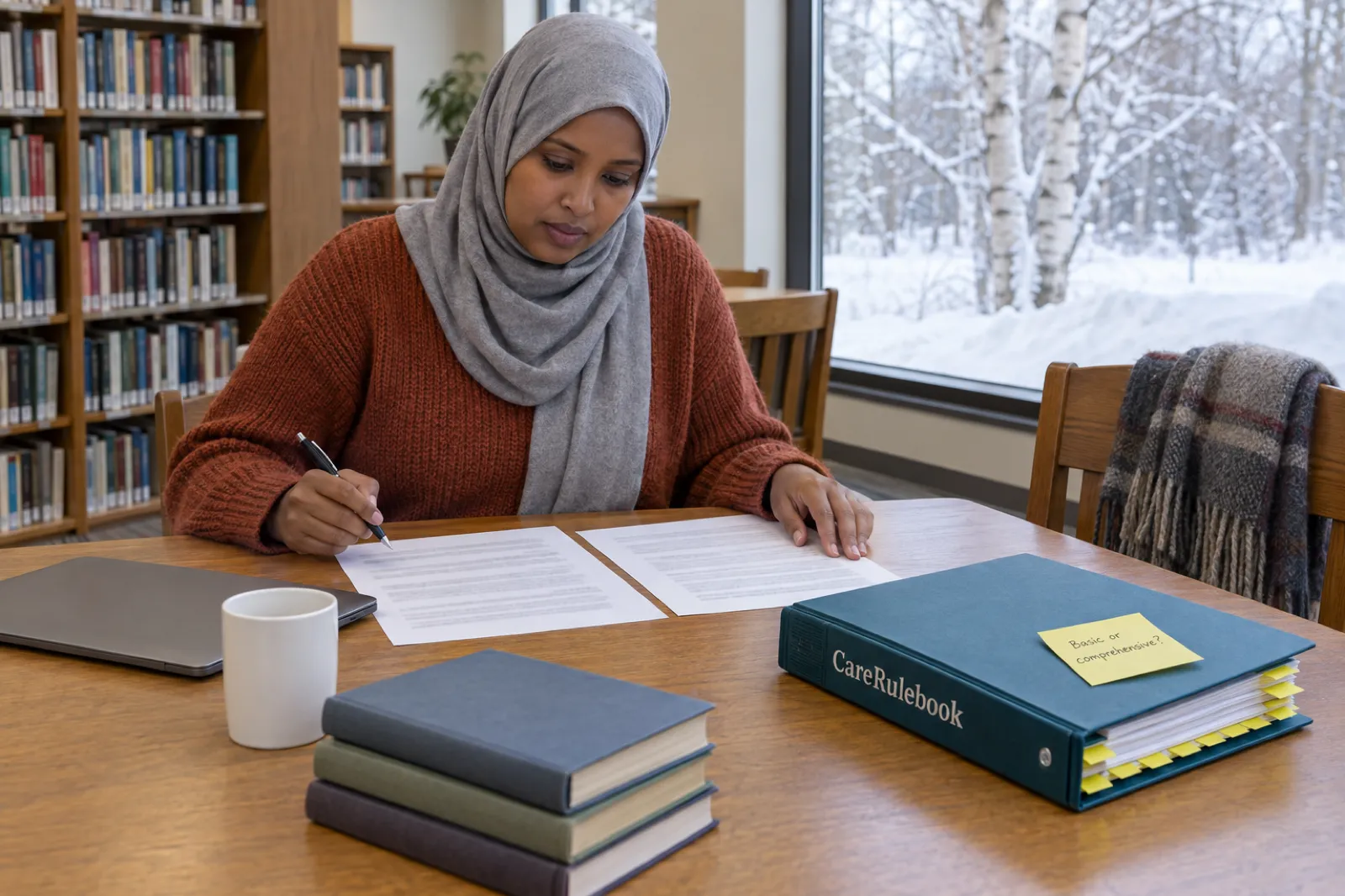
How to start a home care agency in Minnesota (basic vs comprehensive license, 2026)
To run a home care agency in Minnesota, you need a home care provider license from the Minnesota Department of Health (MDH), at the basic or comprehensive level. You start on a temporary license, verify ten policies (sixteen for comprehensive) on the application, and pass an unannounced survey once you are serving clients. This guide walks through each step, quoted from the statute and MDH’s own forms and guidance.
In Minnesota, "A home care provider may not open, operate, manage, conduct, maintain, or advertise itself as a home care provider or provide home care services in Minnesota without a temporary or current home care provider license issued by the commissioner of health." (Minn. Stat. 144A.471, subd. 1). "An applicant seeking to become a home care provider must apply for either a basic or comprehensive home care license." (subd. 5)
A basic license covers assistive tasks such as help with dressing, bathing and toileting, standby assistance and medication reminders. Basic staff may not do delegated nursing tasks, and MDH says no nursing assessment is required (MDH FAQ: Assessments). Hands-on help with transfers and mobility, medication management and delegated nursing tasks need the comprehensive license (144A.471, subds. 6-7). New agencies get a temporary license first, verify ten policies on the application, and pass an unannounced survey within 90 calendar days of MDH learning they are serving clients (144A.473, subd. 2). MDH’s fee is $2,100 for a temporary basic license (144A.472, subd. 7).
There is no rule chapter to read. Minnesota Rules chapters 4668 (home care licensure) and 4669 (license fees) were repealed in full: "[Repealed, L 2013 c 108 art 11 s 33; L 2014 c 275 art 1 s 134]" (Minn. R. ch. 4668 and 4669). The home care standards and MDH’s license fees are now in statute: Minn. Stat. 144A.43 to 144A.484, with the background study and maltreatment reporting laws.
The Minnesota Department of Health (MDH), through its Health Regulation Division. The license is a home care provider license under Minnesota Statutes 144A.43 to 144A.484, issued first as a temporary license and then, after a survey, as a basic or comprehensive license. The old home care rules (Minn. R. chapters 4668 and 4669) were repealed, so the home care standards and MDH’s license fees are in the statute.
What is the difference between a basic and a comprehensive license?
A basic license covers assistive tasks: help with dressing, self-feeding, oral hygiene, hair care, grooming, toileting and bathing, standby assistance, reminders and modified diets. A comprehensive license adds nursing and therapy services, delegated tasks, medication management, hands-on help with transfers and mobility, treatments and other complex care.
MDH’s fee for a temporary license is $2,100 at the basic level and $4,200 at the comprehensive level, nonrefundable. Renewal is yearly and depends on the last calendar year’s home care revenue, from $231 to $7,651. These are MDH’s fees, set in the statute, not CareRulebook prices.
Not routinely. The managerial official initials that each of ten listed policies is in place, and policies are not on the attachment checklist. MDH may still ask for more documents, a meeting or an on-site visit before the temporary license, and surveyors ask for policies at the start of the unannounced initial survey.
You need a home care provider license, probably at the basic level.
MDH issues a temporary basic license first ($2,100, MDH’s fee). A basic license needs no nurse. Hands-on help with transfers and mobility is a comprehensive service, so check the line between them before you choose.
Hands-on assistance with transfers and mobility, medication management, and tasks delegated by a registered nurse are comprehensive services. Comprehensive services start with an in-person assessment by a registered nurse (or the appropriate licensed health professional) within five days. MDH’s fee for a temporary comprehensive license is $4,200.
A provider of only home management services (at least two of housekeeping, meal preparation and shopping for someone unable to do them because of illness, disability or physical condition) needs an MDH certificate of registration: $20 a year for an individual, $50 for an organization (MDH’s fees). Add one assistive task, such as help with bathing or reminders, and you need the license.
Companionship is not a listed home care service, and household chores count only alongside an assistive task. On our reading, companionship alone, with fewer than two of housekeeping, meal preparation and shopping, needs neither a license nor a registration. The MDH toolkit lists “companion care” among basic license services, so ask MDH.
Organizations providing Medical Assistance personal care assistance are exempt from the MDH license. The license exemptions name PCA, not CFSS. The Community First Services and Supports (CFSS) program statute says that, for the purposes of that section, CFSS supports are not considered home care services. Our reading: a CFSS-only agency is outside the MDH license, but ask MDH and DHS before relying on it. Private-pay home care needs the license, and exempt providers still follow the home care bill of rights.
A business that only provides staff under contract to licensed or exempt providers, provides no services under direct agreements with clients, and is contractually bound to work under the provider’s direction and supervision is excluded from the license.
A home care provider is one that is "regularly engaged in the delivery of at least one home care service, directly in a client’s home for a fee" (Minn. Stat. 144A.43, subd. 4). At least one service must be provided directly, and a direct home care service is "a home care service provided to a client by the home care provider or its employees, and not by contract" (144A.471, subd. 2(a)) Operating without a license is a misdemeanor for anyone involved in managing, operating or controlling the business (144A.471, subd. 4).
Who is outside it
Home management-only providers register instead. A home management provider "is a person or organization that provides at least two of the following services: housekeeping, meal preparation, and shopping to a person who is unable to perform these activities due to illness, disability, or physical condition" (144A.482(a)). "A person or organization that provides only home management services may not operate in the state without a current certificate of registration issued by the commissioner of health." (144A.482(b)) MDH’s registration fee is $20 a year for an individual and $50 for an organization (144A.482(c)).
Medicaid PCA and CFSS (program rules). Organizations providing Medical Assistance personal care assistance are exempt from the license (144A.471, subd. 8(b)(1)), and the Community First Services and Supports program statute says that, "For the purposes of this section, ... supports purchased under CFSS are not considered home care services" (Minn. Stat. 256B.85, subd. 1(e), a Medicaid program statute). The license exemptions in 144A.471, subd. 8 name PCA, not CFSS. Our reading: a CFSS-only agency is outside the MDH license, but ask MDH and DHS before relying on it. "An exemption under this subdivision does not excuse the exempted individual or organization from complying with applicable provisions of the home care bill of rights in section 144A.44." (144A.471, subd. 8(b))
Staffing businesses that only provide staff under contract to licensed or exempt providers, provide no services under direct agreements with clients, and are contractually bound to work under the provider’s direction and supervision (144A.471, subd. 9(3)).
One person, one client, a few hours."an individual who performs basic home care services for no more than 14 hours each calendar week to no more than one client" is excluded (144A.471, subd. 9(16)). The statute lists other exemptions (subd. 8) and exclusions (subd. 9) too; read both before relying on one.
No housing."A home care licensee must not provide sleeping accommodations as a provision of home care services." Sleeping accommodations with assisted living services need an assisted living facility license (144A.471, subd. 1a).
Companion-only and homemaker work: our reading
Household chores count as a basic home care service only "if the provider is also providing at least one of the activities in clauses (1) to (5)", the assistive tasks and reminders (144A.471, subd. 6(6)). Two or more of housekeeping, meal preparation and shopping, on their own, need the home management registration above.
Companionship is not on the statute’s list of basic services. The MDH toolkit, prepared by Stratis Health under contract with MDH, says basic license services "may include help with activities of daily living (ADLs), homemaking, and companion care", and lists "Reminders or safety monitoring (not simply social visits)" as a basic service (MDH toolkit, license types). Our reading: a business that only offers companionship, with no assistive task, no reminders and fewer than two of the home management services, needs neither a license nor a registration. MDH has not said so in writing, so ask MDH before relying on it.
Basic vs comprehensive: what each license allows
Minnesota’s basic and comprehensive home care license levels compared: services, nurse, assessment and MDH’s fee
Basic
Comprehensive
Services
Help with dressing, self-feeding, oral hygiene, hair care, grooming, toileting and bathing; standby assistance; medication, treatment and exercise reminders; modified diets; household chores alongside one of these
Any basic service, plus one or more of: nursing and therapy services, delegated tasks, medication management, hands-on help with transfers and mobility, treatments and therapies, help with complicated eating problems, other complex or specialty care
Delegated nursing tasks
Not allowed
Allowed, supervised by an RN or licensed health professional
Medication
Reminders, including bringing already set-up medication
Medication management
First review of each client
An individualized review at the client’s home within 30 days
An in-person assessment by a registered nurse (or the appropriate licensed health professional) within five days
Policies verified on the application
10
16
Temporary license fee (MDH’s)
$2,100
$4,200
Medicare certification
Not eligible, MDH says
Possible after the initial survey, with the full license, MDH says
The comprehensive list includes "hands-on assistance with transfers and mobility" (144A.471, subd. 7(4)). The definitions draw the line:
“Hands-on assistance” means "physical help by another person without which the client is not able to perform the activity" (144A.43, subd. 3a)
“Standby assistance” means "the presence of another person to assist a client with an assistive task by providing cues, oversight, and minimal physical assistance" (144A.43, subd. 30) Standby assistance is a basic service.
Our reading: a basic licensee may stand by and give minimal physical assistance, but if a client cannot transfer or move without someone’s physical help, treat it as a comprehensive service. Where minimal assistance ends is MDH’s call; describe your services carefully in your statement of home care services and ask MDH if you are unsure.
A disagreement to know about. The MDH toolkit’s license types sheet lists among its basic examples: "Help with ADLs such as bathing, dressing, grooming, toileting, or mobility." The same sheet lists "Hands-on assistance with transfers, positioning, and mobility" under comprehensive (MDH toolkit, license types). The statute puts hands-on mobility help under comprehensive, and MDH says its toolkit does not ensure compliance (MDH toolkit page). Our reading: follow the statute, and treat “mobility” on a basic license as standby assistance only.
The statement of home care services
Before services start, you give each client "a written statement which identifies if the provider has a basic or comprehensive home care license, the services the provider is authorized to provide, and which services the provider cannot provide" and get a written acknowledgment (144A.4791, subd. 3). MDH publishes a basic statement of services form with its survey forms.
How a new agency gets licensed, step by step
Tick steps off as you go. Your progress is saved in this browser only.
Choose basic or comprehensive
Before applying
Every applicant applies for one level. Hands-on help with transfers and mobility, medication management and delegated nursing tasks need the comprehensive level (see basic vs comprehensive).
The application asks you to verify ten policies are in place (sixteen for comprehensive). MDH says applicants need agency-specific policies that address all requirements of the home care statutes. See the ten policies.
Upload the application and attachments in MDH’s Facility and Provider Licensing System: workers’ compensation evidence if you have employees, any liability insurance, the IRS 147-C letter and your ownership documents. The managerial official initials each policy and signs.
Owners, managerial officials and any named RN or other licensed health professional must complete and pass DHS background studies before MDH issues the temporary license.
The statute gives MDH 90 days from a complete application to issue or deny; MDH’s page says 60 days. The temporary license lasts up to one year, and you must meet all of 144A.43 to 144A.482 from the start.
Within five days of starting services, notify MDH that you are serving clients, by mail or email. A late notice brings a $1,000 fine. If you serve no one during the temporary license, it expires and you reapply.
"Applicants must upload a completed application and all required attachments through the MDH application portal: Facility and Provider Licensing System." (MDH forms page) The statute requires the application to include "verification that the applicant has the following policies and procedures in place so that if a license is issued, the applicant will implement the policies and procedures and keep them current" (144A.472, subd. 1(14)):
Reporting maltreatment of minors (chapter 260E) and of vulnerable adults (section 626.557)
Conducting and handling background studies on employees
Orientation, training and competency evaluations of home care staff, and a process for evaluating staff performance
Handling complaints from clients, family members or representatives about staff or services
Initial evaluation of clients’ needs and the provider’s ability to provide those services
Initial and ongoing client evaluations, and how changes in condition are identified, managed and communicated
Orientation to and implementation of the home care bill of rights
Infection control practices
Reminders for medications, treatments or exercises, if provided
Screenings, or documentation of prior screenings, showing staff are free of tuberculosis, to current CDC standards
Initial and ongoing assessments by a registered nurse or appropriate licensed health professional, including changes in condition
Ensuring nurses and licensed health professionals have current, valid licenses
Medication and treatment management
Delegation of home care tasks by registered nurses or licensed health professionals
Supervision of registered nurses and licensed health professionals
Supervision of unlicensed personnel performing delegated tasks
Initialled, not attached
On MDH’s temporary basic application, the managerial official in charge of day-to-day operations initials each of the ten under this statement: "I verify that the applicant has the following policies and procedures in place so that if a license is issued, the applicant will implement the policies and procedures and keep them current." (temporary basic application, Managerial Official Verification). The application’s attachment checklist names workers’ compensation and liability insurance evidence (if applicable), the IRS 147-C letter, ownership attachments A to E, any management agreement, and explanations of any past revocation or denial. Policies are not on it (attachment checklist).
That does not mean nobody reads them. "The department shall review each application to determine the applicant’s knowledge of and compliance with Minnesota home care regulations." MDH "may further evaluate the applicant or licensee by requesting additional information or documentation or by conducting an on-site survey" (144A.473, subd. 1(a)), and MDH says it "may request additional information or a telephone or in-person meeting with applicants" (MDH application materials). MDH also says: "To be eligible for a home care license, applicants must have agency-specific policies and procedures in place that address all requirements of Minnesota home care statutes." (MDH application materials)
The rest of the application
The managerial official. The application includes "documentation that identifies the managerial official who is in charge of day-to-day operations and attestation that the person has reviewed and understands the home care provider regulations" (144A.472, subd. 1(11)).
Workers’ compensation."If the applicant has employees, it must have active workers’ compensation insurance, and the applicant must be listed as the insured entity. An application for workers’ compensation insurance is not acceptable as evidence of coverage." (temporary basic application) Liability coverage is documented "if the provider has it" (144A.472, subd. 1(9)).
Your office. The application asks whether the office is in a commercial business building, a private home or residence, or another licensed facility, and says: "If you are using a home address for your business, please let the post office know the name of your business to ensure mail delivery." (temporary basic application). We found no office location rule in the statute.
The fee comes last."Once MDH determines it has all required application information, signatures, and attachments, MDH will contact the applicant to request payment of the application fee, in the MDH application portal." (temporary basic application)
The temporary license, the first client and the initial survey
The temporary license
"For new license applicants, the commissioner shall issue a temporary license for either the basic or comprehensive home care level.""A temporary license is effective for up to one year from the date of issuance, except that a temporary license may be extended according to subdivision 3.""Temporary licensees must comply with sections 144A.43 to 144A.482." (144A.473, subd. 2(a))
How long it takes."Within 90 days after receiving a complete application, the commissioner shall issue a temporary license, renew the license, or deny the license." (144A.473, subd. 1(c)) MDH’s page says: "Once an application is deemed complete MDH has 60 days to issue or deny the temporary license." (MDH application materials)
Changing level. Before the survey, a temporary licensee may ask MDH in writing to change level. "The applicant must pay the difference between the application fees when changing from the basic level to the comprehensive level of licensure. No refund will be made if the provider chooses to change the license application to the basic level." (144A.473, subd. 2(d))
"If the temporary licensee does not provide home care services during the temporary license period, then the temporary license expires at the end of the period and the applicant must reapply for a temporary home care license." (144A.473, subd. 2(c)) If you report clients within 45 days before the temporary license expires, MDH may extend it up to 60 days to finish the survey (subd. 2(e)).
The unannounced initial survey
When."During the temporary license period, the commissioner shall survey the temporary licensee within 90 calendar days after the commissioner is notified or has evidence that the temporary licensee is providing home care services." (144A.473, subd. 2(b)) "Initial full surveys must be completed within 14 months after the department’s issuance of a temporary basic or comprehensive license." (144A.474, subd. 2(a))
No advance notice."Surveys and investigations shall be conducted without advance notice to home care providers." (144A.474, subd. 4) MDH adds: "In most cases, the surveyor will attempt to reach the licensee by phone and/or email shortly before the start of the survey." It says this is not advance notice (MDH FAQ: Survey Process).
What surveyors do. The survey includes "information-gathering through client and staff observations, client and staff interviews, and reviews of records, policies, procedures, practices, and other agency information" (144A.474, subd. 3(7)). MDH’s survey guide says surveyors arrive at the provider’s office location (MDH survey guide), and among the things they observe is "Following the provider’s own policies and procedures" (MDH survey guide, observations).
Policies at the door. MDH’s entrance conference form for basic providers lists required documents with the instruction "Provide these at the start of the survey." Its policies and procedures cover training of unlicensed personnel (documentation, dementia), content of employee records, content of client records, the disaster and emergency plan (for the business and for individual clients), quality management, orientation and annual training with curriculum, maltreatment reporting, complaints and service plans (MDH form 5065b). "These are the same forms MDH staff use when conducting a survey." (MDH survey forms page)
Rosters. On request, give surveyors a list of current and past clients with addresses and phone numbers (144A.474, subd. 6).
After the survey
Pass:"If the temporary licensee is in substantial compliance with the survey, the commissioner shall issue either a basic or comprehensive home care license." (144A.473, subd. 3(a))
Not in substantial compliance: MDH must either "(1) not issue a license and terminate the temporary license; or (2) extend the temporary license for a period not to exceed 90 days and apply conditions" (144A.473, subd. 3(a)). A reconsideration request must reach MDH within 15 calendar days after you receive the correction order (subd. 3(d)).
Fines from the first survey. Correction orders can carry fines straight away: "imposed immediately with no opportunity to correct the violation first", from $500 per Level 2 violation to $5,000 per Level 5 violation (144A.474, subd. 11(a)). These are penalties, not fees.
Fees, and the penalties that are not fees
MDH’s home care license fees and the DHS vendor’s fingerprint fee
Fee
Amount
Per
Temporary basic home care license application (MDH fee, nonrefundable)
The license and registration fees are MDH’s, set in Minn. Stat. 144A.472 and 144A.482. The fingerprint and photo fee is charged by IDEMIA, DHS’s vendor. None is a CareRulebook price. MDH’s license fees under 144A.472 are nonrefundable: "All fees are nonrefundable." (144A.472, subd. 7(j))
Yearly renewal, by revenue
The renewal fee depends on "revenues derived from the provision of home care services during the calendar year prior to the year in which the application is submitted" (144A.472, subd. 7(e)). MDH’s bands:
MDH’s yearly home care license renewal fee by the last calendar year’s home care revenue
Skip the revenue report."At each annual renewal, a home care provider may elect to pay the highest renewal fee for its license category, and not provide annual revenue information to the commissioner." (144A.472, subd. 7(g))
A clean survey discount."A licensee is eligible for a performance incentive if there are no violations identified in a core or full survey. The performance incentive is a ten percent discount on the licensee’s next home care renewal license fee." (144A.474, subd. 10)
Changing level before the survey costs the difference between the two application fees to move up; there is no refund to move down (144A.473, subd. 2(d)).
Background studies. DHS announced that from March 30, 2026 IDEMIA, its fingerprint and photo vendor, charges $13.50 per person, paid directly to IDEMIA and separate from DHS’s study fee (DHS background studies page, archived copy). The statute caps the criminal background check part of DHS’s fee at $44 per study, on top of DHS’s fees for fingerprint preparation and the consent form, for applicants and license holders regulated by the commissioner of health (245C.10, subd. 18). We have not confirmed what DHS currently charges for a home care study; DHS’s site blocks our tools.
Bond and insurance. We found no surety bond in 144A. MDH’s application says: "If the applicant has employees, it must have active workers’ compensation insurance, and the applicant must be listed as the insured entity. An application for workers’ compensation insurance is not acceptable as evidence of coverage." (temporary basic application).
Penalties (not fees)
Late notice of your first client:"The fine for failure to comply with the notification requirements in section 144A.473, subdivision 2, paragraph (c), is $1,000." (144A.472, subd. 7(i))
Survey fines: from $500 per Level 2 violation up to $5,000 per Level 5 violation, which may be imposed immediately (144A.474, subd. 11(a)).
Under-reporting revenue:"A temporary license or license applicant, or temporary licensee or licensee that knowingly provides the commissioner incorrect revenue amounts for the purpose of paying a lower license fee, shall be subject to a civil penalty in the amount of double the fee the provider should have paid." (144A.472, subd. 7(h))
Operating without a license:"A person involved in the management, operation, or control of a home care provider that operates without an appropriate license is guilty of a misdemeanor." (144A.471, subd. 4)
Written policies: what a basic agency needs, and what comprehensive adds
The ten application policies are the start, not the whole list. Other sections of 144A require written documents or procedures from every licensee:
Complaints:"The home care provider must have a written policy and system for receiving, investigating, reporting, and attempting to resolve complaints from its clients or clients’ representatives." (144A.4791, subd. 11(a)) Each client also gets a written complaint notice (subd. 11(c)), and complaint records are kept at least two years (subd. 11(b)).
Emergencies:"The home care provider must have a written plan of action to facilitate the management of the client’s care and services in response to a natural disaster, such as flood and storms, or other emergencies that may disrupt the home care provider’s ability to provide care or services." (144A.4791, subd. 12)
Maltreatment:"Each home care provider must establish and implement a written procedure to ensure that all cases of suspected maltreatment are reported." (144A.479, subd. 6(a)), and an individual abuse prevention plan for each client (see reporting maltreatment).
Records:"The home care provider shall establish and implement written procedures to control use, storage, and security of client’s records and establish criteria for release of client information." (144A.4794, subd. 1(b)) Client records are kept at least five years after discharge (subd. 5) and employee records three years after the person leaves (144A.479, subd. 7).
Quality management:"The home care provider shall engage in quality management appropriate to the size of the home care provider and relevant to the type of services the home care provider provides.""Documentation about quality management activity must be available for two years." (144A.479, subd. 3)
Tuberculosis: a TB infection control program to current CDC guidelines. "This program must include a tuberculosis infection control plan that covers all paid and unpaid employees, contractors, students, and volunteers.""The home care provider must maintain written evidence of compliance with this subdivision." (144A.4798, subd. 1) MDH’s FAQ says "Baseline TB screening is required at the time of hire for all health care personnel in Minnesota", and "employers must cover the costs of those tests" (MDH FAQ: Tuberculosis).
Infection control:"A home care provider must establish and maintain an effective infection control program that complies with accepted health care, medical, and nursing standards for infection control." (144A.4798, subd. 3)
Client paperwork: the bill of rights notice before services start (144A.4791, subd. 1), the statement of home care services (subd. 3), a written service plan within 14 days with a contingency plan (subd. 9), and a written termination notice with at least ten calendar days’ notice in most cases (subd. 10; 144A.44, subd. 1).
Client reviews (basic):"When services being provided are basic home care services, an individualized initial review of the client’s needs and preferences must be conducted at the client’s residence with the client or client’s representative.""This initial review must be completed within 30 days after the date that home care services are first provided." Then "client monitoring and review must be conducted as needed based on changes in the needs of the client and cannot exceed 90 days from the date of the last review." (144A.4791, subd. 7)
MDH’s 2022 guidance on agency-specific policies says "the provider must tailor these policy samples or templates to their agency; otherwise, they will not satisfy the requirements of Minnesota statutes." It also says "an agency providing home care services with a basic home care license does not need to write a policy on medication management because these services cannot be performed by a basic licensee." (MDH guidance, archived copy; the live page now returns an error)
What the comprehensive level adds
The comprehensive level brings an RN-led clinical section on top of everything above:
RN assessment."When the services being provided are comprehensive home care services, an individualized initial assessment must be conducted in person by a registered nurse.""This initial assessment must be completed within five days after the date that home care services are first provided." A reassessment at home follows within 14 days, then monitoring at most 90 days apart (144A.4791, subd. 8). If services start before the assessment, the RN or licensed health professional completes a temporary plan (subd. 6).
Medication management."Medication management services may not be provided by a home care provider who has a basic home care license.""A comprehensive home care provider who provides medication management services must develop, implement, and maintain current written medication management policies and procedures." They are developed under the supervision and direction of a registered nurse, licensed health professional or pharmacist (144A.4792, subd. 1). Each client receiving medication management is assessed first and reassessed "at a minimum, annually" (144A.4792, subds. 2-5).
Delegation and supervision."A home care provider with a comprehensive home care license must have a registered nurse available for consultation to staff performing delegated nursing tasks" (144A.4797, subd. 1(b)). "The direct supervision of staff performing delegated tasks must be provided within 30 days after the date on which the individual begins working for the home care provider and first performs delegated tasks for clients and thereafter as needed based on performance." (subd. 3(b))
An RN employee for direct services. MDH’s comprehensive application says: "To consider medication management services and delegation of tasks to unlicensed personnel as services provided directly, the RN (or the licensed health professional, in the case of non-nursing delegated tasks) must be a direct employee of the licensee." (temporary comprehensive application)
Training and competency
Minnesota home care staff orientation, training and competency
Step
When
What
Who runs it
Orientation
Before providing services
Eight topics, from the statute to maltreatment reporting, plus orientation to each client
The provider
Training and competency (unlicensed staff, basic)
Before giving basic services
15 topics, or a written or oral test plus a practical skills test
People with home care work experience and training
Dementia training
If you serve people with Alzheimer’s or related disorders
The disease, challenging behaviors and communication
Orientation."All staff providing and supervising direct home care services must complete an orientation to home care licensing requirements and regulations before providing home care services to clients." (144A.4796, subd. 1) The eight topics run from an overview of the home care statutes and "introduction and review of all the provider’s policies and procedures related to the provision of home care services by the individual staff person" to emergencies, maltreatment reporting, the bill of rights, complaints, advocacy services and the license scope (subd. 2(a)). "Staff providing home care services must be oriented specifically to each individual client and the services to be provided." (subd. 4)
Competency before basic services. Unlicensed staff must have "successfully completed a training and competency evaluation appropriate to the services provided by the home care provider and the topics listed in subdivision 7, paragraph (b)", or passed a written or oral test on those topics plus a practical skills test on personal hygiene and grooming, standby assistance and reminders (144A.4795, subd. 3(a)). The 15 topics run from documentation and infection control to falls, nutrition, modified diets, boundaries and emergencies (subd. 7(b)). We found no hour count for this training.
Who trains. For basic services, training and competency evaluations are conducted by "individuals with work experience and training in providing home care services listed in section 144A.471, subdivisions 6 and 7" (144A.4795, subd. 7(a)(1)). The MDH toolkit says: "RN involvement is not required." (MDH toolkit 2.1) For comprehensive services, training and competency evaluations "must be conducted by a registered nurse, or another instructor may provide training in conjunction with the registered nurse" (subd. 7(a)(2)).
Nursing assistants. MDH’s employee record review for basic providers says: "ULPs currently listed on the MDH nursing assistant registry (NAR) are assumed to be competent in these requirements." (MDH form 5021b)
Annual training."All staff that perform direct home care services must complete at least eight hours of annual training for each 12 months of employment." It includes maltreatment reporting, a review of the bill of rights, infection control techniques, and "review of the provider’s policies and procedures relating to the provision of home care services and how to implement those policies and procedures" (144A.4796, subd. 6).
Supervision. A basic licensee has a contact person available to staff whenever they are providing services (144A.4797, subd. 1). Basic staff are supervised periodically where services are given: "Supervision includes direct observation of unlicensed personnel while the unlicensed personnel are providing the services and may also include indirect methods of gaining input such as gathering feedback from the client." (subd. 2)
Background studies through DHS
Minnesota’s Department of Human Services (DHS) runs the background studies; MDH does not. "Background study requests are submitted through NETStudy 2.0." (DHS background studies page, archived copy)
Owners and managerial officials first."All owners, managerial officials and the named RN or other licensed health professional on home care license applications must complete and pass background studies, as required by 144A.476, prior to MDH issuing a temporary license." (temporary basic application) No disqualified person may be involved in managing, operating or controlling the provider (144A.476, subd. 1).
Staff after the temporary license."After MDH issues a temporary license, providers must complete background studies for all individuals seeking employment, paid or volunteer, as required by 144.057." (temporary basic application) Employees, contractors and volunteers are subject to the study and may be disqualified under chapter 245C (144A.476, subd. 2).
Fingerprints and a photo. Study subjects give fingerprints and a photograph, recorded by DHS’s vendor, with exceptions in the statute. "The fingerprints shall be submitted by the commissioner to the Bureau of Criminal Apprehension and, when specifically required by law, submitted to the Federal Bureau of Investigation for a national criminal history record check." (245C.05, subd. 5(c)-(d)) For direct care staff who live outside Minnesota, the study includes that state’s substantiated maltreatment findings where available and a check of the National Crime Information Center database (144.057, subd. 1(a)(2)).
Before the result. Until DHS issues a notice, such as one that the person is not disqualified, the person may not be "providing direct contact services to persons served by a program unless the subject is under continuous direct supervision" (245C.13, subd. 2). Laws 2026, chapter 121 amended that subdivision, and the amended text, effective July 1, 2026, keeps the same rule (Laws 2026, ch. 121, art. 4, sec. 16).
Disqualifying offenses. Chapter 245C disqualifies some offenses permanently, "regardless of how much time has passed since the discharge of the sentence imposed" (245C.15, subd. 1), and others for set periods, such as 15, ten or seven years. Laws 2026, chapter 121 amended those subdivisions, and the 2026 session laws table lists chapter 127 as amending them too (Laws 2026, ch. 121, art. 4, secs. 17 to 19), so check the current text before a decision.
Licensed professionals. MDH says: "As of August 1, 2022, providers holding a valid license from a health-related licensing board (HLB) who has also undergone a background check under Minnesota Statutes, section 214.075, shall not have a background study completed by the commissioner of human services (a NETStudy 2.0 background study)." (MDH application materials) By our reading, this does not cover owners and managerial officials: the statute’s exception applies to paragraph (a), clauses (1) to (5), and owners and managerial officials are clause (6) (144.057, subd. 1(a)(6), (b)).
At renewal. The statute requires owners and managerial officials to complete a study before a license is renewed (144A.476, subd. 1(a)). MDH says: "New background studies are not necessary for those that have a current eligible study affiliated with the license being renewed. New background studies will need to be completed for any recently added owners or managerial officials with direct contact." (MDH FAQ: Background Studies) Keep documentation of each person’s study in their employee record (144A.479, subd. 7).
For fees, see fees: $13.50 to IDEMIA per person, plus DHS’s study fee. The statute caps the criminal background check part of that fee at $44 per study, on top of DHS’s fees for fingerprint preparation and the consent form; we have not confirmed what DHS charges.
Reporting maltreatment: MAARC and individual abuse prevention plans
Every adult client is a vulnerable adult. Under the Vulnerable Adults Act, a vulnerable adult includes any person 18 or older who "receives services from a home care provider required to be licensed under sections 144A.43 to 144A.482" (Minn. Stat. 626.5572, subd. 21(a)(3)).
Staff are mandated reporters. Mandated reporters include "an employee or person providing services in a facility as defined in subdivision 6", and that definition includes "a home care provider licensed or required to be licensed under sections 144A.43 to 144A.482" (626.5572, subds. 6, 16).
Report immediately."A mandated reporter who has reason to believe that a vulnerable adult is being or has been maltreated, or who has knowledge that a vulnerable adult has sustained a physical injury which is not reasonably explained shall immediately report the information to the common entry point." (626.557, subd. 3(a)) “Immediately” means "as soon as possible, but no longer than 24 hours from the time initial knowledge that the incident occurred has been received" (626.5572, subd. 10)
Where. The common entry point is the Minnesota Adult Abuse Reporting Center (MAARC), toll free (844) 880-1574 (MDH maltreatment page). "Mandated reporters may use the online reporting system or call the MAARC toll free number above." (MDH)
Clients under 18."For any client under the age of 18, you must report to the county child protection number for the county where the incident occurred. MAARC does not take reports for those under the age of 18." (MDH maltreatment page) Under the Maltreatment of Minors Act, an organization such as a corporation or nonprofit must not have any policies that "prevent or discourage a mandatory or voluntary reporter from reporting" (260E.06, subd. 1(c)).
Internal reporting. Staff may report internally, but "However, the facility remains responsible for complying with the immediate reporting requirements of this section." (626.557, subd. 4a(a)), and "a facility with an internal reporting procedure that receives an internal report by a mandated reporter shall give the mandated reporter a written notice stating whether the facility has reported the incident to the common entry point." The written notice is due within two working days, tells the reporter they may report externally if not satisfied, and tells them about the protection from retaliation (626.557, subd. 4a). No one may stop staff reporting externally (subd. 4a(d)).
The agency’s written duties."Each home care provider must establish and implement a written procedure to ensure that all cases of suspected maltreatment are reported.""Each home care provider must develop and implement an individual abuse prevention plan for each vulnerable minor or adult for whom home care services are provided by a home care provider." (144A.479, subd. 6) The plan covers the client’s susceptibility to abuse, the risk of abusing others, and specific measures, and abuse here includes self-abuse.
Orientation and annual training both cover maltreatment reporting (144A.4796). The 2026 changes to the Vulnerable Adults Act are under law changes in 2026.
After you are licensed
Renew every year. Under the statute, "a license may be renewed for a period of one year if the licensee satisfies the following", including filing "at least 30 days before expiration of the license" and verifying that the application policies are current (144A.472, subd. 3). MDH says a provider "must have delivered qualifying home care services within the past 12 months, for a fee, to be eligible for license renewal", and asks for a client service agreement and a billing statement (MDH renewal page).
Surveys at least every three years. The statute requires a survey of each provider at least once every three years. Frequency may depend on license level, compliance history, number of clients or other factors (144A.474, subd. 1).
Correction orders."By the correction order date, the home care provider must document in the provider’s records any action taken to comply with the correction order." (144A.474, subd. 8)
What MDH cites most. MDH’s FY 2024 report: "MDH issued 1,344 home care correction orders in FY 2024 due to licensing violations found during routine home care surveys; 1,174 of those correction orders were issued to comprehensive home care providers and 170 to basic." Across basic and comprehensive providers, the top violations were TB infection control (109), content of service plan (74), employee records (73), comprehensive assessment and monitoring (66), and individual abuse prevention plans (56) (MDH legislative report, FY 2024). For basic providers in FY 2022, MDH’s report says "content of service plan was the most prevalent violation followed by violations related to TB infection control, employee records, contents of client records, and basic individualized client review/monitoring" (MDH legislative report, FY 2021-2022).
Changes."The temporary licensee or licensee shall notify the commissioner in writing within ten working days after any change in the information required in subdivision 1", though owners’ and managerial officials’ names and contact details are updated at renewal instead (144A.472, subds. 1(5), 6).
Buying or selling an agency."A home care license issued by the commissioner may not be transferred to another party. Before acquiring ownership of or a controlling interest in a home care provider business, a prospective owner must apply for a new license." (144A.472, subd. 5(a)) MDH’s change of ownership fee is $2,100 basic and $4,200 comprehensive (subd. 7(b)). Under Laws 2026, chapter 95, the new owner also takes on outstanding fines and open correction orders (see law changes in 2026).
Display the license."The original current license must be displayed in the home care provider’s principal business office and copies must be displayed in any branch office. The home care provider must provide a copy of the license to any person who requests it." (144A.479, subd. 1)
No powers of attorney."A home care provider or staff cannot accept powers-of-attorney from clients for any purpose, and may not accept appointments as guardians or conservators of clients." (144A.479, subd. 4(b))
The HCBS designation. A licensee can add a home and community-based services designation: "The designation allows the license holder to provide basic support services that would otherwise require licensure under chapter 245D, under the license holder’s home care license governed by sections 144A.43 to 144A.4799." (144A.484, subd. 1) MDH’s FAQ says that although a basic licensee technically can apply, "there is no funding path for MHCP enrollees to receive services under a Basic Home Care license." (MDH FAQ: Integrated Licensure) See also where the sources disagree.
Law changes in 2026, and why there are no rules
Minnesota has no home care rule chapter: Minn. R. chapters 4668 and 4669 are repealed, and every standard is in Minn. Stat. 144A.43 to 144A.484 (Minn. R. ch. 4668 and 4669). Changes come through the Legislature. The revisor’s statute pages still show the 2025 edition, so for these changes we quote the 2026 session laws. All of them are in force.
New owners inherit fines and open correction orders (Laws 2026, chapter 95). Signed May 14, 2026. After a change of ownership, "the new licensee is responsible for any outstanding fines and any fines assessed following the effective date of the change of ownership" (Laws 2026, ch. 95, art. 3), and must complete existing corrections and conditions. Fine money now funds a competitive grant program for home care quality. The sections carry no effective-date clause. Chapter 95 includes appropriation items, so under Minn. Stat. 645.02 they took effect on July 1, 2026 (our reading).
Vulnerable Adults Act changes to the common entry point and county adult protection (Laws 2026, chapter 95, article 7). Article 7 changes how the common entry point (MAARC) takes and refers reports and adds county adult protective services duties. Our reading: it does not change a mandated reporter’s duty to report immediately to the common entry point, or the internal reporting rules (Laws 2026, ch. 95, art. 7).
Federally qualified health centers exempt from the home care license for certain nursing (Laws 2026, chapter 121). A new exemption from the license for a federally qualified health center providing certain nursing services, effective May 28, 2026 (Laws 2026, ch. 121, art. 2, sec. 3). No effect on other agencies.
Background studies (Laws 2026, chapter 121). Chapter 121 also amended chapter 245C, including the rule on working before a study result (still continuous direct supervision) and the subdivisions setting disqualification periods (see background studies).
We will email rule-change alerts when Minnesota changes its home care law or MDH changes its forms and guidance (sign up below), and all states’ open changes are on our rule changes page.
Where the sources disagree, and our readings
Mobility on a basic license. The MDH toolkit lists “mobility” among basic examples; the statute lists hands-on assistance with transfers and mobility as a comprehensive service (above). Our reading: follow the statute.
60 or 90 days. The statute gives MDH 90 days from a complete application to issue or deny a temporary license; MDH’s page says 60 days (144A.473, subd. 1(c); MDH). Either way, the clock starts only once the application is complete.
Who does the basic client review. Subdivision 7 requires the basic review but names no reviewer. Subdivision 6 refers to "the individualized review or assessment by a licensed health professional or registered nurse as required in subdivisions 7 and 8" (144A.4791, subd. 6), while MDH says no nursing assessment is required under a basic license (MDH FAQ: Assessments). Our reading: a basic agency need not use a nurse, but name who does the review and their qualifications in your policy, and ask MDH what it expects.
Dementia training. The statute requires it for providers serving people with Alzheimer’s or related disorders, for staff and supervisors working with those clients (144A.4796, subd. 5). MDH’s basic employee record review says "Initial Dementia training required for all direct care staff and supervisors" (MDH form 5021b). Our reading: expect surveyors to look for it, and train everyone if you may serve clients with dementia.
The HCBS designation and basic licenses. The statute says "A home care provider applicant or license holder may apply" (144A.484, subd. 1); the MDH toolkit says: "Does not apply to basic home care license holders." (MDH toolkit) MDH’s FAQ says that although a basic licensee technically can apply, "there is no funding path for MHCP enrollees to receive services under a Basic Home Care license." (MDH FAQ) Ask MDH before planning on it with a basic license.
Studies at renewal. The statute ties owner and managerial official studies to each renewal; MDH says no new study is needed for anyone with a current eligible study affiliated with the license (above).
Companion-only work. Covered above: on our reading outside both the license and the registration, not confirmed by MDH.
MDH’s policy guidance page. MDH’s “Expectations for Agency-Specific Policies and Procedures” (last updated October 4, 2022) now returns an error, so we quote the Internet Archive copy from March 2026 (archived copy). We do not know whether MDH has withdrawn it.
The 2026 effective date. Laws 2026, chapter 95, article 3 has no effective-date clause. Under Minn. Stat. 645.02, an act with appropriation items takes effect on July 1 after enactment, and chapter 95 has appropriation items, so we show July 1, 2026 (our reading; 645.02).
Is there a CareRulebook manual for Minnesota?
No, we do not sell a Minnesota manual, and this guide is free.
What we suggest if you are writing your own: decide your level first, write the ten application policies in your own words, then add the other written duties above (complaints, emergencies, maltreatment and abuse prevention plans, records, quality management, TB and infection control). Use MDH’s published survey forms to check each one, and keep your policies matched to what your staff actually do, since surveyors check that you follow them. Sign up for Minnesota rule-change alerts below. If you are weighing another state, our policy requirements by state table shows where we do sell a manual.
How many home care agencies does Minnesota have?
MDH’s own counts, from its annual legislative reports on home care licensing:
Home care licenses MDH regulated in FY 2023 and FY 2024, by type (MDH’s counts)
License type
FY 2023
FY 2024
Basic
43
41
Temporary basic
82
46
Comprehensive
640
473
Temporary comprehensive
82
117
Home health agency
159
149
All home care licenses regulated
948
826
MDH’s counts of licenses regulated in each fiscal year, not new licenses. MDH’s FY 2023 breakdown adds up to 1,006, more than its stated total of 948; we show both as MDH printed them. MDH report, FY 2023; MDH report, FY 2024
Why comprehensive numbers fell. MDH’s FY 2024 report says that when assisted living licensure took effect on August 1, 2021, "hundreds of comprehensive home care licensees converted to an assisted living license", and "The comprehensive home care licensees had the most significant change with 1,004 fewer licensees or a 68% decrease in the same time period." (MDH report, FY 2024)
MDH’s directory. MDH’s 2026 directory counted 1,055 home care providers as of March 13, 2026, all license types with no split by level (MDH directory, Table 1).
New agencies a year. MDH does not publish new licenses by level. A temporary license lasts up to one year, so the temporary counts above give a rough idea (our reading, not MDH’s count). We have not found an MDH report for FY 2025.
Minnesota home care myths, checked against the source
Fourteen common questions, each with the statute or guidance it rests on.
Can a basic home care license help clients with transfers?
It depends. Not hands-on. Hands-on help with transfers and mobility is a comprehensive service. "Hands-on" means physical help without which the client cannot do the activity. A basic licensee can give standby assistance: being present with cues, oversight and minimal physical help. On our reading, if clients need someone to lift or bear their weight, you need the comprehensive license. Where minimal help ends is MDH’s call, so describe it carefully in your statement of services.
"hands-on assistance with transfers and mobility;"
Do I need a nurse to open a basic home care agency in Minnesota?
No. Not for a basic license. Basic services are assistive tasks such as help with bathing, dressing and toileting, standby assistance and reminders, and basic staff may not perform delegated nursing tasks. MDH says no nursing assessment is needed under a basic license; instead someone reviews each client’s needs at home within 30 days, then at least every 90 days. Staff are trained by people with home care experience, not necessarily an RN. A comprehensive license is different: it needs an RN for assessments, delegation and supervision.
"No. There can be no delegated nursing tasks under a basic license, therefore no nursing assessment is required."
Do companion or homemaker-only services need a Minnesota home care license?
It depends. Household chores count as home care only when you also give at least one basic assistive service, such as help with dressing, bathing or reminders. If you only provide two or more of housekeeping, meal preparation and shopping for someone who cannot do them, you register with MDH as a home management provider ($20 a year for an individual, $50 for an organization) instead of getting a license. Companionship with no assistive task reads as outside the license on our reading; ask MDH before relying on that.
"assisting with laundry, housekeeping, meal preparation, shopping, or other household chores and services if the provider is also providing at least one of the activities in clauses (1) to (5)."
Does MDH review my policies before issuing the license?
It depends. Not page by page. On the application, the managerial official initials each of the ten required policies to confirm they are in place, and the application’s attachment checklist does not include the policies themselves. MDH reviews the application for your knowledge of the regulations and may ask for documents or meet you. The real test is the unannounced initial full survey, within 90 calendar days of MDH learning you are serving clients, where surveyors ask for your policies at the start and check that staff follow them. You get the full license only if you pass.
"I verify that the applicant has the following policies and procedures in place so that if a license is issued, the applicant will implement the policies and procedures and keep them current."
Can basic home care staff give medications?
No. A basic licensee may only give verbal or visual reminders, bring the client medication already set up or in its original containers, and bring liquid or food to take it with. Medication management, such as setting up or administering medications, is a comprehensive service. MDH says a basic licensee does not write a medication management policy, but it does need a reminders policy if it gives reminders.
"Medication management services may not be provided by a home care provider who has a basic home care license."
How much does a Minnesota home care license cost?
It depends. MDH charges $2,100 for a temporary basic license and $4,200 for a temporary comprehensive license, paid once your application is complete and nonrefundable. Renewal is yearly and depends on last year’s home care revenue: $231 up to $25,000, rising to $7,651 over $1.5 million. On top of that you need workers’ compensation insurance if you have employees, and background studies through DHS (plus a $13.50 fingerprint and photo fee per person, charged by DHS’s vendor IDEMIA). Separately, telling MDH late that you have started serving clients brings a $1,000 fine, which is a penalty, not a fee.
"for a basic home care provider, $2,100; or"
How long does it take to get a Minnesota home care license?
It depends. The statute gives MDH 90 days from a complete application to issue a temporary license, and MDH’s page says 60 days. MDH says the time depends on how complete your application is, and it may ask for more information or a telephone or in-person meeting. The temporary license lasts up to a year; you must start serving clients, tell MDH within five days, and pass the initial full survey (within 90 days of MDH being told) to get the full license.
"Within 90 days after receiving a complete application, the commissioner shall issue a temporary license, renew the license, or deny the license."
Do Medicaid PCA or CFSS agencies need an MDH home care license?
It depends. Organizations providing Medical Assistance personal care assistance are exempt from the MDH license. The license exemptions name PCA, not CFSS, but the CFSS statute says that, for the purposes of that section, supports bought under Community First Services and Supports (CFSS, which replaces PCA) are not considered home care services. On our reading, CFSS work therefore sits outside the MDH license; ask MDH to confirm. Exempt providers still follow the home care bill of rights. Private-pay personal care needs the MDH license.
"an individual or organization that offers, provides, or arranges for personal care assistance services under the medical assistance program as authorized under sections 256B.0625, subdivision 19a, and 256B.0659;"
Is MDH’s free toolkit enough for my policies?
No. It helps, but it is not a policy manual. MDH and Stratis Health publish free worksheets, service plan checklists, training records and audit tools, and say using them does not ensure compliance. MDH also says sample policies must be tailored to your agency or they will not satisfy the statutes. You still need written, agency-specific policies on every required topic.
"the provider must tailor these policy samples or templates to their agency; otherwise, they will not satisfy the requirements of Minnesota statutes."
Can a new caregiver start before the background study clears?
It depends. Not alone with clients. Until DHS issues a notice that the person is not disqualified (or that more time is needed but they need not be removed, or another notice the statute lists), they may not provide direct contact services unless under continuous direct supervision. The DHS notice says whether supervision is required.
"providing direct contact services to persons served by a program unless the subject is under continuous direct supervision;"
Are all my adult clients vulnerable adults?
Yes. Anyone 18 or older who receives services from a licensed home care provider is a vulnerable adult under the Vulnerable Adults Act, so your staff are mandated reporters for every adult client. Suspected maltreatment goes to MAARC (844-880-1574) within 24 hours, and every client needs an individual abuse prevention plan.
"receives services from a home care provider required to be licensed under sections 144A.43 to 144A.482"
How much training do Minnesota basic home care caregivers need?
It depends. The statute sets topics and competency, not hours, for new caregivers: an orientation on licensing rules before they serve anyone, then a training and competency evaluation on 15 topics, or a written or oral test plus a practical skills test on hygiene, standby assistance and reminders. MDH’s survey form for basic providers says nursing assistants on the MDH registry are assumed competent in those topics. After that, every direct care worker needs at least eight hours of training each year.
"All staff that perform direct home care services must complete at least eight hours of annual training for each 12 months of employment."
Will MDH tell me before the survey?
No. Surveys are unannounced. MDH says that in most cases the surveyor tries to reach you by phone or email shortly before the survey starts, and that this is not advance notice. Keep client and discharged client rosters current, and have your policies, records and quality management documentation ready at all times.
"Surveys and investigations shall be conducted without advance notice to home care providers."
Can I run a Minnesota home care agency from my home?
Yes. On our reading. The statute sets no office location rule, and MDH’s application offers "Private Home/Residence" as an office location and tells applicants using a home address to let the post office know the business name. MDH’s survey guide says surveyors arrive at the provider’s office location, and client records must be protected from loss, tampering and unauthorized disclosure, so plan for secure storage and a place to review records.
"If you are using a home address for your business, please let the post office know the name of your business to ensure mail delivery."
Frequently asked questions
How long does it take to get a home care license in Minnesota?+
The statute gives MDH 90 days from a complete application to issue or deny a temporary license; MDH’s page says 60 days. An application is complete only once MDH has every document, signature and attachment, and owners and managerial officials must pass background studies first. After that you serve your first client, tell MDH within five days, and MDH surveys within 90 calendar days. The basic or comprehensive license follows a survey in substantial compliance.
Can a basic home care agency help with transfers in Minnesota?+
Not hands-on. The statute lists hands-on assistance with transfers and mobility as a comprehensive service, and “hands-on” means physical help without which the client cannot do the activity. A basic licensee can give standby assistance: cues, oversight and minimal physical assistance. The MDH toolkit lists mobility among basic examples, which does not match the statute, so ask MDH where your services fall.
Do I need a nurse for a basic home care license?+
No. Basic staff may not perform delegated nursing tasks, MDH says no nursing assessment is required under a basic license, and the MDH toolkit says RN involvement is not required to train basic staff. A comprehensive license is different: comprehensive services start with an in-person assessment by a registered nurse (or the appropriate licensed health professional) within five days.
Can I switch from basic to comprehensive later?+
Before your survey, a temporary licensee may ask MDH in writing to change level, paying the difference between the application fees to move up; there is no refund to move down. After licensing, ask MDH how to change level.
Can I run a Minnesota home care agency from home?+
The application asks whether your office is in a commercial business building, a private home or residence, or another licensed facility, and tells applicants using a home address to tell the post office the business name. We found no office location rule in the statute. Surveyors start at your office, and client records must be kept secure.
Does CareRulebook sell a Minnesota manual?+
No. We publish this free guide and send free Minnesota rule-change alerts. If you write your own policies, start from the ten application policies, add the other written duties in 144A, and tailor every sample to your agency, as MDH asks.
Get Minnesota rule-change alerts
We will email you when Minnesota amends its home care law or MDH changes its forms, survey tools or guidance, with what it means for your agency.