Skip to content
CareRulebook
MenuClose

Where are you starting?

United StatesTexas, North Carolina, Georgia, Virginia, Indiana, Ohio, Illinois, Washington, Colorado, Tennessee, Maryland
TexasManual
North CarolinaManual
GeorgiaManual
VirginiaManual
IndianaManual
OhioGuide
IllinoisManual
WashingtonManual
ColoradoManual
TennesseeManual
MarylandGuideAll US states →
United KingdomEngland
Free toolsChecklists, calculators and templates

Tennessee · Home health vs home care · 0940-05-38, 0720-27 and Public Chapter 110

Tennessee home health vs home care: PSSA, DDA and HFC licenses

Tennessee licenses non-medical home care and home health through different state bodies. A Personal Support Services Agency (PSSA) is licensed by TDMHSAS, or by the Department of Disability and Aging when most clients have an intellectual or developmental disability. Home health is a Health Facilities Commission license that needs a certificate of need. Here is how they differ, where a PSSA has to stop, and what CMS’s 2026 home health moratorium does and does not touch.

  • Rule-verified October 2, 2026
  • Quoted from Tenn. Comp. R. & Regs. 0940-05-38 and 0720-27
  • Public Chapters 110 and 858, HFC and CMS QSO-26-11
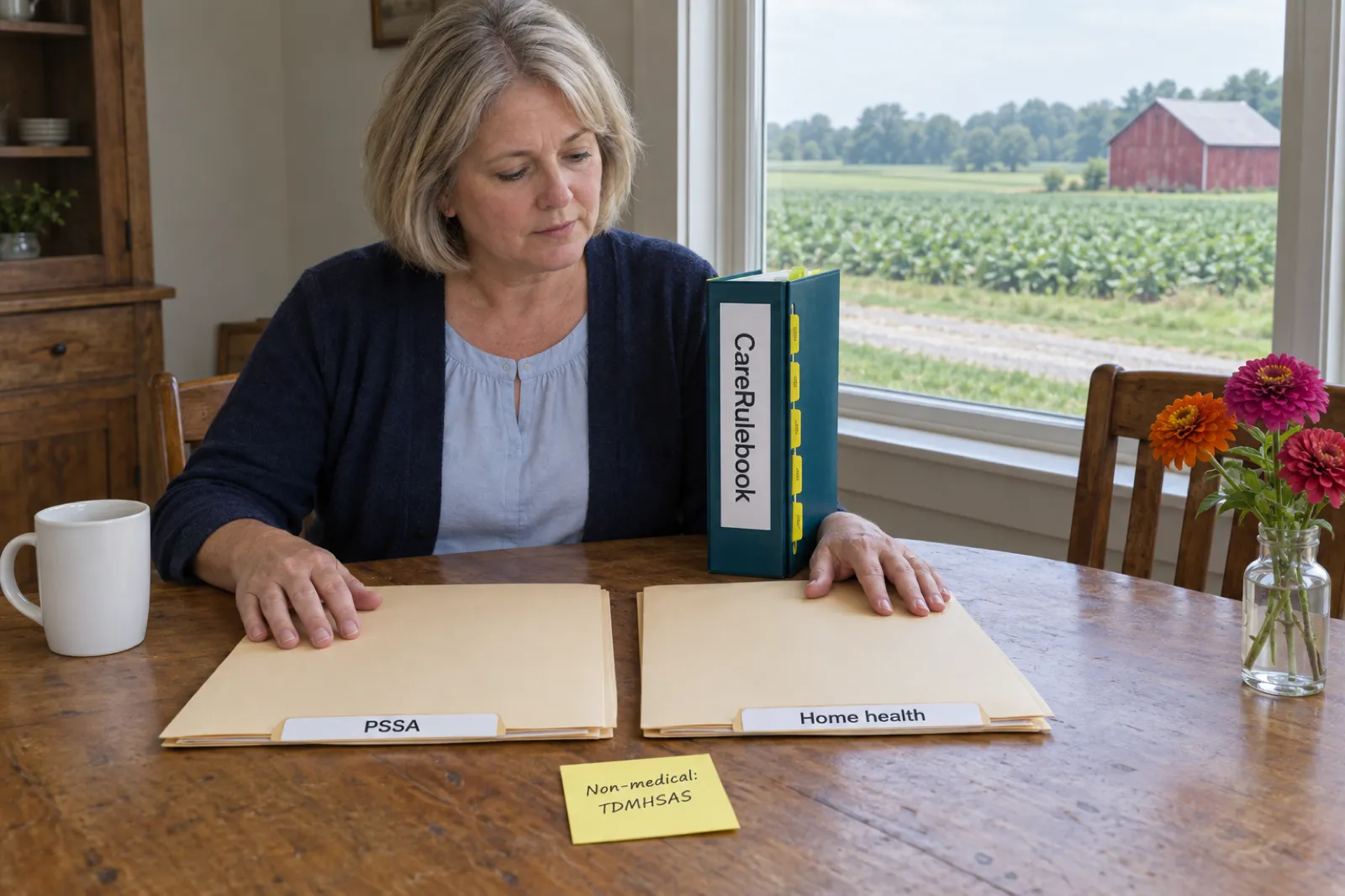
A woman in a navy cardigan at a farmhouse kitchen table rests a hand on each of two manila folders labelled PSSA and Home health, beside a CareRulebook binder and a sticky note reading Non-medical: TDMHSAS, with green fields and a red barn outside the window

Quick answer

Non-medical home care in Tennessee is licensed as a Personal Support Services Agency (PSSA). "To provide personal support services, an agency needs a license from either the Department of Mental Health and Substance Abuse Services or the Department of Intellectual and Developmental Disabilities." 0940-05-38-.04(1) Which one depends on who 50% or more of your clients are, and you need only one of the two. Public Chapter 110 (2015)

Home health is a different license: a home care organization providing home health services, licensed by the Health Facilities Commission, for skilled nursing, therapy, medical social services and home health aide services under a physician’s orders. 0720-27-.01(30) It needs a certificate of need, HFC and HFC’s fee is $1,404 a year, against TDMHSAS’s $810 per site for a PSSA. 0720-27-.02(2)(b) 0940-05-02-.05(1)

CMS halted Medicare enrollment of new home health agencies nationwide from May 13, 2026. QSO-26-11 By our reading that does not touch a PSSA, which is not a Medicare home health agency.
$810

TDMHSAS’s PSSA fee per site, each year

0940-05-02-.05(1)

$1,404

HFC’s yearly fee for a home health license

0720-27-.02(2)(b)

50%

Share of clients with an intellectual or developmental disability that moves the PSSA license to DDA

0940-05-38-.04(3)(b)

75 hours

Training for a home health aide; a PSSA sets no hour minimum

0720-27-.01(29)

Three licenses for care at home

LicenseForSource
PSSA license from TDMHSASNon-medical personal support where 50% or more of clients are aged, or have a mental illness or substance abuse diagnosis.0940-05-38-.04(3)(a)
PSSA license from DDAThe same services where 50% or more of clients have an intellectual or developmental disability, under DDA’s own chapter 0465-02-17.0940-05-38-.04(3)(b)
Home care organization license from HFCHome health, home medical equipment, professional support or hospice services, even for one patient.Public Chapter 858 (2024); HFC determination

When a provider is a home care organization. A provider is operating a home care organization if it holds itself out as providing home health, home medical equipment or hospice services; contracts or agrees to deliver them; accepts physician orders for them; accepts responsibility for delivering them; or contracts with the state agency to provide professional support services. Public Chapter 858 (2024) Non-medical personal support is not in that definition, and a home care organization licensed by HFC is exempt from the PSSA license. 0940-05-38-.03(2)(g) By our reading, a licensed home health agency therefore does not need a PSSA license as well.

A PSSA and a home health agency, side by side

Each line is from the PSSA rules, HFC’s home health rules (Chapter 0720-27), TDMHSAS, HFC or CMS, linked in the cell. Lines marked "by our reading" are ours.

PSSA (non-medical)Home health (HFC)
Who licensesTDMHSAS’s Office of Licensure, under T.C.A. Title 33, Chapter 2, Part 4 (or DDA if 50% or more of clients have an intellectual or developmental disability). 0940-05-02-.01(1); 0940-05-38-.04(3)The Health Facilities Commission (HFC), as a home care organization providing home health services, under Chapter 0720-27. 0720-27-.02(1)
What it coversSelf-care help, household help (housekeeping, laundry, meals, shopping, bill paying), help getting to community activities, and a registered nurse’s education services, in the client’s home. 0940-05-38-.01(1)Services under orders recorded by a physician: skilled nursing, physical, occupational or speech therapy, medical social services and home health aide services. 0720-27-.01(30)
ClientsPeople who depend on personal support for major life activities but do not need nursing-level services for an acute illness or injury. 0940-05-38-.01(2)Patients under a physician’s orders. 0720-27-.01(30)
Who runs itOne individual the licensee designates as responsible for operating the agency. The rules set no qualifications for that person. 0940-05-38-.05(4)An administrator who is a physician, a registered nurse or trained in health service administration, with at least one year of supervisory or administrative experience in home health, hospice or related programs. 0720-27-.01(2)
NurseNone required, unless you offer medication assistance (training by or under a registered nurse) or education services. 0940-05-38-.08(1)(b); .01(6)Skilled nursing given by or under the supervision of a registered nurse who is available at all times during operating hours. 0720-27-.06(5)(a)
CaregiversDocumented competency in seven areas before working with clients, and job-related training every year; no hour minimum. 0940-05-38-.08(1)Home health aides with 75 hours of training, including 16 hours of clinical training. 0720-27-.01(29)
MedicationMedication assistance: reminders and opening packaging. Since 2024, staff certified through a TDMHSAS-approved program may administer some medication in the client’s home. 0940-05-38-.01(9); Public Chapter 730 (2024)Drugs and treatments given by appropriately licensed agency personnel, within the scope of their licenses. 0720-27-.06(4)
State fee$810 per site, each year (TDMHSAS’s fee), non-refundable. 0940-05-02-.05(1)$1,404 each year (HFC’s fee), with the application, not refundable. 0720-27-.02(2)(b)
Certificate of needNone found. Personal support services agencies are not on HFC’s list of institutions that need one. HFC, Certificate of Need BasicsRequired before establishment, licensure or certification, with exceptions such as pediatric-only home health. HFC, Certificate of Need Basics
First inspectionAn electronic desk audit; no fire or life safety inspection. TDMHSAS, steps 4-5An inspection by a surveyor; if deficiencies are noted, a plan of corrective action must be accepted. 0720-27-.02(2)(f)
MedicareBy our reading, not a Medicare home health agency; CMS’s 2026 moratorium memo does not mention non-medical home care. QSO-26-11Enrollment of new Medicare home health agencies is halted nationwide from May 13, 2026. QSO-26-11

Fees are the state’s: TDMHSAS’s for a PSSA and HFC’s for home health, paid to the state and separate from any CareRulebook price. The full PSSA process is on the Tennessee guide.

Where a PSSA has to stop

PSSA clients are people who depend on personal support but "does not require nursing level services to be provided in connection with an acute episode of illness or injury". 0940-05-38-.01(2) TDMHSAS’s PSSA slides then list tasks a PSSA may not do. PSSA slides, slides 25-27

Not allowed under a PSSA license

TDMHSAS lists tasks not allowed under a PSSA license, including blood pressure monitoring, blood sugar checks, insulin injections, giving oral medications, prescription topical creams or pain patches, catheter and feeding tube care, measuring intake and output, taking vital signs and filling medication planners.

PSSA slides, slide 25

Also not allowed

Also not allowed: putting drops in eyes or ears, adjusting oxygen settings or IVs, changing dressings, enemas, catheter irrigation, emptying indwelling catheter or ostomy bags, positioning bed-bound clients to prevent contractures, tube feeding, ventilator management and applying ointments of any kind. For staff certified in medication administration, TDMHSAS says to ask the certification program whether any of these are allowed.

PSSA slides, slides 26-27

Medication assistance, not administration

Medication assistance means reminders and opening packaging. It does not include injections or any medication administration reserved for licensed nurses and others under Title 63, Chapter 7. Since Public Chapter 730 (2024), staff certified through a TDMHSAS-approved program may administer medication in the home to a client who cannot self-administer, but never intravenous, intramuscular or certain subcutaneous injectables.

0940-05-38-.01(9); Public Chapter 730 (2024)

Nebulizers

Adding a tube of medicine to a nebulizer is medication administration, not medication assistance, under the PSSA rules.

PSSA slides, slide 23

Lifts and gait belts

A Hoyer lift or gait belt may be used, after training, to help with transfers into or out of bed, a chair, toilet or shower, but not as part of a therapy regimen.

0940-05-38-.06(1)(n)

The nurse’s role in a PSSA

The PSSA rules name a registered nurse for education services (consultation about a chronic condition), for medication assistance training, and as one option for workers’ consultation. By our reading, none of these is hands-on nursing care.

0940-05-38-.01(6); .08(1)(b); .07(2)(g)

By our reading, when a client needs one of these tasks, a PSSA arranges or refers for it (to a home health agency, a nurse or the client’s doctor) and keeps giving only the personal support it is licensed for. The services you offer, and the tasks your workers do not do, belong in your description of services, which is one of the 17 required policy items. 0940-05-38-.06(1)(a) CareRulebook’s manual covers them in Policy 2.1, and certified medication administration in Policy 2.12.

Homemaker and companion care

HFC’s home health rules define homemaker service as "A non-skilled service in the home to maintain independent living which does not require a physician’s order. An agency does not have to be licensed as a home care organization to provide such services." 0720-27-.01(31) That sentence is about HFC’s license only.

TDMHSAS’s PSSA rules count household help as a personal support service in its own right: "Household assistance with tasks such as housekeeping, laundry, meal planning, meal preparation, shopping, bill paying, and use of telecommunication devices". 0940-05-38-.01(1)(b) The PSSA exemption covers only "A person who provides only housekeeping services to a service recipient and no other assistance with major life activities". 0940-05-38-.03(2)(c) So by our reading a homemaker service that does laundry, meals or shopping for clients who meet the PSSA client definition (substantial limitations in two or more major life activities) needs a PSSA license, even though it needs no HFC license. Companionship on its own is named neither as a service nor as an exemption; ask TDMHSAS if that is your whole plan.

"Non-Medical Home Health". TDMHSAS’s Fact Sheet (rev. 10/27/2025) has a "Non-Medical Home Health" checkbox beside the Personal Support Services Agency box. No rule we saved defines a license category by that name. MH-4386, item 4 Ask your regional office which box applies before you file.

TDMHSAS or DDA: one license, not two

The statute, as rewritten by Public Chapter 110 in 2015, says TDMHSAS "shall also license personal support services for the aged as well as persons with mental illness", and DIDD, now the Department of Disability and Aging (DDA), licenses personal support services for people with intellectual or developmental disabilities. Public Chapter 110 (2015), section 1

  • No duplicate licensing. Under T.C.A. 33-2-403(c)(1) as rewritten in 2015, a service that shows compliance through a current personal support services license from another state agency is treated as compliant, so duplicate licensing is not necessary. Agencies serving both groups "shall not be required to obtain a license from both departments". T.C.A. 33-2-403(c)(1), Public Chapter 110 The same subsection tells TDMHSAS and DIDD (now DDA) to work together so PSSA licensing standards suit every population served and are applied consistently.
  • The larger population decides. For a new applicant, that is "the larger population anticipated to be served by the agency at the time of licensure application". T.C.A. 33-2-403(c)(2), Public Chapter 110 DDA’s chapter says that after January 1, 2016 (TDMHSAS’s chapter says after July 1, 2016), a renewing PSSA applies only to the department that licenses 50% or more of its client base, with a new client-mix attestation. 0465-02-17-.02(4)
  • The attestation. You attest in writing to the category of the majority of your clients when you apply and with every renewal, and then serve only clients who will not take you outside that category. 0940-05-38-.04(3)-(4) .05(5) Either department’s licensee may also serve people with physical or other disabilities. .04(2)
  • DDA’s rules add more. DDA’s IDD PSSA chapter 0465-02-17 adds medication administration, assessments, Individual Support Plan teams and monitoring, and restrictive behavior management rules not in the TDMHSAS chapter. 0465-02-17 DDA’s PSSA chapter has its own rule for medication given by certified staff: locked storage, prescription medication only for the person it is prescribed for, disposal of discontinued medication, and reporting errors and reactions to the prescriber. The TDMHSAS PSSA chapter has no such rule. 0465-02-17-.06(1)
  • DDA’s fees. A DDA-licensed PSSA pays DDA’s fees under DDA’s rule 0465-02-02-.05, which we have not saved; no license is issued until they are paid. 0465-02-17-.02(5)

The rules do not say how the 50% is counted (people, hours, or at application only). If your client mix is close to half, ask your TDMHSAS regional office before you apply.

Professional support services: an HFC license, not a PSSA

The name sounds close to personal support, but it is a different service. HFC’s rules define professional support services as nursing, occupational, physical or speech therapy for people with intellectual or developmental disabilities under a contract with the state agency that pays for those services. 0720-35-.01(49) A home care organization providing professional support services must keep a contract with the Department of Intellectual and Developmental Disabilities (now DDA). 0720-35-.02(2)(b)

A provider that contracts with the state agency to provide professional support services is operating a home care organization under the 2024 definition, Public Chapter 858 (2024) and an organization authorized to provide only professional support services is an exception to the certificate of need requirement. HFC, Certificate of Need Basics

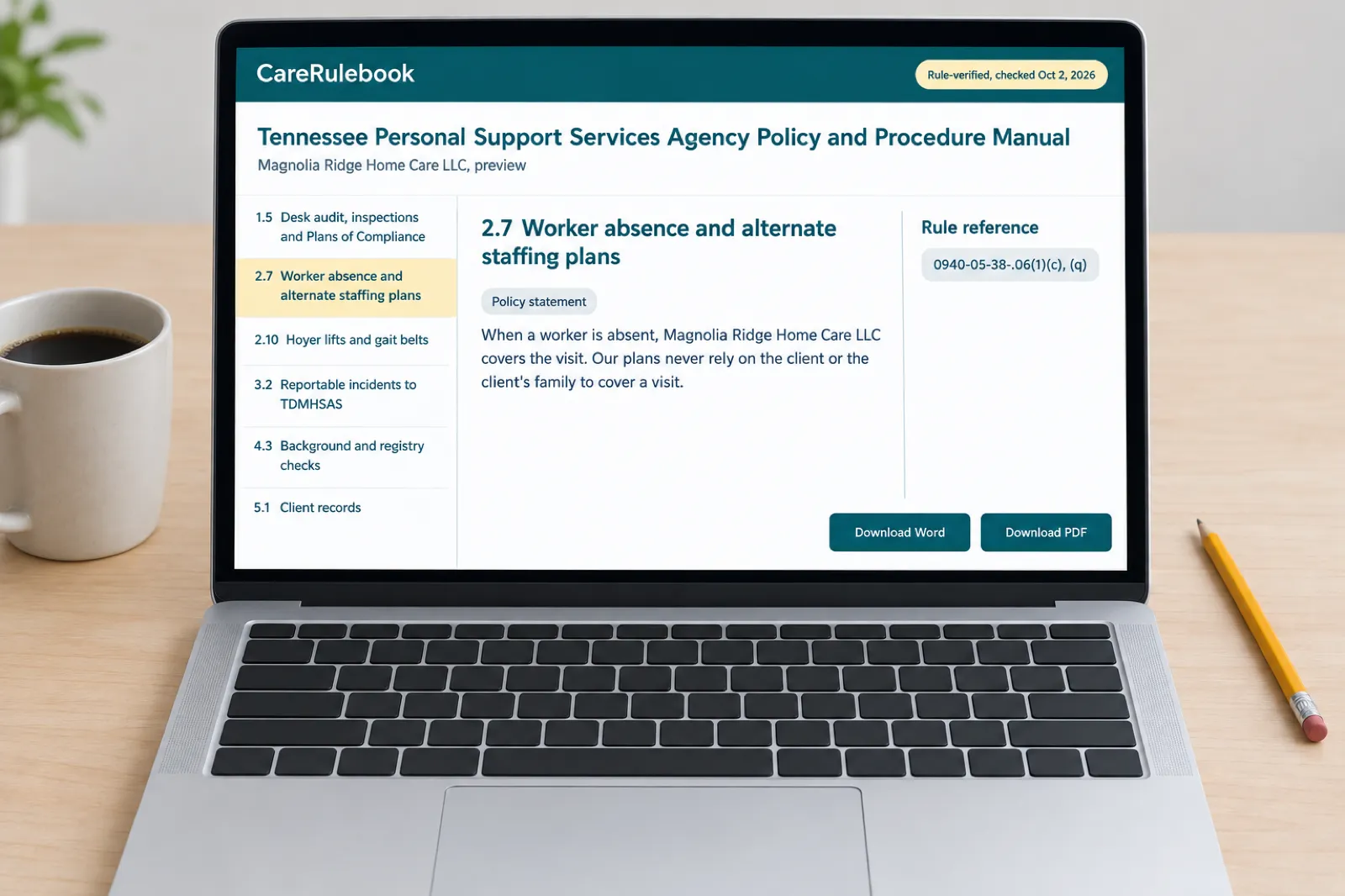
The CareRulebook Tennessee manual preview on a laptop: policy 2.7 on worker absence and alternate staffing plans for a sample agency, citing 0940-05-38-.06(1)(c), (q), with the manual’s contents listed beside it

CareRulebook

Non-medical care, written down clearly

CareRulebook’s Tennessee manual is built for a TDMHSAS-licensed PSSA: the 17 policy items and 8 personnel topics, your description of services and the tasks your workers do not do (Policy 2.1), and your client-mix attestation (Policy 1.3).

  • 32 policies, 107 requirements mapped to 0940-05-38, 0940-05-02 and 0940-05-06
  • Medication assistance, and an optional policy for staff certified to administer medication
  • Editable Word and print-ready PDF, with the rule quoted under each policy
Preview your manual

$199CareRulebook founding price for the first 50 Tennessee agencies, then $249. Not a TDMHSAS fee.

Certificate of need: home health yes, PSSA no

HFC’s guide lists "Home Care Organization (Home Health and Hospice)" among the institutions that need a certificate of need before establishment, licensure or certification, and home health among the services that need one before anyone starts them. HFC, Certificate of Need Basics A home health license covers "for the geographic areas specified by the certificate of need or at the time of the original licensing". 0720-27-.02(1)

  • Exceptions. Since October 1, 2021, no certificate of need is needed for a home health agency limited to patients under 18, or limited to services under the federal Energy Employees Occupational Illness Compensation Program Act (EEOICPA). The license is limited to those services, and the agency must be accredited within two years. HFC, Certificate of Need Exemptions Professional support services only is also an exception. HFC, Certificate of Need Basics
  • Federal billing is not a license. HFC says authorization to bill the federal Department of Labor under EEOICPA is not state licensure: the provider still needs a Tennessee home care organization license. HFC staff determination (2025)
  • A PSSA. Personal support services agencies are not on HFC’s list of institutions that need a certificate of need, and we found no need review in the PSSA rules or TDMHSAS’s licensing steps. TDMHSAS, Become a Licensed Provider

We have not saved the certificate of need statute itself (T.C.A. 68-11-1601 and following) or HFC’s home health need standards, so this page does not cover how a certificate of need is decided. If your plan includes home health, start with HFC.

Federal · Medicare enrollment · from May 13, 2026

Medicare and CMS’s 2026 home health moratorium

CMS’s memo QSO-26-11: "Effective May 13, 2026, CMS will halt the enrollment of new Hospice and HHA providers or HHA branch or practice locations." QSO-26-11

  • How long. The moratorium lasts six months and can be extended for further six-month periods; any extension or lifting is announced in the Federal Register. QSO-26-11 Six months from May 13, 2026 runs to about November 13, 2026, by our arithmetic, unless CMS extends it.
  • No exceptions. CMS regulations do not permit exceptions to the moratorium for individual providers. QSO-26-11
  • Applications. Medicare enrollment applications received before May 13, 2026 continue to be processed. Initial applications submitted during the moratorium are denied and must be resubmitted once it is lifted. QSO-26-11 The moratorium affects new enrollments, not the ongoing compliance obligations of existing Medicare-certified agencies.
  • In Tennessee. HFC’s rules page alerts new home health and hospice certificate of need applicants to CMS’s six-month nationwide moratorium on initial Medicare enrollment of new home health agencies and hospices. The alert gives May 20, 2026, the memo’s date; the memo says the moratorium took effect May 13, 2026. HFC, Rules and Laws

What it means, by our reading. The memo is about Medicare enrollment, not state licenses, and does not mention non-medical home care. A TDMHSAS PSSA is not a Medicare home health agency, so the moratorium does not affect it. For a planned home health agency, the certificate of need and HFC license come first, and Medicare enrollment of new agencies is closed while the moratorium lasts.

Which license matches your plan

Find the line closest to what you will offer. Fees are the state’s, not CareRulebook prices. Lines marked "by our reading" are ours; check with the regulator before you apply.

If you plan to offerLicenseState feeSource
Bathing, dressing, meals, laundry, shopping or outings for clients who are mostly older adults, or who have a mental illness or substance use diagnosisPSSA license from TDMHSAS$810 per site a year (TDMHSAS)0940-05-38-.04(3)(a)0940-05-02-.05(1)
The same services, where 50% or more of clients have an intellectual or developmental disabilityPSSA license from DDA, under 0465-02-17DDA’s own fees (0465-02-02-.05, not saved)0940-05-38-.04(3)(b)0465-02-17-.02(5)
Only housekeeping, only transportation, or only deliveriesNo PSSA license (exempt)None0940-05-38-.03(2)(c), (d), (f)
Medication given by trained unlicensed staff, alongside personal supportPSSA license, with staff certified through a TDMHSAS-approved program$810 (TDMHSAS); DDA’s class fee per workerPublic Chapter 730 (2024)PSSA slide 21
Skilled nursing, therapy, medical social services or home health aide services under a physician’s ordersHFC home care organization license (home health), after a certificate of need$1,404 a year (HFC); CON costs not covered here0720-27-.01(30)HFC, CON Basics
Mostly personal support, plus a few nursing tasks such as vital signs, insulin or dressing changesNot under a PSSA license; by our reading, the HFC home health license$1,404 a year (HFC)PSSA slides 25-270720-27-.01(30)
Nursing or therapy for people with intellectual or developmental disabilities under a state contractHFC home care organization license (professional support services); no certificate of needHFC’s fee for 0720-35 (not covered here)0720-35-.01(49)HFC, CON Basics
Home health only for patients under 18, or only under the federal EEOICPA programHFC home health license without a certificate of need; accreditation within two years$1,404 a year (HFC)HFC, CON Exemptions
Medicare-certified home healthHFC license and certificate of need, then Medicare enrollment, which is halted for new agencies from May 13, 2026$1,404 a year (HFC); Medicare costs not covered hereQSO-26-11HFC alert

Myths about home health and home care in Tennessee

Do I need a home care license from the Health Facilities Commission or Department of Health to start a non-medical home care agency in Tennessee?

No. Non-medical home care (self-care help, household help and community access) is licensed as a Personal Support Services Agency by TDMHSAS, or by the Department of Disability and Aging if most clients have an intellectual or developmental disability. The Health Facilities Commission’s home care organization license is for home health, home medical equipment, professional support and hospice services.

"The Tennessee Department of Mental Health and Substance Abuse Services is authorized to license facilities and services operated for the provision of mental health, substance abuse, and personal support services in the State of Tennessee by T.C.A. Title 33, Chapter 2, Part 4."

HFC’s rules say homemaker services need no home care organization license. Does that mean a Tennessee homemaker service needs no license at all?

No. Not by our reading. That line in the Health Facilities Commission’s home health rules is about HFC’s license only. TDMHSAS’s PSSA rules count household help (housekeeping, laundry, meals, shopping, bill paying, telephones) as a personal support service, and exempt only a person who provides housekeeping alone, with no other help with major life activities. A homemaker service that does more than housekeeping, for clients who meet the PSSA client definition (substantial limitations in two or more major life activities), needs a PSSA license.

"Household assistance with tasks such as housekeeping, laundry, meal planning, meal preparation, shopping, bill paying, and use of telecommunication devices;"

Can a Tennessee PSSA offer some nursing tasks if it hires a nurse?

No. Not under the PSSA license. TDMHSAS lists tasks not allowed under a PSSA license, including taking vital signs, blood sugar checks, insulin injections, catheter care and dressing changes, and the rules describe PSSA clients as people who do not need nursing-level services for an acute illness or injury. The PSSA rules name a registered nurse only for education services, medication assistance training and as one option for workers’ consultation. Skilled nursing at home is a home health service under the Health Facilities Commission’s license, which needs a certificate of need.

"Taking/recording vitals - - blood pressure, pulse, temperature, respiration"

Does the 2026 CMS home health moratorium stop me opening a PSSA in Tennessee?

No. By our reading. CMS’s memo halts Medicare enrollment of new home health agencies and hospices from May 13, 2026, for six months, which CMS can extend. It does not mention state licenses or non-medical home care. A PSSA is licensed by TDMHSAS and is not a Medicare home health agency.

"Effective May 13, 2026, CMS will halt the enrollment of new Hospice and HHA providers or HHA branch or practice locations."

Frequently asked questions

What is the difference between home health and home care in Tennessee?

Different licenses from different state bodies. Non-medical home care (help with self-care, household tasks and getting to activities) is a Personal Support Services Agency (PSSA) license from TDMHSAS, or from the Department of Disability and Aging if 50% or more of clients have an intellectual or developmental disability. Home health (skilled nursing, therapy, medical social services and home health aide services under a physician’s orders) is a home care organization license from the Health Facilities Commission, which needs a certificate of need. TDMHSAS’s fee is $810 per site a year; HFC’s home health fee is $1,404 a year. Both are state fees, not CareRulebook prices.

Do I need a certificate of need to open a home care agency in Tennessee?

Not for a non-medical PSSA, as far as we found: personal support services agencies are not on the Health Facilities Commission’s list of institutions that need one. A home care organization providing home health or hospice does need a certificate of need, with exceptions for home health limited to patients under 18 or to the federal EEOICPA program, and for organizations providing only professional support services.

Do I need licenses from both TDMHSAS and DDA if I serve older adults and people with intellectual disabilities?

No. Since Public Chapter 110 (2015), an agency serving both groups does not need a license from both departments. The licensing department is set by the larger population served or, for a new applicant, the larger population it expects to serve when it applies. You attest to your client mix when you apply and at every renewal, and then serve only clients who keep you within your licensed category.

Does a Tennessee home health agency also need a PSSA license for personal care?

By our reading of the PSSA rules, no: a home care organization licensed by the Health Facilities Commission is listed as exempt from the PSSA license. If your plan mixes both kinds of care, confirm with HFC and TDMHSAS before you apply.

Can a PSSA employ a nurse to do nursing tasks?

Not under the PSSA license. TDMHSAS lists tasks not allowed under a PSSA license, including taking vital signs, blood sugar checks, insulin injections, catheter care and dressing changes, and PSSA clients are people who do not need nursing-level services for an acute illness or injury. The PSSA rules name a registered nurse only for education services, medication assistance training and as one option for workers’ consultation. Skilled nursing at home is a home health service under the Health Facilities Commission’s license.

Can I open a Medicare home health agency in Tennessee in 2026?

Medicare enrollment of new home health agencies is halted nationwide from May 13, 2026, for six months, which CMS can extend for further six-month periods, with no exceptions for individual providers. Initial enrollment applications submitted during the moratorium are denied and must be resubmitted after it is lifted. The Health Facilities Commission points new home health certificate of need applicants to the moratorium. It does not affect a non-medical PSSA license.

What is "Non-Medical Home Health" on the TDMHSAS Fact Sheet?

TDMHSAS’s Fact Sheet (rev. 10/27/2025) has a "Non-Medical Home Health" checkbox beside the Personal Support Services Agency box. No rule we saved defines a license category by that name; the PSSA rules are the ones that cover non-medical care in the home. Ask your TDMHSAS regional office which box applies before you file.

Does the CareRulebook manual cover home health?

No. CareRulebook’s Tennessee manual is for a TDMHSAS-licensed PSSA. Policy 2.1, Description of services, enrollment and termination criteria, and tasks workers do not do, sets out the services you offer and the tasks your workers do not do, and Policy 1.3 covers your client-mix attestation. It does not cover the DDA route or the Health Facilities Commission’s home health license.

Get Tennessee rule-change alerts

TDMHSAS has proposed a rewrite of its licensure procedure rules, Chapter 0940-05-02 (hearing November 18, 2026), and has said PSSA medication administration rules are coming. Leave your email and we will tell you when a Tennessee change affects your policies.

No spam. Only emails about Tennessee home care rule changes. How we use your email.

Keep reading

Sources

  1. Tenn. Comp. R. & Regs. 0940-05-38, Minimum Program Requirements for Personal Support Services Agencies (rules effective June 2, 2016; December 2022 revised edition) · Tennessee Secretary of State, Publications Division (TDMHSAS rules) · retrieved October 1, 2026
  2. Tenn. Comp. R. & Regs. 0940-05-02, Licensure Administration and Procedures (December 2022 revised edition) · Tennessee Secretary of State, Publications Division (TDMHSAS rules) · retrieved October 1, 2026
  3. Tenn. Comp. R. & Regs. 0465-02-17, Minimum Program Requirements for Intellectual and Developmental Disabilities Personal Support Services Agencies (October 2016) · Tennessee Secretary of State, Publications Division (DIDD, now DDA, rules) · retrieved October 1, 2026
  4. Tenn. Comp. R. & Regs. 0720-35, Standards for Home Care Organizations Providing Professional Support Services (July 2022) · Tennessee Secretary of State, Publications Division (Health Facilities Commission rules) · retrieved October 1, 2026
  5. Public Chapter No. 110 (2015), amending T.C.A. 33-2-403(a) and (c), licensing of personal support services agencies · Tennessee Secretary of State (Public Acts) · retrieved October 2, 2026
  6. Public Chapter No. 730 (2024), amending T.C.A. 68-1-904, medication administration by unlicensed PSSA staff · Tennessee Secretary of State (Public Acts) · retrieved October 1, 2026
  7. Public Chapter No. 858 (2024), amending T.C.A. 68-11-201(22), definition of home care organization (effective July 1, 2024) · Tennessee Secretary of State (Public Acts) · retrieved October 1, 2026
  8. Staff Determination on Public Chapter 858 (2024), April 29, 2025 · Tennessee Health Facilities Commission · retrieved October 1, 2026
  9. HFC Rules and Laws · Tennessee Health Facilities Commission · retrieved October 1, 2026
  10. Become a Licensed Provider · Tennessee Department of Mental Health and Substance Abuse Services, Office of Licensure · retrieved October 1, 2026
  11. Personal Support Services Agency (PSSA) Provider Information (2025 slide deck; file modified November 2025) · Tennessee Department of Mental Health and Substance Abuse Services, Office of Licensure · retrieved October 1, 2026
  12. Licensure Application Addendum: Fact Sheet Form, MH-4386 (rev. 10/27/2025) · Tennessee Department of Mental Health and Substance Abuse Services, Office of Licensure · retrieved October 2, 2026
  13. QSO-26-11-HHA & Hospice: Six-Month National Moratoria on Hospice and Home Health Agency Enrollment (May 20, 2026) · Centers for Medicare & Medicaid Services · retrieved October 2, 2026
  14. Tenn. Comp. R. & Regs. 0720-27, Standards for Home Care Organizations Providing Home Health Services (March 2026 revised edition) · Tennessee Secretary of State, Publications Division (Health Facilities Commission rules) · retrieved October 2, 2026
  15. Certificate of Need Basics · Tennessee Health Facilities Commission · retrieved October 2, 2026
  16. Certificate of Need Exemptions · Tennessee Health Facilities Commission · retrieved October 2, 2026
Build your Tennessee manualfrom $199