Skip to content
CareRulebook
MenuClose

Where are you starting?

United StatesTexas, North Carolina, Georgia, Virginia, Indiana, Ohio, Illinois, Washington, Colorado, Tennessee, Maryland
TexasManual
North CarolinaManual
GeorgiaManual
VirginiaManual
IndianaManual
OhioGuide
IllinoisManual
WashingtonManual
ColoradoManual
TennesseeManual
MarylandGuideAll US states →
United KingdomEngland
Free toolsChecklists, calculators and templates

Colorado · Hiring · 6 CCR 1011-1 Ch. 26, 5.9 · C.R.S. 26-3.1-111

Colorado caregiver background checks: the 90-day criminal check, CAPS and DORA

A Colorado home care agency runs a criminal history check, at least a Colorado search, on everyone it hires, no more than 90 days before they start. Everyone who will give direct care also has a CAPS check of Colorado’s adult protective services records and a DORA check of any license or certification. Colorado sets no list of crimes that bar a caregiver, so your agency decides, weighing five factors under its own written policy. Owners and the manager have CBI fingerprint checks that CDPHE reviews.

  • Rule-verified October 2, 2026
  • Quoted from 6 CCR 1011-1 Ch. 26 and C.R.S. 25-27.5, 26-3.1 and 8-2-130
  • And CDHS’s CAPS Check Unit guidance
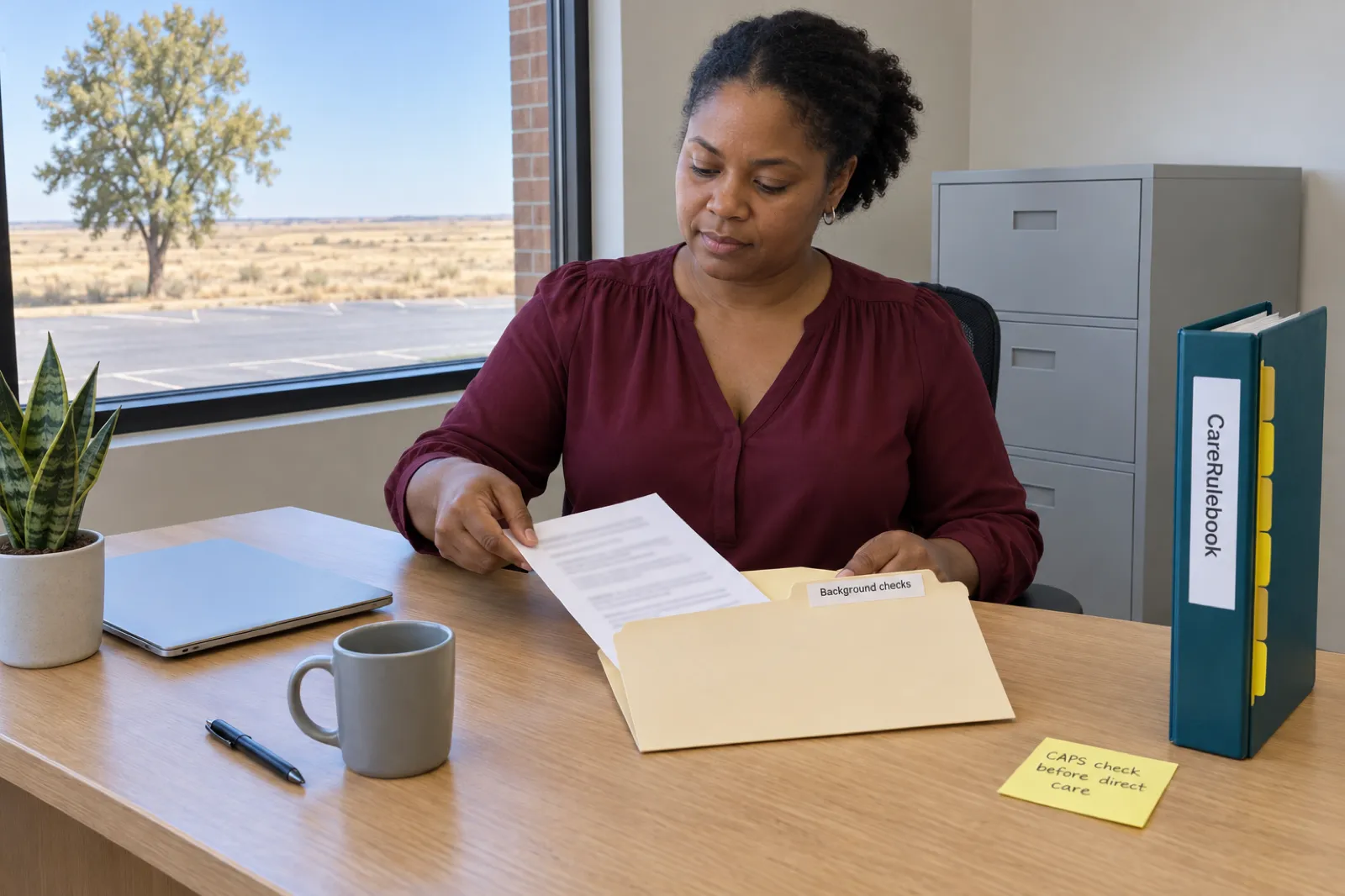
A woman in a burgundy blouse slides a printed page into a manila folder labelled Background checks at an office desk, beside a CareRulebook binder and a sticky note reading CAPS check before direct care, with a lone tree, a parking lot and dry grassland outside the window

Quick answer

Chapter 26 says "The HCA shall require any individual seeking employment with the agency to submit to a criminal history record check to ascertain whether the individual seeking employment has been convicted of a felony or misdemeanor" for conduct that the agency determines could pose a risk to consumers (Ch. 26, 5.9(C)(1)). "The criminal history record check shall, at a minimum, include a search of criminal history in the State of Colorado and be conducted not more than ninety (90) days prior to employment of the individual." Your agency or the applicant pays (Ch. 26, 5.9(C)(2)-(3)).

There is no list of disqualifying crimes for caregivers. Your agency weighs five factors and must have a written policy on employing people with convictions (Ch. 26, 5.9(C)(4)-(5)). Before employing anyone for direct care, you also request a CAPS check from the Colorado Department of Human Services (Ch. 26, 5.9(D); C.R.S. 26-3.1-111) and check with DORA for any license, registration or certification (Ch. 26, 5.9(E)).

Owners with at least 50% and the manager have CBI fingerprint checks, which CDPHE reviews when it decides on the license (Ch. 26, 4.2(D)).
Who is checked

Everyone you hire: a criminal history check

Chapter 26 requires it of “any individual seeking employment with the agency”, in any job, including office staff and the HCA manager. The statute says the person submits to it before employment.

Ch. 26, 5.9(C)(1); C.R.S. 25-27.5-107

Anyone giving direct care: CAPS and DORA

Before employing anyone to provide direct consumer care or services, you show compliance with the CAPS check law and check with DORA for any license, registration or certification. CDHS says each employer decides which of its positions provide direct care.

Ch. 26, 5.9(D)-(E); CDHS

Contractors, students and volunteers

Chapter 26 counts contractors, students, interns and volunteers as personnel, and the CAPS law covers people contracted with the employer. Whether a volunteer is “seeking employment” is not stated. By our reading, check contractors as you would an employee in the same job; the CAPS law lets you check a volunteer who will give direct care, without requiring it.

Ch. 26, 2.21; C.R.S. 26-3.1-111(2)(a), (6)(a)(IV)

Owners and the manager: CBI fingerprints

Each owner with at least 50% and each manager or administrator submits fingerprints to the Colorado Bureau of Investigation for a state and national check, which CDPHE reviews. How that works.

Ch. 26, 4.2(D); 2.17

Direct care, and at-risk adults. The CAPS law is about people who will provide direct care to an at-risk adult: "“At-risk adult” means an individual eighteen years of age or older who is susceptible to mistreatment or self-neglect because the individual is unable to perform or obtain services necessary for his or her health, safety, or welfare" (C.R.S. 26-3.1-101(1.5)), and "“Direct care” means services and supports, including case management services, protective services, physical care, mental health services, or any other service necessary for the at-risk adult’s health, safety, or welfare." (C.R.S. 26-3.1-101(3.5)). Chapter 26 ties the CAPS duty to anyone you employ "to provide direct consumer care or services" (Ch. 26, 5.9(D)), without asking you to sort clients first. By our reading, request a CAPS check for everyone you hire to give direct care, whoever their clients are.

CareRulebook’s manual treats homemakers, personal care workers, supervisors, the HCA manager and anyone else who visits clients as direct care positions, and gives office staff who never visit or serve clients the criminal history check only. That is the manual’s reading of CDHS’s statement that the employer decides.

Each new hire, step by step

The rule and statute duties in hiring order, with CDHS’s CAPS steps. Tick steps off as you go; progress is saved in this browser only.

  1. Keep criminal history off your ads and first application form

    Before you advertise

    Under the Chance to Compete Act, a job ad or application form may not say people with a criminal history cannot apply, and the initial written or electronic application form may not ask about criminal history. The Act has an exception for jobs where the law requires a criminal check, which by our reading covers home care jobs; CareRulebook’s manual follows the Act anyway. The Act and its timing.

    C.R.S. 8-2-130(3)-(4)
  2. Register with the CAPS Check Unit

    Before your first hire

    Your agency registers with the CAPS Check Unit at the Colorado Department of Human Services (CDHS) before it can request any check. Each staff member who requests checks has their own requestor account.

    CDHS, CAPS Check Unit
  3. Run the criminal history check close to the start date

    Within the 90 days before employment

    At least a search of criminal history in Colorado, done not more than 90 days before the person’s employment starts. Your agency or the applicant pays. CBI lists a Colorado-only, name-based Internet Criminal History Check at $6.00, a CBI fee (CBI); whether that alone meets the rule is not settled, so ask CDPHE. CareRulebook’s manual runs it after a conditional offer and has the result reviewed before the first day; that timing is the manual’s choice.

  4. Weigh any conviction under your written policy

    Before you confirm the offer

    If there is a felony or misdemeanor conviction, consider the five factors the rule lists and decide whether the person could pose a risk to consumers. The five factors.

    Ch. 26, 5.9(C)(4)-(5)
  5. Request the CAPS check for direct care staff

    Before hiring for direct care

    The person completes and signs CDHS’s Written Authorization Form themselves, and a requestor submits the request with the person’s own details. CDHS’s fee is $9.00 plus an online processing fee; you pay it or may require the applicant to.

  6. Check DORA for any license or certification

    Before employing for direct care

    Verify with the Department of Regulatory Agencies whether the person holds a license, registration or certification and whether it is in good standing, and put a copy of the inquiry in their personnel file.

    Ch. 26, 5.9(E)
  7. Download and read the CAPS result

    Within 14 days of the email

    CDHS says results come by encrypted email within five business days, and must be collected within 14 days. A “no match” clears the check; a match letter gives the finding, and you decide what it means for the job.

    CDHS, CAPS Check FAQ
  8. Clear the first visit

    Before the first visit

    Before a caregiver’s first visit: the criminal result reviewed, from a search run within the 90 days before their start date, the CAPS request made (or the result received, if your policy waits for it), the DORA inquiry filed, and training and the competency evaluation complete. Training and competency.

  9. File it where the surveyor will look

    Before the survey

    CDPHE’s licensing guidance lists employee background checks in personnel files among what it expects at the initial survey.

Deciding about a criminal record: five factors, your policy

Chapter 26 does not list crimes that bar someone from working for a Class B agency. It says "In assessing whether to employ an applicant with a felony or misdemeanor conviction, the HCA shall consider the following factors:" (Ch. 26, 5.9(C)(4)):

  1. the history of convictions or pleas of guilty or no contest;
  2. the nature and seriousness of the crimes;
  3. the time that has elapsed since the conviction(s);
  4. whether there are any mitigating circumstances; and
  5. the nature of the position for which the applicant would be employed.

And "The HCA shall develop and implement policies and procedures regarding the employment of any individual who is convicted of a felony or misdemeanor to ensure that the individual does not pose a risk to the health, safety, and welfare of the consumer." (Ch. 26, 5.9(C)(5)). CDPHE does not review your caregivers’ results the way it reviews owners’ and the manager’s: the rule leaves the decision to the agency. What CDPHE’s guidance asks to see at the initial survey is the employee background checks in the personnel files (CDPHE guidance, step 6).

What the rule does not say

The factors speak of convictions and pleas. Chapter 26 says nothing about pending charges, arrests without a conviction or records the person says are wrong, and nothing about giving the person a chance to explain. CareRulebook’s manual (Policy 4.2) handles these as its own procedure: the manager tells the person which record is the concern and hears their side before deciding, may wait for the outcome of a pending charge before direct care, can confirm the offer for a job with no client contact, and writes how each factor was weighed on an assessment record. When the person applying is the manager, the governing body decides. Our suggestion: take employment law advice before withdrawing an offer because of a record.

The CAPS check: Colorado’s adult protective services records

CDHS says "A CAPS Check does NOT replace any other requirements for background checks that apply to your agency. The information provided in a CAPS Check pertains only to APS investigations, which are not criminal proceedings. CAPS Checks do not provide criminal background information." (CDHS, CAPS Check FAQ). So it sits alongside the criminal history check, not instead of it. CDHS lists home care agencies among the employers that must use it: "Agencies licensed by the Colorado Department of Public Health and Environment under Title 25 are required to register with the CAPS Check Unit and request CAPS Checks." (CDHS, CAPS Check FAQ).

How to request one

  • Register first. "Your agency must be registered with the CAPS Check Unit prior to requesting CAPS Checks. Potential employees or appointees must complete and sign the Written Authorization Form before their CAPS Check request is submitted." (CDHS, CAPS Check Unit)
  • The person signs the authorization. "Each individual who will be checked must complete and sign the Written Authorization Form. Agencies use the information in this form to request the CAPS Check. Employers cannot complete the WAF on behalf of the individual." (CDHS, CAPS Check FAQ). The statute makes giving that authorization a condition of employment in a direct care job (C.R.S. 26-3.1-111(6)(b)).
  • The fee. CDHS charges $9.00 per CAPS check plus an online processing fee (a CDHS fee, not ours); results come by email within five business days. (CDHS, CAPS Check FAQ) "The employer shall pay a fee established by the state department for each CAPS check, or may require the person seeking employment or to contract with the employer to pay the required fee for the CAPS check." (C.R.S. 26-3.1-111(6)(b)). CDHS may change its fee with 30 days’ notice on its website, up to $16.50 without its State Board’s approval (CDHS, CAPS Check FAQ).
  • The result. A “no match” email, or a match letter that "identifies the date of the finding, the name of the county department that investigated the allegations, the mistreatment type (physical abuse, sexual abuse, caretaker neglect, exploitation, or harmful act) and the severity level of the mistreatment (minor, moderate or severe)." (CDHS, CAPS Check FAQ). "Encrypted results expire, and therefore must be collected by the requestor from the Proofpoint service within 14 days." (CDHS, CAPS Check FAQ)
  • You decide what a finding means. "Employers are responsible for determining whether the results of a CAPS Check shall impact eligibility for hire or ongoing employment." (CDHS, CAPS Check FAQ). CareRulebook’s manual keeps anyone with a substantiated finding away from direct care unless the manager decides in writing, weighing the type and severity of the finding, how long ago it was, any appeal and the job, that they do not pose a risk to clients. That is the manual’s procedure, not CDHS’s.

CAPS timing at a glance

SituationWhat the law or CDHS saysSource
Before you hire someone for direct careRequest a CAPS check. Chapter 26 says you must show compliance before employing anyone for direct consumer care or services.C.R.S. 26-3.1-111(6)(a)(I); Ch. 26, 5.9(D)
Waiting for the resultThe law lets you hire before the result arrives. CDHS suggests a written policy, with ways to reduce the risk, if you do.C.R.S. 26-3.1-111(6)(f); CDHS FAQ
Hiring more than 30 days laterThe statute requires a new check if you start hiring more than 30 days after receiving the result. CDHS’s FAQ counts the 30 days from your request instead.C.R.S. 26-3.1-111(6)(a)(I); CDHS FAQ
Rehiring someone who leftCDHS says a new check is needed before rehire if more than 30 days have passed since they left.CDHS FAQ
Every yearNot required. CDHS tells you if a substantiated finding against someone you checked is entered later.CDHS FAQ; C.R.S. 26-3.1-111(10)
At licensing and renewalYou show CDPHE that you comply with the CAPS check law when you apply and at each renewal.Ch. 2, 2.3.6, 2.5.4(B)

Two ways of counting the 30 days. The statute says a new check is needed when the employer "wants to hire the person at a subsequent time that is more than thirty days from receipt of the prior CAPS check results, the employer shall request a new CAPS check" (C.R.S. 26-3.1-111(6)(a)(I)). CDHS’s FAQ counts from the request: "If more than thirty (30) days have elapsed between an employer's request for a CAPS Check for a potential employee or volunteer, and the employer's decision to initiate hiring, the employer must request a new CAPS Check prior to hiring the employee or volunteer." (CDHS, CAPS Check FAQ). The request always comes first, so counting from it is the stricter of the two. CareRulebook’s manual counts from the request, which meets both.

Hiring before the result. "Nothing in this section prohibits an employer from hiring or contracting with an employee who will provide direct care to an at-risk adult prior to receiving the results of the CAPS check." (C.R.S. 26-3.1-111(6)(f)) and "The CCU recommends agencies consider developing policies to standardize their practices and identify methods to mitigate potential risks in the event they wish to hire an individual prior to receipt of their CAPS Check results." (CDHS, CAPS Check FAQ). The manual asks which you want: no direct care until the result is reviewed, or direct care once the request is in and the criminal and DORA checks are reviewed, with the worker taken off visits while the manager decides about any match.

Confidential. "Any person who improperly releases or who willfully permits or encourages the release of data or information obtained through a CAPS check to persons not permitted access to the information pursuant to this article 3.1 commits a class 2 misdemeanor" (C.R.S. 26-3.1-111(6)(e)). Sharing it with people directly involved in your hiring process is allowed, and so is releasing it "To a state agency or its contractor, upon the request of the agency or contractor, for purposes of an employer inspection or survey" (C.R.S. 26-3.1-111(6)(d)). Requesting a check on someone who is not an employee or volunteer in, or being considered for, a direct care job is also a class 2 misdemeanor (C.R.S. 26-3.1-111(6)(e.3)), which is one reason to decide which jobs are direct care before you start.

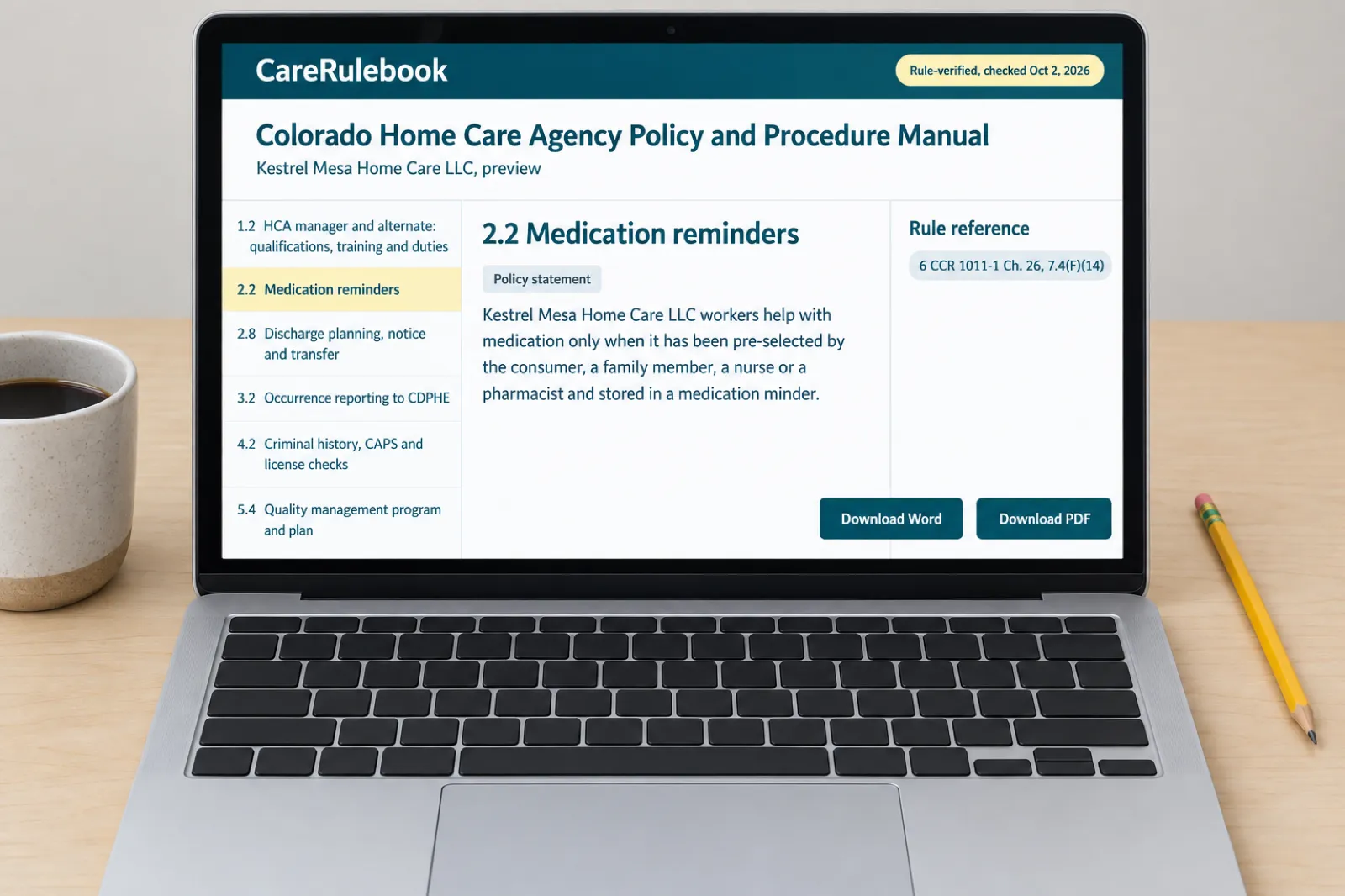
The CareRulebook Colorado manual preview on a laptop: policy 2.2 on medication reminders for a sample agency, citing 6 CCR 1011-1 Ch. 26, 7.4(F)(14), with policy 4.2 on criminal history, CAPS and license checks in the contents

CareRulebook

Background checks written for your agency

CareRulebook’s Colorado manual includes Policy 4.2 (Criminal history, CAPS and license checks): fair-chance hiring, the 90-day criminal check, the five factors with a conviction and CAPS finding assessment record, CAPS registration, authorization, timing and confidentiality, the DORA check, owner and manager fingerprints, and a background check log.

  • 33 policies, 155 requirements mapped
  • Written for review at CDPHE’s initial survey
  • Editable Word and PDF, delivered instantly
Preview your manual

$199CareRulebook founding price for the first 50 Colorado agencies, then $249. Not a CDPHE fee.

The DORA license check

The rule says "the agency shall contact the DORA to verify whether a license, registration, or certification exists and is in good standing." "A copy of the inquiry shall be placed in the individual’s personnel file." (Ch. 26, 5.9(E)). It applies "before employing any individual to provide direct consumer care or services".

The rule asks whether a credential exists, so by our reading the check covers every direct care hire, including people who say they hold no license. The rule does not say how to contact DORA. CareRulebook’s manual has the manager search DORA by name for each direct care applicant and file the dated result, including a result showing no license found, and treats a credential that is not in good standing like a criminal record, under the same factors.

A nurse or certified nursing assistant you hire still works as a homemaker or personal care worker: a Class B agency may not provide any skilled service (Ch. 26, 4.1(A)(2)). How their credential affects training is on the caregiver training page.

Owners and the HCA manager: CBI fingerprints through CDPHE

"With the submission of an application for licensure or within ten (10) calendar days after a change in the owner, manager, or administrator, each owner and each manager or administrator of a home care agency shall submit a complete set of their fingerprints to the Colorado Bureau of Investigation for the purpose of conducting a state and national fingerprint-based criminal history record check." Each person pays the Colorado Bureau of Investigation’s fee (Ch. 26, 4.2(D); C.R.S. 25-27.5-106(3)). CBI lists $39.50 for the home care agency fingerprint check, a Colorado and nationwide search (CBI), and the fingerprinting vendor charges its own fee on top (CBI). These are CBI’s and the vendor’s fees, not ours. An owner here is someone "who has at least a fifty-percent (50%) ownership interest in the business entity." (Ch. 26, 2.17).

  • Form 1 starts it. HCA Form 1 is signed by the administrator and every owner with 50% or more direct ownership. CDPHE then sends fingerprint instructions; fingerprinting before that may have to be repeated. "Please do not complete your fingerprint background check prior to submitting the Form 1, or prior to receiving the background check instructions directly from CDPHE." (CDPHE application checklist, HCA Form 1). For a Class B agency, by our reading, the administrator is your HCA manager.
  • CDPHE reads the result. "Upon completion of the fingerprint-based criminal history record check, the bureau shall forward the results to the department." (C.R.S. 25-27.5-106(3)(a)). If the result shows an arrest with no disposition, CDPHE requires a name-based check (Ch. 26, 4.2(D)(1)-(2)).
  • Convictions can stop the license. The rule says CDPHE will not issue or renew a license if the owner, applicant or licensee has a conviction for conduct CDPHE decides could put consumers at risk (Ch. 26, 4.2(D)(3)), and the statute names the manager or administrator as well: "The department shall not issue a license or registration if the owner, manager, or administrator of the home care agency or home care placement agency has been convicted of a felony or of a misdemeanor" involving that kind of conduct (C.R.S. 25-27.5-106(4)).
  • Later convictions. Each owner, applicant or licensee must tell CDPHE of a later felony conviction, or a misdemeanor involving moral turpitude or risk to consumers. "Failure to advise the Department of a conviction may result in non-renewal or other appropriate sanctions" (Ch. 26, 4.2(D)(4)).

The fingerprint check is CDPHE’s check of the people running the agency. If your manager or an owner will also visit clients, CareRulebook’s manual gives them the criminal history, CAPS and DORA checks as well, like any other direct care employee; that is the manual’s approach.

Fair-chance hiring: the Chance to Compete Act

Since September 1, 2021 every employer in Colorado other than the state, local governments and other public bodies has been barred from saying in an ad or on an application form that people with a criminal history may not apply, and from asking about it on the first application form: an employer may not "inquire into, or require disclosure of, an applicant’s criminal history on an initial written or electronic application form." (C.R.S. 8-2-130(3)(a)). "An employer may obtain the publicly available criminal background report of an applicant at any time." (C.R.S. 8-2-130(3)(b))

The exception. The Act does not apply to a position if "The employer is required by federal, state, or local law or regulation to conduct a criminal history record check for that position, regardless of whether the position is for an employee or an independent contractor." (C.R.S. 8-2-130(4)(c)). Our reading: that covers every job at a home care agency, because Chapter 26 and C.R.S. 25-27.5-107 require a criminal history check of everyone seeking employment. We found no court decision or state guidance on it, so confirm with a Colorado employment lawyer before relying on it.

StageWhat the Act says (if it applies)CareRulebook’s manual
Job adMay not say people with a criminal history may not applySays any offer depends on the background checks
Initial application formMay not ask about, or require disclosure of, criminal historyDoes not ask
Later in hiringThe Act’s limits name the ad, application forms and the initial form; by our reading it does not bar asking laterAsks and runs the checks after a conditional offer (the manual’s choice)
Public background reportMay be obtained at any timeRuns the Chapter 26 check within the 90 days before the start date

C.R.S. 8-2-130(3) · C.R.S. 8-2-130(4)(c). Our summary of the Act’s text; read the section in full.

Our suggestion: follow the Act’s limits even if the exception may apply. The 90-day rule already pushes the criminal check close to the start date, after you have chosen someone. Enforcement is by complaint to the Colorado Department of Labor and Employment: a warning and an order to comply within 30 days for a first violation, then civil penalties of up to $1,000 and $2,500 (C.R.S. 8-2-130(5)). We also suggest: if you use a background screening company, ask it and an employment lawyer what notices and authorizations consumer reporting laws require before a check, and before you decide not to hire because of a report.

Records, and when to check again

  • In the personnel file before the survey. CDPHE’s guidance lists "Employee background checks in personnel files" among what it expects at the initial survey (CDPHE guidance, step 6), and the DORA inquiry goes in the file (Ch. 26, 5.9(E)).
  • CAPS at licensing and renewal. "Applicants must show compliance with the Colorado Adult Protective Services Data System (CAPS Check) requirements", and licensees must show it again at renewal (Ch. 2, 2.3.6, 2.5.4(B)).
  • How long to keep them. We found no retention period for personnel files in Chapter 26 or Chapter 2. A worker who returns within a year can skip initial training only if their earlier records are still on file (Ch. 26, 7.5(A)(1)), so CareRulebook’s manual keeps each file at least a year after the person leaves (Policy 5.3), with five years as Recommended practice.
  • Repeat checks. No rule we found requires a yearly criminal check, and CDHS says "There is no requirement for recurring/annual CAPS Checks, because the CCU provides automatic updates to employers on future substantiations." (CDHS, CAPS Check FAQ). The statute requires CDHS to tell you of later findings (C.R.S. 26-3.1-111(10)). CareRulebook’s manual offers a yearly Colorado criminal search, and a fresh DORA search when a worker’s credential is due to expire, as Recommended practice.

CareRulebook’s manual keeps every result, authorization form, DORA inquiry and assessment record in a confidential background check section of the personnel file (Policy 4.8), opened only by the manager, the acting manager and, for CAPS results, the person who requested the check. That is the manual’s arrangement, built on the CAPS confidentiality rule above.

Myths about Colorado hiring checks

Does Colorado have a list of crimes that bar someone from working for a home care agency?

No. Not for caregivers. Chapter 26 and C.R.S. 25-27.5-107 require a criminal history check of everyone seeking employment, but set no list of disqualifying crimes. The agency decides, weighing five factors (the history of convictions or pleas, the nature and seriousness of the crimes, the time since conviction, mitigating circumstances and the position) under its own written policy. Owners and the manager are different: CDPHE reviews their fingerprint results and will not license an agency whose owner or manager has a conviction for conduct CDPHE decides could put consumers at risk. We have not checked HCPF’s Medicaid provider rules, so check them if you will bill Medicaid.

"In assessing whether to employ an applicant with a felony or misdemeanor conviction, the HCA shall consider the following factors:"

Do all my caregivers need FBI fingerprint checks?

No. Not under the license rules. CBI fingerprint checks are required for each owner (50% or more) and the manager or administrator. For caregivers, the agency runs a criminal history record check (at least a Colorado search) within 90 days before hire, a CAPS check with CDHS before direct care, and a DORA check of any license or certification, then decides under its own written policy. We have not checked HCPF’s Medicaid provider rules, so check them if you will bill Medicaid.

"The criminal history record check shall, at a minimum, include a search of criminal history in the State of Colorado and be conducted not more than ninety (90) days prior to employment of the individual."

Must a new caregiver wait for the CAPS result before starting?

No. The law does not require it. You must request the CAPS check before hiring someone for direct care, but the statute says nothing stops you hiring before the result arrives, and CDHS suggests a written policy for that situation. Whether to wait is your agency’s choice; CDHS says results usually come within five business days.

"Nothing in this section prohibits an employer from hiring or contracting with an employee who will provide direct care to an at-risk adult prior to receiving the results of the CAPS check."

Do I have to repeat CAPS checks every year?

No. CDHS says there is no requirement for recurring or annual CAPS checks, because it tells the employer if a substantiated finding against someone it has checked is entered later. A new check is needed if you start hiring someone more than 30 days after their result, and, CDHS says, before rehiring someone more than 30 days after they left.

"There is no requirement for recurring/annual CAPS Checks, because the CCU provides automatic updates to employers on future substantiations."

Frequently asked questions

Do Colorado home care caregivers need fingerprint checks?

Not under the license rules. CBI fingerprint checks are for each owner with at least 50% and the manager or administrator, and CDPHE reviews them. For caregivers, the agency runs a criminal history record check (at least a Colorado search) no more than 90 days before employment, a CAPS check before direct care and a DORA check of any license or certification. We have not checked HCPF’s Medicaid provider rules, so check them if you will bill Medicaid.

What crimes disqualify a caregiver in Colorado?

Chapter 26 sets no list. It asks whether the person has a felony or misdemeanor conviction for conduct that the agency determines could pose a risk to consumers, and the agency weighs five factors: the history of convictions or pleas of guilty or no contest, the nature and seriousness of the crimes, the time since the conviction, any mitigating circumstances, and the nature of the position. You also need a written policy on employing people with convictions.

How recent must a caregiver’s criminal background check be?

Not more than 90 days before the person’s employment starts, under both Chapter 26 and C.R.S. 25-27.5-107. A check run earlier than that has to be run again before they start. Our reading: someone who leaves and is rehired needs a new check unless their last one falls within the 90 days before the new start date.

What is a CAPS check and what does it cost?

A check of the Colorado Adult Protective Services data system for substantiated findings of mistreatment of an at-risk adult. It is not a criminal check. You register with the CAPS Check Unit at CDHS, the person signs CDHS’s Written Authorization Form, and you request the check online. CDHS charges $9.00 plus an online processing fee (a CDHS fee, not ours) and returns results within five business days.

Can a caregiver start work before the CAPS result comes back?

The law allows it: you must request the check before hiring, but nothing stops you hiring before the result arrives. CDHS suggests a written policy for that situation. CareRulebook’s manual lets you choose: wait for the result before any direct care, or start direct care once the request is in, with the criminal and DORA checks already reviewed.

Can I ask about criminal history on a job application in Colorado?

Not on the initial written or electronic application form, and your ads and forms may not say people with a criminal history cannot apply, under the Chance to Compete Act. The Act lets you obtain an applicant’s publicly available criminal background report at any time, and it does not apply where the law requires a criminal check for the job. By our reading that exception covers home care jobs, but CareRulebook’s manual follows the Act anyway and asks only after a conditional offer.

Do I need to repeat background checks every year?

No rule we found requires yearly criminal checks, and CDHS says there is no requirement for recurring CAPS checks because it tells you about later findings. You do need new checks in some cases: a criminal check that would fall outside the 90 days before a start date, and a new CAPS check before hiring more than 30 days after a result or before rehiring someone who left more than 30 days ago.

Get Colorado rule-change alerts

CDPHE has proposed changes to Chapter 2 (comments due November 12, 2026), and the home care law is due for review before September 1, 2028. Leave your email and we will tell you when a Colorado change affects your hiring checks or your policies.

No spam. Only emails about Colorado home care rule changes. How we use your email.

Keep reading

Sources

  1. 6 CCR 1011-1 Chapter 26, Home Care Agencies (effective July 1, 2025) · Colorado Secretary of State, Code of Colorado Regulations · retrieved October 2, 2026
  2. 6 CCR 1011-1 Chapter 2, General Licensure Standards (effective September 14, 2025) · Colorado Secretary of State, Code of Colorado Regulations · retrieved October 2, 2026
  3. C.R.S. Title 25, Article 27.5, Home Care Agencies (sections 25-27.5-101 to -110; Colorado Revised Statutes 2024) · Colorado General Assembly, Office of Legislative Legal Services · retrieved October 2, 2026
  4. C.R.S. 26-3.1-101, -102, -107 and -111, Protective services for at-risk adults: definitions, reporting, CAPS checks (Colorado Revised Statutes 2024) · Colorado General Assembly, Office of Legislative Legal Services · retrieved October 2, 2026
  5. Initial Health Facility/Agency Licensure: Guidance and Instructions (All License Types), updated September 11, 2025 · Colorado Department of Public Health and Environment, HFEMSD · retrieved October 2, 2026
  6. Home Care Agencies (HCA/HHA): Initial Application Checklist, updated July 23, 2026 · Colorado Department of Public Health and Environment, HFEMSD · retrieved October 2, 2026
  7. CAPS Check Unit: home page and Frequently Asked Questions · Colorado Department of Human Services, CAPS Check Unit · retrieved October 2, 2026
  8. C.R.S. 8-2-130, Colorado Chance to Compete Act (Colorado Revised Statutes 2024) · Colorado General Assembly, Office of Legislative Legal Services · retrieved October 2, 2026
  9. Employment and Background Checks; Fees and Forms Information; Internet Criminal History Check · Colorado Bureau of Investigation · retrieved October 2, 2026
Build your Colorado manualfrom $199