Skip to content
CareRulebook
MenuClose

What do you run?

Home care in the US19 states with a manual, 6 with a free guide
ColoradoManual
ConnecticutPack
DelawareManual
GeorgiaManual
IllinoisManual
IndianaManual
KansasManual
MaineManual
MarylandManual
MinnesotaManual
NevadaManual
North CarolinaManual
OklahomaManual
OregonManual
South CarolinaManual
TennesseeManual
TexasManual
VirginiaManual
WashingtonManual
CaliforniaGuideFloridaGuideNew JerseyGuideNew YorkGuideOhioGuidePennsylvaniaGuideAll US home care states →
Care homes in the USCalifornia, Michigan, Minnesota; more states coming
Home care in the UKEngland, Scotland, Wales
Free toolsChecklists, calculators and templates

England · Domiciliary care agency · CQC · 2026

How to start a care agency in England: CQC registration step by step

To start a care agency in England that helps people with personal care at home, you must register with the Care Quality Commission first. There is no application fee, but since July 2025 CQC rejects incomplete or inaccurate homecare applications on arrival, and you go to the back of the queue.

  • Rule-verified 30 September 2026
  • 16 CQC requirements mapped
  • 49 official sources
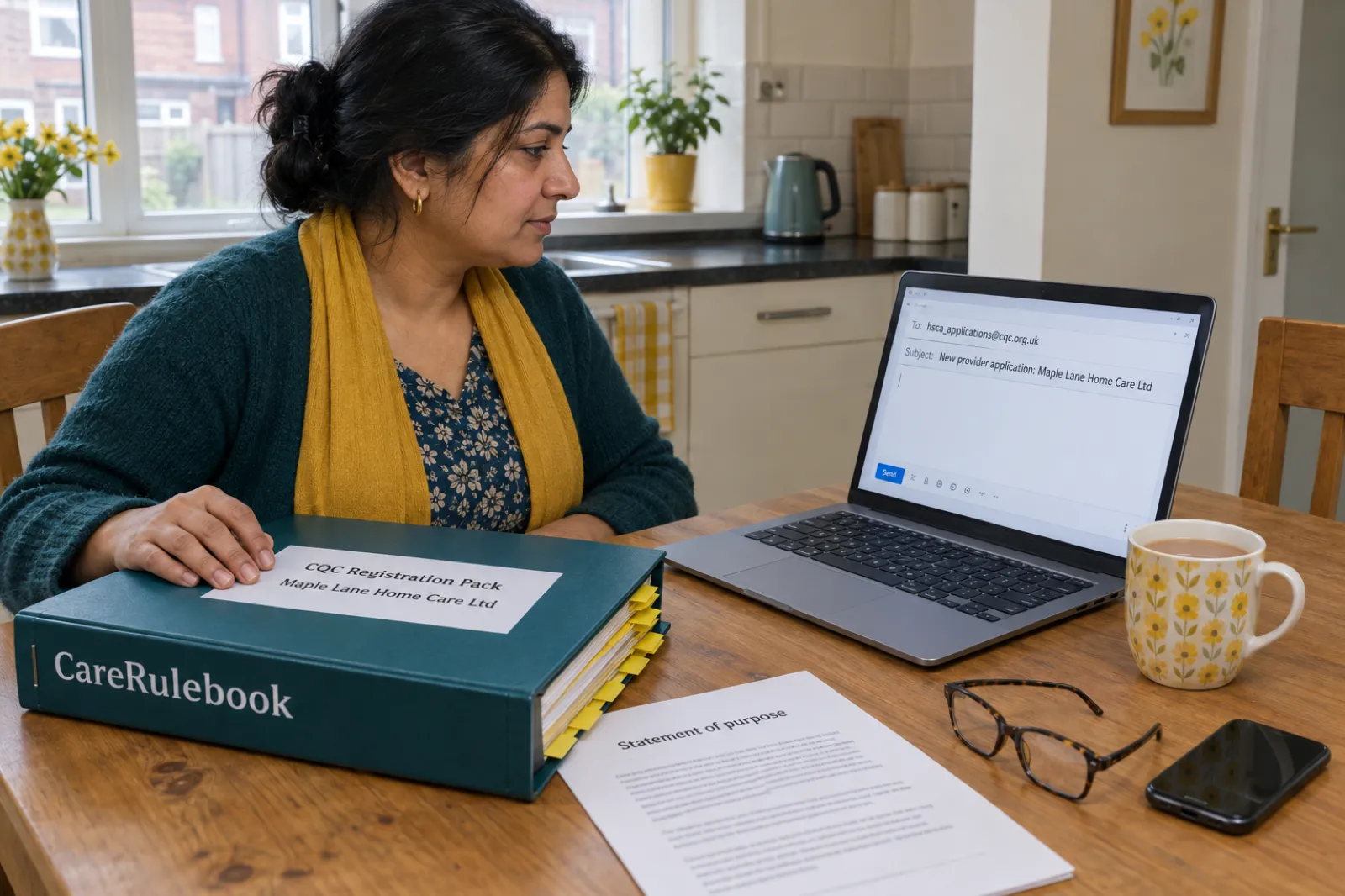
A new home care provider at her kitchen table with a CareRulebook CQC registration pack and a statement of purpose, writing an email to hsca_applications@cqc.org.uk

Quick answer

To start a care agency (a domiciliary care agency) in England, you must first register with the Care Quality Commission (CQC) for the regulated activity personal care. Providing it without registration is a criminal offence.

You apply by emailing CQC the application forms and around 14 supporting documents in one go, including a statement of purpose, eight core policies, a business plan with a 12-month forecast, a service user guide and a staff training plan (the full list is on our CQC registration requirements page). Since 1 July 2025, CQC rejects homecare applications that are not complete or accurate when received, and a resubmission goes to the back of the queue. There is no application fee (see CQC registration fees).

Setting up elsewhere in the UK? Scotland, Wales and Northern Ireland have their own regulators. See our Wales guide and CIW registration pack, and our Scotland guide and Care Inspectorate registration pack; Northern Ireland is not yet covered.

Rule-verified, checked against official sources on 30 September 2026

Edited by . Built from the official text; every quoted rule is checked against the saved source before publishing.

1 Jul 2025

Reject-at-receipt began for homecare

CQC registration update

£41

DBS fee for an enhanced check, from 5 Oct 2026

DBS fees

12 months

Oldest DBS check CQC accepts

CQC DBS guidance

28 days

To agree assessment dates once contacted

CQC, Register as a provider

Direct answers

Do I need to register a care agency with CQC?

Yes, if your staff provide personal care, such as help with washing, dressing, eating or toileting, to people in their own homes in England. Carrying on a regulated activity without registration is a criminal offence. CareRulebook’s check on this page covers the exceptions.

Health and Social Care Act 2008, s.10

What happens if my CQC application is incomplete?

Since 1 July 2025 CQC rejects homecare applications that are not complete or accurate when they arrive, and a corrected resubmission joins the back of the queue. CareRulebook lists every document CQC asks for below.

CQC, How to apply

Can I start providing care while CQC assesses my application?

No. CQC says you cannot manage regulated activities until it confirms your registration, and providing personal care without registration is a criminal offence. CareRulebook’s steps below show what to have ready before you apply.

CQC, After you apply

Can I run a home care agency from my house?

Possibly. CQC excludes a private home only where it is not the primary place the service is managed from, and it does not accept virtual offices or PO boxes. CareRulebook covers the premises rules in the office section.

CQC, What is a location

Interactive check

Does your domiciliary care agency need to register with CQC?

Will your staff give physical help with eating or drinking, toileting, washing, dressing, oral care, or skin, hair and nail care?

This also counts if staff prompt and supervise someone who cannot decide to do these things without prompting.

Starting a care agency elsewhere in the UK

Each UK nation has its own regulator and registration route. This guide covers England; here is how Wales and Scotland compare, from our guides to each.

Home care registration in England, Wales and Scotland
NationRegulatorHow you applyRegulator’s feeWhen policies are checked
EnglandCare Quality Commission (CQC). HSCA 2008, s.10Email the forms and every document to CQC together. CQC, How to applyNo application fee. Annual fee from £239 plus £54.305 per person you support, per location. CQC feesSent with the application. CQC rejects an incomplete or inaccurate application on arrival. CQC registration update
WalesCare Inspectorate Wales (CIW). RISCA 2016, s.5Online, through CIW Online. CIW, Guide to registrationNo CIW fee found (our reading: the law lets the Welsh Ministers set one, and we found no fee regulations). RISCA 2016, s.40A copy made available at the registration inspection. CIW, Guide to registration, Annex 9
ScotlandCare Inspectorate. PSR(S)A 2010, s.80Online portal, where you upload documents and pay the fee. Care Inspectorate, Register online£1,261 to £2,798 to apply, then £676 to £2,255 a year, by staff numbers (the Care Inspectorate’s fees). Care Inspectorate feesEnclosed with the application and assessed by an inspector at stage 2. Care Inspectorate, Guidance for applicants
Northern IrelandNot yet covered by CareRulebook.

Fees are the regulators’ own, not CareRulebook’s. Wales: registering a domiciliary support service with CIW. Scotland: registering a care at home service with the Care Inspectorate.

What has changed since July 2025

Advice written before mid-2025 can be out of date. These are the changes that affect a new homecare application.

  1. 1 July 2025

    CQC began rejecting homecare applications that are not complete or accurate when they arrive. A corrected resubmission joins the back of the queue. CQC

  2. 22 July 2025

    Entry clearance for overseas care workers closed. CQC still asks how you will recruit, but a sponsor licence is not a CQC document. GOV.UK

  3. Early 2026

    CQC’s additional form for personal care providers asks what checks you carried out on your directors and nominated individual, how they are recorded and how they were obtained impartially. CQC form · Nominated individual →

  4. 9 February 2026

    CQC brought in the same reject-at-receipt process for all new applications for learning disability and autism services, and extra documents for care home and supported living applicants. CQC

  5. June to October 2026

    CQC planned pilots of draft assessment frameworks that would replace the quality statements. When we checked on 6 November 2026, it had not published a final framework. It says to keep using its current guidance until then. Details below

  6. 5 October 2026

    The DBS fee for an enhanced check fell to £41.00, from £49.50. A registered body may add its own administration fee. DBS

  7. By 23 October 2026

    CQC’s business plan guidance now asks the 12-month forecast to show how projected income has been calculated, as well as the income itself. CQC guidance · Business plan guide →

How to set up a domiciliary care agency and register with CQC, step by step

Tick steps off as you go. Your progress is saved in this browser only.

  1. Check you need to register

    You need to register if you provide personal care to people where they live, in England. Housing or social support alone, or medicines support alone, does not need registration.

    CQC scope guidance
  2. Set up your business and key people

    Decide who is the provider (a sole trader, partnership or company), the registered manager and, for a company, the nominated individual. Companies and partnerships need a registered manager.

    2009 Regulations, reg. 5
  3. Get enhanced DBS checks

    Before applying

    Registered persons need an enhanced DBS with barred list information, CQC-countersigned unless they are a registered healthcare professional such as a nurse. CQC rejects applications with DBS checks over 12 months old and does not accept the DBS Update Service. From 5 October 2026 the DBS fee for an enhanced check is £41.00, down from £49.50; a registered body may add its own administration fee (DBS fees).

    CQC DBS guidance
  4. Set up your office in England

    Before applying

    A physical location in England that you can prove you legally occupy. No PO boxes or virtual offices.

    CQC, What is a location
  5. Recruit your staff

    Before applying

    CQC says to apply only once DBS checks are done, premises are set up and staff are recruited. What each care worker needs: staff DBS checks and the Care Certificate.

    CQC, How to apply
  6. Write your statement of purpose and documents

    Every document tailored to your business, with the business name, the person responsible, created and review dates, and working legislation links. What the statement of purpose must contain.

  7. Complete the forms

    The new provider application form, the additional form for personal care providers, and registered manager forms where needed.

    CQC, How to apply
  8. Send everything together

    Email the forms and all documents in one go to hsca_applications@cqc.org.uk. CQC cannot process an application that arrives in parts.

    CQC, How to apply
  9. Pass the stage one checks

    Stage one

    CQC checks completeness, then whether your documents are complete, accurate and relevant. If not, it rejects the application and you start again at the back of the queue.

    CQC, After you apply
  10. Take part in the assessment

    Stage two

    CQC may interview you and your registered manager and visit your premises. Agree dates within 28 days of being contacted, or the application may be returned or refused. How long CQC registration takes.

England homecare key facts

Regulator
Care Quality Commission (CQC)HSCA 2008 s.10
Activity
Personal careSch. 1 para. 1
CQC fees
No application fee. Annual fee per locationCQC fees
Incomplete application
Rejected at receipt, back of the queueCQC, How to apply
DBS
Enhanced, under 12 months old, CQC-countersigned unless a registered health professionalCQC DBS
Office
In England. No PO box or virtual officeCQC location
Timeline
"Can take a few months"CQC, After you apply

Checked against official sources on 30 September 2026.

CQC registration requirements, tailored to your agencyEvery requirement in one table, then six questions for a free checklist with the source behind each step. Email it to yourself.See the requirements →

Set up the business before you apply

CQC says to apply only when you are ready to operate. These are the business steps that have to be done, or at least under way, first.

Arrange insurance

CQC needs evidence of public liability insurance with every application, and of employer’s liability if you employ staff and the law requires that cover. A quote is accepted if it is still valid when you apply.

CQC; ELCIA 1969 s.1

Secure premises, with permission

A lease, licence or title for an office in England, plus written permission from your landlord or lender, or from whoever owns the premises if it is not the provider or a director.

CQC, Evidence of legal occupancy

Pay the data protection fee

A data controller pays the Information Commission a yearly fee unless all its processing is exempt: £52 for a micro organisation, £78 for most small and medium ones, £5 less by direct debit. The regulations named the Information Commissioner until 30 September 2026. This is a statutory fee, not a CareRulebook charge.

DP (Charges and Information) Regs 2018

Start the DBS checks early

Registered persons need an enhanced DBS, no more than 12 months old when you apply, and CQC-countersigned unless they are a registered healthcare professional. CQC says a countersigned certificate can take up to 60 working days. The DBS fee for an enhanced check is £41.00 from 5 October 2026.

CQC DBS guidanceDBS fees

What it costs to start a care agency, and what CQC charges

These are the fixed costs and legal minimums set by the government, regulators and the law, each with its source. They are not CareRulebook prices, and they are not a start-up total. Fees and rates in this table were checked against GOV.UK and legislation.gov.uk on 10 October 2026.

Fixed and statutory costs of starting a home care agency in England
CostWhat the rule saysSet by
CQC registrationNo application fee. Annual fee for each location: £239 plus £54.305 for each person you support, up to £92,558. CQC fees CQC registration fees and calculator →CQC’s fee (2019/20 fees scheme)
Enhanced DBS check, for each registered person£41.00 from 5 October 2026 (was £49.50). A registered body may add its own administration fee. DBS feesDBS’s fee
Registering a limited company£100 online (£124 on paper), then £50 a year online for the confirmation statement. Companies House feesCompanies House fee
Data protection fee£52 a year for a micro organisation, £78 for most small and medium ones, £5 less by direct debit. DP (Charges and Information) Regs 2018Set by regulations, paid to the Information Commission
Employers’ liability insuranceIf the law requires you to hold it (most employers): cover of at least £5 million for claims from any one occurrence. Your insurer sets the premium. ELCI Regulations 1998, reg. 3Minimum cover set by law
Public liability insuranceEvidence with every CQC application. Your insurer sets the premium. CQC, insurance evidenceCQC requirement
Care worker payNational Living Wage of £12.71 an hour for workers aged 21 and over, from April 2026. GOV.UK lists £13.21 from April 2027; if your forecast runs past April 2027, we suggest budgeting at least that rate for those months. GOV.UK, minimum wage ratesMinimum rate set by government
Workplace pensionUnder automatic enrolment the employer pays at least 3% (8% in total with the worker’s share), in most schemes on earnings between £6,240 and £50,270 a year. GOV.UK, workplace pensionsLegal minimum
Employment Allowance (a saving)Up to £10,500 a year off employers’ Class 1 National Insurance. You must do less than half your work in the public sector (such as for local councils and NHS services), and a company’s only director must not be its only employee liable for secondary Class 1 National Insurance. If most of your work is for councils or the NHS, check HMRC’s guidance before counting on it. GOV.UK, Employment AllowanceHMRC relief

We do not give a start-up total. Wages, premises, insurance premiums and software depend on your agency, your area and how fast you grow. CQC asks for a month-by-month 12-month forecast with your application anyway, so build your figures there: our free 12-month forecast template has rows for care worker wages, employer pension contributions, DBS checks, insurance and the CQC annual fee. CQC, Business plan and forecast

CQC does not publish a decision deadline. It says the assessment "can take a few months", so allow for costs before your first client. CQC registration fees and how long it takes →

Every document CQC asks for with a homecare application

CQC publishes the list, but the requirements for each document are spread across a dozen guidance pages. We mapped each one to what CQC says it must contain and the regulation behind it. Filter by topic or section.

16 rows

BasisWhat CQC asks forDocument in your pack
2009 Regs, reg. 12 and Sch. 3

Statement of purpose

Your aims, services, service user bands, contact details, legal status and locations. CQC returns applications without one.

"The registered person must give the Commission a statement of purpose containing the information listed in Schedule 3."

Document in your pack1.1 Statement of purpose
Reg 16; CQC guidance

Complaints policy

Who complaints go to (named), each stage and how long it takes, and how complaints about the registered manager are handled fairly.

"who complaints should be sent to (we need to know their name and contact details)"

Document in your pack2.2 Complaints policy
Regs 9, 11, 13; MCA 2005

Consent policy and procedure

How you apply the Mental Capacity Act, assess capacity, and involve attorneys and deputies.

"how you'll meet your responsibilities under the Mental Capacity Act 2005 how you'll apply the five principles of the Mental Capacity Act"

Document in your pack2.3 Consent policy and procedure
Equality Act 2010; HRA 1998

Equality, diversity and human rights policy

Reasonable adjustments, accessible technology, and how you address bullying and harassment.

"how you will make reasonable adjustments so that people with a disability can access and use services on an equal basis to others"

Document in your pack2.4 Equality, diversity and human rights policy
Reg 17

Governance and quality assurance policies

Audits, how you monitor and improve quality and safety, and an accurate organisational structure chart.

"We also want to see an organisational structure chart that accurately reflects your business and roles."

Document in your pack1.5 Governance and quality assurance policies
Reg 12; IPC code of practice

Infection prevention and control policy

Including how you assess infection risks in people’s homes, and cleaning and waste in home settings.

"how you assess infection risks in domestic environments"

Document in your pack3.3 Infection prevention and control policy
Regs 12, 13; NICE NG67

Medicines management policy

The levels of medication support you offer, covert and PRN medication, and storage in people’s homes.

"The different levels of medication assistance you offer"

Document in your pack3.2 Medicines management policy
Reg 19

Recruitment policy and procedures

Every recruitment stage, employment history checks, and your approach to overseas workers.

"how you check previous employment history, particularly if the applicant has worked in health or social care or with children or vulnerable adults"

Document in your pack4.1 Recruitment policy and procedures
Reg 13; Care Act 2014

Safeguarding policy and procedure

A named safeguarding lead with out-of-hours contacts, a reporting flowchart, and your local authority safeguarding team.

"The name and role of your safeguarding lead, including their contact details including emergency and out of hours contacts"

Document in your pack3.1 Safeguarding policy and procedure
CQC guidance

Liability insurance

Evidence of public liability insurance, and employer’s liability if you are legally required to hold it. Quotes must be valid.

"You must always submit evidence of public liability insurance."

Document in your pack1.4 Public and employer liability insurance
Regs 9, 10, 11, 17

Service user guide

What you do and do not offer, how you decide if you can meet needs, charges, call monitoring and complaints.

"Your guide must clearly explain: what services you provide what services you do not or cannot offer how you decide if you can meet someone's needs."

Document in your pack2.1 Service user guide
Reg 18; Care Certificate

Staff training plan

Induction, mandatory and specialist training per role, named providers and refresher frequency.

"what your induction process includes and what training new staff will receive."

Document in your pack4.2 Staff training plan
CQC guidance

Business plan and financial forecast

Local market research, pricing and staff pay, and a month-by-month 12-month forecast with itemised costs.

"You must provide a 12-month financial forecast for your first year of business."

Document in your pack1.2 Business plan and 12-month financial forecast
CQC guidance

Evidence of legal occupancy

Title register, tenancy or licence agreement, plus written permission from your landlord or lender if you do not fully own the premises.

"If you do not provide this evidence, we will not be able to approve your application."

Document in your pack1.3 Evidence of legal occupancy
CQC guidance

Documents to keep ready

keep ready; CQC may ask

Do not send these, but CQC may ask for them: duty of candour, whistleblowing, risk management and a list of risk assessments, reportable incidents, care planning, sample contract and care plan, staffing structure and rotas.

"Do not send these documents with your application. Keep them ready in case we request them. If you cannot provide them when asked, your application may be delayed."

Document in your pack5.1 Duty of candour policy5.2 Freedom to speak up and whistleblowing policy5.3 Risk management policy and list of risk assessments5.4 Reportable incidents policy5.5 Person-centred care planning policy5.6 Sample care contract and care plan5.7 Staffing structure and rotas
CQC guidance

Learning disability and autism services

if you support autistic people or people with a learning disability

A positive behaviour support policy, a restraint policy and an extra form.

"You must also send us your: Positive behaviour support policy Restraint policy"

Document in your pack6.1 Positive behaviour support policy6.2 Restraint policy

Quotes are verbatim from CQC guidance or legislation.gov.uk. Rows marked "keep ready" are documents CQC says not to send but may ask for. For every CQC registration requirement in one table (people, DBS, office, staff and documents), see CQC registration requirements.

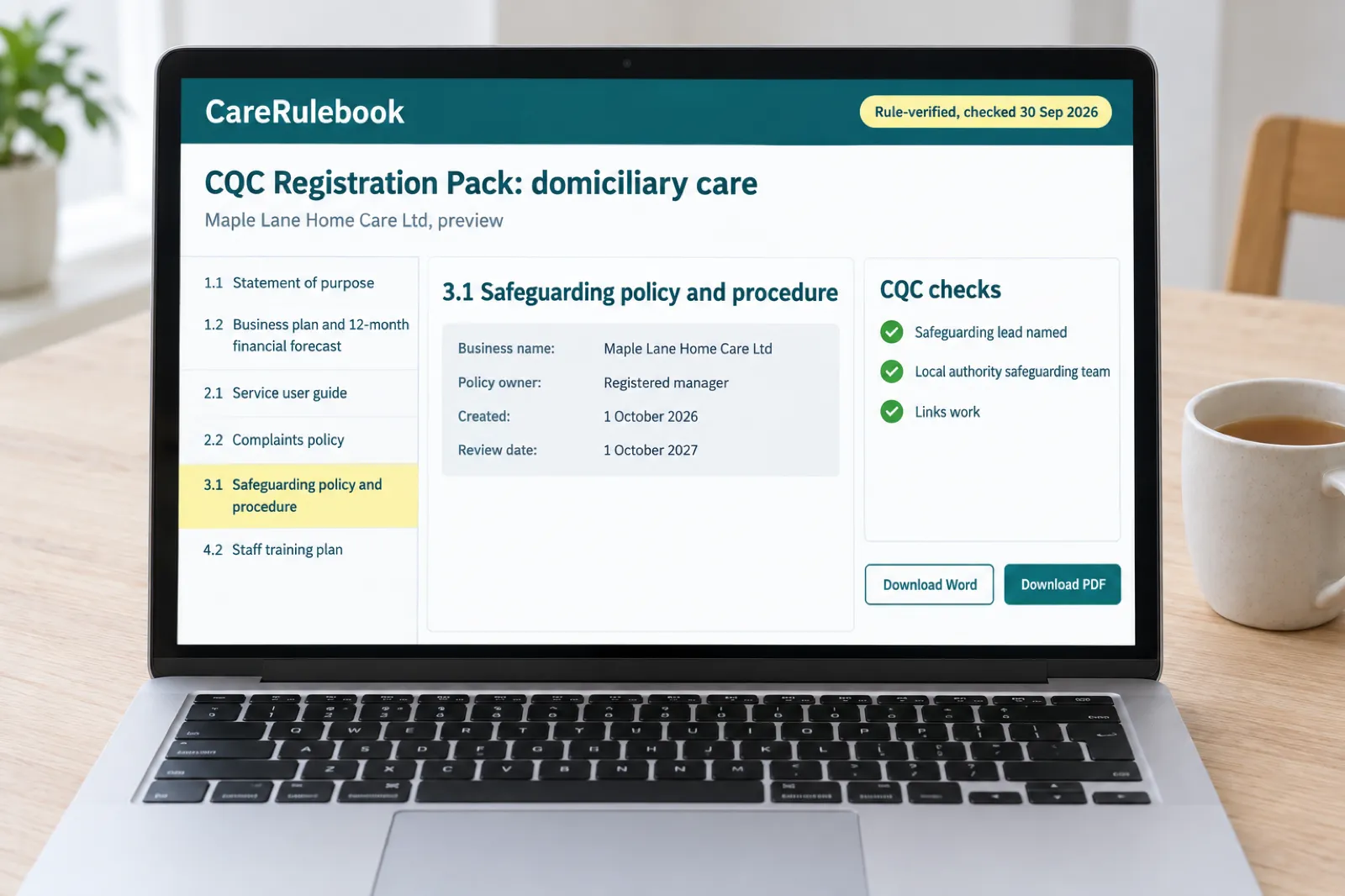
The CareRulebook CQC registration pack preview on a laptop, showing the safeguarding policy with its header details, and Word and PDF download buttons

CareRulebook

Your CQC pack, built from this list

Answer a few questions about your agency and CareRulebook writes every document on this list, tailored to your services and area, with the header details and legislation links CQC checks. For insurance and legal occupancy it gives you a cover sheet to send with your own certificate and lease or title.

  • 23 documents, including the ones CQC may ask for later
  • Business name, person responsible, created and review dates on every document
  • Working links to the legislation and guidance
  • Editable Word and PDF, delivered instantly

Free sample, no email needed

Read a full document before you buy

Document 3.1, Safeguarding policy and procedure, as it prints in the England CQC registration pack, filled in for a fictional agency. The rule text it rests on is quoted word for word under Rule basis.

PDF · 8 pages · 110 KB · Rule-verified 30 September 2026

Collecting answers for a care service or a client? The intake questionnaire lists all 50 questions the builder asks, what each decision changes in the pack, and a completed example: Word · PDF.How consultants use CareRulebook.

Download the sample (PDF)
Or email it to me

We send the link once. Nothing else unless you tick the box. Privacy notice.

The rules every document must follow

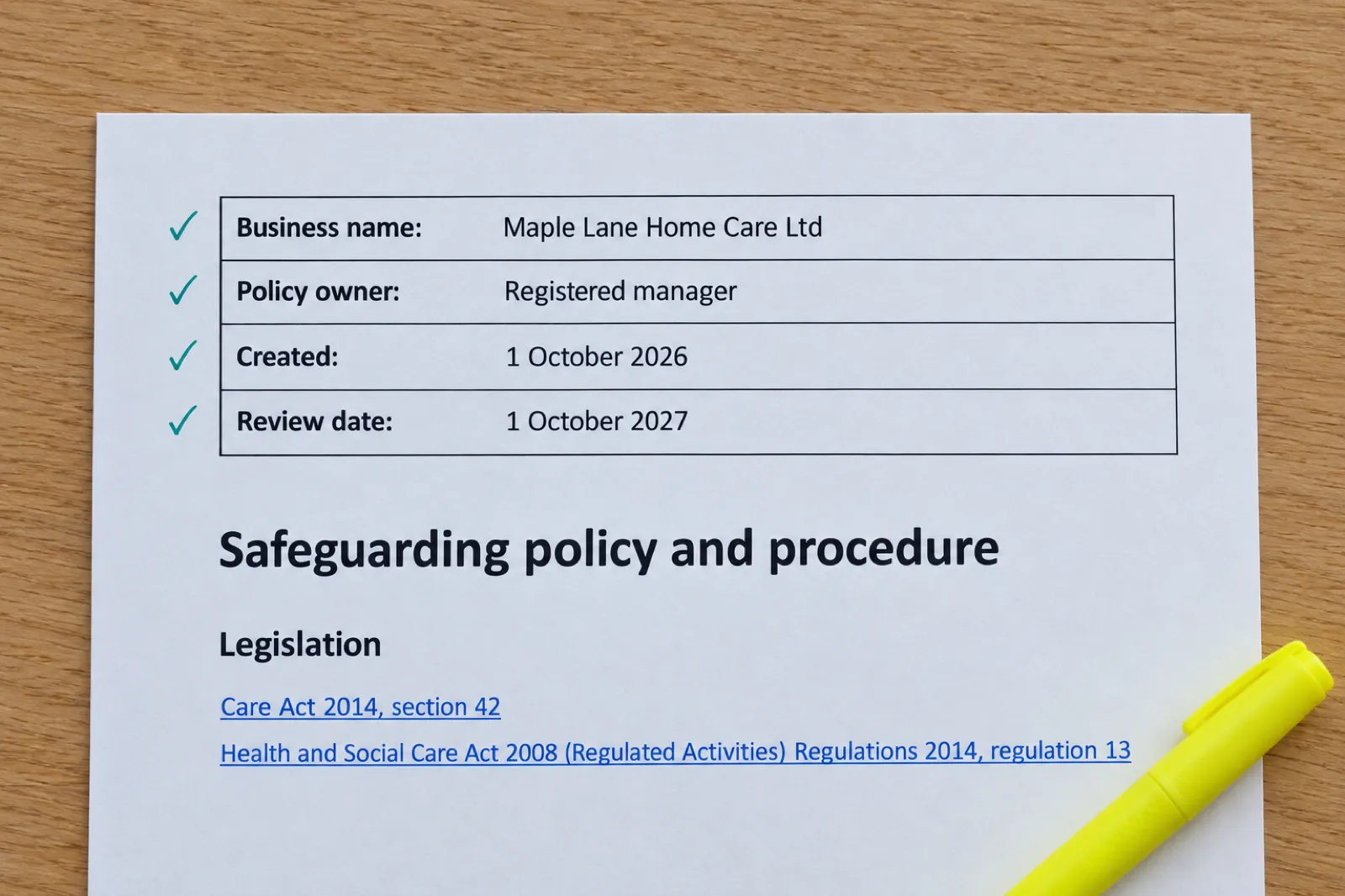
CQC checks the documents themselves, not just that they arrived. Its guidance says every document must include your business name, the name of the person responsible for the policy, the date it was created and the date it will be reviewed. Each must also:

  • be complete, relevant and up to date;
  • contain no personal information about people who use the service or members of the public;
  • have up-to-date references to legislation or guidance, with working links;
  • be consistent with your other policies;
  • be accessible to your staff, the people who will use your service and their representatives; and
  • be unique and tailored to your business.

On templates (full guide), CQC is blunt: "a template for residential care will not work for home care applicants." In its published examples, one applicant who had bought policies online but could not explain them was refused (on that and other grounds), and another who had adapted bought policies and could explain how they applied was approved.

The top of a printed safeguarding policy with a header box showing business name, policy owner, created date and review date, each ticked
The four details CQC requires on every document, and working legislation links (CQC, What each document must include).

Your office and premises

Even though care happens in people's homes, CQC needs your main office: the place you manage the service and keep records. It must be in England, and CQC does not accept PO boxes or virtual offices.

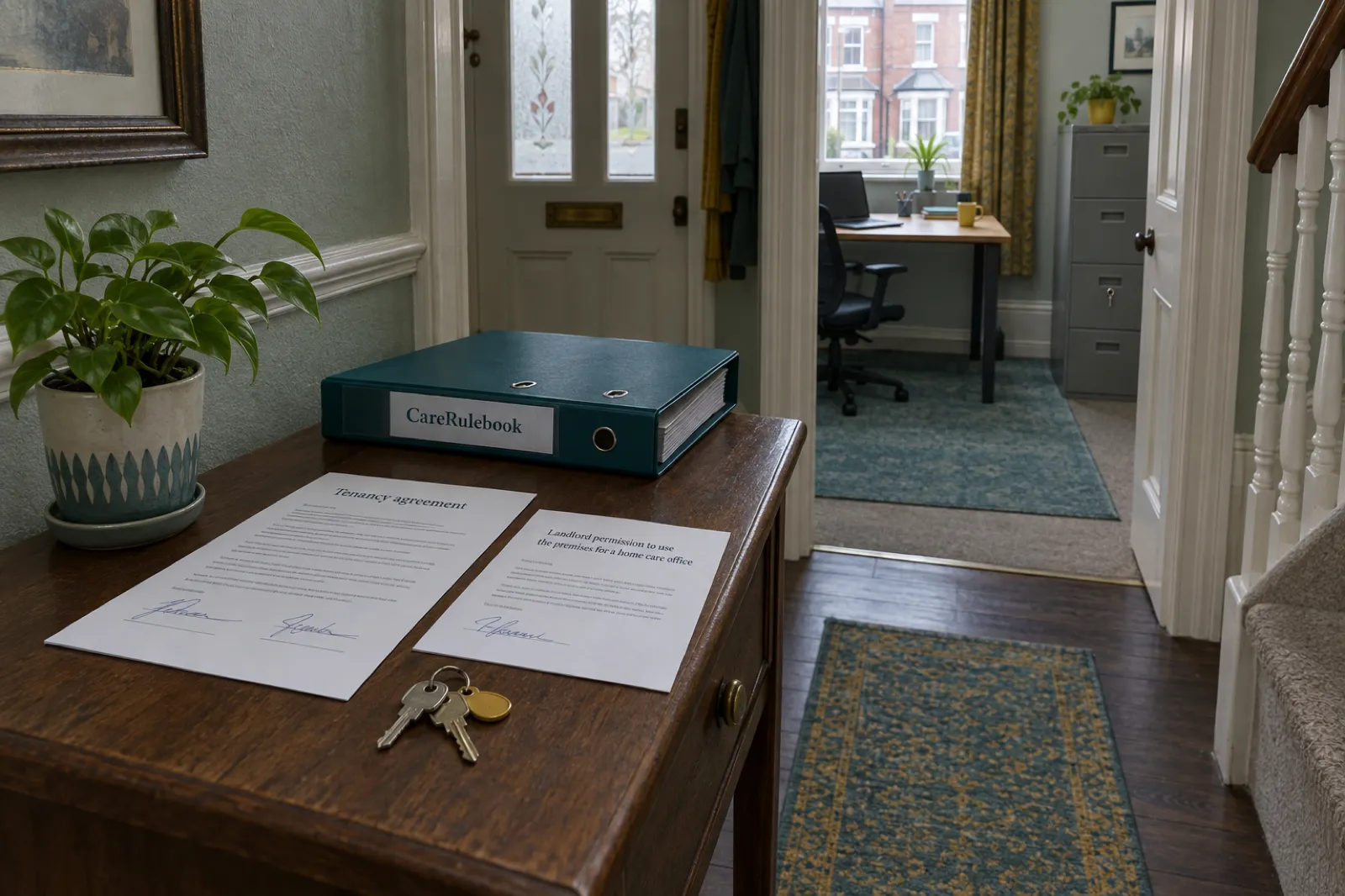
A private home is not automatically ruled out. CQC's location guidance excludes a private home only "where that private home is not the primary place from where the service is managed". Whatever the premises, you must send evidence of legal occupancy: the title register if you own it, or a signed tenancy or licence agreement, plus written permission from your landlord or lender if you do not fully own it. If someone other than the provider or a director owns the premises, such as a director’s spouse or the registered manager, CQC also needs that person’s written permission.

A signed tenancy agreement and a landlord permission letter on a hallway table, with a CareRulebook binder and keys
Legal occupancy evidence: a tenancy or licence agreement, plus written permission if you do not fully own the premises (CQC guidance).

Running it from home, virtual and serviced offices, and the evidence CQC needs →

Registered manager and nominated individual

If the provider is a company or partnership, or an individual who will not run the service day to day, you need a registered manager, who applies alongside you. CQC gives the Level 5 Diploma in Leadership and Management for Adult Care as an example qualification, and for homecare it expects experience with complaints, mental capacity assessments, safeguarding concerns and medication errors.

A company must also name a nominated individual: a director, manager or secretary who supervises the management of the service. Directors must meet the fit and proper persons requirement.

Nominated individual requirements, the application form and whether your manager can do both →

Registered manager requirements in full: who needs one, what CQC wants to see, and the notices you owe after registration →

Proposed · not yet in force

CQC draft adult social care assessment framework

CQC consulted on draft sector-specific assessment frameworks that would replace the 34 quality statements with key lines of enquiry. The consultation closed on 12 June 2026. CQC planned pilots from June to October 2026 with final evaluation in November 2026, and in August 2026 said it planned more engagement with each sector in the autumn. When we checked on 6 November 2026, CQC had not published a final framework or a date for it. CQC says to keep using the current guidance until it implements the new approach.

As we read it, the draft frameworks change how CQC assesses services, not the 2014 Regulations your documents are written against. If the final framework changes what CQC asks of new homecare applicants, we will update the pack, and buyers still within their 12 months of updates can download the new version.

CQC registration myths, checked against the source

Do you need a sponsor licence to register a homecare agency with CQC?

No. A sponsor licence is not on any CQC required-document list. CQC asks your recruitment policy to explain your approach to overseas workers. Entry clearance for overseas care workers closed on 22 July 2025; until 22 July 2028 a licensed sponsor can still take on workers switching from other UK visa routes, but only after they have legally worked for it for at least 3 months.

"information about your approach to sponsoring overseas workers, including what checks you will perform"

Will CQC contact you to fix gaps in your application?

No. Not for homecare since 1 July 2025. CQC rejects the application and emails you why. A corrected resubmission counts as a new application and loses its place in the queue.

"You can correct and resend it, but this will count as a new application and will not keep its place in the queue."

Does buying policies online get you refused?

It depends. Not by itself. In CQC’s own examples, an applicant who bought policies but could not explain them was refused, and one who adapted them and could explain how they applied was approved.

"Mr Jones had reviewed and adapted these to the service and written others himself. He could tell us in detail how they applied to the running of the service."

Do you need to rent a commercial office?

No. Not necessarily. You need a physical location in England that you can prove you legally occupy, not a PO box or virtual office. A private home is excluded only where it is not the primary place the service is managed from.

"a private home, where that private home is not the primary place from where the service is managed"

Does a homecare agency need a financial viability statement?

No. Homecare agencies are exempt. You do need a business plan with a 12-month, month-by-month financial forecast.

"You also need to send us your financial viability statement, unless you are: a corporate provider an NHS trust a care home a home care (domiciliary care) agency a supported living service (SLS)"

Does prompting medication on its own need CQC registration?

No. Medicines support alone, without any personal care task, does not need registration.

"you do not need to register for the activity if you only provide support to administer, prompt or supervise medicines but do not intend to provide any of the activities defined as personal care."

Can you use the DBS Update Service for your CQC application?

No. Registered persons need an enhanced DBS under 12 months old, CQC-countersigned unless they are a registered healthcare professional. CQC does not accept Update Service certificates or third-party checks such as U-check.

"We cannot accept certificates from the DBS update service or submissions from 3rd party services, such as U-check."

Can your manager get the experience they need after CQC registers you?

No. CQC will not register a service where key people plan to get the training and experience they need after registration.

"We will not register services where key people plan to get the training and experience they need after they are registered."

Do you need a different person as nominated individual and registered manager?

No. CQC says registered managers can act as nominated individuals in certain circumstances, normally where the organisation is small. Both of CQC’s published homecare examples had one person in both roles.

"In certain circumstances, registered managers can act as nominated individuals, normally where the organisation is small."

Frequently asked questions

How much does it cost to start a care agency in England?

There is no single figure, so we do not give one. The fixed costs set by law or by a regulator include CQC’s annual fee (there is no application fee), £41.00 for each enhanced DBS check from 5 October 2026, £100 to register a limited company online and a data protection fee of £52 or £78 a year. Wages, premises and insurance depend on your agency, so build your own figures in a 12-month forecast. The costs section above lists each fee with its source. DBS fees

Do I need a limited company to start a care agency?

No. The provider can be an individual (a sole trader), a partnership or a company. A company must name a nominated individual, and companies, partnerships and individuals who will not be in full-time day-to-day charge of the service need a registered manager. 2009 Regulations, reg. 5

Is registering a care home the same as starting a care agency?

No. A care home registers with CQC for a different regulated activity, accommodation for persons who require nursing or personal care, and CQC asks care home applicants for extra documents. This guide is for home care: personal care given to people in their own homes. A care home that also gives personal care in people’s own homes applies separately for personal care. CQC scope of registration: personal care

Does CQC give you policy templates?

CQC publishes statement of purpose templates. For policies, it says that if you use a third-party template it must suit your service type, and that a template for residential care will not work for home care. CQC, What each document must include

Do I need a Level 5 diploma to be a registered manager?

CQC gives the Level 5 Diploma in Leadership and Management for Adult Care as an example of a relevant qualification. For homecare it expects managers to have experience with complaints, mental capacity assessments, safeguarding concerns and medication errors. CQC, Before you apply

Do I need a sponsor licence?

No. A sponsor licence is not on CQC’s document lists. Your recruitment policy should explain your approach to overseas workers. Overseas entry clearance for care workers closed on 22 July 2025. CQC, Recruitment policy

Can I use the DBS Update Service?

Not for your CQC application. CQC does not accept Update Service certificates. Registered persons need an enhanced DBS under 12 months old, CQC-countersigned unless they are a registered healthcare professional, and CQC does not accept third-party submissions such as U-check for a countersigned check. CQC DBS guidance

Is a financial viability statement required for homecare?

No. Homecare agencies are exempt, but must send a business plan with a month-by-month 12-month financial forecast. CQC, All providers

Which regulations do my policies need to reference?

The fundamental standards in Regulations 9 to 20A of the Health and Social Care Act 2008 (Regulated Activities) Regulations 2014, plus laws such as the Mental Capacity Act 2005, the Care Act 2014 and the Equality Act 2010, depending on the policy. CQC wants working links. CQC, What each document must include

Has CQC replaced the quality statements?

Not when we checked on 6 November 2026. CQC consulted on draft frameworks with key lines of enquiry and planned pilots from June to October 2026, with final evaluation in November 2026. It says to keep using the current published guidance until it implements the new approach. CQC consultation

Get CQC rule-change alerts

CQC consulted in 2026 on new assessment frameworks for adult social care. Leave your email and we will tell you when a change affects your registration documents.

No spam. Only emails about rule changes that affect homecare in England. How we use your email.

Keep reading

England

Your CQC statement of purpose 

The five legal requirements, service user bands and the 28-day rule.

England

CQC business plan and forecast 

The eight sections, pricing questions and a free forecast template.

Tool

CQC registration requirements 

Every requirement in one table, plus a free checklist tailored and emailed to you.

England

Registered manager requirements 

Who needs one, experience, Level 5, DBS and absences.

England

DBS checks and the Care Certificate 

Staff checks under Schedule 3, DBS for care workers, and induction and training.

England

Office and premises 

Running it from home, and legal occupancy evidence.

England

CQC nominated individual 

Who needs one, the legal tests and the DBS rule.

England

The CQC registration interview 

What CQC looks for, from its refused and registered examples.

Tool

CQC registration fees 

The fee calculator and how long registration takes.

England

Can you use policy templates for CQC? 

CQC’s refused and registered examples, and what it checks.

England

Do you need a sponsor licence? 

No. What CQC asks about overseas workers instead.

United Kingdom

Registration in Scotland, Wales and Northern Ireland 

Each UK nation has its own regulator and rules.

Wales

Registering a domiciliary support service with CIW 

For Wales: one service per area, 10 named policies, and what differs from CQC.

Scotland

Registering a care at home service with the Care Inspectorate 

For Scotland: the policies to enclose, the Care Inspectorate’s fees, SSSC and PVG, and what differs from CQC.

Trust

How we verify rules 

Every quote is checked against the official text, dated, and linked.

Trust

About CareRulebook 

Who writes these guides, the company behind them and how to contact us.

United States

Starting a home care agency in Texas 

The HCSSA license, fees and required policies.

Tracker

Rule-change tracker 

Proposed and adopted changes to care agency rules.

Sources

  1. Health and Social Care Act 2008, section 10 · legislation.gov.uk · retrieved 30 September 2026
  2. Health and Social Care Act 2008 (Regulated Activities) Regulations 2014 · legislation.gov.uk · retrieved 30 September 2026
  3. Care Quality Commission (Registration) Regulations 2009 · legislation.gov.uk · retrieved 30 September 2026
  4. Registering a homecare agency (personal care) · Care Quality Commission · retrieved 30 September 2026
  5. A better registration process for new homecare applications · Care Quality Commission · retrieved 30 September 2026
  6. CQC update for adult social care providers (3 February 2026) · Care Quality Commission · retrieved 30 September 2026
  7. Statement of purpose (page last updated 25 March 2026) · Care Quality Commission · retrieved 30 September 2026
  8. Employers’ Liability (Compulsory Insurance) Act 1969 · legislation.gov.uk · retrieved 30 September 2026
  9. Data Protection (Charges and Information) Regulations 2018 · legislation.gov.uk · retrieved 10 October 2026
  10. Applying as a new provider: guidance · Care Quality Commission · retrieved 30 September 2026
  11. 2026 additional form for providers of personal care · Care Quality Commission · retrieved 30 September 2026
  12. New provider registration application form (V12) · Care Quality Commission · retrieved 30 September 2026
  13. Register as a new manager (page last updated 6 January 2026) · Care Quality Commission · retrieved 30 September 2026
  14. Supporting documents for new provider registration applications · Care Quality Commission · retrieved 6 November 2026
  15. What is a location? · Care Quality Commission · retrieved 30 September 2026
  16. Scope of registration: personal care · Care Quality Commission · retrieved 30 September 2026
  17. CQC fees: community social care · Care Quality Commission · retrieved 30 September 2026
  18. CQC fees scheme 2019/20 (legal fees scheme document, effective 1 April 2019) · Care Quality Commission · retrieved 30 September 2026
  19. DBS checks for CQC registration · Care Quality Commission · retrieved 30 September 2026
  20. Register as a provider · Care Quality Commission · retrieved 30 September 2026
  21. State of Care 2024/25: adult social care access · Care Quality Commission · retrieved 30 September 2026
  22. State of Care 2025/26: fragmentation in community adult social care (published 23 October 2026) · Care Quality Commission · retrieved 6 November 2026
  23. CQC consultations (page last updated 22 June 2026) · Care Quality Commission · retrieved 6 November 2026
  24. CQC draft sector-specific assessment frameworks (consultation and 2026 updates, latest 27 August 2026) · Care Quality Commission · retrieved 30 September 2026
  25. Explanatory memorandum to the statement of changes to the Immigration Rules (HC 997) · GOV.UK · retrieved 30 September 2026
  26. Statement of changes to the Immigration Rules (GOV.UK collection, read 6 November 2026) · GOV.UK · retrieved 6 November 2026
  27. Immigration Rules Appendix Skilled Worker (page shows updated 29 October 2026; last listed rule change HC 584, 8 October 2026) · GOV.UK · retrieved 6 November 2026
  28. Check a job applicant's right to work · GOV.UK · retrieved 30 September 2026
  29. Mental Capacity Act 2005, section 1 · legislation.gov.uk · retrieved 30 September 2026
  30. DBS reduces fees for checks and Update Service from 5 October 2026 (news story, published 9 September 2026) · GOV.UK (Disclosure and Barring Service) · retrieved 10 October 2026
  31. Companies House fees (updated 25 September 2026) · GOV.UK (Companies House) · retrieved 10 October 2026
  32. Employers’ Liability (Compulsory Insurance) Regulations 1998, regulation 3 · legislation.gov.uk · retrieved 10 October 2026
  33. National Minimum Wage and National Living Wage rates (April 2026 and April 2027) · GOV.UK · retrieved 6 November 2026
  34. Workplace pensions: what you, your employer and the government pay · GOV.UK · retrieved 10 October 2026
  35. Employment Allowance: what you’ll get and eligibility · GOV.UK (HMRC) · retrieved 10 October 2026
  36. Regulation 19: Fit and proper persons employed (CQC guidance, page last updated 16 May 2025) · Care Quality Commission · retrieved 10 November 2026
  37. Provider and CQC Inspector FAQs for meeting CQC’s requirements of employment for Regulation 19 (PDF, 2018) · Care Quality Commission · retrieved 10 November 2026
  38. Regulation 18: Staffing (CQC guidance, page last updated 16 May 2025) · Care Quality Commission · retrieved 10 November 2026
  39. Safeguarding Vulnerable Groups Act 2006, section 35 and Schedule 4 paragraph 7 · legislation.gov.uk · retrieved 10 November 2026
  40. Health and Care Act 2022, section 181 (mandatory training on learning disability and autism) · legislation.gov.uk · retrieved 10 November 2026
  41. DBS checks guidance for employers, voluntary organisations and third parties (updated 5 October 2026) · GOV.UK (Disclosure and Barring Service) · retrieved 10 November 2026
  42. DBS Update Service · GOV.UK (Disclosure and Barring Service) · retrieved 10 November 2026
  43. Care Certificate standards (updated March 2025) · Skills for Care · retrieved 10 November 2026
  44. Care Certificate standards updated 2025: questions and answers for health and adult social care professionals (NHS England, Skills for Care and Skills for Health) · Skills for Care · retrieved 10 November 2026
  45. Care Certificate: recommended routes for adult social care (2025) · Skills for Care · retrieved 10 November 2026
  46. Level 2 Adult Social Care Certificate qualification · Skills for Care · retrieved 10 November 2026
  47. The Oliver McGowan code of practice on statutory learning disability and autism training (final 6 September 2025) · GOV.UK (Department of Health and Social Care) · retrieved 10 November 2026
  48. Care Certificate questions and answers (Health Education England, Skills for Care and Skills for Health, updated March 2018) · Health Education England · retrieved 10 November 2026
  49. Statutory and mandatory training guide for adult social care employers (updated December 2025) · Skills for Care · retrieved 10 November 2026
Build your CQC registration pack