1. Written authorization first
Medication assistance shall be provided only after written authorization has been obtained from the service recipient or the service recipient’s authorized representative.
0940-05-38-.06(1)(l)1Where are you starting?
Tennessee · Medication · 0940-05-38-.01(9) and Public Chapter 730
A Tennessee PSSA works at two levels. Any trained worker may give medication assistance: reminders, opening packaging and a short list of hands-on help. Since 2024, employees certified through a TDMHSAS-approved class may also administer medication to clients who cannot take it themselves. Here is what each allows, the training and paperwork, what TDMHSAS asks of agencies, and which of DDA’s rules and sample policy fit a home care agency.
Quick answer
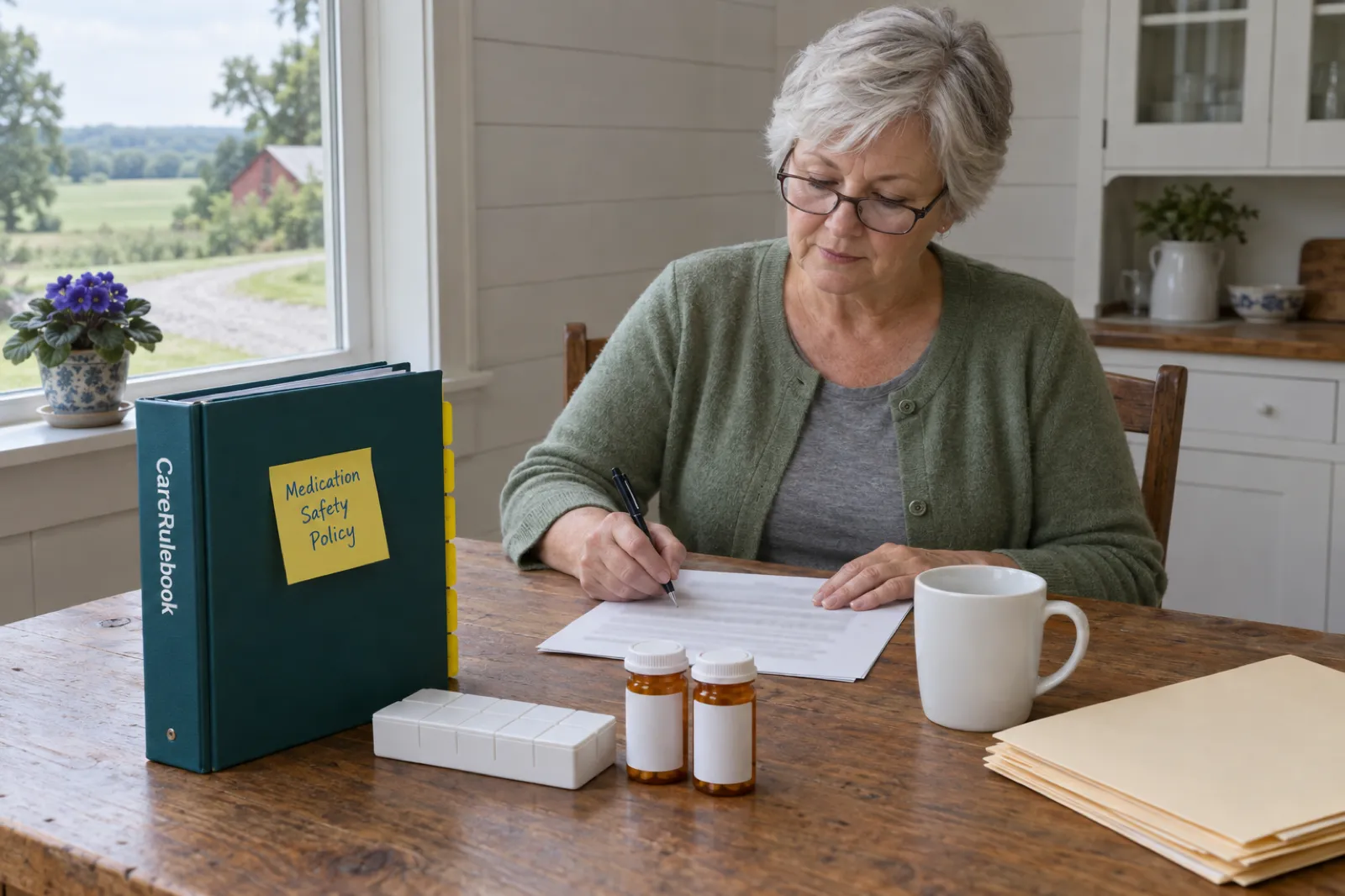
Medication assistance is what any PSSA worker may give: "providing medication reminders and opening medication packaging, but does not mean giving the service recipient injections or any form of medication or medication administration" that is only appropriate for people authorized by Title 63, Chapter 7 (0940-05-38-.01(9)). If you offer it, you need the client’s written authorization first and documented training by or under a registered nurse before any worker assists (.06(1)(l); .08(1)(b)). TDMHSAS lists filling medication planners as not allowed.
Medication administration became possible in 2024. Public Chapter 730 says an unlicensed PSSA employee "may administer medications to an individual who is incapable of self-administration in the individual’s place of residence after the unlicensed person satisfactorily completes a competency-based training program approved by the department of mental health and substance abuse services" (Public Chapter 730, section 2). TDMHSAS has approved DDA’s 20-hour Medication Administration class; DDA charges $50 per participant, and certification lasts three years (PSSA slide 21). Certified staff never give intravenous, intramuscular or certain subcutaneous injections (section 3).
TDMHSAS asks agencies using certified staff to tell their surveyor, keep each certificate in the personnel file, develop and implement a Medication Safety Policy and make sure staff understand the certification. It has said it will make PSSA rules on this; none had been filed on October 2, 2026 (PSSA slide 22; Secretary of State).
The PSSA rules cover medication assistance. Public Chapter 730 added a second level for certified employees. Everything beyond both stays with licensed professionals.
| Medication assistance | Administration by certified staff | Licensed professionals only | |
|---|---|---|---|
| Who | Any worker trained by or under a registered nurse | An unlicensed employee certified through a TDMHSAS-approved program (today, DDA’s classes) | Licensed nurses and others authorized under Title 63, Chapter 7 |
| What | Reminders, opening packaging and the seven tasks the rule lists (0940-05-38-.01(9)) | Administering medication to a client who cannot self-administer, in the client’s home; no IV, IM or certain subcutaneous injections (Public Chapter 730) | Everything else, including injections and judgment about medication |
| Training | Documented training before assisting, by or under the general supervision of a registered nurse (.08(1)(b)) | DDA’s 20-hour class with written and skills tests; renewed every three years (0465-01-03-.04) | Their own professional license, outside the PSSA rules |
| Agency paperwork | A written policy with three elements, and the client’s written authorization in the record (.06(1)(l); .09(1)(n)) | What TDMHSAS asks: tell the surveyor, certificates in personnel files, a Medication Safety Policy (PSSA slide 22) | Outside the PSSA license |
The last column is our summary of the boundary in 0940-05-38-.01(9) (rule). Nursing practice law (Title 63, Chapter 7) was not saved, so we do not describe what nurses may do.
The PSSA rules define it as "providing medication reminders and opening medication packaging, but does not mean giving the service recipient injections or any form of medication or medication administration" that is only appropriate for people authorized by Title 63, Chapter 7. It includes, but is not limited to (0940-05-38-.01(9)(a)-(g)):
TDMHSAS’s older general definitions rule (last replaced in 2008, before the 2016 PSSA chapter) puts the line plainly: assistance "does not allow the caregiver to give the medication to the individual" (0940-05-01-.01(31)). The PSSA chapter also defines self-administration as "the ability of a service recipient to take prescribed or over-the-counter medications without assistance from another person" (.01(10)). By our reading, the line between the two levels on this page is whether the client can take the medication themselves: assistance helps a client who can, and certified administration is for a client who cannot.
Creams and lotions. Non-prescription creams and lotions are on the rule’s list. Prescription creams, pain patches and ointments of any kind are on TDMHSAS’s not-allowed list (PSSA slide 25; slide 27). Ask TDMHSAS if a product falls between the two.
The policy item applies "if a worker will be providing medication assistance if the licensee provides that service" (0940-05-38-.06(1)(l)). If you do, five duties follow:
Medication assistance shall be provided only after written authorization has been obtained from the service recipient or the service recipient’s authorized representative.
0940-05-38-.06(1)(l)1The client record holds the written authorization by the client or authorized representative. It is first on TDMHSAS’s list of common PSSA deficiencies.
.09(1)(n); PSSA slide 12Medication assistance training shall be provided to personal support services workers prior to providing assistance and training shall be documented in the personal support service worker’s record.
0940-05-38-.06(1)(l)2Individuals who provide medication assistance receive documented training in medication assistance performed by, or under the general supervision of, a registered nurse and consistent with T.C.A. § 63-7-102. TDMHSAS says a physician assistant cannot approve it.
.08(1)(b); PSSA slide 24Personal support workers shall have procedures for collecting information about medications taken by service recipients.
0940-05-38-.06(1)(l)3The training rule says it must be "consistent with T.C.A. § 63-7-102" (.08(1)(b)). We could not save the Tennessee Code, so we cannot tell you what that section adds; ask your nurse trainer. The rules set no length, curriculum or refresher schedule for medication assistance training. Both RN-supervised training and the authorization are on TDMHSAS’s common deficiency list (PSSA slides 12-16).
CareRulebook’s manual turns these into Policy 2.11, with an authorization form, a medication information form and a training record signed by your registered nurse. A yearly observed check of each worker is offered as recommended practice, labelled as going beyond the rules.
TDMHSAS’s PSSA slides list services that are not allowed under the PSSA license. The medication-related ones include (PSSA slide 25; slides 26-27):
Nebulizers. Adding a tube of medicine to a nebulizer is medication administration, not medication assistance, under the PSSA rules. TDMHSAS explains: "This would be considered medication administration because the personal support worker would be determining dosage by inserting a tube of medicine into a machine for use." (PSSA slide 23)
For certified staff, ask first. Against each list TDMHSAS adds: "Please consult with the Medication Administration Certification Program to determine if these services are allowed for certified personnel according to the new statue for PSSAs under TDMHSAS Licensure." (PSSA slides 25-27) By our reading, a task on the list stays off limits for certified staff too until the program confirms it, and you keep that answer in writing.
CareRulebook’s manual restates the full not-allowed list in plain words in Policy 2.1, with what a worker says when a client or family asks for one of these tasks.
Public Chapter 730 (2024) amended T.C.A. 68-1-904 and took effect when it became law: "This act takes effect upon becoming a law, the public welfare requiring it." (section 4) It does four things for PSSAs:
Three conditions, read together. By our reading of section 2, certified administration needs all three: an employee of the PSSA, a client who is incapable of self-administration (the rules define self-administration as taking medication "without assistance from another person", 0940-05-38-.01(10)), and the client’s place of residence. A client who can take their own medication with reminders stays with medication assistance.
Employees, not subcontractors or family. The act says "employed by". DDA’s sample policy adds: "Administration of medications by natural supports or volunteers is not covered under the exemption since they are not employed by a Department of Disability and Aging (DDA) provider." (DDA sample, section 3). Whether a subcontracted worker counts as employed here is not answered in the sources we saved. By our reading, use employees for medication administration until TDMHSAS says otherwise.
Children. DDA’s sample also says "Administration of medications to persons under the age of 18 is not covered under the exemption." (DDA sample, section 3). The PSSA client definition sets no age limit (0940-05-38-.01(2)), so if you serve children, by our reading keep them on medication assistance.
TDMHSAS says: "TDMHSAS has partnered with the Tennessee Department of Disability & Aging (DDA) to review and approve of their Medication Administration classes." Other programs may be approved later (PSSA slide 21). DDA says classes may be taught by webinar (DDA, Medication Administration).
Tick steps off as you go. Your progress is saved in this browser only.
Certified administration is optional. It suits clients who cannot take their own medications. TDMHSAS asks you to tell your assigned surveyor that you intend to seek caregiver certification.
Public Chapter 730 speaks of unlicensed people employed by a PSSA. TDMHSAS says only people working for agencies properly licensed by TDMHSAS as a PSSA, or meeting other eligibility criteria, qualify. Make sure each one has read what the certification involves before the class.
Enrollment needs the worker’s name, date of birth, date of employment, Social Security number and agency name. DDA’s fee for a PSSA not serving people with an intellectual or developmental disability is $50 per participant for the 20-hour class. That is DDA’s fee, not TDMHSAS’s and not ours.
At least 80% on the written test and competency in at least three skills.
DDA’s rules have the agency obtain the participant record as proof of certification before the person administers medication. TDMHSAS asks you to keep a copy of each certification in the personnel file.
DDA says each agency’s own policies are taught outside the 20-hour class. DDA’s rules have the agency monitor at least the first medication pass after original certification.
Certification lasts three years and is renewed by retaking the class or by a test-out (DDA charges $25 for a PSSA test-out renewal). Staff must stop administering when their certification expires.
TDMHSAS’s notice to PSSAs says agencies "should" do four things beyond signing caregivers up (PSSA slide 22):
These are TDMHSAS’s requests, not rule text: the PSSA chapter has no medication administration rule. TDMHSAS also says its intended rules "are not necessary on the front end of caregiver ability to receive this certification" (PSSA slide 22), so you can certify staff now. By our reading, an agency that follows all four requests, in writing, is in the strongest position when the rules arrive.
DDA’s Chapter 0465-01-03, Administration of Medication by Unlicensed Personnel, runs the certification program. It was written in 2015 for DDA’s own providers: it defines a provider agency as a "private non-profit or for-profit entity under agreement/contract with the Department to provide services to individuals with intellectual and/or developmental disabilities" (0465-01-03-.02(15)). Public Chapter 730 came later, and TDMHSAS has not said which of DDA’s agency duties it expects PSSAs to follow. By our reading, the parts that describe the certification itself apply to anyone certified through DDA’s classes, and the agency duties are a sound model until TDMHSAS makes its own rules.
| DDA’s rule says | Our reading for a PSSA | Source |
|---|---|---|
| Certified staff may give medication by the oral, rectal, vaginal, eye, ear, nasal and topical routes. | Part of the certification. TDMHSAS still lists eye and ear drops as not allowed under the PSSA license, so ask the program first. | .06(1) |
| Injectable medications are limited to routine insulin pre-drawn or prepared by the pharmacy and ordered regularly (with additional training), and injectable epinephrine such as an EpiPen. | The likeliest meaning of "certain subcutaneous injectable medications, as defined by rule" in Public Chapter 730. TDMHSAS lists insulin injections as not allowed under the PSSA license, so confirm before you offer it. | .02(10) |
| "Administration does not include judgment, evaluation or assessment", and "administration of medications included in this exemption cannot be delegated". | Part of the certification. Certified staff give doses as ordered; questions of judgment go to the prescriber, pharmacist or a nurse. | .02(1); .06(3) |
| Get the participant record as proof of certification before a new employee administers. | Matches TDMHSAS’s request to keep certificates in personnel files. Follow it. | .05(1) |
| Have a written policy covering at least: medication prohibitions, security, program requirements, storage and labeling, editing of medication records, refusal, the MAR, controlled substances, variances, disposal, family visits and self-administration. | The same twelve headings as DDA’s sample. A sound outline for the Medication Safety Policy TDMHSAS asks for. | .07(1) |
| A separate Medication Administration Record (MAR) for each person, showing at least the name, each medication with its indication, dose and route, time and date given, prescriber, start and stop dates, and any specific directions. | By our reading, essential in a client’s home: it is the only record of each dose. | .07(2) |
| Monitor at least the first medication pass after original certification, then as the agency’s policy sets, and document it. | Follow it, and write your own schedule for later checks. | .09(2) |
| If a certified worker cannot administer medication safely (impairment, unsafe care, or failure to follow the standards), the agency recommends to DDA that their authority end. | Take the worker off medication at once, and ask DDA how a PSSA sends the recommendation. | .08(1) |
| DDA’s page lets certified staff direct staff not yet certified to administer medication over a live audio and video connection. | TDMHSAS has said nothing about PSSAs doing this. By our reading, do not use it until TDMHSAS says you may. | DDA page |
For comparison: DDA’s own PSSA rule. DDA’s own PSSA chapter, for agencies serving mainly people with an intellectual or developmental disability, has a medication rule: consider the person’s ability when supervising self-administration, prescriptions taken only by the person they are prescribed for, locked storage, disposal of discontinued or badly labeled medication, and reporting errors and reactions to the prescriber. TDMHSAS’s chapter has no such rule. (0465-02-17-.06(1))
DDA’s sample covers medication prohibitions, security, program requirements, storage and labeling, MAR editing, refusals, the MAR, controlled substances, variances, disposal, family visits and self-administration. It is written for DDA providers; by our reading it needs adapting to home care. (DDA sample, revised 10/15/25) Some of it assumes staff control a medication room in a home the provider runs. In a client’s own home the medications belong to the client, so a few parts need changing:
CareRulebook’s manual makes these adaptations in Policy 2.12, offered only if you choose certified administration, and says plainly that, beyond TDMHSAS’s four requests, its contents are the agency’s own practice until TDMHSAS files rules.
Incident reporting in full is in the guide (abuse and incident reporting).
Promised · not filed · checked October 2, 2026
Public Chapter 730 (2024) lets unlicensed PSSA staff administer medication after a TDMHSAS-approved competency program (TDMHSAS has approved DDA’s classes). TDMHSAS’s PSSA slides (file dated November 2025) say it intends to make PSSA-specific rules, mostly requiring medication administration policies and procedures, and will notify licensed PSSAs when they are filed. Until then it asks agencies using certified staff to notify their surveyor, keep certificates on file and develop and implement a Medication Safety Policy. No draft text, hearing or comment deadline exists; the Secretary of State’s pending rules list showed nothing for 0940-05-38 on October 2, 2026.
In TDMHSAS’s words: "These regulations will mostly help frame operational expectations of the PSSA (i.e., mandate the presence of policies and procedures related to medication administration)" (PSSA slide 22). No filing yet. Watch the Secretary of State’s rulemaking hearings list for chapter 0940-05-38, or ask TDMHSAS Licensure at MHLicensure@tn.gov.
CareRulebook
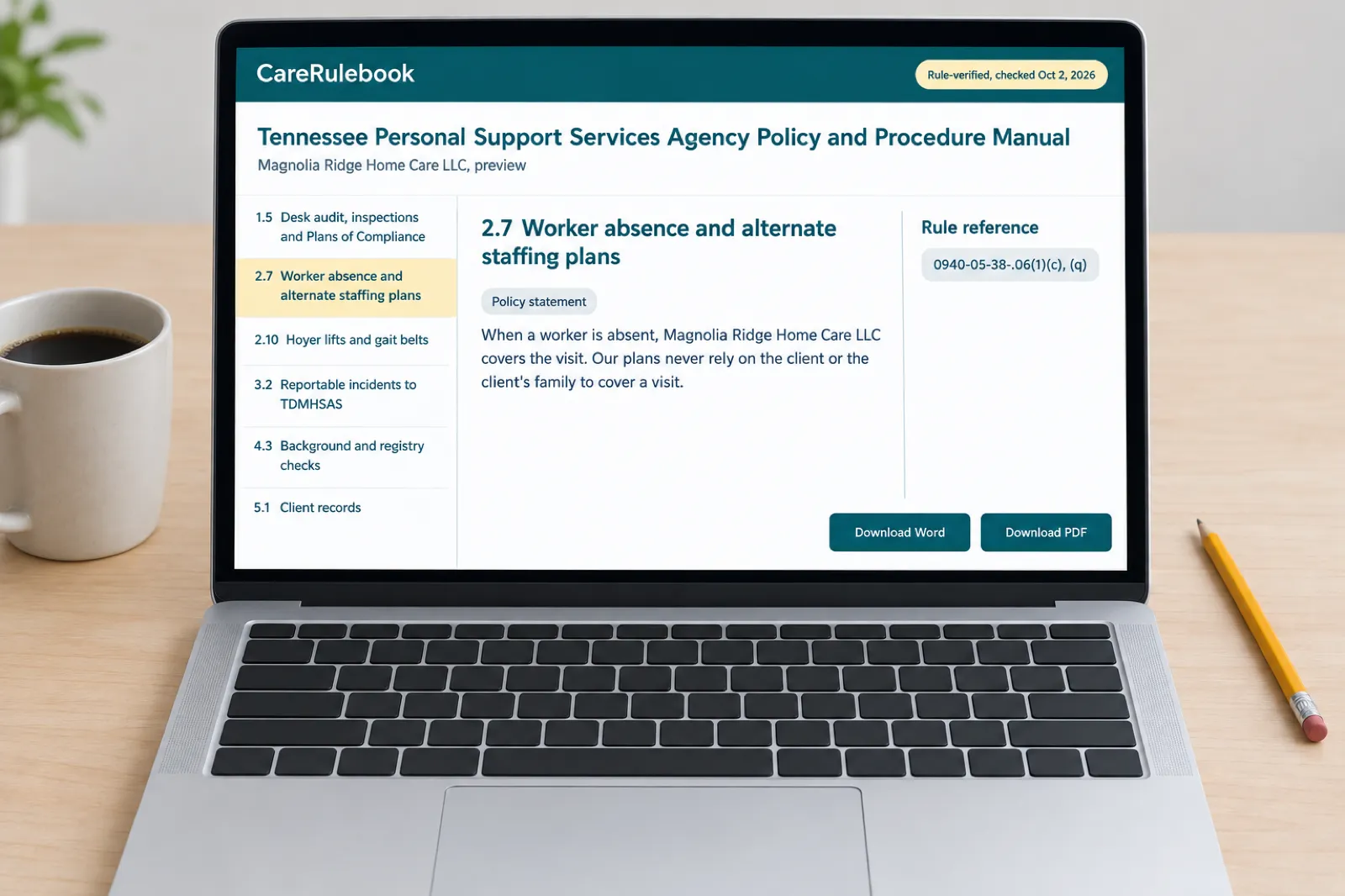
CareRulebook’s Tennessee manual includes Policy 2.11, medication assistance, and, if you choose certified administration, Policy 2.12, medication administration by certified staff (Medication Safety Policy), built on TDMHSAS’s four requests and DDA’s sample, adapted to clients’ homes.
$199CareRulebook founding price for the first 50 Tennessee agencies, then $249. Not a TDMHSAS fee.
No. Not under the basic license. Medication assistance is limited to reminders and opening packaging, such as opening a pill box filled by the client, their representative or a licensed professional; TDMHSAS lists filling medication planners as not allowed. Since 2024, staff who complete a TDMHSAS-approved medication administration certification (DDA’s 20-hour class) may administer medication in the client’s home to a client who cannot self-administer, and TDMHSAS then asks for a Medication Safety Policy.
"Opening pill reminder box if the box is filled by the service recipient or authorized representative or licensed medical personnel practicing within the scope of their license;"
It depends. Under medication assistance, a worker may guide the client’s hand while the client puts in eye, ear or nose drops, and wipe away the excess. Putting the drops in for the client is on TDMHSAS’s list of tasks not allowed under the PSSA license. Staff certified through DDA’s medication administration classes are trained for the eye and ear routes under DDA’s rules, but TDMHSAS asks agencies to check with the certification program before certified staff take on a task from its not-allowed list.
"Guiding the service recipient’s hand when the individual is applying eye/ear/nose drops and wiping the excess liquid;"
It depends. Not under medication assistance: TDMHSAS lists insulin injections among tasks not allowed under the PSSA license. Public Chapter 730 lets certified staff administer medication but not intravenous, intramuscular or "certain subcutaneous injectable medications, as defined by rule". DDA’s rules for its certified staff allow only routine insulin that the pharmacy has pre-drawn or prepared and that is ordered regularly, after additional training, and injectable epinephrine. TDMHSAS has made no rule of its own yet and asks agencies to check with the certification program, so confirm before you offer it.
"Injectable medications that may be given by certified unlicensed personnel are limited to routine insulin injections that are pre-drawn/prepared by the pharmacy and ordered on a regular basis (with additional training) or injectable epinephrine (i.e.EpiPen)."
Under a basic PSSA license, no: workers may give medication assistance, which means reminders and opening packaging, and it does not include giving medication or injections. Since Public Chapter 730 (2024), an unlicensed employee of a PSSA may administer medication to a client who cannot self-administer, in the client’s home, after completing a competency-based training program TDMHSAS has approved. TDMHSAS has approved the Department of Disability and Aging’s Medication Administration classes. Certified staff may not give intravenous, intramuscular or certain subcutaneous injectable medications.
No. TDMHSAS lists filling medication planners as a task not allowed under the PSSA license. Under medication assistance a worker may open a pill reminder box that the client, their authorized representative or a licensed professional filled. TDMHSAS asks agencies with certified staff to check with the certification program before those staff take on any task on its not-allowed list.
A registered nurse, or someone working under a registered nurse’s general supervision. The training is documented in the worker’s record before they assist anyone. TDMHSAS says a physician assistant cannot approve medication assistance training, and missing RN-supervised training is on its list of common PSSA deficiencies.
For PSSAs that do not serve people with an intellectual or developmental disability, DDA charges $50 per participant for the 20-hour class and $25 for the test-out renewal, and the certification is valid for three years. These are DDA’s fees, as TDMHSAS reports them; they are not TDMHSAS license fees or CareRulebook prices.
Only if staff certified in medication administration will give medication for your agency. TDMHSAS says such agencies should notify their surveyor, keep each worker’s certification in the personnel file, develop and implement a Medication Safety Policy, and make sure staff understand the certification. DDA publishes a sample policy that TDMHSAS points to. TDMHSAS has said it intends to make PSSA rules on medication administration but had filed none as of October 2, 2026.
Public Chapter 730 speaks of an unlicensed person employed by a PSSA, and DDA’s sample policy says medication given by natural supports or volunteers is not covered because they are not employed by a provider. Whether a subcontracted worker counts as employed for this purpose is not answered in the sources we saved. By our reading, use employees for medication administration until TDMHSAS says otherwise.
DDA’s sample Medication Safety Policy says administration to people under 18 is not covered under the exemption. TDMHSAS has not said otherwise, so by our reading certified staff should not administer medication to clients under 18.
TDMHSAS has said it will make PSSA rules on medication administration by certified staff, and has proposed a rewrite of its licensure procedure rules (hearing November 18, 2026). Leave your email and we will tell you when a Tennessee change affects your medication policies.
No spam. Only emails about Tennessee home care rule changes. How we use your email.
Tennessee
How to start a home care agency in Tennessee
The PSSA license, TDMHSAS vs DDA, the desk audit and the 17 policy items.
Tennessee
Who runs a Tennessee PSSA
The licensee, the person responsible, what TDMHSAS checks, and when you need a registered nurse.
Manual
Build your Tennessee policy manual
Including Policy 2.11 on medication assistance and Policy 2.12, the Medication Safety Policy.
Tennessee
Tennessee home health vs home care
Where a PSSA stops and home health begins: nursing tasks, licensed staff and the HFC license.
Tennessee
Tennessee caregiver training
Competency in seven areas before work, training for each client, and RN-supervised medication assistance training.
Tennessee
Tennessee PSSA policies and procedures
The 17 policy items, including item (l) on medication assistance, and the 8 personnel topics.
Tennessee
Tennessee PSSA inspections
The desk audit, unannounced inspections and the common deficiencies, led by the medication authorization.
Colorado
Colorado caregiver training
Medication reminders and the training topics Colorado’s Class B rules set.
Washington
Washington caregiver training and certification
Orientation, training hours and certification for home care aides.
North Carolina
How to start a home care agency in North Carolina
The DHSR license and the 32-item policy checklist, also reviewed before licensing.