Route 1
A health care practitioner
As defined in G.S. 90-640(a). The rule points to that statute for the definition.
13J .1001(b)(1)Where are you starting?
North Carolina · Agency director and RN · 10A NCAC 13J .1001, .1110, .1503
Every North Carolina home care agency designates one agency director, and an agency providing in-home aide services needs an RN available whenever aides are working. Here is who qualifies, what each role does, when one person can hold both, and what to tell DHSR if your director leaves.

Quick answer
A North Carolina home care agency must designate an agency director with "the authority and responsibility for administrative direction of the agency". The director needs one of three qualifications: be a health care practitioner as defined in G.S. 90-640(a); have two years of supervisory or management experience in home care or another provider licensed under G.S. 131E or 122C; or hold a relevant bachelor’s degree with one year of that experience. An agency licensed only for companion, sitter and respite services has a lighter test.
If the post falls vacant, tell DHSR in writing within five working days. For in-home aide services, an RN must be available for supervision and consultation whenever aides work. The RN assesses each client at home, writes the plan of care, checks aides’ skills and makes a supervisory visit every 90 days. The rules let one qualified person be both director and service supervisor.
The rules define the agency director as "the person having administrative responsibility for the operation of the agency". For an agency providing in-home aide services, 10A NCAC 13J .1001(b) gives three routes. The director must meet one or more of them:
Route 1
As defined in G.S. 90-640(a). The rule points to that statute for the definition.
13J .1001(b)(1)Route 2
In home care, or in any other provider licensed under G.S. 131E or G.S. 122C. No degree is required on this route.
13J .1001(b)(2)Route 3
A bachelor’s degree in health, business or public administration science, and at least one year of supervisory or management experience in home care or another licensed health care program.
13J .1001(b)(3)DHSR’s initial survey is a review of the documents you send, and its checklist includes the agency director job description among the administrative policies and a personnel record review with a column for the agency director. For the director it lists: DHSR checklist
The resume is how DHSR sees which route your director meets, so make the supervisory or management experience, dates and employers easy to find. The full table for every role is on the North Carolina survey page. DHSR checklist, Personnel Record Review
Rule .1503 sets separate director rules for companion, sitter and respite services. DHSR’s FAQ lists them under the heading "For agencies licensed to provide Companion, Sitter, and Respite services only." An agency that also provides in-home aide services uses the three routes above. DHSR FAQ 37
Required
"The agency director shall be a high school graduate, or be certified under the G.E.D. Program, and shall meet one or more of the following qualifications".
13J .1503(1)Plus one or more of these
The supervision schedule for companions and sitters is further down this page.
Most new agencies start small, so these are the first questions founders ask. Here is what the saved rule text supports.
The rules do not require the director to be someone other than the owner. Rule .1001(b) requires the agency to designate an individual who meets one or more of the qualifications, and the governing body is "the person or group of persons having legal authority for the operation of the agency". An owner who meets a qualification can be designated.
The DHSR-approved training that first-time owners complete before licensing is a separate requirement. It is not one of the director qualifications.
The agency designates a person to supervise each type of home care service it provides. "This individual may be the supervisor for one or more home care services and may also serve as the agency director." So an RN who supervises your in-home aide services can also be your agency director, provided they meet one of the director qualifications.
Plan the workload honestly: the RN must be available for supervision whenever in-home aide services are provided, and able to go on site when necessary, as well as running the agency.
The rule gives the director "the authority and responsibility for administrative direction of the agency". The rule does not list the director’s tasks one by one. Instead, "There shall be written documentation that specifies the responsibilities and authority of the agency director and supervisor." That written document is the agency director job description on DHSR’s checklist. 13J .1001(d)
Practical guidance, not rule text: the rules place these duties on the agency or its governing body, and in a small agency they usually sit with the director. Each card links to the rule.
The governing body or its designee sets and follows written policies on 11 listed topics, available for DHSR to inspect.
13J .1001(a)Written notice 30 days before a change of ownership or name or adding a service, and within five working days if the director post falls vacant.
13J .0903(f), (g); .1001(e)Immediate access to the premises and records when DHSR inspects, and a plan of correction within 10 working days of cited deficiencies.
13J .0904(e), (f)A written job description for every position, and a personnel record for each employee with the items the rule lists.
13J .1003(e), (f)The agency keeps ultimate responsibility for services under its license, including those it arranges through contractors.
13J .1001(f)The governing body or its designee evaluates the agency’s total operation every year and reviews sample client records every 90 days.
13J .1004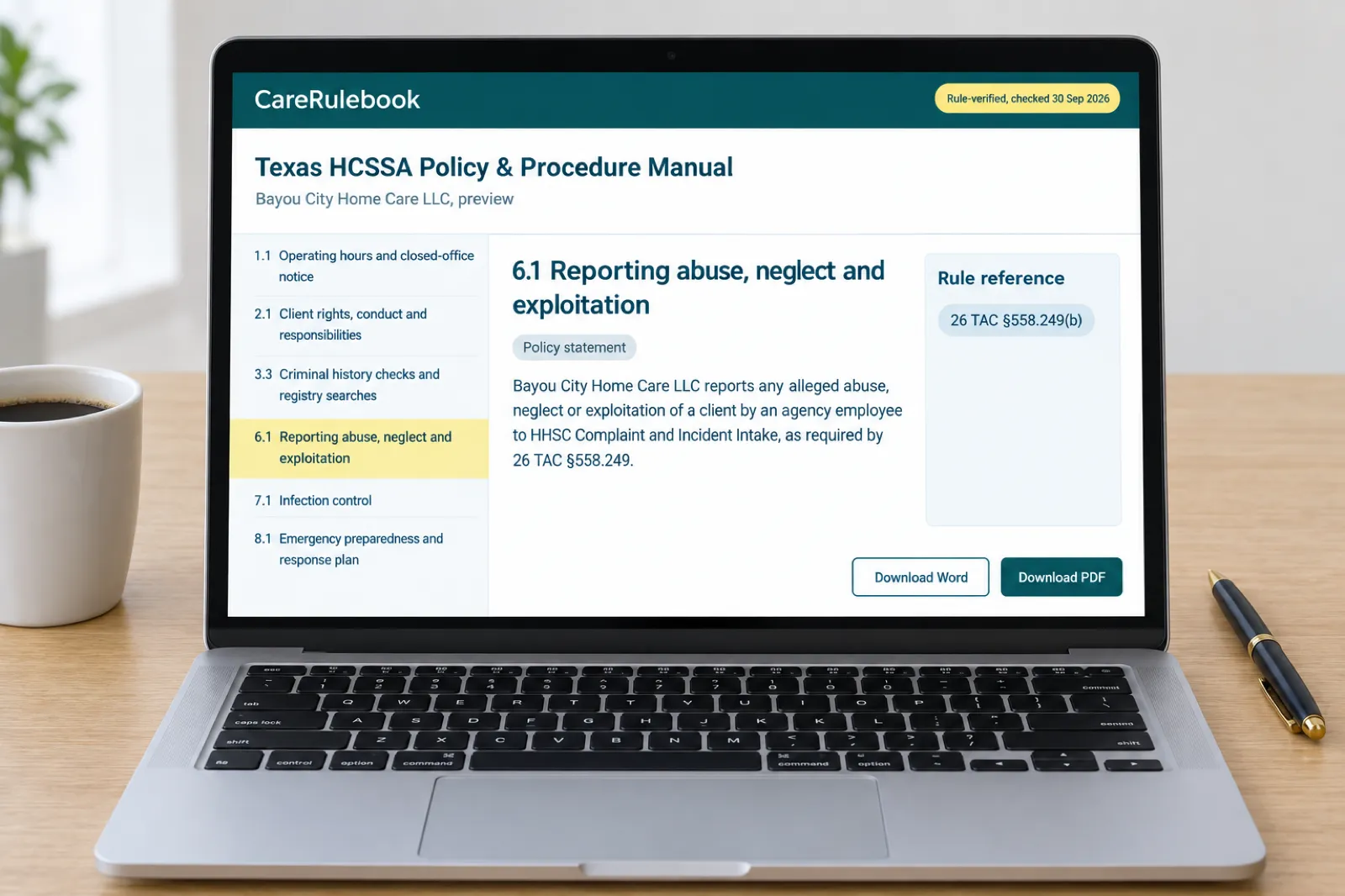
CareRulebook
CareRulebook’s North Carolina manual names your agency director and RN supervisor, sets out their qualifications, responsibilities and authority, and covers competency checks and supervision, with the 13J rule quoted under each policy.
$199CareRulebook founding price for the first 50 North Carolina agencies, then $249. Not a DHSR fee.
Directors move on, and the rule makes the next step simple. "If the position of agency director becomes vacant, the Department shall be notified within five working days in writing of such vacancy along with the name of the replacement, if available." 13J .1001(e)
Within 5 working days
Write to DHSR
Say the post is vacant and name the replacement, if you have one.
13J .1001(e)With the notice
Send the evidence
The effective date, and the documents showing the new director qualifies, such as a resume, licenses and credentials.
DHSR FAQ 38By mail or email
Where to send it
DHSR Acute and Home Care Licensure and Certification Section, 2712 Mail Service Center, Raleigh NC 27699, or DHSR.homecare@dhhs.nc.gov.
DHSR FAQ 38After review
DHSR’s letter
"Once the Agency Director is approved, a notification letter will be mailed to the Agency."
DHSR FAQ 38The other notices DHSR expects, such as a change of ownership, name or address, are covered in the North Carolina license application guide.
The 13J rules speak of the "health care practitioner"; DHSR’s FAQ describes the same work as the RN’s. "A home care agency must have a RN available for supervision and consultation during the hours that in-home aide services are provided." That holds even where Medicaid’s independent assessment nurses assess the client: "the Home Care agency RN must conduct a home visit to make observations, collect data and develop the POC." DHSR FAQ 43 FAQ 44
DHSR sums up the role: "The RN assesses the client, develops the plan of care, validates the competency of In-Home Caregivers (other RN’s, LPN, In-Home Aides, Nurse Aides), supervises the In-Home Caregivers, and coordinates the delivery of services." DHSR FAQ 45
01
Before the plan of care, the health care practitioner assesses the client in their home: functional status in the social, mental, physical health, environmental and economic areas, ADLs and IADLs. The assessment is signed and dated.
13J .1107(d), (e)02
The plan of care is signed and dated by the health care practitioner and the client or their responsible party, and sets the level of assistance for each ADL. Aides follow the practitioner’s written care instructions.
13J .1107(a)-(c)03
Aides show the practitioner each task before they are assigned it. For aides not on the Nurse Aide Registry, an RN verifies six core skills: mobility, bathing, toileting, dressing, eating and continence.
13J .1003(g); .1110(a), (b)04
A supervisory visit to each client’s home every 90 days, with or without the aide there, and once a year while the aide is giving care. The visit reviews the client’s condition, progress and response to the services.
13J .1110(c)05
Each visit record shows the date, the findings and the signature of the person who made the visit. Any corrective action goes in the employee’s record.
13J .1110(d), (e)06
The practitioner is available for supervision and consultation while in-home aide services are provided. DHSR says the RN supervisor must be available to aides and clients and able to go on site when necessary.
13J .1110(g); DHSR FAQ 46LPNs cannot stand in for the RN here
"The LPN may not perform assessments or conduct supervisory visits for in-home aide services." An LPN can still be one of your in-home caregivers; DHSR lists LPNs among the caregivers whose competency the RN validates. DHSR FAQ 45, 47
Companion, sitter and respite services have their own supervision schedule under Rule .1504, on top of the general rule in .1110. The agency’s designated supervisor supervises the staff "by contacting the client receiving care every three months and by making a supervisory visit to each client's place of residence at least every six months", and at least once a year while the companion or sitter is in the home. 13J .1504(2)
Every 3 months
Contact
Contact the client receiving care. This contact can double as the quarterly case review.
13J .1504(2), (5)At least every 6 months
Home visit
With or without the companion or sitter there. It reviews the client’s condition, progress and response, and updates the plan of care as needed.
13J .1504(2), (3)At least once a year
Visit during care
While the companion or sitter is in the home providing services.
13J .1504(2)No. Not necessarily. A bachelor’s degree in health, business or public administration science plus one year of supervisory or management experience is one route. Two years of supervisory or management experience in home care, or in another provider licensed under G.S. 131E or 122C, qualifies without a degree, and so does being a health care practitioner as defined in G.S. 90-640(a).
"an individual who has at least two years of supervisory or management experience in home care or any other provider licensed pursuant to G.S. 131E or G.S. 122C"
No. DHSR says an LPN may not perform assessments or supervisory visits for in-home aide services.
"The LPN may not perform assessments or conduct supervisory visits for in-home aide services."
Under 10A NCAC 13J .1001(b), the agency director must meet one or more of three: be a health care practitioner as defined in G.S. 90-640(a); have at least two years of supervisory or management experience in home care or any other provider licensed under G.S. 131E or 122C; or hold a bachelor’s degree in health, business or public administration science with at least one year of supervisory or management experience in home care or another licensed health care program.
DHSR applies Rule .1503 to agencies licensed for companion, sitter and respite services only. The director must be a high school graduate or GED holder, and also be a health care practitioner as defined in G.S. 90-640(a) or have one year of experience in home care, companion, sitter or respite services, or another provider licensed under G.S. 131E or 122C.
The rules do not require the agency director to be someone other than the owner. Rule .1001(b) requires the agency to designate an individual with authority and responsibility for administrative direction who meets one or more of the qualifications. An owner who meets one can be designated. The DHSR-approved training for first-time owners is a separate licensing requirement, not one of the director qualifications.
The rules allow the person who supervises a home care service to also serve as the agency director: Rule .1001(c) says that person "may be the supervisor for one or more home care services and may also serve as the agency director." They still need to meet a director qualification, and to be available for supervision whenever in-home aide services are provided.
Tell DHSR in writing within five working days of the vacancy, with the name of the replacement if you have one (Rule .1001(e)). DHSR’s FAQ asks for the effective date and the documents that show the new director meets the qualifications, such as a resume, licenses and credentials. DHSR accepts notices by email at DHSR.homecare@dhhs.nc.gov and mails a letter once the new director is approved.
Yes, if it provides in-home aide services. DHSR says the agency must have an RN available for supervision and consultation during the hours that in-home aide services are provided, even when Medicaid’s independent assessment nurses assess the client. The RN assesses clients at home, develops plans of care, validates aides’ competency and supervises them.
No. DHSR’s FAQ says an LPN may not perform assessments or conduct supervisory visits for in-home aide services.
The Medical Care Commission makes the home care rules and DHSR updates its checklist and FAQ. Leave your email and we will tell you when a change affects your director, your RN or your policies.
No spam. Only emails about North Carolina home care rule changes. How we use your email.
North Carolina
How to start a home care agency in North Carolina
The license, DHSR’s 32-item checklist, staffing and supervision.
North Carolina
The North Carolina license application
The form, the fee, the owner training and reporting changes to DHSR.
North Carolina
North Carolina survey and inspections
The personnel files DHSR reviews, including your director’s.
North Carolina
North Carolina caregiver background checks
The checks behind every personnel file, the director’s included.
Tool
North Carolina license checklist
Every step, tailored to your agency, emailed to you.
Manual
Your North Carolina policy manual
The director, competency and supervision policies, written for your agency.
Texas
Texas home care administrator requirements
How Texas does it: an administrator and alternate, with yearly training hours.
Georgia
Georgia administrator and RN
The administrator, the RN on every application and supervisors.
Virginia
Virginia administrator and RN
Administrator experience, the designated RN and 90-day supervision.