Hands-on personal care
Help with dressing, self-feeding, oral hygiene, hair care, grooming, toileting and bathing.
144A.471, subd. 6(1)What do you run?
Coming next: Maryland (assisted living), Georgia (personal care homes)
All care home guides →Minnesota · Home health vs home care · Minn. Stat. 144A.471
Minnesota does not split home health and home care into two licenses. MDH issues one home care provider license at two levels: basic for non-medical help such as bathing, dressing and reminders, and comprehensive for nursing, therapy, delegated tasks, medication management and hands-on transfers. MDH’s temporary license fee is $2,100 for basic and $4,200 for comprehensive. Here is what each level allows, where basic stops, how Medicare home health fits, and what CMS’s 2026 moratorium does and does not touch.
Quick answer
In Minnesota, home health and non-medical home care are two levels of the same home care provider license from the Minnesota Department of Health (MDH). "An applicant seeking to become a home care provider must apply for either a basic or comprehensive home care license." (Minn. Stat. 144A.471, subd. 5)
Basic covers assistive tasks such as help with bathing, dressing and toileting, standby assistance and reminders (subd. 6), and MDH says no nursing assessment is required under it (MDH FAQ). Comprehensive adds nursing and therapy, tasks delegated by a registered nurse, medication management and hands-on help with transfers and mobility (subd. 7). MDH’s temporary license fee is $2,100 basic and $4,200 comprehensive (144A.472, subd. 7).
Medicare home health is a further federal step: MDH says "All Medicare certified HHAs must hold a comprehensive home care license." (MDH, HHA Certification) Separately, CMS halted Medicare enrollment of new home health agencies nationwide from May 13, 2026 (QSO-26-11) and on November 12, 2026, extended the halt for six more months for agencies enrolling in Medicare as new providers, including after a change in majority ownership that requires a new enrollment (CMS, FR Doc. 2026-23241).
Minnesota’s statute puts nursing inside “home care”. A home care service is any of a list of services "delivered in the home of a person whose illness, disability, or physical condition creates a need for the service", starting with "assistive tasks provided by unlicensed personnel" and "services provided by a registered nurse or licensed practical nurse, physical therapist, respiratory therapist, occupational therapist, speech-language pathologist, dietitian or nutritionist, or social worker" (Minn. Stat. 144A.43, subd. 3). So there is no separate state home health license: the line runs between the two levels of one license.
New applicants start on a temporary license at the level they choose: "For new license applicants, the commissioner shall issue a temporary license for either the basic or comprehensive home care level." (144A.473, subd. 2(a)) The full basic or comprehensive license follows only after an unannounced survey finds substantial compliance (Minnesota survey guide).
“Home health agency” in MDH’s numbers. MDH’s FY 2024 report counts "473 comprehensive, 41 basic, 149 home health agency, 117 temporary comprehensive and 46 temporary basic home care licenses" (MDH report, FY 2024). The same report says "MDH issues four primary home care license types: basic home care, comprehensive home care, temporary basic home care, and temporary comprehensive home care." and "Federally-certified home health agencies (HHAs) must have a Minnesota comprehensive home care license." (MDH report, FY 2024), and MDH’s certification page says the same of every Medicare-certified home health agency. Our reading: the 149 are Medicare-certified agencies holding the comprehensive license, counted on their own line; the report does not say so in as many words.
Each line is from the statute, MDH or CMS, linked in the cell.
| Basic (non-medical home care) | Comprehensive (nursing and home health) | |
|---|---|---|
| What it covers | Assistive tasks: help with dressing, self-feeding, oral hygiene, hair care, grooming, toileting and bathing; standby assistance; medication, treatment and exercise reminders; modified diets; household chores alongside one of these. 144A.471, subd. 6 | Any basic service, plus one or more of: nursing and therapy services, delegated tasks, medication management, hands-on help with transfers and mobility, treatments and therapies, help with complicated eating problems, other complex or specialty care. 144A.471, subd. 7 |
| Nursing and therapy | Not on the basic list. Services of a nurse, therapist, dietitian or social worker are comprehensive services. 144A.471, subd. 7(1) | Services of an APRN, physician assistant, RN, LPN, physical, respiratory or occupational therapist, speech-language pathologist, dietitian or nutritionist, or social worker. 144A.471, subd. 7(1) |
| Delegated tasks | Not allowed: basic staff may not perform delegated nursing or therapy tasks. 144A.4795, subd. 3(a) | Allowed. An RN or licensed health professional supervises staff where the work is done, first within 30 days of their first delegated task. 144A.4797, subd. 3 |
| Medication | Reminders, including bringing medication already set up or in its original containers. 144A.471, subd. 6(3) | Medication management, which includes setting up and administering medication. 144A.43, subd. 12; 144A.4792, subd. 1(a) |
| Transfers and mobility | Standby assistance only: cues, oversight and minimal physical assistance. 144A.43, subd. 30 | Hands-on assistance with transfers and mobility. 144A.471, subd. 7(4) |
| First look at each client | An individualized review at the client’s home within 30 days of starting services. MDH says no nursing assessment is required. 144A.4791, subd. 7; MDH FAQ | An in-person assessment by a registered nurse (or the appropriate licensed health professional) within five days. 144A.4791, subd. 8(a) |
| Who must be your employee | At least one home care service is provided directly, by the provider or its employees, not by contract. 144A.471, subd. 2(a) | The same. MDH adds that for medication management and delegation to count as direct services, the RN must be the licensee’s own employee. MDH temporary comprehensive application |
| Policies verified on the application | Ten. 144A.472, subd. 1(14) | Sixteen: the ten, plus six on RN assessment, license checks, medication and treatment, delegation and supervision. 144A.472, subd. 2 |
| Temporary license fee (MDH’s) | $2,100, nonrefundable. 144A.472, subd. 7(a)(1), (j) | $4,200, nonrefundable. 144A.472, subd. 7(a)(2), (j) |
| Medicare home health | Not eligible for Medicare certification, MDH says. MDH application materials | Eligible after substantial compliance at the initial full survey and the full comprehensive license. New Medicare home health enrollment was halted nationwide from May 13, 2026; on November 12, 2026, CMS extended the halt for six more months for agencies enrolling in Medicare as new providers, including after a change in majority ownership that requires a new enrollment. MDH application materials CMS, FR Doc. 2026-23241 |
Fees are MDH’s, set in Minn. Stat. 144A.472, subd. 7, paid to the state and separate from any CareRulebook price. The full process is on the Minnesota guide.
The basic list is short and exact: "Home care services that can be provided with a basic home care license are assistive tasks provided by licensed or unlicensed personnel that include" the six activities in subdivision 6 (144A.471, subd. 6). Anything on the comprehensive list needs the comprehensive level.
Help with dressing, self-feeding, oral hygiene, hair care, grooming, toileting and bathing.
144A.471, subd. 6(1)Being there to give cues, oversight and minimal physical assistance while the client does an assistive task.
144A.43, subd. 30Verbal or visual reminders to take regularly scheduled medication, including bringing medication already set up or in its original containers, and reminders to do scheduled treatments and exercises.
144A.471, subd. 6(3)-(4)Preparing modified diets ordered by a licensed health professional, and laundry, housekeeping, meals and shopping, but only alongside at least one of the assistive tasks.
144A.471, subd. 6(5)-(6)The services of a registered nurse, LPN, therapist, dietitian or social worker are on the comprehensive list.
144A.471, subd. 7(1)Basic staff may not perform delegated nursing or therapy tasks.
144A.4795, subd. 3(a)Medication management, which includes setup and administration, may not be provided under a basic license.
144A.4792, subd. 1(a); 144A.43, subd. 12Physical help without which the client cannot do the move is hands-on assistance, a comprehensive service.
144A.43, subd. 3a; 144A.471, subd. 7(4)Treatment or therapy management services cannot be provided by a basic licensee.
144A.4793, subd. 1Helping clients eat when they have difficulty swallowing, recurrent lung aspirations, or need a tube or intravenous instruments to be fed.
144A.471, subd. 7(6)Transfers are where most basic agencies get caught. “Hands-on assistance” means "physical help by another person without which the client is not able to perform the activity" (144A.43, subd. 3a), and standby assistance means "the presence of another person to assist a client with an assistive task by providing cues, oversight, and minimal physical assistance" (subd. 30). Our reading: if a client cannot transfer or move without someone’s physical help, treat it as a comprehensive service; where minimal assistance ends is MDH’s call. The Minnesota guide covers MDH’s toolkit, which lists “mobility” among basic examples.
Tell each client what you cannot do. Before services start, a provider gives the client "a written statement which identifies if the provider has a basic or comprehensive home care license, the services the provider is authorized to provide, and which services the provider cannot provide under the scope of the provider’s license" (144A.4791, subd. 3).
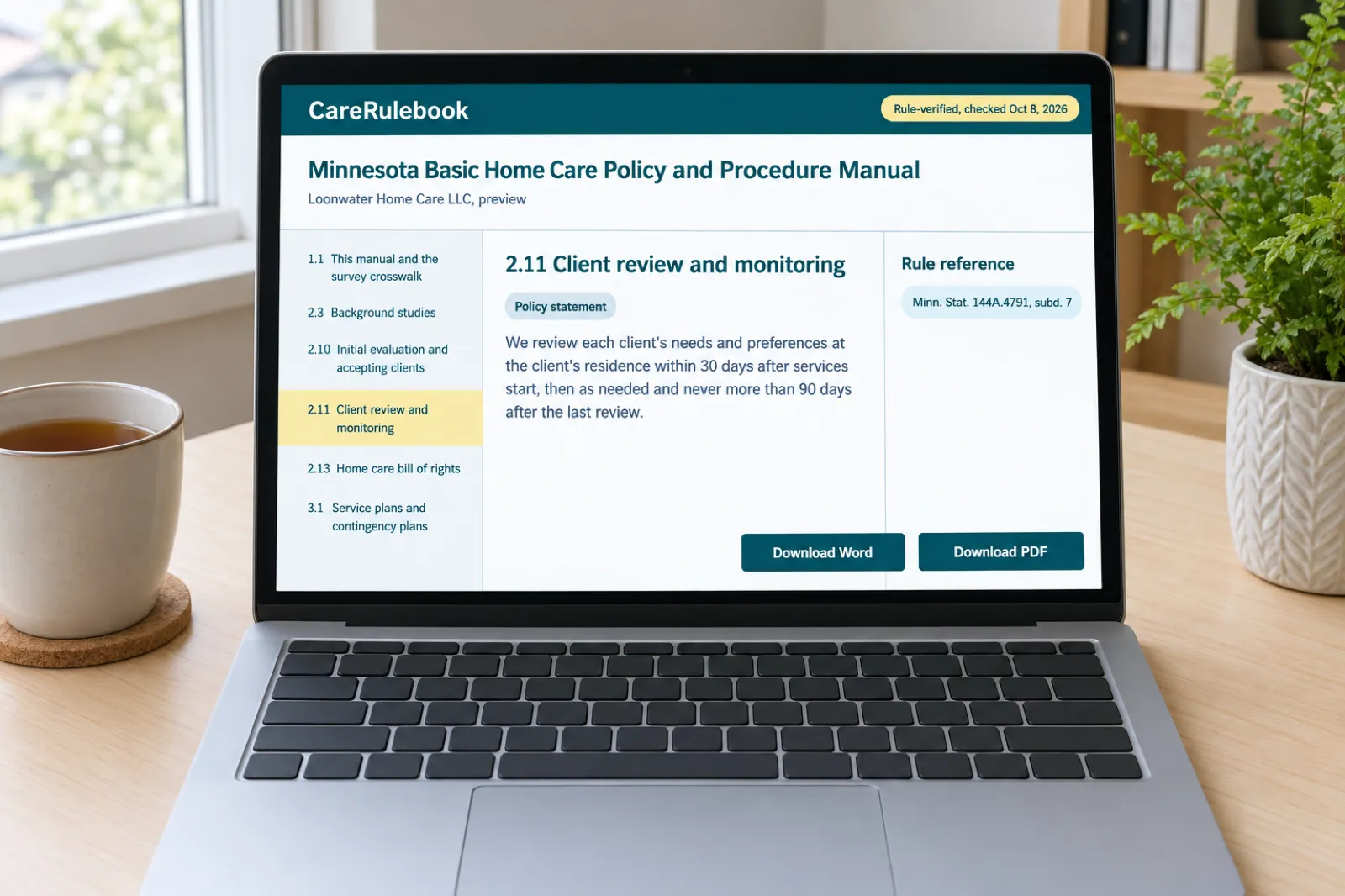
CareRulebook’s manual sets these limits out for your caregivers in Policy 1.4, scope of a basic license and the statement of home care services, with reminders in Policy 2.15 and the client review in Policy 2.11.
Changing level. "A temporary licensee may request a change in the level of licensure prior to being surveyed and granted a license by notifying the commissioner in writing", paying the difference between the fees to move up; "No refund will be made if the provider chooses to change the license application to the basic level." (144A.473, subd. 2(d)) The statute section we quote is about temporary licensees; after licensing, ask MDH how to change level.
National · from May 13, 2026, extended to about May 12, 2027 (our count)
To bill Medicare as a home health agency you need federal certification on top of the state license. MDH sets the order: "Licensed home care providers may apply to become Medicare certified home health agencies (HHAs) after being found in substantial compliance with the initial full survey and receiving a comprehensive home care license. Temporary licensees are not eligible for Medicare certification, nor are basic licensees." (MDH, Home Care Agency Application Materials)
The moratorium. "Effective May 13, 2026, CMS will halt the enrollment of new Hospice and HHA providers or HHA branch or practice locations." (CMS, QSO-26-11) On November 12, 2026, CMS extended the moratorium for six more months (to about May 12, 2027, by our count) and narrowed it to home health agencies and hospices enrolling in Medicare as new providers, including after a change in majority ownership that requires a new enrollment. New branches of home health agencies already enrolled, and new practice locations of enrolled hospices, are no longer covered. The notices appear in the Federal Register of November 16, 2026 (91 FR 73603 and 91 FR 73597); we last checked on November 15, 2026. Federal Register, FR Doc. 2026-23241 (home health) FR Doc. 2026-23242 (hospices)
Medicaid. The memo’s instructions speak of Medicare enrollment applications. Its background adds that CMS announced the moratoria under its authority to "combat fraud, waste and abuse in the Medicare, Medicaid and the Children’s Health Insurance Program (CHIP)", without saying how that applies to enrollment with Minnesota’s Medical Assistance program (QSO-26-11, page 1). We make no claim about Medicaid either way; if you plan to bill Medical Assistance for home health, check with DHS.
What it does not do, by our reading: QSO-26-11 says nothing about state licensing, so it does not stop MDH issuing temporary basic or comprehensive licenses, and a basic license is not eligible for Medicare certification in any case.
Companion-only work, staffing businesses and the small individual exclusion are covered on the Minnesota guide.
A decision aid we built from the statute and MDH guidance cited in each row. It is our reading, not MDH’s, and not legal advice. If a service sits near the line, ask MDH before you apply.
| If you plan to offer | What matches, by our reading | MDH fee | Source |
|---|---|---|---|
| Help with bathing, dressing, toileting or grooming, standby help, reminders, and chores alongside them | Basic home care license (temporary basic first) | $2,100 (MDH) | 144A.471, subd. 6144A.473, subd. 2(a) |
| Lifting or bearing a client’s weight in transfers, or other hands-on mobility help | Comprehensive license | $4,200 (MDH) | 144A.471, subd. 7(4) |
| Setting up pill organizers or giving medication | Comprehensive license | $4,200 (MDH) | 144A.4792, subd. 1(a) |
| Nursing visits, therapy, or tasks delegated by an RN | Comprehensive license | $4,200 (MDH) | 144A.471, subd. 7(1)-(2)144A.4795, subd. 3(a) |
| A Medicare-certified home health agency | Comprehensive license, then federal certification; new enrollment halted from May 13, 2026, and on November 12, 2026, extended for six more months for new enrollments, including after some changes of ownership | $4,200 (MDH); federal costs not covered here | MDH HHA pageQSO-26-11FR Doc. 2026-23241 |
| Only two or more of housekeeping, meal preparation and shopping | Home management registration, not a license | $20 a year individual, $50 organization (MDH) | 144A.482(b)-(c) |
| Medical Assistance personal care assistance (PCA) only | Exempt from the MDH license (a program route) | None to MDH | 144A.471, subd. 8(b)(1) |
| Supplying staff only to licensed or exempt providers, under their direction | Excluded from the license | None to MDH | 144A.471, subd. 9(3) |
The license check on the Minnesota guide asks what your business will do and points you to the right level.
Every step and cost for a basic agency: Minnesota license cost and timeline and the license application.
CareRulebook
CareRulebook writes the Minnesota policies a basic home care provider needs, to Minn. Stat. 144A, with your agency’s details and the statute quoted under each policy. Policy 1.4 sets out what your caregivers may and may not do under a basic license. It is not written for a comprehensive license or Medicare home health.
$199CareRulebook founding price for the first 50 Minnesota agencies, then $249. Not an MDH fee.
Our practical notes, each linked to the rule it rests on.
If a client cannot transfer or move without someone’s physical help, that is hands-on assistance, a comprehensive service. A basic agency stands by and gives minimal physical assistance only.
144A.43, subds. 3a, 30; 144A.471, subd. 7(4)Medication setup is part of medication management, which a basic licensee may not provide. Basic reminders can include bringing the client medication already set up, which the statute defines as arranged by a nurse, pharmacy or authorized prescriber.
144A.43, subds. 12-13; 144A.471, subd. 6(3); 144A.4792, subd. 1(a)The level, not the staff, sets what you may provide. Services of a registered nurse or LPN are on the comprehensive list, and basic staff may not do delegated nursing tasks.
144A.471, subd. 7(1); 144A.4795, subd. 3(a)Home care providers may not use false, fraudulent or misleading advertising, and each client gets a written statement of your license level and what you cannot provide before services start.
144A.479, subd. 2; 144A.4791, subd. 3A temporary licensee may change level in writing before it is surveyed, paying the difference in fees to move up; there is no refund to move down. After licensing, ask MDH how to change level.
144A.473, subd. 2(d)No. MDH says licensed providers may apply to become Medicare-certified home health agencies only after substantial compliance at the initial full survey and a comprehensive home care license; temporary and basic licensees are not eligible. MDH also says every Medicare-certified home health agency must hold a comprehensive license. Separately, CMS halted Medicare enrollment of new home health agencies nationwide from May 13, 2026, and on November 12, 2026, extended the halt for six more months for agencies enrolling in Medicare as new providers, including after a change in majority ownership that requires a new enrollment.
"Licensed home care providers may apply to become Medicare certified home health agencies (HHAs) after being found in substantial compliance with the initial full survey and receiving a comprehensive home care license. Temporary licensees are not eligible for Medicare certification, nor are basic licensees."
No. Not on our reading. CMS’s memo halts the Medicare enrollment of new home health agencies and hospices; it says nothing about state licensing, and a basic license is not eligible for Medicare certification anyway. MDH still issues temporary basic licenses under Minn. Stat. 144A.473. The moratorium matters if you plan a comprehensive agency that will bill Medicare as a home health agency.
"Effective May 13, 2026, CMS will halt the enrollment of new Hospice and HHA providers or HHA branch or practice locations."
It depends. Not hands-on. Hands-on help with transfers and mobility is a comprehensive service. "Hands-on" means physical help without which the client cannot do the activity. A basic licensee can give standby assistance: being present with cues, oversight and minimal physical help. On our reading, if clients need someone to lift or bear their weight, you need the comprehensive license. Where minimal help ends is MDH’s call, so describe it carefully in your statement of services.
"hands-on assistance with transfers and mobility;"
No. A basic licensee may only give verbal or visual reminders, bring the client medication already set up or in its original containers, and bring liquid or food to take it with. Medication management, such as setting up or administering medications, is a comprehensive service. MDH says a basic licensee does not write a medication management policy, but it does need a reminders policy if it gives reminders.
"Medication management services may not be provided by a home care provider who has a basic home care license."
Minnesota licenses both through one MDH home care provider license, at two levels. A basic license covers non-medical assistive tasks: help with dressing, bathing, toileting and grooming, standby assistance, reminders, modified diets and household chores alongside them. A comprehensive license adds nursing and therapy services, tasks delegated by a registered nurse, medication management, hands-on help with transfers and mobility, and treatments. MDH says every Medicare-certified home health agency must hold a comprehensive license. MDH’s temporary license fee is $2,100 for basic and $4,200 for comprehensive; these are MDH’s fees, not CareRulebook prices.
No separate state license. Home health in the usual sense, nursing and therapy at home, is a comprehensive home care service under the same MDH license. To bill Medicare as a home health agency you also need federal certification, which MDH says is open only to comprehensive licensees after their initial full survey.
No. A basic licensee may give verbal or visual reminders to take regularly scheduled medication, including bringing medication already set up or in its original containers. Medication management, which includes setting up and administering medication, may not be provided under a basic license.
Yes, but the level sets the services. Basic services are assistive tasks provided by licensed or unlicensed personnel, so a nurse may work for a basic agency, within the basic list. The services of a registered nurse or LPN as such are on the comprehensive list, and basic staff may not perform delegated nursing tasks. By our reading, a nurse at a basic agency may, for example, do the client reviews, but may not give nursing care as a service.
You can apply to MDH for a temporary comprehensive license; the CMS memo does not mention state licensing. Medicare certification comes only after substantial compliance at the initial full survey and the full comprehensive license, MDH says, and CMS halted Medicare enrollment of new home health agencies nationwide from May 13, 2026, with no exceptions for individual providers. On November 12, 2026, CMS extended the moratorium for six more months (to about May 12, 2027, by our count) and narrowed it to home health agencies and hospices enrolling in Medicare as new providers, including after a change in majority ownership that requires a new enrollment. New branches of home health agencies already enrolled, and new practice locations of enrolled hospices, are no longer covered. The notices appear in the Federal Register of November 16, 2026 (91 FR 73603 and 91 FR 73597); we last checked on November 15, 2026. Initial enrollment applications submitted during the moratorium are denied and must be resubmitted once it is lifted.
Organizations providing Medical Assistance personal care assistance are exempt from the license. The CFSS program statute says supports bought under CFSS are not considered home care services for the purposes of that section, while the license exemptions name PCA, not CFSS. On our reading a CFSS-only agency is outside the MDH license; ask MDH and DHS before relying on it. Private-pay personal care needs the license.
No. CareRulebook’s Minnesota manual is written for the basic home care license only: standby assistance but no hands-on transfers, and reminders at most. Policy 1.4 sets out what your caregivers may and may not do under a basic license and how you tell each client in the statement of home care services. A comprehensive license, and Medicare home health, need more than this manual.
We watch Minnesota’s home care law, MDH’s guidance and CMS’s home health moratorium, which began on May 13, 2026, and was extended on November 12, 2026, for agencies enrolling in Medicare as new providers, including after a change in majority ownership that requires a new enrollment. Leave your email and we will tell you when a change affects your agency.
No spam. Only emails about Minnesota home care rules and the CMS moratorium. How we use your email.
Minnesota
How to start a home care agency in Minnesota
The license, basic vs comprehensive, the temporary license and the survey.
Manual
Build your Minnesota policy manual
For the basic license, including Policy 1.4 on what caregivers may and may not do.
Minnesota
Minnesota policies and procedures
The ten application policies, and the six more a comprehensive license adds.
Minnesota
Minnesota home care surveys
The unannounced survey that turns a temporary license into a basic or comprehensive one.
Minnesota
Minnesota license cost and timeline
MDH’s fees, renewal by revenue and the months to a full license.
Oklahoma
Oklahoma home health vs home care
One OSDH license for personal and skilled care, with a supervising RN for both.
Colorado
Colorado home health vs home care
One CDPHE license in two classes: Class B personal care and Class A skilled care.
Virginia
Virginia home health vs home care
One HCO license covers both, with no Certificate of Public Need.
Illinois
Illinois home health vs home care
Five IDPH licenses: home services, home nursing, home health and two placement types.
Free sample, no email needed
Policy 2.9, Client complaints and the complaint notice, as it prints in the Minnesota manual, filled in for a fictional agency. The rule text it rests on is quoted word for word under Rule basis.
PDF · 13 pages · 142 KB · Rule-verified October 8, 2026
Collecting answers for an agency or a client? The intake questionnaire lists all 49 questions the builder asks, what each decision changes in the manual, and a completed example: Word · PDF.How consultants use CareRulebook.