Education and training history
Including the qualification route the home attendant relies on, and the result of verifying it.
12VAC5-381-200 O 2, 4What do you run?
Coming next: Maryland (assisted living), Georgia (personal care homes)
All care home guides →Virginia · Home care organizations · 12VAC5-381-200, -290, -360
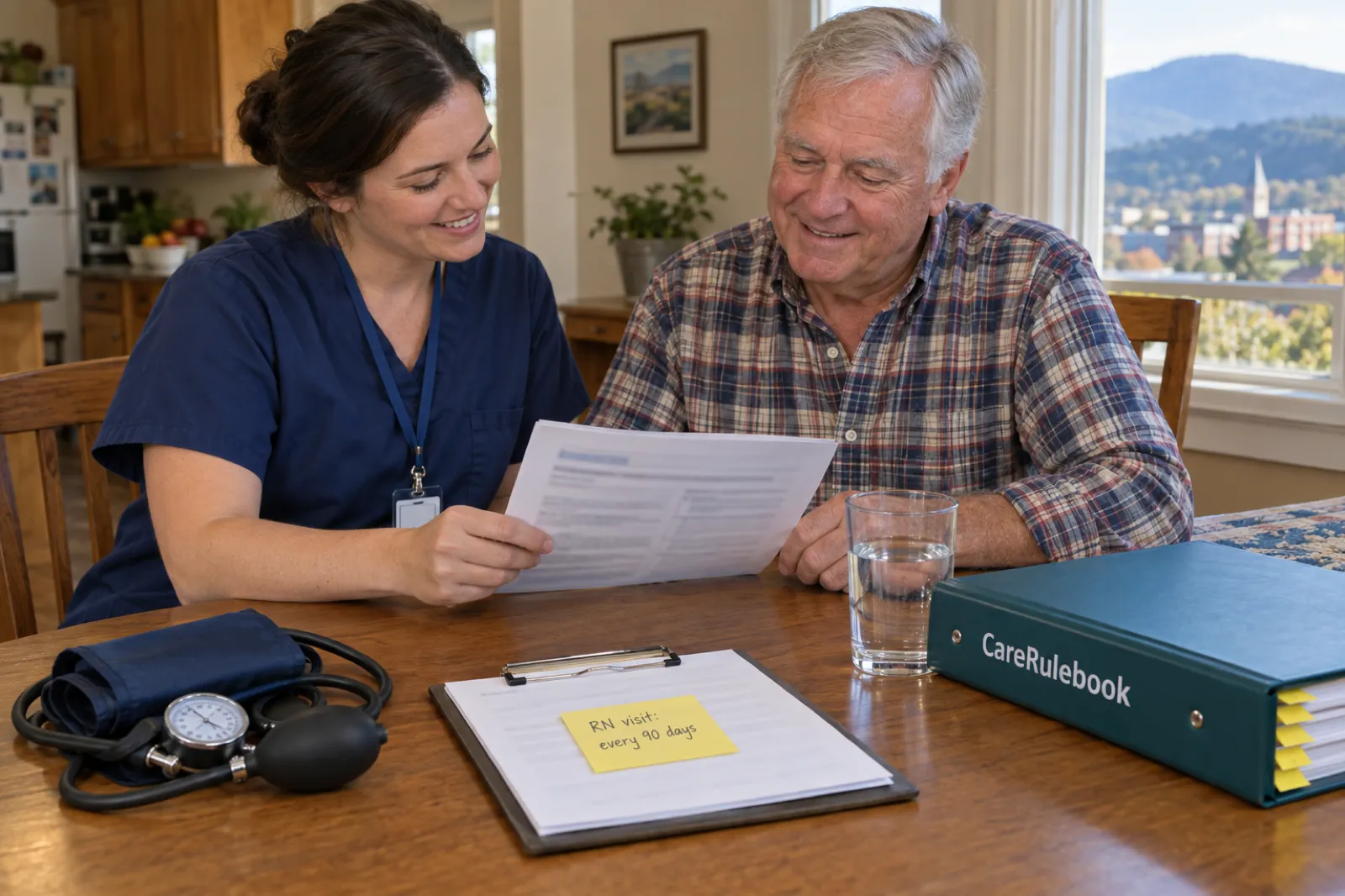
Virginia’s home care organization rules set qualifications, not pre-start hours. Each home attendant speaks, reads and writes English and meets one of six routes, from nurse aide certification to the DMAS Personal Care Aide Training Curriculum. Then orientation on nine topics, the client’s plan of services reviewed before the first visit, at least 12 hours of in-service training a year, RN supervision at least every 90 days and a yearly performance and competency evaluation.
Quick answer
"Home attendants shall be able to speak, read and write English and shall meet one of the following qualifications:" six routes, including Board of Nursing nurse aide certification, a competency evaluation and the DMAS Personal Care Aide Training Curriculum (12VAC5-381-290). The HCO rules set no hour count of their own before a home attendant starts; the program or certification behind the qualification route sets what they bring.
The organization then orients every new employee and contract individual on nine topics (-200 I), reviews each client’s plan of services with the assigned home attendant before services start (-360 D), and gives home attendants providing personal care at least 12 hours of in-service training a year (-360 G). Performance and competency are evaluated every year (-180 E 4).
The training duties in the order a new home attendant meets them. The sworn statement and State Police report run alongside: Virginia caregiver background checks. Tick steps off as you go; progress is saved in this browser only.
A home attendant must be able to speak, read and write English and meet one of six qualification routes, such as nurse aide certification or the DMAS Personal Care Aide Training Curriculum. Verify the route and keep the proof. The six routes.
Employers of mandated reporters notify employees of the duty to report adult abuse, neglect or exploitation when they are hired.
New employees and contract individuals are oriented commensurate with their job, on nine topics from confidentiality and client rights to infection control and cultural awareness. The nine topics.
The RN’s plan of services for the client is reviewed with the assigned home attendant before they deliver services.
As often as the client’s needs, the RN’s assessment and your policies require, and never more than 90 days apart. In-service training can be given during on-site supervision.
For home attendants providing personal care, with each person’s participation recorded.
A yearly evaluation of each employee’s performance and competency, with their staff development needs and plans as part of it.
A home attendant is "a nonlicensed individual performing skilled, pharmaceutical and personal care services, under the supervision of the appropriate health professional, to a client in the client's residence", also known as a certified nurse aide, home care aide, home health aide or personal care aide (12VAC5-381-10). Every home attendant must be able to speak, read and write English and meet one of these:
Routes 5 and 6 have personal care wording. Route 5 is open to any home attendant and points to a federal competency evaluation standard, 42 CFR 484.36(b); for personal care "home attendants of personal care services need only be evaluated on the tasks in 42 CFR 484.36 (b) as those tasks relate to the personal care services to be provided". Route 6 is a Medicaid agency curriculum: the license rule accepts the 2003 edition of DMAS’s Personal Care Aide Training Curriculum, and adds: "However, this training is permissible for home attendants of personal care services only." (-290 6). This page covers the license rules; we have not reviewed DMAS’s Medicaid program rules for aides, so check them too if you plan to bill Medicaid.
Verify it. Your personnel policies need a "process for verifying current professional licensing or certification and training of employees or independent contractors" (-180 E 3). In CareRulebook’s manual, Policy 3.1 (Personnel qualifications and job descriptions) has the administrator or the RN supervisor see the original certificate, transcript or competency evaluation record, or confirm it with the program, before the home attendant starts work. Contract staff are checked too: your personnel policies include a "process for verifying that contractors and their employees meet the personnel qualifications of the organization" (-180 E 5).
The rules also define ""Qualified" means meeting current legal requirements of licensure, registration or certification in Virginia or having appropriate training, including competency testing, and experience commensurate with assigned responsibilities." (-10) That definition applies to every role, from the administrator to the home attendant.
"New employees and contract individuals shall be oriented commensurate with their function or job-specific responsibilities." Orientation shall include (12VAC5-381-200 I):
When. The rule says “new employees” and sets no deadline. By our reading, orientation belongs before a person first serves a client; CareRulebook’s manual orients everyone who will serve clients before their first client, and office staff when they start.
The mandated reporter duty. Anyone paid to care for an adult, "including, but not limited to, companion, chore, homemaker, and personal care workers", is a mandated reporter (Va. Code § 63.2-1606 A), and "Employers whose employees are mandated reporters shall notify employees upon hiring of the requirement to report." (§ 63.2-1606 F). The Department of Social Services lists an "Adult Protective Services - Mandated Reporter Training" on its Mandated Reporters page (VDSS). If you include Recommended practice in your manual, Policy 4.1 suggests new staff complete it during orientation; that is our suggestion, not a VDH rule.
CareRulebook’s manual has the administrator, or the RN supervisor for home attendants, give orientation on the nine topics, and the trainer and the new person sign and date the record, which goes in the personnel record (or the contractor’s file).
Personal care is delivered under a written plan of services developed by a registered nurse with the client and family (12VAC5-381-360 C). "Copies of the plan shall be provided to the client receiving services and reviewed with the assigned home attendant prior to delivering services." (12VAC5-381-360 D) By our reading, this is Virginia’s client-specific training step: the home attendant learns the client’s needs, limitations, activities permitted, diet and the specific services to give before the first visit.
Clients also have a right to be "Served by individuals who are properly trained and competent to perform their duties" (-230 C 5). So if a plan calls for a task the home attendant has not been trained in, by our reading they are trained and checked before doing it. CareRulebook’s manual tells home attendants to ask about anything in the plan they have not been trained to do (Policy 5.2).
The rule sets no form, test or pass mark for competency. In CareRulebook’s manual, Policy 3.3 (Annual performance evaluation) has the registered nurse observe each home attendant doing their assigned personal care services, during a supervisory visit or by demonstration in the office, record the results and the development plan, and stop a skill that is not shown competent until the person is retrained. That method is the manual’s, not VDH’s.
CareRulebook
CareRulebook’s Virginia manual includes Policy 4.1 (Orientation, job training and competency), Policy 3.3 for the yearly performance and competency evaluation, Policy 3.1 for qualifications and verifying them, and Policy 5.5 for RN supervision, with your administrator and RN supervisor named.
$199CareRulebook founding price for the first 50 Virginia organizations, then $249. Not an OLC fee.
"Home attendants providing personal care services shall receive at least 12 hours annually of inservice training and education." "Inservice training may be in conjunction with on-site supervision." (12VAC5-381-360 G) For all staff, "The organization shall provide opportunities for and record participation in staff development activities designed to enable staff to perform the responsibilities of their positions." (-200 L)
The rule sets no topic list and does not say how to count the year or whether orientation counts toward the 12 hours. CareRulebook’s manual counts each year from the home attendant’s start date, has the RN supervisor choose topics from each person’s development plan, supervision findings, complaints and policy changes, records each session’s date, topic, hours, trainer and participants, and keeps a running total. Time spent training during supervision counts when it is recorded with its length. If you include Recommended practice, it also suggests keeping orientation and in-service hours apart, since the rule is silent.
Personal care services include "Administration of normally self-administered drugs as allowed in § 54.1-3408 of the Virginia Drug Control Act" (12VAC5-381-360 B 2). That section says: "Nothing in this title shall prohibit the administration of normally self-administered drugs by unlicensed individuals to a person in his private residence." (Va. Code § 54.1-3408 R)
The Board of Nursing medication training routes in the same section are for other settings. Subsection L lists seven, such as programs licensed by the Department of Behavioral Health and Developmental Services and adult day centers licensed by the Department of Social Services (§ 54.1-3408 L), and registered medication aides work in assisted living facilities (§ 54.1-3408 M). A client’s private residence is in neither, so by our reading no Board of Nursing medication course or medication aide registration is required for HCO home attendants working in clients’ homes.
No set course does not mean no training. If staff help with medication you need medication management policies (-180 C 7), and clients have the right to properly trained and competent staff. In CareRulebook’s manual, Policy 5.3 (Medication management) is included when you answer yes to medication help: home attendants give only drugs that the RN has put in the client’s plan of services, after the RN is satisfied they have been trained and are competent, and record each one. If you answer no, the manual says home attendants do not handle clients’ medication.
Each personnel record includes "Education and training history", "Results of performance evaluations" and "A record of participation in staff development activities, including orientation" (12VAC5-381-200 O). Policy 3.2 in CareRulebook’s manual lists every item. How OLC inspects is on Virginia home care inspections.
Including the qualification route the home attendant relies on, and the result of verifying it.
12VAC5-381-200 O 2, 4A record of participation in staff development, including orientation. Our suggestion: date, topics, hours and trainer for each session, so the 12 hours can be totalled.
12VAC5-381-200 L, O 9The results of each yearly evaluation of performance and competency, with the person’s development needs and plans.
12VAC5-381-200 K, O 6Our suggestion: a signed note that you told the person of the duty to report when they were hired, so you can show it.
Va. Code § 63.2-1606 FEach personnel record is kept in its entirety for at least three years after employment ends.
12VAC5-381-200 QProposed · not published for comment
The statute already says the personal care rules must provide for supervision of home care attendants by a licensed nurse through interactive audio or video (Va. Code § 32.1-162.12). The amendment to do that has not been published for comment: Town Hall shows review by the Secretary of Health and Human Resources still in progress in July 2026 (Town Hall, action 5783). Until it takes effect, supervision stays face to face under the current definition (12VAC5-381-10). Virginia’s pending rule changes →
No. Nurse aide certification is one of six routes. For personal care, completing the Department of Medical Assistance Services Personal Care Aide Training Curriculum also qualifies, as does a competency evaluation on the personal care tasks. Aides must also speak, read and write English.
"However, this training is permissible for home attendants of personal care services only."
No. Not in the home care organization rules. Before working as a home attendant, each aide must speak, read and write English and meet one of six qualification routes, such as Board of Nursing nurse aide certification, a competency evaluation on the personal care tasks or the DMAS Personal Care Aide Training Curriculum. Orientation comes on top. The only hour figure in the personal care rule is at least 12 hours of in-service training a year.
"Home attendants shall be able to speak, read and write English and shall meet one of the following qualifications:"
No. Not under the Drug Control Act: it says nothing in Title 54.1 prohibits unlicensed individuals from giving normally self-administered drugs to a person in his private residence. The HCO rule lists administration of normally self-administered drugs, as § 54.1-3408 allows, among personal care services, and your medication management policy and the RN’s plan of services set out who does what for each client. Clients also have the right to be served by staff who are properly trained and competent.
"Nothing in this title shall prohibit the administration of normally self-administered drugs by unlicensed individuals to a person in his private residence."
It depends. Not under the regulation, as of our November 6, 2026 check. The statute says the rules must provide for supervision by interactive audio or video, but VDH’s projects page still listed the amendment to do this as under Executive Branch Review. The current regulation defines supervision as regular, documented, face-to-face guidance.
"Regulations governing the delivery of personal care services shall provide for supervision of home care attendants providing personal care services by a licensed nurse through use of interactive audio or video technology."
The home care organization rules set no hour count before an aide starts. Instead, each home attendant must speak, read and write English and meet one of six qualification routes, such as Board of Nursing nurse aide certification, a competency evaluation on the personal care tasks or the DMAS Personal Care Aide Training Curriculum. Once working, home attendants providing personal care receive at least 12 hours of in-service training a year.
No. Nurse aide certification is one of six routes. For personal care, completing the DMAS Personal Care Aide Training Curriculum (2003 edition) also qualifies, and so does passing a competency evaluation on the tasks that relate to the personal care services given.
Nine topics: the organization’s objectives and philosophy; confidentiality; client rights; mandated reporting of abuse, neglect and exploitation; applicable personnel policies; emergency preparedness procedures; infection control practices and measures; cultural awareness; and the laws, regulations, policies and procedures for the person’s position. It applies to new employees and contract individuals, commensurate with their job.
12VAC5-381 names no trainer qualification for orientation or in-service. The administrator is responsible for ensuring adequate staff orientation, training, education and evaluation, and a registered nurse supervises personal care services. In-service training may be given during on-site supervision.
Personal care services include administering normally self-administered drugs as § 54.1-3408 of the Drug Control Act allows, and that section says nothing in Title 54.1 prohibits unlicensed individuals from giving normally self-administered drugs to a person in his private residence. If your home attendants do this, you need a medication management policy, and clients have the right to be served by staff who are properly trained and competent.
We found no CPR, first aid or dementia training requirement in 12VAC5-381. Training on a client’s particular needs comes through the plan of services, which is reviewed with the home attendant before they deliver services, and through in-service training and supervision.
Not under the current regulation, which defines supervision as regular, documented, face-to-face guidance and instruction. A proposed amendment on remote supervision was still under executive branch review when we last checked VDH’s projects page, on November 6, 2026, and had not been published for comment.
VDH has proposed amendments on remote supervision of personal care aides, under executive branch review. Leave your email and we will tell you when they move, and when a Virginia change affects your training or your policies.
No spam. Only emails about Virginia home care rule changes. How we use your email.
Virginia
How to start a home care agency in Virginia
The HCO license, RN supervision at least every 90 days and the 35 policy topics.
Virginia
Virginia caregiver background checks
Sworn statements, the State Police report within 30 days, barrier crimes and drug testing.
Manual
Build your Virginia policy manual
Including Policy 4.1 on orientation, in-service and staff development.
Virginia
Virginia administrator and RN requirements
The administrator’s qualifications and duties, and the RN who supervises personal care.
Virginia
Virginia home care policies and procedures
Every topic in 12VAC5-381-180, including the personnel policies.
Virginia
Virginia home care inspections
OLC inspections, what surveyors check and plans of correction.
Tool
Virginia license checklist
Every step to an HCO license, tailored to your organization, emailed to you.
US
Caregiver training requirements by state
Hours, competency checks, orientation and yearly training in every state we cover.
Georgia
Georgia caregiver training
Orientation in four items, the 40-hour aide course and 8 hours a year after the first.
North Carolina
North Carolina caregiver training
Competency by demonstration and an RN’s check of six core skills for aides not on the registry.
Maryland
Maryland caregiver training
Seven COMAR topics, a skills demonstration and dementia training hours.
Tennessee
Tennessee caregiver training
Competency in seven areas before work, then job-related training every year.
Free sample, no email needed
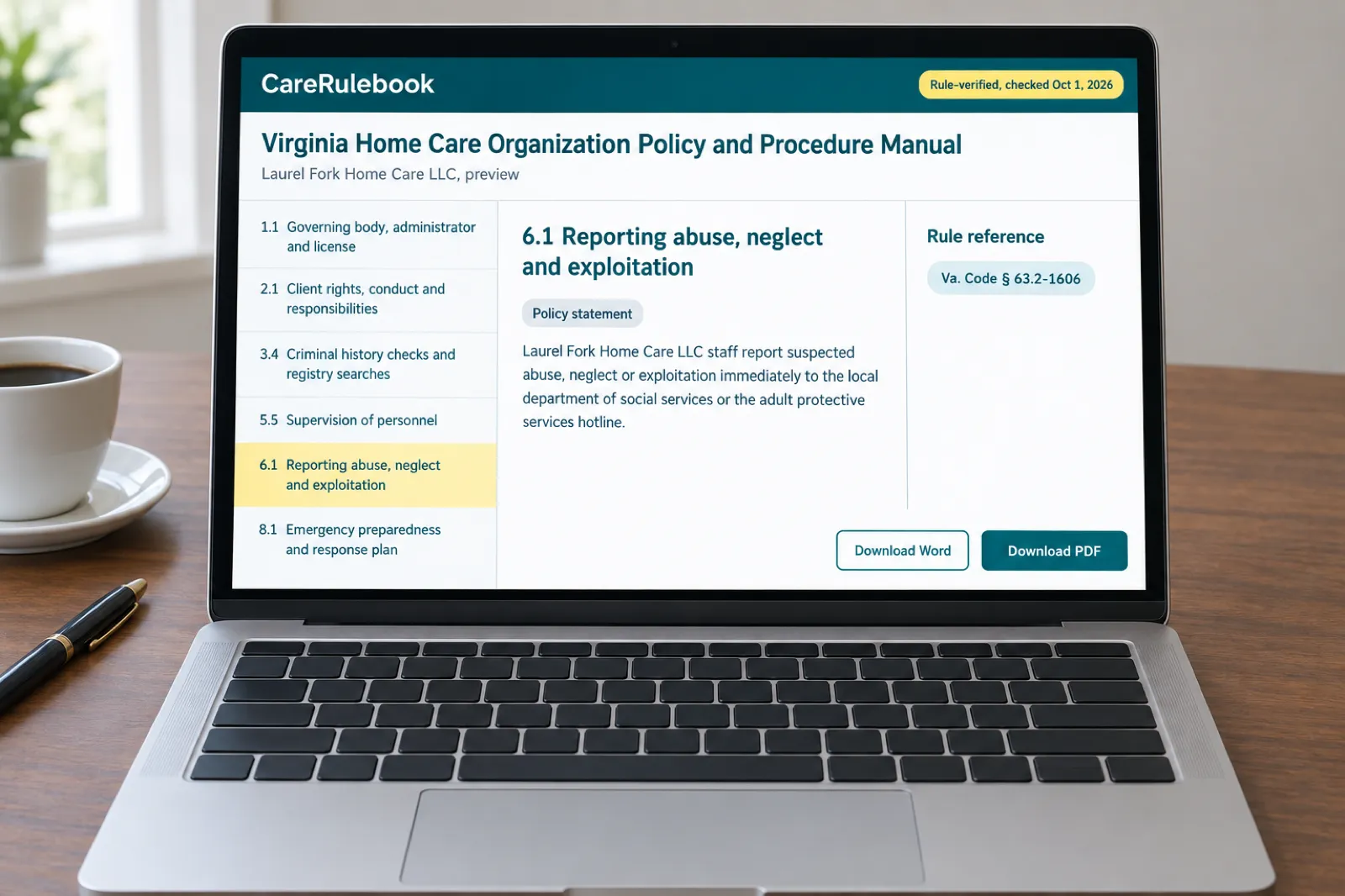
Policy 6.1, Reporting abuse, neglect and exploitation, as it prints in the Virginia manual, filled in for a fictional agency. The rule text it rests on is quoted word for word under Rule basis.
PDF · 9 pages · 111 KB · Rule-verified October 1, 2026
Collecting answers for an agency or a client? The intake questionnaire lists all 18 questions the builder asks, what each decision changes in the manual, and a completed example: Word · PDF.How consultants use CareRulebook.