Quick answer
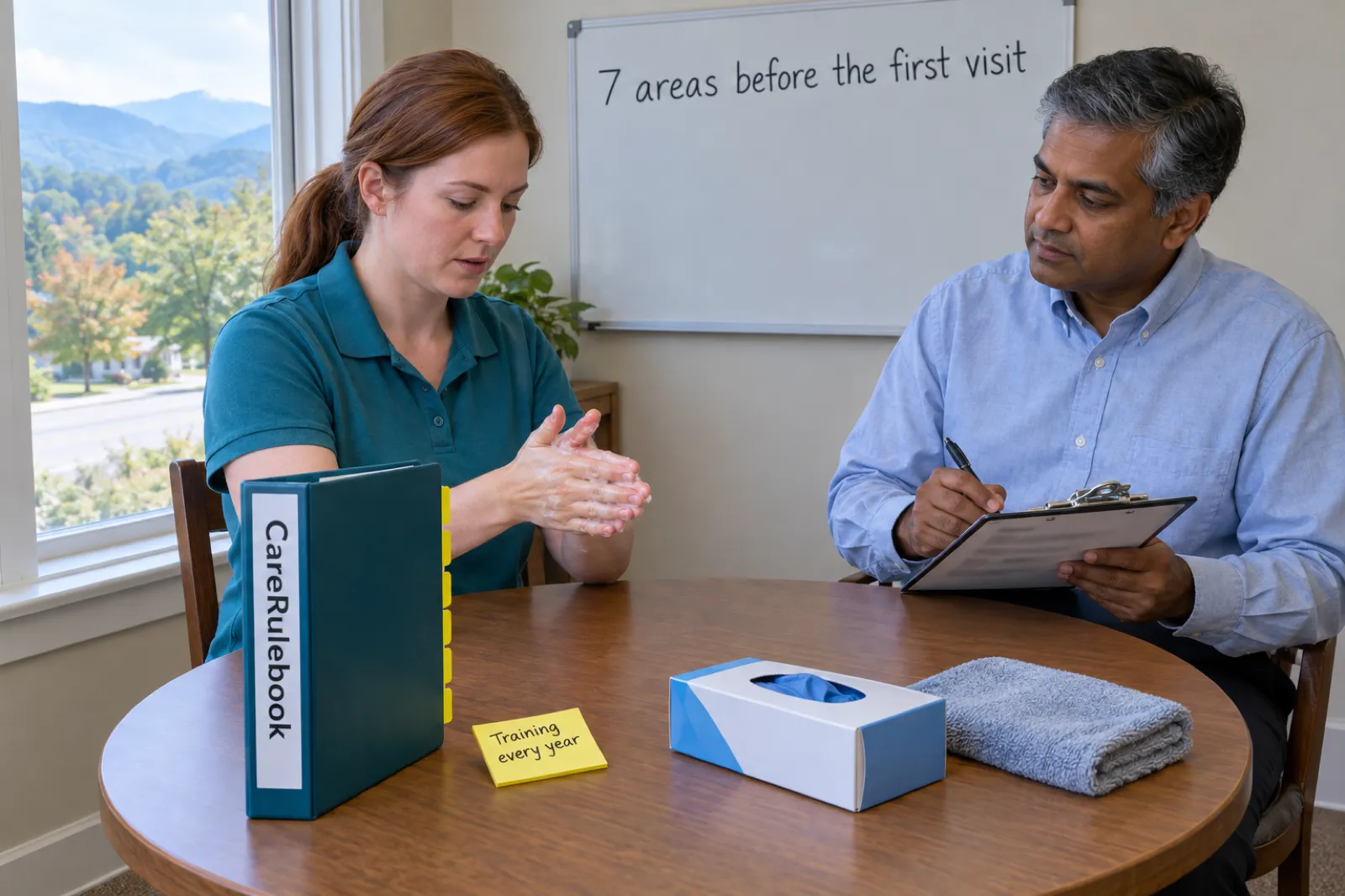
The training rule opens: "The licensee shall ensure and document that:" "Individuals who provide personal support services demonstrate basic competency in the following skill/knowledge areas prior to beginning work with service recipients", seven of them (0940-05-38-.08(1)(a)). Workers also "receive training on job related topics at least annually" (.08(1)(c)), and get documented training specific to each client’s needs (.08(1)(d)).
There is no hour minimum and no state curriculum for personal support workers. The only training a nurse must give is medication assistance training, by or under the general supervision of a registered nurse (.08(1)(b)). TDMHSAS lists competency before work and RN-supervised medication assistance training among its common PSSA rule deficiencies (PSSA slides 12-16).
20 hours
DDA’s optional medication administration class
PSSA slide 21CareRulebook
Training records written for your agency
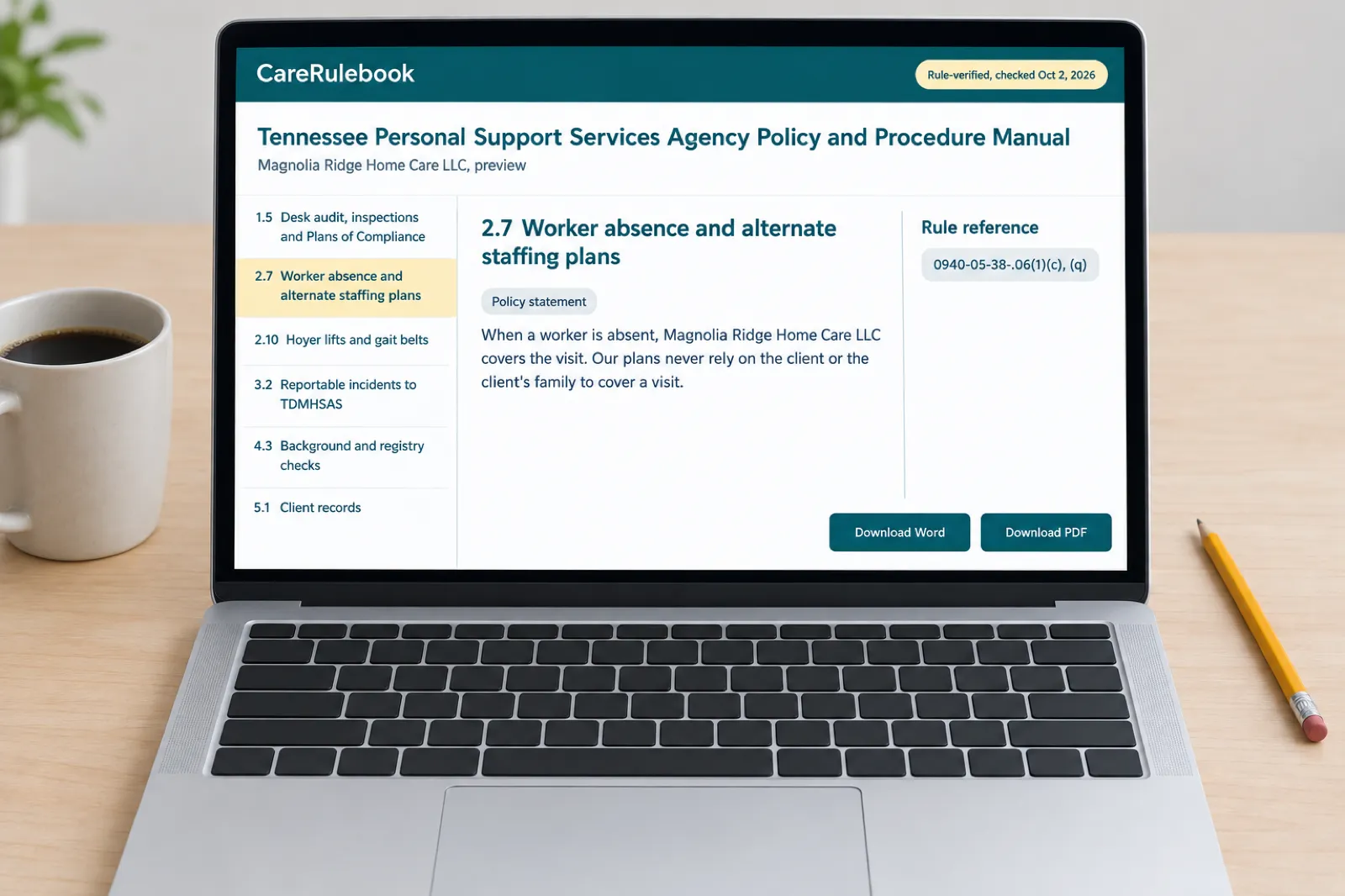
CareRulebook’s Tennessee manual includes Policy 4.6 (Competency before work, client-specific and annual training): a training plan for the service areas, a seven-area competency checklist with a language skills check, a client-specific training record and a yearly training record, plus medication assistance training (Policy 2.11), lift and gait belt training (Policy 2.10) and yearly evaluations (Policy 4.7).
- 32 policies, 107 requirements mapped
- Competency before work and RN-supervised medication assistance training: both on TDMHSAS’s common deficiency list
- Editable Word and print-ready PDF, with the rule quoted under each policy
Preview your manual$199CareRulebook founding price for the first 50 Tennessee agencies, then $249. Not a TDMHSAS fee.
Frequently asked questions
How many hours of training do Tennessee home care caregivers need?+
The PSSA rules set no hours. Before working with clients, each worker shows basic competency in seven areas, has the language skills to read instructions, keep records and talk with the client, and has documented training in self-care, household management, community living and service methods. Then training on each client’s needs, and job-related training at least once a year. Only the optional medication administration certification has set hours: DDA’s 20-hour class.
What are the seven competency areas for Tennessee PSSA caregivers?+
Observing, reporting and documenting changes in a client’s daily living skills; detecting, reporting and preventing abuse, neglect and exploitation; client rights; universal health precautions, including infection control; helping with personal hygiene; client safety; and emergency and disaster procedures, including at least emergency transportation, emergency medical care and staff coverage.
Do Tennessee caregivers need to be CNAs?+
No. Chapter 0940-05-38 asks for competency, language skills and documented training, not a certification. TDMHSAS also says a TB skin test and CPR certification are not licensure requirements, though a contract may ask for them.
Who can give medication assistance training?+
A registered nurse, or someone working under a registered nurse’s general supervision, and the training is documented in the worker’s record before they give any medication assistance. TDMHSAS says a physician assistant cannot approve medication assistance training. The rule also says the training must be consistent with T.C.A. 63-7-102, a statute we could not save.
Can Tennessee caregivers give medication?+
Not under the basic license: medication assistance means reminders and opening packaging. Since Public Chapter 730 (2024), an unlicensed PSSA employee may administer medication to a client who cannot self-administer, in the client’s home, after completing a competency-based training program approved by TDMHSAS. TDMHSAS has approved DDA’s Medication Administration classes.
Can caregiver training be online in Tennessee?+
The PSSA rules do not say how training is given, only that competency is shown and training documented. Whatever course you use, your agency still has to ensure and document each worker’s competency in the seven areas. DDA says its medication administration classes may be taught by webinar.
Does a caregiver need training before each new client?+
The rule requires documented training specific to meeting each client’s needs, without saying when. By our reading it belongs before the worker’s first visit to that client, and CareRulebook’s manual does it then, with a short record signed by the worker and the person who trained them.
Get Tennessee rule-change alerts
TDMHSAS has said PSSA medication administration rules are coming, and has proposed a rewrite of its licensure procedure rules, Chapter 0940-05-02 (hearing November 18, 2026). Leave your email and we will tell you when a Tennessee change affects your training or your policies.
No spam. Only emails about Tennessee home care rule changes. How we use your email.
Sources
- Tenn. Comp. R. & Regs. 0940-05-38, Minimum Program Requirements for Personal Support Services Agencies (rules effective June 2, 2016; December 2022 revised edition) · Tennessee Secretary of State, Publications Division (TDMHSAS rules) · retrieved October 1, 2026
- Public Chapter No. 730 (2024), amending T.C.A. 68-1-904, medication administration by unlicensed PSSA staff · Tennessee Secretary of State (Public Acts) · retrieved October 1, 2026
- Personal Support Services Agency (PSSA) Provider Information (2025 slide deck; file modified November 2025) · Tennessee Department of Mental Health and Substance Abuse Services, Office of Licensure · retrieved October 1, 2026
- Nursing: Medication Administration (classes, rules, forms, Medication Safety Policy Sample) · Tennessee Department of Disability and Aging · retrieved October 2, 2026
- Medication Administration Agency Guidelines and Medication Administration Standards · Tennessee Department of Disability and Aging · retrieved October 2, 2026