Michigan · AFC criminal history checks · MCL 400.734b
Michigan adult foster care background checks
A Michigan adult foster care home may not employ or contract with anyone who has direct access to residents until it has run the criminal history check the AFC Act requires, with fingerprints, a State Police and FBI check and a registry check. The applicant or licensee designee, and owners with direct access to residents or on-site duties, are fingerprinted through LARA. Here is who is checked, the offenses that disqualify and for how long, starting before the results, reporting arrests, and what your records must show.
- Rule-verified November 13, 2026
- Quoted from MCL 400.734b and 400.713
- Every rule linked to its source
Quick answer
Under the AFC Act, "an adult foster care facility shall not employ or independently contract with an individual who has direct access to residents until the adult foster care facility or staffing agency has conducted a criminal history check in compliance with this section", apart from a limited conditional employment route (MCL 400.734b(2)). In the Act, "Direct access" means access to a resident or resident's property, financial information, medical records, treatment information, or any other identifying information. (MCL 400.734b(17)(d))
The check includes fingerprints, a State Police and FBI check and a check of the abuse and neglect registries (MCL 400.734b(4)-(5)). LARA’s technical assistance manual calls it the Workforce Background Check system (LARA technical assistance manual).
15 years
Look-back after the sentence for listed violent, abuse and sexual felonies
10 days
Business days to give fingerprints when working unsupervised on a conditional basis, if applicable
Who is checked, and how
| Who | How | Source |
|---|---|---|
| Staff and contractors with direct access to residents | The Act’s criminal history check before they have direct access, which LARA runs through its Workforce Background Check system: written consent, fingerprints, State Police and FBI checks and a check of the abuse and neglect registries. | MCL 400.734b(2)-(5) |
| The person in charge when the licensee or administrator is away | LARA’s technical assistance manual says the same check as direct care staff, including fingerprinting and a Workforce Background Check eligibility determination. | LARA technical assistance manual, R 400.623(7) |
| Agency temps and volunteers | LARA’s technical assistance manual says to get the employment agency’s verification of a Workforce Background Check or run one; a volunteer doing direct care, or with unsupervised access to residents, needs one too. | LARA technical assistance manual, R 400.629 |
| Staff aged 16 or 17 | Counted as direct care staff only under the rule’s conditions, including a parent’s consent for the background check. | R 400.629(2)(e) |
| The applicant (if an individual), the licensee designee, and owners, partners or directors with regular direct access or on-site responsibilities | Fingerprints for a State Police and FBI check through LARA, with the Licensing Record Clearance Request (BCAL-1326A-FP) sent with the application. Written consent is given with the original application, or by a licensee designee when appointed. | MCL 400.713(19)-(21) |
| The administrator and adult household members | LARA’s group home page asks for a Licensing Information Request (BCHS-AFC 100) for the administrator and for household members 18 or older who are not residents or staff. The licensee tells LARA within 48 hours about a household member or volunteer on probation or parole or with a felony. | LARA group home page; R 400.623(9) |
Who is outside it. Independent contractors who are not under the home’s control and whose work is not clinical, health care or personal services, or who do not work ongoing with direct access to residents, are outside the check: for example utility, maintenance, construction or communication contractors. (MCL 400.734b(15))
Character, not only convictions. "The applicant is responsible for assessing the good moral character of the employees of the facility." (MCL 400.713(3)(e))
Help with the system. LARA’s technical assistance manual gives the Workforce Background Check Program’s number as 877-718-5542 (LARA technical assistance manual).
Each new hire, step by step
The order follows MCL 400.734b and R 400.639. Tick steps off as you go; progress is saved in this browser only.
References first
Before hireEach staff record verifies at least 2 reference checks, or documents that they were attempted.
Written consent and ID with the application
At applicationThe job applicant gives written consent for the State Police check, with acceptable identification, when they apply for the job.
Make a good-faith offer, then request the check
After the offerAfter a good-faith offer, the home requests the State Police check, the FBI fingerprint check and a check of the registries for substantiated findings of abuse, neglect or misappropriation of property. The person gives a set of fingerprints.
Results within 30 days
Up to 30 daysThe State Police report the state and FBI results to LARA within 30 days of the request. If a conviction is disclosed, LARA tells the home and the person the type of crime, without the details, and explains the appeal process.
Decide eligibility, then let them work with residents
Before direct accessNo direct access to residents until the check is done, unless you use the conditional employment route.
Sign the agreement to report arraignments
At hireAs a condition of continued employment, the staff member agrees in writing to report an arraignment, conviction, court order or substantiated finding immediately.
Health statement within 30 days
Within 30 daysA physician’s statement on the staff member’s physical health, obtained within 30 days of the start date.
The offenses that disqualify, and for how long
The Act says "an adult foster care facility shall not employ or independently contract with an individual who regularly has direct access to or provides direct services to residents of the adult foster care facility if the individual satisfies 1 or more of the following" (MCL 400.734b(1)):
| Record | Disqualifies | Source |
|---|---|---|
| A crime that excludes people from Medicare and Medicaid (42 USC 1320a-7(a)) | No time limit in the Act | MCL 400.734b(1)(a) |
| Felonies involving the intent to cause, or resulting in, death or serious impairment of a body function, violence or the threat of it, cruelty or torture, vulnerable adult abuse (Penal Code chapter XXA), criminal sexual conduct, abuse or neglect, a firearm or dangerous weapon, or diverting or adulterating prescription drugs | Until 15 years after completing the sentence, parole and probation | MCL 400.734b(1)(b) |
| Any other felony | Until 10 years after completing the sentence, parole and probation | MCL 400.734b(1)(c) |
| Misdemeanors involving a weapon with intent to injure, force or violence, vulnerable adult abuse, criminal sexual conduct, cruelty or torture, or abuse or neglect | Convicted within the 10 years before the application | MCL 400.734b(1)(d) |
| Misdemeanors involving cruelty by someone under 16, home invasion, embezzlement, negligent homicide or a violation of MCL 257.601d(1) of the Michigan Vehicle Code, larceny, second-degree retail fraud, and other assault, fraud, theft or controlled substance misdemeanors not covered by the 3-year or 1-year rows | Convicted within the 5 years before the application | MCL 400.734b(1)(e) |
| Simple assault (no weapon, no intent to murder or inflict great bodily injury), third-degree retail fraud, controlled substance misdemeanors under part 74 of the Public Health Code | Convicted within the 3 years before the application | MCL 400.734b(1)(f) |
| Drug misdemeanors under part 74 of the Public Health Code if the person was under 18 when convicted; larceny or second- or third-degree retail fraud misdemeanors if under 16 when convicted | Convicted within the year before the application | MCL 400.734b(1)(g) |
| A court order or disposition under MCL 769.16b, or a substantiated finding of neglect, abuse or misappropriation of property by a state or federal agency | No time limit in the Act | MCL 400.734b(1)(h)-(i) |
Our summary of MCL 400.734b(1). For the felony rows, attempts and conspiracies count too; for the felony and misdemeanor rows, so do similar crimes under other state or federal law. Where an offense fits more than one misdemeanor row, the Act sends it to the more specific one. Read the section itself before deciding on a person.
CareRulebook
The checks, the statements and the logs, written for your home
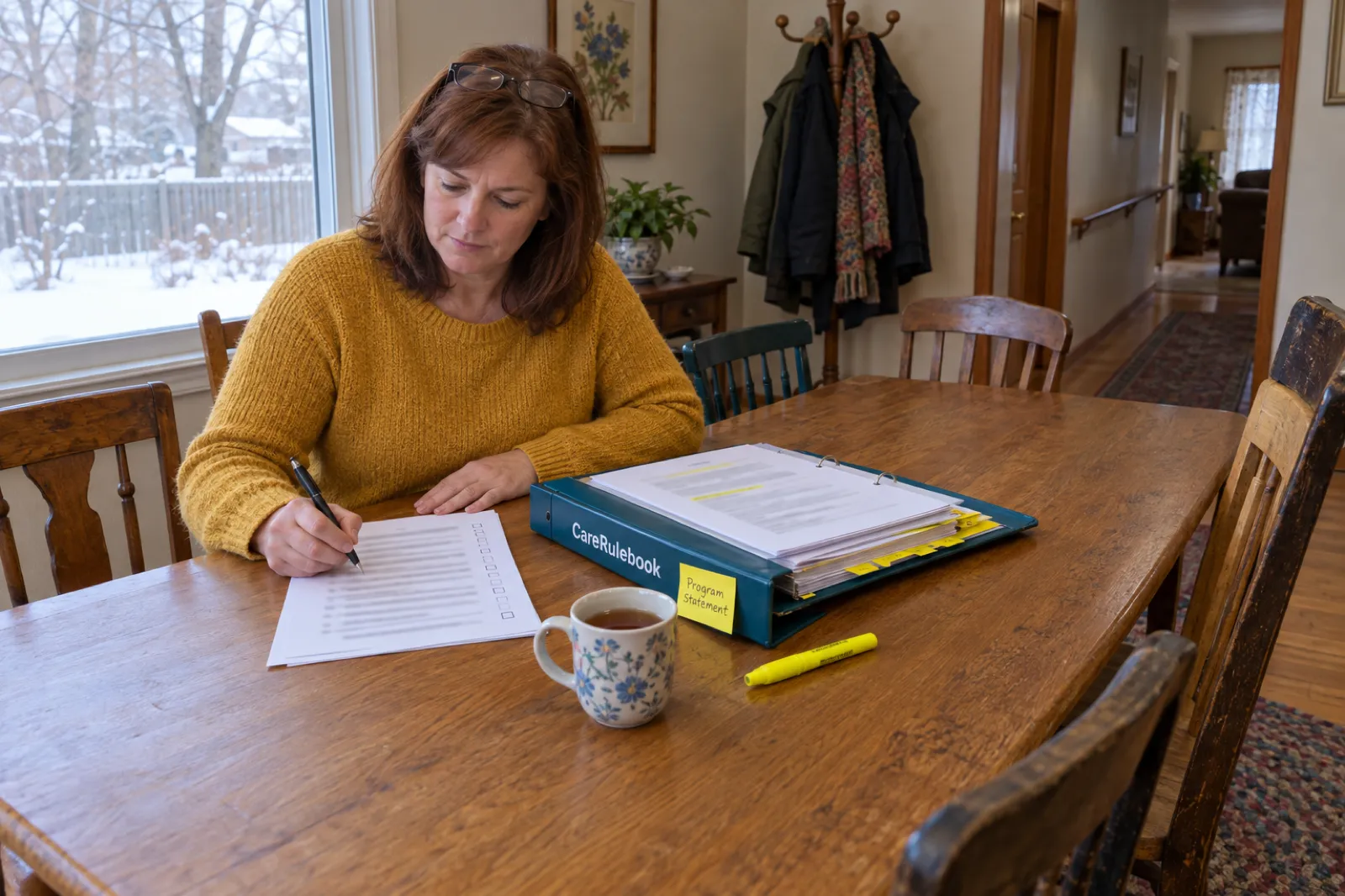
CareRulebook’s Michigan adult foster care manual covers staff records, references and criminal history checks in Policy 3.4: who is checked, the steps, the conditional employment route, the written agreement to report arraignments, and the records LARA’s employee records worksheet looks for. Your home’s details go in throughout, with the rule quoted under each policy.
- 41 policies and documents, 102 requirements mapped
- A staff record checklist, reference check form and background check log
- A conditional employment statement and record, and the arraignment reporting agreement
$299CareRulebook founding price for the first 50 Michigan homes, then $349. Not a LARA fee.
Starting before the results: conditional employment
A home that needs someone to start before the results arrive may employ them conditionally: it requests the check when it hires them, the person signs a statement about their record, and until they are found eligible they work with residents only under on-site supervision by someone who has had the check. (MCL 400.734b(6))
- The signed statement. The person states that they have no disqualifying conviction within the Act’s time periods, no court order under MCL 769.16b and no substantiated finding, and agrees that their employment ends if the check does not confirm it (MCL 400.734b(6)(b)).
- Working without supervision. A conditionally employed person may work without supervision before the results only if the home first searches the State Police’s internet criminal history access tool at its own expense and finds nothing that makes them ineligible, the person signs that they have lived in Michigan without a break for the last 12 months, and, if applicable, they give fingerprints within 10 business days of starting. (MCL 400.734b(6)(c))
- If the results do not match. If the check does not confirm the conditionally employed person’s statement, the home ends their employment. Knowingly giving false information on the statement is a misdemeanor. (MCL 400.734b(8)-(9))
On our reading, conditional employment is for when you need someone to start before the results; it is safest to plan hiring so the results are back before a new staff member has direct access.
After hire
- Reporting arraignments and convictions. "Agree in writing to report to the adult foster care facility or staffing agency immediately upon being arraigned on 1 or more of the criminal offenses listed in subsection (1)(a) to (g)", and on conviction, a court order or a substantiated finding (MCL 400.734b(12)(a)). "Reporting of an arraignment under this subdivision is not cause for termination or denial of employment." (MCL 400.734b(12)(a))
- Later arrests are flagged. The State Police keep the fingerprints, and a later arrest that matches them sets off a notice; LARA then contacts each home or staffing agency the person is associated with. (MCL 400.734b(14))
- Moving between homes. A home may rely on the record LARA holds, without a new FBI request, if the earlier check was within the last 24 months, the person has worked continuously since in an AFC home, mental health facility or covered health facility (or was laid off for less than a year), and has lived in Michigan for the last 12 months. (MCL 400.734b(11))
- Household members and volunteers. Tell LARA within 48 hours of becoming aware that a volunteer or household member is on court-supervised probation or parole or has a felony conviction (R 400.623(9)).
The licensee, designee and owners
- Fingerprints with the application. "The department shall require the applicant, if an individual, the licensee designee, owner, partner, or director of the applicant who has regular direct access to residents or who has on-site facility operational responsibilities to submit his or her fingerprints to the department of state police" (MCL 400.713(21)). LARA’s group home page asks for the Licensing Record Clearance Request (BCAL-1326A-FP) with the application, and says: "To obtain this form, contact the Licensing Unit at 1-866-685-0006." (LARA)
- The designee meets every licensee requirement. "For purposes of these rules, the licensee designee shall meet all the requirements of the licensee." (R 400.605(3))
- Convictions that bar a license. LARA may not license or renew if the applicant, the licensee designee, or an owner, partner or director with regular direct access to residents or on-site responsibilities has a felony under the AFC Act or the Penal Code’s vulnerable adult abuse chapter, or, within the previous 10 years, a misdemeanor under them or one involving abuse, neglect, assault, battery, criminal sexual conduct, or fraud or theft against a vulnerable adult. (MCL 400.713(9)) A licensee, designee, owner, partner or director convicted of adult abuse, neglect or financial exploitation, or of an offense listed under the Sex Offenders Registration Act, may not be on the home’s premises or have direct access to residents or their records. (MCL 400.713(25))
- Good moral character. LARA may not issue a license if the applicant lacks good moral character, and set offenses, such as fraud, false claims and violence, presume a lack of it (R 400.1151 to R 400.1152). When a conviction presumes a lack of good moral character, LARA tells the applicant in writing, and the applicant may have an informal conference to show they are of good moral character. (R 400.1152(3)) LARA does not deny a renewal because of convictions it already reviewed when it issued the license, unless new findings or convictions come to light. (R 400.1153)
- The cost. The State Police may charge the person checked a fee of no more than the actual and reasonable cost of the state and FBI checks. The Act sets no amount. (MCL 400.713(22))
- At renewal. A licensee, designee or listed owner who was checked and has stayed continuously licensed or employed does not repeat the criminal history and FBI check at renewal. (MCL 400.713(23))
- What the consultant checks. LARA’s licensee, designee, administrator and household worksheet checks administrative and financial capability, the licensing record clearance with good moral character and suitability, the physician’s health statement, the ten competencies, education and experience, the written stand-in, household probation or felony notices, annual training and New Provider Training. (LARA practice inspection worksheet)
Records, privacy and appeals
- The staff record. Identity, any professional license, a driver’s license if they drive residents, age, experience, education and training, at least 2 reference checks, dates of employment, health information and a signed receipt for your policies and job description, kept 2 years after employment ends (R 400.639). LARA’s employee records practice worksheet checks these row by row (LARA worksheets).
- Privacy. The home uses the criminal history information only to decide on the job, and shares it only with people directly involved in that decision. (MCL 400.734b(10))
- Appeals. A person disqualified because of a criminal history check may appeal to LARA if they believe the report is inaccurate, within 15 business days of receiving it; LARA’s director or designee decides, and that decision is final. (MCL 400.734c(1))
- Skipping the checks. A licensee, owner, administrator or operator who knowingly and willfully fails to run the required checks commits a misdemeanor, punishable by up to 1 year in prison or a fine of up to $5,000, or both, on top of licensing sanctions. (MCL 400.734b(13))
What the CareRulebook manual covers
The Michigan adult foster care manual puts this page into your home’s own policies. Policy 3.4 (staff records, references and criminal history checks) sets out who is checked, the steps, the conditional employment route and the records, in the order of LARA’s employee records worksheet, with a staff record checklist, a reference check form, a background check log, a conditional employment statement and record, and the agreement to report arraignments, convictions and findings. Policy 3.3 covers the written designation of the person in charge, and Policy 3.5 the health statements and baseline screening.
It is not legal advice. Read each policy before you adopt it, and read MCL 400.734b itself before deciding on a person’s record.
$299 CareRulebook founding price for the first 50 Michigan homes, then $349. Not a LARA fee.
Frequently asked questions
Who needs a background check in a Michigan adult foster care home?
Anyone the home employs or contracts with who has direct access to residents, meaning access to a resident or to their property, financial information, medical records, treatment information or other identifying information. LARA’s technical assistance manual adds the person in charge when the licensee or administrator is away, agency temps, and volunteers who do direct care or have unsupervised access. The applicant, licensee designee and owners or directors with direct access or on-site responsibilities are fingerprinted through LARA: the applicant and owners with the license application, and a licensee designee when appointed.
Can a new hire start before the check comes back?
Only under the Act’s conditional employment route: the home requests the check when it hires them, the person signs a statement about their record, and they work with residents only under on-site supervision by someone who has had the check. They may work unsupervised only if the home first searches the State Police’s internet criminal history access tool and finds nothing disqualifying, the person signs that they have lived in Michigan for the last 12 months, and, if applicable, they give fingerprints within 10 business days.
Who pays for the check?
Since July 1, 2020, the Act says any State Police or FBI fee for a staff check is paid by the home, the staffing agency or the individual. For the licensee’s own check, the State Police may charge the person checked a fee of no more than the actual and reasonable cost. The Act sets no amount for either, and we found none in LARA’s pages.
Does an old conviction stop someone working in an AFC home forever?
Not always. Most disqualifying offenses have a look-back period: 15 years after completing the sentence for listed violent, abuse, sexual, weapon and drug-diversion felonies, 10 years for other felonies, and 10, 5, 3 or 1 years for listed misdemeanors. Crimes that exclude people from Medicare and Medicaid, and substantiated findings of abuse, neglect or misappropriation, have no time limit in the Act. Someone disqualified who believes the report is inaccurate can appeal to LARA within 15 business days of receiving the written report (or of a court order on an application to set the conviction aside).
Does a staff member have to tell us about a new arrest?
Yes. As a condition of continued employment, each employee or contractor agrees in writing to report immediately an arraignment or conviction for a listed offense, a court order under MCL 769.16b, or a substantiated finding. The Act says reporting an arraignment is not, by itself, cause for termination. The State Police also keep the fingerprints, and a later matching arrest sets off a notice that LARA passes to the home.
Do we redo the check when the license is renewed?
For the licensee, designee and listed owners, no, if they were checked and have stayed continuously licensed or employed (MCL 400.713(23)). For staff you already employ, the Act sets no repeat check at renewal: the State Police keep their fingerprints and LARA tells you of a later matching arrest, and staff must report arraignments themselves. When you hire someone checked by another home, you may rely on that check without a new FBI request if it was within the last 24 months, they have worked continuously since in an AFC home, mental health facility or covered health facility, and they have lived in Michigan for the last 12 months.
Get Michigan AFC rule-change alerts
We will email you when the AFC Act’s background check rules, LARA’s rules or its forms change, with what it means for your home.
No spam. Only emails about Michigan adult foster care rules. How we use your email.
Keep reading
Michigan
How to open an adult foster care home in Michigan
Home types, the 2025 rules, LARA’s checklist and the steps.
Michigan
Michigan AFC staff training
The nine training areas, the licensee’s 16 hours and LARA’s free trainings.
Michigan
Michigan AFC inspections
What the consultant checks in staff and licensee records.
Tool
Michigan AFC license checklist
Every step to a LARA license, tailored to your home.
Manual
Build your Michigan AFC manual
Policy 3.4 covers the checks. Preview free.
US
Home care background checks by state
For agencies that send caregivers into clients’ homes.
Sources
- Adult Foster Care Facility Licensing Act, 1979 PA 218, MCL 400.701 to 400.737 (Michigan Compiled Laws, complete through PA 114 of 2026) · Michigan Legislature · retrieved November 13, 2026
- Licensing Adult Foster Care Facilities, Mich. Admin. Code R 400.601 to R 400.745 (2025 AACS) · Michigan Office of Administrative Hearings and Rules (Administrative Code, for LARA Bureau of Community and Health Systems) · retrieved November 13, 2026
- AFC Home Practice Inspection Worksheets (facility records, employee records, resident records, licensee and household, physical plant, special certification; revised 1/7/2026) and the worksheets page · LARA Bureau of Community and Health Systems, Adult Foster Care Division · retrieved November 13, 2026
- Adult Foster Care Administrative Licensing Rules Technical Assistance Manual, revised October 7, 2026 · LARA Bureau of Community and Health Systems, Adult Foster Care Division · retrieved November 13, 2026
- LARA AFC web pages: AFC home, applicants, licensees (example policies and templates), trainings, license application packet, group home and family home application instructions, rules and statutes, resident forms (Internet Archive copies, 2026) · LARA Bureau of Community and Health Systems · retrieved November 13, 2026
- Good Moral Character rules, R 400.1151 to R 400.1153 · Michigan Administrative Code (LARA Bureau of Community and Health Systems) · retrieved November 13, 2026
Free sample, no email needed
Read a full policy before you buy
Policy 6.1, Emergency preparedness policy and plan, as it prints in the Michigan adult foster care manual, filled in for a fictional home. The rule text it rests on is quoted word for word under Rule basis.
PDF · 14 pages · 151 KB · Rule-verified November 13, 2026
Collecting answers for a home or a client? The intake questionnaire lists all 100 questions the builder asks, what each decision changes in the manual, and a completed example: Word · PDF.How consultants use CareRulebook.