
Skip to content
CareRulebook
MenuClose

What do you run?

Home care in the US19 states with a manual, 6 with a free guide
ColoradoManual
ConnecticutPack
DelawareManual
GeorgiaManual
IllinoisManual
IndianaManual
KansasManual
MaineManual
MarylandManual
MinnesotaManual
NevadaManual
North CarolinaManual
OklahomaManual
OregonManual
South CarolinaManual
TennesseeManual
TexasManual
VirginiaManual
WashingtonManual
CaliforniaGuideFloridaGuideNew JerseyGuideNew YorkGuideOhioGuidePennsylvaniaGuideAll US home care states →
Care homes in the USCalifornia, Michigan, Minnesota; more states coming
Home care in the UKEngland, Scotland, Wales
Free toolsChecklists, calculators and templates

Delaware · PASA survey · 16 DE Admin. Code 3345-2.3, 2.4 and 2.7

Delaware PASA survey: what DHCQ checks in the first 90 days and after

Delaware checks a new personal assistance services agency (PASA) twice. Before licensing, DHCQ reviews your binder of documents. Then, during the 90-day initial license and once you are serving consumers, a surveyor makes an unannounced on-site survey. Here is what the surveyor looks at, how plans of correction work, what happens after licensing, and the State’s sanctions and penalties.

  • Rule-verified October 4, 2026
  • Quoted from 16 DE Admin. Code 3345
  • With DHCQ’s slides, FAQ, process steps and plan of correction directions (Internet Archive copies)
A woman in a rust cardigan writes a page number on a printed page in an open white binder with colored tabs at a wooden table by a window, beside a closed teal CareRulebook binder, a yellow highlighter, a white mug and a sticky note reading Number every page, with brick row houses and a yellow-leafed tree outside

Quick answer

Before licensing, DHCQ reviews your binder of documents against its 57-row Document Compliance Checklist (DHCQ checklist). The visit comes later. Once you are serving consumers on the 90-day initial license, "you must notify the OHFLC in writing (email) and a surveyor will conduct an unannounced, comprehensive on-site survey." (DHCQ slides, slide 28) The rule requires that survey during the first 90 days of operation, with the agency in operation and caring for consumers (3345-2.3.1.2).

Pass, and you get the annual license. With deficiencies, "agencies with deficiencies must complete an acceptable plan of correction before getting an annual license." (DHCQ process steps, 6b) After that, a Department representative inspects periodically, and "inspections by authorized representatives of the Department may occur at any time and may be scheduled or unannounced" (3345-2.7). The rule sets no interval (our reading).

DHCQ surveys

Who surveys
DHCQ’s Office of Health Facilities Licensing and Certification (OHFLC)DHCQ slides, slide 5
Before the license
A review of your binder against DHCQ’s 57-row checklistDHCQ checklist
First survey
Unannounced and on site, during the 90-day initial license, once you serve consumers3345-2.3.1.2; slide 28
Later inspections
Periodic, scheduled or unannounced; no interval set3345-2.7
Deficiencies
An acceptable plan of correction before the annual licenseDHCQ process steps, 6b
Penalty
Up to $5,000 per violation, each day separate (the State’s penalty)16 Del. C. § 122(3)x.7

Checked against official sources on October 4, 2026.

90 days

Initial license, not renewable, in which the first survey must happen

3345-2.3.1

57 rows

On DHCQ’s Document Compliance Checklist, reviewed before licensing

DHCQ checklist

$5,000

Maximum State penalty per violation; each day is a separate violation

16 Del. C. § 122(3)x.7

20 days

Written notice before a disciplinary action, and to ask for a hearing

3345-2.4.3.1

Before the license: the binder review

DHCQ’s first check is on paper. You hand in the Part 1 application with a binder of policies, forms, orientation teaching material and a competency test with its answer key (DHCQ slides, slide 18), and DHCQ’s checklist asks you to write, for each of its 57 rows, the binder page that shows compliance (DHCQ checklist). DHCQ says no face-to-face review is needed: a complete, properly organized binder goes on the review waitlist (DHCQ FAQ).

  • Some items wait for the survey. "Some documents will be reviewed in the Binder review, others during the initial survey." (DHCQ slides, slide 13)
  • The checklist is not the limit. "The Document Compliance Checklist contains the basics of compliance; and completion of this checklist is a starting point for licensure." DHCQ adds that surveyors check compliance with all applicable laws and regulations (DHCQ slides, slide 21).
  • Tag each policy. DHCQ’s sample policy template says: "Tag this policy with the regulation number for easy reference at the time of the Document Compliance Meeting and the initial licensure survey." (DHCQ slides, slide 19)
  • Revisions. If DHCQ asks for revisions, you have 30 days to respond (process steps, 4b), and a submission still non-compliant after the second review means restarting the licensure process (DHCQ checklist).

Every row of the checklist, with what it needs: Delaware PASA policies and procedures. Each stage of applying, with DHCQ’s forms: the Delaware PASA license application.

The unannounced survey in the first 90 days

The clock is the hard part. "During your 90-day process you must have a client and provide services in time to have a survey and make any corrections that may be needed. An initial survey cannot be renewed or extended." (DHCQ FAQ) DHCQ issues the initial license only once you have Background Check Center access, so the 90 days are not spent waiting for it (DHCQ FAQ), and it warns that if the license expires before you serve a client, you would need to start the licensing process over (DHCQ FAQ). DHCQ does not supply clients to any agency (DHCQ slides, slide 8).

  1. The 90-day initial license

    Day 0

    It lets you hire or contract with direct care workers and take on consumers. It lasts 90 calendar days and cannot be renewed.

  2. Serve your first consumer

    As early as you can

    Tell OHFLC as soon as you begin serving a client. DHCQ’s slides say that with no consumer within the first 90 days you will not meet the definition of an agency and will not get an annual license.

    DHCQ slides 8 and 28
  3. Tell DHCQ in writing

    When services are under way

    Once you have provided the services that meet the definition of your license type, notify OHFLC in writing, by email. A surveyor then makes the survey.

    DHCQ slides, slide 28
  4. The unannounced, comprehensive on-site survey

    Within the 90 days

    At your location, with the agency in operation and caring for consumers. Someone who can show the surveyor the binder, files, forms, orientation material and competency test must be there.

    3345-2.3.1.2; DHCQ FAQ
  5. Pass: the annual license

    After the survey

    DHCQ’s slides say an agency found in compliance is granted a license for the remaining nine months. The rule itself says an annual license lasts 12 months from its issue date.

  6. Deficiencies: a plan of correction first

    If cited

    An agency with deficiencies completes an acceptable plan of correction before it gets the annual license. OHFLC’s plan of correction directions give 10 calendar days to send it. DHCQ’s slides say there is a limited number of chances to gain compliance this way.

  7. Not in substantial compliance: no annual license

    If it cannot be corrected

    An agency that, at the survey, does not meet the definition of its license type or is not in substantial compliance is not granted an annual license.

Tick steps off as you go; progress is saved in this browser only. Fees and the timing of every step: Delaware PASA license cost and timeline.

What the surveyor checks

  • Who must be there. "During any survey, OHFLC personnel require someone who has access to the policies and procedures, personnel files and consumer/patient files, agency forms, orientation material and competency test." "We need someone at the agency that has the authority to answer questions on the agency’s behalf and receive the survey findings." (DHCQ FAQ)
  • Personnel files. DHCQ’s slides say each must include: application, service letters, criminal check, adult and child abuse checks, physical, drug test, orientation, competency, signed job description, TB (DHCQ slides, slide 29). Pre-hire information for every employee must be in place before they care for a consumer; DHCQ reviews it at the unannounced initial survey (DHCQ FAQ). Owners have the same pre-screening, physicals, drug tests and service letters as employees (DHCQ FAQ).
  • Consumer files. The rule lists what each consumer record holds (3345-5.5.1). Activity logs are signed and dated by the worker the same day, and the originals filed at the office at least every 2 weeks (3345-5.5.3, 5.5.5). All agency records must be available at all times for review by DHCQ’s representatives (3345-5.5.6).
  • Copies of records. "The personal assistance services agency shall permit photocopying of any records or other information by authorized representatives of the Department, as necessary to determine or verify compliance with these regulations." (3345-3.11) Refusing access to the agency or its records for inspections, surveys or investigations is a ground for discipline (3345-2.4.1.8).
  • Any rule, not only the checklist. DHCQ’s process steps give the survey’s purpose: "Unannounced survey to occur to confirm compliance with regulations." (process steps, 6) Its slides say surveyors check compliance with all applicable laws and regulations (DHCQ slides, slide 21).

Where the sources are silent. Rule 3345 and DHCQ’s saved pages do not say how long a survey lasts, how many files a surveyor samples, or whether surveyors visit consumers in their homes (our reading). DHCQ publishes no PASA survey checklist that we found; its Document Compliance Checklist is the nearest thing.

After licensing: inspections and renewal

  • Periodic inspections. "Inspections by authorized representatives of the Department may occur at any time and may be scheduled or unannounced." (3345-2.7) The rule sets no interval, so do not count on a yearly visit, or on a gap (our reading).
  • The annual license. "An annual license shall be granted, for a period of 1 year (12 months) to all personal assistance services agencies which are and remain in substantial compliance with these regulations." (3345-2.3.3.1)
  • Renewal. Apply at least 30 calendar days before the license expires (3345-2.3.3.3). DHCQ’s renewal application asks ten Licensure Survey questions: admissions and census, last program review, employees or contractors, annual competency tests and performance reviews, competency before care, worker status notices, rights notices, ownership changes and medication administration (renewal application, p. 2).
  • Provisional license. A provisional license, for less than a year, may be issued to an agency that is not in substantial compliance or that fails to renew on time (3345-2.3.2.1). A provisional license given for lack of substantial compliance is renewed only once DHCQ has approved a plan of correction and the agency has carried it out (3345-2.3.2.3).
  • Changes. Tell DHCQ in writing within 15 calendar days of a change of director or management (3345-3.7) and at least 30 calendar days before moving office (3345-2.1.3). A change of ownership voids the license (3345-2.5.2).

Complaints, incidents and investigations

DHCQ’s slides say of OHFLC: "We are responsible for all state and federal complaint investigations and compliance surveys." (DHCQ slides, slide 5) Its FAQ adds that OHFLC must investigate all complaint allegations and incidents about the providers it licenses (DHCQ FAQ).

  • Consumers can complain to DHCQ. Your agency must have "a procedure including the consumers and families right to report concerns/complaints to the Department at a telephone number established for that purpose," (3345-3.6). OHFLC’s numbers: 302-292-3930; toll free 1-800-942-7373, 24 hours a day; off-hours messages are picked up the next business day (OHFLC page).
  • The agency first. OHFLC’s complaints page tells the public that the first course of action is to discuss concerns with the agency, and to contact OHFLC if the agency cannot resolve them (OHFLC page). Your own grievance process, which the rule requires, is where that conversation happens (3345-6.4).
  • Your own reports. Major adverse incidents are reported to DHSS within 48 hours, with a full investigation report within 30 calendar days (3345-5.5.12.1, 5.5.12.3). They include suspected abuse, neglect, mistreatment, financial exploitation, solicitation or harassment; serious injury; unexpected death; medication diversion; medication error or omission (3345-5.5.12.2.1).
  • Abuse reports to Adult Protective Services are a separate duty: any person with reasonable cause to believe an impaired or incapacitated adult needs protective services must report to DHSS (31 Del. C. § 3910(a)(1)).

CareRulebook’s binder has Policy 2.9 (Reporting concerns to the Department) for the 3.6 procedure and Policy 2.5 (Major adverse incidents: 48-hour report and 30-day investigation) for the 48-hour report.

Plans of correction

How plans of correction work for a Delaware PASA under 16 DE Admin. Code 3345 and DHCQ guidance
StepWhat the sources saySource
What it isYour written response to findings of regulatory non-compliance. It follows the format DHCQ specifies, includes acceptable timeframes for correcting each deficiency, and must be approved by DHCQ.3345-1.0, "Plan of Correction"
The deadlineOHFLC’s plan of correction directions say you have 10 calendar days to complete and submit the plan, by mail or electronically. Rule 3345 itself sets no number of days, and the directions date from September 2017 and are written for every provider type OHFLC surveys, so we read them as applying to PASAs; follow any date DHCQ gives with your findings. Failing to submit a reasonable timetable for correcting deficiencies is a ground for discipline.PoC directions, p. 2; 3345-2.4.1.2
The formatThree sections, each needed for an acceptable plan: A, what was done at once for each person or area affected, with the responsible job title; B, the cause, the action plan so it does not recur, and evidence it was done; C, how success will be measured and who monitors it. Name no consumers or employees (use the identifiers in the findings, or job titles), and never write only “The deficiency has been corrected”.PoC directions, pp. 1-2
Completion datesOne completion date for each cited tag, within 60 days of the survey exit date; system changes and compliance are to be in place within those 60 days. Put right what you can for the people affected at once.PoC directions, pp. 1, 3
Who can see itOHFLC treats every statement of deficiencies and plan of correction as a public document, releasable to anyone who asks.PoC directions, p. 1
At the initial surveyAn acceptable plan of correction comes before the annual license. DHCQ’s slides say that if you cannot gain compliance, you will not receive the full annual license and can no longer operate.Process steps 6b; slide 8
On a provisional licenseA provisional license given for lack of substantial compliance is renewed only once DHCQ has approved a plan of correction and you have carried it out. A license follows the provisional period only if you have regained substantial compliance and fulfilled the plan.3345-2.3.2.3, 2.3.2.5
Carrying it outFailing to correct deficiencies on the timetable you submitted and DHCQ agreed, or a pattern of cyclical deficiencies over 2 or more years, are grounds for discipline.3345-2.4.1.3, 2.4.1.4

Our suggestions. Write the date the findings arrive and the plan’s due date (10 calendar days later, or any date DHCQ sets) the same day. Give each deficiency its own line: what you did at once, what you will change, how you will measure it, who checks it and a real completion date. Keep the evidence of each correction with the plan, because a provisional license is not renewed until the plan is carried out, and the initial license will not wait.

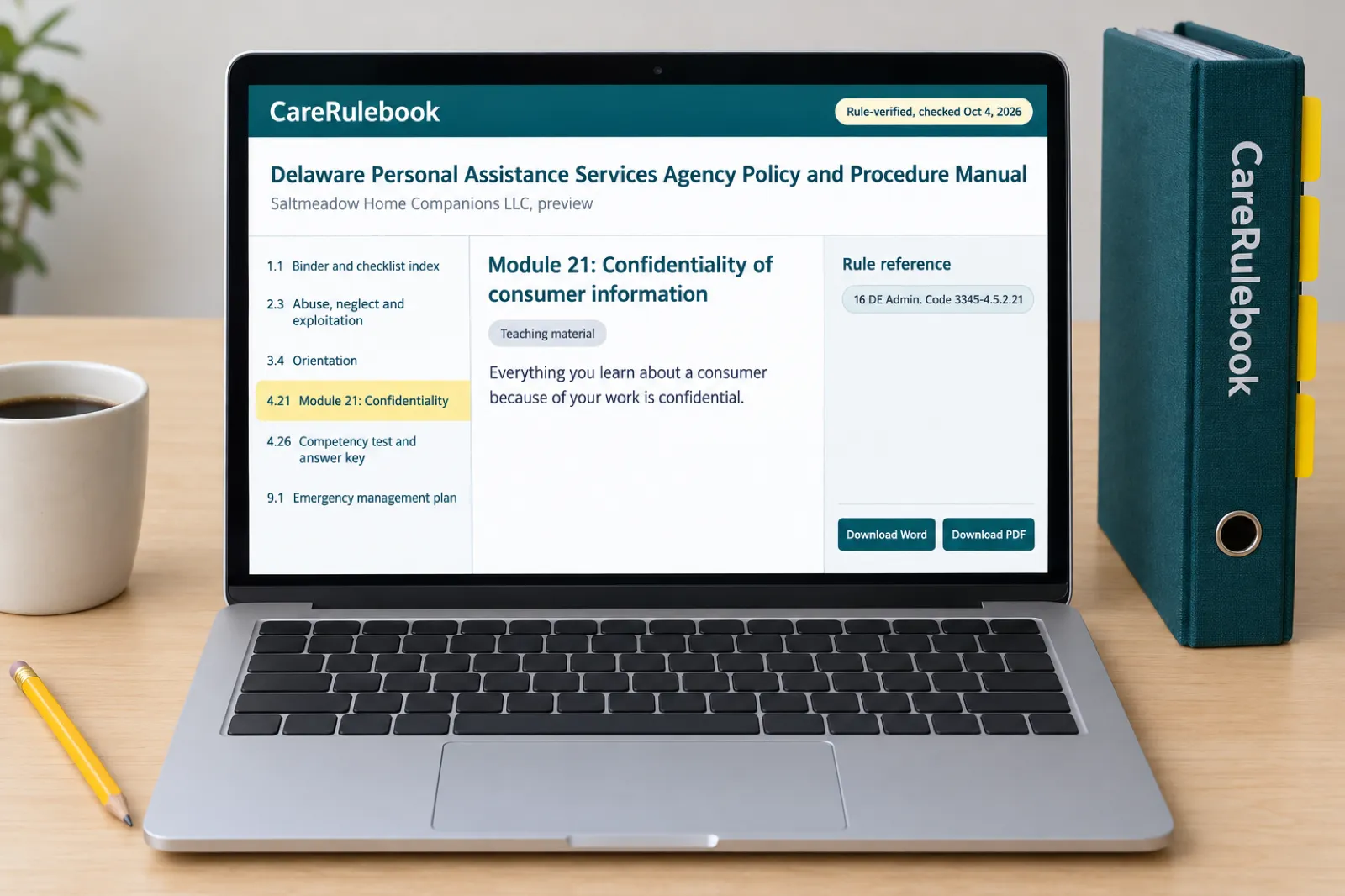
The CareRulebook Delaware manual preview on a laptop: orientation module 21 on confidentiality of consumer information for a sample agency, citing 16 DE Admin. Code 3345-4.5.2.21, with six of the manual’s sections listed beside it and a CareRulebook binder on the desk

CareRulebook

A written process for every DHCQ survey

CareRulebook’s Delaware binder includes Policy 1.4, License, initial survey, renewal, changes and inspections: the first consumer notice, the unannounced survey, access to records, who meets the surveyor and plans of correction, with a license calendar and a plan of correction worksheet. Policy 1.1 ends with an index of all 57 rows of DHCQ’s checklist.

  • 38 policies, 25 orientation modules and an 80-question competency test
  • 116 requirements mapped
  • A Document Compliance Checklist index with the page numbers of your PDF binder
  • Editable Word and PDF; download again free for 12 months
Preview your binder

$199CareRulebook founding price for the first 50 Delaware agencies, then $249. Not a DHCQ fee.

Sanctions and penalties

A plan of correction is the usual answer to a finding. For completeness, this is what rule 3345 and the statute allow beyond it. The Department may impose the sanctions singly or in combination (3345-2.4).

The sanctions

Permanently revoking or suspending a license, a letter of reprimand, provisional status, refusing a license or refusing to renew it, penalties, or other discipline. A licensee placed on provisional status may be required to report regularly, limit its practice to areas DHCQ sets and suspend new intakes and admissions.

3345-2.4.2

Penalties

The Department may ask the Superior Court to impose a civil penalty of up to $5,000 for a violation, or instead impose an administrative penalty of up to $5,000 itself. Each day a violation continues is a separate violation. These are the State of Delaware’s penalties, not CareRulebook charges.

16 Del. C. § 122(3)x.7; 3345-2.4.2.7

What sets the amount

Seriousness and threat to consumers, the history of violations, efforts to correct, culpability, any misrepresentation to DHSS, and anything else affecting consumers’ health, safety or welfare.

16 Del. C. § 122(3)x.8

Notice and a hearing

Before disciplinary action, other than an emergency temporary suspension, DHCQ gives 20 calendar days’ written notice with its reasons. The action becomes final unless you ask in writing, within those 20 days, for a hearing before the Secretary or a designee.

3345-2.4.3.1

Temporary suspension

For an immediate or imminent danger, DHSS may temporarily suspend a license, pending a final hearing, with at least 24 hours’ written or oral notice; the order lasts no longer than 60 days unless the licensee asks for a continuance. The notice includes a copy of the deficiency report.

3345-2.4.4.1, 2.4.4.2

Immediate jeopardy

The rule defines it as a crisis in which consumers’ health and safety are at risk: a deficient practice showing an inability to furnish safe care and services. No license may be issued to an agency whose deficient practices present an immediate threat to its consumers.

3345-1.0; 2.3.3.4.3

It reaches the owners

When a license is revoked, or surrendered to avoid revocation, the loss of the right to provide services extends to the agency, its owners, officers and directors with a financial interest of 5% or more, and corporation officers.

3345-2.4.5.1

Background check penalties are separate: hiring without a criminal history costs $1,000 to $5,000 per hire under the background check law, also a State penalty (16 Del. C. § 1145(g)). Delaware caregiver background checks.

Common deficiencies

We found no list of common PASA survey deficiencies published by DHCQ (our reading of its saved pages). What its own documents single out, and so what we would check first:

  • Pre-hire records missing before care. DHCQ’s FAQ says pre-hire information for every employee must be in place before they care for a consumer, and that it reviews it at the unannounced initial survey (DHCQ FAQ).
  • A child abuse registry check for adult-only agencies. DHCQ requires a child abuse registry check even for adult-only agencies (DHCQ FAQ).
  • Orientation and the test before care. DHCQ’s review guide says the orientation policy must state that orientation is completed and the competency test passed before client care is assigned (review guide, p. 13). The renewal application asks whether every new worker passed the competency test before providing care (renewal application, p. 2).
  • Notices signed by every consumer. The renewal application asks whether every consumer received and signed the Notice of Direct Care Worker Status and received written notice of their rights (renewal application, p. 2).
  • Follow-up visits and service plans. Follow-up visits at least every 90 calendar days (3345-5.2.4) and service plans reviewed at least every 90 calendar days (3345-5.3.4) are dated duties a file shows at a glance.

How to be ready

Our practical suggestions, not rule text. Each card links the source it helps you meet and the CareRulebook binder policy that covers it.

Plan the 90 days backwards

The initial survey cannot be extended, and you need time after it for any corrections. Line up staff and your first consumer before the initial license arrives, so services start early.

DHCQ FAQBinder: Policy 1.4

Email DHCQ the day services start

Write to OHFLC as soon as you begin serving a client, keep the sent email, and be ready for the surveyor from that day.

DHCQ slides, slide 8Binder: Policy 1.4

Finish every personnel file before care

Application or resume, service letters, criminal background, adult and child abuse checks, physical, drug test, orientation, competency, signed job description and TB testing, for owners working shifts too.

DHCQ slides, slide 29; FAQBinder: Policy 3.3

Meet both physical windows

The rule allows a physical from the 12 months before hire, but DHCQ’s FAQ (October 2025) still says three months. A physical from the last three months satisfies both.

3345-4.4.2.6.5.1; DHCQ FAQBinder: Policy 3.2

Keep consumer files and logs current

Activity logs signed and dated by the worker the same day, with the originals filed at the office at least every two weeks.

3345-5.5.3, 5.5.5Binder: Policy 7.1

Decide who meets the surveyor

The director, or the alternate director appointed in writing, with access to every record and the authority to answer for the agency and receive the findings.

DHCQ FAQ; 3345-4.1.2Binder: Policy 1.3

Training records the surveyor reads: Delaware caregiver training. Hiring checks: Delaware caregiver background checks.

How the CareRulebook binder helps at the survey

  • The Document Compliance Checklist index. Policy 1.1 ends with all 57 rows of DHCQ’s checklist in DHCQ’s order and wording, each with the policy that answers it. At a survey, the director hands the surveyor the binder and this index, so any rule can be found quickly. A separate index download gives the page numbers of your PDF binder for each row. DHCQ has not approved the index.
  • Policy 1.4, License, initial survey, renewal, changes and inspections. For a new agency: the license calendar with the 90-day dates and a first consumer notice email to OHFLC. For every agency: what employees do when DHCQ arrives, who receives the findings, access to and copying of records, and a plan of correction worksheet with a line per deficiency and its completion date.
  • The files the surveyor reads. Policy 3.3 has a personnel file checklist built on DHCQ’s slide 29 list, Policy 3.2 lets you choose a physical window of 3 or 12 months, and Policy 7.1 has the consumer record checklist and the activity log.
  • Already licensed? Policy 1.1 then ends with a renewal and annual review checklist that follows DHCQ’s renewal application, starting with its ten Licensure Survey questions, then the yearly duties in rule 3345, each with the policy that answers it.

It is a written process and the forms to follow it. It cannot promise a survey without findings: what the surveyor checks is what your agency actually does.

Preview your Delaware binder →

Myths about DHCQ surveys

Will DHCQ tell me the date of my Delaware initial survey?

No. The survey is unannounced. Once your agency has started serving consumers, you tell DHCQ’s Office of Health Facilities Licensing and Certification in writing (by email), and a surveyor then makes an unannounced, comprehensive on-site survey. It has to happen within your 90-day initial license, which cannot be renewed, and DHCQ says the initial survey cannot be extended, so start services early enough to leave time for the survey and any corrections.

"you must notify the OHFLC in writing (email) and a surveyor will conduct an unannounced, comprehensive on-site survey."

Does DHCQ inspect a licensed Delaware PASA every year?

It depends. Rule 3345 sets no interval. It says a Department representative periodically inspects every licensed agency, and that inspections may occur at any time and may be scheduled or unannounced. DHCQ also investigates complaints and incidents. The renewal application asks ten Licensure Survey questions each year, but that is a form, not a visit (our reading).

"A representative of the Department shall periodically inspect every personal assistance services agency for which a license has been issued under this chapter."

If my Delaware initial survey finds deficiencies, do I lose the license?

It depends. Not automatically. DHCQ’s process steps say an agency with deficiencies completes an acceptable plan of correction before it gets its annual license. But its slides warn that there is a limited number of chances to gain compliance through the plan, and an agency that is not in substantial compliance, or does not meet the definition of a PASA, at the survey is not granted an annual license.

"Agencies with deficiencies must complete an acceptable plan of correction before getting an annual license."

If my binder meets all 57 checklist rows, is my Delaware agency fully compliant?

No. Not necessarily. DHCQ’s slides call the Document Compliance Checklist the basics of compliance and a starting point for licensure, and say surveyors check compliance with all applicable laws and regulations. Rule 3345 has duties with no checklist row, such as the Notice of Direct Care Worker Status, home visits, activity logs, major adverse incident reports and the COVID-19 items.

"The Document Compliance Checklist contains the basics of compliance; and completion of this checklist is a starting point for licensure."

Frequently asked questions

When does DHCQ survey a new Delaware PASA?

During the 90-day initial license, once you are serving consumers. Rule 3345 says every PASA has an on-site survey during its first 90 days of operation and must then be in operation and caring for consumers. DHCQ’s slides say to notify OHFLC as soon as you begin serving a client and, once you have provided the services your license type requires, to tell OHFLC in writing (by email); a surveyor then makes an unannounced, comprehensive on-site survey.

Will I know the date of the Delaware initial survey?

No. DHCQ’s process steps and slides describe it as unannounced. DHCQ’s slides say a surveyor comes after your email telling OHFLC that services have started. The initial survey cannot be renewed or extended, so start services early enough to leave time for the survey and any corrections.

What does a DHCQ surveyor look at?

DHCQ’s FAQ says that during any survey it needs someone with access to the policies and procedures, personnel files and consumer files, agency forms, orientation material and the competency test, who can answer questions for the agency and receive the findings. Its slides list what each personnel file must include, and say the checklist is a starting point: surveyors check compliance with all applicable laws and regulations.

How often does DHCQ inspect a licensed PASA?

Rule 3345 sets no interval. A Department representative periodically inspects every licensed agency, and inspections may occur at any time and may be scheduled or unannounced. DHCQ also investigates complaints and incidents. Each renewal application asks ten Licensure Survey questions, but that is a form, not a visit (our reading).

What happens if the survey finds deficiencies?

You complete an acceptable plan of correction before you get the annual license: a written response to the findings, in DHCQ’s format, with acceptable timeframes, approved by DHCQ. OHFLC’s plan of correction directions give 10 calendar days to submit it and ask for each correction to be complete within 60 days of the survey exit date. DHCQ’s slides warn that there is a limited number of chances to gain compliance this way, and an agency not in substantial compliance at the survey is not granted an annual license.

Can DHCQ fine a Delaware home care agency?

Yes. The Department may ask the Superior Court for a civil penalty of up to $5,000 per violation, or impose an administrative penalty of up to $5,000 itself, and each day a violation continues is a separate violation. These are the State of Delaware’s penalties. It may also reprimand, place a licensee on provisional status, refuse, refuse to renew, suspend or permanently revoke a license, after 20 calendar days’ written notice and the chance of a hearing (an emergency temporary suspension needs at least 24 hours’ notice).

Does the CareRulebook binder help with the survey?

Yes. Policy 1.4, License, initial survey, renewal, changes and inspections, covers the first consumer notice to DHCQ, the initial survey, inspections, access to records, who meets the surveyor and plans of correction, with a license calendar, a first consumer notice email and a plan of correction worksheet. Policy 1.1 ends with an index of DHCQ’s 57 checklist rows, which you hand the surveyor with the binder, and agencies already licensed get a renewal and annual review checklist that follows DHCQ’s renewal application.

Get Delaware rule-change alerts

We will email you when Delaware changes rule 3345 or DHCQ updates its survey, binder or renewal guidance, with what it means for your agency.

No spam. Only emails about Delaware home care rules. How we use your email.

Keep reading

Sources

  1. 16 DE Admin. Code 3345, Personal Assistance Services Agencies (official text) · Delaware Department of Health and Social Services, Division of Health Care Quality (Delaware Administrative Code) · retrieved October 4, 2026
  2. 16 Del. C. § 122(3)x, personal assistance services agencies · Delaware General Assembly (Delaware Code Online) · retrieved October 2, 2026
  3. 16 Del. C. §§ 1145 and 1146, criminal background checks and mandatory drug screening for home-care agencies · Delaware General Assembly (Delaware Code Online) · retrieved October 4, 2026
  4. 31 Del. C. chapter 39, Adult Protective Services · Delaware General Assembly (Delaware Code Online) · retrieved October 4, 2026
  5. 3345 Personal Assistance Services Agencies (PASA) Part 1 Document Compliance Checklist · DHCQ Office of Health Facilities Licensing and Certification (Internet Archive copy) · retrieved October 2, 2026
  6. PASA Document Compliance Review for Agencies (PASA Binder Review Guide, 46 pages) · DHCQ Office of Health Facilities Licensing and Certification (Internet Archive copy) · retrieved October 2, 2026
  7. PASA Part 1 Initial Licensure Application (Rev. 10-31-2022), Initial Application Process Steps, process flow chart, Letter to Applicants, Statement of Intent and Change of Information form · DHCQ Office of Health Facilities Licensing and Certification (Internet Archive copies) · retrieved October 4, 2026
  8. Licensure Renewal Application for 3345 Personal Assistance Services Agencies (Rev 11182022) · DHCQ Office of Health Facilities Licensing and Certification (Internet Archive copy) · retrieved October 4, 2026
  9. Interested Provider Meeting Frequently Asked Questions (Rev. 10/22/2025) · DHCQ Office of Health Facilities Licensing and Certification (Internet Archive copy) · retrieved October 4, 2026
  10. Interested Provider Meeting slides (2-21-24) and Interested Provider Receipt of Acknowledgement (Rev. 2025) · DHCQ Office of Health Facilities Licensing and Certification (Internet Archive copies) · retrieved October 4, 2026
  11. Office of Health Facilities Licensing and Certification, Licensing and Certification, Background Checks, Adult Abuse Registry and Report Abuse pages · Delaware Health and Social Services, Division of Health Care Quality (Internet Archive copies) · retrieved October 4, 2026
  12. Plan of Correction (PoC) Submission Directions (created September 2017) · DHCQ Office of Health Facilities Licensing and Certification (Internet Archive copy) · retrieved November 2, 2026

Free sample, no email needed

Read a full policy before you buy

Policy 2.3, Abuse, neglect, mistreatment and financial exploitation: prevention and reporting, as it prints in the Delaware manual, filled in for a fictional agency. The rule text it rests on is quoted word for word under Rule basis.

PDF · 8 pages · 110 KB · Rule-verified October 4, 2026

Collecting answers for an agency or a client? The intake questionnaire lists all 48 questions the builder asks, what each decision changes in the manual, and a completed example: Word · PDF.How consultants use CareRulebook.

Download the sample (PDF)
Or email it to me

We send the link once. Nothing else unless you tick the box. Privacy notice.

Build your Delaware binderfrom $199