Skip to content
CareRulebook
MenuClose

What do you run?

Home care in the US19 states with a manual, 6 with a free guide
ColoradoManual
ConnecticutPack
DelawareManual
GeorgiaManual
IllinoisManual
IndianaManual
KansasManual
MaineManual
MarylandManual
MinnesotaManual
NevadaManual
North CarolinaManual
OklahomaManual
OregonManual
South CarolinaManual
TennesseeManual
TexasManual
VirginiaManual
WashingtonManual
CaliforniaGuideFloridaGuideNew JerseyGuideNew YorkGuideOhioGuidePennsylvaniaGuideAll US home care states →
Care homes in the USCalifornia, Michigan, Minnesota; more states coming
Home care in the UKEngland, Scotland, Wales
Free toolsChecklists, calculators and templates

Georgia · Private home care · 111-8-65-.09(5)-(6)

Georgia caregiver training: orientation first, then 8 hours a year

Georgia sets caregiver training by job. Every employee is oriented before working with clients. Personal care assistants qualify through one of four routes, including a 40-hour agency course directed by a registered nurse or a health care professional with similar education and experience; companions complete training or show competency in seven areas. A supervisor evaluates each staff member in writing, and after the first year everyone gets at least 8 clock hours of training a year.

  • Rule-verified September 30, 2026
  • Quoted from Ga. Comp. R. & Regs. 111-8-65-.09 and .10
  • And DCH’s application checklist
A woman in navy scrubs reads a printed page at an office desk while a colleague in a green polo shirt works on a laptop beside her, with a teal CareRulebook binder and a yellow highlighter on the desk

Quick answer

Georgia’s training rule opens: "Prior to working with clients, all employees hired or used on or after the effective date of these rules and who provide services to clients shall be oriented in accordance with these rules", and they then receive additional training under the rules (111-8-65-.09(6)). What comes before work depends on the job: a personal care assistant qualifies through one of four routes, one of them a 40-hour agency course, 20 hours before serving clients (.09(5)(c)); a companion or sitter completes training or shows competency in seven areas (.09(5)(d)).

Then: "a minimum of eight clock hours of training or instruction shall be provided annually for each employee after the first year of employment" (.09(6)(b)), and a written evaluation of each staff member by their supervisor at least once a year (.10(2)). Of the training duties, only the 40-hour course names who must direct it: a registered nurse, or a health care professional with commensurate education and experience (.09(5)(c)2).

4 items

of orientation before any work with clients

111-8-65-.09(6)(a)

40 hours

on the agency route for aides, 20 before serving clients

111-8-65-.09(5)(c)2

7 areas

of training or shown competency for companions

111-8-65-.09(5)(d)2

8 hours

of training a year for each employee after year one

111-8-65-.09(6)(b)

From hire to first visit, and every year after

The training duties in the order a new caregiver meets them. The background checks run alongside: Georgia caregiver background checks. Tick steps off as you go; progress is saved in this browser only.

  1. Check the qualification for the work

    Before hire

    A personal care assistant (PCA) needs one of four qualification routes. A companion or sitter must be able to read and write, follow spoken and written instructions, and complete written reports. The four PCA routes.

  2. Orient them before any client work

    Before working with clients

    Every employee who provides services to clients is oriented first, in four items: your policies, their duties, reporting and emergencies, and their duty to report TB or hepatitis exposure. The four items.

    111-8-65-.09(6), (6)(a)
  3. Agency-trained PCAs: 20 hours first

    Before serving clients

    On the 40-hour agency course, 20 hours are completed before the PCA serves clients. The course is directed by a registered nurse, or a health care professional with commensurate education and experience.

    111-8-65-.09(5)(c)2
  4. Companions: train or check seven areas

    Before the first assignment (our timing)

    Training, or shown understanding and practical competency, in seven areas from meal preparation to medical emergencies and infection control. The rule sets no timing beyond hiring; CareRulebook’s manual confirms both requirements before the first assignment.

    111-8-65-.09(5)(d)2
  5. Watch each task before you assign it

    Before each new task

    No PCA is assigned a task until training for it is complete and competency has been determined. A supervisor observes the job tasks, by demonstration or observation, and records the result in writing.

    111-8-65-.09(5)(a), (c)2
  6. Agency-trained PCAs: the other 20 hours

    Within 6 months

    The second 20 hours are completed within six months of the date the training first began.

    111-8-65-.09(5)(c)2
  7. Evaluate each caregiver every year

    Every year

    Each staff member who provides services to clients is evaluated in writing by their supervisor, at least annually, through direct observation or demonstration of the job tasks they do.

    111-8-65-.10(2)
  8. Give 8 clock hours of training a year

    Every year after year one

    For each employee after the first year of employment, in subjects that relate to their duties.

    111-8-65-.09(6)(b)

Orientation in four items, before any client work

Every employee hired or used who provides services to clients is oriented before working with clients (111-8-65-.09(6)). Orientation includes instruction in:

  1. Your written policies on scope of services and the types of clients you serve, client rights and responsibilities and complaints, and any other policies relevant to the employee’s duties.
  2. The employee’s assigned duties and responsibilities.
  3. Reporting client progress and problems to supervisors, and the procedures for handling medical emergencies or other incidents that affect services under the client’s service plan.
  4. The employee’s obligation to report known exposure to tuberculosis and hepatitis to you.

111-8-65-.09(6)(a)1-4 Taking part in the orientation and training the rules require is itself one of the minimum qualifications for staff (.09(5)(a)2).

The administrator too

DCH’s application checklist asks for evidence that the administrator completed this orientation: "The orientation training must include items #1 through #4, signed and dated by the Administrator." (DCH checklist, item 10). More on the role: Georgia administrator and RN requirements.

What the rule leaves to you

Chapter 111-8-65 sets no length for orientation and does not say who gives it. CareRulebook’s manual has the administrator, or a supervisor the administrator names, give it from an orientation checklist that the employee signs and dates, and files it in the personnel record. That method is the manual’s, not DCH’s.

Personal care assistants: four ways to qualify

A PCA does personal care tasks: help with bathing, toileting, grooming, shaving, dental care, dressing and eating (111-8-65-.03(n)). "Such persons may also perform companion or sitter tasks for clients, but shall not provide nursing services unless qualified as stated in rule .09(5)(b) above." (.09(5)(c)) Each PCA hired under the rules has one of these:

  1. A nurse aide training and competency evaluation program under 42 CFR Part 483, Subpart D;
  2. A competency examination for nurse aides recognized by DCH;
  3. A health care or personal care credentialing program recognized and approved by DCH; or
  4. "successful completion or progress in the completion of a 40 hour training program provided by a private home care provider".

111-8-65-.09(5)(c)1(i)-(iv)

The 40-hour agency course

Covers at least

  1. Ambulation and transfer of clients, including positioning
  2. Help with bathing, toileting, grooming, shaving, dental care, dressing and eating
  3. Basic first aid and CPR
  4. Caring for clients with special conditions and needs, within the tasks authorized
  5. Home management
  6. Home safety and sanitation
  7. Infection control in the home
  8. Medically related activities, including taking vital signs
  9. Proper nutrition
111-8-65-.09(5)(c)1(iv)(I)-(IX)

Who and when

The course "must be conducted under the direction of a licensed registered professional nurse, or a health care professional with commensurate education and experience."

"Twenty hours of the program must be completed by the employee prior to serving clients and the additional twenty hours must be completed within six months of the date the training initially began."

111-8-65-.09(5)(c)2

The rule writes the course topic as “Basic first aide and CPR”; we read it as first aid. Because the route says “progress in the completion” of the course, a PCA can start serving clients after the first 20 hours, as long as the other 20 are done within six months. That is our reading of the two sentences together.

Only the tasks they are trained for

"No PCA shall be assigned to perform a task for which training has not been completed and competency has not been determined." "No PCA shall be assigned to care for a client with special conditions unless the PCA has received training and has demonstrated competency in performing such services related to such special conditions." (111-8-65-.09(5)(c)2) They sit in the paragraph on the 40-hour course, but both say “No PCA”, so by our reading they apply to every PCA, whichever route they qualified by. The rules do not define “special conditions”; by our reading, a client whose diagnosis or equipment calls for skills beyond the basic course, such as a client with dementia or one using a lift, is the kind of case they cover.

What DCH has said

DCH’s 2022 application packet described the routes this way: "PCA qualifications require completion of the NLN exam on-line and assessment of competency for services to be performed, or completion of a provided 40-hour training curriculum and assessment of competency." It added: "CNA must be registered in GA and requires a current GA certification, completion of the NLN exam on-line and assessment of competency for services to be performed, or completion of a provided 40-hour training curriculum and assessment of competency." (2022 application packet, item 9). That packet asked CNAs for the NLN exam or the 40-hour curriculum, plus a competency assessment, on top of their certification, which goes further than the rule’s nurse aide route on its own. DCH’s current application checklist (July 2026) does not repeat this description, so ask DCH before relying on the NLN exam as the recognized competency exam, or on a CNA certificate alone.

CareRulebook’s manual asks how your PCAs will qualify. If you hire only aides who already qualify, Policy 4.1 says so and lists the proof you keep. If you run your own 40-hour course (the default), it names the nurse who directs it, sets the 20-hour and six-month timing, and lists the records for each trainee: start date, hours on each date, areas covered, instructor and the competency found for each task.
Companions and sitters: seven areas, no hour count

Companion or sitter tasks are transport and escort, meal preparation and serving, and household tasks essential to cleanliness and safety (111-8-65-.03(c)). Each companion or sitter hired must "Be able to read and write, follow verbal and written instructions, and complete written reports and documents", and must "Successfully complete training or demonstrate understanding and practical competency in the following areas" (111-8-65-.09(5)(d)2):

  • 1Understanding the needs and characteristics of elderly, handicapped or convalescing individuals
  • 2Meal preparation and serving
  • 3Transportation and escort services
  • 4Housekeeping, including sanitation
  • 5Home safety
  • 6Handling medical emergencies in the home
  • 7Infection control

The word “or” matters: a companion can meet each area by training, or by showing understanding and practical competency, so the rule sets no hours. "Such persons may not provide other private home care services to clients unless qualified as stated in rules .09(5)(b)and(c)." (.09(5)(d)1) A companion who will also bathe or dress a client must first qualify as a PCA (or be a licensed nurse).

Companion work can be supervised by any qualified supervisor, including the administrator (111-8-65-.10(2)(c)). In CareRulebook’s manual, the companion supervisor confirms both requirements before the first assignment and records how each area was met, by training or by shown competency, with the date.

Competency: a supervisor watches, and writes it down

Every staff member’s personnel record holds a written evaluation that "The written evaluation must reflect that the employee's performance of required job tasks was observed personally by a supervisor either by demonstration or observation" and that their performance "was determined to be competent for all job tasks required to be performed" (111-8-65-.09(5)(a)). On top of that, "Each staff member providing services to a client shall be evaluated in writing by his or her supervisor, at least annually, either through direct observation or demonstration, on the job tasks the staff member is required to perform" (.10(2)).

When. The first sentence of .09(5)(a) ties the written evaluation to "a written evaluation that was performed within one year before or after the effective date of these rules", and sets no separate deadline for staff hired later. By our reading, the safe course is to evaluate each task before you first assign it, which also matches the PCA rule above. CareRulebook’s manual does that, and adds each new task to the evaluation before the staff member does it.

Who. Personal care supervisors must be qualified by education, training and experience (.10(2)(b)), and for medically frail or compromised clients a licensed RN or LPN supervises the personal care (.10(2)(b)). Supervisory home visits come at least every 92 days for personal care clients (.10(2)(b)2) and every 122 days for companion clients (.10(2)(c)2); our suggestion is to use them to observe tasks too. Policy 5.2 (Supervision of personnel) in CareRulebook’s manual sets out the visits and the yearly evaluation.

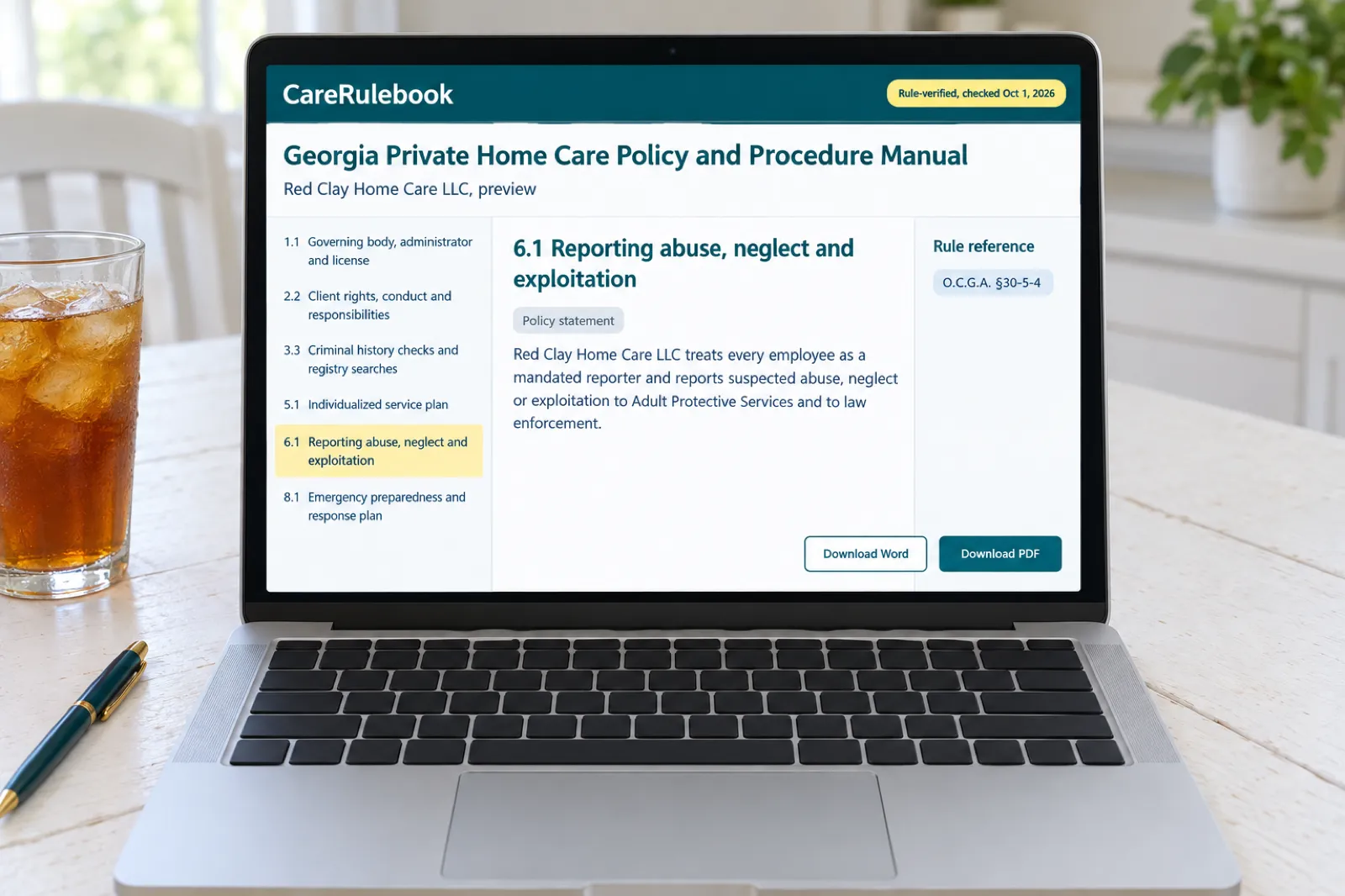
The CareRulebook Georgia manual preview on a laptop, showing the table of contents, policy 6.1 on reporting abuse, neglect and exploitation and its O.C.G.A. §30-5-4 citation

CareRulebook

Training records DCH can check

DCH reviews your policies at its unannounced inspections. CareRulebook’s Georgia manual includes Policy 4.1 (Orientation, job training and competency) for orientation, PCA and companion qualification, competency and yearly hours, Policy 5.2 for annual evaluations and Policy 3.2 for what goes in each personnel record, written for the services you offer.

  • 25 policies, 54 rule requirements mapped
  • Your choice: hire qualified aides only, or run your own 40-hour course
  • Editable Word and print-ready PDF, with the rule quoted under each policy
Preview your manual

$199CareRulebook founding price for the first 50 Georgia agencies, then $249. Not a DCH fee.

Training and evaluation every year

  • Eight clock hours. "A minimum of eight clock hours of training or instruction shall be provided annually for each employee after the first year of employment" "Such training or instruction shall be in subjects that relate to the employee's assigned duties and responsibilities." (111-8-65-.09(6)(b)) No topic list and no format are set.
  • A written evaluation. By the supervisor, at least annually, through direct observation or demonstration of the job tasks (.10(2)).

The hours start after the first year of employment, so a new hire’s first year is covered by orientation, their qualification and the competency evaluation. The rule does not say how to count the year. CareRulebook’s manual runs each employee’s training year from the anniversary of their start date and records the date, subject, clock hours, trainer and the employee’s signature for each session.

If you include Recommended practice in your manual (a builder choice), Policy 4.1 suggests covering infection control, abuse, neglect and exploitation, emergency preparedness, client rights and safe moving and handling each year. That list is ours, not DCH’s.

Medication, CPR, TB and dementia

Medication reminders

“Medically related activities”, one of the 40-hour course areas, include "reminding clients to take medication, and assisting with self-administration of medication", but not professional services regulated by licensing laws. We found no separate medication training rule in Chapter 111-8-65. In CareRulebook’s manual (Policy 2.5), a PCA reminds and helps a client take their own medication and does not give it.

111-8-65-.03(k)

First aid and CPR

A topic of the 40-hour course, not a certificate: we found no CPR card requirement in Chapter 111-8-65. Companions cover handling medical emergencies in the home. If you include Recommended practice (a builder choice that goes beyond the rules), Policy 4.1 suggests that hands-on staff keep a current CPR and first aid certification.

111-8-65-.09(5)(c)1(iv)(III)

TB and hepatitis

Orientation teaches each employee to report known exposure to TB and hepatitis, and "No supervisor shall knowingly permit an employee who has been exposed to tuberculosis or hepatitis or diagnosed with the same to provide services to clients until it is determined that the employee is not contagious." TB screening itself is a health check, not training: see TB screening. Policy 3.4 (Employee health and TB screening) covers both.

111-8-65-.10(2)

Infection control and dementia

Infection control is an area in both the 40-hour course and the companions’ seven; Policy 7.1 in CareRulebook’s manual sets the practices. We found no dementia training rule in Chapter 111-8-65. A client with special conditions still needs a PCA trained and shown competent for them (see above).

111-8-65-.09(5)(c)-(d)

This page covers the license rules. If you plan to serve Medicaid waiver clients, our suggestion is to read that program’s provider manual as well; we have not reviewed those program rules here.

Records to keep

Each employee’s personnel record holds "Records of qualifications", "Documentation of orientation and training required by these rules" and "Documentation of at least an annual performance evaluation" (111-8-65-.09(4)(c)3, 7, 8). Surveyors get "reasonable and meaningful access to the provider's premises, all records relevant to licensure and all provider staff" (.08(2)(a)); how surveys work is on the Georgia home care survey.

Proof of qualification

For a PCA, the route they qualified by, for example a certificate, an exam result or a training record. For a companion, how each of the seven areas was met.

111-8-65-.09(4)(c)3

Orientation record

Documentation that the employee was oriented before working with clients. Our suggestion: list the four items, the date and who gave it, signed by the employee.

111-8-65-.09(4)(c)7

Written competency evaluation

Showing a supervisor personally observed the job tasks and found the employee competent in all of them.

111-8-65-.09(5)(a)

40-hour course records

If you train PCAs yourself: the start date, the hours completed, the areas covered and who directed the course, so you can show 20 hours before clients and 40 within six months. The rule sets no form; this list is ours.

111-8-65-.09(5)(c)2

Yearly training

At least eight clock hours a year after the first year. Our suggestion: record the date, subject and clock hours of each session.

111-8-65-.09(4)(c)7; .09(6)(b)

Annual evaluation

Documentation of at least an annual performance evaluation.

111-8-65-.09(4)(c)8

In force since July 29, 2026

Did the 2026 rule change affect training?

Not the training rules, by our comparison of the old and amended texts. The amended rule .09, in force since July 29, 2026, repeats the orientation, PCA, companion and yearly training wording, including: "Additional training consisting of a minimum of eight clock hours of training or instruction shall be provided annually for each employee after the first year of employment." (111-8-65-.09(6)(b))

What changed sits beside training in the staff rules: a satisfactory fingerprint result "Prior to serving as a direct access employee" (.09(5)(a)1), a health screening program for employees and contractors (.09(4)(c)4(i)), and TB screening before work starts in place of the yearly TB test (.09(4)(c)4(ii)). The official rule history reads "Amended: F. July 9, 2026; eff. July 29, 2026." The 2026 rule changes, side by side →

Myths about Georgia caregiver training

Do Georgia caregivers need 8 hours of training in their first year?

No. The eight clock hours a year start after the first year of employment. In the first year, the rules ask for orientation before any work with clients and the aide or companion qualification for the work the person does, and every staff member is evaluated in writing by a supervisor at least once a year.

"a minimum of eight clock hours of training or instruction shall be provided annually for each employee after the first year of employment."

Do Georgia companions and sitters need the 40-hour aide course?

No. The 40-hour course is one way a personal care assistant qualifies. Companions and sitters must be able to read, write and follow instructions, and complete training or show understanding and practical competency in seven areas. A companion who will also give personal care must qualify as a PCA.

"Successfully complete training or demonstrate understanding and practical competency in the following areas"

Do Georgia home care caregivers need CPR certification?

No. We found no CPR card requirement in Chapter 111-8-65. Basic first aid and CPR is one of the nine areas a 40-hour agency course for personal care assistants must cover, so aides who qualify that way are trained in it. Companions train in, or show competency in, handling medical emergencies in the home, and the rule does not name CPR for them.

"Basic first aide and CPR;"

Can Georgia caregivers be 1099 independent contractors?

No. Not unlicensed aides. The rules define a provider as acting through its own employees or through contractors who are licensed health care professionals. DCH’s 2022 packet says only RNs and LPNs can be contractors.

"contractual arrangements with independent contractors who are health care professionals licensed pursuant to the applicable chapter of Title 43"

Frequently asked questions

How many hours of training do Georgia home care aides need?

It depends on the route. A personal care assistant who qualifies through the agency route completes a 40-hour training program: 20 hours before serving clients and the other 20 within six months of the date the training began. PCAs can also qualify through a federal nurse aide program, a nurse aide competency exam DCH recognizes, or a credentialing program DCH approves. Companions have no hour count: they complete training or show competency in seven areas. After the first year of employment, every employee gets at least eight clock hours of training a year.

Who can teach the 40-hour PCA course in Georgia?

The course must be conducted under the direction of a licensed registered nurse, or a health care professional with commensurate education and experience. Chapter 111-8-65 names no qualification for whoever gives orientation, companion training or the yearly hours.

Do Georgia home care aides have to be CNAs?

No. A federal nurse aide training and competency evaluation program is one of four routes for a personal care assistant. The others are a nurse aide competency exam DCH recognizes, a health care or personal care credentialing program DCH approves, and the 40-hour course run by a private home care provider.

What training do Georgia companions and sitters need?

They must be able to read and write, follow spoken and written instructions and complete written reports, and they complete training or show understanding and practical competency in seven areas: the needs of elderly, handicapped or convalescing people; meal preparation and serving; transportation and escort; housekeeping and sanitation; home safety; handling medical emergencies in the home; and infection control. Like every employee, they are also oriented before working with clients.

What does Georgia home care orientation cover?

Four items: your policies on scope of services, client rights and complaints and any others relevant to the job; the employee’s duties; reporting progress and problems and handling medical emergencies or other incidents; and the duty to report known exposure to tuberculosis and hepatitis. DCH also asks for evidence that the administrator completed the same orientation, signed and dated, with the license application.

Do Georgia caregivers need CPR certification?

We found no CPR card requirement in Chapter 111-8-65. Basic first aid and CPR is one of the nine areas the 40-hour agency course must cover, and companions train in, or show competency in, handling medical emergencies in the home.

Can Georgia caregiver training be online?

Chapter 111-8-65 does not say how training is delivered. It does say no PCA may be assigned a task until competency has been determined, and the written evaluation must show a supervisor personally observed the job tasks, by demonstration or observation. By our reading, an online course alone does not cover that hands-on check.

Get Georgia rule-change alerts

Changes to Chapter 111-8-65 covering fingerprint checks and TB screening for staff took effect on July 29, 2026. Leave your email and we will tell you when a Georgia change affects your training or your policies.

No spam. Only emails about Georgia home care rule changes. How we use your email.

Keep reading

Georgia

How to start a home care agency in Georgia 

The license, the RN requirement, staff training and supervision.

Georgia

Georgia caregiver background checks 

Registry checks, GCHEXS fingerprints and the 2026 change that puts the result before client contact.

Manual

Build your Georgia policy manual 

Including Policy 4.1 on orientation, aide and companion training, competency and yearly hours.

Georgia

Georgia administrator and RN requirements 

The administrator’s orientation, the RN on your application and who supervises each service.

Georgia

Georgia home care policies and procedures 

Every rule that asks for a written policy, including orientation and training.

Georgia

The Georgia home care survey 

The initial survey on the provisional license, re-licensure surveys and plans of correction.

Tool

Georgia license checklist 

Every step, tailored to your agency, emailed to you.

US

Caregiver training requirements by state 

Hours, competency checks, orientation and yearly training in every state we cover.

Virginia

Virginia caregiver training 

Six ways a home attendant qualifies, nine orientation topics and 12 hours of in-service a year.

North Carolina

North Carolina caregiver training 

Competency by demonstration and an RN’s check of six core skills for aides not on the registry.

Tennessee

Tennessee caregiver training 

Competency in seven areas before work, then job-related training every year.

Maryland

Maryland caregiver training 

Seven COMAR topics, a skills demonstration and dementia training hours.

Sources

  1. Ga. Comp. R. & Regs. Chapter 111-8-65, Rules and Regulations for Private Home Care Providers (official text, current through rules filed through October 21, 2026) · Georgia Secretary of State, Rules and Regulations of the State of Georgia · retrieved November 6, 2026
  2. Private Home Care Providers Application Checklist (July 2026) · Georgia Department of Community Health · retrieved September 30, 2026
  3. Private Home Care Providers Application Packet (posted March 2022) · Georgia Department of Community Health · retrieved September 30, 2026

Free sample, no email needed

Read a full policy before you buy

Policy 6.1, Reporting abuse, neglect and exploitation, as it prints in the Georgia manual, filled in for a fictional agency. The rule text it rests on is quoted word for word under Rule basis.

PDF · 12 pages · 132 KB · Rule-verified September 30, 2026

Collecting answers for an agency or a client? The intake questionnaire lists all 22 questions the builder asks, what each decision changes in the manual, and a completed example: Word · PDF.How consultants use CareRulebook.

Download the sample (PDF)
Or email it to me

We send the link once. Nothing else unless you tick the box. Privacy notice.

Build your Georgia manualfrom $199