Skip to content
CareRulebook
MenuClose

What do you run?

Home care in the US19 states with a manual, 6 with a free guide
ColoradoManual
ConnecticutPack
DelawareManual
GeorgiaManual
IllinoisManual
IndianaManual
KansasManual
MaineManual
MarylandManual
MinnesotaManual
NevadaManual
North CarolinaManual
OklahomaManual
OregonManual
South CarolinaManual
TennesseeManual
TexasManual
VirginiaManual
WashingtonManual
CaliforniaGuideFloridaGuideNew JerseyGuideNew YorkGuideOhioGuidePennsylvaniaGuideAll US home care states →
Care homes in the USCalifornia, Michigan, Minnesota; more states coming
Home care in the UKEngland, Scotland, Wales
Free toolsChecklists, calculators and templates

England · CQC · Staff checks and induction · 2026

DBS checks and the Care Certificate for home care in England

Everyone a home care agency in England employs must be fit to do the job, and the 2014 Regulations list what you must hold for each person, including, for care roles, an enhanced DBS certificate. New care workers then go through an induction CQC expects to follow the Care Certificate standards. This guide covers both, and says which parts are law, which are CQC’s expectations and which are Skills for Care guidance.

  • Rule-verified 10 November 2026
  • Quoted from the 2014 Regulations
  • CQC, DBS and Skills for Care guidance
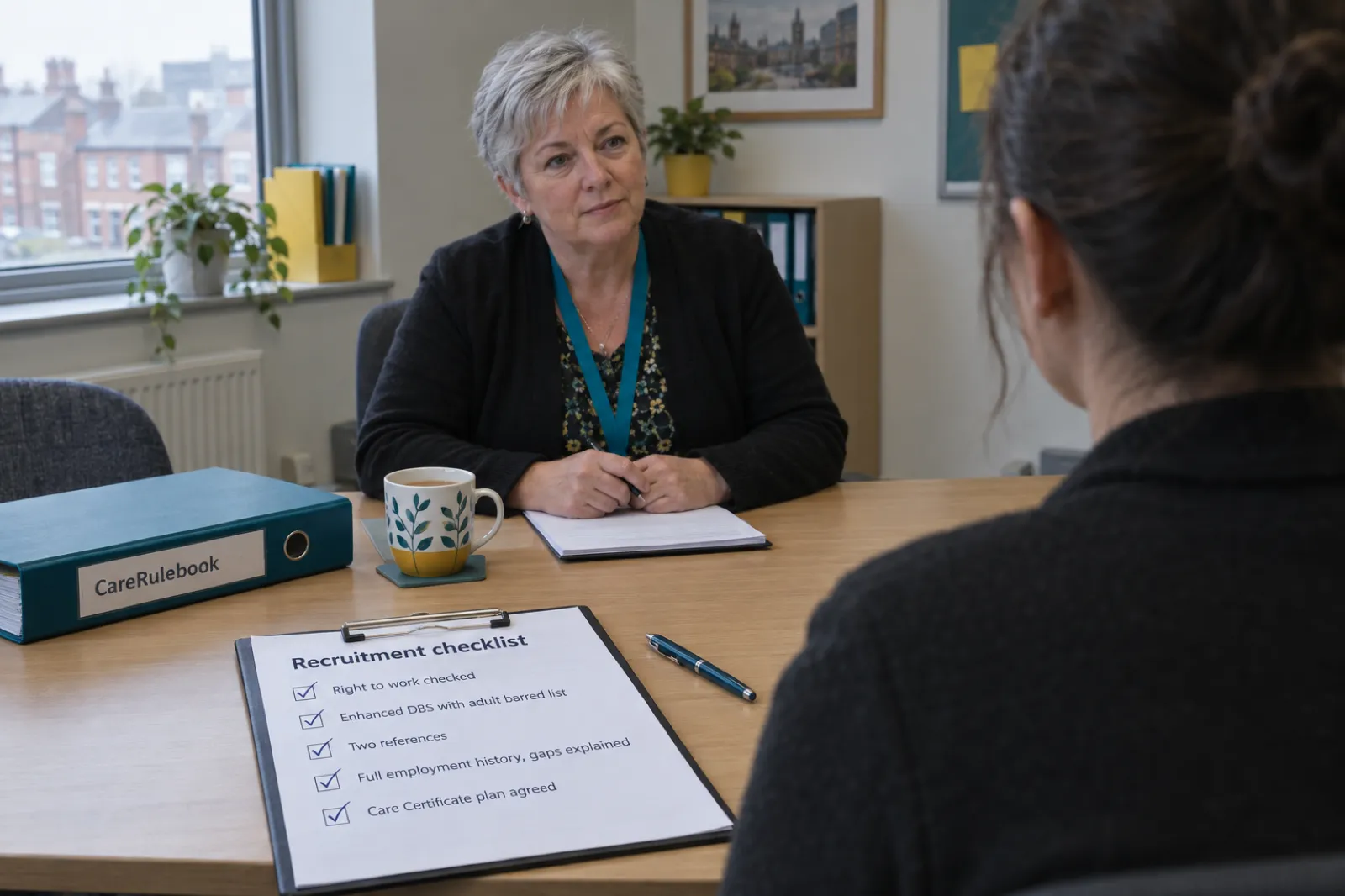
A registered manager interviews a candidate across a desk, with a clipboard checklist ticking right to work, enhanced DBS with adult barred list, references, full employment history with gaps explained, and a Care Certificate plan

Quick answer

Fit, with the Schedule 3 checks. Regulation 19 of the 2014 Regulations says everyone employed for the regulated activity must "be of good character", have the qualifications, competence, skills and experience the work needs, and be able to do it given their health (reg. 19(1)). For each person you must hold the Schedule 3 information (reg. 19(3)), which includes, where the role is eligible, "a copy of an enhanced criminal record certificate" with suitability information about vulnerable adults (Sch. 3 para. 3). CQC says "Information about candidates set out in Schedule 3 of the regulations must be confirmed before they are employed" (CQC, Regulation 19).

The Care Certificate is CQC’s expectation, not a law. CQC’s guidance says "It is expected that providers that employ healthcare assistants and social care support workers should follow the Care Certificate standards to assess their competence" (CQC, Regulation 19). Since March 2025 there are 16 standards (Skills for Care).

Fees. The DBS charges £41 for an enhanced check (DBS fees from 5 October 2026). That is the DBS’s fee, not CQC’s, and an umbrella body may add its own.
Rule-verified, checked against official sources on 30 September 2026

Edited by . Built from the official text; every quoted rule is checked against the saved source before publishing.

£41

the DBS’s fee for an enhanced check, from 5 October 2026 (not a CQC fee)

DBS fees

16

Care Certificate standards since the March 2025 update

Skills for Care

12 months

the oldest DBS certificate CQC accepts for your registered manager’s application

CQC, DBS checks

6 to 8 months

how long Skills for Care expects the Level 2 Adult Social Care Certificate to take a new learner

Skills for Care

Direct answers

What DBS check do home care workers need in England?

An enhanced DBS check with a check of the adults’ barred list. Personal care for adults is regulated activity, and the barred list check is only available for regulated activity. The 2014 Regulations make a copy of the enhanced certificate part of the information you must hold for each person employed, where the role is eligible.

SVGA 2006, Sch. 4; 2014 Regulations, Sch. 3 para. 3

Is the Care Certificate a legal requirement?

Not in itself. The law requires staff to be competent and to get the training and supervision their role needs. CQC’s guidance expects providers to follow the Care Certificate standards to assess new care workers’ competence, and its application guidance asks your training plan to show how you will meet them. The standards themselves are Skills for Care guidance, recommended and non-accredited.

CQC, Regulation 19; Care Certificate Q&A

How much is a DBS check for a care worker?

The DBS’s fee is £41 for an enhanced check, including one with a barred list check, from 5 October 2026. The Update Service is £15 a year and volunteer checks are free. Umbrella bodies may add their own administration fee, which the DBS does not set.

DBS guidance for employers; DBS fees

Do I need to register with the DBS?

Not usually. The DBS says organisations with fewer than 100 checks a year should use an umbrella body, which submits and countersigns checks for you.

DBS guidance for employers

What is law, what is CQC’s expectation, and what is guidance

CQC must refuse registration if you cannot satisfy it that you can and will comply with regulation 19 (CQC, Regulation 19). CQC’s guidance on regulations 18 and 19 is guidance providers must have regard to (CQC, Regulation 19). Skills for Care’s Care Certificate and training guides are sector guidance. They overlap, so here is which is which.

Staff check and training duties for home care in England, and whether each is law, CQC guidance or Skills for Care guidance
WhatWhere it comes fromSource
Staff must be fit: good character, the right qualifications, competence, skills and experience, and able to do the jobLaw2014 Regulations, reg. 19(1)
Hold the Schedule 3 information for each person employed, including an enhanced DBS certificate where the role is eligibleLaw2014 Regulations, reg. 19(3) and Sch. 3
Check right to work before employing someoneLaw (immigration): civil penalty without a correct checkGOV.UK, right to work checks
Refer someone to the DBS when you remove them from regulated activity for a reason in section 35LawSVGA 2006, s.35
Support, training, supervision and appraisal staff need for their dutiesLaw2014 Regulations, reg. 18(2)
Learning disability and autism training appropriate to each roleLaw (reg. 18, read with HCA 2022 s.181(7)), the statutory code of practice and CQC guidanceHCA 2022, s.181(7)
Confirm the Schedule 3 checks before someone is employedCQC guidanceCQC, Regulation 19
Use the Care Certificate standards to assess new care workers’ competenceCQC guidanceCQC, Regulation 19
An induction programme that prepares staff for their roleCQC guidanceCQC, Regulation 18
A training plan showing how you will meet the Care Certificate standards, sent with your applicationCQC application requirementCQC, Staff training plan
The 16 standards, signed off by the employer when all are completeSector guidance (NHS England, Skills for Care, Skills for Health)Care Certificate Q&A
Which statutory and mandatory topics to train, and how often to refreshSkills for Care guidanceStatutory and mandatory training guide

Who needs which checks

CQC says "“person employed” will include any member of staff who currently works in the service as a volunteer or a contractor, as well as agency or bank staff" (CQC, Regulation 19), following the 2014 Regulations’ definition of employment, which includes "employment under a contract of service, an apprenticeship, a contract for services or otherwise than under a contract" (reg. 2(1)).

DBS checks and other checks for each role in a home care agency in England
RoleDBS checkOther checks and induction
Care workers and senior care workersEnhanced with the adults’ barred list: providing personal care to adults is regulated activity.All of Schedule 3, right to work, and the Care Certificate standards if they are new to care.
Coordinators and supervisors of care workersEnhanced with the adults’ barred list if they regularly manage or supervise care workers day to day, which is regulated activity too.All of Schedule 3 and right to work.
Registered managerAs a member of staff, the enhanced check you apply for. For CQC registration, their own CQC-countersigned enhanced DBS, under 12 months old.All of Schedule 3, including a full employment history, plus CQC’s manager registration.
Office staff who never provide or supervise careThe level their role is eligible for, which may be lower. Ask your umbrella body: knowingly requesting a higher level than the law allows is unlawful.CQC expects the Schedule 3 information for most, if not all, staff. No Care Certificate needed.
VolunteersThe level their role is eligible for. The DBS does not charge for volunteer checks.Schedule 3, except the full employment history (unless they are the provider, the nominated individual or the registered manager).
Agency or bank staffThe same checks, which the agency may carry out for you.You must assure yourself every check is complete and satisfactory, and assess their training needs.

The Schedule 3 checks, right to work and health

Recruitment procedures "must be established and operated effectively" to make sure the people you employ are fit (reg. 19(2)), and CQC says your recruitment policy "must show how you’ll meet the requirements of regulation 19" (CQC, Recruitment policy). For each person employed, Schedule 3 lists:

  • Identity. "Proof of identity including a recent photograph." (para. 1)
  • The DBS certificate. Where the role is eligible, a copy of an enhanced certificate with suitability information relating to vulnerable adults (para. 3), meaning the information in sections 113BA and 113BB of the Police Act 1997 (para. 9(c)). On our reading, that is the barred list information. Paragraph 2 covers a standard certificate where only that is eligible.
  • Conduct in past care work. Satisfactory evidence of conduct in previous employment in health or social care, or with children or vulnerable adults (para. 4). CQC’s FAQ says this evidence "may be in the form of a Reference from a previous employer - but need not be", and that appraisals and other written evidence can count (CQC, Regulation 19 FAQs). The law sets no number of references; the CareRulebook policy asks for two, one from the most recent employer.
  • Why it ended. "Where a person (P) has been previously employed in a position whose duties involved work with children or vulnerable adults, satisfactory verification, so far as reasonably practicable, of the reason why P's employment in that position ended." (para. 5)
  • Qualifications. So far as reasonably practicable, documentary evidence of any qualification relevant to the duties (para. 6), and professional registration where a law requires it (reg. 19(4)).
  • Employment history. "A full employment history, together with a satisfactory written explanation of any gaps in employment." (para. 7) CQC’s FAQ reads this as a career history from the age of first employment, with start and end months and an explanation of periods out of work (CQC, Regulation 19 FAQs).
  • Health. Satisfactory information about any physical or mental health condition relevant to the person’s ability to do the job, after reasonable adjustments (para. 8), asked in line with the Equality Act 2010 rules on pre-employment health checks (CQC, Regulation 19).

"Satisfactory" in Schedule 3 "means satisfactory in the opinion of the Commission" (para. 9(b)), so CQC, not you, has the last word on whether your evidence is enough.

Right to work. "You must check that a job applicant is allowed to work for you in the UK before you employ them." You could face a civil penalty for employing an illegal worker without a correct check, and you keep copies during employment and for 2 years after (GOV.UK). Regulation 19 also requires any information another law requires you to keep (reg. 19(3)(b)).

DBS checks for your staff

  • The right level. CQC "expects each provider to undertake the level of DBS check for which a particular staff member is eligible" (CQC, Regulation 19 FAQs). "Enhanced with Barred List(s) check - £41 ... The Enhanced check with Barred List(s) check is only available for those individuals who are carrying out regulated activity and a small number of positions listed in Police Act 1997 (Criminal Records) regulations" (DBS guidance for employers), and personal care for adults is regulated activity (SVGA 2006, Sch. 4 para. 7).
  • An umbrella body, usually. "An umbrella body is a Registered Body that gives other non-registered organisations access to DBS checks." "If your organisation has a requirement to carry out fewer than 100 checks per year, you should use the services of an umbrella body." (DBS guidance for employers) Registering with the DBS costs £300, plus £5 for each countersignatory (the DBS’s fees). (DBS guidance) "When an individual applies for a DBS check their identity must be verified by the Registered Body." (DBS guidance)
  • Fees. £41 for an enhanced check (DBS fees), £15 a year for the Update Service, and "Volunteer checks remain free of charge." (DBS fees) Umbrella bodies may add an administration fee, and "DBS is not involved in setting or regulating these charges" (DBS fees). These are the DBS’s fees, not CQC’s or ours.
  • The Update Service. The worker joins it, for £15 a year, and "You must register for the Update Service within 30 days of the certificate being issued." (GOV.UK, DBS Update Service) To check a status online you must be legally entitled to the check and have the worker’s permission, and "You do not need to pay or register to carry out a status check." (GOV.UK) A new certificate is needed if the role needs a different workforce, such as adult rather than child (GOV.UK). A status check only tells you whether anything has changed: see the original certificate and check it matches the person, because, as CQC puts it, the DBS requires identity to be checked "in person" and matched to the certificate (CQC, DBS checks).
  • The record. CQC’s inspectors "will expect to see that the provider is keeping a record of the information obtained (including whether barred list information was received) and, if a criminal record was reported, evidence that any risks posed by the staff member have been considered and assessed" (CQC, Regulation 19 FAQs). If you decide someone is suitable despite a disclosure, "the provider's reasons should be recorded for future reference" (CQC, Regulation 19). The DBS code of practice says certificate information "should be destroyed after a suitable period has passed - usually no longer than 6 months" (DBS guidance), so keep the date, the certificate number and your decision, rather than the certificate itself for longer than you need it.
  • Renewal. The 2014 Regulations set no renewal interval or maximum age for staff certificates; that is our reading of regulation 19 and Schedule 3. CQC’s guidance says "Providers must regularly review the fitness of employees" (CQC, Regulation 19). Set your own interval in your recruitment policy, such as yearly Update Service status checks.

Before the certificate arrives: Adult First

The DBS offers Adult First, at £6 (the DBS’s fee): "Depending on the result, a person can be permitted to start work, under supervision, with vulnerable adults before a DBS certificate has been obtained." (DBS guidance for employers) It is not a replacement for the enhanced check. Adult First is only for a position that needs a check by law and is eligible for the adults’ barred list, where the adults’ barred list check was requested on the DBS application. The reply is either “wait for the DBS certificate” or “no match”, and is only the first part of the application. So you request it through your umbrella body alongside the full enhanced application with the adults’ barred list check, and a “wait” reply means waiting for the certificate (DBS guidance for employers).

CQC is cautious about it. Its 2018 Regulation 19 FAQs say: "Providers must be able to demonstrate sound reasons for not obtaining a full DBS check before a person takes up post, and also demonstrate they have assessed any potential risk. AdultFirst checks are for working with adults, and should not be relied upon routinely." (CQC, Regulation 19 FAQs) Its current guidance on regulation 19 says the Schedule 3 information must be confirmed before someone is employed (CQC, Regulation 19).

Our reading: plan for no one to work with the people you support until their enhanced certificate is in and assessed. The CareRulebook recruitment policy says this and makes no Adult First exception: Adult First is the DBS’s option, which the pack does not use. If you decide to use it, first change your policy to say when, who decides and how the person is supervised, and record the reasons and your risk assessment each time. A new agency waiting for CQC registration is not yet providing care, so it can wait for certificates.

Your own DBS check for the CQC application

For an individual provider, a registered partner or a registered manager, the DBS check is part of the application, and CQC considers any convictions or disclosures. (CQC, DBS checks) These rules are separate from your staff checks:

  • CQC-countersigned. "You will need to apply for a CQC countersigned enhanced DBS with appropriate barred list information." (CQC, DBS checks) A registered healthcare professional still needs an enhanced check with barred list information, but not countersigned by CQC (CQC, DBS checks).
  • Recent. "Applications with expired DBS checks (over 12 months old) will be rejected without further review." (CQC, DBS checks)
  • Not the Update Service. "We cannot accept certificates from the DBS update service or submissions from 3rd party services, such as U-check." (CQC, DBS checks)
  • Start early. "It can take up to 60 working days to receive your DBS certificate. Until you have it, you will not be able to submit your application." (CQC, DBS checks)

For a company, the nominated individual needs an enhanced DBS certificate too, and CQC returns the application without it (CQC, application guidance); the rules above also apply if they are the registered manager. See our guides to the registered manager and the nominated individual.

Each new hire, step by step

Tick steps off as you go. Your progress is saved in this browser only.

  1. Decide what the role needs

    Before you advertise

    Is it regulated activity (personal care, or regular day-to-day management or supervision of people giving it)? That decides whether the role is eligible for the adults’ barred list check. Say in the advert that the job needs an enhanced DBS check and a right to work check.

  2. Application and interview

    Application and interview

    A full employment history with dates, and explore every gap at interview. Ask about health only in line with the Equality Act 2010 rules on pre-employment health checks; the CareRulebook policy asks after a conditional offer.

  3. Conditional offer

    Offer stage

    Offer the job subject to the checks, and say the person may not start until you confirm they are complete. CQC says the Schedule 3 information must be confirmed before someone is employed.

    CQC, Regulation 19
  4. Identity and right to work

    Before the start date

    See proof of identity including a recent photograph, and carry out the Home Office right to work check before employment starts. Keep copies during employment and for 2 years after.

  5. Apply for the enhanced DBS check

    After the conditional offer

    Enhanced with the adults’ barred list, through your umbrella body, which verifies the applicant’s identity. The DBS’s fee is £41; the umbrella body may add its own charge. For someone on the Update Service, check the certificate’s status online with their permission instead.

  6. Conduct, references and why past care work ended

    Before the start date

    Evidence of conduct in any previous health or social care work, or work with children or vulnerable adults, and verification so far as reasonably practicable of why that work ended. Check qualifications and any professional registration.

  7. Assess the certificate and record your decision

    Before the offer is confirmed

    Record the information obtained, including whether barred list information was received. If you decide someone is suitable despite a disclosure, record your reasons and your risk assessment.

  8. Induction, Care Certificate and supervision

    From day one

    Start the induction. A worker new to care works through the Care Certificate standards, and is supervised until assessed as competent to work out of sight of a more experienced colleague.

  9. Keep checking

    Ongoing

    Review fitness regularly, keep training and refreshers on a tracker, and act straight away on any concern. For staff on the Update Service, status checks are free.

    CQC, Regulation 19

CareRulebook

CQC reads your recruitment policy and training plan before it registers you.

CareRulebook’s CQC registration pack writes both for your agency, from your answers, with the regulation quoted under each part.

  • 4.1 Recruitment policy and procedures: every recruitment stage, the Schedule 3 checks, right to work, DBS risk assessment and references
  • 4.2 Staff training plan: induction, the Care Certificate, mandatory and specialist training by role, providers and refreshers
  • 3.1 Safeguarding policy and procedure: referrals to the DBS
  • Editable Word and PDF
  • 12 months of updates: download again after a rule change

When someone stops being fit: action and the DBS

  • The Regulations. If someone no longer meets regulation 19(1), you must take necessary and proportionate action, and tell their regulator if they are a registered professional (reg. 19(5)). CQC adds that providers must inform others as appropriate about concerns or findings about someone’s fitness: "They may inform bodies such as professional regulators, police, and safeguarding authorities about concerns." (CQC, Regulation 19)
  • The duty to refer to the DBS. If you remove someone from regulated activity, or would or might have done had they not left, because you think they harmed or may harm a vulnerable adult or child, or for another reason in section 35(3), you must give the DBS the prescribed information. The harm test is that the person may harm, or put at risk of harm, a child or vulnerable adult (SVGA 2006, s.35). This is law, and it applies even if the person resigns first.

The CareRulebook safeguarding policy and procedure (3.1) sets out how your agency makes that referral.

The Care Certificate

The Care Certificate standards "are a recommended tool to support minimum training, supervision and assessment that staff new to care (health and adult social care) should receive as part of induction" (Care Certificate Q&A), and they name homecare workers among the roles (Q3). "The standards were updated in March 2025 to align with sector developments and the introduction of the Level 2 Adult Social Care Certificate qualification." (Skills for Care) The 16 standards are:

  1. Understand your role
  2. Your personal development
  3. Duty of care
  4. Equality, diversity, inclusion and human rights
  5. Work in a person-centred way
  6. Communication
  7. Privacy and dignity
  8. Fluids and nutrition
  9. Awareness of mental health and dementia
  10. Adult safeguarding
  11. Safeguarding children
  12. Basic life support
  13. Health and safety
  14. Handling information
  15. Infection prevention and control
  16. Awareness of learning disability and autism

Source: Care Certificate standards 2025.

What CQC expects

  • To assess competence. "It is expected that providers that employ healthcare assistants and social care support workers should follow the Care Certificate standards to assess their competence." (CQC, Regulation 19)
  • In your training plan. CQC’s guidance for the plan you send with your application: "Your training plan should identify how you will meet the Care Certificate standards and aligned with statutory and regulatory requirements" (CQC, Staff training plan).
  • Supervised until competent. "Providers should have systems in place to assess the competence of employees before they work unsupervised in a role. They must provide appropriate direct or indirect supervision until the person is assessed as competent to carry out the role" (CQC, Regulation 19). For home care, "Regulated providers are expected to assess the competence of the new support worker before they start delivering care out of line of sight of a more experienced colleague" (Care Certificate Q&A).

How it works

  • Assessed at work. Workers must show knowledge and competence in all 16 standards; most evidence comes from observed real work, and eLearning alone cannot achieve it. (Care Certificate Q&A)
  • The employer signs it off. The employer awards the certificate only when all 16 standards are complete; an external learning provider must not sign and issue it. (Care Certificate Q&A)
  • Not a replacement. The Care Certificate does not replace induction or statutory and mandatory training. (Care Certificate Q&A)
  • Experienced or qualified staff. "Employers should ensure that any skills and knowledge are current and can use the self-assessment tool to identify gaps or refreshers required in skills and knowledge." (Care Certificate Q&A)
  • Agency and bank staff. CQC-regulated providers must assess the training needs of all staff new to them, including agency and bank workers. (Care Certificate Q&A)
  • Office staff. Roles such as receptionists, drivers, cleaners and finance clerks do not need to complete the Care Certificate. (Care Certificate Q&A)
  • How long. No 2025 Skills for Care document we saved sets a time limit. You may see 12 weeks quoted: the 2018 questions and answers said that "for a full-time member of staff, the average amount of time taken to complete the Care Certificate was 12 weeks" (Care Certificate Q&A, 2018), an average from the pilot, which the 2025 version does not repeat. Treat any deadline as your own target. The CareRulebook training plan sets 12 weeks from starting.

The Level 2 Adult Social Care Certificate

  • What it is. "This accredited qualification is based on the same 16 Care Certificate standards but builds, deepens and consolidates the knowledge and understanding." (Skills for Care) Ofqual-regulated, with observational assessment; Skills for Care expects a new learner to take about 6 to 8 months. (Skills for Care)
  • Not the same thing. The Care Certificate standards are recommended and non-accredited; the Level 2 is accredited and regulated by Ofqual (Care Certificate Q&A).
  • When. Skills for Care says you might enrol a worker straight away or wait until they pass probation. (Skills for Care, recommended routes)
  • Funding. Employers can claim funding for eligible staff through the Learning and Development Support Scheme, subject to its criteria and the funding available each year. (Skills for Care)

No law requires a care worker in England to hold it. Regulation 18 requires that staff are enabled, where appropriate, to obtain further qualifications appropriate to their work (reg. 18(2)(b)).

Induction, statutory and mandatory training

  • The law. Staff must "receive such appropriate support, training, professional development, supervision and appraisal as is necessary to enable them to carry out the duties they are employed to perform" (reg. 18(2)(a)).
  • CQC’s guidance. "Providers must ensure that they have an induction programme that prepares staff for their role." Staff should be supported to take part in statutory training, other mandatory training the provider defines for their role, and first aid training (CQC, Regulation 18). "Where appropriate, staff must be supervised until they can demonstrate required/acceptable levels of competence to carry out their role unsupervised." (CQC, Regulation 18)
  • Learning disability and autism, for everyone. "Providers must ensure that all staff receive training in how to interact appropriately with people with a learning disability and autistic people, at a level appropriate to their role." (CQC, Regulation 18) The Health and Care Act 2022 says the regulations "must require service providers to ensure that each person working for the purpose of the regulated activities carried on by them receives training on learning disability and autism which is appropriate to the person’s role" (HCA 2022, s.181). The Oliver McGowan Mandatory Training is the government’s preferred training for learning disability and autism awareness, and one way to evidence Standard 16. (Care Certificate Q&A) Until regulations are made under the 2022 Act, the law says regulation 18 is to be read as containing this duty, in force since 1 July 2022 (HCA 2022, s.181(7)). The Oliver McGowan code of practice, final on 6 September 2025, sets the standards the training must meet, and CQC must take it into account (GOV.UK, Oliver McGowan code of practice). "Registered providers are responsible for ensuring that their staff undertake training on learning disability and autism at least every 3 years or more regularly if a member of staff requires it." (the code)
  • Statutory or mandatory? Statutory training is usually required by law; mandatory training is what the organisation or commissioners decide is essential. (Skills for Care)
  • Which topics. Skills for Care’s guide, part 1. For all workers: health and safety awareness, fire safety, moving and handling objects, infection prevention and control, adult safeguarding, child safeguarding, and learning disability and autism awareness. Depending on the role: basic life support and first aid (the employer decides how many people need it and to what level), assisting and moving people, food hygiene and medication. (Skills for Care, Part 1) If a worker supports people with medication, training is required; the guide notes that NICE advises staff only give medicines once trained and assessed as competent by the employer. (Skills for Care)
  • How often. For most Part 1 topics the guide suggests a minimum refresher period of three years; basic life support at least yearly; first aid every three years. (Skills for Care) These are Skills for Care’s suggestions, not legal intervals. For learning disability and autism, the statutory code says at least every 3 years (the code).

For your CQC application. The staff training plan must include induction and mandatory training, training for each job role including managers, specialist training, the training provider for each topic and refresher frequency (CQC, Staff training plan). CQC refused one homecare applicant partly because "Mrs Smith did not have a firm plan for staff training", and registered another that "had a clear staff induction, appraisal, supervision and training system that supported the aims and objectives of the service" (CQC, homecare examples).

Overseas recruits

The same checks apply. Two points are specific: "DBS is unable to access criminal records held overseas, so a DBS check may not provide a complete view of an applicant’s criminal record, if they have lived outside of the UK." (DBS guidance for employers) And CQC asks your training plan to cover "any extra support for overseas workers such as a longer induction or language support if needed" (CQC, Staff training plan). Entry clearance for overseas care workers closed on 22 July 2025 (HC 997 explanatory memorandum); our sponsor licence guide covers what is still possible and what CQC asks about it.

Myths, checked against the source

Is the Care Certificate a qualification?

No. The Care Certificate standards are recommended and non-accredited. The Level 2 Adult Social Care Certificate is a separate qualification, regulated by Ofqual and built on the same 16 standards.

"The Care Certificate standards are recommended and non-accredited and can be used by health and adult social care providers. The Level 2 Adult Social Care Certificate qualification is accredited and regulated by Ofqual."

Can a care worker start once an Adult First check comes back clear?

It depends. Only as an exception you can justify. The DBS says that, depending on the result, a person can start work under supervision before the certificate arrives. CQC says you must be able to show sound reasons and a risk assessment for not getting the full DBS check first, and that Adult First should not be relied on routinely.

"Providers must be able to demonstrate sound reasons for not obtaining a full DBS check before a person takes up post, and also demonstrate they have assessed any potential risk. AdultFirst checks are for working with adults, and should not be relied upon routinely."

Can you use the DBS Update Service for your CQC application?

No. Registered persons need an enhanced DBS under 12 months old, CQC-countersigned unless they are a registered healthcare professional. CQC does not accept Update Service certificates or third-party checks such as U-check.

"We cannot accept certificates from the DBS update service or submissions from 3rd party services, such as U-check."

Frequently asked questions

Can a care worker start before their DBS certificate comes back?

Plan for no. CQC’s guidance on regulation 19 says the Schedule 3 information, which includes the enhanced certificate, must be confirmed before someone is employed. CQC’s 2018 Regulation 19 FAQs say you must be able to show sound reasons and a risk assessment for not getting a full DBS check before someone takes up post, and that Adult First checks should not be relied on routinely. Our reading is to wait. The CareRulebook recruitment policy says no one works with the people you support until every check is complete, and makes no Adult First exception. Adult First is the DBS’s option, which the pack does not use; if you decide to use it, first change your policy to say when, who decides and how the person is supervised.

Can I use a care worker’s DBS certificate from a previous job?

If they are on the DBS Update Service, you can check the certificate’s status online with their permission, free, as long as it is the right level and workforce for your role. You still see the original certificate and check it matches the person: CQC notes the DBS requires identity to be checked in person against the certificate. The 2014 Regulations do not say a staff certificate must come from your own application or set a maximum age. Our practice, and the pack’s, is to apply for a new enhanced check for anyone not on the Update Service.

How often should care workers’ DBS checks be renewed in England?

The 2014 Regulations set no fixed interval for staff, unlike Wales. CQC’s guidance says providers must regularly review the fitness of employees. The interval is your decision, for example a yearly status check for staff on the Update Service, so set it in your recruitment policy and keep to it. The 12-month limit you may have heard of is CQC’s rule for the registered manager’s and other registered persons’ own checks.

How long does the Care Certificate take?

The 2025 Care Certificate standards and Skills for Care’s questions and answers that we saved set no time limit. A worker needs to show knowledge and competence in all 16 standards, mostly through observed real work, so it takes as long as that takes. You may see 12 weeks quoted: the 2018 questions and answers said that was the average for a full-time worker in the pilot, not a deadline. Treat any deadline as your own target. The CareRulebook training plan sets 12 weeks from starting.

Do office staff need the Care Certificate?

No. The Care Certificate questions and answers (NHS England, Skills for Care and Skills for Health) say roles such as receptionists, drivers, cleaners and finance clerks do not need to complete it. They still need induction, the statutory and mandatory training their role needs, and learning disability and autism training appropriate to their role.

What is the Level 2 Adult Social Care Certificate?

An Ofqual-regulated qualification built on the same 16 standards as the Care Certificate, which Skills for Care expects a new learner to take about 6 to 8 months to complete. Employers can claim funding for eligible staff through the Learning and Development Support Scheme, subject to its criteria and the funding available each year.

Who pays for a care worker’s DBS check?

Neither the 2014 Regulations nor the DBS guidance we saved says. Decide it in your recruitment policy and tell candidates before they apply. The worker joins the Update Service themselves.

Get CQC rule-change alerts

We will email you when the 2014 Regulations, CQC’s guidance or the DBS and Care Certificate rules change, with what it means for your agency.

No spam. Only emails about rule changes that affect homecare in England. How we use your email.

Keep reading

Sources

  1. Health and Social Care Act 2008 (Regulated Activities) Regulations 2014 · legislation.gov.uk · retrieved 30 September 2026
  2. Registering a homecare agency (personal care) · Care Quality Commission · retrieved 30 September 2026
  3. Supporting documents for new provider registration applications · Care Quality Commission · retrieved 6 November 2026
  4. DBS checks for CQC registration · Care Quality Commission · retrieved 30 September 2026
  5. Explanatory memorandum to the statement of changes to the Immigration Rules (HC 997) · GOV.UK · retrieved 30 September 2026
  6. Check a job applicant's right to work · GOV.UK · retrieved 30 September 2026
  7. DBS reduces fees for checks and Update Service from 5 October 2026 (news story, published 9 September 2026) · GOV.UK (Disclosure and Barring Service) · retrieved 10 October 2026
  8. Regulation 19: Fit and proper persons employed (CQC guidance, page last updated 16 May 2025) · Care Quality Commission · retrieved 10 November 2026
  9. Provider and CQC Inspector FAQs for meeting CQC’s requirements of employment for Regulation 19 (PDF, 2018) · Care Quality Commission · retrieved 10 November 2026
  10. Regulation 18: Staffing (CQC guidance, page last updated 16 May 2025) · Care Quality Commission · retrieved 10 November 2026
  11. Safeguarding Vulnerable Groups Act 2006, section 35 and Schedule 4 paragraph 7 · legislation.gov.uk · retrieved 10 November 2026
  12. Health and Care Act 2022, section 181 (mandatory training on learning disability and autism) · legislation.gov.uk · retrieved 10 November 2026
  13. DBS checks guidance for employers, voluntary organisations and third parties (updated 5 October 2026) · GOV.UK (Disclosure and Barring Service) · retrieved 10 November 2026
  14. DBS Update Service · GOV.UK (Disclosure and Barring Service) · retrieved 10 November 2026
  15. Care Certificate standards (updated March 2025) · Skills for Care · retrieved 10 November 2026
  16. Care Certificate standards updated 2025: questions and answers for health and adult social care professionals (NHS England, Skills for Care and Skills for Health) · Skills for Care · retrieved 10 November 2026
  17. Care Certificate: recommended routes for adult social care (2025) · Skills for Care · retrieved 10 November 2026
  18. Level 2 Adult Social Care Certificate qualification · Skills for Care · retrieved 10 November 2026
  19. The Oliver McGowan code of practice on statutory learning disability and autism training (final 6 September 2025) · GOV.UK (Department of Health and Social Care) · retrieved 10 November 2026
  20. Care Certificate questions and answers (Health Education England, Skills for Care and Skills for Health, updated March 2018) · Health Education England · retrieved 10 November 2026
  21. Statutory and mandatory training guide for adult social care employers (updated December 2025) · Skills for Care · retrieved 10 November 2026

Free sample, no email needed

Read a full document before you buy

Document 3.1, Safeguarding policy and procedure, as it prints in the England CQC registration pack, filled in for a fictional agency. The rule text it rests on is quoted word for word under Rule basis.

PDF · 8 pages · 110 KB · Rule-verified 30 September 2026

Collecting answers for a care service or a client? The intake questionnaire lists all 50 questions the builder asks, what each decision changes in the pack, and a completed example: Word · PDF.How consultants use CareRulebook.

Download the sample (PDF)
Or email it to me

We send the link once. Nothing else unless you tick the box. Privacy notice.

Build your CQC registration pack