Skip to content
CareRulebook
MenuClose

Where are you starting?

United StatesTexas, North Carolina, Georgia, Virginia, Indiana, Ohio, New York, Illinois, Washington, Colorado, Tennessee, Maryland, Kansas, South Carolina, Nevada
TexasManual
North CarolinaManual
GeorgiaManual
VirginiaManual
IndianaManual
OhioGuideNew YorkGuide
IllinoisManual
WashingtonManual
ColoradoManual
TennesseeManual
MarylandManual
KansasManual
South CarolinaManual
NevadaManual
All US states →
United KingdomEngland
Free toolsChecklists, calculators and templates

Nevada · Personal care agency license · HCQC’s application

Nevada personal care agency license application: HCQC’s uploads, fees and bond

You apply for a Nevada personal care agency license online, uploading HCQC’s checklist of business, insurance, bond and owner documents and paying the state’s fee. Your policies come later, at the prelicensure survey. Here is each upload with HCQC’s conditions, what the statute adds, the fees and the bond, owners’ fingerprints, the survey, and how renewal, changes, a sale and closing work.

  • Rule-verified October 3, 2026
  • Quoted from NRS 449B and NAC 449
  • From HCQC’s Licensing Checklist (updated 04/09/2026)
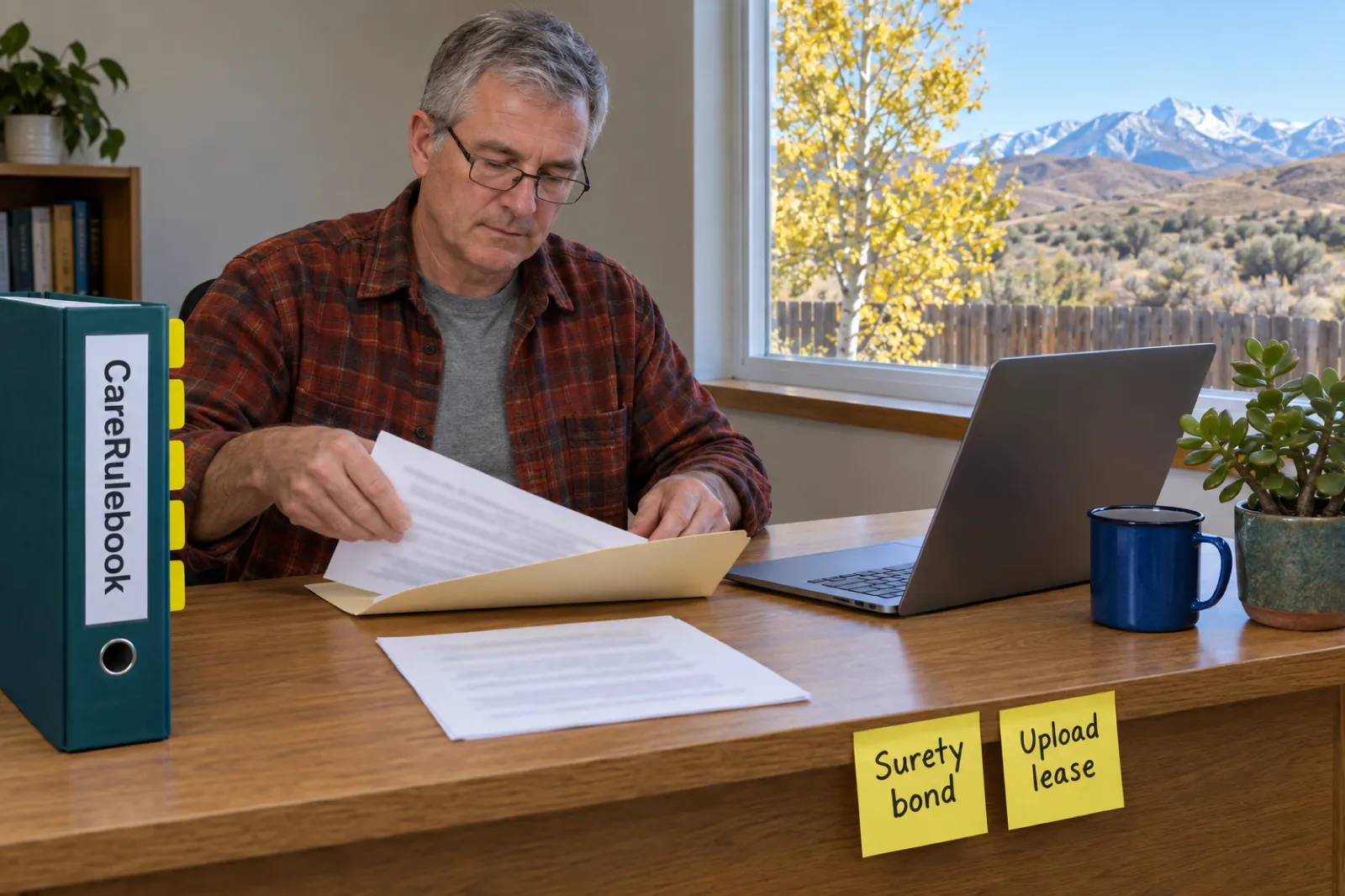
A man with gray hair and glasses in a rust flannel shirt slides papers into a manila folder at an oak desk beside a teal CareRulebook binder, with two sticky notes on the desk edge reading Surety bond and Upload lease, a blue mug, a laptop and a jade plant, and a yellow aspen, sagebrush hills and snowy mountains outside the window

Quick answer

In Nevada, "no person, state or local government or agency thereof may operate or maintain in this State an agency to provide personal care services in the home without first obtaining a license" from the Health Care Purchasing and Compliance Division (NRS 449B.100; 449B.030), whose Bureau of Health Care Quality and Compliance (HCQC) runs licensing (HCQC, Health Facilities Licensing). You apply online in the state’s licensing system (CLICS) at myhealthfacilitylicense.nv.gov (HCQC PCA page), upload the items on HCQC’s checklist and pay the state’s nonrefundable fee of $1,374 (NAC 449.013(1)(n)).

Your policies are not uploaded. Once the application is complete, "the Division shall conduct an investigation concerning the premises, facilities, qualifications of personnel, methods of operation and policies of the applicant and perform a prelicensure survey" (NAC 449.0112(1)). The license comes after that, and you may not serve clients before it (NRS 449B.485).

"Rule requires" means NAC 449 (the personal care rules as R089-24 amended them, and the general licensing rules that still apply) or the statute, NRS chapter 449B. "HCQC says" or "HCQC asks" rests on HCQC’s Licensing Checklist for Personal Care Services, its license, renewal and background check pages, or its 12.2024 inspection workbook. Where we add our own reading or arithmetic, we say so.

$1,374

The state’s nonrefundable fee to apply (not a CareRulebook price)

NAC 449.013(1)(n)

18

Items on HCQC’s upload checklist, 13 of them for a new LLC (our count)

HCQC Licensing Checklist

$5,000

Surety bond for fewer than 7 employees, rising to $50,000 for more than 25

NRS 449B.185(1)

55

Tags on the policy, form and document checklist in HCQC’s inspection workbook

HCQC workbook (12.2024)

From first check to HCQC’s license

Here is the whole path. Tick steps off as you go; your progress is saved in this browser only. HCQC publishes no processing time, so we give no dates.

  1. 1. Check that this is the license you need

    First

    A personal care agency employs or contracts the attendants and sends them to clients. A business that contracts with people to provide nonmedical care in the home as an employment agency needs a different license. HCQC warns that applying for the wrong one can delay processing and the fee is not refunded. Who needs a license.

  2. 2. Set up the business and the office

    Before applying

    Register the company, get the Nevada State Business License, sign a lease (or hold a recorded deed) for a physical location in Nevada, and get the city or county business license, conditional use verification or special use permit for that address. HCQC’s uploads.

    HCQC Licensing Checklist
  3. 3. Appoint the administrator and complete elder abuse training

    Before applying

    The administrator is at least 18 with a high school diploma or equivalent, or a Nevada long-term care administrator license. The applicant, or the person in charge of a company, completes elder abuse training before the license is issued, and HCQC wants the administrator’s current certificate uploaded.

  4. 4. Buy liability insurance and the surety bond

    Before applying

    The insurance certificate lists the Health Care Purchasing and Compliance Division as certificate holder. The bond is $5,000, $25,000 or $50,000 depending on how many employees you have. The surety bond.

  5. 5. Apply online, upload and pay the state’s fee

    Day 0

    Apply in the state’s online licensing system (CLICS), upload HCQC’s checklist items, including each 10% owner’s fingerprint waiver, and pay the nonrefundable state fee of $1,374. The application is valid for one year.

  6. 6. Have your policies and forms ready for the survey

    Before the survey

    Policies are not uploaded. The Division investigates your methods of operation and policies at a prelicensure survey, and HCQC’s initial inspection workbook ends with a 55-tag checklist of the policies, forms and documents it looks for. The prelicensure survey.

  7. 7. Pass the survey, then get the license

    After the survey

    The Division issues the license when you fully comply with chapter 449B and substantially comply with the Board’s rules. You may not serve clients before then.

  8. 8. Display it, open the fingerprint account and renew every year

    Once licensed

    Display the license, open your Department of Public Safety fingerprint account (possible only once you are licensed), report changes on time and renew before the license expires. Renewal and the license term.

Before you apply

  • The right license. HCQC warns that "an Employment Agency to Provide Non-Medical Services is different than an Agency to Provide Personal Care Services", and that if you apply for the wrong one, processing can be delayed and "application fees are non-refundable as stated in NAC 449.013" (HCQC PCA page). An agency is "any person, other than a natural person, which provides services authorized pursuant to NRS 449B.465 to elderly persons or persons with disabilities in the home" (NRS 449B.015(1)). Who needs a license.
  • A company, not a person. The definition covers persons other than natural persons, and HCQC’s checklist asks for LLC, corporate or partnership documents (Licensing Checklist). The statute still asks whether an applicant who is a natural person is 21 or older (NRS 449B.155(1)). By our reading, form an LLC or corporation, and ask HCQC before applying as a sole proprietor.
  • A physical office in Nevada. "All Licensed facilities must have a physical location in the State of Nevada", shown by a fully executed lease or recorded deed (Licensing Checklist), and the city or county must license or permit the business at that address (Licensing Checklist). The records stay at the licensed location, even if you use work stations (NAC 449.3972(1)).
  • A criminal record? A person with a criminal history may petition the Division, even before paying any fee, to find out whether that history would disqualify them from a license. The Division answers within 90 days, may charge up to $50, and is not bound by its answer. (NRS 449B.110) Owners’ fingerprints and history.
  • The administrator. At least 18, a high school diploma or equivalent (or, since R089-24, a Nevada long-term care administrator license), maturity and understanding of elderly and disabled people, knowledge of the rules and statute, and English literacy. No nurse is required. (NAC 449.3973(1), as amended by R089-24) HCQC’s checklist lists only the diploma route; if your administrator qualifies by a long-term care administrator license, ask HCQC what to upload.
  • Elder abuse training first. The applicant (for a company, the person in charge) completes training to recognize and prevent abuse of older persons before the license is issued, then yearly before each renewal. (NRS 449B.225(1)-(3)) HCQC’s Training & Education page links an Elder Abuse/Adult Protective Services course. (HCQC, Training & Education)

HCQC’s uploads, item by item

HCQC’s Licensing Checklist for Personal Care Services says: "For all initial/CHOW licensure applications the following items are required to be uploaded to your application:" (Licensing Checklist). Here are its items in its order, with HCQC’s conditions shortened. Some apply only to an LLC, a corporation, a partnership or a change of ownership.

UploadWhoHCQC’s conditionsSource
Resume for the administratorEvery applicantIn the administrator’s name as given in the application.Licensing Checklist
Administrator’s elder abuse trainingEvery applicantThe application must include a copy of the administrator’s current elder abuse, neglect and exploitation training.Licensing Checklist
Nevada State Business LicenseEvery applicantHCQC wants a copy of the Nevada State Business License itself, listing the registered name and the Nevada business ID given in the application. Receipts and SilverFlume screenshots are not accepted.Licensing Checklist
Bill of saleChange of ownership onlyBuyer and seller, the date of the sale, a description of the transaction, the price and both parties’ signatures.Licensing Checklist
Letter of the governing bodyChange of ownership onlyThe effective date and what is changing, for example the owner from and to.Licensing Checklist
Lease agreement (or recorded deed)Every applicantEvery licensed agency needs a physical location in Nevada, shown by a fully executed lease (or recorded deed) proving the agency may operate from that address. The lease lists the facility name as in your application and its physical address.Licensing Checklist
Articles of organizationLLCsListing the LLC name, the names of the officers and the Nevada business ID number.Licensing Checklist
Operating agreementLLCsListing the LLC name, fully executed.Licensing Checklist
Articles of incorporationCorporationsListing the corporation name, the names of the officers and the Nevada business ID number.Licensing Checklist
Governing body bylawsCorporationsListing the corporation’s name, fully executed.Licensing Checklist
Partnership agreementIf applicableListing the partners’ names, fully executed.Licensing Checklist
3-year business historyEvery applicantOwners show three years of owning the same type of facility, or else give a resume and one letter of reference for each owner.Licensing Checklist
Certificate of liability insuranceEvery applicantThe certificate of liability insurance names the agency and its physical address as insured and lists the Health Care Purchasing and Compliance Division in Carson City as certificate holder. The insurer completes the occurrence and amount information.Licensing Checklist
Surety bondEvery applicantThe bond must name the State of Nevada, Department of Human Services, Aging and Disability Services as obligee, show the DBA name and physical address, be signed by the owner and carry the bond company’s original seal.Licensing Checklist
Local business license, conditional use verification or special use permitEvery applicantA copy of the city or county business license, conditional use verification or special use permit, showing the agency name and physical location. Receipts are not accepted.Licensing Checklist
Background checksEach owner with 10% or moreEach owner with 10% or more completes a background check; HCQC’s Background Check page has the owner instructions and the fingerprint waiver to upload.Licensing Checklist; Background Check page
High school diploma or equivalentEvery applicantA US high school diploma or equivalent, such as a GED. A foreign diploma goes through NACES.Licensing Checklist
Proof the administrator is 18Every applicantGovernment-issued ID, such as a driver’s license or state ID card.Licensing Checklist

Our count. Eighteen items, of which a new LLC or a new corporation uploads 13: the administrator’s four documents, the state and local business licenses, the lease, its two company documents, the business history, the insurance certificate, the bond and the owners’ background checks (Licensing Checklist, our count).

Policies are not on the list. HCQC reviews them at the prelicensure survey (below). By our reading, keep them ready while you apply, because the survey can only start once the application is complete (NAC 449.0112(1)).

What the statute and the rules add

The application form is the Division’s (NRS 449B.155), and HCQC’s checklist is the practical list. The law also asks for these.

  • What the form must contain. The application names the applicant, the principal place of business and the person in charge, describes in specific terms the services and type of care to be offered, and gives evidence of reputable character and ability to comply. (NRS 449B.155)
  • Character and three years of history. The application includes evidence that the applicant is of reputable and responsible character; for a company, the same evidence for its members and the person in charge. (NRS 449B.155(6)) To show that character, the application includes personal references and information on the applicant’s financial status, business activities and associations in and outside Nevada over the previous 3 years; for a company, the same for its members and the person in charge. (NAC 449.011(3)) HCQC’s 3-year business history upload is how it asks for this, by our reading.
  • Ownership in full. The application gives full ownership information: each natural person who owns the agency, each person with a direct or indirect interest of 10% or more who also holds a mortgage, note or other obligation secured by the agency or its assets, each officer and director of a corporation and each partner of a partnership, plus any ownership change while the application is pending. (NAC 449.011(4)(a))
  • Identity. "Must be complete and include proof of the identity of the applicant that is acceptable to the Division." (NAC 449.011(1)) The application includes the applicant’s Social Security number; an applicant without one gives another identifying number, such as an individual taxpayer identification number. The Division may not deny an application solely on immigration status, and it keeps the number confidential. (NRS 449B.165, 449B.180)
  • Child support. Each application and renewal includes a signed statement on child support. The license is not issued or renewed if the statement is missing, or if it shows the applicant is behind on a child support order with no approved repayment plan. (NRS 449B.170)

The state’s fees

These are the state’s fees, set in NAC 449.013 and paid to the Division. They are not CareRulebook prices.

State feeAmountSource
Initial license, nonrefundable$1,374NAC 449.013(1)(n)
Yearly renewal, nonrefundable$687NAC 449.013(2)(n)
Cancer registry fee, 6% of the renewal fee, on issue and each renewal$41.22NAC 449.013(3); NRS 449B.210(3)
Late renewal without good cause (after November 15, by December 31)+$343.50NAC 449.0116(2)

The 6% fee. On the issue and each renewal of the license, "the licensee shall pay to the Division a nonrefundable fee equal to 6 percent of the renewal fee set forth in subsection 2", and the Division uses it for the state’s cancer reporting system (NAC 449.013(3)). By our arithmetic, the state’s fees come to $1,415.22 for the first license and $728.22 for each renewal on time.

Nonrefundable, and valid a year. "An application for a license is valid for 1 year after the date on which the application is submitted." If you do not meet the requirements by then, you apply and pay again (NAC 449.013(4)).

The 2026 fee rule. HCQC’s licensing page says: "Recent Amendments apply to Health Facility Licensing Fees", for initial and change of ownership applications, license changes and renewals, and links R071-26 (HCQC, Health Facilities Licensing). The State Board of Health approved a 7% rise in most health facility fees (R071-26, approved regulations dated July 1, 2026). The LCB draft keeps the personal care agency fees at $1,374 and $687. (R071-26 LCB draft; Board minutes, June 5, 2026) We have not seen the approved text, so check the fee shown in the licensing system before you pay.

Other costs. The bond premium, liability insurance, business licenses and fingerprinting are priced by others. Applicants pay their own fingerprinting and state and federal background check costs. For staff, the agency may recover no more than half the Central Repository fee from the employee, and must allow installments if the agency charges the employee any part of the fee. (HCQC Background Check FAQ; NRS 449B.310(7))

Filed with the application and every renewal

The surety bond

EmployeesBond (NRS 449B.185)HCQC’s checklist wording
Fewer than 7$5,000fewer than 7
7 to 25$25,0007-24
More than 25$50,000more than 25

Statute and checklist differ by one employee. HCQC’s checklist, citing NRS 449.065 rather than NRS 449B.185, words the tiers as $5,000 for fewer than 7 employees, $25,000 for 7 to 24 and $50,000 for more than 25, which leaves an agency with exactly 25 employees in neither. NRS 449B.185 puts 7 to 25 employees in the $25,000 tier. (Licensing Checklist; NRS 449B.185(1)) By our reading the statute governs. The rules do not say whether contracted attendants count as employees; ask HCQC if you are near a tier.

Who it protects. With each application and renewal the agency files a surety bond of $5,000 (fewer than 7 employees), $25,000 (7 to 25) or $50,000 (more than 25), payable to the Aging and Disability Services Division to cover property damage to clients aged 60 or older. (NRS 449B.185(1)-(2), (7)) The bond is executed by the agency as principal and a surety company as surety, and covers the whole initial license period or renewal period. (NRS 449B.185(2)-(3)) The amount is the bond’s face value; what you pay is the surety company’s premium, which the rules do not set.

How HCQC wants it. The bond must name the State of Nevada, Department of Human Services, Aging and Disability Services as obligee, show the DBA name and physical address, be signed by the owner and carry the bond company’s original seal. (Licensing Checklist)

Never let it lapse. "A license is suspended by operation of law when the agency is no longer covered by a surety bond" (NRS 449B.185(5)). A surety may be released after giving the Administrator 30 days’ written notice. The Administrator gives the agency at least 20 days’ written notice that the license will be suspended by law until another bond or substitute is filed. (NRS 449B.185(4)-(5))

A deposit instead. With the Administrator’s approval, an agency may instead deposit with a bank or trust company in Nevada certain bank, US government or Nevada government obligations worth at least the bond amount, which can be withdrawn only by order of the ADSD Administrator. (NRS 449B.190)
Owners: fingerprints and history

  • Fingerprints. Each owner with 10% or more completes a fingerprint background check; the statute requires every applicant to submit fingerprints to the Central Repository for an FBI report. (Licensing Checklist; NRS 449B.300(1)) HCQC’s Background Check page links instructions for owners (for an initial or CHOW application, each designated owner completes step 1) and a Civil Applicant fingerprint background waiver, fully executed for each designated owner and uploaded to the license application. (HCQC, Background Check Requirements)
  • What the check looks for. The Central Repository tells the Division whether an applicant has been convicted of a crime listed in NRS 449B.440(1)(a), and the Division may deny the license to an applicant convicted of one. Some listed crimes count only within the past 7 years; others have no time limit. (NRS 449B.300(2); 449B.440(1)) The listed crimes.
  • Asking first. A person with a criminal history may petition the Division, even before paying any fee, to find out whether that history would disqualify them from a license. The Division answers within 90 days, may charge up to $50, and is not bound by its answer. (NRS 449B.110)
  • Business history. Owners show three years of owning the same type of facility, or else give a resume and one letter of reference for each owner. (Licensing Checklist) The rule behind it asks for references and three years of financial and business information for the members of a company and its person in charge (NAC 449.011(3)).
  • Who counts. HCQC fingerprints each owner of 10% or more (Licensing Checklist), while the ownership disclosure also names officers, directors and partners (NAC 449.011(4)(a)).
  • Pending charges or an incomplete check. If the Central Repository cannot complete an applicant’s check, the Division asks for the missing information (or proof it cannot be obtained) within 30 days, or, if charges are pending, for court dates and the outcome. It may deny the application if the applicant does not comply, and may hold the application until the check is complete. (NAC 449.01125) Your staff’s checks start only after you are licensed (HCQC Background Check FAQ). Background checks for staff.

The prelicensure survey

When it starts. Once the Division has a properly completed application, acceptable proof of identity and the fee, "the Division shall conduct an investigation concerning the premises, facilities, qualifications of personnel, methods of operation and policies of the applicant and perform a prelicensure survey" (NAC 449.0112(1)). HCQC does not publish whether the survey is on site, how long after the application it comes, or what it finds most often.

What HCQC uses. HCQC links an initial inspection workbook for personal care agencies on its licensing page. Each rule is a tag with Y/N, P&P (policy and procedure) and Form/Doc columns. (HCQC PCA page) The workbook ends with a checklist of 55 tags (P0015 to P0950) naming the policy, form or document the surveyor expects for each rule. (HCQC workbook (12.2024)) The workbook is dated 12.2024, so it predates the R089-24 changes of February 27, 2026 (R089-24). The 55 tags, grouped.

No fire inspection. Personal care agencies are exempt from the State Fire Marshal or local fire department inspection that other facilities need before licensing. (NAC 449.0112(2)(b))

The decision. The Division issues the license if, after investigation, the applicant is in full compliance with chapter 449B and substantial compliance with the Board’s standards and regulations. (NRS 449B.200(1)) After a statement of deficiencies, the agency submits a plan of correction with timeframes within 10 days; failing to do so is a further deficiency and a ground for license action. (NAC 449.9987(1); 449.0118(5))

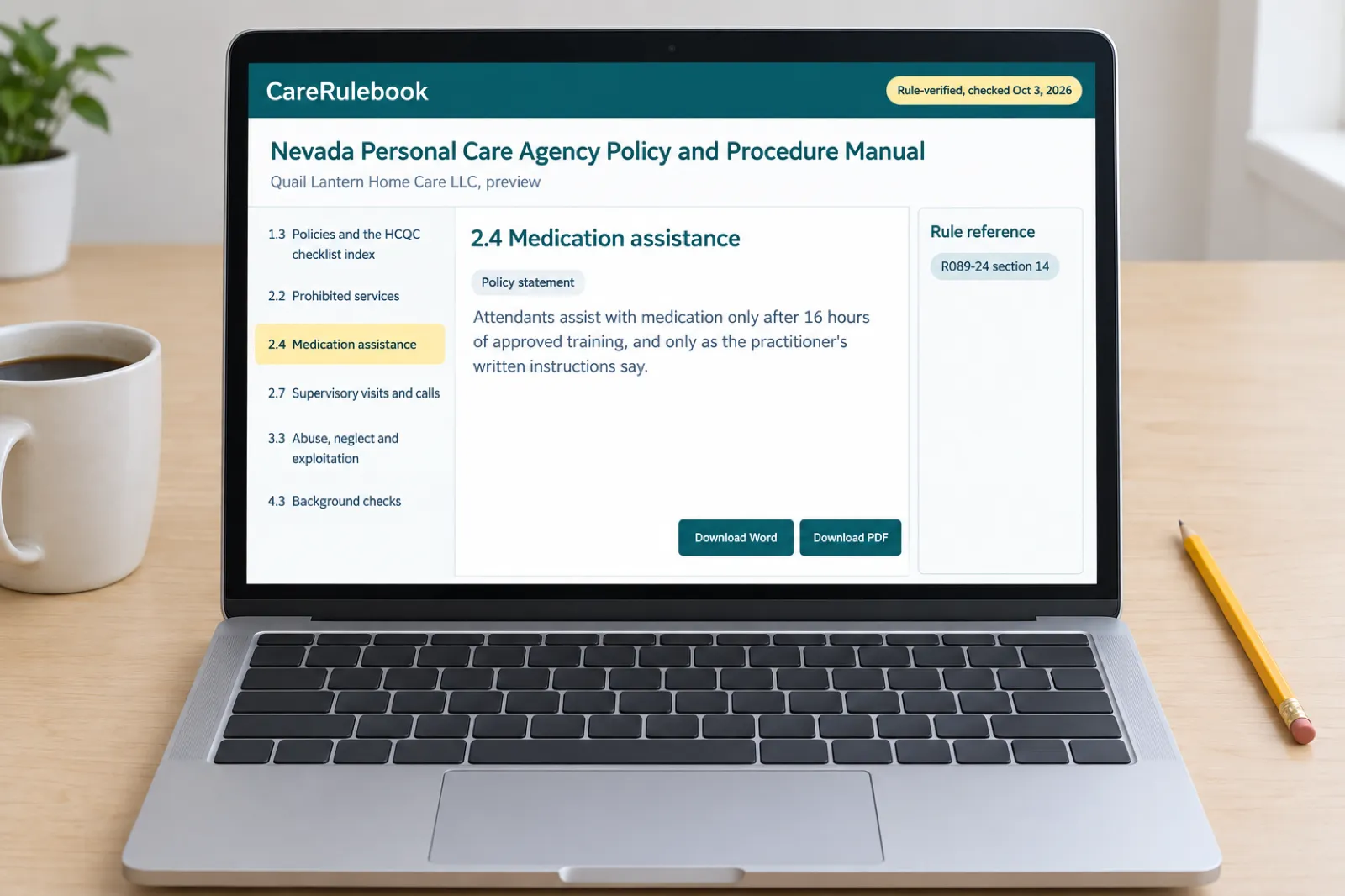
The CareRulebook Nevada manual preview on a laptop: policy 2.4 on medication assistance for a sample agency, citing R089-24 section 14, with six of the manual’s policies listed beside it

CareRulebook

Ready for the survey, tag by tag

CareRulebook’s Nevada manual follows NAC 449.396 to 449.3982 as R089-24 changed them on February 27, 2026, with chapter 449B of NRS and the general NAC 449 rules, your agency’s details filled in and the rule quoted under each policy. Policy 1.3 indexes every one of HCQC’s 55 checklist tags to the policy or form that answers it, and an HCQC checklist index download gives the pages in your PDF.

  • 35 policies, 127 requirements mapped to NRS 449B and NAC 449
  • All 55 tags of HCQC’s checklist indexed
  • Written to the 2026 rules the compiled code does not show
  • Editable Word and print-ready PDF
Preview your manual

$199CareRulebook founding price for the first 50 Nevada agencies, then $249. Not an HCQC fee.

Once the license arrives

  • What it says. The license names the person or persons authorized to operate the agency and states the nature of the services offered and the licensee’s capacity to deliver them. (NRS 449B.205) The person designated as responsible for the agency is named on it too (NAC 449.3972(2)).
  • Display it. "Upon receipt of a license, the licensee shall display the license at a conspicuous location within the facility." (NAC 449.0114(1))
  • The cancer registry fee. Due on issue, $41.22 (NAC 449.013(3)).
  • The fingerprint account. An agency can open its Department of Public Safety fingerprint account only after it receives its license. New applicants first take HCQC’s NABS training (about 1 hour 20 minutes). (HCQC Background Check FAQ) Then every hire is checked within 10 days (NRS 449B.310(1)).
  • HCQC’s email list. HCQC runs an email list for personal care agencies with guidance on regulations, inspections, infection control and more. To join, use the link on HCQC’s personal care agency page and put only "subscribe PERSONALCAREAGENCY" in the body. (HCQC PCA page)
  • Medicaid, if you want it. To enroll as a Nevada Medicaid personal care provider (provider type 30), an agency must hold this license. (Medicaid Services Manual 3503)

Renewal, and a license term that is not settled

What the statute says. A license "expires on December 31 following its issuance and is renewable for 1 year upon reapplication and payment of all fees" (NRS 449B.210(1)). The rule says to submit a complete renewal application on or before November 15 of the year the license expires. The existing license stays valid until the Division decides, and the Division may inspect before it renews. (NAC 449.0116(1)) HCQC’s renewal page says to renew "no later than Nov. 15 to avoid a 50% late penalty (licenses expire on Dec. 31)" (HCQC, License Renewal).

What HCQC’s list shows. HCQC’s licensee list shows recent licenses expiring one year after issue (for example first issued 08/26/2026, expiring 08/25/2027), in line with AB 544 for chapter 449 licenses, although NRS 449B.210 still says December 31. 50 licenses first issued in 2026 expire on their anniversary in 2027, while 26 others first issued in 2026 still expire on December 31, 2026. (HCQC licensee export, our count) The R116-25 rulemaking notice says a new chapter 449 license will be valid for a full year, to the anniversary date, instead of to December 31. (R116-25 notice) We have not seen R116-25’s approved text or anything from HCQC saying it reaches chapter 449B licenses.

What to do, by our reading. Read the expiry date printed on your license, put both November 15 and that date in your calendar, and renew by whichever comes first. If your license was issued after November 15, ask HCQC on the day it arrives how and when to renew.

  • What a renewal includes. The fee, the 6% fee, and "a statement that the agency is in compliance with the provisions of NRS 449B.300 to 449B.340, inclusive, and 449B.440", with a statement that the licensee, administrator and employees have completed elder abuse training (NRS 449B.210(2)-(3)). A renewed surety bond goes with it (NRS 449B.185(1)), and the child support statement (NRS 449B.170).
  • Business ID and state debts. A renewal application says whether the agency has a state business license and gives its Secretary of State business ID. The license is not renewed without that, or while the agency owes a debt assigned to the State Controller that it has not paid, agreed to pay or shown to be invalid. (NRS 449B.175)
  • No changes in a renewal. HCQC says no changes can be made in a renewal application; a change needs its own amendment application. All fees due must be paid before a renewal is processed. (HCQC, License Renewal) HCQC says a facility that has submitted its renewal application and paid the fee keeps an active license while the renewal is under review. (HCQC, License Renewal)
  • Late. Renewing after November 15 but by December 31, without good cause, costs the renewal fee plus half of it again. (NAC 449.0116(2)) By our arithmetic that is $1,030.50, plus the 6% fee.
  • Expired. A licensee that does not apply to renew before the license expires cannot renew and must apply for a new license. (NAC 449.0116(3))

Reporting changes

Changes are applied for in the same online system (HCQC Licensing Checklist). Some have deadlines in the rule.

A new administrator

Rule requires; HCQC says

Within 30 days (it was 10 before R089-24). Missing it costs the new-license application fee under NAC 449.0168 plus 50% of it; the old rule charged 150% of that fee, so by our reading the total is the same. HCQC lists a change of administrator among the changes you apply for in the online licensing system.

NAC 449.0114(4), as amended by R089-24

New owners, a new location or different services

Rule requires

"A licensee shall notify the Division immediately of any change in:" the ownership, the location or the services provided. A new owner also needs a new license, because a license cannot be transferred (below).

NAC 449.0114(5)

Your building is sold, but you stay

Rule requires

If the property the agency operates from changes hands but the operator stays the same, the licensee tells the Division in writing within 10 days and sends a copy of any lease agreement relating to the transfer.

NAC 449.0114(3), as amended by R089-24

A new name, suite or corporate personnel

HCQC says

HCQC says a licensee making a change to its license uses the online licensing system to apply for it, for example a change of administrator, suite number, endorsements, location, facility name or corporate personnel.

HCQC Licensing Checklist

More employees

Statute requires; our reading

With each application and renewal the agency files a surety bond of $5,000 (fewer than 7 employees), $25,000 (7 to 25) or $50,000 (more than 25), payable to the Aging and Disability Services Division to cover property damage to clients aged 60 or older. By our reading, check the bond amount whenever your headcount crosses a tier, not only at renewal.

NRS 449B.185(1)

A new administrator: 30 days, and a fee question

R089-24 changed the notice period: "If there is a change in the administrator of the facility, the licensee shall notify the Division of the change within ... 30 days." (NAC 449.0114(4), as amended by R089-24 section 17). The new administrator must meet the same qualifications (NAC 449.3973(1)), and the administrator appoints a designee for absences (NAC 449.3973(2)-(3)).

Missing the 30 days means the NAC 449.0168 application fee plus 50% of it (NAC 449.0114(4)), but that section is not clearly written for personal care agencies: it charges $250 (the R071-26 draft: $268) for a new license to reflect a change such as a new name or administrator, but its list of license holders does not name agencies to provide personal care services in the home. (R071-26 LCB draft, NAC 449.0168(1)) We do not know whether HCQC charges a fee for an on-time change of administrator; ask HCQC before you file. Either way, report within 30 days.

Selling or buying an agency

  • No transfer. "A license applies only to the person to whom it is issued and is not transferable." (NRS 449B.200(2)) The seller tells the Division immediately of the change of ownership (NAC 449.0114(5)(a)).
  • The buyer applies. HCQC’s licensing system takes applications for a new facility or a change of ownership (CHOW), and the checklist applies to both. A change of ownership (CHOW) uses the same checklist plus a bill of sale (buyer and seller, date, description of the transaction, price, both signatures) and a letter from the governing body stating the effective date and what is changing. (Licensing Checklist) The buyer’s owners complete their own fingerprint checks (HCQC, Background Check Requirements), and the buyer files its own bond (NRS 449B.185(1)).
  • Timing. Neither the statute nor HCQC’s pages say how far ahead to apply or whether the seller may keep operating while the buyer’s application is pending. By our reading, apply well before closing and agree a date with HCQC, because no one may operate the agency without a license of their own (NRS 449B.100).

Closing an agency

The rules are silent. We found no Nevada rule or HCQC page on how a personal care agency closes: no notice period to the Division, no step for returning the license and no rule on keeping client records afterwards. Here is what the law does say.

  • Clients. Your disclosure statement already gives clients the criteria for ending services and your policy for notifying them (NAC 449.3979(2)(e)), and the administrator’s termination of services policy applies (NAC 449.3973(2)(f)). Where a client needs services you can no longer give, explain the transfer and the alternatives (NRS 449A.100).
  • Records. If the Division suspends a license, or an agency otherwise ceases to operate, the Division may take control of the agency’s records to keep them safe. It keeps them confidential, may share them with law enforcement and licensing bodies, and releases a client’s record to the client or legal guardian. (NRS 449B.430)
  • The bond. A surety may be released after giving the Administrator 30 days’ written notice. A release does not discharge claims for property damage that happened while the bond was in force (NRS 449B.185(4)).

By our reading: tell HCQC in writing before your last day of service, ask what it wants done with the license and the records, and give clients enough notice to arrange other care.

HCQC’s licensing team takes questions by email at nvhalicensing@nvha.nv.gov. (HCQC, Health Facilities Licensing)

If HCQC refuses, and how to appeal

  • Grounds. The Division may deny an application, or suspend or revoke a license, for violating chapter 449B, the patients’ rights law (NRS 449A.100 to 449A.124) or the Board’s rules; aiding or permitting an illegal act; or conduct harmful to public health and safety, or to the health or safety of clients or employees. (NRS 449B.400(1)) The general rules add "the failure or refusal to cooperate fully with an investigation or inspection by the Bureau" (NAC 449.0118(6)), and not returning an adequate plan of correction within 10 days (NAC 449.0118(5)). An owner’s listed conviction is a ground too (NRS 449B.440(1)).
  • A provisional license. If an agency fails to meet the standards but is making the changes, or has agreed to make them within a reasonable time, the Division may cancel its license and issue a provisional license for a period the Division sets. (NRS 449B.215(1)(b))
  • Notice and appeal. Before it denies, suspends or revokes a license or imposes a sanction, the Division gives notice by certified mail with its reasons, unless public health requires immediate action. To contest the action, the person files an appeal under the Board’s regulations, and the Division holds a hearing. (NRS 449B.420) The general NAC 449 rule sends appeals of a denial, suspension or revocation to the procedures in NAC 439.300 to 439.395. (NAC 449.0119)
  • A new appeals rule in workshop. R164-26 would create an appeal process for disciplinary actions against entities providing personal care services, under the Nevada Health Authority. Workshop October 7, 2026. (Notice of workshop, R164-26) It is a proposal, not in force. Nevada rule changes.

Myths about applying

Do I send my policies and procedures with my Nevada application?

No. Not with the online application: HCQC’s upload checklist asks for business documents, insurance, the surety bond and background checks. Your policies are reviewed at the prelicensure survey, when the Division investigates your methods of operation and policies before issuing the license. HCQC’s initial inspection workbook lists the policies and forms it expects for each rule, so have them ready and organized by tag.

"the Division shall conduct an investigation concerning the premises, facilities, qualifications of personnel, methods of operation and policies of the applicant and perform a prelicensure survey"

Can I start serving clients while HCQC processes my application?

No. No one may operate a personal care agency in Nevada without first obtaining the license, which comes after the prelicensure survey. Operating without one is a misdemeanor, and the Division may serve a cease and desist order.

"no person, state or local government or agency thereof may operate or maintain in this State an agency to provide personal care services in the home without first obtaining a license"

Is the Nevada surety bond a fee I pay to the state?

No. The bond is an agreement between your agency and a surety company, payable to the Aging and Disability Services Division, to cover property damage to clients aged 60 or older caused by the agency. Its face amount is $5,000, $25,000 or $50,000 depending on how many employees you have; what you pay is the surety company’s premium, which the rules do not set. You file a bond with each application and renewal, and the license is suspended by law while you have no bond or approved deposit.

"A bond filed pursuant to this section must be executed by the agency as principal and by a surety company as surety."

Does a Nevada personal care agency need a fire inspection before it is licensed?

No. Most facilities need a satisfactory report from the State Fire Marshal or local fire department before the Division licenses them, but the rule exempts agencies to provide personal care services in the home. Your city or county may still have its own conditions for a business license or use permit, and HCQC wants a copy of that local license or permit with the application.

"The Division is not required to receive such a report before issuing a license or certificate, as applicable, to: ... An agency to provide personal care services in the home"

If I buy a Nevada personal care agency, can I keep using its license?

No. A license applies only to the person it was issued to and cannot be transferred. The buyer applies for a change of ownership (CHOW) in the online licensing system, with the same uploads as a new agency plus a bill of sale and a letter from the governing body giving the effective date, and the licensee must tell the Division immediately of a change of ownership.

"A license applies only to the person to whom it is issued and is not transferable."

Can I renew my Nevada license after it has expired?

No. A licensee that does not apply to renew before the license expires is not eligible to renew and must apply for a new license. The rule asks for renewal by November 15, with a late charge of half the renewal fee up to December 31; HCQC’s licensee list shows some newer licenses expiring on their anniversary instead, so check the date on yours.

"is not eligible to renew the license and, if he or she wishes to be licensed, must submit an application for a new license"

How much does a Nevada personal care agency license cost?

It depends. The state fee is $1,374 for the initial license and $687 for each annual renewal, both nonrefundable, plus a cancer registry fee of 6% of the renewal fee. You also need a surety bond ($5,000 to $50,000 depending on staff numbers), liability insurance, business licenses and owner fingerprinting. The 7% fee rise approved in 2026 left these two fees unchanged in the LCB draft.

"An agency to provide personal care services in the home 1,374"

Can I run a Nevada personal care agency from my home?

It depends. The rules do not ban it, but HCQC needs a physical location in Nevada, a fully executed lease (or recorded deed) proving you may run the agency from that address, and a city or county business license, conditional use verification or special use permit for that location. Check your city’s or county’s home business rules first. If you use work stations, client and staff records stay at the licensed location.

"Proof that you are allowed to run the facility from that location"

Frequently asked questions

How do I apply for a personal care agency license in Nevada?

Online, in the state’s licensing system (CLICS) at myhealthfacilitylicense.nv.gov. HCQC’s checklist lists the uploads: the administrator’s resume, elder abuse training, diploma and ID; the Nevada State Business License; a lease or recorded deed for a physical location in Nevada; your LLC, corporate or partnership documents; a 3-year business history; a certificate of liability insurance; the surety bond; the city or county business license or use permit; and each 10% owner’s background check. You pay the nonrefundable state fee of $1,374. Your policies are not uploaded: the Division reviews them at a prelicensure survey before it issues the license.

How much does the Nevada license cost?

The state’s fees are $1,374 to apply and $687 for each yearly renewal, both nonrefundable, plus a fee of 6% of the renewal fee ($41.22) on issue and each renewal for the state’s cancer reporting system. By our arithmetic that is $1,415.22 in state fees for the first license. You also need a surety bond, liability insurance, business licenses and fingerprinting, which are priced by others. These are the state’s fees, not CareRulebook prices.

How long does HCQC take to issue a license?

HCQC publishes no processing time. The Division starts its investigation and prelicensure survey once it has a complete application, proof of identity and the fee, and the application stays valid for one year. We cannot give you a date.

Do I send my policies with the application?

No. They are not on HCQC’s upload list. The Division investigates your methods of operation and policies at the prelicensure survey, and HCQC’s inspection workbook ends with a 55-tag checklist of the policies, forms and documents its surveyor expects.

What if I have more than 25 employees, or exactly 25?

The statute sets the bond at $5,000 for fewer than 7 employees, $25,000 for 7 to 25 and $50,000 for more than 25. HCQC’s checklist words the middle tier as 7 to 24, which leaves exactly 25 in neither. By our reading the statute governs, so 25 employees means a $25,000 bond; ask HCQC if you are at the edge.

When does a Nevada license expire?

It is not settled. The statute says December 31 after it is issued, and HCQC’s renewal page says to renew by November 15 to avoid a 50% late penalty. But HCQC’s licensee list shows many licenses first issued in 2026 expiring on their anniversary in 2027, in line with a 2026 rule (R116-25) for chapter 449 licenses. Check the date on your license and ask HCQC.

Can I buy an existing agency and use its license?

No. A license applies only to the person it was issued to and is not transferable. The buyer applies for a change of ownership in the online licensing system, with the same uploads as a new agency plus a bill of sale and a letter from the governing body.

Get Nevada rule-change alerts

Nevada’s personal care rules changed on February 27, 2026, the Division has proposed R164-26 on appeals, and the State Board of Health approved changes to chapter 449 fees and renewal dates in 2026. Leave your email and we will tell you when a Nevada change affects your application or your policies.

No spam. Only emails about Nevada home care rule changes. How we use your email.

Keep reading

Sources

  1. NRS chapter 449B, Agencies to Provide Personal Care Services and Related Entities (added by AB 519, 2025; page revised 4/15/2026) · Nevada Legislature, Legislative Counsel Bureau (Internet Archive copy) · retrieved October 2, 2026
  2. NAC 449.396 to 449.3982, Agencies to Provide Personal Care Services in the Home (compiled text, NAC-449 revised 8-24, as amended by LCB File No. R089-24, filed February 27, 2026) · Nevada Legislature, Legislative Counsel Bureau (State Board of Health regulations; Internet Archive copies) · retrieved October 3, 2026
  3. LCB File No. R089-24, approved regulation of the State Board of Health (filed February 27, 2026), with the adopted text, informational statement, notice of hearing and Board packet · Nevada Legislature, Legislative Counsel Bureau, Register of Administrative Regulations; Nevada Health Authority · retrieved October 3, 2026
  4. NAC chapter 449 general provisions that apply to personal care agencies (449.0112, 449.0113, 449.0114, 449.0116, 449.0118, 449.01065, 449.011901 to 449.011951, 449.013, 449.9987), compiled text revised 8-24 · Nevada Legislature, Legislative Counsel Bureau (Internet Archive copy) · retrieved October 2, 2026
  5. Agency to Provide Personal Care Services in the Home (Personal Care Agency), page last updated 07/21/2026 · Nevada Health Authority, Bureau of Health Care Quality and Compliance · retrieved October 2, 2026
  6. Licensing Checklist for Personal Care Services (PCS), page last updated 04/09/2026 · Nevada Health Authority, Bureau of Health Care Quality and Compliance · retrieved October 2, 2026
  7. Agencies to Provide Personal Care Services in the Home Workbook (12.2024), linked as the Initial Inspection Workbook, with the PCS Policies & Procedures/Form/Document Checklist · Nevada Health Authority, Bureau of Health Care Quality and Compliance · retrieved October 2, 2026
  8. Licensee search export: Agency to Provide Personal Care Services in the Home (credential codes PCS and PCO), October 2, 2026 · Nevada Health Authority, Bureau of Health Care Quality and Compliance · retrieved October 2, 2026
  9. Background Check Requirements and FAQs (page last updated 05/26/2026) · Nevada Health Authority, Bureau of Health Care Quality and Compliance · retrieved October 3, 2026
  10. Health Facilities Licensing, License Renewal and renewal fee schedule pages · Nevada Health Authority, Bureau of Health Care Quality and Compliance · retrieved October 3, 2026
  11. Public Workshops, Hearings and Proposed Regulations (last updated 09/29/2026), with the notice of public workshop for LCB File No. R164-26 and the State Board of Health regulations page · Nevada Health Authority, Health Care Purchasing and Compliance Division · retrieved October 3, 2026
  12. LCB File No. R071-26 (health facility fee increase): LCB draft of April 20, 2026, notice of hearing and State Board of Health minutes of June 5, 2026 · Nevada State Board of Health · retrieved October 2, 2026
  13. LCB File No. R116-25 (license renewal dates under AB 544, rehabilitative residential mental health care facilities): Board packet excerpt and minutes of June 5, 2026 · Nevada State Board of Health · retrieved October 2, 2026
  14. Medicaid Services Manual chapter 3500, Personal Care Services Program (July 1, 2026) · Nevada Health Authority, Nevada Medicaid · retrieved October 3, 2026
Build your Nevada manualfrom $199