DPH asks; rule requires
The random drug testing policy
The one policy DPH asks to see. Our suggestion: send it as its own document, under your agency’s name, with nothing that depends on the rest of the manual. What it must say.
Where are you starting?
South Carolina · In-Home Care Provider license · DPH’s application
You apply for a South Carolina in-home care provider license on one DPH form, Form 1307, sworn before a notary and emailed with your random drug testing policy, your insurance evidence, each signer’s SLED check and drug test, and proof that you paid DPH’s fee. Here is the form part by part, what goes with it, the one policy DPH asks to see, how DPH decides, and how renewal, an amended license, a change of owner, exceptions and closing work.
Quick answer
South Carolina licenses non-medical home care through the Department of Public Health (DPH), which took over from DHEC in 2024 (2023 Act No. 60). "No person, private or public organization, political subdivision, or governmental agency shall establish, operate, maintain, or represent itself (advertise and/or market) as an in-home care provider in South Carolina without first obtaining a license from the Department." (R.60-122 §103.A)
You apply on DPH’s Licensure Application for In-Home Care Provider, Form 1307-ENG-DPH (08/2026), signed under oath before a notary (Form 1307, Part D), and send it to IHCP@dph.sc.gov, DPH’s preferred method, or by mail (Form 1307, p. 1). With it go "A copy of your Random Drug Testing Policy", your liability insurance and your workers’ compensation coverage (Form 1307, Additional Documents), each signer’s SLED check and drug test (R.60-122 §103.F.4), and proof that you paid DPH’s $1,000 fee (R.60-122 §103.I).
Then "An initial license shall not be issued to a proposed provider until the applicant has demonstrated to the Department that the proposed provider is in substantial compliance with the licensing standards." (R.60-122 §103.B) So the rest of your policy manual is not sent, but it should be in place before you apply.
"Rule requires" means R.60-122 as rewritten from May 22, 2026, or the In-Home Care Providers Act (S.C. Code 44-70). "DPH asks" or "DPH says" rests on DPH’s Form 1307-ENG-DPH (08/2026) or its web pages. The form and the rule do not always match, and we say where. Where we add our own reading or advice, we say so.
$1,000
DPH’s non-refundable fee for a first license (a state fee, not a CareRulebook price)
R.60-122 §103.I3
Documents DPH’s form lists with every initial and renewal application: the drug testing policy, liability insurance and workers’ compensation
Form 1307, Additional Documents30 days
The earliest each signer’s drug test may be taken before DPH receives the application
R.60-122 §103.HThe rule asks for a complete and accurate application, on a form or by electronic means DPH sets, before the first license and at intervals DPH decides (R.60-122 §103.F). Here is the whole path. Tick steps off as you go; your progress is saved in this browser only. For a version tailored to your agency, use the free license checklist.
In-home care is non-medical: the rule lists 13 tasks, with medication reminders the only medication task on the list. Skilled nursing needs a home health agency license and a Certificate of Need. Home care, home health or Medicaid?
Gather the Secretary of State documents and ownership list the form asks for, check the name against other licensees, and get a county or municipal zoning permit (or, if unzoned, a local letter) for a primary office in a commercially zoned or unzoned area. Before you fill it in.
Liability insurance or a surety bond of at least $100,000 per occurrence and $300,000 aggregate, indemnity coverage for clients, and workers’ compensation.
Policies for each section of R.60-122. DPH’s form asks for one of them with the application: the random drug testing policy. The drug testing policy DPH reads.
Each person who signs needs a SLED name-based check no older than 90 days, and a 5-panel drug test no earlier than 30 days, both counted to the day DPH receives the application. The signers’ checks.
Parts A and B for a first application, then Part D, the oath, signed by the owner, the head of an LLC or two corporate officers, and notarized. Form 1307, part by part.
Attach the drug testing policy, insurance evidence, the signers’ checks and tests and proof of payment, and email everything to IHCP@dph.sc.gov, DPH’s preferred method, or mail it. What goes with it.
DPH will not issue a first license until you show substantial compliance with the standards. The rule allows a visit to a proposed provider but does not say whether every applicant gets one, and no processing time is published. DPH’s decision.
DPH’s Licensure Application for In-Home Care Provider, 1307-ENG-DPH (08/2026), is linked from DPH’s in-home care page (DPH, In-Home Care Providers). It starts with a cover page and a page of instructions, then the reason for the application and Parts A to D (Form 1307-ENG-DPH). A first application completes Parts A, B and D.
| Part | What it asks for | Source |
|---|---|---|
| Reason for the application | The form has three boxes: Initial, Renewal and Change Request. DPH says to tick Initial only the first time you apply for a license, and not for a change of ownership of an existing licensed provider. For an amended license, or a change of name, location or ownership, DPH says to complete only Parts C and D. | Form 1307, Instructions |
| Part A. Provider information | Part A asks for the provider’s name, primary office address, county, phone and fax; up to three multiple locations (not the primary office), with a box for each new or relocated office and a sheet for more; the administrator’s name, phone, fax and email; and a contact person, with title, mailing address, phone and email, who can make licensure decisions and receives all of DPH’s letters, including the license. | Form 1307, Part A |
| Part B. Operation disclosure | Part B names the licensee, the person or legal entity that will hold the license, with address and phone, and the ownership type: sole proprietorship, partnership, limited partnership, corporation, LLC, government or other. Three attachments follow where they apply: Secretary of State documents, a list of officers (corporation or partnership), and everyone owning 5% or more. | Form 1307, Part B |
| Part C. Licensure changes | Part C is only for changes. Section 1 gives the current and new name or address, Section 2 the current and new owner, each signing and dating, and Section 3 adds multiple locations. The instructions call the changes part "Part D: Licensure Changes", but on the form itself the changes are Part C and the sworn verification is Part D. | Form 1307, Part C |
| Part D. Verification | The application is signed under oath and notarized: by the owner(s), the head of an LLC, or two officers of a corporation. The signers swear that they have read the application and its attachments, that the statements are correct and true to the best of their knowledge, and that they understand they must comply with R.60-122 and that non-compliance may lead to enforcement. A notary public witnesses it. | Form 1307, Part D |
| Additional documents | DPH’s form asks for a copy of the Random Drug Testing Policy, the liability insurance and workers’ compensation coverage with both initial and renewal applications. | Form 1307, Additional Documents |
| Attachments | Anything that needs more room, and any documentation, goes on letter-size (8.5 by 11 inch) attachments labeled with the section they belong to. | Form 1307, Instructions |
The contact person. Part A asks for the "Name of person who can make licensure/operation decisions about facility and address where you want to receive ALL correspondence, including the license" (Form 1307, Part A). Our suggestion: name someone who reads email every day, because the license itself goes to that address.
What the rule wants the form to show. The rule says the application gives the provider’s full name and address, the owner’s name and address if different, and the names of the persons in control of the provider. (R.60-122 §103.F) DPH may ask for more information, including evidence that the applicant can comply with the rule. (R.60-122 §103.F)
Who signs, form and rule. DPH’s form names the head of the LLC for an LLC (Form 1307, Part D); the rule names only owners (individual or partnership) and two officers (corporation) (R.60-122 §103.F). Neither says how many members sign for an LLC with several members. Ask DPH, because every signer needs the checks below.
The form and the rule list the attachments differently. DPH’s form asks for three documents with initial and renewal applications (Form 1307, Additional Documents). The rule says: "When submitting an application for an initial license, the provider shall include evidence of" insurance or a bond, indemnity coverage, workers’ compensation, the signers’ checks and drug tests, and the random drug testing policy (R.60-122 §103.F.1-5). By our reading, send everything on both lists.
DPH asks; rule requires
The one policy DPH asks to see. Our suggestion: send it as its own document, under your agency’s name, with nothing that depends on the rest of the manual. What it must say.
DPH asks; rule requires
At least $100,000 per occurrence and $300,000 aggregate. "The provider shall maintain such coverage for the duration of the license period."
DPH asks; rule requires
The form lists "Workman’s Comprehensive Insurance Coverage" and explains it as workers’ compensation insurance under S.C. Code 42-5-10 and following. The rule asks for workers’ compensation insurance under the same statute.
Rule requires
"The provider shall maintain indemnity coverage to compensate clients for injuries and losses resulting from services provided." The rule lists evidence of it with an initial application; the form does not. By our reading, send it.
Rule requires
The rule asks for the criminal record checks and drug test results for the prospective licensee with an initial application. The form does not list them. By our reading, send them. The signers’ checks.
DPH asks
Corporations, partnerships and LLCs attach the name, address and percentage of everyone owning 5% or more, plus Secretary of State documents and officer lists.
DPH asks
"Proof of payment is required for all applications submitted." DPH’s fee is $1,000 for a first license. DPH’s fees.
Rule requires
"For the primary office, the applicant must obtain a county or municipal zoning permit to operate the provider." In an unzoned area, the applicant gets a letter from the county or municipality instead. The form does not ask for either; keep it with your license papers.
Sent with the application and every renewal
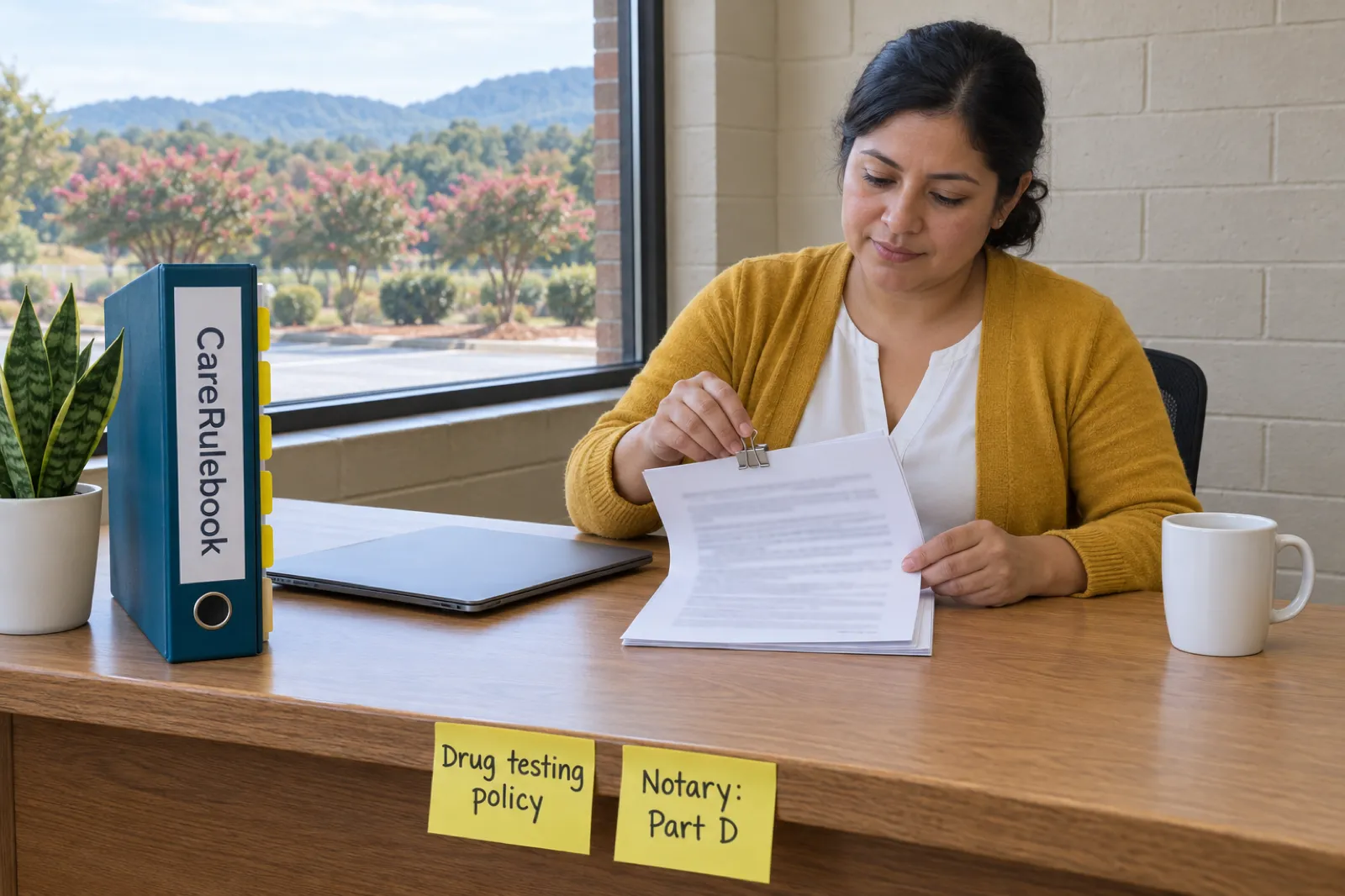
The statute: "A licensed in-home provider and an individual employed as an in-home caregiver by a licensed in-home care provider are subject to random drug testing." (S.C. Code 44-70-70) The rule turns that into a policy duty: "The provider’s policies and procedures must address random drug testing and describe the procedure chosen." (R.60-122 §402.C) What the rule says the policy has to cover:
What the rule leaves to you. It sets no testing frequency and no share of staff to test, and DPH has published no guidance on what it looks for. By our reading, the policy should say how people are picked (so that the choice is random), how often, who orders and reviews tests, how an office kit is used if you use one, and what happens to a signer who tests positive, because the rule speaks only to caregivers there. The pre-employment test is a separate duty (R.60-122 §402.B).
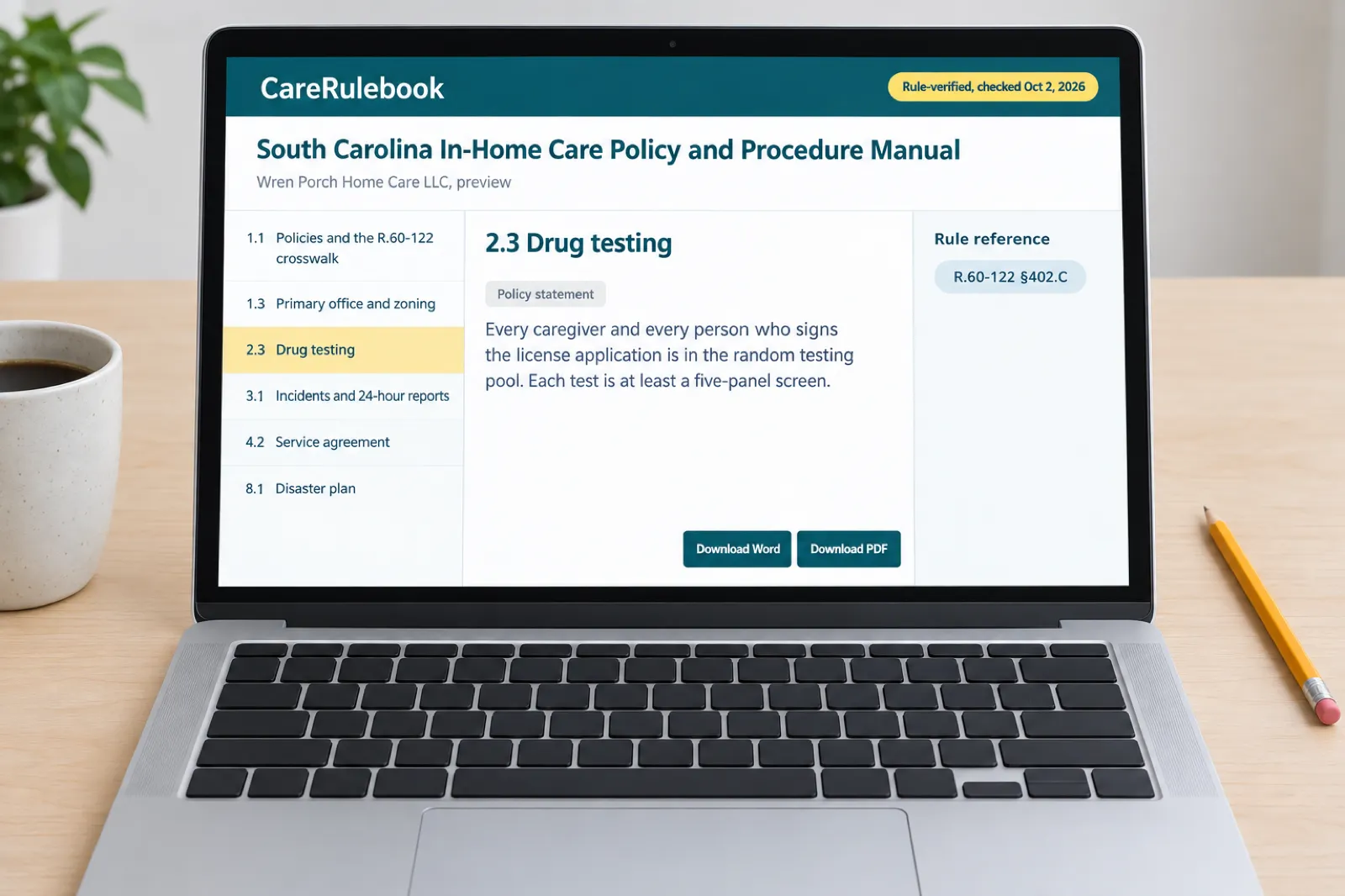
In CareRulebook’s South Carolina manual this is policy 2.3, and it also comes as its own file to attach to Form 1307. Preview the manual.
The statute sets the duty: "Before becoming licensed as an in-home care provider, a person must undergo a criminal record check as provided for in regulations promulgated by the department pursuant to Section 44-70-40 and submit to a drug test." (S.C. Code 44-70-60(A)) The rule applies it to everyone who signs the application.
Each signer "shall undergo a State Law Enforcement Division (SLED) name-based criminal records check", and the evidence must not be older than 90 calendar days when DPH receives it (R.60-122 §103.G). SLED says a CATCH search is name-based only and covers South Carolina records only. (SLED CATCH) It costs $25 plus an online service fee (SLED CATCH, Fees & Payments). By our reading a CATCH report is the check the rule means, but DPH has not said so; ask DPH.
What bars a license. No license if a signer must register as a sex offender or has a conviction or plea for abuse, neglect or exploitation of a vulnerable adult, unlawful conduct toward or cruelty to children, any violent crime, any other drug-related felony, or forgery, embezzlement or breach of trust with fraudulent intent. Signers must report such convictions to DPH immediately. (R.60-122 §103.G.1-2) This list is for the signers; caregivers have their own list (R.60-122 §405.G).
Each signer takes a 5-panel urine, hair, saliva or blood screen for cannabis, cocaine, amphetamines, opiates and phencyclidine. "The test must be taken not earlier than thirty (30) days before the Department’s receipt of the licensure application." (R.60-122 §103.H) "Test results shall be received and reviewed by a person other than the person being tested and who is not related to the person being tested by blood or marriage." (R.60-122 §103.H) A positive test means denial unless a physician states it came from a prescribed medication (R.60-122 §103.H).
The documentation. For a laboratory test, the documentation is the laboratory’s result. For a test done in the office: the name, date, time and signature of the person tested and of the unrelated reviewer, the type of screen with the kit’s manufacturer and model, the date, time and result, and the kit’s lot number and expiry date. (R.60-122 §103.H.1-5)
Both windows run to the day DPH receives the application, not the day you sign it. By our reading, order the SLED check and take the drug test in the last few weeks before you send, and email the application, DPH’s preferred method (Form 1307, p. 1), so the receipt date is clear. After licensing, signers stay subject to random drug testing (R.60-122 §402.C).
These are DPH’s fees, set by R.60-122 §103 and repeated in DPH’s FY2026 fees report (FY2026 Fees and Fines Report). They are paid to the state and are not CareRulebook prices.
| DPH fee (state fee) | Amount | Source |
|---|---|---|
| DPH initial in-home care provider license fee | $1,000 | R.60-122 §103.I |
| DPH annual license renewal fee | $800 | R.60-122 §103.I |
| DPH late renewal fee | $200 | R.60-122 §103.J |
| DPH amended license fee | $50 | R.60-122 §103.L.3 |
| DPH reinstatement of a suspended license | $400 | R.60-122 §103.K.1 |
How to pay. The rule says fees are paid to DPH "via a secured portal or specific website" and are not refundable (R.60-122 §103.I), and "Proof of payment is required for all applications submitted." (Form 1307, Instructions) Neither the form nor DPH’s in-home care page names the portal; ask DPH (803-545-4370) how to pay before you send.
If DPH says no. "If the application is denied, a portion of the fee may be refunded based upon the remaining months of the licensure year." (R.60-122 §103.I)
Other costs (not DPH license fees). SLED CATCH checks for the signers, drug screens, the insurance, and an office in a commercially zoned or unzoned area are market costs we have not surveyed. License cost and timeline.
Once licensed. Post the license in a public area of the business office, or keep it readily available to the public. (R.60-122 §103.C.1) A license covers a named provider at specific locations: the primary office and any registered multiple locations. (R.60-122 §103.C.4) Every caregiver then needs a criminal record check, registry checks and a negative drug test before starting (R.60-122 §402, §405). Caregiver background checks.
CareRulebook
CareRulebook’s South Carolina manual follows R.60-122 section by section, as rewritten on May 22, 2026, with your agency’s details filled in and the rule quoted under each policy. Your random drug testing policy also comes as its own file, ready to attach to Form 1307 with your initial application and each renewal. Policy 1.1 shows which policy answers each section of the rule.
$199CareRulebook founding price for the first 50 South Carolina agencies, then $249. Not a DPH fee.
"The provider may request a variance to this regulation in a format as determined by the Department." DPH decides case by case and may revoke a variance (R.60-122 §103.N). DPH has a form for this. DPH’s Request for Exception to Licensing Standard (0226-ENG-DPH) is for licensed and proposed providers. It asks for the standard, the specific requirement, why the exception is needed and how the protection the standard gives will still be provided. Send it to ExR.BHFL@dph.sc.gov or by mail; DPH answers in writing. (Form 0226-ENG-DPH) If DPH approves an exception, the applicant signs and returns DPH’s letter for it to take effect; DPH’s instructions say not returning it within 7 days counts as withdrawing the request. Keep a copy of the decision for inspections. (Form 0226-ENG-DPH, Instructions)
The rule says "variance" and the form says "exception"; by our reading the form is the format DPH has set for both. The case most agencies ask about is the office: an agency licensed before May 22, 2026 and run from a home in a residential zone. The zoning rule has no exception for earlier licensees (R.60-122 §103.D.1), so ask before you rely on one. The primary office and zoning.
It depends. Not as a set submission. Only the random drug testing policy goes in with the application (and again at each renewal). But DPH may not issue an initial license until you show substantial compliance with the standards, and inspections are unannounced, so the full manual should be in place before you apply. Ask DPH whether it inspects before the first license.
"A copy of your Random Drug Testing Policy"
No. DPH’s form asks for it with initial and renewal applications, together with your liability insurance and workers’ compensation coverage. The 2026 rule lists it with the initial application only, but the form is what DPH processes, so by our reading send it every year. It is the one policy DPH’s form asks you to send; the rest of your manual must be in place and ready to show DPH, but is not sent.
"Additional Documents (to be submitted with your Initial and/ Renewal Application)"
No. Each signer’s SLED check must be no older than 90 calendar days when DPH receives the application, and the drug test no earlier than 30 days before DPH receives it. Time both close to the day you send the form, and send by email (DPH’s preferred method) so the receipt date is clear.
"The test must be taken not earlier than thirty (30) days before the Department’s receipt of the licensure application."
No. The rule bars operating as an in-home care provider, and also representing yourself as one, which it spells out as advertising or marketing, before DPH issues the license. If DPH finds services being given without a license, the owner must stop at once and make sure clients are safe.
"represent itself (advertise and/or market) as an in-home care provider in South Carolina without first obtaining a license from the Department"
No. A license is not assignable or transferable, and a change in controlling interest needs a new license, applied for before the change. DPH’s form says the new owner completes the change of ownership section and both owners sign it, and that Initial is not the box to tick for a change of ownership. Until DPH acts, the seller stays responsible for renewing on time.
"Application must be completed by new owner, as licenses are not transferable."
No. R.60-122 treats a change of legal entity as a change of licensee, which needs a new license applied for before the change, even when the same people stay in control. An amended license ($50, a DPH fee) is for a move to another site or a change of name or postal address.
"A change of the legal entity, for example, sole proprietorship to or from a corporation, partnership to or from a corporation, even if the controlling interest does not change."
It depends. Only if it is in a commercially zoned area with a county or municipal zoning permit, or in an unzoned area with a letter from the county or municipality saying a provider may be operated there. That is the rule for the primary office since May 22, 2026. By our reading, a home in a residential zone does not qualify; ask DPH about your address. SCDHHS already required a commercially zoned or unzoned office for Medicaid agencies.
"The primary office must be in an office that is in a commercially zoned or unzoned area."
It depends. DPH charges $1,000 for the initial license and $800 a year to renew. A late renewal adds $200, an amended license is $50 and reinstating a suspended license is $400. Fees are non-refundable. Budget too for liability insurance or a surety bond ($100,000 per occurrence, $300,000 aggregate), workers’ compensation, background checks and drug tests.
"The initial license fee shall be one thousand dollars ($1,000)."
Fill in DPH’s Licensure Application for In-Home Care Provider (Form 1307-ENG-DPH), Parts A and B, and sign Part D under oath before a notary: the owner or owners, the head of an LLC, or two officers of a corporation. Attach your random drug testing policy, your liability insurance or surety bond and your workers’ compensation coverage, which the form lists; the rule also asks for indemnity coverage and each signer’s SLED check and drug test. Add proof that you paid DPH’s $1,000 fee and email it all to IHCP@dph.sc.gov, DPH’s preferred method, or mail it to the Bureau of Health Facilities Licensing, P.O. Box 2046, West Columbia, SC 29171.
DPH’s form asks for one policy, the random drug testing policy, with initial and renewal applications. The rest of your manual is not sent, but the rule requires written policies for each section of R.60-122, and DPH will not issue a first license until you show substantial compliance with the standards, so have them all in place before you apply.
The rule does not say. It defines an inspection as a DPH visit to a proposed or licensed provider, and says DPH uses inspections, applications and other documents to enforce the rule. Whether DPH visits every applicant before the first license is not stated, and we could not confirm DPH’s practice. Ask DPH, and be ready for a visit.
DPH does not publish a processing time, and the rule sets none. DPH’s form says missing information may delay processing. We cannot give you a date; ask DPH at 803-545-4370.
DPH’s form says the owner or owners for an individual business, the head of the limited liability company for an LLC, two officers for a corporation, and the head of the department for a government unit. The rule names the owners of an individual business or a partnership, and two officers of a corporation. Everyone who signs needs a SLED check and a drug test, and is subject to random drug testing afterwards.
DPH’s form asks for the random drug testing policy, your liability insurance and your workers’ compensation coverage with renewal applications, and the name must appear exactly as it did the year before. DPH’s renewal fee is $800. If the renewal or fee is not in by the expiration date, DPH adds a $200 late fee, and 30 days after expiry an agency that has not renewed is unlicensed.
Apply for an amended license before the move, or before a change of name or postal address. DPH’s fee is $50 for each amendment. On Form 1307, tick Change Request and complete only Parts C and D. A new primary office still has to be in a commercially zoned or unzoned area.
The rewritten R.60-122 took effect on May 22, 2026, and DPH updated Form 1307 in August 2026. We found no proposal to amend the rule since. Leave your email and we will tell you when a South Carolina change affects your application, your renewal or your policies.
No spam. Only emails about South Carolina home care rule changes. How we use your email.
South Carolina
How to start a home care agency in South Carolina
Who needs the license, what changed on May 22, 2026, the zoned office and DPH’s fees.
Tool
South Carolina license checklist
Every step to a DPH license, or to the 2026 rule if you are already licensed, tailored and emailed to you.
Manual
South Carolina policy manual
Policies for each section of R.60-122, with the drug testing policy as its own file for Form 1307. Preview free.
South Carolina
South Carolina license cost and timeline
DPH’s fees, the other costs and why no processing time is published.
South Carolina
The South Carolina administrator and office
The administrator, the zoned primary office and multiple locations.
South Carolina
South Carolina caregiver background checks
SLED or FBI checks, registries, disqualifying offenses and drug tests.
South Carolina
South Carolina policies and procedures
What R.60-122 asks your policies to cover, section by section.
North Carolina
The North Carolina license application
DHSR reviews your policies before it licenses you.
Georgia
The Georgia license application
DCH’s application checklist, GAHLES and a three-month provisional license.
Tennessee
The Tennessee license application
Four forms to a TDMHSAS regional office and an electronic desk audit.
Kansas
The Kansas license application
An emailed application, then policies uploaded into 13 folders for KDHE’s review.
Virginia
The Virginia license application
The VDH OLC Portal, the prelicensure consultation and renewal every three years.