
Skip to content
CareRulebook
MenuClose

Where are you starting?

United StatesTexas, North Carolina, Georgia, Virginia, Indiana, Ohio, New York, Illinois, Washington, Colorado, Tennessee, Maryland, Kansas, South Carolina, Nevada
TexasManual
North CarolinaManual
GeorgiaManual
VirginiaManual
IndianaManual
OhioGuideNew YorkGuide
IllinoisManual
WashingtonManual
ColoradoManual
TennesseeManual
MarylandManual
KansasManual
South CarolinaManual
NevadaManual
All US states →
United KingdomEngland
Free toolsChecklists, calculators and templates

Kansas · Home health vs home care · K.S.A. 65-5101; K.A.R. 28-51-100, -105

Kansas home health vs home care: Supportive Care and Skilled Services

In Kansas, KDHE licenses non-medical home care and home health alike as a home health agency, at two levels. The Non-Medical Supportive Care Services license allows no nursing of any kind; the Skilled Services license covers nursing, Medicaid HCBS attendant care and supportive care. Here is how they differ, where supportive care stops, why homemaker-only work is a gray area, what the office rules ask, and what CMS’s 2026 home health moratorium does and does not touch.

  • Rule-verified October 2, 2026
  • Quoted from K.S.A. 65-5101 and K.A.R. 28-51
  • With KDHE’s Letter of Introduction, April 2026 answers and CMS QSO-26-11
A man in a rust plaid flannel shirt at a farmhouse kitchen table, pen in hand, looks down at two manila folders labelled Supportive care and Skilled Services, beside a CareRulebook binder, a blue enamel mug and a sticky note reading No nursing, with prairie, a fence and a lone tree outside the window

Quick answer

Kansas has one home health agency license from KDHE, at two levels. "Non-Medical Supportive Care Services. This can also be referred to as either chore, companion, or in-home services." KDHE Letter of Introduction Under it, "A person that applies for a license to provide only supportive care services shall not provide nursing services." K.A.R. 28-51-105(e)

The Skilled Services license covers nursing and other home health services, HCBS waiver services and supportive care, KDHE, Skilled Services and "A Clinical Manager (Registered Nurse) is required." Letter, Option 1 KDHE says KDADS "requires Skilled Services HHA licensure for all waiver programs". Letter of Introduction

Homemaker-only work is a gray area: KDHE’s 2024 letter says every agency must be licensed, but its April 2026 answers say homemaker-type tasks need no hands-on care and are offered by businesses, such as cleaning agencies and ride share companies, that are not required to be licensed. KDHE answers, April 2026

$250

KDHE’s fee to apply for Supportive Care Services (under 100 clients)

K.A.R. 28-51-101(a)(1)(B)(iii)

$500

KDHE’s fee to apply for Skilled Services (under 100 clients)

K.A.R. 28-51-101(a)(1)(B)

2 years

Nursing experience for a Skilled Services RN clinical manager

K.A.R. 28-51-100(k)

200 miles

Service area around the parent office

K.A.R. 28-51-100(vv)

The two licenses side by side

Both levels are a Home Health Agency license from KDHE under the same Act and rules. K.S.A. 65-5102 KDHE describes the first level as Skilled Services together with HCBS attendant care, "(also now called Personal Care Services)", with supportive care included. Letter of Introduction, p. 1 Fees below are KDHE’s, not CareRulebook prices.

Non-Medical Supportive Care ServicesSkilled Services
What it coversSupportive care only: chore and companionship services and hands-on help with activities of daily living such as bathing, dressing, eating, medication reminders, transferring, walking, toileting and continence care. KDHE, Non-Medical Supportive Care ServicesSkilled care (nursing, with an order from the patient’s provider), HCBS waiver services and supportive care. KDHE says it covers all home health services allowed by law in Kansas. KDHE, Skilled Services
NursingNone of any kind, including a nurse supervising, delegating or doing assessments. K.A.R. 28-51-105(e); attestation formSkilled services must include nursing, supervised by a registered nurse or clinical manager, with a registered nurse’s evaluation of each patient within 48 hours of referral. Letter, Option 1; K.A.R. 28-51-105(a)
Who runs itAn administrator, an alternate administrator and a supervisor or manager function. No registered nurse. Letter of Introduction, Option 2An administrator and alternate, plus a clinical manager who is a registered nurse. If neither administrator is a physician or RN, the clinical manager is a Kansas RN with at least two years of nursing experience. Letter, Option 1; K.A.R. 28-51-100(k)
CaregiversSupportive care workers. CNAs and home health aides may work as supportive care workers, but may not use their certification’s skilled tasks. The rules set competency topics, not training hours. Attestation form; K.A.R. 28-51-117(c)-(d)Home health aides: Kansas certified nurse aides on the registry who complete a 20-hour home health aide course and pass a state test, supervised by a registered nurse every 14 days or as applicable. K.A.R. 28-51-113(a)-(b); Letter, Option 1
Orders and planNo physician order. The manager assesses each client and writes the plan of care, reviewed at least every 60 days. Letter, Option 2; K.A.R. 28-51-104(c)(3)Skilled services need an order from the patient’s physician, nurse practitioner, clinical nurse specialist or physician assistant. Letter, Option 1
Supervisory visitsThe manager visits each client every three months to supervise the worker. K.A.R. 28-51-104(c)(3)(K), -117(e)Every two weeks where nursing or therapy is provided; at least every 60 days if only personal care is provided. K.A.R. 28-51-104(c)(1)(K)
PayersKDHE says mainly private pay, private duty and some private insurance. No Medicare certification. KDHE, Non-Medical Supportive Care Services; Letter, Option 2Required for all HCBS waiver programs and by many payers, including Veterans Affairs. CMS certification is available. Letter, p. 1 and Option 1
KDHE fee to apply$250 under 100 unique clients a year; $500 for 100 or more. K.A.R. 28-51-101(a)(1)(B)$500 under 100; $750 for 100 or more. K.A.R. 28-51-101(a)(1)(B)
KDHE renewal fee$100 a year under 100 unique clients; $350 for 100 or more. K.A.R. 28-51-101(b)(2)$350 a year under 100; $600 for 100 or more. K.A.R. 28-51-101(b)(2)
PoliciesKDHE says all policies should be specific to non-medical supportive care services. Letter, Option 2KDHE says policies must say which level each applies to: skilled services, HCBS or supportive care. Letter, Option 1

This site covers the supportive care license in depth: the administrator, alternate and manager on Kansas administrator and manager requirements, and the application on the Kansas license application. For Skilled Services, start with KDHE’s Skilled Services page and application.

What the statute means by each service

A home health agency is an organization that provides, for a fee, at the client’s home, one or more of three kinds of service. K.S.A. 65-5101(c)(1)

  • Home health services means "any of the following services provided at the current residence of the patient on a full-time, part-time or intermittent basis: Nursing, physical therapy, speech therapy, nutritional or dietetic consulting, occupational therapy, respiratory therapy, home health aide or medical social service". K.S.A. 65-5101(d)
  • Supportive care services: Help with activities of daily living that the client could do if physically able (bathing, dressing, eating, medication reminders, transferring, walking, mobility, toileting and continence care), given at home, that does not need supervision by a healthcare professional such as a physician assistant or registered nurse. Supportive care "does not include any home health services". K.S.A. 65-5101(k)
  • Attendant care services means "basic and ancillary services provided under home and community based services waiver programs". K.S.A. 65-5101(a) The in-home care statute says basic attendant services include health maintenance activities, which "include, but are not limited to, catheter irrigation; administration of medications, enemas and suppositories; and wound care". K.S.A. 65-6201(b), (d) K.S.A. 65-6201 lists homemaker-type and companion-type services as "ancillary" to basic attendant care for someone who needs at least one basic service. K.S.A. 65-6201(c)

By our reading, this helps explain why KDHE puts attendant care with Skilled Services: it can include health maintenance tasks such as giving medications and wound care, which a supportive care worker may not do. KDHE’s own reason is that HCBS waiver services may include medical services driven by a plan of care. Letter, Option 1 (HCBS)

Where supportive care stops

KDHE’s attestation, which every supportive care applicant signs: "Nursing services of any kind are prohibited with a Supportive Care Services license. This includes a nurse providing supervisory, assignment, delegation, oversight, medication administration/set-up, wound care", treatments, assessments or other nursing activities. Attestation Form, p. 2 The 16 assigned duties in K.A.R. 28-51-117(g) set the rest of the line. Where it falls on some common tasks:

  • Medication. Supportive care workers and other staff of a supportive care agency may not take part in medication administration or set up medications. Workers help only with medications already sorted into marked reminder containers. K.A.R. 28-51-117(g)(1) No unlicensed employee of a home health agency may prefill insulin syringes; doing so is a class C misdemeanor. K.S.A. 65-5116(b)
  • Skin and wounds. Skin care only on unbroken skin without active chronic skin problems; no applying medication, wound care or dressing changes. K.A.R. 28-51-117(g)(2)
  • Catheters and ostomies. Workers may empty urinary collection devices, including catheter bags, and empty ostomy bags; inserting or removing catheters, external catheter care, suppositories and enemas are not allowed. K.A.R. 28-51-117(g)(13)
  • Feeding. Help with feeding only if the client can chew and swallow without difficulty and stay upright; no syringe, tube or IV feeding. Clients at high risk of choking or aspiration need a licensed home health agency. K.A.R. 28-51-117(g)(7)
  • Nails and oxygen. Supportive care workers may soak, push back cuticles without utensils and file nails; nail trimming is only for agencies licensed for home health services. K.A.R. 28-51-117(g)(10) Workers may remove and replace a cannula or mask to wash or shave, and may set oxygen flow by written instructions when changing tanks if specifically trained and competent. Respiratory care is skilled and not allowed. K.A.R. 28-51-117(g)(15)-(16)

Stay within your level. "Each home health agency shall offer only the home health services, HCBS, or supportive care services specified on the home health agency’s initial application or renewal application." K.A.R. 28-51-101(d)(2) KDHE says that, through surveys, it has found that blending services under one license often leads to agencies not complying with the regulations. KDHE answers, April 2026, p. 8 More on surveys in KDHE surveys and plans of correction.

Every duty and its limits: what Kansas non-medical caregivers can and cannot do.

Attendant care and Medicaid HCBS need Skilled Services

KDHE’s letter to applicants: KDADS, which oversees the HCBS programs, "requires Skilled Services HHA licensure for all waiver programs", and in some circumstances CMS certification for some waiver programs. Letter of Introduction, p. 1 "We recommend you check with the KDADS HCBS program regarding specific waiver requirements beyond licensure." Letter of Introduction, p. 1

  • Other payers. "Many payor programs, including Veterans Affairs, require Skilled Services HHA licensure", so KDHE says to check your payer programs’ requirements before applying. Letter, Option 2 The supportive care license is mainly for private pay, private duty and some private insurance. KDHE, Non-Medical Supportive Care Services
  • Self-directed care is different. The Nurse Practice Act does not prohibit attendant care services directed by or for an individual in need of in-home care (the self-directed HCBS model). It is not a basis for a supportive care agency to do health maintenance tasks. K.S.A. 65-1124(l) Self-directed workers employed under K.S.A. 39-7,100(b)(2) are outside the Home Health Agency Act. K.S.A. 65-5112(f)
  • An old opinion. Attorney General Opinion 2016-7 said a business providing only attendant care services did not need a home health agency license. It predates the 2017 amendments to the Act (L. 2017, ch. 17), and the current K.S.A. 65-5102 names attendant care services in the license duty. K.S.A. 65-5101, annotations
  • Switching later. The rules do not say how a supportive care licensee moves to Skilled Services. By our reading it means a Skilled Services application to KDHE, with the higher fee and an RN clinical manager in place; ask KDHE first.

Homemaker and companion only: a gray area

KDHE has said two different things.

  • 2024: KDHE’s letter says "currently the Secretary of KDHE requires all agencies to be licensed as a home health agency in the state of Kansas unless the individual or persons are part of a recognized church or religious denomination". KDHE Letter of Introduction Its license page says the supportive care license includes "chore and/or companionship services". KDHE, Non-Medical Supportive Care Services
  • April 2026: answering providers who asked for rules on housekeeping, meals, shopping, laundry and transportation, KDHE wrote: "These activities do not require hands-on care and many of these are available by businesses (cleaning agencies, grocery store delivery services, ride share companies, etc.) not required to be licensed as a home health agency." KDHE answers, April 2026, p. 36

Our reading: the license duty attaches to supportive care services, which the statute defines as help with activities of daily living, and names medication reminders among them. K.S.A. 65-5101(k) So a business offering only housekeeping, meals, shopping, laundry, errands, rides or companionship, with no hands-on help, probably needs no license; once you help with bathing, dressing, eating, transfers, walking, toileting or medication reminders, you need the supportive care license. KDHE has not confirmed this. Ask KDHE in writing before you operate without a license, because operating without one is a class B misdemeanor. K.S.A. 65-5114

Who else is outside the Act, and the quiz to check your plan: who needs a license, on the Kansas guide.

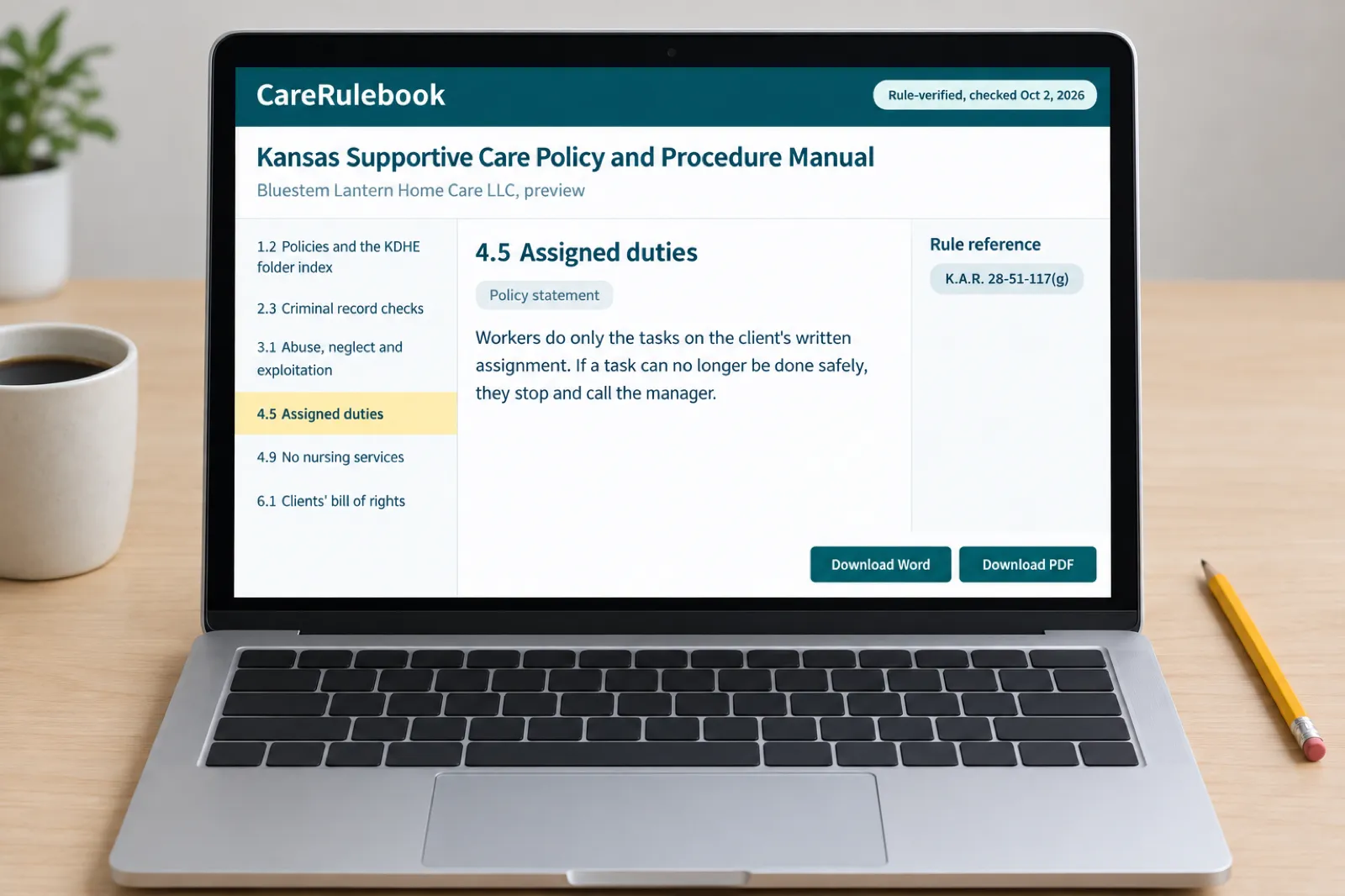
The CareRulebook Kansas manual preview on a laptop: policy 4.5 on assigned duties for a sample agency, citing K.A.R. 28-51-117(g), with six of the manual’s policies listed beside it

CareRulebook

A manual that keeps a supportive care agency inside its license

CareRulebook’s Kansas manual is written for the Non-Medical Supportive Care Services license. Policy 4.2 sets out what your workers do, Policy 4.5 the 16 assigned duties, Policy 4.9 gives KDHE the statement that nursing is not provided and insulin syringes are never prefilled, and Policy 1.4 covers your office, office hours and service area.

  • 31 policies, 130 requirements mapped to K.A.R. 28-51 and K.S.A. 65-5101 to 65-5117
  • No nursing anywhere: a manager, not a nurse, assesses and supervises
  • Editable Word and print-ready PDF, with the rule quoted under each policy
Preview your manual

$199CareRulebook founding price for the first 50 Kansas agencies, then $249. Not a KDHE fee.

Office and premises rules, for either level

The office rules are the same for both levels. "Each parent office shall have a local street address with a local telephone number and shall be continuously staffed during posted and advertised office hours." The office hours are posted for public view, and no PO box may be the parent office. K.A.R. 28-51-100(hh) Office hours are "the times of the day and days of the week that a parent office is open and staffed to serve the public". K.A.R. 28-51-100(ff)

What KDHE says the office is for

  • Visitors. "Current and potential clients and patients should be able to visit the agency to request records, ask questions", or file a complaint. "Staffing the office during posted and advertised office hours ensures that clients and patients have an avenue to address their needs." KDHE answers, April 2026, p. 2
  • Surveyors. KDHE told providers in April 2026 that the current and drafted rules require an office the public can visit to ask about services and get records, and that surveyors can visit for surveys. KDHE answers, April 2026, p. 6
  • Hours. "The current and proposed regulations do not detail the required hours an agency must be open." KDHE answers, April 2026, p. 2
  • Second offices. KDHE says an office other than the parent office that keeps records is a branch office, which posts office hours and is staffed during them; an office used only for supply storage or staff documentation and not open to the public is not a branch office. KDHE answers, April 2026, p. 6

Can the office be in your home?

The rules do not say, and neither do KDHE’s documents. Nothing we found rules a home out, but the office must have a local street address, be staffed during the hours you post and advertise, and by KDHE’s account be a place clients can visit and surveyors can access. K.A.R. 28-51-100(hh) By our reading, a home office works only if you can meet all of that, including letting the public in during posted hours. Ask KDHE before you name a home address, and check your city or county zoning rules for running a business from home, which KDHE’s rules do not cover.

Around the office

  • Service area. You serve clients only within "a geographic region within a 200-mile radius of a home health agency’s parent office". K.A.R. 28-51-100(vv) The administrator must reside within the service area; KDHE asks for evidence that the administrator and alternate live within 200 miles of the parent office. K.A.R. 28-51-103(b)(2)
  • The license on the wall. "Licenses shall be posted in a conspicuous place in the main offices of the licensed home health agency." K.S.A. 65-5104(d)
  • Moving. Tell KDHE before moving the parent office or changing the phone number; tell KDHE in writing within five days after a change of address or name and send back the old license for an amended one. K.A.R. 28-51-101(f)-(g)
  • Agencies from other states. If a bordering state does not license home health agencies, or its rules are not substantially the same as Kansas's, an agency from that state "shall meet all requirements of this act and shall operate in Kansas from offices located in Kansas". K.S.A. 65-5104(f)

Drafted, not in force: a fixed office with a private space

Each parent and branch office would be a fixed physical office able to conduct day-to-day business, staffed in advertised hours, with posted hours, no PO box, and a private space for confidential document review, interviews and conversations; branch offices get administrator visits. Summary of Changes Guide KDHE’s October 2025 slides list "Have a designated space available for clients, patients, and surveyors which allows for confidential review of documents, interviews, and conversations." Listening session slides, slide 11 KDHE’s draft rewrite of K.A.R. 28-51 must still go through formal public comment; KDHE says it will tell agencies when the Notice of Public Hearing appears in the Kansas Register. None was found by October 2, 2026. Summary of Changes Guide, Introduction By our reading, if you choose an office now, one with a room where you can talk to a client or surveyor privately would also suit the draft.

Federal · Medicare enrollment · from May 13, 2026

Medicare and CMS’s 2026 home health moratorium

In Kansas, only a Skilled Services agency can be Medicare-certified: "Certification through CMS is not available to a Non-Medical Supportive Care Services Licensure only." Letter, Option 2 KDHE’s directory on October 2, 2026 listed 346 home health agency rows, 68 of them with the facility type Medicare. KDHE directory

CMS’s memo QSO-26-11: "Effective May 13, 2026, CMS will halt the enrollment of new Hospice and HHA providers or HHA branch or practice locations." QSO-26-11

  • How long. The moratorium lasts six months and can be extended for further six-month periods; any extension or lifting is announced in the Federal Register. QSO-26-11 Six months from May 13, 2026 runs to about November 13, 2026, by our arithmetic, unless CMS extends it.
  • No exceptions. CMS regulations do not permit exceptions to the moratorium for individual providers. QSO-26-11
  • Applications. Initial Medicare enrollment applications submitted during the moratorium are denied and must be resubmitted once it is lifted; applications received before May 13, 2026 continue to be processed. QSO-26-11

What it means, by our reading. The memo is about Medicare enrollment, not state licenses, and does not mention non-medical home care. It does not affect a Kansas supportive care license. For a planned Medicare home health agency, the KDHE Skilled Services license comes first, and new Medicare enrollment is closed while the moratorium lasts.

Which license matches your plan

Find the line closest to what you will offer. Fees are KDHE’s, not CareRulebook prices, and depend on whether you expect fewer than 100 unique clients a year. Lines marked "by our reading" are ours; check with KDHE before you apply.

If you plan to offerLicenseKDHE feeSource
Bathing, dressing, eating, toileting, transfers, walking or medication reminders, with no nursing, paid privatelyNon-Medical Supportive Care Services$250 or $500 to applyK.S.A. 65-5101(k)K.A.R. 28-51-101(a)
Housekeeping, meals, shopping, laundry, errands, rides or companionship only, with no hands-on helpNot settled; by our reading probably none. Ask KDHENone, if no licenseKDHE answers, April 2026KDHE letter, 2024
Medicaid HCBS waiver services, such as attendant or personal care paid by KanCareSkilled Services$500 or $750 to applyKDHE Letter of IntroductionK.S.A. 65-5101(a)
Personal care paid by Veterans Affairs or another payer programUsually Skilled Services; check the payer first$500 or $750 to applyLetter, Option 2
Nursing, therapy, home health aides or medication administrationSkilled Services, with an RN clinical manager$500 or $750 to applyK.S.A. 65-5101(d)Letter, Option 1
Medicare-certified home healthSkilled Services, then CMS certification (new Medicare enrollment halted from May 13, 2026)$500 or $750 to applyLetter, Option 1QSO-26-11
Caring for clients yourself, with no business and no employeesOutside the ActNoneK.S.A. 65-5112(a)

Myths about home health and home care in Kansas

Do I need a license in Kansas if I only offer companionship and housekeeping?

It depends. It is not settled, and KDHE has said both things. The license duty covers supportive care services, which the statute defines as help with activities of daily living. KDHE’s 2024 letter says every agency must be licensed, and its license page lists chore and companionship services within this license. Yet its April 2026 answers to providers say homemaker-type tasks (housekeeping, shopping, laundry, transportation) need no hands-on care and are offered by businesses, such as cleaning agencies and ride share companies, that are not required to be licensed. Our reading: a business with no hands-on help probably needs no license, and once you help with bathing, dressing, eating, medication reminders, transfers, walking or toileting, you need the Non-Medical Supportive Care Services license. Ask KDHE before operating without one.

"not required to be licensed as a home health agency"

Can a non-medical home care agency in Kansas bill Medicaid (KanCare HCBS)?

No. Not with the supportive care license. KDHE says KDADS requires the Skilled Services home health agency license for all HCBS waiver programs, and many payers, including Veterans Affairs, also require it. The non-medical license is mainly for private pay, private duty and some private insurance.

"requires Skilled Services HHA licensure for all waiver programs"

Can my Kansas supportive care agency add nursing or Medicaid waiver work later under the same license?

No. Not under the supportive care license. The rule limits each agency to the services named on its initial or renewal application, and a supportive-care-only licensee may not provide nursing. Nursing and HCBS waiver work need the Skilled Services license, which needs a registered nurse clinical manager and has higher KDHE fees. The rules do not say how an existing licensee moves from one level to the other, so ask KDHE before you plan the change.

"Each home health agency shall offer only the home health services, HCBS, or supportive care services specified on the home health agency’s initial application or renewal application."

Does the 2026 CMS home health moratorium stop me opening a Kansas supportive care agency?

No. By our reading. CMS’s May 2026 memo halts new Medicare enrollment of home health agencies and hospices. It is about Medicare enrollment, not state licenses, and KDHE says Medicare (CMS) certification is not available to a supportive-care-only license anyway. It matters only if you plan a Skilled Services agency that wants Medicare certification.

"Effective May 13, 2026, CMS will halt the enrollment of new Hospice and HHA providers or HHA branch or practice locations."

Do I need a registered nurse to open a non-medical home care agency in Kansas?

No. A supportive-care-only agency needs an administrator, an alternate administrator and a manager, not a nurse. In fact it may not provide nursing services of any kind, and KDHE’s attestation says that includes a nurse supervising or delegating. If you want to offer nursing or Medicaid waiver services, or be paid by Veterans Affairs, you need the Skilled Services license, which requires a registered nurse clinical manager.

"A person that applies for a license to provide only supportive care services shall not provide nursing services."

Can I run a Kansas home care agency from my home?

It depends. The rules do not say. The parent office needs a local street address and phone, must be staffed continuously during posted and advertised office hours with the hours posted for public view, and cannot be a PO box. KDHE says staffing the office in those hours gives clients an avenue to address their needs. Whether a residence meets this, and local zoning, is something to confirm with KDHE and your city.

"Each parent office shall have a local street address with a local telephone number and shall be continuously staffed during posted and advertised office hours."

Frequently asked questions

Is home care the same as home health in Kansas?

Not quite, though one agency licenses both. KDHE licenses non-medical home care and home health alike as a home health agency, at two levels. The Non-Medical Supportive Care Services license covers chore, companionship and hands-on help with daily living, with no nursing of any kind. The Skilled Services license covers nursing and other home health services, Medicaid HCBS waiver services and supportive care, and needs a registered nurse clinical manager.

Can a Kansas supportive care agency employ a nurse?

Not for nursing. The rule says an agency licensed only for supportive care services shall not provide nursing services, and KDHE’s attestation form says that includes a nurse supervising, assigning, delegating, overseeing, setting up medication, doing wound care, treatments or assessments. The manager who assesses clients and supervises caregivers does not need to be a nurse.

Which license do I need to bill KanCare for attendant care?

The Skilled Services license. KDHE says KDADS requires Skilled Services licensure for all HCBS waiver programs, and CMS certification for some of them. In the Home Health Agency Act, attendant care services are basic and ancillary services provided under the waiver programs. KDHE recommends checking with the KDADS HCBS program about each waiver’s requirements beyond licensure.

Do I need a license for companion and housekeeping services only?

It is not settled. The statute defines supportive care services by hands-on help with activities of daily living, including medication reminders. KDHE’s 2024 letter says every agency must be licensed, and its license page lists chore and companionship services within this license. In April 2026, KDHE told providers that housekeeping, meals, shopping, laundry and transportation need no hands-on care and are offered by businesses not required to be licensed. Our reading: with no hands-on help, you probably need no license. Ask KDHE before you rely on it.

Can my Kansas home care office be in my house?

The rules do not say. The parent office needs a local street address and phone number, must be continuously staffed during the office hours you post and advertise, must post those hours for public view, and cannot be a PO box. KDHE told providers in April 2026 that current and potential clients should be able to visit the agency to request records, ask questions or file a complaint, and that surveyors access the office for survey visits. Ask KDHE whether your home meets this, and check local zoning.

How many office hours does a Kansas home health agency need?

No minimum is set. KDHE says neither the current nor the drafted rules set the hours an agency must be open. Office hours are the times of day and days of the week the parent office is open and staffed to serve the public, and the office must be staffed during the hours you post and advertise.

Can I open a Medicare home health agency in Kansas in 2026?

Not with new Medicare enrollment for now. CMS halted the Medicare enrollment of new home health agencies nationwide from May 13, 2026, for six months, extendable for further six-month periods, with no exceptions for individual providers. Initial applications submitted during the moratorium are denied and must be resubmitted after it is lifted. In Kansas, Medicare certification is available only with the Skilled Services license. The moratorium does not affect a supportive care license, which cannot be Medicare-certified.

Does the CareRulebook manual cover Skilled Services?

No. CareRulebook’s Kansas manual is written for the Non-Medical Supportive Care Services license. Policy 4.2, Provision of supportive care services and the supportive care worker’s scope of practice, sets out what your workers do, and Policy 4.9, Nursing services (not provided) and no prefilling of insulin syringes, gives KDHE the written statement that nursing is not provided. Policy 1.4 covers your office, office hours and service area.

Get Kansas rule-change alerts

KDHE has drafted a rewrite of the home health agency rules that would split the license into three types, narrow the supportive care task list and add fixed-office requirements. Leave your email and we will tell you when it is formally proposed, or when another Kansas change affects your license or your policies.

No spam. Only emails about Kansas home care rule changes. How we use your email.

Keep reading

Sources

  1. K.A.R. 28-51-100 to 28-51-118, Home Health Agency Licensure (as amended or adopted in Kansas Register Vol. 41, No. 18, May 5, 2022, effective May 20, 2022; 28-51-108 and 28-51-114 to -116 from the Cornell LII mirror) · Kansas Secretary of State, Kansas Register (KDHE regulations); Cornell Legal Information Institute mirror · retrieved October 2, 2026
  2. K.S.A. 65-5101 to 65-5117, Home Health Agency Act (65-5101 as amended by L. 2025, ch. 85) · Kansas Office of Revisor of Statutes · retrieved October 2, 2026
  3. K.S.A. 65-6201, individuals in need of in-home care: definitions (attendant care services, basic and ancillary services) · Kansas Office of Revisor of Statutes · retrieved October 2, 2026
  4. K.S.A. 65-1124, Nurse Practice Act: acts which are not prohibited · Kansas Office of Revisor of Statutes · retrieved October 2, 2026
  5. HHA Letter of Introduction, with Two Options for State of Kansas HHA Licensure and Packet Submission Requirements (reviewed/revised 03/2024) · Kansas Department of Health and Environment, Bureau of Facilities and Licensing · retrieved October 2, 2026
  6. Home Health Agency Non-Medical Supportive Care Services Attestation Form (reviewed/revised 03/2024) · Kansas Department of Health and Environment, Bureau of Facilities and Licensing · retrieved October 2, 2026
  7. Non-Medical Supportive Care Services (license scope, documents, renewal, criminal record check) · Kansas Department of Health and Environment · retrieved October 2, 2026
  8. Skilled Services (license scope) · Kansas Department of Health and Environment · retrieved October 2, 2026
  9. 2025 Home Health Agency Regulations Summary of Changes Guide (September 8, 2025), with the October 9, 2025 Supportive Care listening session slides and KDHE’s answers to feedback (April 2026) · Kansas Department of Health and Environment, Bureau of Facilities and Licensing · retrieved October 2, 2026
  10. HHA Listening Sessions Questions and Feedback (KDHE responses; PDF dated April 14, 2026) · Kansas Department of Health and Environment, Bureau of Facilities and Licensing · retrieved October 2, 2026
  11. Directory of KDHE Regulated Health Care Facilities (CSV export, October 2, 2026) · Kansas Department of Health and Environment (hosted on webapps.kdads.ks.gov) · retrieved October 2, 2026
  12. QSO-26-11-HHA & Hospice: Six-Month National Moratoria on Hospice and Home Health Agency Enrollment (May 20, 2026) · Centers for Medicare & Medicaid Services · retrieved October 4, 2026
Build your Kansas manualfrom $199