Skip to content
CareRulebook
MenuClose

What do you run?

Home care in the US19 states with a manual, 6 with a free guide
ColoradoManual
ConnecticutPack
DelawareManual
GeorgiaManual
IllinoisManual
IndianaManual
KansasManual
MaineManual
MarylandManual
MinnesotaManual
NevadaManual
North CarolinaManual
OklahomaManual
OregonManual
South CarolinaManual
TennesseeManual
TexasManual
VirginiaManual
WashingtonManual
CaliforniaGuideFloridaGuideNew JerseyGuideNew YorkGuideOhioGuidePennsylvaniaGuideAll US home care states →
Care homes in the US4 states with a manual, 1 with a free guide
Home care in the UKEngland, Scotland, Wales
Free toolsChecklists, calculators and templates

Georgia · Personal care homes · Chapter 111-8-62

How to open a personal care home in Georgia (the DCH permit, 2026)

To open a personal care home in Georgia, a home where two or more unrelated adults live and get help with daily living, you need a permit from the Georgia Department of Community Health (DCH). You apply online, a surveyor inspects the home before the permit is issued, and your written policies on 16 topics named in the rule should be in place by then. This guide walks through each step, quoted from Chapter 111-8-62 and DCH’s own forms.

  • Rule-verified November 17, 2026
  • Quoted from Chapter 111-8-62 and DCH’s forms
  • 21 sources
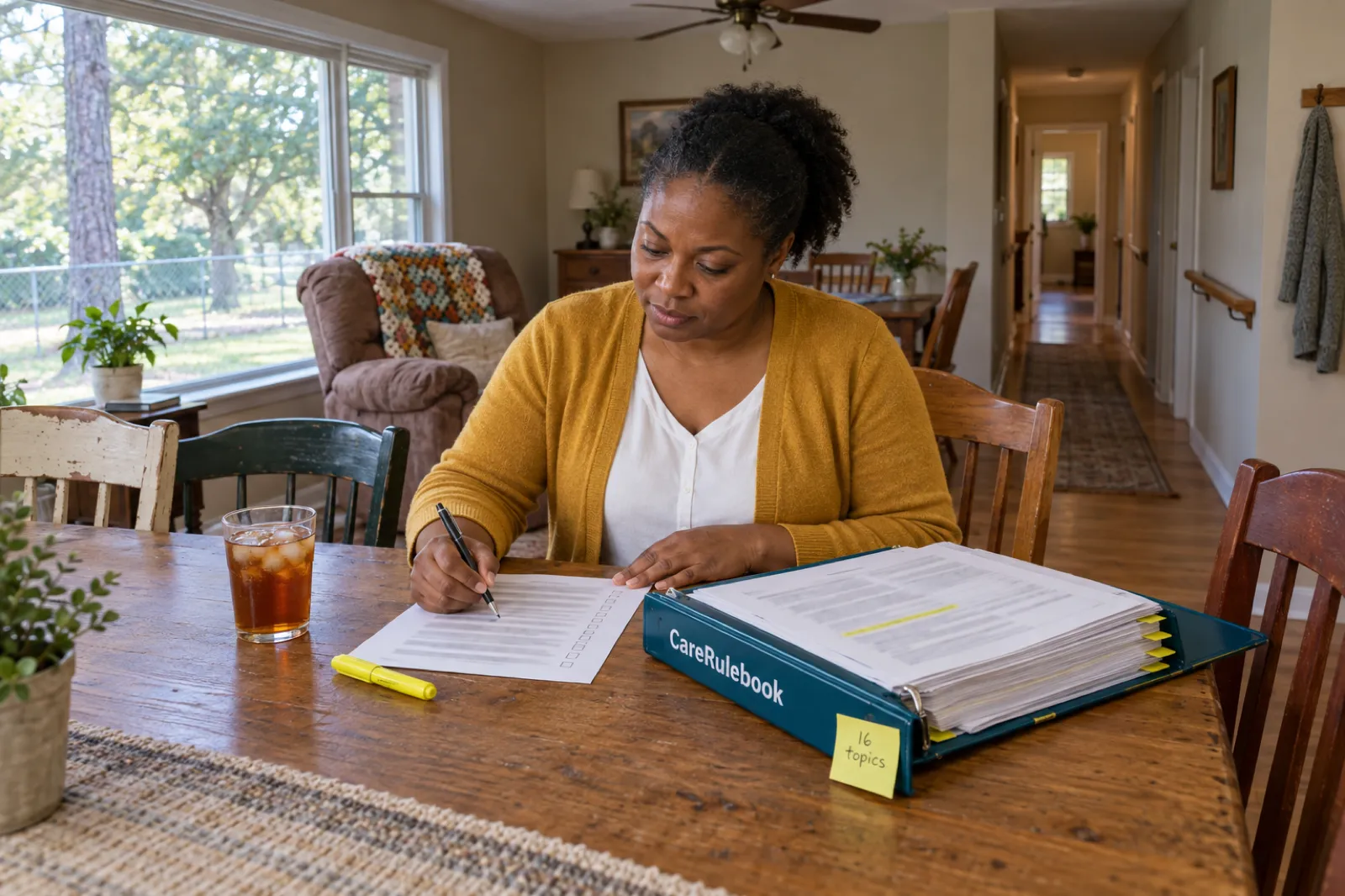
A woman in a mustard cardigan at a farmhouse dining table in a Georgia ranch house ticks off a printed list beside a teal CareRulebook binder with yellow tabs, a sticky note reading 16 topics, a highlighter and a glass of iced tea, with a recliner, a hallway handrail and pine trees through the window

Running a home care agency instead? Georgia licenses home care separately: read the Georgia home care guide or build the Georgia policy manual.

Quick answer

The rule is plain: "The governing body of each personal care home must obtain a valid permit from the Department prior to operating as a personal care home" (Rule 111-8-62-.06(1)). A personal care home is a dwelling that gives housing, food service and at least one personal service to two or more adults who are not related to the owner or administrator (.03(bb)).

You apply online with DCH’s checklist and fees. Your policies are not on the upload list (our reading), but they must be in place and readily available on request (DCH application checklist); DCH’s older guidance said before the initial inspection and the permit. A surveyor inspects the home before the permit is issued. Under 25 beds, the administrator needs no state license, and a home without a memory care center needs no nurse; DCH’s fees start at $300 to apply and $350 a year (DCH fee schedule).

About the rule text. Quotes from Chapter 111-8-62 are checked word for word against the rule text published by the Georgia Secretary of State, in a copy of the live page saved on November 17, 2026. DCH’s 2026 proposal is not in it (Secretary of State, Chapter 111-8-62).

1,339

Personal care homes operating on November 15, 2024, in the state auditor’s count

State audit, June 2025

16

Policy topics Rule 111-8-62-.07(3) names, from services to the staffing plan

Rule 111-8-62-.07(3)

$300

DCH’s application fee, plus the first permit fee ($350 for 2 to 24 beds). DCH fees, not CareRulebook prices

DCH fee schedule

25

Beds at which a licensed administrator, two staff on site and more rules begin

Rule 111-8-62-.08(1)(b), .10(1)(b)

Direct answers

Who licenses personal care homes in Georgia?

The Georgia Department of Community Health (DCH), through its Healthcare Facility Regulation Division’s Personal Care Home Program, under Chapter 111-8-62 of the Georgia rules. A personal care home needs a DCH permit before it operates, and no resident may be admitted without a current permit.

Rule 111-8-62-.06(1)

How much does a personal care home permit cost in Georgia?

DCH charges a $300 application processing fee and a first permit fee equal to the annual fee: $350 a year for 2 to 24 beds, $750 for 25 to 50 and $1,500 for 51 or more. A memory care certificate is $200 a year. Those are DCH’s fees, not CareRulebook prices.

DCH fee schedule, October 2024

Do I send my policies to DCH with the application?

Not as an upload, by our reading of DCH’s current checklist: it lists 14 items (13 documents and the fee) and no policies, and reminds applicants that all policies and procedures must be in place and readily available on request. DCH’s older guidance said to have them at the home for the initial inspection, before the permit.

DCH application checklist

Does a Georgia personal care home need a nurse?

Not a basic one. Staff help residents with medications they take themselves, and the home may not admit anyone who needs continuous nursing care. A memory care center needs a registered nurse or licensed practical nurse for set hours each week, and a home using certified medication aides needs a registered nurse or pharmacist for quarterly checks.

Rule 111-8-62-.15(1)(e), .19(5)(d), .20(6)(c)

Interactive check

Do you need a Georgia personal care home permit?

Where will the people you serve live?

Pick the option closest to your plan.

Who needs a personal care home permit in Georgia

A personal care home is "any dwelling, whether operated for profit or not, which undertakes through its ownership or management to provide or arrange for the provision of housing, food service, and one or more personal services for two or more adults who are not related to the owner or administrator by blood or marriage" (Rule 111-8-62-.03(bb)). Personal services "includes, but is not limited to, individual assistance with or supervision of self-administered medication, assistance with ambulation and transfer, and essential activities of daily living such as eating, bathing, grooming, dressing, and toileting" (.03(cc)). There is no separate small-home permit: a home with two residents and a home with forty hold the same kind of permit, with some rules that change at 25 beds.

One resident: our reading

The definition needs two or more unrelated adults, so a home caring for one unrelated adult falls outside it, and a second unrelated resident brings you under the permit. Relatives of the owner or administrator by blood or marriage do not count. Our reading: ask DCH before you rely on serving one person without a permit.

  • No residents before the permit. "No personal care home shall be operated and no residents admitted without such a permit which is current under these rules and regulations." (.05(10)) DCH’s fee rule lists a $550 involuntary application processing fee after an unlicensed complaint investigation, a DCH fee (Rule 111-8-25-.03(8)).
  • One permit per address. "A permit is required for each home located on different premises where more than one home is operated under the same governing body." (.06(5)) A home may not serve more residents than its approved licensed capacity (.06(3)), and the permit must be returned when the home closes, moves, changes ownership, significantly changes its governing body, or is suspended or revoked (.06(4)).
  • Dementia care needs a certificate. "No licensed personal care home may provide or hold itself out as providing specialized care for residents with probable Alzheimer's disease or other dementia" unless it meets the memory care center rules (.19(11)). See the memory care certificate.
  • No continuous nursing care. "No home is permitted to admit residents who either require continuous medical services or continuous nursing care and treatment." (.15(1)(e)) Residents buy periodic health services from licensed providers; the home may help arrange them, not provide them (.15(1)(f)).

Who is exempt

The rule lists settings that are not personal care homes (.04(2)), among them "Boarding homes or rooming houses which provide no personal services other than lodging and meals", emergency shelters, facilities regulated by the Department of Behavioral Health and Developmental Disabilities (DBHDD), host homes, free charitable shelters, community living arrangements and VA medical foster homes.

Personal care home, assisted living community or CLA?

In Georgia, a personal care home and an assisted living community are different licenses from the same DCH program, and a third, the community living arrangement, sits beside them.

Georgia personal care homes, assisted living communities and community living arrangements compared
Personal care homeAssisted living communityCommunity living arrangement
RulesChapter 111-8-62Chapter 111-8-63Chapter 290-9-37
SizeTwo or more unrelated adults; no upper limit in the definition25 residents or more2 to 4 beds, in the state auditor’s table
MedicationsStaff help residents who take their own medications; certified medication aides only in a home with a memory care center, where they may also help other residents in the same building (our reading, .06(7) and .20(6))Certified medication aides may administer medicationsNot covered here
Who it servesAdults who are ambulatory and can get themselves to safety with minimal help, apart from up to three aging in place exceptionsAdds help with evacuation and limited nursing servicesHomes funded by DBHDD through Medicaid waivers
Operating on November 15, 20241,3393031,202

From Rule 111-8-62-.03(bb), .15(1)(b), .03(f), .04(2)(i) and the state auditor’s Exhibit 1 (State audit, June 2025).

  • Assisted living is a separate license. DCH describes an assisted living community as "a personal care home serving 25 residents or more that is licensed by the department to provide assisted living care" (DCH Personal Care Homes page). The rule for your home is direct: "A home licensed as a personal care home, but not specifically licensed as an assisted living community, must not provide assisted living care" (Rule 111-8-62-.06(7)). Assisted living care "includes the provision of personal services, the administration of medications by a certified medication aide, the provision of assisted self-preservation, and the provision of limited nursing services" (.03(f)). DCH’s packet has a separate application to convert a personal care home to an assisted living community, with a minimum of 25 beds (DCH application packet).
  • The name is protected. "A personal care home which is not licensed as an assisted living community must not use the term "assisted living" in its name or marketing materials." (.11(8)) DCH’s notice adds that it will not issue an initial permit to a personal care home using the term in its name or marketing unless it is applying as an assisted living community (DCH notice).
  • Community living arrangements are homes DCH classifies under the Chapter 290-9-37 rules; the state auditor describes them as homes for two or more unrelated adults supported by DBHDD funds from Medicaid waivers. "A facility classified as a Community Living Arrangement cannot be operated on the same premises as a personal care home." (.04(2)(i)) We do not cover them in this guide.

Rules that change with the number of beds

Chapter 111-8-62 and DCH rules by licensed beds
SizeWhat appliesSource
Every homeAn administrator, on-site manager or responsible staff person on the premises 24 hours a day, at least one staff person per occupied floor; at least one person trained under .09(2) present whenever residents are; staff above the minimum ratios when residents’ needs require it..10(1)(b) .09(3) .10(1)
2 to 24 bedsAt least one awake direct care staff person per 15 residents while residents are awake and per 25 at night, where residents have minimal care needs. An administrator with an associate’s degree, or a diploma or GED and 2 years’ experience; no state license. DCH’s annual fee $350..10(1) .08(1)(a) DCH fees
7 beds or moreA sprinkler system, on DCH’s application checklist.DCH checklist
25 beds or moreA Letter of Determination from DCH’s Office of Health Planning and a CPA’s financial stability affidavit with the application; an administrator licensed by the State Board of Long-Term Care Facility Administrators; a monthly average of one awake direct care staff person per 15 residents awake and per 20 at night, calculated on DCH’s methods and forms; two staff on the premises at all times, one posted on each occupied floor unless the home has a medical alert system; a food service permit (25 or more residents); staff ID badges (more than 24 residents); a pandemic plan and next-day outbreak notices under Chapter 111-8-16. DCH’s annual fee $750 (25 to 50) or $1,500 (51 or more).DCH checklist .05(9) .08(1)(b) .10(1) .10(1)(b) .21(5) .10(8) 111-8-16-.04(7) 111-8-16-.05(1)

Letter of Determination or Certificate of Need? DCH’s checklist asks homes of 25 or more beds for "a Letter of Determination approved by DCH Office of Health Planning (OHP)" (DCH checklist), whose Office of Health Planning charges $500 to file a determination request (OHP forms page). The state auditor’s 2025 report says an "approved Certificate of Need must be obtained before HFRD will consider" applications for homes of that size (State audit, p. 3). We follow DCH’s checklist; ask DCH’s Office of Health Planning which applies to your plan. Neither applies under 25 beds.

The application and the initial inspection

You apply through DCH’s online portal, GAHLES (DCH application checklist). DCH’s checklist for an initial personal care home application has 14 items:

  1. Secretary of State registration for your business, or other proof of legal authority.
  2. City or county zoning approval (Rule 111-8-62-.05(7) leaves zoning to local officials).
  3. A notarized affidavit of personal identification, and
  4. a copy of the photo ID shown to the notary.
  5. Proof of ownership or legal control of the property.
  6. A fire safety inspection report showing capacity, with no violations, dated within 12 months; a sprinkler system from 7 beds (item 6).
  7. An electrical inspection compliance form from a Georgia licensed electrician, dated within 6 months of submission; the rule allows a licensed electrician or local code enforcement official, within six months before filing (.13(3)).
  8. A floor sketch with every room labeled, bedroom measurements, doors, windows and bed placement (.05(4)).
  9. The online owner form.
  10. A satisfactory GCHEXS fingerprint determination letter, dated within 12 months, for administrators and owners of 10% or more (item 10).
  11. Water source and sewage approval.
  12. For 25 or more beds, the Letter of Determination, and
  13. the notarized Affidavit of Financial Stability.
  14. The licensure fee.

The checklist opens with a reminder: "As a reminder, all policies and procedures must be established as part of the requirements for regulations and readily available upon request." (DCH application checklist). Our reading: you do not upload your policies, but they must be written and at the home before the inspection. If DCH asks for more documents, "failure to upload the requested documents will result in the denial of your application" (checklist). "Application fees are non-refundable. All licensure fees must be paid in full prior to receiving a permit or license" (checklist).

The initial inspection

The state auditor describes the process: "HFRD conducts an initial inspection to verify facility's compliance with licensure requirements." "After the surveyor confirms all requirements are met, the facility is granted its license to operate and house residents." (State audit, p. 3)

What DCH’s older guidance said about policies

DCH’s current checklist says little more than the reminder above. Its superseded 2017 packet was more explicit: policies had to be developed before HFRD granted a permit and before the on-site inspection, and "Written Policies and Procedures should be on-site (at the home) during the initial inspection. Do not mail the Policies and Procedures in with your application" (DCH packet, 2017, Step K). That packet included a policies and procedures checklist dated January 7, 2013, with 18 items, marked for information only (DCH packet, 2017). HFRD’s 2013 interpretive guidelines say "Policies must be developed prior to granting a permit", and that all staff must be trained on the home’s policies (HFRD guidelines, tag A0703). In those guidelines, survey tags A0704 to A0719 follow the 16 topics of Rule 111-8-62-.07(3)(a) to (p) one to one; DCH has not said whether its current system still uses them (HFRD guidelines). Both are old guidance: they show how surveyors have read the rule, not the rule itself.

The Affidavit of Compliance

DCH’s packet includes a notarized Affidavit of Compliance in which the governing body’s authorized representative attests that the entity "has developed policies and procedures mandated under the rules and regulations", ticking the chapter that applies (Chapter 111-8-62 for a personal care home). It also accepts that, once licensed, the home is "subject to unannounced periodic inspections at which time the policies and procedures shall be readily available for review for sufficiency and compliance with applicable rules and regulations", and that deficient policies may bring sanctions under Chapter 111-8-25 (DCH application packet). In the current checklist the affidavit is listed under memory care certification, not among the 14 initial items (checklist). Our reading: it is required with a memory care certification; whether the online application also asks for it at the initial stage, we could not see without an account.

After the permit

  • Inspections. "Unannounced compliance inspections for healthcare facilities are conducted approximately every 11 to 15 months or as needed." (DCH Personal Care Homes page) The home and its records must be open to DCH’s representatives (.11(1)).
  • Plan of correction. "Within 10 days of receipt of the written report of inspection, the home must develop a written plan for correcting any rule violations identified." (.11(2)) Post the latest report and plan in the home; a home with a website links to all reports and plans from the last 18 months on its main page (.11(4)).
  • Fines. Up to $2,000 a day for each violation, and no more than $40,000 for violations found in the same inspection (Rule 111-8-25-.05(1)(e)).

CareRulebook

Your policies must be in place and readily available on request, and a DCH surveyor inspects before the permit.

CareRulebook’s Georgia personal care home manual answers each of the 16 topics in Rule 111-8-62-.07(3), in the rule’s order, and the other written duties of Chapter 111-8-62. Your home’s details go in throughout, and the rule each part meets is quoted under it.

  • One policy for each of the 16 topics, with titles drawn from the rule’s words, and a disaster preparedness plan written to Chapter 111-8-16
  • An admission agreement content schedule, not a contract template. Have a Georgia lawyer review your admission agreement, refund and deposit terms and discharge notices before you use them
  • A basic home needs no clinical sign-off. With a memory care center, certified medication aides or proxy caregivers, your nurse or pharmacist reviews and adopts those policies before you use them
  • Holding or applying for a memory care center certificate? Section 7 adds the written description families get before admission and the center’s operations
  • A DCH policy topic index with the pages in your manual for each topic, and an admission packet
  • 32 policies and documents (34 with a memory care center) mapped to 168 requirements, in Word and PDF, with 12 months of updates
Preview your manual

$299CareRulebook founding price for the first 50 Georgia homes, then $349. Not a DCH fee.

Free sample, no email needed

Read a full policy before you buy

Policy 5.4, Disaster preparedness plan (111-8-16), as it prints in the Georgia personal care home manual, filled in for a fictional home. The rule text it rests on is quoted word for word under Rule basis.

PDF · 27 pages · 249 KB · Rule-verified November 17, 2026

Collecting answers for a home or a client? The intake questionnaire lists all 88 questions the builder asks, what each decision changes in the manual, and a completed example: Word · PDF.How consultants use CareRulebook.

Download the sample (PDF)
Or email it to me

We send the link once. Nothing else unless you tick the box. Privacy notice.

How a new personal care home gets its permit, step by step

Tick steps off as you go. Your progress is saved in this browser only.

  1. Decide your size and services

    Before applying

    Your number of beds sets DCH’s fee band and some rules, with a step at 25 beds. Decide whether you will offer memory care, allow proxy caregivers and use a medical alert system. Rules by size.

    Rule 111-8-62-.10(1)
  2. Form the business and secure the house

    Before applying

    Register the business with the Secretary of State, get proof of ownership or a lease, and settle zoning with your city or county. What DCH asks for.

    Rule 111-8-62-.05(7)
  3. Inspections and building papers

    Before applying

    A fire safety inspection showing capacity, dated within 12 months (a sprinkler system from 7 beds); an electrical inspection within 6 months; water and sewage approval; a floor sketch with room measurements and bed placement.

  4. Fingerprint checks for owners and administrators

    Before applying

    Administrators and individual owners of 10% or more complete a fingerprint-based check through GCHEXS; the satisfactory determination letter must be dated within 12 months of the application.

  5. 25 beds or more: two extra papers

    Before applying

    A Letter of Determination from DCH’s Office of Health Planning (a $500 filing fee, DCH’s) and a financial stability affidavit from a certified public accountant.

    Rule 111-8-62-.05(9)
  6. Write your policies and plans

    Before applying

    Policies on the 16 topics in Rule 111-8-62-.07(3), the admission agreement and written house rules (.16(1)), and the disaster preparedness plan (.08(4)), ready at the home. The 16 topics.

    Rule 111-8-62-.07(3)
  7. Apply online in GAHLES

    Day 0

    Upload the checklist documents and pay DCH’s $300 application fee and the first permit fee. DCH acts only on a complete application.

    Rule 111-8-62-.05(2)
  8. The initial inspection, then the permit

    After DCH reviews

    A surveyor inspects the home to verify it meets the licensing requirements; once the surveyor confirms all requirements are met, the permit is granted. No resident may be admitted before then.

    State audit, p. 3
  9. Post the permit and admit residents

    Permit day

    Display the permit where residents and visitors can see it, and serve no more residents than your licensed capacity.

    Rule 111-8-62-.06(2)-(3)
  10. Memory care certificate, if you want one

    After the permit

    Once you hold the permit, apply for the certificate with a notarized Affidavit of Compliance ($200 a year, DCH’s fee). What it takes.

  11. Every year

    Every year

    Pay the annual fee between October 1 and December 31 for the next year. DCH says it inspects about every 11 to 15 months, unannounced (DCH Personal Care Homes page).

    DCH annual fee notice

How long it takes. DCH publishes no review time for personal care homes that we found; for assisted living communities its packet says "the initial review timeframe is 30 business days from the application submission date" (DCH assisted living community packet).

Buying an existing home? The permit does not transfer: it "is no longer valid and must be returned to the Department" when the ownership changes (.06(4)). The current owner gives DCH and every resident at least 30 days’ written notice of the change (.08(7)(b)); the notice to DCH takes the form of the new owner’s application, and DCH’s packet has a separate change of ownership checklist.

The administrator and staff

Administrator, under 25 beds

  • At least 21
  • An associate’s degree, or
  • a GED or high school diploma and 2 years’ experience in a licensed personal care home or other healthcare setting
  • No state administrator license
.08(1) .08(1)(a)

Administrator, 25 beds or more

  • At least 21
  • A license from the State Board of Long-Term Care Facility Administrators
  • Effective no more than 60 days from the date of hire
.08(1)(b)
  • What the administrator does. The administrator or on-site manager must "ensure that the policies and procedures are effective and enforced to support the health and safety of the residents", name responsible staff to act in their absence (never a resident), investigate serious incidents and monitor staff (.08(2)).
  • Ages. "The on-site manager and all other direct-care supervisory staff working in a personal care home must be at least 21 years of age. Non-supervisory staff providing hands-on care to the residents must be at least 18 years of age." (.09(1))
  • Someone always in charge. "At least one administrator, on-site manager, or a responsible staff person must be on the premises 24 hours per day and available to respond to resident needs, with a minimum of one staff person per occupied floor." (.10(1)(b))
  • Who counts toward the ratio. Cooks and maintenance staff without ongoing direct care training do not count, and "personnel who work for another entity, such as a private home care provider, hospice, or private sitters cannot be counted in the staff ratios for the home" (.10(1)(a)).
  • Staffing plan and schedules. Every home keeps an accurate staffing plan and monthly work schedules showing planned and actual coverage for each day and night, with the schedules kept for a year (.10(4)-(5)).
  • No nurse for a basic home. The rule names no nurse for a personal care home without a memory care center. Residents who need nursing get it from licensed providers they arrange (.15(1)(f)).

Background checks, health screening and training

Fingerprint records checks

Georgia’s check is a fingerprint records check under Chapter 111-8-12, run through DCH’s Georgia Criminal History Check System (GCHEXS), which covers personal care homes (Rule 111-8-12-.03(9)(a)).

  • Owners, before the permit. The owner complies with Chapter 111-8-12 before any new license is issued (.09(7)), and DCH’s checklist asks for GCHEXS letters for administrators and owners of 10% or more.
  • Directors, administrators and on-site managers, before they are employed (.09(8)).
  • Every direct access employee. "Prior to serving as a direct access employee, the home must obtain a satisfactory fingerprint records check determination for the person to be hired in compliance with the Rules and Regulations for Criminal Background Checks, Chapter 111-8-12." (.09(9))
  • Getting access. DCH’s Office of Inspector General says "owners or administrators of long-term facilities may request a facility account in GCHEXS" by sending its registration form (DCH GCHEXS page).
  • Employment history. The administrator or on-site manager obtains and verifies a five-year employment history for each employee where possible, and files it (.09(10)).

TB screening and a physical

The rule in force: "The administrator, on-site manager, and each employee must have received a tuberculosis screening and a physical examination by a licensed physician, nurse practitioner or physician assistant within twelve months prior to their employment with the home" (.09(6)). Staff returning after a significant illness or injury need a follow-up examination. DCH has proposed replacing this with a health screening program; see 2026 changes.

Training

  • In the first 60 days, each staff member gets work-related training in first aid, CPR with a return demonstration, emergency evacuation, residents’ needs, residents’ rights, recognizing and reporting abuse, neglect and exploitation (with a copy of the Long-Term Care Facility Resident Abuse Reporting Act) and infection control (.09(2)). At least one person with that training is in the home whenever residents are (.09(3)).
  • Every year. "All direct care staff, including the administrator or on-site manager, must have at least sixteen (16) hours of training per year." (.09(5))
  • Medications. Unlicensed staff who help residents with medications are trained on the home’s medication policy, labels, the rights of medication assistance, side effects, storage and the Medication Assistance Record (.20(3)), show a qualified supervisor their skills at hire and every year (.20(4)), and read, write and follow written instructions in English (.20(2)(b)).
  • Reviews. Unlicensed staff giving hands-on care have written initial and annual performance reviews, which may be skills competency checklists (.09(11)(f)).

Proxy caregivers

A proxy caregiver is "an unlicensed person or a licensed health care facility that has been selected by a disabled individual or a person legally authorized to act on behalf of such individual to serve as such individual's proxy caregiver" (Rule 111-8-62-.03(ee)). They perform health maintenance activities, which Chapter 111-8-100 says are "limited to those activities that, but for a disability, a person could reasonably be expected to do for himself or herself" (Rule 111-8-100-.03(f)), and not complex care such as intravenous medications, central line maintenance or complex wound care.

  • Every home has a policy on them, even one that allows none: "the specific use of proxy caregivers allowed within the home and the oversight of proxy caregivers the home requires or provides in accordance with Georgia law, these rules and the rules for proxy caregivers, Chapter 111-8-100" (.07(3)(n)). The admission agreement says whether residents may hire their own proxy caregivers or sitters, or must buy those services from the home or approved providers (.16(1)(i)).
  • Written informed consent. "No licensed facility will permit a proxy caregiver to provide health maintenance activities by or through the licensed facility unless the individual with a disability, or the legally authorized representative has executed an informed consent." (111-8-100-.04(2))
  • Training. A written curriculum developed by licensed healthcare professionals, skills checklists completed before a licensed professional, and re-checks at least yearly (111-8-100-.05(1)).
  • Medications. Proxy caregivers who give medications are trained on DCH’s medication administration curriculum, and "the training on medication administration must be provided by an appropriately licensed healthcare professional, e.g. registered professional nurse, advance practice registered nurse, physician's assistant, pharmacist or physician" (111-8-100-.05(4)). They must read and follow written English instructions and "have achieved at least a minimum score of 75 on the Test of Functional Health Literacy for Adults (TOFHLA)" (.05(6)). A licensed professional is called before they help with any new medication, and they may not mix, compound or calculate doses (.05(5), (7)).
  • Sitters and aides residents hire. If residents may hire their own, "the home must require assurance that the companion-sitter, proxy caregiver or aide so hired is familiar with emergency evacuation routes", with documentation that it meets Chapter 111-8-100 where it applies (.09(12)). They never count toward your staff ratio (.10(1)(a)).
  • A written care plan. A home that provides proxy caregivers writes each resident’s care plan within 14 days of admission (.17(9)).

Certified medication aides

In a basic personal care home, staff assist with or supervise medications residents take themselves (Rule 111-8-62-.20(2)). Certified medication aides (CMAs) go further and administer medications. In a memory care center, medications "must be provided to the residents by a proxy caregiver trained in accordance with the requirements of Chapter 111-8-100; a licensed registered nurse; a licensed practical nurse working under the supervision of a physician or registered nurse; or a certified medication aide" subject to the rule’s requirements (.20(5)).

  • A home using CMAs. "A home using certified medication aides must meet the requirements below. CMAs working in the memory care center may also assist non-memory care residents in the same building." (.20(6)) It checks the Georgia Certified Medication Aide Registry before an aide gives medications (.20(6)(a)); uses a registered nurse or pharmacist for quarterly random observations and a pharmacist for quarterly reviews of each resident’s drug regimen (.20(6)(c)-(d)); has a Georgia registered nurse, pharmacist or physician check each aide’s skills yearly (.20(6)(f)); and lets aides do only the listed tasks, from unit or multidose packaging (.20(6)(e)).
  • Hospice liquid morphine. Aides who give liquid morphine to hospice patients in the center are trained by a licensed hospice first and every year (.19(6)(d)), and the home keeps no more than 50 ml on site for each hospice patient with an order (.20(11)(f)).

Can a home without memory care use CMAs? Our reading

The rule is not clear. A personal care home "must not provide assisted living care" (.06(7)), and assisted living care is defined to include "the administration of medications by a certified medication aide" (.03(f)). Yet .20(6) speaks of any “home using certified medication aides”, and the statute also has a paragraph on medication aides in personal care homes, which we have not been able to read in full. Our reading: use CMAs to administer medications only with a certified memory care center, and ask DCH before using them anywhere else in the home.

GLP-1 medications

HB 659 (2026) revised the injectables item in the statute’s list for medication aides in personal care homes (O.C.G.A. 31-7-12(h)(4)(B)) to read: "Administer insulin, epinephrine, GLP-1, and B12 pursuant to physician direction" and protocol (HB 659, Section 1). The Governor signed it on May 5, 2026 (Georgia General Assembly, HB 659), as Act 385 (status history), and the General Assembly’s record gives its effective date as July 1, 2026 (effective date), the date Georgia law sets for an Act approved between January 1 and June 30 that names no other date (O.C.G.A. 1-3-4(a)(1)). The statute is in force. The rule has not caught up: it still lists insulin, epinephrine and B12 (.20(6)(e)), and DCH’s amendment to add GLP-1 is only proposed. Ask DCH before an aide gives a GLP-1 injection.

The memory care center certificate

A memory care center is a unit, or a whole home, that "holds itself out as providing additional or specialized care to persons with diagnoses of probably Alzheimer's or other dementias or with cognitive deficits that may place the resident at risk" (Rule 111-8-62-.03(v)), or that charges more for that care. "No memory care center shall be operated and no residents admitted without a certificate which is current under these rules and regulations." (.05(11))

  • Permit first. DCH’s packet: "Before you apply for a memory care certification, you must have a Personal Care Home permit." You apply with the identity affidavit, a copy of your photo ID and a notarized Affidavit of Compliance with the personal care home box ticked (DCH checklist). DCH’s fee is $200 a year (DCH fee schedule).
  • A written description of the center, with 12 named contents from its philosophy and staffing to fees, discharge and family involvement (.19(2)), given to anyone who asks and to the family or representative before admission (.19(3)).
  • Staffing. One dementia-trained direct care staff person per 12 residents awake and per 15 at night, on a monthly average; "One registered professional nurse, licensed practical nurse, or certified medication aide on-site or available in the building at all times"; and two direct care staff on site at all times (.19(5)).
  • Nurse hours. A registered nurse or licensed practical nurse for at least 8 hours a week for 1 to 12 residents, 16 for 13 to 30, 24 for 31 to 40 and 40 for more than 40 (.19(5)(d)).
  • Training. All staff get at least 4 hours of dementia orientation within 30 days (.19(6)(a)). Direct care staff also get "A minimum of sixteen (16) hours of specialized, competency-based training using forms specified by the department" (.19(6)(b)(ii)), then at least 8 hours every year (.19(6)(c)).
  • Admission and plans. A physical exam on DCH’s form showing probable Alzheimer’s disease or other dementia and a need for the center (.19(7)), then an individual service plan within 14 days, written by a team with input from each shift and updated at least quarterly (.19(8)-(9)).
  • The building. Among other features, "an effective automated device or system to alert staff to individuals entering or leaving the building in an unauthorized manner" (.19(4)), and therapeutic activities every week, some every day (.19(10)).

A home without a center that serves residents at risk of wandering away still needs elopement policies, safety devices that respect fire safety, and current pictures of those residents on file (.18).

Medical alert systems

A 2025 amendment added medical alert systems to the rule. A medical alert system is "any device or combination of devices used to detect and immediately communicate that an individual is experiencing a medical emergency", and DCH must approve the device for its effectiveness (Rule 111-8-62-.03(s)).

  • At 25 beds or more. Two staff must be on the premises at all times, one posted on each occupied floor; but, in the rule’s words, "the staff person posted on the designated floor may move about the premises as necessary if the personal care home has implemented a medical alert system and each resident has been offered a wearable device" that connects to the system (.10(1)(b)).
  • Homes relying on a system under the 25-bed rule must have a wearable sensor that lets residents call for help and tells staff who and where (.10(9)(a), (c)); "the home may encourage, but not require, residents to wear the sensor device and must ensure that residents who do not consistently wear the sensor device receive appropriate monitoring from staff" (.10(9)(b)); and written policies, with records, on testing and maintenance, training for residents and staff, outages and severe weather, and reviewing the system’s data (.10(9)(d)).
  • In the admission agreement. "For residents first admitted after July 1, 2025, information on the medical alert system, if applicable, including a statement explaining that use of the system is optional for residents." (.16(1)(m))

Our reading: the .10(9) requirements are written for homes that use a system to let floor staff move about under the 25-bed rule. A smaller home that uses one still gives the admission agreement information, and following .10(9) is good practice.

The 16 policy topics in Rule 111-8-62-.07(3)

The governing body puts in place policies, procedures and practices that support residents’ dignity, choice, independence and privacy, and "at a minimum, the policies and procedures that are developed must provide direction for the staff and residents on the following" (Rule 111-8-62-.07(3)):

The 16 policy topics in Rule 111-8-62-.07(3)(a) to (p), in the rule’s words
RuleThe rule’s words
(a)The services available in the home, including, personal services, memory care services/centers and any other specialized services such as designated proxy caregivers.
(b)Admissions, discharges and immediate transfers which ensure that the home does not admit or retain residents who need more care than the home is authorized or capable of providing.
(c)Refunds when a resident is transferred or discharged.
(d)Training and ongoing evaluation of staff, including specialized training if designated proxy caregivers are provided or memory care is offered.
(e)House rules and their enforcement.
(f)Protecting the rights of the residents as set forth in these rules.
(g)Medication management, procurement and the professional oversight provided for such services.
(h)Health and hygiene issues for residents and staff relating to infection control, work policies and return to work policies, food borne illnesses and reportable diseases.
(i)The investigation and reporting of abuse, neglect, exploitation of residents, residents' wandering away from the community, accidents, injuries and changes in residents' conditions to required parties.
(j)Discipline procedures for handling conduct which is inconsistent with the policies of the home committed by staff.
(k)Emergency preparedness, drills and evacuation requirements.
(l)Quality assurance and peer review mechanisms to determine opportunities for improving care utilizing information acquired from reports and investigations of serious incidents, including resident and family feedback.
(m)The use of volunteers, who have unsupervised access to the residents and their orientation regarding resident's rights and basic safety precautions.
(n)The specific use of proxy caregivers allowed within the home and the oversight of proxy caregivers the home requires or provides in accordance with Georgia law, these rules and the rules for proxy caregivers, Chapter 111-8-100.
(o)The safety and security precautions that will be employed by the home to protect residents from harm by other residents, designated proxy caregivers and other individuals, not employed by the home who routinely come into the home.
(p)The staffing plan which takes into account the specific needs of the residents and also includes arrangements for staffing in the absence of regularly scheduled staff.

Quoted from Rule 111-8-62-.07(3)(a) to (p), in order.

Other written documents the rules ask for

The 16 topics are not everything. Chapter 111-8-62 and the rules it brings in also ask for:

  • The admission agreement, in writing, covering fees and what they include, 30 days’ notice of increases for personal services and 60 for room and board, consent to release medical information, transport, the refund policy, a statement that residents do not work for the home, the house rules, sitters and proxy caregivers, how medications are handled, discharge, social media and photos, and any medical alert system (.16(1)(a)-(m)).
  • House rules, written and posted, consistent with residents’ rights (.16(1)(h)), and the Resident’s Bill of Rights given to each resident at admission (.25(2)).
  • A disaster preparedness plan under Chapter 111-8-16 (.08(4)), rehearsed at least twice a year (16-.03(1)), reviewed every year (16-.03(4)), with staff named to take part in the regional healthcare coalition (16-.03(3)).
  • Residents’ records: a needs assessment at admission, updated as things change (.17(8)); a daily Medication Assistance Record (.20(8)); and a file for each resident, including the National Sex Offender Registry search and any safety plan (.24(2)(s)).
  • Only if they apply: a written care plan within 14 days with proxy caregivers or memory care (.17(9)); elopement policies (.18(1)(a)); a written EPI pen protocol (.20(2)(a)7.); medical alert system policies (.10(9)(d)); a pharmacist’s drug policies with CMAs (.20(6)(d)(iii)); the memory care written description (.19(2)); a pandemic plan at 25 beds or more (16-.04(7)); and a plan of correction after an inspection (.11(2)-(3)).

Reporting. Call local police within 30 minutes of learning a resident is missing, and report the start and end of that Mattie’s Call to DCH within 30 minutes (.30(1)); report serious incidents to DCH within 24 hours (.30(2)); and report abuse or exploitation of a resident at once to DCH and law enforcement, then in writing to DCH within 24 hours (O.C.G.A. §31-8-82).

Fees: DCH’s

State fees for a Georgia personal care home
State fee (whose)AmountWhen
Application processing fee (DCH fee)$300application, paid on submission, non-refundable DCH fee schedule
Annual permit fee, 2 to 24 beds (DCH fee)$350year (the first permit fee, for the rest of that calendar year, is paid with the application) DCH fee schedule
Annual permit fee, 25 to 50 beds (DCH fee)$750year DCH fee schedule
Annual permit fee, 51 or more beds (DCH fee)$1,500year DCH fee schedule
Memory care certificate (DCH fee)$200year DCH fee schedule
Letter of Determination filing fee, 25 or more beds (DCH Office of Health Planning fee)$500determination request OHP forms page
Follow-up visit to a periodic inspection (DCH fee)$250visit, billed at the renewal date DCH fee schedule

These are the State of Georgia’s charges (DCH’s and its Office of Health Planning’s), not CareRulebook prices. DCH’s fee schedule is dated October 2024; we last checked it on September 30, 2026.

  • Your first year. The first permit fee is the same as the annual fee and is paid with the application fee (Rule 111-8-25-.03(8)), so a home of 2 to 24 beds pays DCH $650 to apply. DCH says that first fee covers the rest of the calendar year in which it is paid, and the fee billed from October to December is for the next year, so a home licensed late in the year pays again within weeks (DCH annual fee notice).
  • No expiration date. DCH’s notice: "The licenses issued by the department have issue dates and no expiration date. The licenses are valid until surrendered or revoked." (DCH annual fee notice)
  • The annual fee. "The annual fees are collected from October 1st through December 31st each year without penalty. A late fee of $150 is automatically added to the unpaid balance on January 1st each year." (DCH annual fee notice) DCH may revoke a license if the fee is unpaid 60 days after its written invoice (Rule 111-8-25-.03(7)).
  • Other DCH charges. A $550 involuntary application processing fee after an unlicensed complaint investigation (Rule 111-8-25-.03(8)), and fines of up to $2,000 a day per violation (Rule 111-8-25-.05(1)(e)).

We did not price the other costs: fingerprinting, the fire, electrical and water inspections, zoning, sprinklers, building work, the CPA’s affidavit, training and insurance.

2026: a proposed rule change and a new statute

DCH’s proposed change to .09 and .20: proposed, not adopted

On July 9, 2026 the Board of Community Health approved changes to Chapter 111-8-62 for initial adoption (Board summary, July 9, 2026). DCH scheduled a public hearing for August 11 and took written comments until August 13, 2026 (DCH public notice). The proposal would:

  • Health screening program. Each home would keep a health screening program for employees and contractors, with initial, routine and targeted screenings. (111-8-62-.09(6) (proposed))
  • TB screening by CDC guidance. All employees would be screened for TB before starting work under CDC baseline guidance for health care personnel. (111-8-62-.09(7) (proposed))
  • GLP-1 for certified medication aides. CMAs could give GLP-1 medications under physician direction and protocol, as HB 659 already allows by statute. (111-8-62-.20(6)(e)(ii) (proposed))

Status when we checked on November 17, 2026. DCH’s notice said "The Board expects to vote on the proposed changes at the Board meeting to be held on September 10, 2026" (DCH public notice). DCH’s schedule then said "The September board meeting is cancelled" (DCH Board schedule), and the Board’s August 13, August 27, October 8 and November 12 agendas had no Chapter 111-8-62 item. DCH’s public notices page listed no final adoption (DCH public notices), and the Secretary of State’s live page still had the current .09(6) and .20(6)(e)(ii) wording.

What to do now. Follow the rule in force: TB screening and a physical within 12 months before employment (.09(6)). If DCH adopts the change, we will update this guide; you can get an email when it happens.

HB 659: GLP-1 in the statute

HB 659 (2026) added GLP-1 medications to what certified medication aides may give under physician direction and protocol, in the statute for personal care homes (O.C.G.A. 31-7-12(h)(4)(B)) and for assisted living communities (HB 659). It has been in force since July 1, 2026 (Georgia General Assembly, HB 659; see certified medication aides); the rule still lists insulin, epinephrine and B12 until DCH adopts its change.

All states’ open changes are on our rule changes page.

How many personal care homes does Georgia have?

  • By type. The state auditor counted 1,339 personal care homes, 303 assisted living communities and 1,202 community living arrangements actively operating on November 15, 2024 (State audit, June 2025, Exhibit 1).
  • Residents. More than 2,800 Personal Care Home Program facilities in Georgia provide residential care to nearly 48,000 vulnerable residents, in the auditor’s words (State audit, summary). DCH’s own page puts its program at 2,910 facilities including adult day centers, serving about 55,000 residents; that page is undated (DCH Personal Care Homes page).
  • New homes. The auditor left out 302 facilities of the three types that opened after May 2023 (State audit, p. 9). That is roughly 190 to 200 new facilities a year across the three types (our arithmetic); the report does not say how many were personal care homes.
  • Inspections. The same report found that 43% (1,100) of 2,540 active facilities had no routine inspection between January 2019 and November 2024 (State audit, p. 9).

We could not get a count of personal care homes by number of beds: DCH’s facility search was unavailable when we tried on November 17, 2026.

The CareRulebook manual for Georgia personal care homes

CareRulebook’s Georgia personal care home policy and procedure manual is written for a home of any size, to Chapter 111-8-62 and the disaster preparedness, proxy caregiver and background check rules. It has 32 policies and documents in six sections, or 34 in seven with a memory care center: the manual, the permit and leadership; the 16 policy topics of Rule 111-8-62-.07(3), one policy each, in the rule’s order; admission documents, care planning, changes in condition and residents’ money; wandering, certified medication aides and medical alert systems; meals, daily life, the home and the disaster preparedness plan; staff hiring and personnel records; and, with a memory care center, the center’s written description and operations. Your home’s details go in throughout, and the rule each one meets is quoted under it.

With it come a DCH policy topic index (the 16 topics in the rule’s order and words, plus the 12 parts of the memory care center description if you have a center, each with its pages in your manual; DCH has not approved it) and an admission packet: the admission agreement content schedule, the house rules, the Resident’s Bill of Rights and, for a memory care center, the written description families get before admission. If you already hold a permit, Policy 1.1 adds a What to check now table.

Every quote in it is checked against the official text we saved (Rule-verified). A basic home needs no clinical sign-off; if you have a memory care center, certified medication aides or proxy caregivers, your nurse or pharmacist reviews and adopts those policies before you use them. The admission agreement content schedule and the refund, deposit and discharge policies were written from the rules they cite and are not legal advice: have a Georgia lawyer review your admission agreement, refund and deposit terms and discharge notices before you use them. The manual does not cover assisted living community licensing (Rule 111-8-63). For 12 months after you buy, you can download it again after a rule change.

Writing your own instead? Write a policy for each of the 16 topics in Rule 111-8-62-.07(3), then the admission agreement, house rules and disaster preparedness plan; have them at the home before the initial inspection; train every staff member on them; and read the current Chapter 111-8-62 against each one.
Preview your manual

$299 CareRulebook founding price for the first 50 Georgia homes, then $349. Not a DCH fee.

Georgia personal care home myths, checked against the source

Nine common questions, each with the rule, statute or DCH guidance it rests on.

Do I send my policies to DCH with the application?

No. Not as an upload, by our reading of DCH's current checklist: it does not list policies among the documents you send, and it says they must be in place and available on request. DCH's older guidance said to have them at the home for the initial inspection, and surveyors review them at inspections.

"As a reminder, all policies and procedures must be established as part of the requirements for regulations and readily available upon request."

Do I need an administrator license for a small personal care home?

No. Not under 25 beds. The administrator must be at least 21 with an associate's degree, or a GED or diploma plus two years' experience. From 25 beds, the administrator needs a license from the State Board of Long-Term Care Facility Administrators.

"Administrators of homes licensed for twenty-five (25) or more beds must hold a valid license from the State Board of Long-Term Care Facility Administrators"

Does a Georgia personal care home need a nurse?

It depends. Not for a basic personal care home: staff assist with self-administered medication and the home may not give continuous nursing care. A memory care center needs RN or LPN hours each week, and a home using certified medication aides needs an RN or pharmacist for quarterly observations and a pharmacist for quarterly reviews.

"One registered professional nurse or licensed practical nurse on-site or available in the building at all times as follows:"

Can I call my personal care home "assisted living"?

No. Not unless DCH licenses it as an assisted living community (25 or more residents). DCH will not issue an initial permit to a personal care home using the term in its name or marketing.

"A personal care home which is not licensed as an assisted living community must not use the term "assisted living" in its name or marketing materials."

Can I advertise dementia care without a memory care certificate?

No. A personal care home may not hold itself out as giving specialized Alzheimer's or dementia care, or charge more for it, unless it meets the memory care center rules and holds the certificate.

"No licensed personal care home may provide or hold itself out as providing specialized care for residents with probable Alzheimer's disease or other dementia or charge a differential rate for care of residents with cognitive deficits that place the residents at risk of engaging in unsafe wandering activities (eloping) unless it meets the additional requirements specified in"

Does a Georgia personal care home permit expire each year?

No. DCH licenses have no expiration date and stay valid until surrendered or revoked. The annual fee is paid each October to December for the next calendar year, and unpaid fees can lead to revocation.

"The licenses issued by the department have issue dates and no expiration date. The licenses are valid until surrendered or revoked."

Can a personal care home use restraints for a resident who wanders?

No. A home must not admit or keep residents who need physical or chemical restraints, isolation or confinement. Homes serving people at risk of wandering use elopement policies and fire-safe devices instead.

"The home must not admit, or retain persons who require the use of physical or chemical restraints, isolation, or confinement for behavioral control."

Can certified medication aides give GLP-1 injections in Georgia personal care homes?

It depends. HB 659 (2026) added GLP-1 to the statute's list of injectables a CMA may give under physician direction and protocol. DCH's rule still lists only insulin, epinephrine and B12 until its proposed amendment is adopted, when we checked on November 17, 2026. Ask DCH before relying on the statute alone.

"Administer insulin, epinephrine, GLP-1, and B12 pursuant to physician direction"

Frequently asked questions

How long does it take to get a personal care home permit in Georgia?

DCH publishes no review time for personal care homes that we found. For assisted living communities, DCH’s packet says the initial review takes 30 business days from submission. The steps that wait on others are your local zoning, the fire and electrical inspections, fingerprint results, DCH’s review and the initial inspection. DCH assisted living community packet

Can I open a personal care home in my house?

Yes, if local zoning allows it. The rule covers any dwelling, and zoning is for you to settle with local officials (Rule 111-8-62-.05(7)). DCH’s checklist requires a sprinkler system from 7 beds, and each bedroom needs at least 80 square feet per resident, with no more than four residents to a room. Rule 111-8-62-.12(6)

What is the difference between a personal care home and assisted living in Georgia?

An assisted living community is a personal care home serving 25 or more residents that DCH also licenses to give assisted living care: medication administration by certified medication aides, help with evacuation and limited nursing services. A home licensed only as a personal care home must not give assisted living care or use “assisted living” in its name or marketing. Rule 111-8-62-.06(7)

Does a personal care home permit expire?

No. DCH says its licenses have issue dates and no expiration date, and stay valid until surrendered or revoked. You pay the annual fee each October to December for the next year; DCH may revoke a license if the fee is unpaid 60 days after its written invoice. DCH annual fee notice

Who can be the administrator?

Someone at least 21. Under 25 beds, an associate’s degree, or a GED or high school diploma plus 2 years in a licensed personal care home or other healthcare setting. At 25 beds or more, a license from the State Board of Long-Term Care Facility Administrators within 60 days of hire. Rule 111-8-62-.08(1)

I already run a licensed home. What should I check?

Since 2025, the admission agreement for residents first admitted after July 1, 2025 includes information on any medical alert system, saying its use is optional. HB 659 (2026) added GLP-1 medications to the statute for certified medication aides, while the rule still lists insulin, epinephrine and B12. DCH’s proposed health screening change was not adopted when we checked on November 17, 2026. Rule 111-8-62-.16(1)(m)

Does CareRulebook sell a Georgia personal care home manual?

Yes. The Georgia personal care home policy and procedure manual is written for a home of any size, whether you are applying, buying a home or already hold a permit: a policy for each of the 16 topics in Rule 111-8-62-.07(3), in the rule’s order, and the other written policies, plans and procedures of Chapter 111-8-62, with your home’s details throughout and the rule quoted under each one. A memory care center certificate adds a section of its own. It comes with a page-numbered DCH policy topic index and an admission packet. If you have a memory care center, certified medication aides or proxy caregivers, your nurse or pharmacist reviews and adopts those policies before you use them. The admission agreement content schedule is not legal advice: have a Georgia lawyer review your admission agreement, refund and deposit terms and discharge notices. You can preview it free before you buy, and this guide stays free.

Get Georgia personal care home rule-change alerts

We will email you when Georgia’s personal care home rules or DCH’s forms change, including DCH’s proposed health screening change, with what it means for your home.

No spam. Only emails about Georgia personal care home rules. How we use your email.

Keep reading

Sources

  1. Ga. Comp. R. & Regs. Chapter 111-8-62, Personal Care Homes (official Secretary of State text, saved from the live page on November 17, 2026) · Georgia Secretary of State (Fastcase), for the Georgia Department of Community Health · retrieved November 17, 2026
  2. Ga. Comp. R. & Regs. Chapter 111-8-100, Proxy Caregivers Used in Licensed Healthcare Facilities (official SOS text, saved from the live page on November 17, 2026) · Georgia Secretary of State (Fastcase), for the Georgia Department of Community Health · retrieved November 17, 2026
  3. Ga. Comp. R. & Regs. Chapter 111-8-16, Disaster Preparedness Plans (official SOS text, saved from the live page on November 17, 2026) · Georgia Secretary of State (Fastcase), for the Georgia Department of Community Health · retrieved November 17, 2026
  4. Ga. Comp. R. & Regs. Chapter 111-8-25, General Licensing and Enforcement Requirements (incl. 111-8-25-.03 fees) · Georgia DCH (Internet Archive copy of the SOS text, July 3, 2025, and Cornell LII) · retrieved November 17, 2026
  5. Ga. Comp. R. & Regs. Chapter 111-8-12, Rules and Regulations for Criminal Background Checks · Georgia DCH (Internet Archive copy of the SOS text, July 3, 2025, and Cornell LII) · retrieved November 17, 2026
  6. Public notice of proposed rule changes and synopsis, Personal Care Homes 111-8-62-.09 and -.20 (notice given July 9, 2026; hearing August 11, 2026; comments to August 13, 2026) · Georgia Department of Community Health · retrieved November 17, 2026
  7. DCH Public Notices page, 2026 Board meeting schedule, and Board agendas and summaries of July 9, August 13, August 27, October 8 and November 12, 2026 · Georgia Department of Community Health · retrieved November 17, 2026
  8. House Bill 659 (2026), as passed House and Senate; posted by the Governor's office under 2026 signed legislation · Georgia General Assembly; Office of the Governor · retrieved November 17, 2026
  9. HB 659 (2025-2026 Regular Session), legislation detail and status history · Georgia General Assembly · retrieved November 17, 2026
  10. O.C.G.A. 1-3-4, Effective date of legislative Acts (unofficial copy: Justia, 2018 Georgia Code, via the Internet Archive) · Georgia General Assembly (text via Justia) · retrieved November 17, 2026
  11. Personal Care Homes (HFRD PCH Program page) · Georgia Department of Community Health · retrieved November 13, 2026
  12. Personal Care Home application packet: application checklist, O.C.G.A. 50-36-1 affidavit, Affidavit of Compliance, Affidavit of Financial Stability, electrical and water forms · Georgia Department of Community Health, HFRD · retrieved November 13, 2026
  13. Assisted Living Community application packet · Georgia Department of Community Health, HFRD · retrieved November 13, 2026
  14. Annual License Fee Payments and Schedule of Licensure Activity Fees (October 2024) · Georgia Department of Community Health · retrieved September 30, 2026
  15. Notice: Use of the Term, Assisted Living, by Personal Care Homes · Georgia Department of Community Health, HFRD · retrieved November 13, 2026
  16. CON Applications and Forms: Letter of Determination request forms · Georgia Department of Community Health, Office of Health Planning · retrieved November 17, 2026
  17. ASPEN Regulation Set A 4.0 Personal Care Homes, with Interpretive Guidelines (printed 07/18/2013; copy hosted by a provider site) · Georgia DCH, Healthcare Facility Regulation Division · retrieved November 17, 2026
  18. Personal Care Home Initial Licensure Packet (9-27-17), with the PCH and ALC Policies and Procedures Checklist (01/07/13) and Memory Care checklist (Internet Archive copy, June 12, 2024; superseded) · Georgia DCH, Healthcare Facility Regulation Division · retrieved November 17, 2026
  19. Performance Audit Report 24-05, Personal Care Home Program: Improvements needed to better ensure residents' safety and well-being (June 2025) · Georgia Department of Audits and Accounts · retrieved November 17, 2026
  20. Georgia Criminal History Check System (GCHEXS) · Georgia Department of Community Health, Office of Inspector General · retrieved November 17, 2026
  21. O.C.G.A. §§31-8-80 to 31-8-82, Reporting abuse or exploitation of long-term care facility residents (unofficial copy) · Georgia General Assembly (text via onecle) · retrieved September 30, 2026
Build your Georgia personal care home manualfrom $299